M E T H O D O L O G Y
Open Access
A simple and efficient transient transformation for
hybrid aspen (Populus tremula
×
P. tremuloides)
Naoki Takata
1,2and Maria E Eriksson
1,3*Abstract
Background:The genusPopulusis accepted as a model system for molecular tree biology. To investigate gene functions inPopulusspp. trees, generating stable transgenic lines is the common technique for functional genetic studies. However, a limited number of genes have been targeted due to the lengthy transgenic process. Transient transformation assays complementing stable transformation have significant advantages for rapidin vivo
assessment of gene function. The aim of this study is to develop a simple and efficient transient transformation for hybrid aspen and to provide its potential applications for functional genomic approaches.
Results:We developed anin plantatransient transformation assay for young hybrid aspen cuttings using Agrobacterium-mediated vacuum infiltration. The transformation conditions such as the infiltration medium, the presence of a surfactant, the phase of bacterial growth and bacterial density were optimized to achieve a higher transformation efficiency in young aspen leaves. TheAgrobacteriuminfiltration assay successfully transformed various cell types in leaf tissues. Intracellular localization of four aspen genes was confirmed in homologousPopulus spp. using fusion constructs with the green fluorescent protein. Protein-protein interaction was detected in
transiently co-transformed cells with bimolecular fluorescence complementation technique.In vivopromoter activity was monitored over a few days in aspen cuttings that were transformed with luciferase reporter gene driven by a circadian clock promoter.
Conclusions:TheAgrobacteriuminfiltration assay developed here is a simple and enhanced throughput method that requires minimum handling and short transgenic process. This method will facilitate functional analyses of Populusgenes in a homologous plant system.
Keywords:Populus, Agrobacterium-mediated vacuum infiltration, Transient expression, Subcellular localization, Co-localization, Luciferase reporter assay
Background
The genus Populus, which includes poplar, aspen, and cottonwood species, can serve as a model organism for perennial woody plants. Populus trees have several po-tential biological advantages such as small genome size, over 30 species growing worldwide, rapid juvenile growth, ease of clonal propagation, simplicity of genetic transformation and regeneration, and extensive genetic maps. The first draft genome of black cottonwood
(Populus trichocarpa) was published in 2006 [1] and
provided the first insights into the genomic organization of a tree species. The genome contains more than 45,000 protein-coding genes and ~12% of the genes show no similarity to genes in the model plant Arabi-dopsis thaliana[2]. To unravel the biological function of
Populus genes, transgenic trees are generated and
char-acterized, providing insight in unique characteristics, life style, and biological organization of perennial woody plants. However, a limited number of Populus genes have been targeted in transgenic studies due to a lengthy transformation process and the need for characterization of many transgenic lines for each construct.
Transient transformation assays complement stable transformation and make gene function analysis more effi-cient. Transient gene expression techniques (e.g., biolistic bombardment, protoplast transfection, andAgrobacterium * Correspondence:[email protected]
1
Umeå Plant Science Centre, Department of Plant Physiology, Umeå University, SE-901 87, Umeå, Sweden
3
Department of Plant Sciences, University of Cambridge, Cambridge CB2 3EA, UK
Full list of author information is available at the end of the article
tumefaciens(Agrobacterium)-infiltration) are available for model plants such asArabidopsis and rice as well as for crop plants such as corn, potato, soybean, tomato, and wheat [3-7]. InPopulusspp., several studies have success-fully demonstrated transient gene expression via biolistic bombardment, protoplast transfection, andAgrobacterium
co-cultivation [8-13]. For example, leaf epidermal and guard cells were transiently transformed with a reporter construct in a hybrid poplar (Populus tremula×Populus alba) by particle bombardment [12]. Transient transfec-tion of Populusprotoplasts isolated from leaf tissues and suspension culture cells was achieved either by means of electroporation or chemically with polyethylene glycol [8,10,12].Agrobacteriumco-cultivation was used to exam-ine ectopic expression of a reporter gene in P. nigra,
P. tomentosa, and P. trichocarpabefore the regeneration of stable transformants [9,11,13]. However, such trans-formation assays have certain disadvantages such as the requirement for expensive equipment and supplies asso-ciated with particle bombardment. In addition, the trans-formation efficiency is relatively low in the transfection
of Populus protoplasts, and only a small piece of a
tissue isolated from seedlings is used in Agrobacterium
co-cultivation. To avoid these drawbacks, another transi-ent assay such as Agrobacterium-mediated infiltration would be useful forPopulustrees. This assay allows for a simple transformation process, easy operation, and high transformation efficiency in several plant species including
Arabidopsis, grapevine, potato, switchgrass, tobacco, and tomato [6,7,14-17].
Transient transformation techniques are available for rapid in vivo analyses of gene function such as protein subcellular localization, protein-protein interaction, and promoter activity. For in vivo functional analyses, re-porter genes such as green fluorescence protein (GFP), variants of GFP, and firefly luciferase (LUC) are common tools for molecular and cell biology studies. Protein sub-cellular localization, which is crucial for elucidating the cellular functions of proteins, is easily monitored by a transient expression of fluorescent fusion protein [18]. In this assay, a reporter construct harboring the gene of interest is fused with GFP or its variants and is transi-ently transformed into plant cells where intracellular localization is visualized through fluorescence of the re-porter gene. Fluorescent proteins are also used for
in vivo protein-protein interactions. Interaction assays, such as bimolecular fluorescence complementation (BiFC) and fluorescence resonance energy transfer (FRET), allow visualization of protein-protein interaction and subcellular localization of target proteins [19]. In these assays, transient co-transformation techniques with two different constructs are a convenient and prac-tical alternative to generation of double-transformed transgenic plant and allow testing of several constructs
and combinations. In addition to fluorescent proteins, LUC is used as a reporter gene mainly for measuring transcriptional activity. The LUC reporter is suitable for real-time monitoring of gene expression as it has a rela-tively short half-life compared to fluorescent proteins. For example, expression patterns of circadian clock-related genes, most of which show rhythmic expression in a day, are extensively examined by LUC reporter assays [20]. Typically, these assays use bioluminescence to visualize diurnal or circadian rhythms that express the LUC gene driven by a clock promoter of transgenic plants. Although studies regarding the plant clock sys-tem have principally been conducted using stable trans-formants, published studies report successful transient LUC assays [21,22].
In this study, we develop a transient transformation assay– Agrobacterium-mediated vacuum infiltration–for
a model tree, hybrid aspen (P. tremula×P. tremuloides). The assay was optimized for aspen leaves and applicable to various cell types in leaf tissue. We investigated sub-cellular localization of Populus proteins and protein interaction by co-transformation of two different plas-mids in aspen leaf cells. Furthermore, in vivo promoter activity of a hybrid aspen clock gene was measured using a LUC reporter assay. The transient transformation assay we developed is enhanced throughput and easily employed for rapid functional analyses of Populus gene and protein expression.
Results and Discussion
Transient transformation in hybrid aspen cuttings
We first examined whether the syringe injection tech-nique, used in tobacco species, was useful for hybrid aspen leaves [14]. An infiltration medium [10 mM MgCl2and 5 mM MES-KOH (pH 5.6)] in a blunt-tipped
Transient transformation was monitored by the ex-pression binary vector pPZP221-CaMV35S::EmGFP in
the A. tumefaciens strain GV3101 (pMP90).
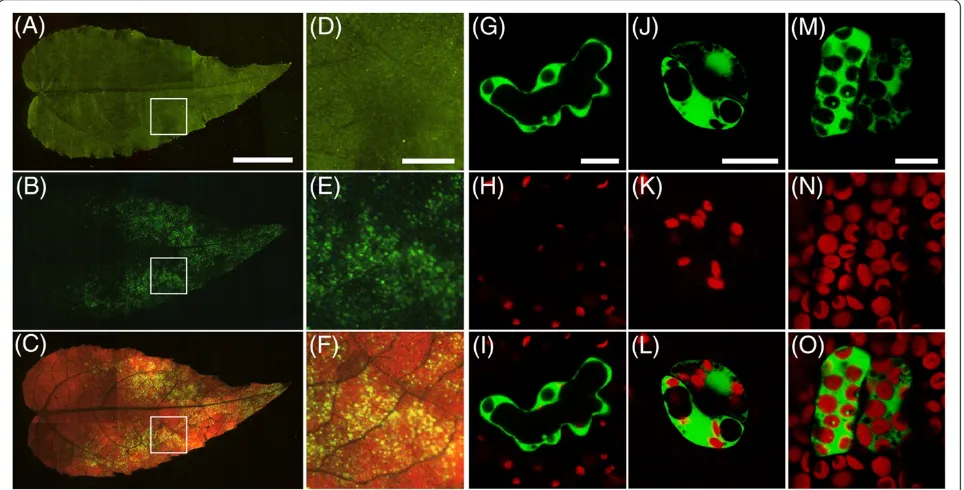
Agrobacter-ium cells grown until stationary phase were re-suspended in an infiltration medium. Vacuum infiltra-tion was performed using three- to four-week-old aspen cuttings without removing any tissues. When using a shoot detached from root tissues, the infiltration medium could not be evaporated from the intercellular spaces of the leaves and few cells were successfully transformed (data not shown). After three days of the transformation, GFP signals were principally observed in younger leaves and scattered in individual cells (Figure 1A-F). Most of the transformed cells were in the middle to tip region of the leaves. Although the intact plants were submerged and vacuum-infiltrated in the bacterial solution, few cells had GFP signals in petioles, stipules, stems, and roots (data not shown). GFP fluores-cence was detected in various cell types such as epider-mal cells, guard cells, and mesophyll cells in the leaf tissues (Figure 1G-O). This result indicates that the
Agrobacterium-mediated vacuum infiltration technique
can be used to analyze cells in young leaves. The valid-ity of the tissue-dependent transformation is also described in Agrobacterium-mediated infiltration assay
ofArabidopsis, where young cotyledons are more highly
transformed than petioles and roots [15]. In the follow-ing studies, we principally used younger leaves for moni-toring transformed cells.
Conditions for efficient transient transformation in hybrid aspen leaves
We optimized the transformation conditions such as the infiltration medium, the concentration of Silwet L-77, the growth phase of bacteria, and the density of bacteria. Studies using other plant species report that these con-ditions influence the transient transformation efficiency in Agrobacterium infiltration technique [7,15,17,25,26]. We first estimated the effect of an infiltration medium on transformation efficiency. Two media were tested: (i) 10 mM MgCl2 and 5 mM MES-KOH (pH 5.6)
estab-lished in anAgrobacterium-mediated vacuum infiltration
ofArabidopsis[15] and (ii) 0.5 × MS medium and 5 mM
MES-KOH (pH 5.6) based on the culture medium of hy-brid aspen. A saturated overnight culture of Agrobacter-ium was re-suspended in the media containing 200 μM Acetosyringon and then diluted to a final OD600of 0.5.
Next, 0.0075% Silwet L-77 was added to the solution be-fore applying vacuum. Three days after the vacuum-infil-tration, GFP positive cells in the younger leaves were
Figure 1Expression of GFP in hybrid aspen usingAgrobacterium-mediated vacuum infiltration. (A-F)Transient expression of GFP in aspen
leaves. CaMV35S::EmGFP construct was transformed into hybrid aspen cuttings. Bright field image(AandD), GFP fluorescence(BandE), and
GFP fluorescence and chloroplast autofluorescence(CandF)were captured using a fluorescence stereomicroscope. Scale bar = 5 mm(A-C).
Areas with a white box inA,B, andCare magnified inD,E, andF, respectively. Scale bar = 1 mm(D-F).(G-O)Transient expression of GFP in
various cell types in aspen leaves. GFP signals were observed in epidermal cells(G-I), guard cells(J-L), and mesophyll cells(M-O). GFP
fluorescence(G,J, andM)and autofluorescence of chloroplasts(H,K, andN)were captured using a CLSM. GFP signal and autofluorescence of
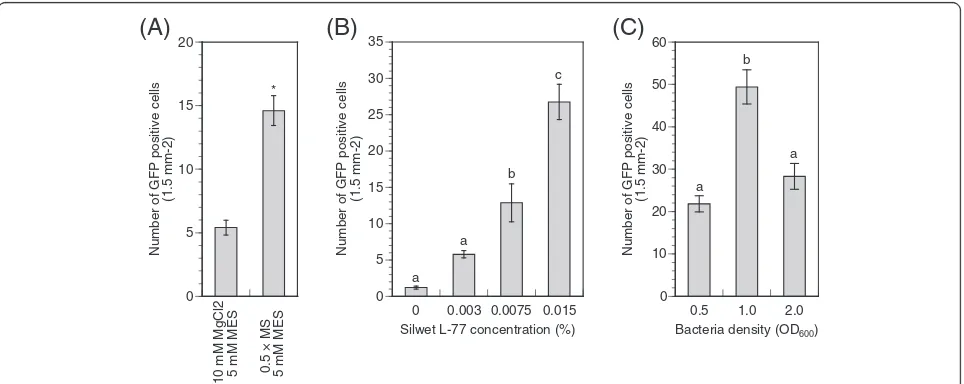
scanned and counted in small compartments (1.5-mm2 leaf area) to evaluate the transformation efficiency. The leaves transformed in the MS solution possessed 14.6 ± 1.2 (average ± SE) GFP positive cells per compart-ment (Figure 2A). However, fewer cells were trans-formed in the magnesium chloride solution (5.4 ± 0.6 cells per compartment). Hence, we decided to use the MS medium for further estimations of transient transformation.
Next, we investigated the effect of the surfactant Silwet L-77 concentration on the transient transformation effi-ciency. The presence of the surfactant allows a bacterial solution to penetrate into leaf lumen and boost the tran-sient transformation efficiency, although excess surfac-tant accelerated necrosis ofArabidopsisleaf cells [26]. In this study, Silwet L-77 (0%, 0.003%, 0.0075%, 0.015%, and 0.03%) was added to the infiltration solution in which the bacteria were suspended (OD600= 0.5) before
the vacuum infiltration. As expected, few cells showed GFP fluorescence following transformation with media lacking Silwet L-77 because the penetration of the solu-tion to the leaves was limited (Figure 2B). The Silwet L-77 concentration was positively correlated with the transformation efficiency and the highest number of transformed cells was obtained with 0.015% Silwet L-77 in the solution. However, in the medium containing
0.03% Silwet L-77, leaf cells appeared to be feeble and to be less transformed (data not shown). In theArabidopsis
transient transformation by co-cultivation with Agrobac-terium, a similar positive correlation between the trans-formation efficiency and the Silwet L-77 concentration are reported and peak efficiency was established at 0.005% ofAgrobacterium solution [26]. In this study, the surfactant concentration for aspen cuttings was three times higher than in Arabidopsis; this difference was probably because of different leaf structures and ages be-tween species. In addition, transformation procedures were distinct from each other. We fixed the concentra-tion at 0.015% of the Agrobacterium solution for aspen plants.
We determined the bacterial growth stage and density in the infiltration medium. The appropriate bacterial conditions lead to higher transformation rate in various plants, although the conditions depend on plant species [7,15,16,23,24,26]. To determine the appropriate bacter-ial growth stage, we harvested Agrobacterium at two growth phases–the log (OD600= 0.8) and the stationary
(OD600= 1.6). The bacteria were re-suspended in the MS
medium to an OD600of 0.5. The leaf cells were
success-fully transformed in the stationary phase bacteria (data not shown). However, few transformed cells were obtained in the log phase bacteria, although an
0.5 1.0 2.0 0
10 20 30 40 50 60
a
a b
Number of GFP positive cells
(1.5 mm-2)
Bacteria density (OD600)
(C)
(A)
10 mM MgCl2 5 mM MES 0.5 × MS 5 mM MES
Number of GFP positive cells
(1.5 mm-2)
*
0 5 10 15
20
(B)
Number of GFP positive cells
(1.5 mm-2)
0.003 0.0075 0.015 0
a b
c
a
Silwet L-77 concentration (%) 0
5 10 15 20 25 30 35
Figure 2Transient transformation efficiency in hybrid aspen leaves. (A)Effect of infiltration medium on transient transformation. Overnight
culture ofAgrobacteriumwas re-suspended in individual infiltration medium containing 200μM Acetosyringon and 0.0075% Silwet L-77 (final
OD600= 0.5). The GFP signals were observed after three days of the transformation. Transformation efficiency was calculated by counting GFP
positive cells in a 1.5-mm2leaf area. Values are means ± SE (n = 330). Asterisk indicates a statistically significant difference based on a Student’s
t-test (P < 0.01).(B)Effect of Silwet L-77 concentration on transient transformation. Overnight culture ofAgrobacteriumwas re-suspended in the
medium [0.5 × MS, 5 mM MES-KOH (pH 5.6) and 200μM Acetosyringon] (final OD600= 0.5). Appropriate Silwet L-77 was added to the solution.
Values are means ± SE (n = 350). Means with different letters are different according to Tukey’s HSD test (P < 0.05).(C)Effect of bacteria density on
transient transformation. Overnight culture ofAgrobacteriumwas re-suspended in the medium [0.5 × MS, 5 mM MES-KOH (pH 5.6), 200μM
Acetosyringon and 0.015% Silwet L-77]. The final OD600was adjusted to 0.5, 1.0, and 2.0. Values are means ± SE (n = 480). Means with different
letters are different according to Tukey’s HSD test (P < 0.05). The experiments shown are from two or three experiments each of which included
Agrobacterium at log phase growth was harvested and used to generate a stable transformant of hybrid aspen [27]. Next, we investigated the bacterial densities in the infiltration medium using the bacteria at the stationary phase growth. The final OD600 in the infiltration
medium was adjusted to 0.5, 1.0, and 2.0. The highest transformation efficiency was achieved with a final bac-terial density of OD600= 1.0 (Figure 2C). When in the
higher (OD600= 2.0) and lower (OD600= 0.5) bacterial
concentration, the transformation yield dropped by half. Altogether, the simple and efficient transient transform-ation assay (the Agrobacterium-mediated vacuum infil-tration) was optimized and developed for younger leaves of hybrid aspen, which were showing a higher incidence of transformation compared to older tissues.
Subcellular localization of aspen proteins
One of the major applications of transient transform-ation assays is to observe the subcellular localiztransform-ation pat-terns of proteins in cells. Several studies have applied transient transformation to monitor subcellular locali-zation of Populus proteins in heterologous plant systems [28-31]. However, few localization studies were tested in homologous Populus spp. Thus, we examined subcel-lular localization of Populus proteins in a homologous plant system using an Agrobacterium-mediated vacuum infiltration.
This study examined the intracellular localization of four aspen genes–CINNAMIC ACID 4-HYDROXYLASE
(C4H),GLYCOSYLTRANSFERASE FAMILY 47(GT47C),
METAL-TOLERANCE PROTEIN 1(MTP1) and
PEROX-IREDOXIN Q (PrxQ)– which were previously described
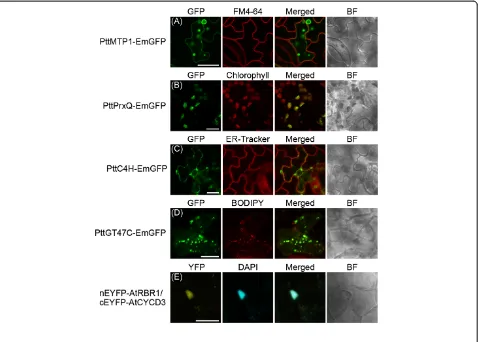
in heterologous plant expression system [28,29,32,33]. The expression vectors of C-terminal GFP tagged pro-teins were transiently transformed into hybrid aspen cut-tings usingAgrobacterium-mediated vacuum infiltration. We first determined the subcellular localization of the PttMTP1-EmGFP fusion proteins. The PttMTP1 protein, a vacuolar zinc transporter [28], was localized to the ring-like structure of the vacuolar membrane (Figure 3A). The tonoplast localization of the protein was distinguishable from the plasma membrane marked by lipophilic styryl dye FM4-64. The GFP signals of the PttPrxQ-EmGFP proteins overlapped with the autofluor-escence of plastids (Figure 3B), in accordance with the finding that PrxQ is involved in detoxifying peroxides at the thylakoid membrane [29]. The PttC4H, a member of the cytochrome P450 monooxygenase superfamily, was distributed in the reticular network of ER labeled with ER Tracker (Figure 3C). The C4H protein targets ER in
Arabidopsis and tobacco cells [32,34]. Finally, we tested the intracellular localization of the PttGT47C-EmGFP. The fluorescence from GFP-tagged PttGT47C exhibited a punctate pattern in the cytoplasm and was
co-localized with the Golgi marker dye BODYPY TR cera-mide (Figure 3D). In previous studies, Arabidopsis
GT47C (FRA8) and poplar GT47C exhibited a similar localization pattern and served as a Golgi marker [33,35,36]. Therefore, the transient transformation protocol results showed reliability with respect to sub-cellular localization of the proteins selected to test tar-geting to various cell compartments.
Co-transformation and protein-protein interaction by BiFC assay
We next investigated whether the transformation tech-nique could be applicable to transient co-transformation assay in aspen leaves. To this end, we tested the BiFC assay, which is a powerful tool for visualizing protein-protein interactions in living cells. The transient BiFC assay is often performed via Agrobacterium infiltration technique in tobacco andArabidopsis[15,26,37]. In this study, the validity of transient BiFC assay was evaluated using the Arabidopsis CYCLIN D3;1 (CYCD3;1) and RETINOBLASTOMA-RELATED 1 (RBR1) proteins for which an interaction has been shown in the nucleus [[38], Bakó László, personal communications]. A set of binary vectors for the BiFC assay–pGreen-CaMV35S:: cEYFP-AtCYCD3;1 and pGreen-CaMV35S::nEYFP-AtRB R1–was transiently infiltrated into aspen cuttings. The EYFP fluorescence was detected in the nucleus co-localized with DAPI staining (Figure 3E), suggesting that AtCYCD3 and AtRBR1 formed a protein complex and functioned in the nucleus. However, co-transformation efficiency appeared to be lower than transformation with a single construct. This result suggests that two different constructs are successfully introduced into a single cell of hybrid aspen leaves and are viable for detecting pro-tein interactions via BiFC using the Agrobacterium -vacuum infiltration technique.
LUC reporter assay usingPopuluscircadian clock gene promoter
Finally, we tested whether the transient transformation technique can be used in combination with the LUC re-porter. We focused on rhythmic expression pattern of a circadian clock gene. Many circadian clock-related genes are identified in the model plant Arabidopsis and most of them show diurnal and circadian expression patterns in a phase-dependent manner [39]. The LUC reporter system easily and precisely estimates the rhythmic ex-pression of a clock-related gene since gene exex-pression can be followed as the LUC activity in the same plant over several days [20]. As the reporter system is gener-ally applicable for a plant that stably expresses theLUC
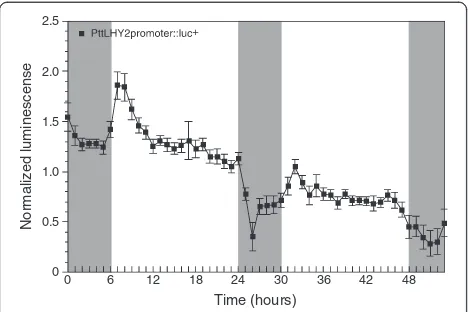
We targeted the promoter ofPopulus LATE ELOGATED HYPOCOTYL 2(LHY2) gene, a key factor in the plant cir-cadian clock system [40,41], in the transient LUC reporter assay. The reporter construct (PttLHY2promoter::luc+) was transformed into hybrid aspen seedlings by the Agrobacter-ium-mediated vacuum infiltration. The LUC activities were detected at one-hour intervals under light/dark cycles for two days. TheLUCexpression was robust in the shoot tips and the younger leaves (Additional file 2). In the leaves, the LUC activities in the young folded leaves were higher than those in the expanding and expanded leaves. The biolumin-escence reflecting the PttLHY2 gene expression showed a diurnal rhythm and a peak of the rhythm occurred 1–2 hours after dawn (Figure 4). The typical diurnal expression in the transformed aspen apices was followed over two days, although the luminescence level was reduced on the
second day. A similar diurnal rhythm of Populus LHY2
gene has been reported in the previous studies; these stud-ies examined the expression level using the Real-time PCR technique [40,41]. Compared with the diurnal rhythm determined by Real-time PCR, more acute peaks inLHY2
expression were monitored in the transient LUC assay, in-dicating that the assay would be a good tool for evaluating the phase and period of circadian expression. Taken to-gether, the Agrobacterium-infiltration technique and the LUC reporter assay could be used to analyze driven, diurnal gene expression and could accelerate functional analysis of
Populusclock-related genes.
Conclusions
We have developed a novel transient transformation assay for hybrid aspen cuttings. For thePopulusspecies, Figure 3Subcellular localization ofPopulusproteins and protein-protein interaction in hybrid aspen cells. (A-D)Transient GFP fusion
protein expression assay in hybrid aspen leaves.(A)PttMTP1-GFP labels the tonoplast,(B)PttPrxQ-GFP labels the plastids,(C)PttC4H-GFP labels
the ER and(D)PttGT47C-GFP labels the Golgi. After three days of the transformation, GFP signals, chlorophyll autofluorescence and fluorescence
of organelle markers were captured using a CLSM. Columns show GFP fluorescence (left), fluorescence of organelle markers and chloroplast
autofluorescence (middle, left), the superimposed images (Merged; middle, right), and bright field images (BF, right). Scale bar = 10μm.(E)BiFC
assay in aspen leaves using transient co-transformation. The plasmid constructs containing CaMV35S::nEYFP-AtRBR1 and CaMV35S::cEYFP-AtCYCD3;1 were used for BiFC assay. YFP signals and DAPI fluorescence were captured using a CLSM. Columns show YFP fluorescence (left), DAPI
this simple assay has a higher throughput than the con-ventional transient assays [12]. Furthermore, this assay could be used to conduct quick functional analysis of protein subcellular localization, protein-protein inter-action, andin vivopromoter activity. Although this tech-nique is optimized in a wild-type plant, it can be applied to stable transgenic aspens, enabling the generation of a double mutant without additional long-term ation process. Consequently, the transient transform-ation assay will facilitate functional analyses of Populus
genes from various genera in a homologous plant system.
Methods
Plant material
Sterile rooted cuttings of hybrid aspen P. tremula×
P. tremuloides (Ptt; wild type clone T89) were used for transient transformation assay. The cuttings were grown in 0.5 × Murashige and Skoog (MS) medium (pH 5.6) containing 0.8% (w/v) agar under a cycle of 18 h fluores-cent light (50μmol m-2 s-1)/6 h dark; 22°C/ 18°C.
GFP-based constructs
The pUC18-based expression vector that harbors
EmGFP gene (Invitrogen, USA) driven by the
Cauli-flower Mosaic Virus 35S (CaMV35S) promoter was pro-vided by Dr. Tomokazu Yamazaki (Graduate School of Life Sciences, Tohoku University) [42,43]. The cloning sites (XbaI and BamHI) between the CaMV35S pro-moter and EmGFP were altered into unique restriction sites (SpeI and KpnI) by PCR-based site-directed muta-genesis [44] using the following primer set: forward,
5’-TACAGTCGACACTAGTGGTACCATGGTGAG-3’; and reverse, 5’-CTCACCATGGTACCACTAGTGTCGA CTGTA-3’. To create a binary vector harboring CaMV35S:: EmGFP, the pUC18-based vector was digested with EcoRI and HindIII and subsequently introduced into the EcoRI/
HindIII site of the binary vector pPZP221 [45].
cDNA clones of C4H, GT47C, MTP1 and PrxQ
were isolated from P. tremula×P. tremuloides cDNA libraries [46]. Accession numbers of PttC4H,PttGT47C,
PttMTP1, and PttPrxQ are BU883009, AI162472,
BU893269, and BU813259, respectively. Coding se-quence of these genes (without stop codon) were ampli-fied by PCR using Platinum pfx DNA polymerase (Invitrogen, USA) with following primer sets: PttC4H
(forward, 5'-CACCACTAGTATGGATCTCCTCCTCCT GG-3’; reverse, 5’-GGTACCAAAGGACCTTGGCTTT GCAAC-3’), PttGT47C (forward, 5'-CACCACTAGTAT GAAACTATTACACAGACATGCT-3’; reverse, 5’-GGT ACCGTGGTTTGAAAGCCTCACG-3’), PttMTP1
(for-ward, 5'-CACCACTAGTATGGAAGCACAAAATCCT
CAG-3’; reverse, 5’-GGTACCACGCTCTATCTGGAT GGTTAC-3’) and PttPrxQ (forward, 5'-CACCACTAG TATGGCTTCCATTTCTCTCCC-3’; reverse, 5’-GGT
ACCAAGGCTTTGAAGTAGTTTAAGAGTT-3’). The
PCR products were digested with SpeI and KpnI and subsequently introduced into theSpeI/KpnI site between the CaMV 35 S promoter andEmGFPof the expression binary vector pPZP221-CaMV35S::EmGFP.
Agrobacterium infiltration
The expression binary vectors were transformed into
Agrobacterium tumefaciens strain GV3101 (pMP90)
[47]. Agrobacterium harboring individual vector was inoculated in LB media with appropriate antibiotics. An overnight culture of Agrobacterium was harvested at OD600of 0.8 or 1.6, centrifuged at 4,000 × g for 20
min-utes, and re-suspended in 25 mL of infiltration medium. This step was repeated. Finally,Agrobacteriumcells were suspended in 100 mL of infiltration medium. Two infil-tration media were used in this study: (i) 10 mM MgCl2,
5 mM MES-KOH (pH 5.6), and 200 μM Acetosyringon and (ii) 0.5 × MS medium, 5 mM MES-KOH (pH 5.6), and 200 μM Acetosyringon at OD600of 0.5, 1.0, or 2.0.
The bacterial solution was incubated at room temperature for three hours with gentle shaking under dark conditions. Hybrid aspen T89 cuttings (three to four week-old) were soaked in Agrobacterium solution containing 0%, 0.003%, 0.0075%, 0.015%, or 0.03% con-centrations of Silwet L-77 (Lehle Seeds, USA) and then
Agrobacterium infiltration was performed by applying
vacuum (Boekel Scientific, USA) three times for three minutes. The aspen cuttings were subsequently put on paper towels to remove excess infiltration medium and transplanted in 0.5 × MS medium (pH 5.6) with 0.6%
0 6 12 18 24 30 36 42 48
0 0.5 1.0 1.5 2.0 2.5
Normalized luminescense
Time (hours)
Figure 4LUC reporter assay in hybrid aspen apices.The plasmid
construct containingPttLHY2promoter::luc+was transformed into
aspen cuttings using theAgrobacterium-mediated vacuum
(w/v) agar and 50μg/mL Cefotaxime. The cuttings were returned to grow under initial growing conditions for three days before imaging.
Microscopy
Images of whole leaves were monitored by a fluores-cence stereomicroscope (Leica MZ FLII, Germany) with a GFP3 filter (excitation 470/40, emission 525/50 nm) (Leica, Germany) for GFP fluorescence and a GFP2 filter (excitation 480/40 nm, emission 510 nm) (Leica, Ger-many) for GFP fluorescence and chloroplast autofluores-cence. For the evaluation of transformation efficiency, GFP images in a 1.5-mm2leaf area were captured using an epifluorescence microscopy (Axioplan 2 imaging, Carl Zeiss, Germany) with Zeiss filter set 09 (excitation 450– 490 nm, emission 510 nm) (Carl Zeiss, Germany). GFP positive cells were counted in the small compartments using ImageJ 1.44 software [48].
Staining and confocal microscopy
For confocal laser scanning microscopy (CLSM), GFP fluorescence, chloroplast autofluorescence and fluorescence of organelle markers in transformed cells were monitored using a Leica TCS SP2 AOBS system (Leica, Germany) with a water-corrected 63x objective NA = 1.2 (HCX PL APO 63.0x1.20 W BD UV, Leica, Germany) and a Leica TCS SPE system (Leica, Germany) with an oil-corrected 63x object-ive NA = 1.3 (ACS APO 63.0x1.30 OIL CS, Leica, Ger-many). For subcellular localization, transformed leaves were stained with plasma membrane marker FM4-64 (32 μM, Invitrogen, USA), ER marker ER-Tracker Blue-White DPX (1μM, Invitrogen, USA) or Golgi marker BODIPY TR cer-amide (5μM, Invitrogen, USA). GFP and chlorophyll were excited at 488 nm laser. GFP and Chlorophyll emission were detected between 500 to 550 nm and between 664 to 696 nm, respectively. FM4-64 and BODIPY TR ceramide were excited at 532 nm laser. Fluorescence of FM4-64 and BODIPY dye were monitored between 640 to 660 nm and between 610 to 630 nm, respectively. ER-Tracker Blue-White DPX was excited at 405 nm laser and the emission was detected between 430 to 460 nm.
BiFC assay
The BiFC vectors–pSAT1-nEYFP-C1-AtRBR1 (AGI code, At3g12280) and pSAT1-cEYFP-C1-B-AtCYCD3;1 (AGI code, At4g34160)–were provided by Dr. László Bakó (Umeå Plant Science Centre, Umeå University). The vectors were digested withNaeI andNotI and subsequently intro-duced into the EcoRV/NotI site of the binary vector pGreenI 0029 [49]. The binary vectors were transformed
intoA. tumefaciensstrain GV3101 (pMP90). The
Agrobac-teriumcells were inoculated in LB media with appropriate antibiotics and grown until the OD600was above 1.8. The
collected cells were washed twice by the MS infiltration
medium and re-suspended in 50 mL of the medium at a final OD600of 2.0. The same amount of the solutions were
mixed and incubated at room temperature for three hours with gentle shaking.Agrobacterium-mediated vacuum infil-tration was performed by the method described above. The transformed cuttings were grown on 0.5 × MS medium (pH 5.6) with 0.6% (w/v) agar and 50μg/mL Cefotaxime for two days. To visualize nuclei, the leaves were stained with 4’ ,6-diamidino-2-phenylindole (DAPI, 5 μg/mL, Dojindo, Japan). EYFP fluorescence and DAPI fluorescence were detected using a Leica TCS SPE system with an oil-corrected 63x objective NA = 1.3. EYFP and DAPI were excited at 488 nm and 405 nm laser, respectively. EYFP and DAPI emission were detected between 510 to 550 nm and between 430 to 460 nm, respectively.
Luciferase reporter assay
The promoter region of P. tremula×P. tremuloides
PttLHY2was isolated by PCR with following primer sets:
forward, 5'-TTAAGCTTTGCCTTCTGCAGATTTTC AG-3’; reverse, 5’-CGGGATCCTAGTGGACCTTAGGC AGCCA-3’) [Genbank/EMBL/DDBJ: AB661779]. The PCR products were digested with HindIII and BamHI and subsequently introduced into the HindIII/BamHI site of the binary vector pPZP221-luc+ [50]. The binary vector was transformed into A. tumefaciens (GV3101 pMP90). Agrobacterium-mediated vacuum infiltration was performed by the same protocol described above. The transformed cuttings were grown on 0.5 × MS medium (pH 5.6) with 2% sucrose (w/v) and 0.8% (w/v) agar and brought back to standard growth conditions for a day following transformation. Subsequently, shoot tips with additional younger leaves were cut and transplanted on the same medium. The apices were supplemented with 5 mM luciferin in 0.01% Triton X-100 and placed under 18 h light (20μmol m-2s-1)/6 h dark; 22°C/ 22°C condi-tion, light provided from red (660 nm) and blue (470 nm) light-emitting diodes (LEDs, MD Electronics, UK). Expres-sion levels reflected by emitted photons were monitored using an ORCA-II-ERG 1024 cooled camera (Hamamatsu Photonics, Japan). Image acquisition and light control were driven by WASABI imaging software (Hamamatsu Pho-tonics, Japan). The images were processed using Meta-morph image-analysis software (Molecular Devices, USA).
Statistical analysis
All statistical analyses were performed with R package version 2.9 [51].
Additional files
Additional file 2: Figure S2.The LUC activity in the shoot tip, folded and unfolded leaves. (A) Bright field image and (B) LUC bioluminescence eight hours after detection.
Abbreviations
BiFC: bimolecular fluorescence complementation; C4H: Cinnamic acid 4-hydroxylase; CaMV: Cauliflower mosaic virus; CLSM: Confocal laser scanning microscopy; CYCD3;1: CYCLIN D3;1; GFP: Green fluorescent protein; GT47C: Glycosyltransferase family 47; LHY2: Late elongated hypocotyl 2; LUC: Luciferase; MTP1: Metal-tolerance protein 1; PrxQ: Peroxiredoxin Q; RBR1: Retinoblastoma-related 1.
Competing interests
The authors declare that they have no competing interests.
Authors’contributions
NT conceived of the study and drafted the manuscript. ME participated in planning, coordination and writing of the manuscript. Both authors read and approved the final manuscript.
Acknowledgements
We gratefully acknowledge financial support. NT received support from the Kempe Foundation. MEE is a VINNMER Marie Curie International Qualification Fellow funded by the Swedish Governmental Agency for Innovation Systems (VINNOVA) and the European Union assisted with grants from Umeå University, the Berzelii Center of Forest Biotechnology, the Swedish Foundation for Strategic Research, and Nils och Dorthi Troëdssons Forskningsfond. We also wish to thank Krisztina Ötvös and Lászlo Báko for providing us with the pSAT1-nEYFP-C1-AtRBR1 and pSAT1-cEYFP-C1-B-AtCYCD3;1 constructs.
Author details 1
Umeå Plant Science Centre, Department of Plant Physiology, Umeå University, SE-901 87, Umeå, Sweden.2Present address: Forest Bio-Research Center, Forestry and Forest Products Research Institute, Hitachi, Ibaraki 319-1301, Japan.3Department of Plant Sciences, University of Cambridge, Cambridge CB2 3EA, UK.
Received: 28 April 2012 Accepted: 20 July 2012 Published: 7 August 2012
References
1. Tuskan GA, Difazio S, Jansson S, Bohlmann J, Grigoriev I, Hellsten U, Putnam
N, Ralph S, Rombauts S, Salamov A, Schein J, Sterck L, Aerts A, Bhalerao RR, Bhalerao RP, Blaudez D, Boerjan W, Brun A, Brunner A, Busov V, Campbell M, Carlson J, Chalot M, Chapman J, Chen GL, Cooper D, Coutinho PM,
Couturier J, Covert S, Cronk Q,et al:The genome of black cottonwood,
Populus trichocarpa(Torr. & Gray).Science2006,313:1596–1604.
2. Street NR, Tsai CJ:PopulusResources and Bioinformatics. InGenetics and
Genomics of Populus. Edited by Jansson S, Bhalerao R, Groover A. New York:
Springer Science+Business Media, LLC;2010:135–152.
3. Klein TM, Fitzpatrick-McElligott S:Particle bombardment: a universal
approach for gene transfer to cells and tissues.Curr Opin Biotechnol1993, 4:583–590.
4. Zhang Y, Su J, Duan S, Ao Y, Dai J, Liu J, Wang P, Li Y, Liu B, Feng D, Wang
J, Wang H:A highly efficient rice green tissue protoplast system for
transient gene expression and studying light/chloroplast-related processes.Plant Methods2011,7:30.
5. Rasco-Gaunt S, Riley A, Barcelo P, Lazzeri PA:Analysis of particle
bombardment parameters to optimise DNA delivery into wheat tissues. Plant Cell Rep1999,19:118–127.
6. Orzaez D, Mirabel S, Wieland WH, Granell A:Agroinjection of tomato fruits.
A tool for rapid functional analysis of transgenes directly in fruit.Plant Physiol2006,140:3–11.
7. Bhaskar PB, Venkateshwaran M, Wu L, Ané JM, Jiang J:Agrobacterium
-mediated transient gene expression and silencing: a rapid tool for functional gene assay in potato.PLoS One2009,4:e5812.
8. Chupeau MC, Pautot V, Chupeau Y:Recovery of transgenic trees after
electroporation of poplar protoplasts.Transgenic Res1994,3:13–19.
9. Confalonieri M, Balestrazzi A, Bisoffi S, Cella R:Factors affecting
Agrobacterium tumefaciens-mediated transformation in several black poplar clones.Plant Cell Tissue and Organ Cult1995,43:215–222.
10. Qiao J, Ishihara Y, Kuroda H, Sakai F, Sakai H, Komano T:Transient
expression of goat growth hormone gene in poplar(Populus albaL.) protoplasts: a quick method for detection of foreign gene expression in mRNA level.Biosci Biotechnol Biochem1997,61:1580–1581.
11. Ma C, Strauss SH, Meilan R:Agrobacterium-mediated transformation of the
genome-sequenced poplar clone, Nisqually-1 (Populus trichocarpa).Plant Mol Biol Rep2004,22:311–312.
12. Nowak K, Luniak N, Meyer S, Schulze J, Mendel RR, Hänsch R:Fluorescent
proteins in poplar: a useful tool to study promoter function and protein localization.Plant Biol2004,6:65–73.
13. Zhang C, Gai Y, Zhu Y, Chen X, Jiang X:Construction of a bidirectional
promoter and its transient expression inPopulus tomentosa.Front Forest China2008,3:112–116.
14. Schöb H, Kunz C, Meins F Jr:Silencing of transgenes introduced into
leaves by agroinfiltration: a simple, rapid method for investigating sequence requirements for gene silencing.Mol Gen Genet1997, 256:581–585.
15. Marion J, Bach L, Bellec Y, Meyer C, Gissot L, Faure JD:Systematic analysis of
protein subcellular localization and interaction using high-throughput transient transformation ofArabidopsisseedlings.Plant J2008,56:169–179.
16. Zottini M, Barizza E, Costa A, Formentin E, Ruberti C, Carimi F, Lo Schiavo F:
Agroinfiltration of grapevine leaves for fast transient assays of gene expression and for long-term production of stable transformed cells. Plant Cell Rep2008,27:845–853.
17. Chen X, Equi R, Baxter H, Berk K, Han J, Agarwal S, Zale J:A
high-throughput transient gene expression system for switchgrass (Panicum virgatumL.)seedlings.Biotechnol Biofuels2010,3:9.
18. Chiu W, Niwa Y, Zeng W, Hirano T, Kobayashi H, Sheen J:Engineered GFP
as a vital reporter in plants.Curr Biol1996,6:325–330.
19. Bhat RA, Lahaye T, Panstruga R:The visible touch:in plantavisualization
of protein-protein interactions by fluorophore-based methods.Plant Methods2006,2:12.
20. Millar AJ, Carre IA, Strayer CA, Chua NH, Kay SA:Circadian clock mutants in
Arabidopsisidentified by luciferase imaging.Science1995,267:1161–1163.
21. Miwa K, Serikawa M, Suzuki S, Kondo T, Oyama T:Conserved expression
profiles of circadian clock-related genes in twoLemnaspecies showing long-day and short-day photoperiodic flowering responses.Plant Cell Physiol2006,47:601–612.
22. Kim J, Somers DE:Rapid assessment of gene function in the circadian
clock using artificial microRNA inArabidopsismesophyll protoplasts. Plant Physiol2010,154:611–621.
23. Mahmoudian M, Yücel M, Öktem HA:Transformation of lentil(Lens
culinarisM.) cotyledonary nodes by vacuum infiltration ofAgrobacterium tumefaciens. Plant Mol Biol Rep2002,20:251–257.
24. de Oliveira ML, Febres VJ, Costa MG, Moore GA, Otoni WC:High-efficiency
Agrobacterium-mediated transformation of citrus via sonication and vacuum infiltration.Plant Cell Rep2009,28:387–395.
25. Manavella PA, Chan RL:Transient transformation of sunflower leaf discs
via anAgrobacterium-mediated method: applications for gene expression and silencing studies.Nat Protoc2009,4:1699–1707.
26. Li JF, Park E, von Arnim AG, Nebenführ A:The FAST technique: a simplified
Agrobacterium-based transformation method for transient gene expression analysis in seedlings ofArabidopsisand other plant species. Plant Methods2009,5:6.
27. Nilsson O, Aldén T, Sitbon F, Little CHA, Chalupa V, Sandberg G, Olsson O:
Spatial pattern of cauliflower mosaic virus 35 S promoter-luciferase expression in transgenic hybrid aspen trees monitored by enzymatic assay and non-destructive imaging.Transgenic Res1992,1:209–220.
28. Blaudez D, Kohler A, Martin F, Sanders D, Chalot M:Poplar metal tolerance
protein 1 confers zinc tolerance and is an oligomeric vacuolar zinc transporter with an essential leucine zipper motif.Plant Cell2003,
15:2911–2928.
29. Rouhier N, Gelhaye E, Gualberto JM, Jordy MN, De Fay E, Hirasawa M,
Duplessis S, Lemaire SD, Frey P, Martin F, Manieri W, Knaff DB, Jacquot JP: Poplar peroxiredoxin Q. A thioredoxin-linked chloroplast antioxidant functional in pathogen defense.Plant Physiol2004,134:1027–1038.
30. Sasaki K, Ohara K, Yazaki K:Gene expression and characterization of
31. Rinne PL, Welling A, Vahala J, Ripel L, Ruonala R, Kangasjärvi J, van der
Schoot C:Chilling of dormant buds hyperinducesFLOWERING LOCUS T
and recruits GA-inducible 1,3-β-glucanases to reopen signal conduits and release dormancy inPopulus.Plant Cell2011,23:130–146.
32. Ro DK, Mah N, Ellis BE, Douglas CJ:Functional characterization and
subcellular localization of poplar (Populus trichocarpa×Populus deltoides) cinnamate 4-hydroxylase.Plant Physiol2001,126:317–329.
33. Zhou GK, Zhong R, Richardson EA, Morrison WHIII, Nairn CJ, Wood-Jones A,
Ye ZH:The poplar glycosyltransferase GT47C is functionally conserved
withArabidopsis Fragile Fiber8.Plant Cell Physiol2006,47:1229–1240.
34. Achnine L, Blancaflor EB, Rasmussen S, Dixon RA:Colocalization of
L-phenylalanine ammonia-lyase and cinnamate 4-hydroxylase for
metabolic channeling in phenylpropanoid biosynthesis.Plant Cell2004,
16:3098–3109.
35. Zhong R, Peña MJ, Zhou GK, Nairn CJ, Wood-Jones A, Richardson EA,
Morrison WHIII, Darvill AG, York WS, Ye ZH:Arabidopsis fragile fiber8, which
encodes a putative glucuronyltransferase, is essential for normal secondary wall synthesis.Plant Cell2005,17:3390–3408.
36. Lee C, Teng Q, Huang W, Zhong R, Ye ZH:TheArabidopsisfamily GT43
glycosyltransferases form two functionally nonredundant groups essential for the elongation of glucuronoxylan backbone.Plant Physiol
2010,153:526–541.
37. Gehl C, Waadt R, Kudla J, Mendel RR, Hänsch R:New GATEWAY vectors for
high throughput analyses of protein-protein interactions by bimolecular fluorescence complementation.Mol Plant2009,2:1051–1058.
38. Boruc J, Van den Daele H, Hollunder J, Rombauts S, Mylle E, Hilson P, Inzé
D, De Veylder L, Russinova E:Functional modules in theArabidopsiscore
cell cycle binary protein-protein interaction network.Plant Cell2010,
22:1264–1280.
39. Pruneda-Paz JL, Kay SA:An expanding universe of circadian networks in
higher plants.Trends Plant Sci2010,15:259–265.
40. Takata N, Saito S, Saito CT, Nanjo T, Shinohara K, Uemura M:Molecular
phylogeny and expression of poplar circadian clock genes,LHY1and LHY2.New Phytol2009,181:808–819.
41. Ibáñez C, Kozarewa I, Johansson M, Ögren E, Rohde A, Eriksson ME:
Circadian clock components regulate entry and affect exit of seasonal dormancy as well as winter hardiness inPopulustrees.Plant Physiol2010,
153:1823–1833.
42. Niwa Y, Hirano T, Yoshimoto K, Shimizu M, Kobayashi H:Non-invasive
quantitative detection and applications of non-toxic, S65T-type green fluorescent protein in living plants.Plant J1999,18:455–463.
43. Yamazaki T, Kawamura Y, Minami A, Uemura M:Calcium-dependent
freezing tolerance inArabidopsisinvolves membrane resealing via synaptotagmin SYT1.Plant Cell2008,20:3389–3404.
44. Sambrook J:Russell DW: Molecular cloning: a laboratory manual. 3rd edition.
New York: Cold Spring Harbor Laboratory Press; 2001.
45. Hajdukiewicz P, Svab Z, Maliga P:The small, versatile pPZP family of
Agrobacteriumbinary vectors for plant transformation.Plant Mol Biol
1994,25:989–994.
46. Sterky F, Bhalerao RR, Unneberg P, Segerman B, Nilsson P, Brunner AM,
Charbonnel-Campaa L, Lindvall JJ, Tandre K, Strauss SH, Sundberg B, Gustafsson P, Uhlén M, Bhalerao RP, Nilsson O, Sandberg G, Karlsson J,
Lundeberg J, Jansson S:APopulusEST resource for plant functional
genomics.Proc Natl Acad Sci USA2004,101:13951–13956.
47. Koncz C, Schell J:The promoter of TL-DNA gene 5 controls the
tissue-specific expression of chimaeric genes carried by a novel type of Agrobacteriumbinary vector.Mol Gen Genet1986,204:383–396. 48. ImageJ 1.44, http://rsb.info.nih.gov/ij/.
49. Hellens RP, Edwards EA, Leyland NR, Bean S, Mullineaux PM:pGreen: a
versatile and flexible binary Ti vector forAgrobacterium-mediated plant transformation.Plant Mol Biol2000,42:819–832.
50. McWatters HG, Kolmos E, Hall A, Doyle MR, Amasino RM, Gyula P, Nagy F,
Millar AJ, Davis SJ:ELF4is required for oscillatory properties of the
circadian clock.Plant Physiol2007,144:391–401.
51. R Development Core Team:R: A language and environment for statistical
computing. Vienna, Austria: R Foundation for Statistical Computing; 2009.
doi:10.1186/1746-4811-8-30
Cite this article as:Takata and Eriksson:A simple and efficient transient transformation for hybrid aspen (Populus tremula×P. tremuloides).Plant Methods20128:30.
Submit your next manuscript to BioMed Central and take full advantage of:
• Convenient online submission
• Thorough peer review
• No space constraints or color figure charges
• Immediate publication on acceptance
• Inclusion in PubMed, CAS, Scopus and Google Scholar
• Research which is freely available for redistribution