https://doi.org/10.5194/gmd-12-3773-2019 © Author(s) 2019. This work is distributed under the Creative Commons Attribution 4.0 License.
CAM6 simulation of mean and extreme precipitation over Asia:
sensitivity to upgraded physical parameterizations and higher
horizontal resolution
Lei Lin1, Andrew Gettelman2, Yangyang Xu3, Chenglai Wu4, Zhili Wang5, Nan Rosenbloom2, Susan C. Bates2, and Wenjie Dong1
1School of Atmospheric Sciences and Guangdong Province Key Laboratory for Climate Change and Natural Disaster Studies, Sun Yat-sen University, Zhuhai, Guangdong, China
2National Center for Atmospheric Research, Boulder, Colorado, USA
3Department of Atmospheric Sciences, College of Geosciences, Texas A&M University, College Station, Texas, USA 4International Center for Climate and Environment Sciences, Institute of Atmospheric Physics,
Chinese Academy of Sciences, Beijing, China
5State Key Laboratory of Severe Weather and Key Laboratory of Atmospheric Chemistry of CMA, Chinese Academy of Meteorological Sciences, Beijing, China
Correspondence:Wenjie Dong ([email protected]) Received: 2 January 2019 – Discussion started: 28 January 2019
Revised: 26 June 2019 – Accepted: 11 July 2019 – Published: 28 August 2019
Abstract. The Community Atmosphere Model version 6 (CAM6), released in 2018 as part of the Community Earth System Model version 2 (CESM2), is a major upgrade over the previous CAM5 that has been used in numerous global and regional climate studies. Since CESM2–CAM6 will participate in the upcoming Coupled Model Intercompari-son Project phase 6 (CMIP6) and is likely to be adopted in many future studies, its simulation fidelity needs to be thoroughly examined. Here we evaluate the performance of a developmental version of the Community Atmosphere Model with parameterizations that will be used in version 6 (CAM6α), with a default 1◦ horizontal resolution (0.9◦×
1.25◦, CAM6α-1◦) and a high-resolution configuration (ap-proximately 0.25◦, CAM6α-0.25◦), against various obser-vational and reanalysis datasets of precipitation over Asia. CAM6αperformance is compared with CAM5 at default 1◦ horizontal resolution (CAM5-1◦) and a high-resolution con-figuration at 0.25◦(CAM5-0.25◦). With the prognostic treat-ment of precipitation processes and the new microphysics module, CAM6α is able to better simulate climatological mean and extreme precipitation over Asia, better capture the heaviest precipitation events, better reproduce the diurnal cy-cle of precipitation rates over most of Asia, and better sim-ulate the probability density distributions of daily
3774 L. Lin et al.: CAM6 over Asia 1 Introduction
The Community Atmosphere Model (CAM) is an atmo-spheric general circulation model (AGCM) developed at the National Center for Atmospheric Research (NCAR) with extensive community support. The fifth version of CAM (CAM5) (Neale et al., 2010), as part of the Community Earth System Model version 1 (CESM1) (Hurrell et al., 2013), was widely used for climate studies over Asia. CAM5 included a two-moment cloud microphysics scheme that is missing in the previous CAM versions and improved the representation of low-level clouds (Morrison and Gettelman, 2008), net con-version rates from water vapor to cloud condensation (Neale et al., 2010; Zhang and McFarlane, 1995) and a three-mode aerosol module (Liu et al., 2012).
Among various applications, CESM1–CAM5 has been used in many studies relating to clouds and precipitation over Asia. For example, Y. Zhang et al. (2014) evaluated the sensitivity of simulated stratus clouds over eastern China to horizontal resolution in CAM5. Zhang and Chen (2016) in-vestigated the mean state and diurnal cycle of summer pre-cipitation over continental East Asia in CAM4 and CAM5. Li et al. (2015) used CAM5 with different resolutions (2.8, 1.0 and 0.45◦) to study the impact of horizontal resolution on model performance in simulating precipitation over East Asia. Wang et al. (2018) investigated the sensitivity of the Indian summer monsoon to different convective schemes in CAM5. Jiang et al. (2015) examined anthropogenic aerosol optical depths and their effects on clouds and precipitation in East Asia. Vinoj et al. (2014) found with CAM5 simulations that dust-induced atmospheric heating over North Africa and West Asia modulated monsoon rainfall over central India.
A prereleased version of CAM6 (denoted here as CAM6α, extensively tested in late 2017) shares the same basic physics as the released version of CAM6, except for slightly dif-ferent tuning parameters and without the updated surface drag scheme. CAM6α was thoroughly evaluated over the continental United States (Gettelman et al., 2018), but the improvement of CAM6αover its predecessors remains un-known for East and Southeast Asia. Since CAM6 and other CMIP6-era (Coupled Model Intercomparison Project phase 6) (Eyring et al., 2016) models are likely to be widely used for hydroclimate studies over Asia in the next 5 to 10 years, model fidelity needs to be carefully evaluated. For example, the UK Met Office atmosphere model Global At-mosphere 6.0 (GA6) was used to study the interannual and intraseasonal precipitation variability over China (Stephan et al., 2018a, b; Walters et al., 2017). Similarly, Martin et al. (2017) analyzed tropical precipitation in GA6 with a range of horizontal resolutions and found that the behavior of the deep convection parameterization in GA6 is largely indepen-dent of the grid-box size and time step length over which it operates.
In addition to model physics upgrades, another area of growth in global climate model development is the
enhance-ment of horizontal spatial resolution. Grid spacing of 0.25◦ (approximately 25 km) is the targeted resolution for global atmosphere modeling in the near future (Sharma et al., 2016), while most of default CMIP6 runs at the decadal to cen-tennial scale are still performed at 1◦. Generally, enhanced model resolution tends to reduce model biases (Palmer, 2014; Yao et al., 2017; Chen et al., 2018). Nevertheless, Johnson et al. (2016) indicated that increasing horizontal resolution was not a solution to many South Asian monsoon biases in the Met Office Global Atmosphere 3.0 (GA3) model. For CAM, high-resolution performance has been evaluated in several studies. Wehner et al. (2014) found that extreme pre-cipitation amounts are larger as the resolution increases in CAM5. Other CAM5 studies have also tested resolutions of 0.5◦(Bacmeister et al., 2014; Lau and Ploshay, 2009) and 1◦ (C. Zhang et al., 2014; Li et al., 2015; Lin et al., 2015, 2016). However, the performance of 0.25◦CAM6 simulations over Asia has not been examined rigorously.
In order to provide insights into both physical schemes and horizontal resolution, here we analyze a four-model hierar-chy. First, we explore the effects of new physical parameteri-zations by contrasting a CAM6α-1◦simulation with CAM5-1◦. Second, we evaluate CAM6α with 1 and 0.25◦ resolu-tions to quantify model sensitivity to horizontal resolution. In addition, we also analyze CAM5 at 0.25 and 1◦ resolu-tion to evaluate if the impact of higher resoluresolu-tion is model dependent.
This technical paper of model evaluation is divided into the following sections. After the Introduction (Sect. 1), Sect. 2 provides detailed information on the model configu-rations, model experimental setup and observational datasets used as benchmarks. In Sect. 3, we compare the climato-logical (multi-year) average of monthly mean and daily ex-treme precipitation simulated by four versions of CAM in the context of observational uncertainty. Section 4 is devoted to the evaluation of precipitation variability at a wide range of timescales that is not tuned during the model development process. Section 5 discusses in detail whether climate simula-tions are improved over northern China, southwestern China and the Maritime Continent due to new physical parameter-izations and/or higher resolution (by conducting a moisture budget analysis using both CAM5 and CAM6). Finally, we present a further discussion and a summary in Sect. 6.
2 Methods
2.1 CAM simulation
Brether-ton, 2009). The ice cloud fraction scheme allows supersatu-ration via a modified relative humidity over ice and the in-clusion of ice condensation amount (Gettelman et al., 2010). A three-mode (lognormal) aerosol model was used to pre-dict aerosol concentration, and the number concentrations of aerosols are connected to ice–warm cloud microphysics, ac-counting for ice and the liquid activation of cloud crystals and drops (Liu et al., 2012). A finite-volume (FV) dynamical core (1◦) is used. The second set of simulations uses CAM5 with the spectral element (SE) dynamical core at a resolution of 0.25◦(Meehl et al., 2019). The other settings are identical to the first set of simulations of CAM5-1◦.
The third and fourth sets of simulation considered in this study use a nearly final version of CAM6 (denoted as CAM6α) that has the same basic physics as the final version of CAM6 released in 2018 (Bogenschutz et al., 2013; Gettel-man et al., 2018) but with slightly different tuning parame-ters. CAM6αuses CLUBB (Cloud Layers Unified by Binor-mals) (Golaz et al., 2002a, b) to unify the boundary layer and shallow convective turbulence with cloud macrophysics, a new ice nucleation parameterization (Hoose et al., 2010), up-dated cloud microphysics with prognostic precipitation (Get-telman and Morrison, 2015; Get(Get-telman et al., 2018) and a modified aerosol modal model (Liu et al., 2016). CAM6α, with the spectral element (SE) dynamical core (Lauritzen et al., 2018), was run twice with different horizontal resolu-tions (i.e., ∼1 and ∼0.25◦). The same uniform-resolution SE simulations with CAM6αforced by observed sea surface temperature data for 1979–2005 (saved output for monthly, daily and 3 hourly) are analyzed in Gettelman et al. (2018). Using these simulations, we can evaluate the differences due to resolution increase from 1 to 0.25◦in CAM5 (sets 1 and 2) and CAM6 (sets 3 and 4). That offers us an opportunity to explore whether the response from higher resolution is de-pendent on the CAM version.
All model simulations evaluated here (Table 1) followed the protocol of the Atmospheric Model Intercomparison Project (AMIP). Simulations are forced by observed monthly sea surface temperature and sea ice from 1979 to 2005, which are linearly interpolated to obtain specified daily val-ues, as well as the evolution of aerosol emissions and trace gas concentration (including CO2). The 25-year simulations for 1980–2004 are analyzed here to match available observa-tional and reanalysis datasets. Monthly and daily frequency output data are used.
2.2 Observational datasets
Asian Precipitation – Highly Resolved Observational Data Integration Towards Evaluation (APHRODITE) For the direct observation of temperature and precipita-tion, APHRODITE data are used (Yatagai et al., 2012). APHRODITE is a gridded daily precipitation product cov-ering monsoonal Asia, the Middle East and Russia, and it
is available at 0.25◦×0.25◦resolution during the period of 1951–2007. The dataset was created by collating a dense net-work of rain gauge daily measurements across Asia.
2.3 The Japanese 55-year reanalysis (JRA55)
The Japan Meteorological Agency (JMA) reanalysis dataset (JRA55) uses an operational data assimilation system with the 4D-Var scheme (Kobayashi et al., 2015). The dataset cov-ers 55 years from 1958 (when regular radiosonde observation began on a global basis) to 2013. JRA55 has a horizontal res-olution of 0.56◦.
2.4 Modern-Era Retrospective analysis for Research and Applications version 2 (MERRA2)
MERRA2 is a NASA atmospheric reanalysis for the satellite era (from 1980 to present) using the Goddard Earth Observ-ing System Model version 5 (GEOS-5) with its Atmospheric Data Assimilation System. MERRA2 has a spatial resolution 0.625◦×0.5◦(Gelaro et al., 2017).
The APHRODITE data might be limited by the potential lack of gauge observations in mountainous areas (Zhao et al., 2015), and therefore we adopted MERRA2 as an addi-tional data source specifically for daily precipitation eval-uation. Note, however, that rainfall in reanalysis products such as JRA55 and MERRA2 is dependent on the reanaly-sis model physics, and it is well known that there is large uncertainty among various observational datasets (Sheffield et al., 2012; Trenberth et al., 2014).
2.5 Tropical Rainfall Measuring Mission (TRMM)
The latest TRMM 3B43 version 7 data (0.25◦) between 1998 and 2016, downloaded from NASA Goddard Space Flight Center, combine multiple independent precipitation estimates from TRMM Microwave Imager and Global Pre-cipitation Climatology Project (GPCP) rain gauge analysis. The 3-hourly data over Asia (a temporal resolution unavail-able in the other three data sources) for 1999–2004 are used in our study to assess the diurnal cycle of precipitation (Huff-man and Bolvin, 2013).
Climate Prediction Center (CPC) temperature
3776 L. Lin et al.: CAM6 over Asia
Table 1.Four CAM versions with major physical schemes and the time step listed in abbreviations. ZM1995 is Zhang and McFarlane (1995). PB2009 is Park and Bretherton (2009). BP2009 is Bretherton and Park (2009). P2014 is Park et al. (2014). MG1 is Morrison and Gettelman (2008). MG2 is Gettelman and Morrison (2015). G2010 is Gettelman et al. (2010). CLUBB is Golaz et al. (2002a). MAM3 is Liu et al. (2012). MAM4 is Liu et al. (2016).
CAM5-1◦ CAM6α-1◦ CAM5-0.25◦ CAM6α-0.25◦
Deep convection ZM1995 ZM1995 ZM1995 ZM1995
Shallow convection PB2009 CLUBB PB2009 CLUBB
Planetary boundary layer BP2009 CLUBB BP2009 CLUBB
Warm cloud macrophysics P2014 CLUBB P2014 CLUBB
Ice cloud macrophysics G2010 G2010 G2010 G2010
Cloud microphysics MG1 MG2 MG1 MG2
Aerosols MAM3 MAM4 MAM3 MAM4
Horizontal resolution 0.9◦×1.25◦ 0.9◦×1.25◦ 0.23◦×0.31◦ 0.23◦×0.31◦ (latitude×longitude)
Time step 1800 s 900 s 1800 s 900 s
The deep convective timescale 3600 s 3600 s 3600 s 3600 s
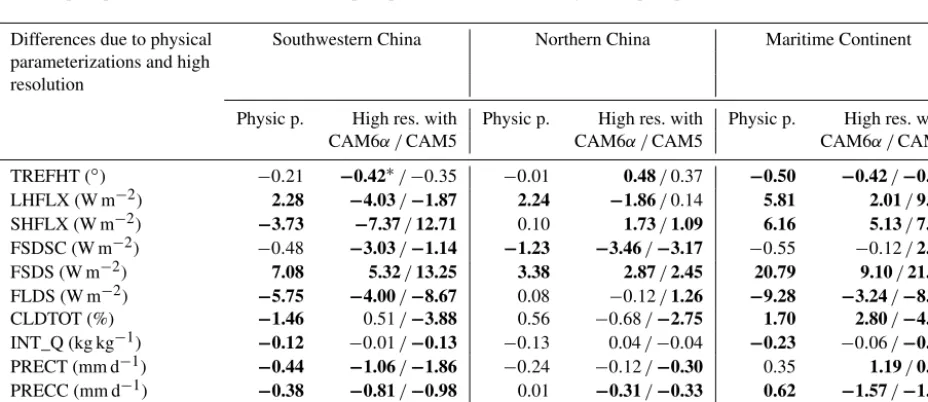
Table 2.Simulation differences due to physical parameterizations (CAM6α-1◦minus CAM5-1◦) and high horizontal resolution (CAM6α -0.25◦minus CAM6α-1◦/CAM5-0.25◦minus CAM5-1◦). The values are averages over southwestern China, northern China and the Mar-itime Continent during 1980–2004. Descriptions of variables are as follows: TREFHT, surface air temperature; LHFLX, surface latent heat flux; SHFLX, surface sensible heat flux; FSDSC, clear-sky downwelling solar flux at the surface; FSDS, downwelling solar flux at the sur-face; FLDS, downwelling longwave flux at the sursur-face; CLDTOT, vertically integrated total cloud; INT_Q, vertically integrated humidity; PRECT, total precipitation rate; PRECC, convective precipitation rate; PRECL, large-scale precipitation rate.
Differences due to physical Southwestern China Northern China Maritime Continent
parameterizations and high resolution
Physic p. High res. with Physic p. High res. with Physic p. High res. with
CAM6α /CAM5 CAM6α /CAM5 CAM6α /CAM5
TREFHT (◦) −0.21 −0.42∗/−0.35 −0.01 0.48/0.37 −0.50 −0.42/−0.64
LHFLX (W m−2) 2.28 −4.03/−1.87 2.24 −1.86/0.14 5.81 2.01/9.17
SHFLX (W m−2) −3.73 −7.37/12.71 0.10 1.73/1.09 6.16 5.13/7.16
FSDSC (W m−2) −0.48 −3.03/−1.14 −1.23 −3.46/−3.17 −0.55 −0.12/2.96
FSDS (W m−2) 7.08 5.32/13.25 3.38 2.87/2.45 20.79 9.10/21.57
FLDS (W m−2) −5.75 −4.00/−8.67 0.08 −0.12/1.26 −9.28 −3.24/−8.01
CLDTOT (%) −1.46 0.51/−3.88 0.56 −0.68/−2.75 1.70 2.80/−4.37
INT_Q (kg kg−1) −0.12 −0.01/−0.13 −0.13 0.04/−0.04 −0.23 −0.06/−0.39
PRECT (mm d−1) −0.44 −1.06/−1.86 −0.24 −0.12/−0.30 0.35 1.19/0.90
PRECC (mm d−1) −0.38 −0.81/−0.98 0.01 −0.31/−0.33 0.62 −1.57/−1.74
PRECL (mm d−1) −0.06 −0.25/−0.88 −0.25 0.19/0.03 −0.27 2.76/2.64
∗Statistically significant differences are emphasized in bold (95 % confidence level from a two-sidedttest).
3 Climatological statistics of mean precipitation and daily extreme precipitation
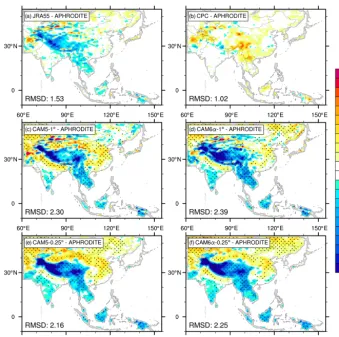
Figure 1 shows the annual mean surface air temperature dif-ferences relative to APHRODITE. First note that although they share some common surface measurements, JRA55
temper-Figure 1. The difference of 1980–2004 annual mean surface air temperature (◦) between observations (APHRODITE) and(a)JRA55,
(b)CPC,(c)CAM5-1◦,(d)CAM6α-1◦,(e)CAM5-0.25◦and(f)CAM6α-0.25◦. The values at the lower left of each panel indicate the root mean square difference (RMSD) relative to APHRODITE. Grid points in panels(c–f)are stippled if the absolute difference between the respective model and APHRODITE is larger than that between JRA55 and APHRODITE. All the data were interpolated to 1◦resolution.
ature, to have a better agreement with the observational benchmark (APHRODITE here) than the reanalysis prod-uct (JRA55), which is fully constrained by both ground and atmospheric observations. Thus, only the regions over which the model–APHRODITE difference is larger than the JRA55–APHRODITE difference are considered “signifi-cant” and stippled in Fig. 1c–f.
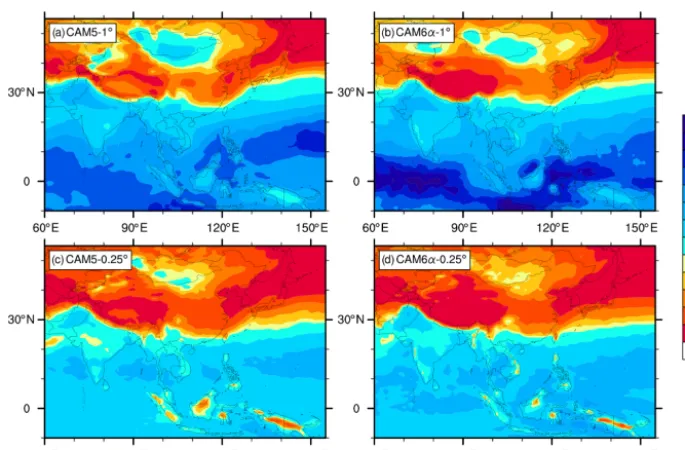
Similar to the difficulty in capturing the high-elevation temperature in JRA55, there is a warm bias over eastern and southern China and a cool bias over Tibet in the CAM5 sim-ulations (Fig. 1c). The cool bias over the Tibetan Plateau and warm bias over the foothill regions (both the Indian side and the northern edge of the Tibetan Plateau) are a long-standing bias in many global and regional climate models. We note that the bias over the Sichuan province appears to be muted in the high-resolution version (Fig. 1e, f), illustrating the promise of further enhancing the resolution.
Moreover, CAM6α reduces the temperature bias over southern China (Fig. 1c, d). Over the entire domain consid-ered in Fig. 1, the root mean square difference (RMSD)
rela-tive to APHRODITE is 2.3◦for CAM5-1◦, 2.4◦for CAM6α -1◦, 2.2◦for CAM5-0.25◦and 2.3◦for CAM6α-0.25◦(note that RMSD for JRA55 is 1.5◦). The RMSD as a regional average quantity is not sufficient to characterize the perfor-mance of models that vary at finer scales. Because of this limitation, in the following evaluation for precipitation, we divide East Asia into several regional boxes (Fig. 2).
3778 L. Lin et al.: CAM6 over Asia
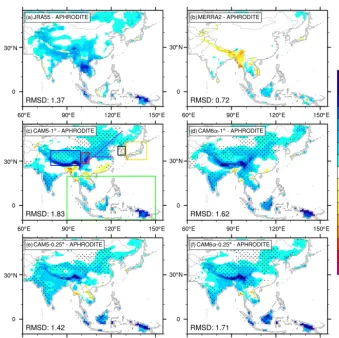
Figure 2. The difference of 1980–2004 annual mean precipitation (mm d−1) between APHRODITE and (a) JRA55,(b) MERRA2,
(c)CAM5-1◦,(d)CAM6α-1◦,(e)CAM5-0.25◦and(f)CAM6α-0.25◦. The values at the lower left of each panel indicate the root mean square difference (RMSD) relative to APHRODITE. Grid points in panels(c–f)are stippled when the absolute value of the difference between the model and APHRODITE is larger than that between JRA55 and APHRODITE. All the data were interpolated to 1◦resolution. The boxes with different colors in Fig. 2c are as follows. (1) Tibet (blue box): 27–37◦N, 79–99◦E; (2) southwestern China (red box): 28.5–35.5◦N, 100–105◦E; (3) Korea (black box): 34–40◦N, 124.5–129.5◦E; (4) Japan (gold box): 31–43◦N, 130–144◦E; (5) the Maritime Continent (green box): 9.75◦S–19.75◦N, 90–150◦E. The India average is entirely within mainland India. Northern China and southern China are also defined in Fig. 2c: northern China is north of Qin Mountain and the Huai River at 32.8◦N, and southern China is south of this. The western boundary of northern China and southern China is a straight line called the Hu–Huanyong line between Heihe (50.2◦N, 127.5◦E) and Tengchong (24.5◦N, 98.0◦E).
headwaters in those regions; and (b) these regions are also prone to natural hazards such as landslides.
Overall, the CAM6α-1◦ performance is slightly better than CAM5-1◦, and CAM6α-0.25◦falls in between the 1◦ resolution models (RMSD is 1.83 mm d−1 for CAM5-1◦, 1.62 mm d−1for CAM6α-1◦and 1.71 mm d−1for CAM6α -0.25◦). The CAM5-0.25◦ RMSD (1.42 mm d−1) is better than that of CAM6-0.25◦due to the lower bias over the Hi-malayas and Kalimantan (Fig. 2e, f).
Because of large spatial heterogeneity, eight regions are selected to evaluate precipitation. Five domains are shown as colored boxes in Fig. 2c: (1) Tibet: 27–37◦N, 79–99◦E; (2) southwestern China: 28.5–35.5◦N, 100–105◦E; (3) Ko-rea: 34–40◦N, 124.5–129.5◦E; (4) Japan: 31–43◦N, 130– 144◦E; (5) the Maritime Continent: 9.75◦S–19.75◦N, 90–
150◦E. Only the land within these boxes is considered in this study. The other three are India, northern China and south-ern China. The India average is entirely within mainland In-dia. Northern China and southern China are also defined in Fig. 2c: northern China is north of Qin Mountain and the Huai River at 32.8◦N, and southern China is south of this. The western boundary of northern China and southern China is a straight line called the Hu–Huanyong line between Heihe (50.2◦N, 127.5◦E) and Tengchong (24.5◦N, 98.0◦E).
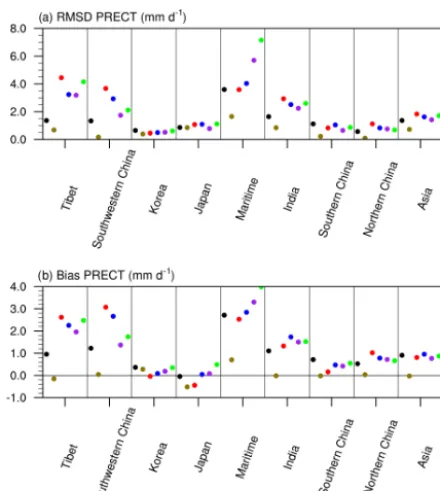
Figure 3. The root mean square difference (RMSD) and bias of annual mean precipitation (PRECT, mm d−1) relative to
APHRODITE for JRA55, MERRA2, CAM5-1◦, CAM6α-1◦,
CAM5-0.25◦and CAM6α-0.25◦over six regions: Tibet: 27–37◦N, 79–99◦E; southwestern China: 28.5–35.5◦N, 100–105◦E; Korea: 34–40◦N, 124.5–129.5◦E; Japan: 31–43◦N, 130–144◦E; Mar-itime: 9.75◦S–19.75◦N, 90–150◦E; Asia: 5–55◦N, 60–140◦E. Three other domains follow the geographical boundary and climatic zones for India, northern China and southern China as in Lin et al. (2018). The India average is entirely within mainland India. The western boundary of northern China and southern China is a straight line (shown in Fig. 2c) called the Hu–Huanyong line between Heihe (50.2◦N, 127.5◦E) and Tengchong (24.5◦N, 98.0◦E). The separa-tion of northern China and southern China (shown as the straight line in Fig. 2c) is along the latitude of Qin Mountain and the Huai River (32.8◦N).
will not further investigate model improvements. Among re-gions where CAM versions perform poorly compared with reanalyses (southwestern China, Tibet, India, northern China and the Maritime Continent), the CAM6α-1◦ performance (RMSD) is better (lower) than CAM5-1◦ for Tibet, south-western China and northern China, but it gets worse for the Maritime Continent. Notably, CAM6α-0.25◦is closer to observations over southwestern China and northern China, but it also gets considerably worse for the Maritime Con-tinent (with a large RMSD of 7.2 mm d−1 and a bias of 4.0 mm d−1). Both CAM versions with higher resolution simulate the climatological precipitation over northern China better. Increasing model resolution decreases the RMSD and bias of CAM5 over Tibet and southwestern China, while it increases those of CAM6 (Fig. 3).
We will explore the details that might lead to the pro-gressive improvement over southwestern China and northern China and the poor performance of CAM6-0.25◦ over the Maritime Continent in Sect. 5.
We next assess the model performance in simulating con-vective and large-scale precipitation components separately. The ratio of convective to large-scale precipitation is a useful diagnostic because both convective activity and large-scale instability can lead to precipitation in this model. Most at-mospheric models use convective parameterizations to repre-sent the effects of sub-grid-scale convective processes, with reduced-complexity microphysics (Zhang and McFarlane, 1995; Kooperman et al., 2016). The convective precipita-tion in CAM5 includes shallow and deep convective precip-itation. In CAM6 the shallow convective regime is handled by CLUBB coupled to stratiform microphysics, and hence shallow convective precipitation is prognostic and part of the large-scale precipitation.
The latent heating required by the atmosphere imposes an important constraint on the amount of mean rainfall, but model horizontal resolution and parameter settings dictate the timescales (Gustafson Jr. et al., 2014). CAM6 estimates shallow convective precipitation from the prognostic calcu-lations in CLUBB (which have memory between time steps of turbulent motion) rather than diagnostically representing the effects of sub-grid-scale convective processes at each lo-cation and time step. One of the reasons why the simulated rainfall intensity is expected to improve when the model is run at higher resolution is that the variance of sub-grid-scale humidity and thermodynamics drops, and the parameterized sub-grid-scale processes (such as sub-grid-scale turbulence with CLUBB) are better separated into regimes (Kopparla et al., 2013).
Figure 4 illustrates the ratio of convective (PRECC) to large-scale (PRECL) precipitation. This ratio (PRECC/PRECL) is greater over the ocean than over the land, as expected. CAM6α-1◦has a larger ratio over the tropics compared to CAM5-1◦. CAM6α-0.25◦ simulated a lower ratio than CAM6α-1◦(Fig. 4b) and a similar pattern as CAM5-0.25◦(Fig. 4c).
Higher-horizontal-resolution models tend to simulate higher vertical velocities (Gettelman et al., 2018) and a lower ratio of convective to total rainfall. A larger frac-tion of precipitafrac-tion can be resolved as a consequence of large-scale flow, limiting the need to invoke sub-grid con-vective schemes. Increasing resolution also better resolves topographic and surface effects, and it separates regimes as sub-grid-scale variance is reduced, particularly in the ther-modynamic variables. With a fixed amount of precipitable water, more condensation caused by the stratiform scheme means less is available for convective precipitation, so the ratio becomes lower.
3780 L. Lin et al.: CAM6 over Asia
Figure 4.The 1980–2004 convective to large-scale precipitation ratio (unitless) for(a)CAM5-1◦,(b)CAM6α-1◦,(c)CAM5-0.25◦and
(d)CAM6α-0.25◦.
(CLUBB and microphysics) instantaneously condenses all vapor in excess of liquid saturation to cloud liquid. In con-trast, the deep convective parameterization has a timescale that produces mass flux and precipitation at a defined rate. Note that as the time step gets shorter, the mass flux and precipitation over a time step will decrease, which is the major reason for the decrease in deep convective precipita-tion in CAM6. The large-scale condensaprecipita-tion (including shal-low convection and cloud microphysics) does more as the time step changes, while the deep convective parameteriza-tion does less (Gettelman et al., 2018).
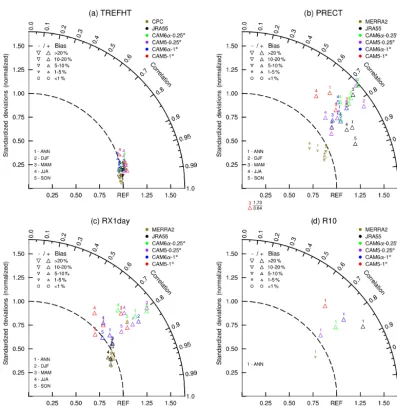
Figure 5 uses Taylor diagrams (Taylor, 2001) to evaluate the simulation of annual and seasonal surface air tempera-ture, mean precipitation and two metrics of extreme precip-itation. Red circles show the results from CAM5-1◦, with blue for CAM6α-1◦ and green for CAM6α-0.25◦. Move-ment closer to the point of (1.0,1.0) in the Taylor dia-grams indicates improvement of the simulation relative to APHRODITE. For example, the model circles are very close to the blue circles representing JRA55 for near-surface (2 m) temperature (TREFHT) (Fig. 5a), which indicates good per-formance for surface air temperature for all three models. The annual and seasonal precipitation (PRECT) correla-tions of the two CAM6αsimulations are around 0.8, while the annual correlation of CAM5-1◦ is 0.7 (Fig. 5b). The CAM6α-0.25◦root mean square (RMS) is bigger than that of CAM6α-1◦(green circles relative to blue circles in Fig. 5b). The maximum daily precipitation during each month of a year (RX1day) of CAM6α-1◦ performs better than CAM5 (blue circles relative to red circles in Fig. 5c). The number of heavy precipitation days (R10) has large differences among the observational and reanalysis data (black and gold circles
in Fig. 5d). CAM6αhas higher correlation coefficients with APHRODITE (∼0.8) than CAM5 (∼0.7).
Overall, CAM6αversions perform better than CAM5-1◦ for the mean precipitation (Fig. 5b), maximum daily precipi-tation and number of heavy precipiprecipi-tation days (Fig. 5c, d). Although CAM6α-0.25◦ performs worse than 1◦ for the mean precipitation and RX1day (green circles relative to blue circles in Fig. 5b and c), mostly due to the bias over the Mar-itime Continent (defined as 9.75◦S–19.75◦N, 90–150◦E), CAM6α-0.25◦ performs better for R10 (Fig. 5d). All three model versions show that precipitation bias in JJA is bigger than other seasons (Fig. 5b, c).
4 Variability of simulated precipitation over Asian regions on various timescales
In this section, we evaluate simulated rainfall variability across a wide range of timescales. This serves as a useful test of model performance because it is difficult to improve model performance in simulating temporal variability, as op-posed to the climatological average, based on the simple tun-ing of one or more parameters. Moreover, it is expected that CAM6 will be widely used to study climate variability at var-ious timescales.
4.1 Variability of precipitation due to PDO, ENSO and East Asian summer monsoon index
regres-Figure 5.Taylor diagrams for(a)surface air temperature,(b)precipitation,(c)RX1day (the maximum daily precipitation during each month of a year; mm d−1) and(d)R10 (number of days with precipitation more than 10 mm; units: days). These two extreme indices are suggested by the Expert Team for Climate Change Detection and Indices (Zhang et al., 2011). Note that R10, by design, only has an annual mean but not a seasonal mean. Spatial correlations and normalized RMS (root mean square) are calculated for ANN (1, annual), DJF (2, winter), MAM (3, spring), JJA (4, summer) and SON (5, fall). APHRODITE is used as the benchmark over Asia for 1980–2004. All the data were interpolated to 1◦resolution.
sion of observed and simulated annual precipitation against the PDO index, derived from the leading principal compo-nent of monthly SST anomalies in the North Pacific Ocean (Mantua et al., 1997). A common feature as revealed in the observational records is the drying tendency over Indochina (e.g., Thailand) during positive PDO phases. This feature is well represented in all four CAM versions. Similarly, a wet anomaly over most of India during positive PDO is also cap-tured in all CAM versions. In contrast, the wet anomaly over southern China is simulated well in the CAM6-0.25◦ ver-sion, while the opposite anomaly is seen in CAM6α-1◦and CAM5-0.25◦.
3782 L. Lin et al.: CAM6 over Asia
Figure 6.Regression of annual mean precipitation (mm d−1) onto observed PDO indices for 1980–2004.
boreal summer monsoon rainfall over Asia is well known. Figure 7h–n show the regression coefficients between JJA precipitation and ENSO. Those patterns are similar when the analysis is done with annual mean precipitation but with a weaker correlation of annual precipitation and ENSO. Our results here thus call into question the fidelity of previous ENSO studies on hydroclimate over southern China using CAM5.
Next, we examine seasonal precipitation variability asso-ciated with the East Asian summer monsoon (EASM). The EASM is an important climate system over eastern China. Climate models are widely used for EASM studies (Zhou and Li, 2002; Chen et al., 2010; Zhou et al., 2013), al-though model biases for the EASM are a long-lasting prob-lem from CMIP3 (Coupled Model Intercomparison Project phase 3) to CMIP5 with limited improvement (Song and Zhou, 2015; Kusunoki and Arakawa, 2015). The East Asian summer monsoon index (EASMI) is a unified dynamic nor-malized seasonality (DNS) monsoon index defined by Li and Zeng (2002, 2003):
EASMI=
V1−Vi
V
−2, (1)
whereV1andViare the January climatological and monthly
wind vectors for a grid, respectively, andV is the mean of January and July climatological wind vectors for the same gird. The constant 2 on the right-hand side of the formula is the determinant criterion. The double vertical line indicates
the normalized value. EASMI can be used to depict both the seasonal cycle and interannual variability of the EASM. The EASMI summer average is considered here.
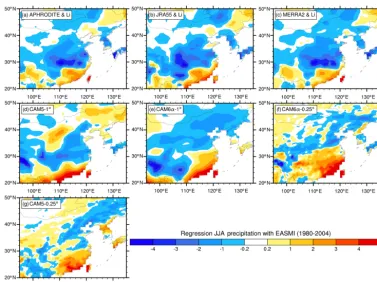
Figure 8 shows regression coefficients between summer (JJA) precipitation in the east of China and EASMI. There is an apparent negative relationship between the EASMI and summer rainfall in the middle and lower reaches of the Yangtze River in China for the observational and reanalysis data (Fig. 8a–c). All three CAM versions capture the posi-tive correlation over southern China (Fig. 8d–g) found in the observations and reanalyses (Fig. 8a–c), although CAM6α
at both 1 and 0.25◦and CAM5-0.25◦has the northern edge of the positive correlation more northward (about 2◦ lati-tude) distributed than that of observational and reanalysis data (Fig. 8e–g).
4.2 Seasonal cycle
Figure 7.Regression of annual mean(a–g)and summer (JJA,h–n) precipitation onto the observed ENSO index (mm d−1) for 1980–2004. Top color bar is for panels(a–g), bottom color bar is for panels(h–n).
overestimate seasonal variability over arid regions in west-ern China. CAM6α-0.25◦shows a bigger bias than CAM5-0.25◦over the Himalayas (Fig. 9e, f). The seasonal variabil-ity is significantly improved in CAM6α-0.25◦, especially in Himalayan mountain regions. Southern China, again, is a
re-gion where the CAM6-0.25◦performance is improved sub-stantially. This is further diagnosed in the next figure.
3784 L. Lin et al.: CAM6 over Asia
Figure 8.Regression of summer (JJA) precipitation onto EASMI (mm d−1) for 1980–2004.
precipitation. Figure 10 shows that precipitation mainly oc-curs from May to September, rapidly shifts to northern China around June and continues to September (Su et al., 2017). It is clear that APHRODITE, JRA55 and MERRA2 all de-pict such a northern shift (Fig. 10a, b, c). Both versions of CAM6αcapture this northern shift and its persistence from June to September, especially CAM6α-0.25◦ (Fig. 10e, f), while CAM5-1◦illustrates persistence from June to July only (the area of continuous yellow shading in Fig. 10d is smaller than those of CAM6). High-resolution CAM5-0.25◦ cap-tures that shift and its persistence from June and September (Fig. 10g). This explains the CAM5-1◦deficiency as shown in Fig. 9.
4.3 Daily precipitation frequency and diurnal cycle of precipitation
Figure 11 illustrates the daily rainfall frequency distribution from reanalyses, observations and models. Despite large un-certainties among observational datasets, daily rainfall in-tensity for CAM6-0.25◦ (green line) is closer to observa-tional values over southwestern China than other simula-tions (Fig. 11b). CAM5-0.25◦overestimates the frequency of light precipitation (0.1–10 mm d−1) over southwestern China (purple line in Fig. 11b). CAM5-1◦ simulates a higher fre-quency of light precipitation (0.1–1.0 mm d−1) over Korea, Japan, northern China and southern China (Fig. 11a, c, d, g, h). New physical schemes in CAM6-1◦ capture the
ob-served distribution over Korea and Japan (Fig. 11c, d). Real-istic rainfall intensity is not energetically necessary because more frequent weak events can produce the same latent heat-ing as less frequent but more intense rainfall events. CAM6 improves the light large-scale precipitation over Korea, Japan and northern China (not shown).
To look into the heavy precipitation more carefully, Fig-ure 12 shows precipitation percentiles from 90 % to 99.99 %, which captures the heaviest precipitation events (Kooperman et al., 2016). CAM6 with new physics modules (blue) has a better performance than CAM5 over five of eight selected re-gions (Tibet, southwestern China, Japan, India, northern and southern China). Higher horizontal resolution in CAM6 and CAM5 (green and purple) better simulates intensities over the Maritime Continent (Fig. 12e), but the results of CAM6 (CAM5) degrade (upgrade slightly) for the heaviest precipi-tation events over India, northern China and southern China (Fig. 12f–h). No significant differences are found between CAM5 and CAM6 over Tibet, southwestern China, Japan and the Maritime Continent.
earlier-in-the-Figure 9.The difference of summer minus winter (JJA−DJF) precipitation (mm d−1) between APHRODITE and(a)JRA55,(b)MERRA2,
(c)CAM5-1◦,(d)CAM6α-1◦,(e)CAM5-0.25◦and(f)CAM6α-0.25◦. The values at the lower left of every panel indicate the root mean square difference (RMSD) relative to APHRODITE. Grid points in panels(c–f)are stippled when the absolute value of the difference between the model and APHRODITE is larger than that between JRA55 and APHRODITE.
day peak precipitation over India, southern China and the Maritime Continent (Fig. 13b, d). CAM6α-0.25◦simulates the diurnal cycle better than CAM6α-1◦ in southern Tibet (Fig. 13d) along the Himalayas. In general, CAM6 at all res-olutions has significant improvements over CAM5 in sim-ulating the diurnal cycle of precipitation in East Asia, and CAM5 with higher resolution improves the diurnal cycle only slightly.
The CLUBB parameterization appears to be the reason for this improvement. CLUBB has prognostic moments that pro-vide memory to facilitate the initiation of shallow convection in the midmorning and early afternoon. It is important to note that improved simulation of the diurnal cycle by CLUBB is a robust feature in every coupled and atmosphere-only simula-tion with CAM6α. The CLUBB unified parameterization is able to prevent the deep convective scheme from firing off too early and better simulate a gradual transition of these regimes successfully (Bogenschutz et al., 2018).
5 Change due to physical parameterizations and high resolution: northern China, southwestern China and the Maritime Continent
Here, we quantitatively contrast climate variables over south-western China, northern China and the Maritime Continent, since the model with new physical modules or high hori-zontal resolution simulates a better climatology over south-western China and northern China but does the opposite over the Maritime Continent (Fig. 3). We attempt to attribute changes to either physical parameterizations or resolution. Additionally, we investigate whether the improvement due to resolution is dependent on the CAM version. Table 2 il-lustrates simulation differences due to physical parameter-izations (CAM6α-1◦minus CAM5-1◦) and higher horizon-tal resolution (CAM6α-0.25◦minus CAM6α-1◦and CAM5-0.25◦minus CAM5-1◦).
3786 L. Lin et al.: CAM6 over Asia
Figure 10.Annual cycle of the regional mean precipitation rate (mm d−1) for 1980–2004 within a part of Asia (between 100 and 125◦E):
(a)APHRODITE,(b)JRA55,(c)MERRA2,(d)CAM5-1◦,(e)CAM6α-1◦,(f)CAM6α-0.25◦and(g)CAM5-0.25◦.
latent heat flux but less vertically integrated humidity, which leads to a decrease in convective precipitation over south-western China (Table 2). Higher resolutions in CAM6 and CAM5 both decrease the surface latent heat flux and convec-tive precipitation over southwestern China (Table 2). How-ever, higher resolution leads to an opposite change in surface sensible heat flux (total cloud amount) between CAM5 and CAM6αby 12.7 and−7.4 W m−2 (−3.9 % and 0.5 %), re-spectively.
Newer physics parameterizations in CAM6α simulate a stronger solar flux reaching the surface in northern China (Table 2). This may be due to improvements in the diurnal cycle of precipitation (Li et al., 2008). The stronger solar flux leads to larger latent heat release, although convective precip-itation over northern China is not changed by the new physics modules. Better representation of topography at 0.25◦ reso-lution leads to increased downward shortwave flux at the sur-face in northern China. Less convective precipitation associ-ated with increased resolution is seen over northern China in Table 2 (−0.31 mm d−1for CAM6 and−0.33 mm d−1for CAM5). Note that CAM6 simulates a decrease in the surface latent heat flux with a higher resolution, while CAM5 does not. We also examine the moisture budget using diagnostics for precipitation changes (Chou and Lan, 2012). The mois-ture budget analysis defines the mass conservation of water substance in an atmospheric column as
P +< ∂x(uq) >+< ∂y(vq) >+Res=E, (2)
whereP is precipitation,qis specific humidity,u(v)is zonal (meridional) wind andEis evaporation into the atmosphere.
< X >is a mass-weighted vertical integral andX denotes a temporal average. The horizontal advection can be further decomposed into the stationary and transient terms based on
X=X+X0=X+X∗+X0, (3)
where[X]and(X∗)are the climatological zonal mean (sta-tionary) eddy, and X0 is transient variation. See Yao et al. (2017) and Chen et al. (2018) for more details.
No significant difference in evaporation (E) is seen be-tween the model and JRA55 data (Fig. 14). The results indi-cate that CAM6 (both resolutions) simulates a moisture bud-get closer to JRA55 than CAM5-1◦, and the model precipi-tation bias appears mostly in the zonal moisture flux conver-gence term(−∂x(uq))over southwestern China (Fig. 14a).
Figure 11.Frequency distribution of daily precipitation (mm d−1) over (a) Tibet, (b) southwestern China, (c) Korea, (d) Japan,
(e) the Maritime Continent (see the boxes in Fig. 2c), (f) India,
(g)northern China and(h)southern China for 1980–2004. Black lines (shading) are for APHRODITE (the maximum and minimum of APHRODITE, JRA55 and MERRA2). Red solid lines are for CAM5-1◦; blue solid lines are for CAM6α-1◦; green solid lines are for CAM6α-0.25◦; purple solid lines are for CAM5-0.25◦. All data were interpolated to 1◦resolution before regional averaging.
Next, we explore the differences in simulated variables due to higher horizontal resolution over the Maritime Continent (Fig. 3). As seen in Table 2, the higher horizontal
resolu-Figure 12. Similar to Fig. 11, but for daily precipitation rates (mm d−1) as a function of percentile.
sur-3788 L. Lin et al.: CAM6 over Asia
Figure 13.Diurnal cycle of precipitation in June (6-year average for 1999–2004) of(a)TRMM,(b)CAM5-1◦,(c)CAM6α-1◦,(d) CAM5-0.25◦and(e)CAM6α-0.25◦. The local time peak of the diurnal cycle is shown in color on the color wheel. The intensity of the color is the amplitude of precipitation.
face (Table 2). With a fully coupled Community Climate Sys-tem Model version 4 (CCSM4), an earlier version of CAM (CAM4), Shields et al. (2016) have shown that higher hor-izontal resolution tends to decrease convective precipitation and increase large-scale precipitation. The moisture budget analysis shows that the meridional specific humidity eddy transport is the main factor leading to the bias over the Mar-itime Continent (Fig. 14c). Note that the analysis in this study is focused on the Maritime Continent land area only. Johnsan et al. (2016) carried out a moisture budget analysis for the whole Maritime Continent (including the ocean) and found that increased resolution causes increased moisture conver-gence and precipitation on the windward (southern) side of the orography, which leads to decreased moisture availability on the leeward (northern) side, reducing precipitation.
6 Summary
re-Figure 14.Moisture budget over(a)southwestern China,(b) north-ern China and(c)the Maritime Continent (see the boxes in Fig. 2c) for 1980–2004, including precipitation, evaporation, zonal and meridional moisture flux convergence, and the residual and (right to dashed line) major processes contributing to moisture flux con-vergence.
places the previous convective parameterizations that diag-nose the large-scale instability and the shallow convective response separately.
The major findings of this study are as follows.
1. For the climatology of mean precipitation over Asia, CAM6α-1◦ substantially reduces model biases. Using an observational dataset (APHRODITE) as the baseline, the mean squared error is reduced by 11 % in CAM6α -1◦compared to CAM5-1◦. In terms of spatial distribu-tion, the most remarkable bias of CAM5 and CAM6 is excessive precipitation in central China and a rainfall deficit over southern China. Higher resolution in both CAM5 and CAM6 decreases the mean squared error. 2. CAM6αbetter simulates the probability distributions of
daily precipitation over Tibet, Korea, Japan and north-ern China. Specifically, CAM6αperforms better for the
frequency of daily light precipitation over Korea, Japan and northern China and captures the heaviest precipi-tation events over most of Asia. Notably, CAM6α ver-sions capture the observed diurnal cycle of precipita-tion. With a prognostic treatment of large-scale instabil-ity and the convective response, higher horizontal reso-lution in CAM6 leads to better performance on the fre-quency distributions of daily precipitation over south-western China (close to the edge of Tibet Plateau) and heavy precipitation over northern China. The improve-ment, however, is dependent on CAM versions. 3. Upgraded physical modules in CAM6 decrease the
sim-ulated convective precipitation and reduce the total pre-cipitation bias over southwestern China. More complex terrain at higher resolution leads to lower convective precipitation at higher resolution for both CAM ver-sions, which improves the model performance in to-tal precipitation over southwestern China and northern China. Those improvements can be explained in terms of the meridional moisture convergence or zonal mean humidity eddy.
4. Upgraded physical parameterizations and higher hori-zontal resolution substantially improve the seasonal cy-cle of precipitation. For temporal variability at differ-ent scales (decadal, interannual, seasonal, and diurnal), model performance varies. Higher horizontal resolution does not adequately simulate the negative correlation between the Asian monsoon index and summer precipi-tation in the middle and lower reaches of the Yangtze River in China. CAM6α with 1 and 0.25◦ simulates the opposite anomaly during positive PDO phases over southern China, and two CAM5 versions with different resolutions show a similar opposite anomaly. Upgraded physical parameterizations help CAM6 to simulate the drying tendency over southern China during El Niño years.
5. CAM6α versions generally have improvements over CAM5 in simulating the diurnal cycle of precipitation in East Asia due to the CLUBB parameterization. CLUBB has prognostic moments that provide memory to facili-tate the initiation of shallow convection in the midmorn-ing and early afternoon.
3790 L. Lin et al.: CAM6 over Asia
Code availability. The model code of CESM2 is released at http:// www.cesm.ucar.edu/models/cesm2/, last access: 1 June 2019 (Hur-rell et al., 2013). Readers can download the current release code us-ing the followus-ing command: git clone -b release-cesm2.1.0 (https: //github.com/ESCOMP/cesm, last access: 1 June 2019).
Data availability. The model data are archived at https://doi.org/10.5281/zenodo.2548255 (Lin, 2019). Details about MERRA-2 can be found at https://gmao.gsfc.nasa.gov/ reanalysis/MERRA-2/, last access: 1 June 2019. Details about APHRODITE can be found at http://www.chikyu.ac.jp/precip/, last access: 1 June 2019. The observational EASMI is from http: //ljp.gcess.cn/dct/page/65577, last access: 1 June 2019. The ENSO index is from http://research.jisao.washington.edu/data/cti/, last access: 1 June 2019. The PDO index is from http://research.jisao. washington.edu/pdo/PDO.latest, last access: 1 June 2019. TRMM
is from https://pmm.nasa.gov/data-access/downloads/trmm,
last access: 1 June 2019. The CPC dataset is from https: //www.esrl.noaa.gov/psd/data/gridded/data.cpc.globaltemp.html, last access: 1 June 2019.
Author contributions. WD and CW designed the study, LL led the analysis, AG performed CESM simulations, and NR and SCB per-formed the CAM5-0.25◦simulation. LL, YX and ZW prepared the paper with contributions from all coauthors.
Competing interests. The authors declare that they have no conflict of interest.
Acknowledgements. We thank Richard Neale at the National Center for Atmospheric Research (NCAR) for the code for computing the diurnal cycle. We also thank Patrick Callaghan and Colin Zarzycki for assistance with the original CAM6 high-resolution simulations. We thank Julio Bacmeister for providing CAM5 data. This study was supported by the National Key Research and Development Pro-gram of China (2016YFA0602701) and the National Natural Sci-ence Foundation of China (grant 41805053). Chenglai Wu thanks the National Natural Science Foundation of China (grant 41830966) for support. The National Center for Atmospheric Research is sup-ported by the U.S. National Science Foundation. Portions of this study were supported by the Regional and Global Model Analysis (RGMA) component of the Earth and Environmental System Mod-eling Program of the U.S. Department of Energy’s Office of Biolog-ical & Environmental Research (BER; cooperative agreement DE-FC02-97ER62402) and the National Science Foundation. Comput-ing resources (ark:/85065/d7wd3xhc) were provided by the Climate Simulation Laboratory at NCAR’s Computational and Information Systems Laboratory, sponsored by the National Science Founda-tion and other agencies. An award for computer time was provided by the Innovative and Novel Computational Impact on Theory and Experiment (INCITE) program. This research used resources of the Argonne Leadership Computing Facility, which is a DOE Of-fice of Science User Facility supported under contract DE-AC02-06CH11357.
Financial support. This research has been supported by the The National Key Research and Development Program of China (grant no. 2016YFA0602701).
Review statement. This paper was edited by Paul Ullrich and re-viewed by two anonymous referees.
References
Bacmeister, J. T., Wehner, M. F., Neale, R. B., Gettelman, A., Han-nay, C., Lauritzen, P. H., Caron, J. M., and Truesdale, J. E.: Exploratory high-resolution climate simulations using the Com-munity Atmosphere Model (CAM), J. Climate, 27, 3073–3099, 2014.
Bogenschutz, P. A., Gettelman, A., Morrison, H., Larson, V. E., Craig, C., and Schanen, D. P.: Higher-order turbulence closure and its impact on climate simulations in the Community Atmo-sphere Model, J. Climate, 26, 9655–9676, 2013.
Bogenschutz, P. A., Gettelman, A., Hannay, C., Larson, V. E., Neale, R. B., Craig, C., and Chen, C.-C.: The path to CAM6: coupled simulations with CAM5.4 and CAM5.5, Geosci. Model Dev., 11, 235–255, https://doi.org/10.5194/gmd-11-235-2018, 2018.
Bretherton, C. S. and Park, S.: A new moist turbulence parame-terization in the Community Atmosphere Model, J. Climate, 22, 3422–3448, 2009.
Chen, H., Zhou, T., Neale, R. B., Wu, X., and Zhang, G. J.: Perfor-mance of the new NCAR CAM3.5 in East Asian summer mon-soon simulations: Sensitivity to modifications of the convection scheme, J. Climate, 23, 3657–3675, 2010.
Chen, M., Shi, W., Xie, P., Silva, V. B. S., Kousky, V. E., Wayne Hig-gins, R., and Janowiak, J. E.: Assessing objective techniques for gauge-based analyses of global daily precipitation, J. Geophys. Res., 113, D04110, https://doi.org/10.1029/2007JD009132, 2008.
Chen, X., Wu, P., Roberts, M. J., and Zhou, T.: Potential Underes-timation of Future Mei-Yu Rainfall with Coarse-Resolution Cli-mate Models, J. CliCli-mate, 31, 6711–6727, 2018.
Chou, C. and Lan, C. W.: Changes in the annual range of precipita-tion under global warming, J. Climate, 25, 222–235, 2012. Deser, C. and Wallace, J. M.: El Niño events and their relation to the
Southern Oscillation: 1925–1986, J. Geophys. Res., 92, 14189– 14196, 1987.
Eyring, V., Bony, S., Meehl, G. A., Senior, C. A., Stevens, B., Stouffer, R. J., and Taylor, K. E.: Overview of the Coupled Model Intercomparison Project Phase 6 (CMIP6) experimen-tal design and organization, Geosci. Model Dev., 9, 1937–1958, https://doi.org/10.5194/gmd-9-1937-2016, 2016.
Gettelman, A. and Morrison, H.: Advanced two-moment bulk mi-crophysics for global models. Part I: Off-line tests and compari-son with other schemes, J. Climate, 28, 1268–1287, 2015. Gettelman, A., Morrison, H., and Ghan, S. J.: A new two-moment
bulk stratiform cloud microphysics scheme in the Community Atmosphere Model, version 3 (CAM3). Part II: Single-column and global results, J. Climate, 21, 3660–3679, 2008.
Gettelman, A., Liu, X., Ghan, S. J., Morrison, H., Park, S., Conley, A. J., Klein, S. A., Boyle, J., Mitchell, D. L., and Li, J. L.: Global simulations of ice nucleation and ice su-persaturation with an improved cloud scheme in the Com-munity Atmosphere Model, J. Geophys. Res., 115, D18216, https://doi.org/10.1029/2009JD013797, 2010.
Gettelman, A., Bresch, D. N., Chen, C. C., Truesdale, J. E., and Bacmeister, J. T.: Projections of future tropical cyclone damage with a high-resolution global climate model, Climatic Change, 146, 575–585, 2018.
Golaz, J. C., Larson, V. E., and Cotton, W. R.: A PDF-based model for boundary layer clouds. Part I: Method and model description, J. Atmos. Sci., 59, 3540–3551, 2002a.
Golaz, J. C., Larson, V. E., and Cotton, W. R.: A PDF-based model for boundary layer clouds. Part II: Model results, J. Atmos. Sci., 59, 3552–3571, 2002b.
Gustafson Jr., W. I., Ma, P. L., and Singh, B.: Precipitation charac-teristics of CAM5 physics at mesoscale resolution during MC3E and the impact of convective timescale choice, J. Adv. Model. Earth Sy., 6, 1271–1287, 2014.
Herold, N., Kala, J., and Alexander, L. V.: The influence of soil moisture deficits on Australian heatwaves, Environ. Res. Lett., 11, 064003, 2016a.
Herold, N., Alexander, L. V., Donat, M. G., Contractor, S., and Becker, A.: How much does it rain over land?, Geophys. Res. Lett., 43, 341–348, 2016b.
Hoell, A., Hoerling, M., Eischeid, J., Wolter, K., Dole, R., Perlwitz, J., Xu, T., and Cheng, L.: Does El Niño intensity matter for Cal-ifornia precipitation?, Geophys. Res. Lett., 43, 819–825, 2016. Hoose, C., Kristjánsson, J. E., and Burrows, S. M.: How
impor-tant is biological ice nucleation in clouds on a global scale?, Environ. Res. Lett., 5, 024009, https://doi.org/10.1088/1748-9326/5/2/024009, 2010.
Huffman, G. J. and Bolvin, D. T.: TRMM and other data precipi-tation data set documenprecipi-tation, NASA, Greenbelt, USA, 28(2.3), 2013.
Hurrell, J. W., Holland, M. M., Gent, P. R., Ghan, S., Kay, J. E., Kushner, P. J., Lamarque, J., Large, W. G., Lawrence, D., Lind-say, K., Lipscomb, W. H., Long, M. C., Mahowald, N., Marsh, D. R., Neale, R. B., Rasch, P., Vavrus, S., Vertenstein, M., Bader, D., Collins, W. D., Hack, J. J., Kiehl, J., and Marshall, S.: The community earth system model: a framework for collaborative research, B. Am. Meteorol. Soc., 94, 1339–1360, 2013. Jiang, Y., Yang, X. Q., and Liu, X.: Seasonality in anthropogenic
aerosol effects on East Asian climate simulated with CAM5, J. Geophys. Res.-Atmos., 120, 10837–10861, 2015.
Johnson, S. J., Levine, R. C., Turner, A. G., Martin, G. M., Wool-nough, S. J., Schiemann, R., Mizielinski, M. S., Roberts, M. J., Pier Luigi Vidale, P. L., Demory, M.-E., and Strachan, J.: The res-olution sensitivity of the South Asian monsoon and Indo-Pacific in a global 0.35 AGCM, Clim. Dynam., 46, 807–831, 2016.
Kobayashi, S., Ota, Y., Harada, Y., Ebita, A., Moriya, M., Onoda, H., Onogi, K., Kamahori, H., Kobayashi, C., Endo, H., Miyaoka, K., and Takahashi, K.: The JRA-55 reanalysis: General specifica-tions and basic characteristics, J. Meteorol. Soc. Jpn., 93, 5–48, 2015.
Kooperman, G. J., Pritchard, M. S., Burt, M. A., Branson, M. D., and Randall, D. A.: Robust effects of cloud superparameteriza-tion on simulated daily rainfall intensity statistics across multiple versions of the Community Earth System Model, J. Adv. Model. Earth Sy., 8, 140–165, 2016.
Kopparla, P., Fischer, E. M., Hannay, C., and Knutti, R.: Improved simulation of extreme precipitation in a high-resolution atmo-sphere model, Geophys. Res. Lett., 40, 5803–5808, 2013. Kusunoki, S. and Arakawa, O.: Are CMIP5 models better than
CMIP3 models in simulating precipitation over East Asia?, J. Climate, 28, 5601–5621, 2015.
Lau, N. C. and Ploshay, J. J.: Simulation of synoptic-and subsynoptic-scale phenomena associated with the East Asian summer monsoon using a high-resolution GCM, Mon. Weather Rev., 137, 137–160, 2009.
Lauritzen, P. H., Nair, R. D., Herrington, A. R., Callaghan, P., Gold-haber, S., Dennis, J. M., Bacmeister, J. T., Eaton, B. E., Zarzycki, C. M., Taylor, M. A., Ullrich, P. A., Dubos, T., Gettelman, A., Neale, R. B., Dobbins, B., Reed, K. A., Hannay, C., Medeiros, B., Benedict, J. J., and Tribbia, J. J.: NCAR Release of CAM-SE in CESM2.0: A Reformulation of the Spectral Element Dynami-cal Core in Dry-Mass VertiDynami-cal Coordinates With Comprehensive Treatment of Condensates and Energy, J. Adv. Model. Earth Sy., 10, 1537–1570, 2018.
Li, J. and Zeng, Q.: A unified monsoon index, Geophys. Res. Lett., 29, 115-1–115-4, 2002.
Li, J. and Zeng, Q.: A new monsoon index and the geographical distribution of the global monsoons, Adv. Atmos. Sci., 20, 299– 302, 2003.
Li, J., Yu, R., and Zhou, T.: Seasonal variation of the diurnal cycle of rainfall in southern contiguous China, J. Climate, 21, 6036– 6043, 2008.
Li, J., Yu, R., Yuan, W., Chen, H., Sun, W., and Zhang, Y.: Pre-cipitation over East Asia simulated by NCAR CAM5 at differ-ent horizontal resolutions, J. Adv. Model. Earth Sy., 7, 774–790, 2015.
Lin, L., Xu, Y., Wang, Z., Diao, C., Dong, W., and Xie, S. P.: Changes in extreme rainfall over India and China attributed to regional aerosol-cloud interaction during the late 20th cen-tury rapid industrialization, Geophys. Res. Lett., 45, 7857–7865, 2018.
Lin, L.: CAM6 simulation of mean and extreme precip-itation over Asia: Sensitivity to upgraded physical pa-rameterizations and higher horizontal resolution, Zenodo, https://doi.org/10.5281/zenodo.2548255, 2019.
Lin, L., Gettelman, A., Feng, S., and Fu, Q.: Simulated climatology and evolution of aridity in the 21st century, J. Geophys. Res.-Atmos., 120, 5795–5815, 2015.
Lin, L., Gettelman, A., Fu, Q., and Xu, Y.: Simulated differences in 21st century aridity due to different scenarios of greenhouse gases and aerosols, Climatic Change, 146, 407–422, 2016. Liu, X., Easter, R. C., Ghan, S. J., Zaveri, R., Rasch, P., Shi, X.,
3792 L. Lin et al.: CAM6 over Asia
Mahowald, N., Collins, W., Iacono, M. J., Bretherton, C. S., Flan-ner, M. G., and Mitchell, D.: Toward a minimal representation of aerosols in climate models: description and evaluation in the Community Atmosphere Model CAM5, Geosci. Model Dev., 5, 709–739, https://doi.org/10.5194/gmd-5-709-2012, 2012. Liu, X., Ma, P.-L., Wang, H., Tilmes, S., Singh, B., Easter, R. C.,
Ghan, S. J., and Rasch, P. J.: Description and evaluation of a new four-mode version of the Modal Aerosol Module (MAM4) within version 5.3 of the Community Atmosphere Model, Geosci. Model Dev., 9, 505–522, https://doi.org/10.5194/gmd-9-505-2016, 2016.
Mantua, N. J., Hare, S. R., Zhang, Y., Wallace, J. M., and Francis, R. C.: A Pacific interdecadal climate oscil-lation with impacts on salmon production, B. Am. Me-teorol. Soc., 78, 1069–1080, https://doi.org/10.1175/1520-0477(1997)078<1069:APICOW>2.0.CO;2, 1997.
Martin, G. M., Klingaman, N. P., and Moise, A. F.: Connecting spatial and temporal scales of tropical precipitation in observa-tions and the MetUM-GA6, Geosci. Model Dev., 10, 105–126, https://doi.org/10.5194/gmd-10-105-2017, 2017.
Meehl, G. A., Hu, A., Arblaster, J. M., Fasullo, J., and Trenberth, K. E.: Externally forced and internally generated decadal climate variability associated with the Interdecadal Pacific Oscillation, J. Climate, 26, 7298–7310, 2013.
Meehl, G. A., Yang, D., Arblaster, J. M., Bates, S., Rosenbloom, N., Neale, R., Bacmeister, J., Truesdale, Hannay, C. Shields, J., Small, F. B., and Danabasoglu, G.: Effects of model resolution, physics, and coupling on Southern Hemisphere storm tracks in CESM1.3, Geophys. Res. Lett., in preparation, 2019.
Morrison, H. and Gettelman, A.: A new two-moment bulk strati-form cloud microphysics scheme in the Community Atmosphere Model, version 3 (CAM3), Part I: Description and numerical tests, J. Climate, 21, 3642–3659, 2008.
Neale, R. B., Chen, C. C., Gettelman, A., Lauritzen, P. H., Park, S., Williamson, D. L., Conley, A. J., Garcia, R., Kinnison, D., Lamarque, J., Marsh, D., Mills, M., Smith, A. K., Tilmes, S., Vitt, F., Morrison, H., Cameron-Smith, P., Collins, W. D., Iacono, M. J., Easter, R. C., Ghan, S. J., Liu, X., Rasch, P. J., and Taylor, M. A.: Description of the NCAR community atmosphere model (CAM 5.0), NCAR Tech. Note NCAR/TN-486+ STR, 1, 1–12, 2010.
Palmer, T.: Climate forecasting: Build high-resolution global cli-mate models, Nature, 515, 338–339, 2014.
Park, S. and Bretherton, C. S.: The University of Washington shal-low convection and moist turbulence schemes and their impact on climate simulations with the Community Atmosphere Model, J. Climate, 22, 3449–3469, 2009.
Park, S., Bretherton, C. S., and Rasch, P. J.: Integrating cloud pro-cesses in the Community Atmosphere Model, version 5, J. Cli-mate, 27, 6821–6856, 2014.
Seager, R., Naik, N., and Vecchi, G. A.: Thermodynamic and dy-namic mechanisms for large-scale changes in the hydrological cycle in response to global warming, J. Climate, 23, 4651–4668, 2010.
Sharma, V., Kilic, A., and Irmak, S.: Impact of scale/resolution on evapotranspiration from Landsat and MODIS images, Water Re-sour. Res., 52, 1800–1819, 2016.
Sheffield, J., Wood, E. F., and Roderick, M. L.: Little change in global drought over the past 60 years, Nature, 491, 435–438, 2012.
Shields, C. A., Kiehl, J. T., and Meehl, G. A.: Future changes in regional precipitation simulated by a half-degree coupled climate model: Sensitivity to horizontal resolution, J. Adv. Model. Earth Sy., 8, 863–884, 2016.
Song, F. and Zhou, T.: The crucial role of internal variability in modulating the decadal variation of the East Asian summer monsoon–ENSO relationship during the twentieth century, J. Climate, 28, 7093–7107, 2015.
Stephan, C. C., Klingaman, N. P., Vidale, P. L., Turner, A. G., De-mory, M.-E., and Guo, L.: Interannual rainfall variability over China in the MetUM GA6 and GC2 configurations, Geosci. Model Dev., 11, 1823–1847, https://doi.org/10.5194/gmd-11-1823-2018, 2018a.
Stephan, C. C., Ng, Y. H., and Klingaman, N. P.: On Northern Hemi-sphereWave Patterns Associated with Winter Rainfall Events in China, Adv. Atmos. Sci., 35, 1021–1034, 2018b.
Su, T., Xue, F., Chen, M., and Dong, X.: A mechanism study for the intraseasonal oscillation impact on the two northward jumps of the western Pacific subtropical high, Chinese Journal of Atmospheric Sciences, 41, 437–460, https://doi.org/10.3878/j.issn.1006-9895.1609.16125, 2017 (in Chinese).
Taylor, K. E.: Summarizing multiple aspects of model performance in a single diagram, J. Geophys. Res., 106, 7183–7192, 2001. Trenberth, K. E. and Guillemot, C. J.: Evaluation of the global
at-mospheric moisture budget as seen from analyses, J. Climate, 8, 2255–2272, 1995.
Trenberth, K. E., Dai, A., Van Der Schrier, G., Jones, P. D., Barichivich, J., Briffa, K. R., and Sheffield, J.: Global warming and changes in drought, Nat. Climatic Change, 4, 17–22, 2014. Vinoj, V., Rasch, P. J., Wang, H., Yoon, J. H., Ma, P. L., Landu, K.,
and Singh, B.: Short-term modulation of Indian summer mon-soon rainfall by West Asian dust, Nat. Geosci., 7, 308–313, 2014. Walters, D., Boutle, I., Brooks, M., Melvin, T., Stratton, R., Vosper, S., Wells, H., Williams, K., Wood, N., Allen, T., Bushell, A., Copsey, D., Earnshaw, P., Edwards, J., Gross, M., Hardiman, S., Harris, C., Heming, J., Klingaman, N., Levine, R., Man-ners, J., Martin, G., Milton, S., Mittermaier, M., Morcrette, C., Riddick, T., Roberts, M., Sanchez, C., Selwood, P., Stirling, A., Smith, C., Suri, D., Tennant, W., Vidale, P. L., Wilkinson, J., Willett, M., Woolnough, S., and Xavier, P.: The Met Office Unified Model Global Atmosphere 6.0/6.1 and JULES Global Land 6.0/6.1 configurations, Geosci. Model Dev., 10, 1487– 1520, https://doi.org/10.5194/gmd-10-1487-2017, 2017. Wang, Y., Zhang, G. J., and Jiang, Y.: Linking stochasticity of
con-vection to large-scale vertical velocity to improve Indian summer monsoon simulation in the NCAR CAM5, J. Climate, 31, 6985– 7002, 2018.
Wehner, M. F., Reed, K. A., Li, F., Bacmeister, J., Chen, C. T., Pa-ciorek, C., Gleckler, P. J., Sperber, K. R., Collins, W. D., Gettel-man, A., and Jablonowski, C.: The effect of horizontal resolution on simulation quality in the Community Atmospheric Model, CAM5.1, J. Adv. Model. Earth Sy., 6, 980–997, 2014.
simulat-ing the East Asian summer monsoon rain belt, J. Climate, 30, 8825–8840, 2017.
Yatagai, A., Kamiguchi, K., Arakawa, O., Hamada, A., Yasutomi, N., and Kitoh, A.: APHRODITE: Constructing a long-term daily gridded precipitation dataset for Asia based on a dense network of rain gauges, B. Am. Meteorol. Soc., 93, 1401–1415, 2012. Zhang, C., Wang, M., Morrison, H., Somerville, R. C., Zhang, K.,
Liu, X., and Li, J. L. F.: Investigating ice nucleation in cirrus clouds with an aerosol-enabled Multiscale Modeling Framework, J. Adv. Model. Earth Sy., 6, 998–1015, 2014.
Zhang, G. J. and McFarlane, N. A.: Sensitivity of climate simula-tions to the parameterization of cumulus convection in the Cana-dian Climate Centre general circulation model, Atmos. Ocean, 33, 407–446, 1995.
Zhang, X., Alexander, L., Hegerl, G. C., Jones, P., Tank, A. K., Pe-terson, T. C., Trewin, B., and Zwiers, F. W.: Indices for monitor-ing changes in extremes based on daily temperature and precipi-tation data, WIREs Clim. Change, 2, 851–870, 2011.
Zhang, Y. and Chen, H.: Comparing CAM5 and superparameter-ized CAM5 simulations of summer precipitation characteristics over continental East Asia: Mean state, frequency–intensity re-lationship, diurnal cycle, and influencing factors, J. Climate, 29, 1067–1089, 2016.
Zhang, Y., Chen, H., and Yu, R.: Simulations of stratus clouds over eastern China in CAM5: Sensitivity to horizontal resolution, J. Climate, 27, 7033–7052, 2014.
Zhao, C., Yao, S., Zhang, S., Han, H., Zhao, Q., and Yi, S.: Validation of the accuracy of different precipitation datasets over Tianshan mountainous area, Adv. Meteorol., 2015, 617382, https://doi.org/10.1155/2015/617382, 2015.
Zhou, T. J. and Li, Z.: Simulation of the East Asian summer mon-soon using a variable resolution atmospheric GCM, Clim. Dy-nam., 19, 167–180, 2002.