Jyoti Kaushik et al, International Journal of Computer Science and Mobile Applications, Vol.3 Issue. 11, November- 2015, pg. 11-24 ISSN: 2321-8363
©2015, IJCSMA All Rights Reserved, www.ijcsma.com 11
DETECTION AND AVOIDANCE OF
CONGESTION CONTROL USING
AD-HOC NETWORK
Mrs. Sonal Beniwal, Jyoti Kaushik
Computer Science and Engineering, (Network Security), BPSMV KHANPUR KALN SONIPAT, INDIA
ABSTRACT
Recent advances in Wireless Sensor Networks (WSNs) lead to applications with increased traffic
demands. There are many cases in the fields of automation, health, and disaster response that
demand WSNs with strict performance assurances. Congestion occurrence is a key factor that
can negatively affect the performance of WSNs. The overwhelming majority of approaches that
deal with congestion control in WSNs attempt to control congestion, by reducing the rate with
which sources inject packets in the network. This method is called traffic control. Although
traffic control seems to be an effective method for controlling congestion, it presents a number of
drawbacks which are not easy to ignore. By controlling the rate with which packets are injected
in the network, the amount of information that reaches the data sinks reduces. This fact can
jeopardize the purpose of the network. Thus, in case of heavy data load, this path of nodes can
easily become power exhausted. This leads to the creation of routing “holes” in the network. In
this paper we approach congestion control and avoidance in WSNs with a different perspective.
Jyoti Kaushik et al, International Journal of Computer Science and Mobile Applications, Vol.3 Issue. 11, November- 2015, pg. 11-24 ISSN: 2321-8363
©2015, IJCSMA All Rights Reserved, www.ijcsma.com 12
1. MANET
A mobile ad hoc network (MANET) is formed by a group of mobile nodes connected by
wireless.
1.1 An infrastructure network with two base stations. 1.2 A mobile ad-hoc networks.
The nodes can talk to each other by direct peer-to-peer wireless communication when they are
close to each other .When the sender and receiver are far away, their packets can be forwarded
by the intermediate nodes along a multi-hop path.
1.2 Application areas of MANET
Ad-hoc networks are suited for use in situations where an infrastructure is unavailable or to
deploy one is not cost effective. There are many uses of mobile ad-hoc networks such as:
1. Business Environments: In e-business applications, more and correct information might lead to better deals including e learning and in e-learning applications is only possible if
the needed information is available at time.
2. Crisis Management Services: Such as in disaster recovery, where the entire communication infrastructure is destroyed and resorting communication quickly is
crucial. By using a mobile ad-hoc network, an infrastructure could be set up in hours
Jyoti Kaushik et al, International Journal of Computer Science and Mobile Applications, Vol.3 Issue. 11, November- 2015, pg. 11-24 ISSN: 2321-8363
©2015, IJCSMA All Rights Reserved, www.ijcsma.com 13
3. Private Area Network (PANs): Bluetooth designed to support a personal area network by eliminating the need of wires between various devices, such as printers, digital
cameras and personal digital assistants.
4. Industrial and Commercial applications: Some applications of MANET technology could include industrial and commercial applications involving cooperative [6] mobile
data exchange. And also mesh-based mobile networks can be operated as robust,
inexpensive alternatives or enhancements to cell-based mobile network infrastructures.
5. Military Networking requirements: Existing and future military networking requirements for robust, IP compliant data services within mobile wireless
communication networks. Many of these networks consist of highly dynamic
autonomous topology segments.
6. Communication Operations: When properly combined with satellite-based information delivery, MANET technology can provide an extremely flexible method for establishing
communications for fire/safety/rescue operations or other scenarios requiring rapidly
deployable communications with survivable, efficient dynamic networking.
7. Environmental Application: In an environmental network, the temperature, atmospheric pressure, amount of sunlight, and the relative humidity.
2. Security Goals:
I)Availability:Ensures survivability despite Denial Of Service (DOS) attacks. [1] On physical and media access control layer attacker can use jamming techniques to interfere with
communication on physical channel.
II) Confidentiality:Ensures certain information is never disclosed to unauthorized entities.
III)Integrity:Message being transmitted is never corrupted.
IV)Authentication:Enables a node to ensure the identity [1] of the peer node it is communicating with.
Jyoti Kaushik et al, International Journal of Computer Science and Mobile Applications, Vol.3 Issue. 11, November- 2015, pg. 11-24 ISSN: 2321-8363
©2015, IJCSMA All Rights Reserved, www.ijcsma.com 14
3. TCP Congestion control:
On the Internet, Congestion control is in the responsibility of the transport layer, more precisely
of the Transmission Control Protocol (TCP). TCP combines congestion control and reliability
mechanisms. This combination allows to perform congestion control without the need for
explicit feedback about the congestion state of the network, and without direct participation of
the intermediate nodes. [15] To detect network congestion TCP simply observes occurring
packet losses. Since on the Internet missing packets are almost always caused by congestion, a
missing packet is interpreted as a sign for network congestion. In other words, TCP is a protocol
that can exhibit complex behavior, especially when considered in the context of the current
Internet, where the traffic conditions themselves can be quite complicated and subtle. The
attention on the congestion avoidance behavior of TCP and its impact on throughput, taking into
account the dependence of congestion avoidance on ACK behavior, the manner in which packet
loss is inferred (e.g., whether by duplicate ACK detection and fast retransmit, or by timeout),
limited receiver window size, and average round trip time (RTT).
Jyoti Kaushik et al, International Journal of Computer Science and Mobile Applications, Vol.3 Issue. 11, November- 2015, pg. 11-24 ISSN: 2321-8363
©2015, IJCSMA All Rights Reserved, www.ijcsma.com 15
4.4 Characteristics of AODV Routing Protocol
A few characteristics of the AODV protocol are discussed in this section. On-demand routing is
responsible for discovering hops, either in broadcast mode or in non-broadcast mode. Unlike
link-state routing protocols, the distance vector protocol supports all three- unicast, multicast,
and broadcast. It is not necessary to have an additional protocol in the AODV protocol
environment to obtain a loop free network. The AODV routing protocol itself has an added
feature of including a topology database table to ensure that no redundant paths are formed.
Quick aging is one of the characteristics of the AODV protocol and is responsible for the timeout
of route entries in the database. The AODV protocol is deterministic in nature, that is, in a given
AODV protocol environment, the routes between a pair of nodes are preprogrammed or
determined in advance to transmission. These protocols are incapable of load balancing traffic.
Singlepath interconnected networks are not fault tolerant.
4.5 Advantages of AODV Routing Protocol
The AODV protocol does not require a central administrative system for handling the routing
process. It is a flat routing protocol, whereby routes are constituted on demand. The sequence
numbers are utilized for finding the latest route to destination. The AODV protocol reduces the
overhead of control traffic messages at the cost of an increase in latency in routediscovery. This
has a relatively low connection setup delay. The AODV protocol is loop free and avoids the
count-to-infinity problem by utilizing sequence numbers.
4.6 Disadvantages of AODV Routing Protocol
Inconsistent routes may occur due to the source sequence number. If the value of the source
sequence number is stale at the source and the intermediate routes contain a higher (but old)
destination sequence number, then heavy control overhead may be caused if multiple RREP
packets are sent in response to a single RREQ packet. The periodic beaconing leads to
Jyoti Kaushik et al, International Journal of Computer Science and Mobile Applications, Vol.3 Issue. 11, November- 2015, pg. 11-24 ISSN: 2321-8363
©2015, IJCSMA All Rights Reserved, www.ijcsma.com 16
5. PROPOSED WORK
5.1 The Congestion Problem
In computer networks, mismatch of incoming and outgoing data rates results in congestion. For
wired networks like INTERNET, there are mixed links with different bandwidths. The node with
the lowest bandwidth along a path from the source to the destination is called the bottleneck.
Usually, congestion occurs in the bottleneck since it receives more data than it is capable of
sending out. In this situation, packets will be queued and sometimes get dropped. As a
consequence, response time will increase and throughput will also degrade. Figure 3.1 illustrates
network performance as a function of the load. When the load is light, throughput is linearly
proportional to the load and response time is almost unchanged. After the load reaches the
network capacity (the knee point), throughput won‟t increase much with the load. Instead,
packets will be queued and the response time will become longer in this period. The throughput
may suddenly drop if packets get discarded due to buffer overflow, which is called the cliff point
as shown in Figure 4.1. Congestion can be realized in many ways, but in simple terms one may
say that, if, for any time interval, the total sum of demands on a source is more than its available
capacity, the source is said to be congested for that interval. Mathematically speaking:
∑Demand > Available Resources (4.1)
Congestion in wireless networks is different from that of wired networks. Due to the memory
restrictions of the sensor nodes and limited capacity of shared wireless medium, network
congestion may be experienced during the network operation. In wireless networks congestion
happens due to contention caused by concurrent transmissions, buffer overflows and dynamically
Jyoti Kaushik et al, International Journal of Computer Science and Mobile Applications, Vol.3 Issue. 11, November- 2015, pg. 11-24 ISSN: 2321-8363
©2015, IJCSMA All Rights Reserved, www.ijcsma.com 17
Figure 4.1: Effect of congestion on throughput
5.2Effects of Congestion
As WSN is a multi-hop network, congestion taking place at a single node may diffuse to the
whole network and degrade its performance drastically. Congestion causes many folds of
drawbacks:
1. Increases energy dissipation rates of sensor nodes,
2. Causes a lot of packet loss, which in turn diminish the network throughput and
3. Hinders fair event detections and reliable data transmission.
4. Large queuing delays are experienced as the packet arrival rate nears the link capacity.
5. The sender must perform retransmissions in order to compensate for dropped packets due to
buffer overflow.
6. Unneeded retransmissions by the sender in the face of large delays may cause a router to use
Jyoti Kaushik et al, International Journal of Computer Science and Mobile Applications, Vol.3 Issue. 11, November- 2015, pg. 11-24 ISSN: 2321-8363
©2015, IJCSMA All Rights Reserved, www.ijcsma.com 18
5.3 Objective
Our objective in this thesis is to provide efficient data rate throughout the network operation,
handling varying traffic rates. Congestion is main factor in degrading network throughput. To
satisfy this objective we propose techniques to detect congestion, and take action to maintain a
constant traffic rate. Our aim is to try and maintain network in an ideal state in which it will
deliver maximum packets allowed by network bandwidth consistently. Initial step towards
achieving this goal is to categorize packet loss and congestion types in wireless networks.
5.4 Congestion Detection
In our work we have proposed a congestion control technique. But accurate congestion detection
is also equally important. AODV routing protocol is used to make a route from source to
destination. To show congestion multiple sources to single destination are used, which results in
path of common nodes and congestion may occur in that path. Before discussing the detail of
congestion detection mechanism a light has been put on AODV protocol.
5.5.1 AODV
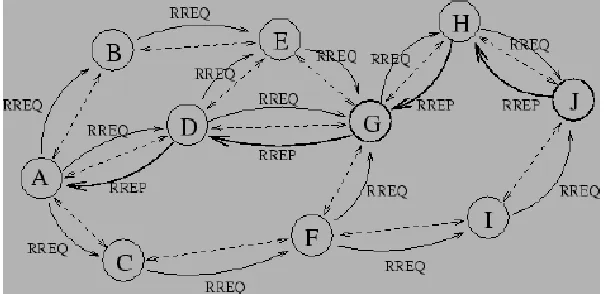
It is on demand protocol, when any node needs to send a message to sink then it broadcasts
request to all nearby nodes which is broadcasted further if no destination node is found. At the
destination acknowledgement message in form RREP is sent back following the same route from
which it gets route request from source and source selects the minimum hopes path to send the
message. A node receiving the RREQ may send a route reply (RREP) if it is either the
destination or if it has a route to the destination with corresponding sequence number greater
than or equal to that contained in the RREQ. If this is the case, it unicasts a RREP back to the
source. Otherwise, it rebroadcasts the RREQ. Nodes keep track of the RREQ's source IP address
and broadcast ID. If they receive a RREQ which they have already processed, they discard the
Jyoti Kaushik et al, International Journal of Computer Science and Mobile Applications, Vol.3 Issue. 11, November- 2015, pg. 11-24 ISSN: 2321-8363
©2015, IJCSMA All Rights Reserved, www.ijcsma.com 19
pointers to the destination. Once the source node receives the RREP, it may begin to forward
data packets to the destination. If the source later receives a RREP containing a greater sequence
number or contains the same sequence number with a smaller hopcount, it may update its routing
information for that destination and begin using the better route. As long as the route remains
active, it will continue to be maintained. If a link break occurs while the route is active, the node
upstream of the break propagates a route error (RERR) message to the source node to inform it
of the now unreachable destination(s). After receiving the RERR, if the source node still desires
the route, it can reinitiate route discovery.
5.5.2 Congestion detection algorithm
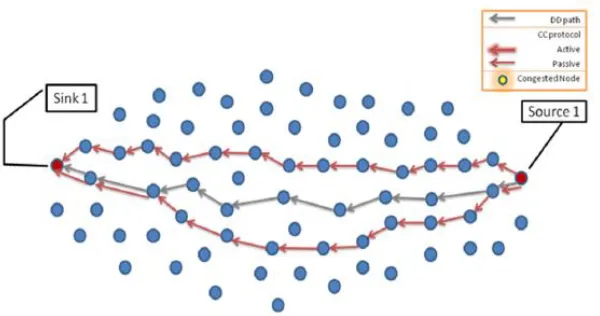
The congestion in path occurs only when a common path is shared by others. Figure 4.2 shows
the single active source path to sink without congestion. Since those path is not shared by others
so no congestion will occur until the data transmitted crosses the bandwidth limit of channel.
This can be case of „HELLO‟ message flood, a attack by intruders in the network.
Figure 4.2: Scenario with a single source - single sink showing paths formed by AODV
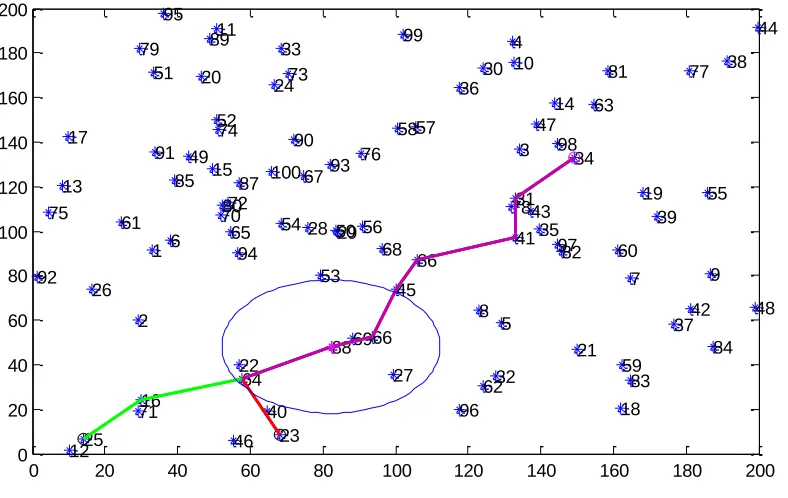
Figure 4.3 shows the path shared by two sources. At node number 34 sharing of paths started as
Jyoti Kaushik et al, International Journal of Computer Science and Mobile Applications, Vol.3 Issue. 11, November- 2015, pg. 11-24 ISSN: 2321-8363
©2015, IJCSMA All Rights Reserved, www.ijcsma.com 20
be altered so nodes have to transmit message within that limit. When message from source 1 is
transmitted to destination and after same time source 2 transmits then it senses the path is already
acquired by other and no space to transmit the new message to destination. It will wait for some
moment at node 34, if this waiting time is high then source node may consider the loss of packets
as no feedback from sink node is received within expected time and again new packet will be
lost if path is still engaged.
Figure 4.3: Common path for two sources to destination
So our algorithm will work on common node, in above case at node 34. Common node will keep
a track of bandwidth usage of channel, when it receives message from other source then it will
check for the space in the channel, if there is space to transmit the partial packets or all packets,
then it will transmit otherwise hold the message upto a specified time, that time is called waiting
time. The time of process is calculated by the following formula:
Tmin= TR + TC + 3TS + TA (4.2)
0 20 40 60 80 100 120 140 160 180 200
Jyoti Kaushik et al, International Journal of Computer Science and Mobile Applications, Vol.3 Issue. 11, November- 2015, pg. 11-24 ISSN: 2321-8363
©2015, IJCSMA All Rights Reserved, www.ijcsma.com 21 Where TR = Time consumed on RTS
TC = time consumed on CTS
TS = SIFS period
TA = time consumed on data acknowledgement
6. RESULTS & DISCUSSION
We have considered two sources selected randomly and one common destination to show
congestion in the path. Their two different paths are shown by green and red colored lines. We
have taken care of no congestion condition too. It‟s not mandatory that every time congestion
occurs in the path. The condition for congestion is either data sent by source should exceed the
channel bandwidth or waiting time should be more than threshold
7. CONCLUSION & FUTURE SCOPE
7.1 Conclusion
Initially in this thesis we prove that traffic bottlenecks is a major issue in WSNs and that queue
formation starts very early when bottlenecks appear in the network. Thus, in order to avoid
queue formation the data rate of the incoming flow must be severely reduced. In case that this
action is omitted, buffer fill-up is going to happen, while the time that passes until the nodes‟
buffers fill-up depends on the difference between incoming and outgoing flows. In order to solve
this issue congestion control algorithms needs to be applied. These algorithms can be based
either on traffic or resource control. According to the results of this paper, the traffic control
method is an effective method for transient congestion occurrences but can be proven
Jyoti Kaushik et al, International Journal of Computer Science and Mobile Applications, Vol.3 Issue. 11, November- 2015, pg. 11-24 ISSN: 2321-8363
©2015, IJCSMA All Rights Reserved, www.ijcsma.com 22
our proposed algorithms to the resource control method, a method that has not attracted a lot of
interest due to the overhead that it creates. In this paper we addressed all possible problems that
resource control methods may face and presented a novel algorithm.
7.2 Future Work
This research area is never ending area as due to sensor nodes battery constraint, researcher
always try to develop algorithm which may consumes very less energy during transmission and
reception as well as in detection mechanism executed on that. In our work we have not
considered the energy concept at nodes, but in actual the congestion detection is done at node
which takes energy of node in processing, decreasing the alive time of node. In future work,
energy can be considered as a constraint in the algorithm as it may happen as with our case, after
50n seconds congestion detection, energy residual are not enough to send an alarm to source
node about congestion in the path. That will increase the packet drop ratio.
REFERENCES
[1] S. Yin, and X. Lin, “MALB: MANET adaptive load balancing”, In Vehicular
Technology Conf. IEEE, Beijing, China, vol. 4, pp. 2843-2847, 2004.
[2] Heena Gupta, Deepak Goyal,”A Review On Congestion Control In Ad-Hoc
Network” International Journal of Computer Science and Mobile Computing, Vol.3
Issue.7, July- 2014.
[3] S. Floyd and K. Fall, “Promoting the use of end-to-end congestion control in the
internet” IEEE/ACM Transactions on Networking, 7(4), August 1999..
[4] BarkhaShakya,Deepak Kulhare,” Investigation of TCP Congestion Control with
Reliable Communication Technique in MANET”,International Journal of Computer
Jyoti Kaushik et al, International Journal of Computer Science and Mobile Applications, Vol.3 Issue. 11, November- 2015, pg. 11-24 ISSN: 2321-8363
©2015, IJCSMA All Rights Reserved, www.ijcsma.com 23
[5] S.Sheeja, RamachandraV.Pujeri,”Cross Layer based Congestion Control Scheme for
Mobile Ad hoc Networks” International Journal of Computer Applications, Volume
67– No.9, April 2013
[6] S.Sheeja, Dr.Ramachandra.V.Pujer,”Effective Congestion Avoidance Scheme for
Mobile Ad Hoc Networks” I. J. Computer Network and Information Security, 2013
[7] L. Xia, Z. Liu, Y. Chang, P. Sun, “An Improved AODV Routing Protocol Based on
the Congestion Control and Routing Repair Mechanism”, Int. Conf. Communications
and Mobile Computing, IEEE, China, 2009, vol. 2, pp. 259-262.
[8] AmandeepKaur, AashdeepSingh,”A Review on Ant Based Routing Protocols for Manet” International Journal of Advanced Research in Computer Science and
Software Engineering, Volume 5, Issue 3, March 2015
[9] H. M. El-Sayed, O. Bazan, U. Qureshi, M. Jaseemuddin” Performance Evaluation of
TCP in Mobile Ad hoc Networks”, Second International Conference on Innovation in
Information Technology (IIT‟05).
[10] V.Elamathi, D.Dhivya “To Avoid Congestion by Using Flooding Approach in
Wireless Ad Hoc Networks”, International Journal of Engineering Science and
Innovative Technology (IJESIT) Volume 2, Issue 2, March 2013.
[11] S. Floyd and K. Fall, “Promoting the use of end-to-end congestion control in the
internet” IEEE/ACM Transactions on Networking, 7(4), August 1999.
[12] NishuGarg, R.P.Mahapatra “MANET Security Issues “, IJCSNS International Journal
of Computer Science and Network Security, VOL.9 No.8, August 2009.
[13] Anup W. Burange, PRMIT &R,Badnera,Dr. Vijay T. Ingole “Minimization of
Jyoti Kaushik et al, International Journal of Computer Science and Mobile Applications, Vol.3 Issue. 11, November- 2015, pg. 11-24 ISSN: 2321-8363
©2015, IJCSMA All Rights Reserved, www.ijcsma.com 24
in Computer Science and Management Studies Research Paper Volume 1, Issue 7,
December 2013.
[14] NaziaZaman, KaziChandrimaRahman, Syed Faisal Hasan “ Explicit Rate-based
Congestion Control for Multimedia Streaming over Mobile Ad hoc Networks”,
International Journal of Electrical & Computer Sciences IJECS -IJENS Vol:10 No:
04.
[15] S.Karunakaran&P.Thangaraj, “A Cluster Based Congestion Control Protocol For
Mobile Ad hoc Networks”, International Journal of Information Technology and
Knowledge Management, July-December 2010, Volume 2, No. 2, pp. 471-474.
[16] “.GasimAlandjani and Eric E. Johnson, “Fuzzy Routing in Ad Hoc Networks” IEEE
2003
[17] S.Sheeja and Ramachandra.V.Pujeri, “Efficient Energy Based Congestion Control
Scheme for Mobile Ad Hoc Networks”, Journal of Theoretical and Applied