ISSN: 2306-9007 Asfahani (2017) 1246
I
www.irmbrjournal.com September 2017I
nternationalR
eview ofM
anagement andB
usinessR
esearchVol. 6 Issue.3
R
M
B
R
Impact of Conflict Management Style on Ethical
Decision-Making Process: Case Study of Saudi Arabia
AHMED M. ASFAHANI, Ph.D.
University of Business and Technology Email: [email protected]
Tel: +966920000490
Abstract
Managers in organizations experience many conflicting scenarios that negatively impact the process of decision-making. Assisting these managers to manage conflict with efficacy is crucial to enhance the decision-making process from an ethical perception. So, this aimed to examine the impact of conflict management style on ethical decision-making process using Saudi Arabia as a case study. the study was carried out in Saudi Arabia using a convenient sample of 236 participants. A questionnaire was distributed to the participants. After analyzing the feedbacks in SPSS in the areas of ANOVA, regression and Correlation the results showed that oblige was the main style of conflict used in Saudi Arabia. There was a positive correlation between ethnic identity and the conflict management style under the umbrella of ethical decision-making. The findings are crucial to the contribution of social change as it equips the leaders with information on how to manage conflict and improve decision-making.
Key Words: Conflict Management Styles, Ethical Decision-Making.
Introduction
Leaders in any organization are faced with the responsibility of upholding high ethical standards. This involves them linking the behaviors of ethics to the ability of concrete decision-making (Li & Madsen, 2011). In the process of upholding ethical conducts and making decision it is worth noting that conflicts may occur since in the workplace people with varied degree of character do exist. As such, several studies have been carried out in the area of managing conflict particularly interpersonal conflict arising in romance (Hubbard, 2001), intercultural (Zhang, Harwood, & Hummert, 2005), and in organizations (Stohl, 2001). Conflict occurs when an individual affects another individual or a group negatively. In terms of definition, various scholars have attempted to define conflict. Marquis and Huston (1996) referred to conflict as a discord that occurs between two or more people as a result of differentiated opinions, ideas, or values. Fisher (2000) used the notion of destruction to define conflict and viewed it as a social circumstance where incompatibilities in the pursuance of goals seem to occur between two or more people. Fisher also affiliated conflict with occurrence of antagonistic feelings towards one another.
ISSN: 2306-9007 Asfahani (2017) 1247
I
www.irmbrjournal.com September 2017I
nternationalR
eview ofM
anagement andB
usinessR
esearchVol. 6 Issue.3
R
M
B
R
Whenever conflict occurs among people in an organization it becomes important to seek the best resolution methods to deal with the difficult differences in an existing social system. In the wake of finding the best alternative, conflict management has emerged as a primary subfield determining organizational behavior. A previous research by Canary (2003) has showed that managing conflict effectively can improve relationship satisfaction and promote closeness. Nonetheless, effective leadership style and the choice followed in managing conflict are also crucial as they determine the outcomes of conflict management. The ability to embrace creativity in managing conflict is becoming a critical requirement for managers in Arab nations. Today, managers must develop culture and behavior that is capable of accommodating and managing conflict in a manner that benefits all the employees. The achievement of this has however been hindered by the dearth of empirical studies regarding conflict management styles in organizations. Therefore, in the pursuit of extending the available research on conflict management, the present study seeks to evaluate the impact of manager‟s conflict management style on ethical organization decision process using Saudi Arabia as the case study.
Conflict within organizations leads to increased unethical behaviour and most managers view unethical behaviour as a hindrance towards the prosperity of the organization as it impedes decision-making. The general problem in an organization turns out to be the effect imposed by unethical behaviour on the ability of managers to make sound decisions. On the other hand, a specific problem is that some managers never seem to have effective conflict management style that can be used to uphold ethics in the organization while promoting decision-making process.
The objective of this quantitative correlational study was to evaluate the impact of manager‟s conflict management style on the ethical organizational decision-making process. Saudi Arabia was used as the case study. The dependent variables for the study were ethical decision-making while the independent variable was conflict management style. The target population was both the managers and employees of various organizations in Saudi Arabia. The implications arising from the positive social change of the study is that it includes encouragement for future research on conflict management styles and ethical decision-making process. In addition, the research will enhance the understanding of the relationship between effective decision-making process and the conflict management styles.
In the line of this purpose, the study seeks to answer several questions particularly;
1. What is the main conflict management styles that Saudi Arabian managers use when making decisions?
2. Is there a correlation between ethical identity and conflict management style used in decision-making? 3. Can ethnic identity predict the conflict management styles that managers use?
Based on this question the study hypothesized that there is a statistically significant effect of conflict management style on the ethical decision-making process.
ISSN: 2306-9007 Asfahani (2017) 1248
I
www.irmbrjournal.com September 2017I
nternationalR
eview ofM
anagement andB
usinessR
esearchVol. 6 Issue.3
R
M
B
R
Prolonged focus on the human influence on managerial decisions and conflict management should not always appeal to managers although they are the ones who assist in foreseeing the major trends in the organization (Toubiana & Yair, 2012). The management theory applied to this study because it complements the independent variable of conflict management style as captured in Section 1 of the questionnaire. The theory also complements the dependent variables of ethics and decision making as captured in Section 2 of the questionnaire. Conflict management style and ethical decision-making process formed the primary foundation for an evaluation of the various factors that may elucidate the correlation between the two.
This research is important as it contributed its ability to add to the existing knowledge regarding conflict management in organizations with respect to the ability of the manager to make ethically sound decisions. The study could be significant to most managers in Arabian countries as it depicts a broad array of the crucial perspectives on having conflict management style in a workplace. Finally, the research adds up to the efficacy of the practices involved in making an ethical sound decision in the face of conflict. Leaders can address conflicts in a way that boosts the morale of the stakeholders and employees to make ethical valuable decisions that can enhance profitability and productivity (DiGrande et al., 2011).
Literature Review
Managing an organization effectively requires leaders who vary magnificently in influence and scale. In addition, the leaders should possess a vast knowledge of different cultures and most importantly, they should be professionals from a wide array of disciplines making up the paradigms of conflict (Bryant 2003). Culture and leadership under the umbrella of conflict management seem to augur well. Presence of personal and emotional tensions in an organization leading to the conflict is often, as a result, various differences which in one way or the other are components of the culture constituting the organization. The methodology in which the leaders adopt to solve crisis in times of problems, the decision-making process they follow and how they embrace disburse incentives to the employees are all relevant to the culture of the organization. Their perception of power tends to impact the strategies they put in place to solve conflicts while enhancing effective decision-making. As a result, it can be deduced that a manager/leader plays a crucial role in managing the conflict of an organization.
As a leader, the manager has a direct influence on the employees and other individuals in the organization and therefore he/she needs to have many qualities and be skilful enough to handle that various forms of conflicts. A leader who is facilitative has the capability of uniting the antagonistic groups and make them work unanimously towards a particular goal. He/she also encourages, supports, and settles amicably any misunderstanding and deals with any form of an unethical character (Fisher 2000). This is strengthened by the study of Sullivan et al. (2003) which revealed that new heads and experienced workers in the nursing arena majorly focused on conflict management under various cultures and personalities as a way of steering their developmental needs. This study, which targeted nurses in the positions of middle management, found out that the role of a nurse manager was so crucial to the success of the organization.
In the pursuit of determining the reasons for conflicts in the public sector and coming up with proper ways of solving conflicts, Al-Sedairy (1994) conducted a survey of 138 construction specialists in Saudi Arabia. His study identified that conflict is a common phenomenon that occurs between contractors and their clients, and between the contractors and their consultants. Perceptional differences and managerial styles were depicted as some of the reasons that contributed to conflicts. This study recommended compromise as a way of solving conflicts.
ISSN: 2306-9007 Asfahani (2017) 1249
I
www.irmbrjournal.com September 2017I
nternationalR
eview ofM
anagement andB
usinessR
esearchVol. 6 Issue.3
R
M
B
R
up with relationship conflicts arising from task conflicts. These findings compounded to a previous research conducted by Holahan et Mooney (2004). Similarly, Rees et al (2012) conducted a study in the mining industry, which found that various external factors outside the scope of a manager influence the style of conflict management.
Effective management of conflict as a leader requires more educational training as denoted by Russell and Scoble (2003). Among the respondents that Russell and Scoble used it was determined that there was a deficiency of knowledge and skills in the area of human resource management and particularly conflict management. Managers deal with conflicts every day. The conflict can appear as either internal or external and manifest in the various forms of altered behaviour, unnecessary authoritarianism, varied beliefs, failing to participate in the decision-making process, and a dearth of managerial support (Hendel, Fish, & Galon, 2005; Rees et al., 2012). In addition, multiculturalism may also influence smooth interactions leading to rise in a conflict which may end up affecting the working environment.
The present study assesses the impact of conflict management style on ethical decision-making with an aim of showing how culture plays a role through examining the relationship between ethnic identity and conflict management style
Conflict forms an integral part of the fabric that makes up a postmodern society that heightens to remain competitive and complex (Hendel, Fish, and Galon, 2005). Much conflict in an organization leads to decrease in the efficacy of the organization while one the hand, too little conflicts makes the organization stagnant. This implies that there is need for managers to embrace the best practices that can be used to manage conflict.
Conflict management refers to the various methods that a party or both the parties involved in a conflict can use to cope with conflict. In the instances of conflicts, Adler and Towne (1990) denoted that there are three courses of actions that can be pursued: 1) living with the problem; 2) embracing change through forcefulness; 3) holding mediations to reach an agreement. These courses can lead to three possible outcomes and in the form of approaches which involve Win-Lose, Lose-Lose, or Win-Win. The choice of conflict management styles is necessarily influenced by the cultural beliefs that an individual hold (McCan & Honeycutt, 2006).
In the pursuit of solving conflicts, the most significant element worth recognizing is being aware of the conflict management strategies and the effects they impose on the wellbeing of the entire organization. Additionally, it is important to be aware of every conflict context in order to come up with up with the appropriate solving strategy that can steer the organization towards identifying its goals. Dahshan and Keshk (2014) suggested that managers use several modes to respond to conflict; that is, competing, comprising, accommodating, collaborating, avoiding among others. In each of these methods, there are the parameters of assertiveness and cooperation that characterize the processes. None of the modes is wrong but there is a critical time that particularly fits every model.
ISSN: 2306-9007 Asfahani (2017) 1250
I
www.irmbrjournal.com September 2017I
nternationalR
eview ofM
anagement andB
usinessR
esearchVol. 6 Issue.3
R
M
B
R
Americans used domination, oblige and, comprising styles to manage conflict more often than the Arabs did. Also, another study by (Hutchings and Weir, 2006) revealed that networking in the Arabian countries was another method that was used to manage the situations of conflict. In the Arabian context, networking implies to connection and mediation.
Arguing in the same line, conflict management style has a significant influence on the decision-making style. In a study that examined various styles of decision-making used by managers in Kuwait, Ali, Taqi, and Krishnan (1997) identified that the managers exhibited much commitment on collectivism rather than individualism. These managers preferred the decision-making styles of consultation and participative to autocracy methods. This implied that autocratic and delegative approaches were never resorted to as effective styles that would lead to enhanced decision-making. For their supervisors, the managers reported that a pseudo consultative approach was used most often. In this approach, the managers highlighted that a decision was made using a collective method. The findings of Ali et al (1997) in a critical way depicted the values of dichotomy and actuality in deeds within the Arab society. It can hence be concluded that the Arabs prefer the conflict management styles that embrace cooperation and consultation.
Following the communism effect in Arabs and the fact that there is culture blend from the various ethnic background, other scholars saw the need to determine the relationship between Identity in the Arabian context and self-construal. In a study that was conducted by Barry et al (2000) involving the relationship between self-construal and ethnic identity among Arab students in the US, it was determined that there was a significant correlation between ethnic identity and the self-construal interdependence. The development of the research question used in the current study was based on the framework that Barry and colleagues used, that is, an individualism-collectivism framework with much focus on the conflict management styles and the self-construal.
Different ethnic identity aligned with different culture calls for the need for managers to apply logical and analytical skills in the decision-making process ethnicity and varied culture dictate the level of ethical behaviour in an organization (Manfredi, Pant, Pennington, & Versmann, 2011). Nevertheless, determining the broad emergence of ethnicity in decision-making in relation to management is a crucial topic that still requires more research particularly to become acquainted with situations when managers can indulge in unethical decision-making (De Cremer, Dick, Tenbrunsel, Pillutla, & Murnighan,2011). Already, this research could be providing one answer that the style used in managing conflict can dictate the prevalence of the manager indulging in unethical decision-making. It is therefore important for leaders to be accountable for their responsibilities in the same line of ethics as with the employees and they should never reduce their activities of ethnicity to employees (Malik, Naeem, & Ali, 2011).
Ethic should be applied to all circumstances irrespective of the status of an individual. As a matter of fact, Kossek et al (2011) recommend that leaders should evaluate the strengths and weaknesses that arise from the approaches of both ethical and unethical decision making as a result of the conflict. In a study conducted by Dyck (2014) involving 13 interviewers with outstanding business leaders in Sri Lanka, it was determined from 87% of the leaders agreed that the ethics pursued in the workplace influence the decision-making ability. All the leaders interviewed concurred unanimously that they used multiple leadership tools including conflict management styles to arrive to the concrete decision in the workplace. The level of ethics to uphold in the work place played a significant role in determining the efficacy of the leader in Sri Lanka to make sound decisions (Dyck, 2014).
ISSN: 2306-9007 Asfahani (2017) 1251
I
www.irmbrjournal.com September 2017I
nternationalR
eview ofM
anagement andB
usinessR
esearchVol. 6 Issue.3
R
M
B
R
communication tactics that can deliver the best principles for decision-making while the second step requires appropriate applications of the principles set for the process (Agbim et al., 2013).
Methodology
The objective of the present study was to evaluate the impact of manager‟s conflict management style on the ethical organizational decision-making process. Saudi Arabia was used as the case study. The research focused on explaining the relationship between variables to become acquainted with the phenomenon being discussed. Based on the variables of the study the study hypothesized that there is a statistically significant effect of conflict management style on the ethical decision-making process.
After discussing the literature review comprehensively, a research design that would lead to great methodological fit was chosen (Edmondson & McManus, 2007). The rationale for the research design used in the study facilitated the measurement of the research outcomes through a process. A number of researchers in the field of leadership have used quantitative studies to establish their hypothesis. Studies in leadership according to Jackson and Parry (2008) have for a long time been using quantitative methods to defend their hypothesis. The hypothesis for this study was prescribed according to the behaviours and styles affiliated with leadership and social identity and generally how they influence ethical decision-making. The gathering of data followed a questionnaire that captured the right data for testing the hypothesis. With the questionnaire, it would be easy to answer the „what‟ questions (such as the best leadership style to embrace to effectively solve conflict). Thus, the questionnaire could be considered for this typical leadership study (Bryman, 2011; Hunter et al, 2007). Therefore, the research followed the principles of the quantitative study.
Based on the target population for the study which was both the managers and the employees in Saudi Arabia multinational companies, a cluster sampling approach was applied. In the first sample, a nonprobability purposive sampling was used to locate the participants but based on cultural diversity. In Saudi, there are foreign workers mixed up with the commoners. The study selected the multinational employees as they represent situations that are likely to have large output data in the area of research (Denscombe, 2014). The second criteria that were used to get the sample involved convenience. It was important for the research to use the most available participants.
Moving to the determination of the sample size the study used 236 participants were chosen for the study. It was crucial to use this size of the sample in order to obtain statistical power in the inferences (Saunders et al.,2011). As Saunders and colleagues that large sample sizes lower the occurrences of error in generalizing the population for a particular reason (p.217). In the current study, there were 169 males and 67 females. These participants came from different ethnic backgrounds based on their countries of origin.
The recruitment of the respondents involved three methods. The white participants, Africans, and mixed were chosen based on their level of participation in the companies while the Asians and the Arabs were recruited through Arabs association in the various companies. All the participants completed a printed version of questionnaire.
Based on the discussed literature, a 3-part questionnaire was developed for data collection. The first part of the questionnaire comprised the conflict management in relation to a manager‟s ability to make decisions. And the other two parts focused on the ethnicity in relation to conflict management. The questionnaire also captured the demographic data of the participants in terms of gender, age, professional experience and region/country of origin.
ISSN: 2306-9007 Asfahani (2017) 1252
I
www.irmbrjournal.com September 2017I
nternationalR
eview ofM
anagement andB
usinessR
esearchVol. 6 Issue.3
R
M
B
R
aware that all the data would be treated with a high degree of confidentiality and only be accessible to the researchers alone. The purpose of the study was explained to the participants through a consent form which explained the full rights of the participants.
Following the purpose of the study which was to evaluate the manager‟s conflict management style on the ethical decision-making process in Saudi Arabia, the participants were provided with the printed questionnaires to answer. In section 1 the participants were required to think of how they manage conflict with their sex peers. A questionnaire was developed to measure the five styles of managing conflict that included; compromise, integration, avoidance, and oblige styles. Along with these were the addition of other items to facilitate the matching of the cross-cultural nature of the study while evaluating the three modes of accessing conflict management style namely help from third-party, negligence, and expression of emotion. The negligence was instead denoted as aggressive to give a better representation of nature regarding style. The participants responded to a Likert-type of a 5-point scale where 1=strongly disagree, 2=disagree, 3=neutral, 4=agree and 5=strongly agree. The reliability of every subscale in the perimeter of conflict management style in the culture group was computed with the alphas of Cronbach ranging between .72 and .91 as depicted in the table below.
Table 1: The Values of Cronbach alpha for Conflict Management Styles, Identity Scales and
Self-Construal.
Conflict Style and Identity Cronbach alpha Integration
Compromise Domination
Oblige Avoidance
Emotional Third-party Aggressive Ethnic identity Independent Self-Construal Interdependent self-Construal
.82 .74 .74 .79 .83 .80 .89 .81 .84 .72 .87
In the second section of the questionnaire, the participants answered questions related to self-construal. In this case, the participants responded using a Likert-type of 5-point scale with 1=strongly disagree and 5=strongly agree. The statements depicted in the questionnaire either supported interdependent self-construal or independent self-self-construal. The Cronbach‟s Alpha was also used for this case and depicted .87 for the interdependent self-construal and .77 for the independent self-construal.
For section 3 the participants provided a response for 6 items that quantified their ethnic identity in relation to conflict management. It was and open-ended questionnaire that focused on the ethnic label of the participants. The items in this section explored the ability of the individual to explore, and show commitment to the culture of an individual. The reliability of this used for this scale was confirmed to have a Cronbach‟s alpha of .85. All the survey questions used the English language with participants acknowledging the clarity of the items.
ISSN: 2306-9007 Asfahani (2017) 1253
I
www.irmbrjournal.com September 2017I
nternationalR
eview ofM
anagement andB
usinessR
esearchVol. 6 Issue.3
R
M
B
R
Results
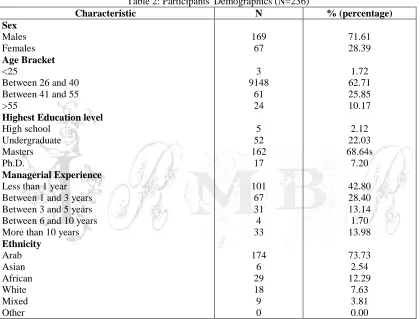
The table 2 below illustrates the respondents‟ characteristics in terms of demographics. Most of the participants were Arabs (73.73%) with a little of them categorized under mixed origins (3. 81%).The percentage of the males used in the study was 71.61% while that of females was 28.39% with most of the participants (62.71%) falling between the age of 26 and 40 years. In regards to education, about 2.12% of the participants were from high schools, 22.03% were undergraduates, 68.64% were masters and, 7.20% were PhD. In terms of profession, most of the participants (42.8%) had been in the company under study for less than 1 year with only 13.98% had stayed in the same company for over a decade.
Table 2: Participants' Demographics (N=236)
Characteristic N % (percentage)
Sex Males Females Age Bracket <25
Between 26 and 40 Between 41 and 55 >55
Highest Education level High school
Undergraduate Masters Ph.D.
Managerial Experience Less than 1 year
Between 1 and 3 years Between 3 and 5 years Between 6 and 10 years More than 10 years Ethnicity Arab Asian African White Mixed Other 169 67 3 9148 61 24 5 52 162 17 101 67 31 4 33 174 6 29 18 9 0 71.61 28.39 1.72 62.71 25.85 10.17 2.12 22.03 68.64s 7.20 42.80 28.40 13.14 1.70 13.98 73.73 2.54 12.29 7.63 3.81 0.00
RQ1: What is the main conflict management styles that Saudi Arabian managers use when making decisions?
ISSN: 2306-9007 Asfahani (2017) 1254
I
www.irmbrjournal.com September 2017I
nternationalR
eview ofM
anagement andB
usinessR
esearchVol. 6 Issue.3
R
M
B
R
Table 3: Descriptive Statistics
N Mean Std.
Deviation
Variance Skewness Kurtosis
Statistic Statistic Statistic Statistic Statistic Std. Error
Statistic Std. Error Accommodation 236 3.32 1.264 1.596 -.566 .158 -.813 .316 Aggressiveness 236 3.06 1.076 1.158 .141 .158 -.837 .316
Avoidance 236 2.82 1.096 1.202 .183 .158 -.574 .316
Compromise 236 3.40 .999 .999 -.644 .158 .023 .316
Dominance 236 3.19 1.099 1.208 -.027 .158 -1.103 .316
Emotional 236 3.11 1.021 1.043 -.223 .158 -.862 .316
Ethnicity 236 3.08 1.115 1.244 -.762 .158 -.790 .316
Integration 236 3.35 1.035 1.070 -.574 .158 -.111 .316
Oblige 236 3.55 1.073 1.151 .117 .158 -1.121 .316
Third Party 236 3.26 .830 .688 -.163 .158 -.709 .316
Valid N (listwise) 236
Third party (M = 3.26, SD = 0.830), dominance (M = 3.19, SD = 1.099), emotional (M = 3.11, SD = 1.021), and ethnicity (M = 3.08, SD = 1.115) ranked sixth, seventh, eight, and ninth respectively as conflict management styles that managers used in ethical decision making. Avoidance (M = 2.82, SD = 1.096) was the least conflict management style employed by managers in ethical decision making.
RQ2: Is there a correlation between ethical identity and conflict management style used in decision-making?
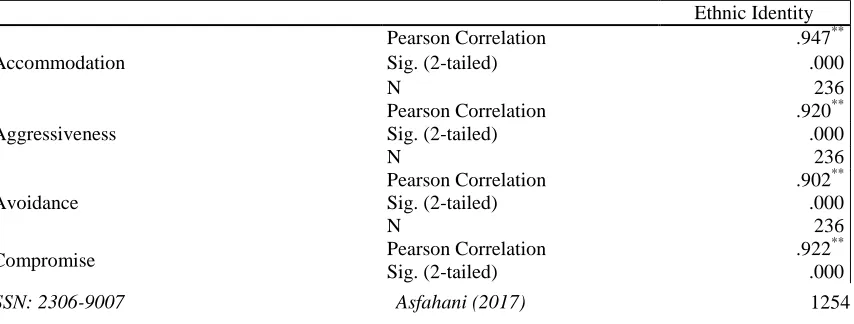
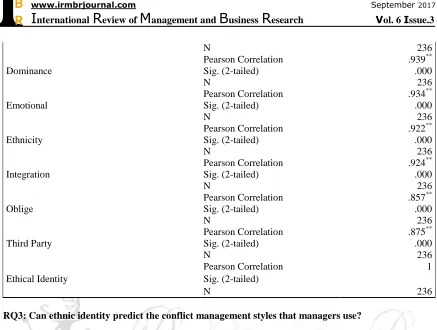
Correlation analyses was performed to indicate whether there was a significant relationship between ethical identity and conflict management style in the process of ethical decision making (Table 4). Accommodation conflict management style and ethnic identity had a very strong positive relationship (r = 0.947, p = 0.000). Aggressive conflict management style and ethnic identity also showed a very strong positive relationship (r = 0.920, p = 0.000). The relationship between avoidance and ethnic identity was not only positive but also very strong (r = 0.902, p = 0.000). Compromise and ethnic identity had a very strong positive relationship (r = 0.922, p = 0.000) while dominance and ethnic identity had statistically significant positive relationship (r = 0.939, p = 0.000). Emotional aspect of conflict management and ethnic identity altogether had a very strong positive relationship (r = 0.934, p = 0.000). In similar manner, ethnicity (r = 0.922, p = 0.000), integration (r = 0.924, p = 0.000), oblige (r = 0.857, p = 0.000), and third party (r = 0.875, p = 0.000) had a very strong positive relationship with ethnic identity that is statistically significant (p = 0.000).
Table 4: Correlation between ethnic identity and conflict management style
Ethnic Identity
Accommodation
Pearson Correlation .947**
Sig. (2-tailed) .000
N 236
Aggressiveness
Pearson Correlation .920**
Sig. (2-tailed) .000
N 236
Avoidance
Pearson Correlation .902**
Sig. (2-tailed) .000
N 236
Compromise Pearson Correlation .922
**
ISSN: 2306-9007 Asfahani (2017) 1255
I
www.irmbrjournal.com September 2017I
nternationalR
eview ofM
anagement andB
usinessR
esearchVol. 6 Issue.3
R
M
B
R
N 236
Dominance
Pearson Correlation .939**
Sig. (2-tailed) .000
N 236
Emotional
Pearson Correlation .934**
Sig. (2-tailed) .000
N 236
Ethnicity
Pearson Correlation .922**
Sig. (2-tailed) .000
N 236
Integration
Pearson Correlation .924**
Sig. (2-tailed) .000
N 236
Oblige
Pearson Correlation .857**
Sig. (2-tailed) .000
N 236
Third Party
Pearson Correlation .875**
Sig. (2-tailed) .000
N 236
Ethical Identity
Pearson Correlation 1
Sig. (2-tailed)
N 236
RQ3: Can ethnic identity predict the conflict management styles that managers use?
The Table 5 below illustrates the strength of the relationship and the extent of influence of ethnic identity on conflict management style. The regression analysis revealed that ethnic identity had a very strong relationship with conflict management style (R = 0.963). R-square (R2 = 0.963) showed that ethnic identity explained 92.7% of the variation in the conflict management style among managers in the ethical decision-making process.
Table 5: Model Summaryb
Model R R Square Adjusted R Square Std. Error of the
Estimate
1 .963a .927 .927 .27227
a. Predictors: (Constant), Ethnic Identity
b. Dependent Variable: Conflict Management Style
An ANOVA table (Table 6) indicated the regression model employed in predicting the influence of ethnic identity on conflict management style in the ethical decision-making process is statistically significant, F (1,234) = 2989.539, p = 0.000.
Table 6: ANOVAa (For predicting the influence of ethnic identity on conflict management style
Model Sum of Squares df Mean Square F Sig.
1
Regression 221.612 1 221.612 2989.539 .000b
Residual 17.346 234 .074
Total 238.958 235
ISSN: 2306-9007 Asfahani (2017) 1256
I
www.irmbrjournal.com September 2017I
nternationalR
eview ofM
anagement andB
usinessR
esearchVol. 6 Issue.3
R
M
B
R
Table of coefficients (Table 7) was used to depict that ethnic identity was a statistically significant predictor of conflict management style (t = 54.677p = 0.000). The regression equation showed that a unit increase in ethnic identity resulted in 0.842 increases in conflict management style when other extraneous variables remained constant.
Table 7: Coefficientsa
Model Unstandardized Coefficients Standardized Coefficients
t Sig.
B Std. Error Beta
1 (Constant) .409 .054 7.531 .000
Ethnic Identity .842 .015 .963 54.677 .000
a. Dependent Variable: Conflict Management Style
The Regression Equation is that:
Conflict management = 0.842 ethnic identity + 0.409
The regression model showed that conflict management styles, namely, third party, avoidance, ethnicity, oblige, dominance, compromise, emotional, accommodation, aggressiveness, and integration collectively explain 94% of the variation in ethical decision-making among managers (R2 = 0.940).
Table 8: Model Summaryb
Model R R Square Adjusted R Square Std. Error of the
Estimate
1 .970a .940 .937 .264
a. Predictors: (Constant), Third Party, Avoidance, Ethnicity, Oblige, Dominance, Compromise, Emotional, Accommodation, Aggressiveness, Integration
b. Dependent Variable: Ethical Decision-Making Process
The regression model was statistically significant in predicting the collective influence of the third party, avoidance, ethnicity, oblige, dominance, compromise, emotional, accommodation, aggressiveness, and integration on ethical decision-making, F (10,225) = 352.970, p = 0.000.
Table 9: ANOVAa
Model Sum of Squares Df Mean Square F Sig.
1
Regression 245.997 10 24.600 352.970 .000b
Residual 15.681 225 .070
Total 261.678 235
a. Dependent Variable: Ethical Decision-Making Process
b. Predictors: (Constant), Third Party, Avoidance, Ethnicity, Oblige, Dominance, Compromise, Emotional, Accommodation, Aggressiveness, Integration
ISSN: 2306-9007 Asfahani (2017) 1257
I
www.irmbrjournal.com September 2017I
nternationalR
eview ofM
anagement andB
usinessR
esearchVol. 6 Issue.3
R
M
B
R
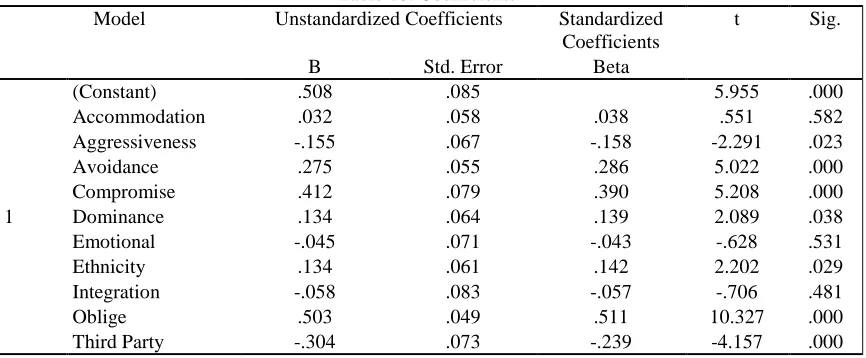
Table 10: Coefficientsa
Model Unstandardized Coefficients Standardized Coefficients
t Sig.
B Std. Error Beta
1
(Constant) .508 .085 5.955 .000
Accommodation .032 .058 .038 .551 .582
Aggressiveness -.155 .067 -.158 -2.291 .023
Avoidance .275 .055 .286 5.022 .000
Compromise .412 .079 .390 5.208 .000
Dominance .134 .064 .139 2.089 .038
Emotional -.045 .071 -.043 -.628 .531
Ethnicity .134 .061 .142 2.202 .029
Integration -.058 .083 -.057 -.706 .481
Oblige .503 .049 .511 10.327 .000
Third Party -.304 .073 -.239 -4.157 .000
a. Dependent Variable: Ethical Decision-Making Process
The regression equation is that:
Ethical decision making = 0.032 accommodation – 0.155 aggressiveness + 0.275 avoidance + 0.412 compromise + 0.134 dominance – 0.045 emotional + 0.134 ethnicity – 0.058 integration + 0.503 oblige - 0.304 third party + 0.508. Correlation showed that ethical decision-making has a very strong positive relationship with conflict management style, which is statistically significant (r = 0.948, p = 0.000).
Table 11: Correlations
Ethical Decision-Making Process
Conflict Management Style
Pearson Correlation
Ethical Decision-Making
Process 1.000 .948
Conflict Management Style .948 1.000
Sig. (1-tailed)
Ethical Decision-Making
Process . .000
Conflict Management Style .000 .
N
Ethical Decision-Making
Process 236 236
Conflict Management Style 236 236
The regression analysis indicated that conflict management style has a strong positive relationship with ethical decision-making (R = 0.948). Moreover, R-square shows that conflict management style accounts for 89.9% of the variation in ethical decision-making (R2 = 0.898).
Table 12: Model Summaryb
Model R R Square Adjusted R Square Std. Error of the
Estimate
1 .948a .899 .898 .337
ISSN: 2306-9007 Asfahani (2017) 1258
I
www.irmbrjournal.com September 2017I
nternationalR
eview ofM
anagement andB
usinessR
esearchVol. 6 Issue.3
R
M
B
R
The regression model for predicting the influence of conflict management style on ethical decision-making was statistically significant, F (1,234) = 2072.220, p = 0.000. This meant that the regression model was statistically relevant in predicting the relationship between conflict management style and ethical decision-making.
Table 13: ANOVAa
Model Sum of Squares df Mean Square F Sig.
1
Regression 235.127 1 235.127 2072.220 .000b
Residual 26.551 234 .113
Total 261.678 235
a. Dependent Variable: Ethical Decision-Making Process b. Predictors: (Constant), Conflict Management Style
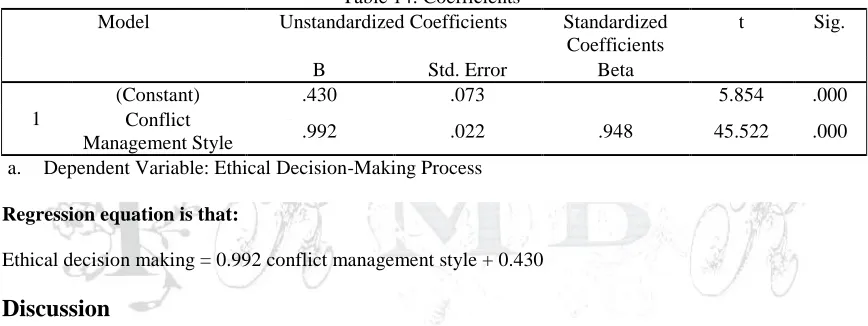
The coefficients‟ table below showed that conflict management style was a statistically significant predictor of ethical decision-making among managers, t = 45.522, p = 0.000. The coefficients showed that a unit increase in the conflict management style resulted in 0.992 increases in ethical decision-making.
Table 14: Coefficientsa
Model Unstandardized Coefficients Standardized Coefficients
t Sig.
B Std. Error Beta
1
(Constant) .430 .073 5.854 .000
Conflict
Management Style .992 .022 .948 45.522 .000
a. Dependent Variable: Ethical Decision-Making Process
Regression equation is that:
Ethical decision making = 0.992 conflict management style + 0.430
Discussion
From the results, the purpose of the study manifests in two folds that involve examining the conflict management styles among the managers in Saudi Arabia and exploring the impact of conflict management style on ethical decision-making. The unmanaged conflict has chronic negative effects on organizational performance. The ability to manage conflict using the conflict management styles is still a challenge in the daily decision-making process and is influenced by both the environment and the individual.
The results of this study showed that managers tend to use oblige form of conflict management style which is win-lose approach although there were other modes almost in the same line with it such as compromising, integration, and third party. These results were in the same line with the findings of Moisoglou et al., (2014). These researchers ranked conflict management styles beginning with oblige, accommodation, all the way down to competition. However, these findings contradicted those of Bankovskaya (2012) who revealed collaboration as the most popular strategy used but concurred with her studies that avoidance is the least used style.
ISSN: 2306-9007 Asfahani (2017) 1259
I
www.irmbrjournal.com September 2017I
nternationalR
eview ofM
anagement andB
usinessR
esearchVol. 6 Issue.3
R
M
B
R
to realize a particular goal. Nevertheless, every practice should remain true to the ethical standards of the organization since lack of proper management as Johansen (2012) describes can always lead to conflict and insubordination of employees.
Ethnic identity was another aspect considered in the study and how it impacts ethical decision-making through conflict. To a significant level of over 92%, it was showed that ethnic identity impacted conflict management style which in the overall influenced the ability to indulge in ethical decision-making. Different ethnic groups perceive different interpretations regarding the attitude of the other person and cultural behaviour leading to the easy eruption of conflict in case of misunderstanding. The positive correlation found out in this study agreed with the findings of Wang (2015) found out that there is importance in considering the ethnic identity of an individual to manage conflict.
Conclusions and Recommendations
The first limitation of the study was the domination of male participants. Women in the Arabian countries have limited liberty to research and even if they were included, it was still hard to have a representative sample.
Secondly, conclusions were derived from the responses that the participants gave rather than studying their actual behaviours. Individual opinions could be a way of providing information regarding conflict management styles but there is no guarantee that such opinions match behaviour. It is therefore important to study communication patterns in groups particularly in Saudi Arabia where language seems to live independently and people barely use it as a way of expressing true feelings and observations.
Based on the findings it can be concluded that the study forms a crucial exploratory step towards understanding the various conflict management styles and how they impact ethical decision-making process among Saudi Arabians. The current study extends the findings of a previous research that managing conflicts effectively can lead to good relations in the workplace and enhance ethical decision-making. However, it adds to the notion of ethnic identity and how it relates to conflict management styles under the umbrella of decision-making. The study also calls for more research regarding how communication is executed in Arabian countries as there is a negative stereotyping towards Arabs. Hopefully enough, the study has provided some baseline foundation for the continued research in conflict management styles and how they influence decision-making from the perception of ethics in Saudi Arabia. In the context of the research‟s findings, it is worth recommending the need for designing and enforcing and educational program that can teach managers different conflict management styles and how they can be well managed to come up with an ethical decision. Along with this is the need to note that there is a need for Arabian researchers to include more women in their studies to balance the views of both gender in findings.
The future research should address the need for including women in studies as perfect representative samples by following the examples from Jordan, and Morocco. Also, future studies should focus on the ways of including conflict management styles in the current Arabian education system so that upcoming managers can get nourished with the skills in the right time.
References
Adler R.B. & Towne N. (1990) Looking Out Looking In, Interpersonal Communication. Holt, Rinehart & Winston, Forth Worth.
ISSN: 2306-9007 Asfahani (2017) 1260
I
www.irmbrjournal.com September 2017I
nternationalR
eview ofM
anagement andB
usinessR
esearchVol. 6 Issue.3
R
M
B
R
Ali, A. J., Taqi, A. A., & Krishnan, K. (1997). Individualism, collectivism, and decision styles of managers in Kuwait. The Journal of Social Psychology, 137(5), 629-637.
Al-Sedairy, S. T. (1994). Management of conflict: Public-sector construction in Saudi Arabia. International
Journal of Project Management, 12(3), 143-151.
Bankovskaya, V. (2012). Development of conflict management strategies to increase the organizational effectiveness in Nordic companies.
Barakat, H. (1993). The Arab world: Society, culture, and state. Univ of California Press.
Barry, D., Elliott, R., & Evans, E. M. (2000). Foreigners in a strange land: Self-construal and ethnic identity in male Arabic immigrants. Journal of Immigrant Health, 2, 133-143.
Bryant, J. (2003). The six dilemmas of collaboration. Willey, Chichester Google Scholar.
Bryman, A. (2011). Mission accomplished? Research methods in the first five years of Leadership.
Leadership, 7(1), 73-83.
Canary, D. J. (2003). Managing interpersonal conflict: A model of events related to strategic choices. In J. O. Greene & B. R. Burleson (Eds.), Handbook of communication and social interaction skills (pp. 515-549). Mahwah, NJ: Lawrence Erlbaum Associates.
Curşeu, P. L., Boroş, S., & Oerlemans, L. A. (2012). Task and relationship conflict in short-term and long-term groups: The critical role of emotion regulation. International Journal of Conflict Management,
23(1), 97-107.
Curtis, E., & O‟Connell, R. (2011). Essential leadership skills for motivating and developing staff: An empowered team is enthusiastic about its work and will deliver high-quality care. The key, argue Elizabeth Curtis and Rhona O‟Connell, is transformational leadership. Nursing Management, 18, 32-35. doi:10.7748/nm2011.09.18.5.32.c8672
De Cremer, D. D., Dick, R. V., Tenbrunsel, A., Pillutla, M., & Murnighan, J. K. (2011). Understanding ethical behaviour and decision-making in management: A behavioural business ethics approach.
British Journal of Management, 22, S1-S4. doi:10.1111/j.1467 8551.2010.00733.x
Denscombe, M. (2014). The good research guide: for small-scale social research projects. McGraw-Hill Education (UK).
DiGrande, L., Neria, Y., Brackbill, R. M., Pulliam, P., & Galea, S. (2011). Long-term posttraumatic stress symptoms among 3,271 civilian survivors of September 11, 2001, terrorist attacks on the World Trade Center. American Journal of Epidemiology, 173, 271-281. doi:10.1093/aje/kwq372
Drucker, P. F. (1960). The practice of management. New York, NY: Harper.
Dyck, B. (2014). God on management: The world‟s largest religions, the “theological turn,” and organization and management theory and practice. In Religion and organization theory (pp. 23-62). Emerald Group Publishing Limited.
Ebesu Hubbard, A. (2001). The conflict between relationally uncertain romantic partners: The influence of relational responsiveness and empathy. Communication Monographs, 68(4), 400-414.
Edmondson, A. C., & McManus, S. E. (2007). Methodological fit in management field research. Academy
of management review, 32(4), 1246-1264.
El Dahshan, M. E. A., & Keshk, L. I. (2014). Managers‟ conflict management styles and its effect on staff nurses‟ turnover intention at Shebin El Kom Hospitals, Menoufiya Governorate. World Journal of Medical Sciences, 11(1), 132-143.
Elsayed-Ekhouly, S. M., & Buda, R. (1996). Organizational conflict: A comparative analysis of conflict management styles across cultures. The International Journal of Conflict Management, 7, 71-81. Fisher, R. (2000). Sources of conflict and methods of conflict resolution. International Peace and Conflict
Resolution, School of International Service, The American University.
George, A. M. (2003). Teaching culture: The challenges and opportunities of international public relations.
Business Communication Quarterly, 66(2), 97-111.
Hendel, T., Fish, M., & Galon, V. (2005). Leadership style and choice of strategy in conflict management among Israeli nurse managers in general hospitals. Journal of nursing management, 13(2), 137-146. Holahan, P., & Mooney, A. (2004). Conflict in project teams: Gaining the benefits, avoiding the costs.
ISSN: 2306-9007 Asfahani (2017) 1261
I
www.irmbrjournal.com September 2017I
nternationalR
eview ofM
anagement andB
usinessR
esearchVol. 6 Issue.3
R
M
B
R
Hunter, S. T., Bedell-Avers, K. E., & Mumford, M. D. (2007). The typical leadership study: Assumptions, implications, and potential remedies. The Leadership Quarterly, 18(5), 435-446.
Hutchings, K., & Weir, D. (2006). Understanding networking in China and the Arab World: Lessons for international managers. Journal of European Industrial Training, 30, 272 290.
Ioannis Moisoglou, R. N., Prezerakos Panagiotis, R. N., Peter Galanis, R. N., & Olga Siskou, R. N. (2014). Conflict Management in a Greek Public Hospital: Collaboration or Avoidance? International Journal of Caring Sciences, 7(1), 75.
Jackson, B., & Parry, K. (2011). A very short fairly interesting and reasonably cheap book about studying leadership. Sage.
Johansen, M. L. (2012). Keeping the peace: Conflict management strategies for nurse managers. Nursing Management, 43(2), 50-54.
Kossek, E. E., Pichler, S., Bodner, T., & Hammer, L. B. (2011). Workplace social support and work family conflict: A meta-analysis clarifying the influence of general and work family specific supervisor and organizational support. Personal Psychology, 64, 289-313. doi:10.1111/1.744-6570.2011.01211.x Li, J., & Madsen, J. (2011). Business ethics and workplace guanxi in Chinese SOEs: A qualitative study.
Journal of Chinese Human Resource Management, 2, 83-99. doi:10.1108/20408001111179140
Malik, M. E., Naeem, B., & Ali, B. B. (2011). How do workplace spirituality and organizational citizenship behavior influence sales performance of FMCG sales force. Interdisciplinary Journal of Contemporary
Research in Business, 3, 610-620. Retrieved from http://www.ijcrb.com/
Manfredi, S., Pant, R., Pennington, D. W., & Versmann, A. (2011). Supporting environmentally sound decisions for waste management with LCT and LCA. International Journal of Life Cycle Assessment, 16, 937-939. doi:10.1007/s11367-011-0315-5
Marquis B.K. & Huston C.J. (2009) Leadership Roles and Managers Function in Nursing, 2nd edn. Lippincott, Philadelphia, PA.
McCann, R. M, & Honeycutt, J. M. (2006). A cross-cultural analysis of imagined interactions. Human
Communication Research, 32, 274-301.
Rees, C., Harvard Kennedy School, Corporate Social Responsibility Initiative, Kemp, D., & Davis, R. (2012). Conflict management and corporate culture in the extractive industries: a study in Peru. Harvard Kennedy School.
Russell G. & Scoble K. (2003) Educational preparation for the future nurse manager. Journal of Nursing Administration 33 (7/8), 404–409.
Saunders, K. L., Adams, A. N., Bryant, L. A., Zilberman, L., & Atkeson, L. R. (2011). Considering mixed mode surveys for questions in political behavior: Using the Internet and mail to get quality data at reasonable costs. Journal of Political Behavior, 33, 161-178. doi:10.1007/s11109-010-9121-1
Stohl, C. (2001). Globalizing organizational communication. In Jablin, F. V., & Putnam, L. L. (Eds.), The
new handbook of organizational communication: Advances in theory, research, and methods. (pp.
323-378). Thousand Oaks: Sage.
Sullivan J., Bretschneider J. & McCausland M.P. (2003) Designing a leadership development program for nurse managers. Journal of Nursing Administration 33 (10), 544–549.
Toubiana, M., & Yair, G. (2012). The solution of meaning in Peter Drucker‟s oeuvre.
Journal of Management History, 18, 178-199. doi:10.1108/1751134121120684
Wang, Y. (2015). Interpersonal conflict between employees and managers: The Chinese immigrants‟ experiences of acculturation in New Zealand public sector workplaces.