International Journal of Scientific Research and Engineering Development-– Volume 2 Issue 6, Nov- Dec 2019 Available at www.ijsred.com
ISSN : 2581-7175 ©IJSRED: All Rights are Reserved Page 124
An Overview To Cloud Computing
Shivam Kashyap
1,
Nitish Kaushik
1, Dr. Deepak Chahal
21
MCA Student, Department of IT, Jagan Institute of Management Studies, Sector -05, Rohini, New Delhi. India
2
Professor , Department of IT, Jagan Institute of Management Studies, Sector -05, Rohini, New Delhi. India
Abstract: This study reveals the feasibility and study of Cloud computing and its concepts .It tells how cloud is computed and used in today’s era with rise of new technologies and day by day changing the generation .
It also specifies how cloud can help society to solve the problems like creating a virtual system without hardware need , memory providence , client server network , cost saving etc.various cloud models are discussed & there are various opportunities can be available by cloud computing .
Keywords : Infrastructure ,reliability ,computerize, pooling , scalability , cloud , protocol ,hybrid , community ,mobilization . Introduction
The term “cloud “is used as a metaphor for the internet which describe how a network or rempte servers can be accessed via the internet
to store and manage information .The process
of building applications has been a journey and it varies depending on one's application requirements and purpose [1]
Cloud computing is a term for characterizing the facilitating administration over the internet . It is basically an on demand delivery of computer power , database ,storage , applications and the other IT resources accessed by the internet . It is a paid service as well as a free service.
There are so many reasons that organizations are turning to cloud services these days- first it is a cost effective method in which you can eliminate capital expenses of buying hardware and software, data centers set-up and run [2].
Cloud computing implies the secured way of data accessing , records as well as tasks over the web instead of any hardware and system .
It computerizes the data at whatever time , any place utilizing any service to the internet . It provides the opportunity of doing things
with more abilities , power and
straightforwardness. Cloud computing has become a popular model for reducing cost of business, improvise quality of services, and provide good & secure computing [3].
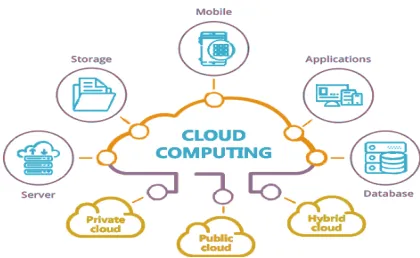
Fig 1: Working of cloud computing
In a cloud computing system, there is a significant workload shift . Local computers have no longer to do all the heavy lifting when it comes to run applications . Cloud computing provides access to to servers, storage, databases, and a broad set of application services over the Internet . Various cloud service providers owns and maintains the network connected hardware which is required for the application services , while a user and use what it needs to require vai the web application . It works on network layer protocol to connect different devices to provide access to resources that are residing in the centralized data center of the cloud.
ISSN : 2581-7175
Features of Cloud Computing
1. On Demand self – service :
cloud computing , a client can provise the computer resources without any interaction with cloud service provider .
2. Cloud Computing also provide
broad network access to the cloud over the network which are using standard methods that provides platform independent access to clients . It is most commonly found in devices like mobile phones , laptops which conclude mixture of heterogeneous OS.
3. Resource Pooling :- resources are
created by cloud service provider which can be pooled together in a multi-tenage user system . As per requirement , physical and virtual systems are dynamically allocated .Pooling specifies the concept of hiding the resource location like virtual machine , memory , network ,bandwidth .
4. Rapid Elasticity :-As per user
requirement , rapid elasticity can be increased by scaling up and out the systems .
5. Measured Service :- Cloud services
are provided to the user in accordance to the use on the basis of time .Charges are applied to user as per usage of the amou storage used , network used
Cloud service delivery models
The cloud service delivery models can be categorized into 3 broad categories :
www.ijsred.com
©IJSRED: All Rights are Reserved
Features of Cloud Computing
service :- In cloud computing , a client can provise the computer resources with cloud
Cloud Computing also provide broad network access to the cloud over the network which are using hods that provides platform independent access to clients . It is most commonly found in devices like mobile phones , laptops which conclude mixture of
resources are created by cloud service provider d together in a tenage user system . As per requirement , physical and virtual systems are dynamically allocated .Pooling specifies the concept of hiding the resource location like virtual machine , memory ,
s per user requirement , rapid elasticity can be increased by scaling up and out
Cloud services are provided to the user in accordance to the use on the basis of time .Charges are applied to user as per usage of the amount of storage used , network used
models
dels can be categorized into 3 broad categories :
Fig 2: Cloud Service Models
Software as a Service (SaaS)
Software as aService (SaaS) is a model for allocation of software where a user can access data over the internet . In this model , the software provider host and retain the servers , databases and code that comprise an application .
Characteristics of SaaS
User is not required to have knowledg back end infrastructure .
Scalable services or resources over the web and well defined API.
Saas provider manage the complete application stack .
Pros & cons of SaaS
Pros :- 1. The client can also access services without installing the software on th
2. SaaS provider look after identifying and fixing the bug .
3. With the help of centralized cloud , software updates are made simpler.
Cons :- 1. Malware attacks can affect the use of SaaS service in a web browser .
2. Proper security mechanism might be require the involvement of third party.
Platform as a Service (PaaS)
Platform as a Service (PaaS) is a type of cloud computing service delivery
provides platform & a solution stack as a
service which include resources like
www.ijsred.com
Page 125
Service Models
Software as a Service (SaaS)
Software as aService (SaaS) is a model for the allocation of software where a user can access data over the internet . In this model , the software provider host and retain the servers , databases and code that comprise an
User is not required to have knowledge of
Scalable services or resources over the
Saas provider manage the complete
1. The client can also access services without installing the software on their device .
2. SaaS provider look after identifying and
3. With the help of centralized cloud , software
1. Malware attacks can affect the use of SaaS service in a web browser .
mechanism might be require
Platform as a Service (PaaS)
Platform as a Service (PaaS) is a type of cloud model that a solution stack as a
International Journal of Scientific Research and Engineering Development-– Volume 2 Issue 6, Nov- Dec 2019 Available at www.ijsred.com
ISSN : 2581-7175 ©IJSRED: All Rights are Reserved Page 126
programming language , operating system , compiler , run time environment ,servers like database server , web server . It is more portable for application developers . The user can subscribe for the required platform , configure and setup the platform depending upon the time required .
Characterstics of PaaS
It provides in-built scalability , web service interface and security to connect other applications outside the PaaS. It provides common packages/ services for network , payment integration & databases .
It uses multi tenant model for multiple concurrent users with appropriate security .
Pros and Cons of PaaS
Pros :1. Facilitates working with multiple
platforms .
2. The users are authorised to develop and upgrade of complete application
3. PaaS automatically takes care of the application’s dynamic resource requirement .
Cons : 1. A secure aware applications must be
taken as a necessary measures like as secure connection & encryption while acquiring PaaS.
2. Customization of underlying hardware and software may be required .
3. Migration from the PaaS vendors’ application to another PaaS vendor will create some problem .
Infrastructure as a Service (IaaS)
Infrastructure as a Service(IaaS) are self service models used for accessing ,monitoring and managing the remote based data centres like storage , computing ,networking services .Best example is Firewall . User can purchase IaaS based on consumption which can’t save time from purchasing or installing hardware .
Infrastructure as a Service comes in all different shapes , sizes and colors . there are 8 types of IaaS providers :
1. Computing
2. Enterprise IT
3. Test/Development
4. Cloud Storage
5. Resource Sharing
6. Telecom
7. Wholesale vending
8. High performance computing
Characteristics of IaaS
> Advance reservations can be made for
resources for a certain duration of time .
> To cater the need of scalability and
provisioned dynamically , elasticity is implemented .
> In order to enhance the avaibility and
responsiveness , data centers are
geographically distributed around the globe .
Pros & Cons of IaaS
Pros :1. No need to purchase suitable
dedicated servers .
2. The software launched on IaaS can be upgraded by the users .
3. The IaaS can be utilized by the developers to test and develop their applications on multiple environments .
Cons: 1. The software can be run in the service provider’s infrastructure and therefore , all of the vulnerabilities of such legacy software can be exposed to other users .
2. The virtual machines may become out of date with respect to the security updates.
Cloud Development Models
Private Cloud
www.ijsred.com
ISSN : 2581-7175 ©IJSRED: All Rights are Reserved Page 127
to host the virtual machines or a particular application within the company’s own network .It has an ability to recover from failures ,errors .It also allows scale up or demand to allow with the request generated by users .
Private cloud are most commonly used by the enterprise for business critical system & to protect data & intellectual property .
Public Cloud
Public cloud is basically describes the business models in the traditional mainstream sense ,
where the resources or services are
dynamically provisioned on a self service basis on internet basis from third party provider . user can can purchase these cloud from third party provider for storage or bandwidth and CPU cycles consumption .
It is beneficial for reducing the need in various organizations to invest and maintain the IT resources . All the resources are fully utilized as customer gets only those resources as per requirement
Community Cloud
A Community is an offering which is provided to the particular community . .It is also known as hosted cloud .This cloud is still a public cloud but the features and offerings are being tailored to a particular community .
When more than one public cloud grouped together , then can form a community of cloud which can be used to various business partners or list of companies .
Hybrid Cloud
Hybrid cloud is a combination of elements ,i.e., implementation of various forms of cloud computing .
Hybrid cloud provides an environment where an organisation serves or manages the resources or services internally and the rest is created externally . They are mostly used is large scale organisations which provide resources for internal solutions .
Applications of Cloud Computing
The fundamental requirements and constraints for developing a software product remain the same [4].
1. Cloud Computing are broadly used in IT industries or in business industries for solving technical and business related problems by providing data centres, accessing the software and Hardware services by saving money and space and making their own data centres .
2. Cloud computing is also used in
Banking industries , since they need a cloud for storing the bank details of people. But , they are providing least amount of security . They also use cloud to set up a network for communication and system .
3. Medical field now a days uses cloud computing for assisting in procuring patient’s details by doctors to access data remotely , which can lead to
update doctors about patient’s
condition whether they are present or not .
4. Cloud computing are also used in the
area of Education fields by providing
conventional and interactive
classrooms (smart classes) and also providing remote access of learning and realistic material , that is E-learning .
Future Scope of Cloud computing
International Journal of Scientific Research and Engineering Development-– Volume 2 Issue 6, Nov- Dec 2019 Available at www.ijsred.com
ISSN : 2581-7175 ©IJSRED: All Rights are Reserved Page 128
Conclusion
So , the study concludes that the main focus of implementing the cloud is having a backup . It is simple for anyone to approach personal devices and make changes to files . It also helps reduce data delay or redundancy and also makes easier to manage data . It also makes capability of using less resources and easier to access file .
References
1. Kharb, L. (2018, January). A Perspective View on Commercialization of Cognitive
Computing. In 2018 8th International
Conference on Cloud Computing, Data Science & Engineering (Confluence) (pp. 829-832). IEEE.
2. Chahal D. et al. Data security in Cloud Computing, International Journal of Engineering Science Invention, Volume 6 Issue 12, December 2017 (PP. 31-36).
3. Kharb l. et al. A Comprehensive Study of Security in Cloud Computing, International Journal of Engineering & Technology, 7 (4) (2018), doi: 10.14419/ijet. v7i4.20742
4. Kharb, L. (2015). IBM blue mix: Future development with open cloud architecture.
JIMS8I-International Journal of
Information Communication and
Computing Technology, 3(2), 165-168.