World Maritime University
The Maritime Commons: Digital Repository of the World
Maritime University
World Maritime University Dissertations Dissertations
2001
Valuation of port assets : impact on the financial
performance of port and the national economy
Martison AnkobiahWorld Maritime University
Follow this and additional works at:http://commons.wmu.se/all_dissertations
Part of theEconomics Commons
This Dissertation is brought to you courtesy of Maritime Commons. Open Access items may be downloaded for non-commercial, fair use academic purposes. No items may be hosted on another server or web site without express written permission from the World Maritime University. For more
Recommended Citation
Ankobiah, Martison, "Valuation of port assets : impact on the financial performance of port and the national economy" (2001).World Maritime University Dissertations. 71.
WORLD MARITIME UNIVERSITY
Malmo, SwedenVALUATION OF PORT ASSETS: IMPACT ON THE
FINANCIAL PERFORMANCE OF A PORT AND
THE NATIONAL ECONOMY
By
MARTISON ANKOBIAH
Republic of Ghana
A dissertation submitted to the World Maritime University in partial fulfilment of the requirements for the award of the degree of
MASTER OF SCIENCE
in
MARITIME AFFAIRS (Port Management)
2001
DEDICATION
To my wonderful wife,
Margie
our daughter Sharon
and the boys,
Kofi
Tabi
Adwinsa
Adutwum
Osei-Bonsu.
DECLARATION
I certify that all the material in this dissertation that is not my own work has been identified and that no material is included for which a degree has previously been conferred on me.
The contents of this dissertation reflect my own personal views, and are not necessarily endorsed by the University.
(Signature) ………..
(Date) ………
Supervised by: Professor Bernard Francou
World Maritime University
Assessor: Professor Patrick Donner
World Maritime University
Co-assessor: Professor Michael C. Ircha
ACKNOWLEDGEMENTS
To God be the glory! Great things He has done! Praise the Lord! Let the people rejoice!
The name of God the father, His son Jesus Christ and the Holy Spirit be blessed for ever!
Thanks and praise be to the living God for His love, grace and mercy towards us.
I am grateful to the Director-General, Headquarters, Tema and the Director of Port,
Takoradi both of the Ghana Ports and Harbours Authority (GPHA) for nominating me for
the 17-month post graduate programme, masters in Maritime Affairs at the World
Maritime University (WMU), Malmo, Sweden.
My gratitude goes to the IMO-Norway Technical Co-operation Programme Fellowships
for providing funding for the course.
To my course professors, Shuo Ma, Patrick Donner, Bernard Francou and Tor Wergeland
and other lecturers at WMU and visiting professors, I say thank you for adding more to
my accumulated knowledge.
I appreciate the efforts of Mr. David Moulder, Susan and Cecilia for providing links to
various items in the WMU library and also Mr. Browne, Sue, Lyndell, Denise and other
administrative and academic staff for helping to make life at WMU and Malmo worth the
sacrifice.
The following deserve tons of praise for providing a wealth of information and vital data:
Mr. Richard Anamoo, Francis Kordieh, Dick Graves and other staff of the Management
Port Consulting, Antwerp, Belgium, Mario Mifsud and Ray Stafrace of Malta Maritime
Authority (MMA) and Bernt Eriksson and Ola Jonsson of Kalmar Group, Lidhult,
Sweden.
I also place on record the assistance received from Capt. J. E. Quansah, Mrs. Rose
Karikari-Anang, Mr. Kwaku Dua-Boateng, Cletus Kuzagbe, Gordon Anim, K. A.
Bonnah, J. F. Walker and other staff of the GPHA especially those at the office of the
chief of training towards my trip and gathering of material.
Esther, Bernard, Felicity and other friends and colleagues at WMU deserve thanks for
their encouragement. God bless the elders, the council and members of the International
English Pentecostal Church, Europaporten in Malmo for their prayer and moral support.
I am grateful to Ghanaians in Malmo and Lund for making me feel at home away from
home.
My heartfelt gratitude to my mother, Madam Abena Nuro and my brothers and sisters,
Nat, Collins, Perp and Ama for their concern.
To my wonderful wife, Margie I say thank you for spending the last moments of the
programme with me in Malmo and helping me to finish this work in style. The greatest is
love (1 Corinthians 13: 13).
My appreciation goes to our daughter Sharon and the boys, Kofi, Tabi, Adwinsa,
Adutwum and Osei-Bonsu for their understanding and support. It was worth leaving you
all behind for the time in Malmo.
And then to you, whom I have not mentioned by name, know that I remember you and
appreciate everything you did to make this work what it is now. Thank you and God
ABSTRACT
Title of Dissertation: Valuation of port assets: impact on the financial performance of a port and the national economy.
Degree: MSc
This dissertation is a study into the impact that the valuation of port assets could have on the running cost and thus the financial performance of a port and eventually on the national economy depending on whether the source of financial input is from foreign or local sources.
The study starts with a look into what constitutes port assets and the difficulties involved in deciding what to include in a port asset valuation. The types and functions of ports and the role of ports in the national economy are also explained. The need for privatisation of ports, types or methods of privatisation and issues concerning valuation of assets during privatisation are considered.
Valuation of port assets is then discussed and various international conventions and methods that are applied for the valuation of port assets are examined. The advantages and difficulties associated with each of these valuation conventions or methods are highlighted.
An analysis of the available data comprising mostly operational and financial records from the ports of Tema and Takoradi in Ghana is enhanced with a comparison of collated information from various sources for ports in Europe and the major port cargo handling equipment manufacturers, Kalmar.
The study ends with various conclusions and a set of recommendations for improving the practice of asset valuation in ports including a suggestion to incorporate trained human resource on the list of port assets to serve as a vital component of the port asset valuation process and the need for further investigation into the subject at a later date.
KEYWORDS: Asset, Financial performance, Impact, Economy, Port, Valuation.
TABLE OF CONTENTS
Declaration iii
Acknowledgements iv
Abstract vi
Table of contents vii
List of Tables x
List of Figures xi
List of Abbreviations xii
1 Introduction 1
1.1 Consistency of port assets 1 1.2 Valuation of port assets 2 1.3 Purpose of the study 6
1.4 Methodology 7
1.5 Structure of the study 9
2 Role of ports in the national economy 10 2.1 Role of seaports 10
2.2 Types of ports 12
2.3 Functions of ports 14 2.4 The need for privatisation of ports 16 2.4.1 Build-Operate-Transfer (BOT) 19 2.4.2 Joint venture 20 2.4.3 Outright sale of assets 21 2.4.4 Lease 22
2.5 Privatization and valuation of port assets 24
3 Asset valuation 26
3.1 Asset recognition 26 3.1.1 Fixed asset 27 3.1.2 Current asset 27 3.1.3 Liabilities 27 3.1.4 Equity 28 3.1.5 Ownership of port assets 28 3.2 Valuation conventions 29 3.2.1 Prudence 29 3.2.2 Objectivity 29 3.2.3 Money measurement 30 3.2.4 Historical cost 30
3.2.5 Stability 30
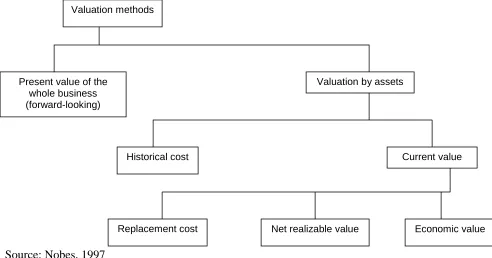
3.2.9 Materiality 32 3.3 Asset valuation practice 32 3.4 Valuation methods 35 3.4.1 Earnings based valuation methods 36 3.4.2 Asset based valuation methods 38 3.4.3 Market based valuation method 40 3.4.4 Industry specific valuation method 40
3.5 Specific port valuation issues 41 3.5.1 Cost structure 42 3.5.2 Port capacity and growth 43 3.5.3 Valuation of assets 44 3.5.4 Surplus assets versus operational assets 45
3.5.5 Tax losses 45 3.6 Problems with valuation of port assets 46 3.7 Strengths of port asset valuation 47
4 Port restructuring and financial performance 49
4.1 Ports of Ghana 49
4.1.1 Port of Takoradi 50 4.1.2 Port of Tema 50 4.2 Ghana Ports and Harbours Authority 51 4.2.1 Operational units 52 4.3 Port Rehabilitation Project 52 4,4 Port Policy Reform 53 4.5 Ghana Gateway Project 55
4.6 Port tariff 56
4.6.1 Operational efficiency of Tema port 56 4.6.2 Container cargo through Tema port 57 4.6.3 General cargo through Tema port 60 4.7 Notes on the financial statement of port of Takoradi 60
4.8 Notes to the financial statements of MMA 62 4.9 The Kalmar Group 64
5 Conclusions and Recommendations 65
References 71
Appendices
Appendix A Handling equipment at port of Takoradi 75
Appendix B Availability and utilisation report, port of Takoradi 76 (January – April 2001)
Appendix D Container traffic – port of Takoradi (1989-2000) 79
Appendix E Balance sheet as at 31 December 1999 80
Appendix F Cash flow statement for 4th quarter ended 31 December 1999 81
Appendix G Average exchange rates – Ghana cedi to US $ (1982-2001) 82
Appendix H Questionnaire 83
LIST OF TABLES
Table 2.1 Port Authority responsibilities 12
Table 2.2 The port function matrix 15
Table 2.3 Methods of privatisation used by ports 18
Table 3.1 Ownership of port assets 28
Table 3.2 Estimated cost of some Kalmar equipment 45
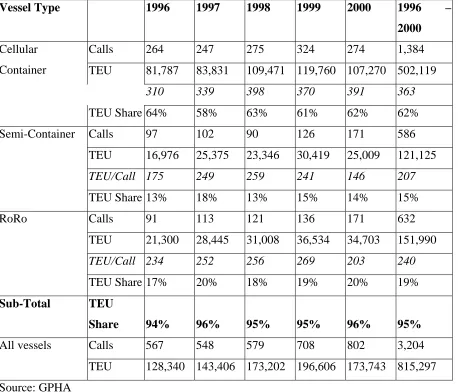
Table 4.1 Container volumes by vessel type at Tema port (1996-2000) 51
Table 4.2 Operating ratio of Tema port 57
Table 4.3 Working ratio of Tema port 57
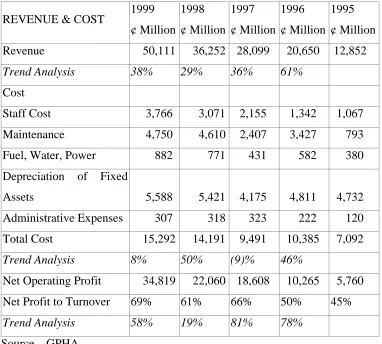
Table 4.4 Container cargo revenue and cost analysis, Tema port (1995-1999) 58
Table 4.5 General cargo revenue and cost analysis, Tema port (1995-1999) 59
Table 4.6 Depreciation rates for port of Takoradi 61
Table 4.7 Depreciation rates for MMA 63
LIST OF FIGURES
LIST OF ABBREVIATIONS
APS Atlantic Port Services BOO Build-Own-Operate BOP Balance of Payment BOT Build-Operate-Transfer CFS Container freight station CMC Cocoa Marketing Company DCF Discounted Cash Flow DKK Danish Kroner
EBVM Earnings based valuation methods ECT European Combined Terminal EDI Electronic Data Interchange EMS Expert Maritime Services
ERP Economic Recovery Programme
ESCAP Economic and Social Council Of Asia and Pacific EU European Union
FRS Financial reporting standard GBP British Pound Sterling
GCHC Ghana Cargo Handling Company GCM Glencar Mining
GDP Gross Domestic Product
GHATIG Ghana Trade and Investment Gateway Project GPA Ghana Port Authority
GPHA Ghana Ports and Harbours Authority HIT Hong Kong International Terminals
IAPH International Association of Ports and Harbors IDA International Development Agency
IMO International Maritime Organisation IPP Improving Port Performance
IRR Internal Rate of Return IT Information Technology MMA Malta Maritime Authority MBO Management Buy Out
MEBO Management Employee Buy Out MIS Management Information System MTS Maritime Transport Services NPV Net Present Value
OECDF Overseas Economic Co-operation and Development Fund PBC Produce Buying Company
POE Pre-owned Equipment
PNDC Provisional National Defence Council ROI Return on Investment
SDV SCAC-Delmas-Vieljeux SEK Swedish Kronor
SOE State Owned Enterprise
SSC Speedline Stevedoring Company SWL Safe Working Load
TLC Takoradi Lighterage Company TEU Twenty-foot Equivalent Unit UK United Kingdom
UNCTAD United Nations Conference on Trade and Development USA United States of America
USD ($) United States (of America) Dollar VALCO Volta Aluminium Company WACC Weighted Average Cost of Capital WMU World Maritime University WTO World Trade Organisation
CHAPTER 1
INTRODUCTION
Ports serve as an interface between sea and land in maritime transport, a place where
facilities and services are provided for ships and cargo, a link in international trade. Ship
time in port and overall quality of service are important factors that affect the cost of
maritime transport. Provision of efficient and quality service to ships and cargo are vital
to attract ships to a particular port. Containerization, computerization and automation
have led to improvement of standards required from ports by ship owners, shippers and
other port users. International trade have been growing at a fast rate as a result of
globalization, liberalization and commercialisation. This has brought a lot of pressure to
bear on ports as logistic platforms to help improve and expand facilities, raise
productivity and lower port costs. Processing, packaging and movement of goods and
services from the manufacturer to the final consumer are now done with the just-in-time
strategy and ports serve as a vital link in this chain. Serving the external trade of a
country implies therefore heavy investments by ports.
1.1 Consistency of port assets
Port assets could be made up of land, moveable and unmoveable property, infrastructure
such as breakwater, entrance channel, main basin and quay apron and superstructure
including container yard, transit shed, container freight station (CFS) and warehouse.
Port equipment includes floating craft, cranes, conveyor belt, forklifts, Roll-on-Roll-off
(RoRo) tractors and trailers. An agreement on what particular items constitute the assets
Service port, landlord port or tool port could have different ownership structure and
regulatory function and separate management responsibility for assets and commercial
services.
Port asset could be material or non-material and the impact of the valuation of port assets
could be quantifiable or non-quantifiable and have positive or negative effect. Human
resource is one of the most important assets of any port. Human resource is the factor
that brings other resources or assets of the port together for a productive venture. Human
resource management and development is essential for the efficient use of other resources.
Trained management and skilled operators are needed to handle planning, maintenance
and effective use of port infrastructure, facilities and equipment. Automation and
computerisation have become essential parts of most efficient ports. The use of
information technology (IT) and the electronic data interchange (EDI) in ports relies very
heavily on trained human resource.
The human resource base of a port could also be considered as a productive force that
contributes towards the efficient running of the port. However, Trade Unions could have
positive or negative effect on the operation of ports and thus on the asset valuation of a
port. For example, in France, the action (or inaction) of port workers on strike for a
number of days could deal a severe blow to the finances of a port much more than the
unavailability of a material asset of the port which could be replaced. We can thus
consider human resource training as an investment that should be evaluated too.
1.2 Valuation of port assets
There is the need for valuation of port assets, infrastructure, superstructure and equipment
for many reasons. Valuation of port assets is carried out to place assets on the balance
sheet, find the net present value (NPV) and future expected income from a particular
asset or agree on the replacement value of an asset. Asset valuation practices vary
financial performance of the port and the national economy in different proportions.
Valuation of port assets for lease, joint venture or outright sale of a terminal could lead to
inflow of capital or foreign exchange that could affect the financial status of a port and
impact on the Gross Domestic Product (GDP) or Balance of Payment (BOP) of a country.
This is especially true for situations in which foreign firms participate as private sector
investors and bring in foreign exchange, equipment or technology or even technical
assistance as their contribution.
Some situations justify the importance of valuation of port assets and explain difficulties
of each valuation.
Ø Privatization. The increasing growth in world trade and economies of scale in cargo shipment are two important factors that have encouraged private sector
investment in port development (Port Development International, 2000,
September). Privatization of a port is the situation in which the ownership and
control of existing port assets are transferred from the public to the private sector.
The most common arrangement for private sector participation in port is usually
through long-term concession contracts. Such contracts involve private
management, operation and investment in existing public assets.
Ø Rehabilitation. An investment in port assets such as rehabilitation of terminal facilities or replacement of cargo handling equipment should be based on an
insight into the viability, potential and profitability of such an investment. The
rate of return on the investment or the economic benefits to be derived from
additional facilities could only be ascertained if a fair idea about the value of the
asset is known. Valuation of port assets is essential both to the public authority of
a port and the management of the private operator in a port to ensure that any
planned investment in facilities or equipment has the potential for future
economic growth.
• The main concern of the state for the national port is to ensure that the import and export trade of the country can be sustained and jobs created for the
people. Governments or public port authorities may not be too much
concerned with the cargo forecast, the need for additional facilities, equipment
maintenance, costs or income projections and may not make any meaningful
analysis of investment requirements once the basic aim of establishing a port
is achieved. The public function of the port is thus mainly to facilitate trade
and employment but not just as a commercial entity.
• On the contrary, the private sector is driven by the desire to make profits and thus seek to minimise costs and maximise return on investment (ROI).
Private sector investment in port assets could look at the port function as one
of a profit venture. As much as possible, valuation of port assets by the
private sector is handled in a professional manner with the view to make profit.
The Associated British Ports had to cut over £80million British Pound
Sterling (GBP) from the original valuation of American Port Services, which
was acquired in 1998 after only 2 years of activity. This was due to the fact
that operational profits went down by about £3m as a result of the lowering of
performance by 70%. The relevant amount was then written off from the
original acquisition price (Port Development International, 2000, March).
Ø Future policies. Whichever way the conception of the port is placed, the valuation of the fixed assets of the port is necessary to determine future policies.
Investment in port infrastructure and equipment is an expensive and risky venture
and the dynamic and competitive nature of maritime transport business requires
that the ROI be carefully calculated. The ROI for certain aspects of port assets
such as entrance channel and breakwater could be difficult to determine but future
profit could be equated to future traffic volumes. Future traffic volumes in a port
could also be affected by macroeconomic variables and other factors in the
Ø Economic value of port assets. Moreover, a financial decision on the economic value of port assets depends on the economic life of the assets, the method of
depreciation used, the running cost of the asset and the cash flows available. For
example, the cost of land in a port used for other services could attract higher
revenue depending on the nature of the activity. Land cost in the port of
Copenhagen is expensive due to the fact that the location of the old port is inside
the city. The market value of the land in the port of Copenhagen is thus higher
than usual for port land. Buildings on the fringes of the port are used as
warehousing facility and office accommodation and attract higher rent charges.
The port of Copenhagen saw an increase in surplus revenue at the end of 1998 of
about 83 million Danish Kroner (DKK) and DKK 212m in 1999 with sale of port
sites amounting to DKK 214m for the same period (Port of Copenhagen, 1999).
Ø Life cycle of port assets. The long life cycle of port investment could also affect the ROI. The breakwater could have an investment life of 50 years, the wharf or
quay, 30 years and container cranes, 15 years (Port Development International,
2000, March). The choice of a particular life cycle obviously results in different
running costs and valuation for the port. The port industry requires long-term
investment but different time periods for different aspects of port assets so it is
appropriate to divide the port into segments to look at each piece separately for
the purpose of port asset valuation. The sources for the financial management of
a port could be local or foreign currency, receipts from tariff and other port
charges, grants and loans from foreign or local source. Traffic forecast, present
and future operational performance of a port could be linked to the financial
performance of the port. The cash flow of a port could be compared with interest
rates or shares on the stock market as there could be other uses for investment in a
port and an analysis of the NPV or internal rate of return (IRR) could be
calculated on such a basis.
operation, accounting practices and methods used for valuation, the valuation of port
assets could be different for different ports. Certain problems are encountered during
port asset valuation and these could in turn affect the financial capacity of a port and the
national economy.
In conclusion, we can say that from an economic point of view, valuation of port assets is
important to enable the public port authority or private sector operator to have an idea of
the assets of a port and place them on the balance sheet, know their economic life span
and when to replace them, determine whether to increase assets to match future traffic
projections or calculate the value or cost to place on them for leasing, concession or
outright sale. The value placed on port assets after valuation could affect the financial
performance of a port and the national economy. Growth in the national economy could
come about as a result of development of external trade and creation of direct, indirect or
induced employment and added value services. These could also have effect on the
financial operation of the port, the GDP and BOP of the country.
1.3 Purpose of the study
The topic for this study is the impact of valuation of port assets on the financial
performance of a port and the national economy. The objectives of the study are to
1. Identify the criteria for the use of a particular convention for the valuation of port
assets
2. Examine the effect of the valuation of port assets on the financial performance of
a port and on the national economy
3. Determine factors that could lead to positive impact of the valuation of port assets
on the national economy
4. Make recommendations to improve the practice of valuation of port assets.
assets such as land, infrastructure, superstructure and equipment could depend on the
alternative use for the asset, whether it is purchased new or pre-owned, the maintenance
schedule, the economic life and replacement procedure. Valuation of port assets could
also give an idea of the current value of an asset, future economic benefits to be derived
from it and the need to invest in other assets for efficient operation of the port.
Sea transport continues to handle a greater proportion of international trade and ports
serve as a link in the global logistics chain. Containerization, automation and
computerisation and the use of IT and EDI are essential for the efficient planning and
provision of effective services for the handling of ships. Valuation of port assets will
enable the port authority or private sector operator to have an idea of the facilities and
inputs available for provision of services to ship, the cost to be incurred and the expected
profit margins. Human resource development and training are essential port assets and
are virtually indispensable for the efficient management and operation of a port. Port
management is a combination of the factors that enable a port to attract ships and offer
efficient services to them and valuation of port assets could be a vital component.
1.4 Methodology
The initial topic was proposed at the end of the 2nd semester in November 2000 and data
was collected during the Christmas break from the ports of Tema and Takoradi in my
home country, Ghana. However, at the beginning of the 3rd semester further changes
were made and the current topic was approved in March 2001 and retrieving of new
information then began from sources on the Internet. Actual work could only start at the
beginning of the 4th semester in June and ended on 31 August.
Further information was gathered during field studies to the ports of Le Havre in France,
Rotterdam and Amsterdam in the Netherlands (Holland), Malta Freeport in Malta, Arhus
from the ports of Malmo in Sweden and Copenhagen in Denmark and also
MaerskSealand, lectures on Improving Port Performance (IPP) 1- 4 and on other
port-related topics by visiting professors from the port of Hamburg in Germany and elsewhere
were the other sources of information.
Three main sources were considered as literature review and base for the study. These
were various reports on port privatisation by UNCTAD (1995 and 1998) and Cass (1996
and 1998) and valuation conventions by Nobes (1997).
Annual reports from various ports, journals and periodicals also provided background
information and review of literature. Questionnaire (see Appendix H) were also sent to
the ports of Tema and Takoradi in Ghana, MMA in Malta, the port of Hamburg in
Germany and the port cargo handling equipment manufacturers, Kalmar Group, at
Lidhult in Sweden. Return of the necessary response to the questionnaire was slow and
needed quite a number of reminders in most cases. In certain instances, the author was
directed to retrieve information from sites that offered only Swedish, Danish or German
and such data was available but not easily usable due to the language barrier.
The author was employed as a management trainee at the GPHA in 1989 and went
through quite a rigorous training schedule. This included lectures on IPP-1 and
management skills and attachment to the ports of Tema and Takoradi for practical
on-the-job training. He has worked in the port operations department throughout his career and
attended various short courses, seminars and other training programmes on port operation
and management. He also had the opportunity to experience at first hand the port
rehabilitation programme, restructuring exercise and policy reform, which were geared
towards efficient operations and greater private sector participation. Such a varied
experience in port operations and management were vital in shaping some of the thoughts
1.5 Structure of the study
The study is divided into 5 chapters. Chapter one is the introduction and it gives a
general background and significance of the topic, defines the problem and the aim of the
study, outline the methodology used and difficulties encountered and a summary of the
various chapters.
Chapter two describes the role of ports in the national economy, types and functions of
ports, the need for privatisation of ports and a description of some of the methods used
for port privatisation.
Chapter three discusses valuation of port assets, asset recognition and ownership of port
assets, the various methods of international valuation conventions, the practice and
application of port valuation methods and the problems of port asset valuation and
suggested solutions.
Chapter four attempts to give an insight into asset valuation and financial performance of
ports. It traces the history and current status of ports in Ghana, indicates operational data
and tariff setting and sets out the effect of port rehabilitation and policy reform on the
financial performance and development of the ports. The chapter ends with notes on the
financial statement of GPHA and MMA and valuation methods for newly manufactured
machines and pre-owned equipment from Kalmar.
Chapter five is the last chapter and it gives the conclusions from the study and provides
recommendations to improve the practice of valuation of port assets.
CHAPTER 2
ROLE OF PORTS IN THE NATIONAL ECONOMY
Sea transport is the most viable alternative for the enormous quantities of cargo moved
around the world each year. Port users require reduced transport and handling costs in
order to sell at a reasonable price and make profit. This can be achieved through
expansion of port facilities, improved cargo handling and efficient services.
Governments require investment in port facilities and management capabilities to ensure
the continued role of ports in the national economy. Most shipping services are now in
the hands of a few global companies who control modern facilities and IT through
alliances, consortium or investment policies to take advantage of the economies of scale
in shipping services and port operation (Port Development International, 2000,
September).
2.1 Role of Seaports
Since the earliest of times the basic purposes of most seaports have been to offer shelter
to ships and allow discharging and loading of cargo to take place. Ports serve as an
interface in maritime transport, a place for provision of technical facilities and other
services to ships, space for storage of cargo and industrial development. Ships carry
about 99% of world trade in volume and 80% in value (Branch, 1986). The geographical
location, physical design, infrastructure, operation and function of a modern port are
Services to ships include stores, bunkers, ship repair, maintenance and auxiliary services,
insurance and banks.
Modern ports serve as a link in International trade by allowing quality service to ship
and cargo. World trade have been growing at a faster rate than world economic growth
(WTO, 1998) and there is the need to have adequate and efficient transport system to
move goods and services around the world. Sea transport is responsible for the
movement of greater volumes of cargo in world trade as a result of a combination of
factors. These include economies of scale, globalisation, increase in ship size, improved
technology in ship design and operation, containerisation, multi-modal and door-to-door
service, development of container terminals with adequate draft and equipment for
handling modern vessels, IT and just-in-time strategy which are all vital to the global
logistic chain system.
Ports in developing countries generally lack strategies for decision-making in terms of
developing patterns of international trade, legislative and institutional procedures and
regulations to cover tariffs and inland transport. Notwithstanding these problems ports
could still lead to development of a particular region as a result of industrialisation,
direct employment at the port and indirect or induced employment for other
professionals such as Ship Brokers, Shipping Agents, Freight Forwarders and Ship
chandlers. Foreign exchange could be earned as a result of revenue from exports, port
dues, stevedoring or cargo handling charges, ship repair and Agency fees. Land-locked
countries may form part of the hinterland of a seaport in another country as ports in
nearby countries usually service import and export trade for such countries.
For example, the port of Le Havre contributes quite substantially to the national
economy of France through value added in industries, transport and commercial services
industries, distribution of goods and services and employment and value added in the
region where it is located. According to “Projections 2020”, a document published by
the Rotterdam Municipal Port Management, at the end of 1995 the total number of
people employed in the Rotterdam port was 315,000 (63,000 directly and 252,000
indirectly). This represent 5.4% of total national employment and total value added was
6.8% of the national Gross Domestic Product (portmanagement.com, 2001).
2.2 Types of Ports
The separation of ports into different types usually relates to the nature of port
ownership, management, organisation, administration and operation. Ports could be said
to be state or private owned, with municipal or autonomous status. Alternative forms of
port ownership, organisation, management and administration are usually of 3 distinct
types. Alderton (1999) describes the 3 classical types of port ownership and operation
as
• Landlord port • Tool port • Service port.
Table 2.1Port Authority Responsibilities
Port type Infrastructure Superstructure Stevedoring
Landlord Yes No No
Tool Yes Yes No
Service Yes Yes Yes
Various levels of ownership and operation may be seen in the port system and the extent
of involvement of the central or municipal government or private enterprise may vary
according to the management, organisational and administrative style.
The Landlord port is where the state, port authority or municipal council own the land
and lease the terminal to private stevedores. The state provides the infrastructure such as
quays and land for the terminal while the private operator provides superstructure and
equipment like cranes, warehouse, terminal equipment and other commercial facilities.
An example is the Rotterdam Port Authority, which lease the port infrastructure to
European Combined Terminal (ECT).
The Tool port is the situation where the state owns both the infrastructure and
superstructure and the private stevedore company provide the labour for operation.
Competition is very high and tenders are put in to secure rights. Examples are Houston
in the United States of America (USA) and most of the autonomous ports in France and
other ports in Europe.
The Service port is also known as comprehensive or public port. The state or port
authority owns both the infrastructure and superstructure and also provides all services
and facilities for ships. Examples include Singapore Port Authority, which was made
private in 1997, and ports in India, Israel, South Africa and Ghana.
A survey organised by the International Association of Ports and Harbors (IAPH) for
member ports with responses from 188 ports representing over 80% of the total
membership, showed that majority of seaports (about 92%) were owned by public
organisations while only about 7% were private (Ports and Harbors, January-February
It is crystal clear that valuation of port assets will be a big problem because state owned
assets do not answer to the same purposes or perform the same functions as the private
ones and the reasons for investment by the state and public sector are different.
2.3 Functions of Ports
According to the port function matrix proposed by Baird (Cass, 1998), there are 3
essential functions performed by a port whether it is in private or public ownership.
These are
• Landowner function
• Utility or Cargo handling function and • Regulatory or Statutory function.
The Landowner function refers to the provision, development, maintenance and
management of channels, breakwaters, basins, and other major civil engineering works
and port facilities. The Utility function concerns cargo handling, stevedoring and
physical transfer of goods and passengers between sea and land. The Regulatory or
statutory functions include provision of vessel traffic management, maintenance of
sound environmental policies, safeguarding of interest of all stakeholders and
enforcement of other laws and regulations.
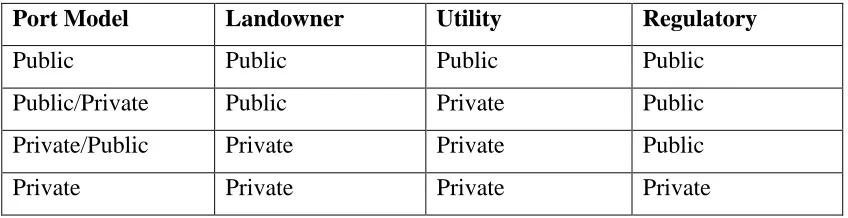
The port function matrix makes it possible to measure the extent or balance of public
and private sector influence on ports and also help to identify the 4 main forms of port
models. These are the • Public port
The Public port, also known as a service or comprehensive port have all 3 functions
controlled by the state. The Public port could be said to be inefficient due to state
control but it can also be one of the most efficient as in the case of the port of Singapore
even before it was turned into a private entity.
The Public/Private port has the public or state as the dominant force with control of both
Landowner and Regulatory functions. Utility or cargo handling function is performed
by the private sector. It is also known as the Landlord or Tool port and is common in
Europe and North America, Estonia, Latvia and Poland in Eastern Europe, Asia and
Latin America.
The Private/Public port has both Landowner and Utility functions in the hands of the
private sector while the state controls Regulatory functions. Several ports in the United
Kingdom including port of Tilbury conform to this model.
The Private port has the private sector as the dominant force. All 3 functions of
Landowner, Utility and Regulatory are controlled by the private enterprise. However
actual port operation could be a mixture of both public and private ownership.
Examples are ports of Felixstowe, Manchester and Liverpool and other private ports
especially in the United Kingdom (UK).
Table 2.2 The Port Function Matrix
Port Model Landowner Utility Regulatory
Public Public Public Public
Public/Private Public Private Public
Private/Public Private Private Public
Private Private Private Private
Whichever the type and function of ports, it is very common to engage in privatisation
of certain portions of the port to enhance productivity. The following is a summary of
the reasons for privatisation and some of the common methods used.
2.4 The need for Privatization of Ports
In recent years Privatization have been proposed as a sine qua non for the development
of ports in Africa and other less endowed countries. The Port of Antwerp made a very
interesting observation when they said in response to a survey that privatisation means
different things to different ports (Alderton, 1999).
Privatization of ports could be defined as the situation where governmental control and
involvement in the ownership, administration, management and operation of a port is
decentralised to allow more private sector participation. There is increased
commercialisation of the port activities and more involvement of the private sector in
provision of capital for infrastructure, superstructure and equipment and most especially
participation in cargo handling operation (Alderton, 1999).
Privatization aims at reduction of state involvement or control in the activities of the port
and increase private sector participation. It helps to reduce the size of financial
commitment by government to the port and make available funds for other social and
economic services of the state. It could break bureaucracy, lead to optimised labour
force and improve productivity through competition. The objectives of an efficient port
system should be the optimum utilization of available resources within acceptable safety
standards at minimal cost and maximum profit for the port and port users, ship owners,
The basic aim of privatisation is to make the private investor more efficient, make profit
and seek higher returns on investment. The private sector ensures optimum use of
resources by applying management principles in viable ventures to ensure profit over
capital cost. An efficient port management system is required to increase productivity
and improve quality service at a port to merit privatisation. In 1985 the container
terminal at Port Klang was given on a 21-year contract to a private consortium and since
then there have been an increase of 75% in container handling and 85% in labour wages
and a reduction of 50% in repair, maintenance and administrative costs (Alderton, 1999).
Factors that spur on greater private sector participation and commercial orientation in
ports include growing international trade as a result of higher growth rate for world trade
as against world economic growth, economies of scale and increase in ship size,
modernisation and improvement in port facilities through the use of IT, higher
productivity and lower costs, efficient management and larger investment portfolio and
benefits to the national economy as a whole.
Privatization could also mean the actual transfer of ownership of all or certain parts of
the existing land, infrastructure and equipment of a port to the private sector to own in
perpetuity (ESCAP, 1997). This long-term concession contract cedes management and
investment in the port to the private sector and there could be problems as to the nature
of the deed of title from public to the private sector. Some of the problems to be
encountered include determination of value of the asset, basis for deciding on economic
or market value, whether the asset should be sold for just financial consideration to the
highest bidder, future regulation and restriction on private operator due to shift in
ownership and loss of social role of the government to the private sector.
Privatization of public port assets is seen as a solution to budget deficit because the
Reasons for Privatization may be political, economic, fiscal or social but the objective
should be to reduce public debt, lead to stable economy and promote savings and
investment (UNCTAD, 1995).
There are various types or methods of Port Privatization including
- Commercialisation
- Liberalisation
- Corporatisation
- Management or Technical contract
- Concessions such as Build-Operate-Transfer (BOT) and Leases
- Joint Ventures
- Outright sale of Assets
The results of the IAPH survey showed that terminal concessions and leasehold
arrangements, BOT, Joint venture and Outright sale of port assets were the most
common methods used to facilitate private sector intervention in ports (Ports and
Harbors, January-February, 2001). Corporatisation was usually combined with
concession/lease arrangements or other methods.
Table 2.3 Methods of Privatization used by Ports
Concession
or lease
BOT Joint
venture
Sale of
Port
land
Corporatisation Management
contract
Other
methods
52% 19% 10% 4% 13% 2% 13%
Considering the results from the IAPH survey as depicted in Table 2.3 and some of the
reasons given under the need for privatisation of ports in section 2.4, this paper would
concentrate on BOT, Joint venture, Outright sale of Assets and Leases. These four
methods are the most widely used during most port privatisation ventures. They allow
parts of the port to be given out to the private sector for investment.
2.4.1 Build-Operate-Transfer (BOT)
High capital costs are needed for construction of ports and they have high commercial
risks and very long payback periods (ESCAP, 1997). Civil facilities such as berths and
breakwaters have investment life of between 30 to 50 years while that for equipment
such as container cranes could be 15 to 25 years (Port Development International, May
2000). Traffic forecasting is a very important feature of the decision to invest in port
infrastructure and equipment. The dynamic and competitive nature of the maritime
industry requires a sustained traffic to achieve good return on investment and future
profit.
BOT is the situation in which the private sector makes major investment in infrastructure
and equipment to create an operational container terminal and transfer it back after
managing for a period of time. In 1994 Westport, Malaysia was given on BOT
concession to the private sector to design, finance, build, operate and manage 30 berths
and 1200acres of land for a period of 30 years (Cass, 1998). The cost of construction of
the facility was important to the government because when the facility reverts back in
future it could be operated by the state or re-allocated to a private company.
A BOT concession operates at the port of Felixstowe in the UK while Compagnie
Indusrielle Maritime for oil and petrochemical storage facilities operate at the port of Le
Operate, Build Transfer and Build-Own-Operate (BOO), in which the developer has
ownership in perpetuity as at the dedicated container terminals in Hong Kong and China.
2.4.2 Joint Venture
A Joint Venture is an association of 2 or more legal entities collaborating in an
enterprise and sharing risks and benefits (UNCTAD, 1995). The total amount involved,
ratio and form of contribution by each party, terms and consequences of termination of
the venture are agreed upon at the outset. One partner usually contributes fixed assets
while the others bring financial capital, management and technological expertise.
Instead of wholesale privatisation to the private sector a Joint venture is entered into
whereby an operating company is established jointly owned by the government or port
authority and the private entity (local/foreign) to construct, manage and provide port
infrastructure and services within a laid down legislation. The government make
available assets, land, infrastructure and superstructure while the private sector provide
finance, up-grade facilities, purchase new equipment and contribute to technological and
managerial expertise (ESCAP, 1997).
Joint ventures have clear laid down conditions for investment, duration of lease,
landownership and reasonable tariff charges. The advantages are that capital is made
available for construction of new facilities and purchase of new equipment, there is
reduced level of investment and risk, technological transfer and training of staff,
efficient management and operational schemes, increased productivity, shared costs and
rewards and mutual benefit.
The Shanghai Container Terminal Co. Ltd. is a joint venture between the Port of
Kong International Terminals (HIT), a private terminal operating company. Financial
assistance and managerial skills of HIT was crucial for this partnership. The duration is
50 years and operation commenced in 1993 on existing container facilities with plans for
new development. It is on 50-50 share equal basis and offers opportunities for equality,
mutual sharing of risks and benefits, and commitment to future negotiation for the public
and private sectors (ESCAP, 1997).
The new container terminal, Freeport Terminal Ltd. was established at Marsaxlokk,
Malta through a joint venture between Malta Freeport Corporation, an agent of the
government of Malta and the UK-based Maritime Transport Services (MTS). MTS was
contracted for their reputation as a container terminal operator and for transfer of
technology (Cass, 1998). This privatisation process moved a step further when the
government of Malta decided to implement the option of selling up to 100% of the share
capital of the Malta Freeport Terminal with a 30-year exclusive licence prior to the sell
off (Lloyds List, 18 May, 2001).
2.4.3 Outright sale of assets
Outright Sale of assets refers to the total sale of infrastructure, superstructure and other
port facilities by the government. It could be at a bargain price or to the highest bidder
as in Hong Kong or China. The problem is how maximum return of income to the
government can be achieved by the price quoted and controversy over subjective
judgement in valuation of the asset can be avoided. A rigorous screening procedure of
potential buyers and quotations may be needed to keep intact the objectives of the
government.
According to Baird (Cass, 1998), Outright sale of assets could also be the situation
either on full or partial basis on the Stock exchange, in an open trading of shares in total
or large blocks or to employees and other small investors. The disadvantage is that port
assets could end up been sold to competitors in other ports in the same country or region
or even to foreign companies who may have diametrically opposed concepts to
operation of the port. A classical example is the case in which some foreign investors
who expressed interest in the port of Takoradi which handles over 85% of the main
export trade of Ghana, were said to have plans to turn the port into a passenger terminal
for tourists, speed boat operators and holiday makers during initial talks on a possible
privatisation arrangement.
The alternative is to have competitive tender for bidding, sale of assets and not shares,
encourage negotiated sale on Management and Employee Buy Out (MEBO) or
Management Buy Out (MBO) basis and as much as possible discourage single buyers
who may not offer the right price or may be unable to pay outright.
2.4.4 Lease
A Lease is a contractual arrangement whereby the owner of an asset (lessor or state)
grants another party (lessee or private company) the right to use the asset and to profit
from it for an agreed period of time in return for the payment of rent (UNCTAD, 1995).
It could also be the full transfer of specified assets from the port to a private operator for
an agreed period of time (ESCAP, 1997).
The lease is thus an agreement or the right to use port asset, land or equipment for an
agreed period of time with a series of payments. A large investment is needed for the
creation of infrastructure, superstructure and other facilities at a port with very long and
uncertain payback period. Lease agreements in China and Hong Kong are usually for 50
Though facilities and equipment are available for use during the lease period transfer of
assets on permanent basis through either sale/purchase or lease/purchase agreements
could be arranged. The contract period usually takes into account the economic life of
the asset and permanent transfer could be limited to mobile assets only.
The lease period could be dependent on the investment made and adapted to suit the
changing market situation. Lease periods for fixed facilities could be between 5 to 20
years or more while that for land developed by the lessor could be for a period of 15 to
30 years (ESCAP, 1997).
The value of the asset could depend on the function or service to be rendered by it,
restrictions that may be placed on the use of the asset, and availability of the asset for
optimum utilisation. There could be a vast difference in the value for land and a mobile
crane. Land could be sold at the price of the highest bidder due to current availability,
the future revenue potential of the asset at the same place or opportunities for use for
other purposes. The value of land in ports in North America and Europe are higher than
those in ports in Asia and Africa. Development of housing estates on the fringes of the
port of Copenhagen have led to rapid increases in cost of warehousing facilities at the
port and a greater contribution to revenue of the port from non-port operation sources
(Port of Copenhagen, Annual Report, 1999).
Various forms of leases may be available but with combined features of different types.
The main problem is with valuation of the assets especially that of the residual value.
Where there is an option to purchase at termination of the lease, renew the lease after the
first period or conduct sale of specified assets at the end of the lease an amount must be
agreed upon and a fair, just and viable valuation is essential. Over 25% of the
privatisation process in Jamaica between 1981-1992 was through the lease method
Hamburg, which are located in one of the most wealthy and efficient region for port
operation in Europe, the so-called blue banana area.
Whichever the alternative for privatisation, be it total or partial, valuation of port assets
is necessary to determine the value of assets.
2.5 Privatization and valuation of port assets
The valuation of the assets of a port is usually a normal procedure and practice for the
financial department of a port authority or the management team to determine the
financial state of the assets of the port in the annual balance sheet. This is normally
carried out at the end of the financial year of the port using certain laid down procedures,
rules and conventions. It gives a clear idea of the value of the assets of the port in the
accounting books and also the physical assets on the ground. This information is equally
important as a form of data through which a decision to build, maintain or buy new
infrastructure, superstructure, equipment or any other form of assets for the port could be
taken. It could also be used to help in the disposal of assets that might have outlived the
economic life.
The valuation of the assets of any port depends on the specific assets available for the
port. The assets of a port is linked to the type of port or the nature of the ownership,
administration and operation of a port. A service port, tool port or landlord port will
have different range of assets as a result of the nature of ownership of infrastructure,
superstructure, equipment and other port assets. The value of the assets for a particular
port will thus depend on the type of port and the assets available for the port. The value
fact that the need to build, buy, maintain or scrap a particular asset of the port depends
on the value attached to that asset.
As previously mentioned, the value of the assets of a port is usually determined at the
end of the year on the balance sheet and the effect of the valuation is usually seen more
in the financial operation of the port and to some extent the national economy. The
ability of a port to handle imports and exports and give other services to ship and cargo
depend on the asset base and availability of inputs for the port and this may add on to the
national economy. On the other hand, the valuation of the assets of a port during the
privatisation process or increased private sector participation could be done at any point
in time within the year. The effect of such a valuation for purposes of privatisation
could have more impact on the national economy rather than the financial performance
of the port. Depending on the nature of the privatisation the income accruing could be
put into the national coffers and this could go a long way to make available funds to the
government for the implementation of economic projects, the provision of social
services and general economic growth.
CHAPTER 3
ASSET VALUATION
3.1 Asset recognition
The provision of physical facilities and services by ports and the periodic maintenance of
such facilities are done at a cost. The beneficiaries of these facilities and services are port
users, cargo owners and ship owners who pay for the benefits they derive. Revenue
received by ports for services they render is used for replacement of facilities. The real
or economic cost of facilities is usually higher than the cost of resources especially where
they have alternate uses. Port facilities such as breakwater, quay apron, CFS and cargo
handling equipment form physical assets while capital is used to provide port services
including pilotage, cargo handling, towage and storage.
The problem with asset recognition has been the difficulty in deciding what constitute
port assets for valuation. Assets are excluded if they are on lease, have no scrap value or
capital is utilized for unfruitful development such as research project with uncertain
future benefits. Assets could also not be placed on the balance sheet due to accounting
conventions while trained staff, good reputation, brand name or customer loyalty is not
recognized because it is difficult to identify the cost or value. The unique assets of Port
Jervis was said to
“… include outstanding architecture landmark buildings, the city’s history as a
railroad center, its location on the Delaware River, its proximity to nearby national
parks and a rail system that connects the city to metropolitan areas.” (th-record.com,
It is uncertain which of these assets can be placed on a port valuation list because of the
difficulty in deciding their cost or value and the control the port have over them.
3.1.1 Fixed assets
The Balance Sheet, which is a statement of assets and liabilities show the financial
position at a particular point in time of what is owned in monetary value by a firm or
enterprise. The Financial Reporting Standard (FRS) of the UK define assets as the
“rights or other access to futures economic benefits controlled by an entity as a result of
past transactions or events” (Nobes, 1997, p. 142). Assets are seen as expected future
economic benefits over which a firm have legal right of control. They have a market
value and help the owners to make profit.
Fixed assets are those intended for use and not to be sold out such as land, buildings,
plant or machinery. They can be differentiated into Intangible, Tangible and Investments.
Intangible assets are made up of development costs, concessions, goodwill, patents and
trademarks. Tangible assets include land, buildings, plant, machinery, fixtures, fittings,
tools and equipment. Trade Investments could be shares or loans (Nobes, 1997).
3.1.2 Current assets
Current asset are assets that can be transformed into something else within a short period
of time and may include stocks of raw materials and finished goods, amount owed to
trade debtors, trade investments or shares and cash at hand or cash at bank (Nobes, 1997).
3.1.3 Liabilities
The FRS of UK has defined liabilities as “an entity’s obligations to transfer economic
benefits as a result of past transactions or events” (Nobes, 1997, p. 142). Liabilities refer
include trade creditors, amount owed to suppliers or debts payable, overdraft and
short-term loans. Contingent liability is “an obligation that will be incurred at a future date”
(Nobes, 1997, p. 21).
3.1.4 Equity
Equity, also known as capital or owners interest is the retained profit or share capital
earned by shareholders. If profit is earned in a year there is excess of assets over
liabilities and it leads to an increase in capital.
3.1.5 Ownership of Port Assets
The survey organised by the IAPH also showed the type of ownership for port assets in
the area of access channel, breakwater, land and cranes for the container terminal. Some
of the results did not round up to 100% probably due to some incomplete responses
(Ports and Harbors, January-February, 2001). Table 3.1 shows that Port Authorities and
some other forms of public organisations such as municipal or city councils, public
agency, corporation or government departments control greater percentage of port assets.
Private companies have negligible control over most port infrastructure or superstructure
but own a sizeable portion of cargo handling equipment due mainly to stevedoring
handled by the private sector.
Table 3.1 Ownership of port assets
Access channel Breakwater Land Cranes
Private
company
0% 0% 4% 22%
Public
organisation
27% 17% 11% 7%
Port Authority 60% 56% 76% 58%
3.2 Valuation conventions
Valuation is a requirement to give value, attach monetary consideration or worth to an
asset. It is usually done at the end of the accounting or financial year of a company to
place items in the balance sheet for the information of owners or others who may be
interested in it. It could also be required when an asset is to be replaced, leased or sold.
Valuation of port equipment is usually done taking into consideration the life cycle or
useful economic life and net depreciation value of the particular item. Depreciation is
normally pegged at about 50% of the historical, purchase or replacement cost or value of
the equipment.
Several alternative valuation conventions are available for inclusion and valuation of
assets on the balance sheet. Some valuation conventions are specifically required by law,
others help to maintain standards while others are used for adjustment with current value
accounting (Nobes, 1997). The following are the various alternative valuation
conventions as set out by Nobes (1997).
3.2.1 Prudence
This is also known as conservatism as it prefers the lowest of a reasonable value for an
asset. There is the need to have caution, balance and optimism and an attempt to take
care of all uncertainties when using it. It holds responsibilities towards shareholders,
creditors, buyers and owners. It could sacrifice the most likely and realistic figure for the
lowest value.
3.2.2 Objectivity
It is based on reliable facts about the estimated valuation and it is deemed to be better
than another valuation that may be based on realistic figures. It is acceptable to
3.2.3 Money measurement
As the name suggests, this considers only items expressed in monetary terms and it relies
on ready information based on money as a measurement of value. It is difficult to
include assets such as skilled management and customer goodwill that may not easily be
quantified as a measure of money.
3.2.4 Historical cost
This is closely related to the valuation convention of money measurement. Asset
valuation is done on the basis that assets are recorded at the cost at the time of their
purchase and at proportion to that cost throughout their useful life. Cash as an asset can
have an identical market value to the cost whereas land can have a different value over a
period of time (Nobes, 1997). The advantage of this valuation convention is that it is
simple, objective and easy to compare with the market value or a series of future cash
flows. However, the disadvantage is that inflation could affect the asset that could either
depreciate or appreciate in value over time like land or wine in a cellar.
3.2.5 Stability
This is usually used together with two other valuation conventions, money measurement
and Historical cost. The assumption is that to ensure a stable valuation figure there
should be no change in the value of currency so that the value of money over time could
be the same. However, from about 1970 after the Israeli-Arab conflict over the Palestine
issue leading to oil crisis and steep changes in oil prices which were reflected in
International trade relations, world economy, inflation and currency differentials there
has been the need to adjust the value of money in relation to major world currencies. The
stability convention takes into account not only historical cost but also the value of an
asset over a time period as it is possible for identical assets to have different values at
3.2.6 Current value
Due to the problem with the valuation convention of historical cost especially in relation
to a stable value of an asset over a period of time particularly after 1970 with high
inflation and wide differentials in currencies, the current value convention was developed.
The valuation of assets in the normal circumstance is related to the replacement cost of
the asset but not the historical cost. The value of an asset to an entity is the deprival
value of that asset or the maximum loss that the entity would feel if it were deprived of
the use of that asset (Nobes, 1997). The deprival value is thus related to the cost of
replacement of the asset or the current value of the asset.
3.2.7 Going concern
It is based on the “assumption that the business will continue for the foreseeable future”
(Nobes, 1997, p. 19). The value of most fixed assets depend not on what they can be sold
for but on what they can contribute to the profit of the entity. Assets that are specific to a
particular business may not be useful for others and could have low scrap value and
hence low market value. However, the value to the entity could be higher due to their
productive potential, replacement cost or deprival value. Most assets of ports including
breakwaters, quay apron, cranes and forklifts and other plant, equipment and machinery
fall into this category. “The going concern convention seems to encourage a value-in-use
approach, which entails consideration of the future benefits from an asset” (Nobes, 1997,
p. 19).
For example, the Irish-based gold mining company, Glencar Mining (GCM) decided to
sell the gold mine at Wassa in Ghana as a result of low prices on the world market and a
production shortfall that made the project unable to meet scheduled debt repayments.
The mine was put up for sale as a going concern and this meant that the sale would “leave
Glencar with no debt, a significant number of exploration assets and sufficient cash