Synthesis and characterization of new thorium and uranium
phenolate complexes
Tamer Andrea
a, Eyal Barnea
a, Mark Botoshansky
a, Moshe Kapon
a, Elisheva Genizi
b,
Zeev Goldschmidt
b, Moris S. Eisen
a,*aThe Schulich Faculty of Chemistry and Institute of Catalysis Science and Technology, Technion-Israel Institute of Technology, Haifa 32000, Israel bDepartment of Chemistry, Bar-Ilan University, Ramat-Gan 52900, Israel
Received 11 October 2006; accepted 26 October 2006 Available online 10 November 2006
Abstract
The reaction between the chelating amino bisphenole ligand (ONOO)H2(1)½ONOO¼MeOCH2CH2NfCH2-ð2-O-C6H2-But2-3;5Þg2
and (ONNO)H2 (2) ½ONNO¼Me2NCH2CH2NfCH2-ð2-O-C6H2-But2-3;5Þg2 with an excess of NaH gives the corresponding
bis-sodium salts3and4quantitatively. The salts were reacted with thorium tetrachloride at room temperature to obtain the corresponding (ONOO)ThCl2(5) and (ONNO)ThCl2(6) complexes. However, ThCl4and UCl4react with (3) at higher temperatures to give the
cor-responding isomorphous homoleptic complexes (ONOO)2Th (7) and (ONOO)2U (8). We have also synthesized and characterized a
tho-rium salicylaldiminato complex L3ThCl (11)½L¼ ðC6H5ÞNCHð2-O-C6H2-But2-3;5Þ, in order to study the effect of the bridged ligand on
the molecular structure.
2006 Elsevier B.V. All rights reserved.
Keywords: Organoactinides; Phenolate complexes; Salicylaldiminato complexes; Homoleptic complexes
1. Introduction
The substituted amino bisphenole compounds are well-known easy to modify ligands, their salts are used as dianionic precursors with early transition metals [1], late transition metals[2]and lanthanides[2]. For group 4
met-als, the first generation of these ligands (ONO) (X = CH3
in Scheme 1) mainly gave the non-reactive homoleptic
complexes L2M[3]. Two modifications were made in order
to prevent the metathesis of the second ligand: (i) increas-ing the steric bulk of the substituents on the aryl group; (ii) attaching a donating group to the side chain terminus (X = O, N, S) to obtain the so called ‘‘second generation’’ ligands (ONXO); in order to induce the coordinative satu-ration and to avoid the activation of the second ligand. The
first modification allowed the formation of (ONO)MR2
complexes (M = Ti, Zr, Hf, Ta) [2,3], whereas the second
modification allowed the formation of (ONXO)MR
(M = Yb, Er)[2]and (ONXO)MR2(M = Ti, Zr, Hf, Ta)
complexes [3–5]. Interestingly, the latter complexes were
found to be highly active in various polymerization reac-tions[4].
The use of the salicylaldiminato ligand (9) also has been widely studied in the polymerization of terminal olefins[6]. It was found that the steric demand of the substituents on the phenyl groups plays a major role in the catalytic activ-ity of these complexes; namely, the bigger the R group, the higher the activity[7].
During the last decade we have developed non-metallo-cene group 4 complexes and study their utilization for
various catalytic processes [8,9]. In addition, we have
found that metallocene complexes of the actinides are excellent catalysts for parallel demanding chemical
trans-formations with complementary reactivities [9]. Recently,
we have found that replacing the cyclopentadienyl moiety of the organoactinide metallocenes by amido groups
introduced some unexpected reactivities [10,11]. Hence,
0022-328X/$ - see front matter 2006 Elsevier B.V. All rights reserved. doi:10.1016/j.jorganchem.2006.10.071
*
Corresponding author.
E-mail address:[email protected](M.S. Eisen).
the introduction of new ancillary ligands in the synthesis of organoactinide complexes is expected to pioneer new catalytic processes.
Herein, we report the synthesis and structure of new actinide complexes containing the amino bisphenolate motifof the type (ONOO), and (ONNO) and the salicylal-diminato ligand.
2. Results and discussion
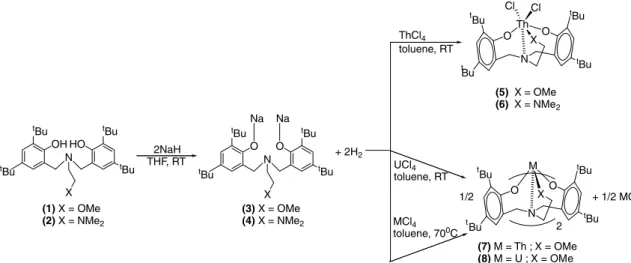
The sodium salt 3 [12] was prepared from1 [3a]. The
sodium salt was reacted with 1 equiv. of ThCl4Æ3THF in
toluene at room temperature to give complex5as a white
solid compound (Scheme 1). The complex was isolated,
recrystallized and characterized by elemental analysis and NMR spectroscopy. Our attempts to obtain suitable single crystals for X ray characterization at low temperatures with a mixture of various solvents failed due to the rapid formation of microcrystalline material. When the reaction
was performed at elevated temperature (70C) (Scheme 1)
the homoleptic complex7 was the main product obtained
as a white solid and characterized by elemental analysis,
NMR and X-ray diffraction (Fig. 1). The same complex
can be prepared by reacting one equivalent of the ligand salt
3with complex 5 at 70C in toluene. A similar procedure
was followed with UCl4, to obtain complex 8 regardless
of the ratio between the ligand and the metal. Complex8
was isolated as a green solid and characterized by elemental
analysis, NMR and X-ray diffraction (Fig. 1). The
forma-tion of complex 8 as the main product indicates that for
uranium the introduction of the second ligand must be much faster than the first one. Hence, it seems plausible that the first ligand (ONOO) activates the intermediate complex
(ONOO)UCl2towards complex8.
1
H NMR of complex5shows that the four benzylic
pro-tons split into two different sets of signals at different
chem-ical shifts (d 3.19 (2H) and 5.59 (2H) ppm). This NMR
behavior indicates that one set of benzylic protons are interacting with the metal center more strongly, leading
to a downfield shift. COSY, DEPT and HMQC spectra showed that one proton at each benzylic moiety displays agostic interaction with the metal center. This interaction leads to a stereotopic discrimination between the two pro-tons on the same benzylic carbon. The same stereotopic
feature was also observed in complex7 having four
differ-ent chemical shifts for the benzylic protons (3.22 (2H), 3.24 (2H), 5.13 (2H), 5.72 (2H) ppm).
The X-ray structures of complexes7and8 corroborate
our findings in solution. In both complexes the distance between the metal and the four endo protons (referred to
Ha at the bottom of Fig. 1) is between 3.17 A˚ and
3.78 A˚ , whereas the distance between the metal and the
exo protons (referred to Hb at the bottom of Fig. 1) is
tBu tBu
t
Bu HO OH
N
X
2NaH THF, RT
tBu tBu
t
Bu O O
N
X Na Na
(1) X = OMe
(2) X = NMe2
(3) X = OMe
(4) X = NMe2
+ 2H2
ThCl4
toluene, RT
(5) X = OMe
(6) X = NMe2
(7) M = Th ; X = OMe
(8) M = U ; X = OMe MCl4
toluene, 700C
+ 1/2 MCl4
1/2
t
Bu t
Bu
O
N Bu
Bu
Th O
t
Bu
tBu
Cl Cl
X
t
t
O
N Bu
Bu
M
O
tBu
t
Bu X
t
t
2 UCl4
toluene, RT
Scheme 1. Synthesis of (ONOO)ThCl2, (ONNO)ThCl2, (ONOO)2Th and (ONOO)2U complexes.
between 3.93 A˚ and 4.39 A˚. Suitable crystals of complexes
7 and 8 were grown from concentrated toluene solutions.
Both molecular structures contain eight coordinated metal centers. The closest coordination sphere around the metals forms a tetrahedral geometry (created by the atoms O1, O3, O4, O6 in both complexes). The pendant side arm in the complexes coordinates to the thorium and uranium
with bond lengths of 2.70 A˚ and 2.69 A˚, respectively,
unlike homoleptic lanthanide complexes where the side arm is not coordinated to the metal center[13]. The
resem-blance between the molecular structure of complexes7and
8(Table 1) in the solid state indicates that the 5f electrons
in complex8do not participate in the bonding, as expected
from inner orbitals.
To understand the effect of the pendant arm donor (X) on the molecular structure, we have prepared the thorium
complex of ligand2[5a]by reacting ThCl4with the
appro-priate salt 4 at room temperature. The complex
(ONNO)ThCl2 (6) was obtained and isolated as a white
solid and characterized by NMR spectroscopy and elemen-tal analysis. The high similarity between the NMR features
(multiplicity and chemical shifts) of complexes 5 and 6
allows us to propose structural resemblance between these two complexes, and to conclude that the X motif do not affect much the molecular structure of the actinide com-plex. This result is indeed potentially important since we might expect that a metal–amine bond would be more
reac-tive than the corresponding ether bond leaving an accessi-ble vacant coordination site for future catalysis.
In addition, we have studied the ‘‘cooperation effect’’ between the two bridged phenoxy groups by synthesizing
the thorium complex11(seeScheme 2). The complex was
prepared by the reaction between one equivalent of the
sal-icylaldiminato lithium salt [14] and ThCl4Æ3THF. The
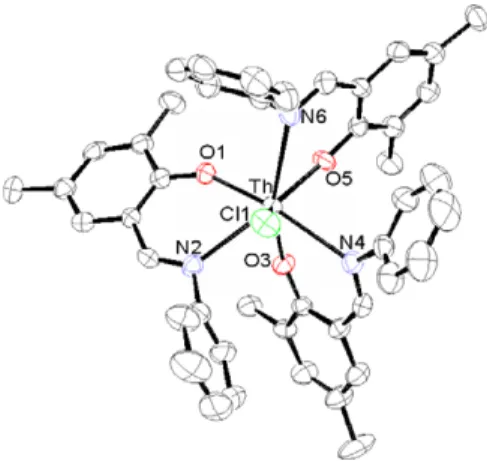
final complex was characterized by NMR spectroscopy and single crystal X-ray diffraction studies (Fig. 2).
Although the same metal–oxygen and metal–nitrogen interactions are present in complexes7and 11, the earlier complex is eight coordinative whereas the latter is seven coordinative. The greater steric hindrance of the ligands
in complex 11 impedes to introduce the fourth ligand to
obtain the corresponding homoleptic complex. The single
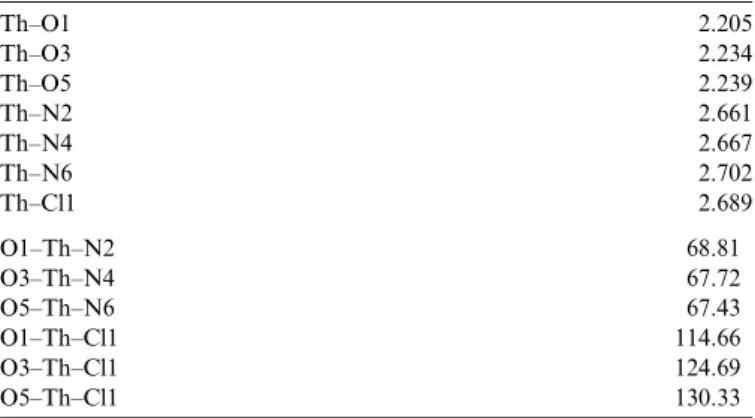
chloride atom is fixed on the Z axis with a bond length
of 2.68(1) A˚ (compared to 2.79 A˚ in [(OPhCH
2-PhO)2ThCl] +
)[15]. The three nitrogen atoms are all located in the same plane pointing towards the chloride atom, with
an average thorium–nitrogen bond length of 2.67(4) A˚
(compared to 2.74 A˚ in (ONOO)2Th and 2.68 A˚ in
(ONOO)2U). The three oxygen atoms are all located in
one plane driving thetert-butyl groups away from the chlo-ride atom, the average metal–oxygen bond length is 2.22(3) A˚ similar to 2.26 A˚ in (ONOO)2Th and 2.22 A˚ in
(ONOO)2U.
In conclusion, we have successfully prepared and
char-acterized two dichloride thorium complexes (5and 6) and
two homoleptic thorium (7) and uranium (8) complexes.
Table 1
Selected bond lengths (A˚ ) and angles () for (ONOO)2Th (7) and (ONOO)2U (8)
Complexes 7 8
M–O1 2.262(4) 2.232(11)
M–O2 2.775(7) 2.782(17)
M–O3 2.256(4) 2.202(11)
M–O4 2.233(4) 2.177(12)
M–O5 2.624(4) 2.590(14)
M–O6 2.313(4) 2.274(11)
M–N1 2.765(5) 2.707(13)
M–N2 2.725(6) 2.654(16)
O1–M–O4 102.53(18) 101.65(4)
O1–M–N1 69.86(16) 70.3(4)
O6–M–N2 71.75(17) 73.2(4)
O2–M–N1 61.17(18) 61.2(5)
N2–M–O1–O6 70.5 69.6
N2–M–O3–O4 71.4 72.1
O N
tBu tBu
MCl
3
+ 3LiCl + 3THF
OH N
tBu tBu
(9) (11)
nBuLi
Et2O
ThCl4 3THF
OLi N
tBu tBu
+ C4H10
(10)
Scheme 2. Synthesis route for thorium salicylaldiminato complex (11).
In addition, we have synthesized and characterized a tho-rium salicylaldiminato complex, L3ThCl (11), in order to study the effect of the bridging of the ligands on the molec-ular structure of the complexes. The difference in structure and ligation among the different complexes will entail us to tailor new organic chemical transformations. Preliminary results using these complexes show that they are better cat-alyst for the coupling of terminal alkynes and isonitriles
[16]. A thorough study of these complexes in new catalytic processes is underway and will be presented shortly (see
Table 2).
3. Experimental
3.1. Instrumentation
All manipulations were performed on a high vacuum (105torr) line, or in a nitrogen filled vacuum atmospheres glovebox with a medium capacity recirculator (1–2 ppm
O2). Argon and nitrogen were purified by passage through
a MnO oxygen-removal column and a Davison 4 A˚
molec-ular sieve column. CCl4was distilled from P2O5, all other
hydrocarbon solvents, toluene-d8and THF-d8(Cambridge
Isotopes) were distilled under nitrogen from Na/K alloy. NMR spectra were recorded on Avance 500 or 300 spec-trometer. Chemical shifts for 1H NMR and 13C NMR are referenced to internal solvent resonances and are reported relative to tetramethylsilane.
3.2. Syntheses
3.2.1. Synthesis of ThCl4Æ3THF
ThO2(8.2 g, 31 mol) was placed in the center of a quartz
tube and heated overnight at 200C under constant Ar
flush. A Schlenk-flask containing freshly distilled CCl4
was attached to the system. The temperature was raised
to 830C and a slow Ar flow was directed through the
CCl4 to the quartz tube for 70 h. ThCl4 accumulated in
the cool part of the quartz tube. The reaction was
moni-tored by the consumption of the ThO2. After the
comple-tion of the reaccomple-tion, the tube was transferred into the glove box, and the white solids carefully transferred to a
round bottom flask which was connected to a Schlenk-frit. THF (30 ml) was syringed into the flask to dissolve the
ThCl4. The volume of the THF was reduced to 20 ml and
hexane (30 ml) was syringed carefully to form two layers.
The flask was cooled to30C and pale-yellow needle-like
crystals of ThCl4Æ3THF were formed. The crystals were
filtered, washed with hexane and dried in vacuum (14.9 g, 25.2 mmol, 81% yield).
Elemental analysis: calculated: C, 24.4; H, 4.1; Cl, 24.0. Experimental: C, 25.5; H, 4.5; Cl, 22.9.
3.2.2. Synthesis of (ONOO)Na2(3)
A solution of ligand 1 (2 g, 3.90 mmol) in 10 ml THF
was added dropwise to a solution of NaH (0.37 g,
15.6 mmol) in 20 ml THF at78C under nitrogen
atmo-sphere over 10 min. the solution was then stirred at room temperature for 2 h and filtered, the solid was washed three times with cold THF. The filtrate was evaporated under low pressure and a white fluffy solid was obtained (90% yield).
1H NMR (300 MHz, THF-d8): d 6.98 (d, J= 2.4 Hz,
2H, Ar); 6.77 (d, J= 2.4 Hz, 2H, Ar); 4.10 (d,
J= 11.7 Hz, 2H, benzylic); 3.14 (t,J= 5.4 Hz, 2H, CH2);
2.87 (d, 11.7 Hz, 2H, benzylic); 2.66 (t, J= 5.4 Hz, 2H,
CH2); 2.41 (s, 3H, OCH3); 1.43 (s, 18H), (C(CH3)), 1.21
(s, 18H), (C(CH3)). d 13C NMR (125 MHz, THF-d8): d
168.0, 136.0, 129.0, 126.5 (ArC); 125.7, 122.0 (CH); 70.2, 65.4 (CH2); 56.8 (OCH3); 55.1 (CH2); 35.4, 33.6 (C(CH3)3); 32.0, 29.8 (C(CH3)3).
3.2.3. Synthesis of (ONNO)Na2(4)
This compound was prepared from the precursor 2 by
identical procedure to that employed for compound 3. A
white fluffy solid was obtained (94% yield).
1H NMR (300 MHz, THF-d8): d 7.01 (d, J= 2.7 Hz,
2H, Ar); 6.79 (d, J= 2.7 Hz, 2H, Ar); 4.08 (d, J= 11 Hz,
2H, benzylic); 2.89 (d, 11 Hz, 2H, benzylic); 2.58 (t, J= 4 Hz, 2H, CH2); 1.91 (t,J= 4 Hz, 2H, CH2); 1.50 (s,
6H, N(CH3)2); 1.45 (s, 18H), (C(CH3)), 1.22 (s, 18H),
(C(CH3)).13C NMR (125 MHz, THF-d8): d 180.3, 136.0,
124.0, 122.5 (ArC); 121.8, 120.2 (CH); 66.3, 65.0, 63.2
(CH2); 55.6 (NCH3); 38.8, 37.5 (C(CH3)3); 28.5, 27.7 (C(CH3)3).
3.2.4. Synthesis of (ONOO)ThCl2(5)
A mixture of ThCl4Æ3THF (0.22 g, 0.36 mmol) and the
di-sodium salt of ligand 3 (0.19 g, 0.35 mmol) were
dis-solved in 30 ml toluene and stirred at room temperature over night under nitrogen atmosphere. A white precipitate was formed and collected over a sinter glass. The collected solid was dissolved in THF, filtered and washed with cold THF three times. The filtrate was removed under reduced
pressure to produce (ONOO)ThCl2(50% yield). The
prod-uct was crystallized from toluene/hexane at30C.
1
H NMR (300 MHz, THF-d8): d 7.27 (d, J= 2.5 Hz,
2H, Ar); 6.99 (d, 2.5 Hz, 2H, Ar); 5.59 (br, 2H, benzylic); 3.57 (s, 3H, OCH3); 3.19 (br, 6H, benzylic); 2.67 (br, 2H,
Table 2
Selected bond lengths (A˚ ) and angles () for L3ThCl (11)
Th–O1 2.205
Th–O3 2.234
Th–O5 2.239
Th–N2 2.661
Th–N4 2.667
Th–N6 2.702
Th–Cl1 2.689
O1–Th–N2 68.81
O3–Th–N4 67.72
O5–Th–N6 67.43
O1–Th–Cl1 114.66
O3–Th–Cl1 124.69
CH2); 1.45 (s, 18H), (C(CH3)), 1.29 (s, 18H), (C(CH3)).13C
NMR (125 MHz, THF-d8): d 162.1; 141.0, 136.8, 128.2
(ArC); 127.4, 125.0 (ArCH); 76.3, 66.5 (CH2); 65.6
(OCH3); 54.7 (CH2); 36.4, 35.5 (C(CH3)3); 33.0; 31.6 (C(CH3)3). Elemental analysis: calculated: C, 48.77; H, 6.33; N, 1.72; Cl, 8.72. Experimental: C, 49.00; H, 6.57; N, 1.60; Cl, 9.00.
3.2.5. Synthesis of (ONNO)ThCl2(6)
This complex was prepared from the sodium salt of
ligand4 by identical procedure to that employed for
com-plex5. A white solid was obtained (47% yield). 1
H NMR (300 MHz, THF-d8): d 7.28 (d, J= 2.4 Hz,
2H, Ar); 6.97 (d, J= 2.4 Hz, 2H, Ar); 5.38 (br, 2H,
ben-zylic); 3.58 (br, 2H, benben-zylic); 3.22 (br, 2H, CH2); 2.63
(br, 2H, CH2); 2.26 (s, 6H, N(CH3)2); 1.46 (s, 18H),
(C(CH3)), 1.27 (s, 18H), (C(CH3)). 13C NMR (125 MHz,
THF-d8): d 163.3; 141.0; 131.8; 128.2 (ArC); 127.4, 125.1 (ArCH); 72.4, 69.0, 66.5 (CH2); 65.6 (NCH3); 36.4; 35.5 (C(CH3)3); 32.9; 31.6 (C(CH3)3). Elemental analysis: calcu-lated: C, 49.45; H, 6.59; N, 3.39; Cl, 8.59. Experimental: C, 49.51; H, 6.79; N, 3.19; Cl, 8.07.
3.2.6. Synthesis of (ONOO)2Th (7)
ThCl4(0.27 g, 0.45 mmol) and di-sodium salt of ligand3 (0.25 g, 0.45 mmol) were mixed together in 30 ml toluene
and heated to 70C over night. A white precipitate was
formed and collected over a sinter glass. The solid was then dissolved with THF and allowed to stand for 2 h till a white solid was precipitated again. The solution was filtered and the solid washed with cold THF three times. The filtrate was then evaporated under reduced pressure and a white solid was obtained (50% yield). The product was
crystal-lized from toluene/hexane at30C.
1H NMR (300 MHz, THF-d8): 7.24 (m, 4H, Ar); 7.04
(d, J= 2.4 Hz, 2H, Ar); 6.97 (d, J= 2.4 Hz); 5.72 (d,
J= 13 Hz, 2H, benzylic); 5.13 (d,J= 13 Hz, 2H, benzylic);
3.24 (d, J= 13 Hz, 2H, benzylic); 3.22 (d, J= 13 Hz, 2H,
benzylic); 3.14 (s, 6H, CH3); 2.95 (t,J= 4 Hz, 2H, CH2); 2.91 (t, J= 4 Hz, 2H, CH2); 2.44 (t, J= 3 Hz, 2H, CH2); 2.39 (t,J= 3 Hz, 2H, CH2); 1.42 (s, 18H), (C(CH3)), 1.34
(s, 18H), (C(CH3)); 1.22 (s, 18H), (C(CH3)); 1.18 (s,
18H), (C(CH3)). 13C NMR (125 MHz, THF-d8): d 163.2,
162.7, 138.9, 138.8, 136.2, 136.1, 128.9, 127.8 (ArC);
127.1, 126.7, 124.8, 124.4 (ArCH); 74.5, 65.9, 64.7 (CH2);
61.8 (OCH3); 49.7 (CH2); 35.8, 35.7, 34.6, 34.5
(C(CH3)3), 32.2, 32.1, 31.2, 31.1 (C(CH3)3) Elemental anal-ysis: calculated: C, 63.34; H, 8.21; N, 2.24. Experimental: C, 63.88; H, 7.91; N, 2.03.
3.2.7. Synthesis of (ONOO)2U (8)
UCl4(0.14 g, 0.36 mmol) and di-sodium salt of ligand3 (0.19 g, 0.35 mmol) were mixed together in 30 ml dry
tolu-ene and heated to 70C over night. The solution was dark
green above brown precipitate. The precipitate was col-lected over a sinter glass and washed with cold toluene three times. The filtrate was removed under reduced
pres-sure and a green solid was obtained (50% yield). The
com-plex was crystallized from toluene at30C.
1
H NMR (300 MHz, Toluened8):d17.5 (br); 12.5 (br);
9.3 (br); 3.41 (s, 2H); 1.28 (s, 18H);0.20 (s, 18H);1.25
(s, 2H); 15.1 (br). Elemental analysis: calculated: C,
63.04; H, 8.18; N, 2.23. Experimental: C, 63.58; H, 8.11; N, 2.00.
3.2.8. Synthesis of L3ThCl (11)
1.6 M nBuLi in hexane (2 ml, 3.20 mmol) was added
dropwise over 5 min to a diethylether solution of (3,5-di-tert-butylsalicylidene)-aniline (9) (1 g, 3.20 mmol) in 20 ml
diethylether at 78C under argon flow. The mixture
was allowed to warm to room temperature and stirred for 12 h. the product was filtered and washed with diethy-lether over a sinter glass. The filtrate was evaporated under reduced pressure to produce the lithium salt (10) as yellow powder (90% yield).
A solution of the lithium salt (0.25 g, 0.79 mmol) in 20 ml diethylether, was added dropwise over 20 min to a
solution of ThCl4Æ3THF (0.238 g, 0.40 mmol) in 20 ml
diethylether at78C. The mixture was allowed to warm
to room temperature and stirred over night. The mixture was filtered and washed with diethylether. The filtrate was evaporated under reduced pressure to obtain a brown yellow solid. The crude product was dissolved with toluene and filtered, the toluene filtrate was then removed by reduced pressure and replaced with hexane, the solids obtained were washed three times with hexane over a sinter
glass to obtain (Lig)3ThCl as bright yellow solid (50%
yield). The complex was crystallized from toluene/hexane
at30C.
1H NMR (300 MHz, C6D6):d8.23 (s, 1H, imine); 7.05–
6.79 (m, 7H, Ar); 1.35 (s, 9H, C(CH3)3); 1.25 (s, 9H,
C(CH3)3). 13C NMR (125 MHz, C6D6): d 171.7 (Imine
CH); 163.7, 155.4, 141.4, 140.5, 130.3 (ArC); 128.8, 127.9, 125.6, 122.2, 124.1(ArCH); 36.8, 35.9 (C(CH3)3); 31.3, 22.6 (C(CH3)3). Elemental analysis: calculated: C, 63.28; H, 6.83; Cl, 2.96; N, 3.51. Experimental: C, 63.76; H, 6.52; Cl, 2.84; N, 3.35.
3.3. X-ray crystallography
Crystal structure determination: Single crystal immersed in Parathone-N oil was quickly fished with a glass rod and mounted on the KappaCCD diffractometer under a cold stream of nitrogen at 230 K. Data collection was carried
out with monochromatized Mo Karadiation usingxand
pscans to cover the Ewald sphere. Accurate cell
parame-ters were obtained with complete collections of intensities and these were corrected in the usual way. The structure was solved by direct methods and completed using succes-sive Fourier difference maps. Refinement was performed anisotropically with respect to the nonhydrogen atoms. Hydrogens were placed at calculated positions and refined using the riding model until convergence was reached (see
Acknowledgment
This research was supported by the Israel Science Foun-dation Administrated by the Israel Academy of Science and Humanities under contract 1069/05.
Appendix A. Supplementary material
CCDC 628840, 628844 and 628845 contain the
supple-mentary crystallographic data for7, 8and 11. These data
can be obtained free of charge via http://www.ccdc.cam.
ac.uk/conts/retrieving.html, or from the Cambridge
Crys-tallographic Data Centre, 12 Union Road, Cambridge CB2 1EZ, UK; fax: (+44) 1223-336-033; or e-mail: [email protected]. Supplementary data associated with this article can be found, in the online version, at
doi:10.1016/j.jorganchem.2006.10.071.
References
[1] (a) A. Amgoune, C.M. Thomas, T. Roisnel, J.-F. Carpentier, Chem. Eur. J. 12 (2006) 169;
(b) S.B.B. Tushar, M. Cheerfulman, B. Smita, R. Eleonora, H. Michal, J. Robert, L. Antonin, D.V. Dick, L.J. Anthony, Organomet. Chem. 691 (2006) 952.
[2] (a) Y. Yao, M. Ma, X. Xu, Y. Zhang, Q. Shen, W.-T. Wong, Organometallics 24 (2005) 4014;
(b) M. Ma, X. Xu, Y. Yao, Y. Zhang, Q. Shen, J. Mol. Struct. 740 (2005) 69.
[3] (a) E.Y. Tshuva, I. Goldberg, M. Kol, Z. Goldschmidt, Inorg. Chem. 40 (2001) 4263;
(b) E.Y. Tshuva, S. Groysman, I. Goldberg, M. Kol, Z. Goldschmidt, Organometallics (2002) 662;
(c) E.Y. Tshuva, I. Goldberg, M. Kol, H. Weitman, Z. Goldschmidt, Chem. Commun. (2000) 379.
[4] (a) S. Groysman, I. Goldberg, M. Kol, E. Genizi, Z. Goldschmidt, Organometallics 23 (2004) 1880;
(b) S. Groysman, S. Segal, I. Goldberg, M. Kol, Z. Goldschmidt, Inorg. Chem. Commun. 7 (2004) 1889.
[5] (a) E.Y. Tshuva, I. Goldberg, M. Kol, Z. Goldschmidt, Organomet-allics 20 (2001) 3017;
(b) E.Y. Tshuva, I. Goldberg, M. Kol, Z. Goldschmidt, Chem. Commun. (2001) 2120.
[6] (a) R. Furuyama, M. Mitani, J.-I. Morhi, R. Mori, H. Tanaka, T. Fujita, Macromolecules 38 (2005) 1546;
(b) H. Makio, T. Fujita, Bull. Chem. Soc. Jpn. 78 (2005) 52. [7] P.G. Cozzi, E. Gallo, C. Floriani, A. Chiesivilla, C. Rizzoli,
Organometallics 14 (1995) 4994.
[8] (a) For recent examples of activity of group-4 complexes in polymerization see: V. Volkis, B. Tumanskii, M.S. Eisen, Organo-metallics 25 (2006) 2722;
(b) V. Volkis, A. Lisovskii, B. Tumanskii, M. Shuster, M.S. Eisen, Organometallics 25 (2006) 2656.
[9] E. Barnea, M.S. Eisen, Coord. Chem. Rev. 250 (2006) 855. [10] (a) For recent examples of activity of group-4 complexes in
hydroamination see: E. Smolensky, M. Kapon, M.S. Eisen, Organo-metallics 24 (2005) 5495;
(b) E. Smolensky, M. Kapon, J.D. Woollins, M.S. Eisen, Organo-metallics 24 (2005) 3255.
[11] For examples of catalytic activity of organoactinides in hydroamin-ation, see: D.B. Stubbert, C.L. Stern, T.J. Marks, Organometallics 22 (2003) 836;
Table 3
Crystallographic data for complexes7,8and11
Compound 7 8 11
Empirical formula C66H102N2O6Th C66H102N2O6U C63H78ClN3O3Th
Formula weight 1251.54 1257.53 1192.77
Crystal system Monoclinic Monoclinic Monoclinic
Space group Cc Cc P21/C
T(K) 230.0(1) 293(2) 293(2)
Wavelength (A˚ ) 0.71073 0.71073 0.71073
a(A˚ ) 23.8940(3) 23.729(5) 21.683(4)
b(A˚ ) 17.8770(4) 17.855(4) 13.083(3)
c(A˚ ) 19.0820(3) 18.984(4) 24.143(5)
a() 90 90 90
b() 127.43 126.97(3) 119.63(3)
c() 90 90 90
V(A˚3) 6472.10(19) 6426(2) 5953(2)
Z 4 4 4
Dcalc(Mgm 3
) 1.284 1.300 1.331
Absorption coefficient (mm1) 2.352 2.574 2.594
F(000) 2600 2608 2432
Crystal size (mm) 0.24·0.21·0.12 0.15·0.08·0.04 0.35·0.22·0.18
hRange for collection () 1.57–27.49 1.57–25.35 1.83–25.34
Reflections collected 12 199 23 711 46 043
Unique reflections 12 198 5785 10 635
Rint 0.0254 0.1823 0.0820
Data/restrains/parameter ratio 12198/2/0.6022 5785/17/347 10635/0/60
AllRindices R1= 0.0628 R1= 0.1115 R1= 0.0642
wR2= 0.0822 wR2= 0.1258 wR2= 0.0760
FinalRindices [I> 2r(I)] R1= 0.0392 R1= 0.0593 R1= 0.0349
wR2= 0.0785 wR2= 0.1117 wR2= 0.0696
Largest difference in peak and hole (e A˚3) 0.558 and
For examples of catalytic activity of organoactinides in hydrosilyla-tion, see: A.K. Dash, I. Gourevich, J.Q. Wang, J. Wang, M. Kapon, M.S. Eisen, Organometallics 20 (2001) 5084.
[12] C.L. Boyd, T. Toupance, B.R. Tyrrell, B.D. Ward, C.R. Wilson, A.R. Cowley, P. Mountford, Organometallics 21 (2002) 1367. [13] M. Ma, X. Xu, Y. Yao, Y. Zhang, Q.J. Shen, Mol. Struct. 740 (2005)
69.
[14] R. Furuyama, J. Saito, S.-I. Ishii, M. Mitani, S. Matsui, Y. Tohi, H. Makio, N. Matsukawa, H. Tanaka, T. Fujita, J. Mol. Catal. A 200 (2003) 31.
[15] I. Korobkov, S. Gambarotta, G.P.A. Yap, Angew. Chem., Int. Ed. 42 (2003) 4958.