Electrical and Computer Engineering Publications
Electrical and Computer Engineering
2-2013
Fine structure observation in magnetostriction near
the transition temperature in Gd5Si1.95Ge2.05
Ravi L. Hadimani
Iowa State University, [email protected]
Y. Melikhov
Cardiff UniversityDavid C. Jiles
Iowa State University, [email protected]
Follow this and additional works at:
http://lib.dr.iastate.edu/ece_pubs
Part of the
Electromagnetics and Photonics Commons
The complete bibliographic information for this item can be found at
http://lib.dr.iastate.edu/
ece_pubs/71
. For information on how to cite this item, please visit
http://lib.dr.iastate.edu/
howtocite.html
.
Fine structure observation in magnetostriction near the transition
temperature in Gd5Si1.95Ge2.05
Abstract
Gd5(Si\rm xGe1 -\rm x)4 has a complex magnetic-structural phase diagram which can be divided into three
distinct regions. It exhibits an unusual first-order coupled magnetic-structural phase transition in the region
\rm x < 0.51. A series of magnetostrictive strain measurements were carried out as a function of magnetic field
strength at different temperatures and as a function of temperature at near-zero magnetic field strengths. In
this paper, we report for the first time the observation of fine structure in the variation of strain with magnetic
field near the first-order phase transition temperature. This fine structure was observed only for the
single-crystalline and polysingle-crystalline samples of Gd5 Si 1.95 Ge2.05 but not for Gd5 Si2 Ge2 and Gd5 Si2.09
Ge1.91 samples. There was a sudden increase of about 200-300 ppm in the magnetostrictive strain just prior
the field-induced first-order phase transition. In this paper, this anomaly is termed as fine structure. It was
observed in measurements of both magnetostrictive strain versus magnetic field and magnetostrictive strain
versus temperature. In the case of the polycrystalline Gd5Si 1.95Ge2.05 sample, this anomaly was not as
sharp, and the sudden magnetostrictive strain change was about 40 ppm just before the field-induced
first-order phase transition.
Keywords
first-order phase transition, Gd5 (Sirm x Gel-\rm x) 4, magnetocaloric effect, magnetostriction, Ames
Laboratory, US Department of Energy
Disciplines
Electrical and Computer Engineering | Electromagnetics and Photonics
Comments
Copyright IEEE 2013.This ia manuscript of an article from
IEEE Transactions on Magnestics
49 (2013):
6269930, doi:
10.1109/TMAG.2012.2213605
. posted with permission.
Fine structure observation in magnetostriction near the transition
temperature in Gd
5
Si
1.95
Ge
2.05
R.L.Hadimani
1, 2,
Member, IEEE,
Y.Melikhov
3,
Member, IEEE,
D.C.Jiles
1, 2,
Fellow, IEEE
1Department of Electrical and Computer Engineering, Iowa State University, Ames, IA 50011, USA
2Ames Laboratory, US Department of Energy, Iowa State University, Ames, IA 50011, USA
3Wolfson Centre for Magnetics, Cardiff University, Cardiff CF24 3AA, UK
Gd5(SixGe1-x)4has a complex magnetic-structural phase diagram which can be divided into three distinct regions. I t exhibits an
unusual first order coupled magnetic-structural phase transition in the region 0.41 ≤ x ≤ 0.51. A series of magnetostrictive strain measurements were carried out as a function of magnetic field strength at different temperatures and as a function of temperature at near zero magnetic field strengths have been carried out. In this paper we report for the first time the observation of fine structure in the variation of strain with magnetic field near the first order phase transition temperature. This fine structure was observed only for the single crystalline and polycrystalline samples of Gd5Si1.95Ge2.05 but not for Gd5Si2Ge2 and Gd5Si2.09Ge1.91 samples. There was a
sudden increase of about 200-300 ppm in the magnetostrictive strain just prior the field induced first order phase transition. In this paper this anomaly is termed as fine structure. It was observed in measurements of both magnetostrictive strain versus magnetic field and magnetostrictive strain versus temperature. In the case of the polycrystalline Gd5Si1.95Ge2.05 sample this anomaly was not as sharp
and the sudden magnetostrictive strain change was about 40 ppm just before the field induced first order phase transition.
Index Terms— First order phase transition, Gd5(SixGe1-x)4, Magnetocaloric effect, Magnetostriction.
I. INTRODUCTION
ARIOUS STUDIES have been conducted on Gd5(SixGe1-x)4
due to its giant magnetocaloric effect near room temperature. It exhibits one of the largest room temperature giant magnetocaloric effect close to its first order phase transition temperature [1, 2]. It also exhibits a colossal magnetostriction of the order of 10,000 ppm [3-5] and a giant
magnetoresistance (ΔR/R) of the order of 25% [6, 7] close to
the first order phase transition temperature for x=0.5. The room temperature giant magnetocaloric effect can be utilised for energy efficient refrigeration. The energy conversion efficiency of these refrigerators can reach as high as 60% of Carnot efficiency which is twice the efficiency of normal liquid/vapor refrigerators [8].
Gd5(SixGe1-x)4 has a complex phase diagram which can be
divided into three main regions with distinct transition temperatures and two small regions that exhibit two-phase behavior, where the transition temperature is not distinct. The three main regions can be divided on the basis of their
crystallographic structures at room temperature. The Sm5Ge4
type structure occurs for the composition 0 ≤ x ≤ 0.31,
Gd5Si2Ge2 type structure occurs for the composition
0.41 ≤ x ≤ 0.51 and Gd5Si4 type structure occurs for the
composition 0.575 ≤ x ≤ 1 [9]. Region I with the composition
0 ≤ x ≤ 0.31 has two kinds of transitions, first order
ferromagnetic orthorhombic (Gd5Si4) to antiferromagnetic
orthorhombic (Sm5Ge4) at lower temperatures and second
order antiferromagnetic to paramagnetic at higher
temperatures. Region II with the composition 0.41 ≤ x ≤ 0.51
has an unusual first order phase transition from ferromagnetic
orthorhombic (Gd5Si4) to paramagnetic monoclinic. Region III
with the composition 0.575 ≤ x ≤ 1 has a second order phase
transition from ferromagnetic orthorhombic (Gd5Si4) to
paramagnetic orthorhombic (Gd5Si4) [10]. Region II exhibits
the largest magnetocaloric effect hence it is the most researched region in the phase diagram.
In this paper we report the observation of anomaly close to the first order phase transition in magnetostriction curves for the composition Gd5Si1.95Ge2.05 (which is in region II of the
phase diagram). This anomaly near the phase transition is termed as fine structure. Magnetostrictive strain as a function
of magnetic field for different temperatures and
magnetostrictive strain as a function of temperature for constant magnetic field strengths were measured for single
crystalline and polycrystalline samples of Gd5Si1.95Ge2.05
(x=0.487). Similar measurements were carried out on single
crystalline Gd5Si2Ge2 (x=0.5) and polycrystalline
Gd5Si2.09Ge1.91 (x=0.522) samples but they did not show any
fine structure in the measurements.
II. SAMPLEPREPARATION
Single crystalline samples of Gd5Si1.95Ge2.05 and Gd5Si2Ge2
were prepared at Ames Laboratory, US Department of Energy [11] by the Tri-arc pulling method using 99.996 % pure gadolinium (weight basis), 99.9999 % pure silicon (weight basis) and 99.999 % germanium (weight basis). The ingot was pulled at a rate of 4 mm/hour. The crystal was subsequently heat treated at 1273 K for 24 h to reduce or eliminate the amount of orthorhombic phase present. The sample was then slow cooled at a rate of 10 degrees/minute from the annealing temperature to produce a more phase-pure sample. This ingot was cut using an electric discharge machine (EDM) to limit any stress on the final cut sample. The sample was indexed using Laue X-ray diffraction technique. The polycrystalline
V
—————————
Manuscript received March 23, 2012. Corresponding author: R. L. Hadimani (e-mail: [email protected]).
Digital Object Identifier inserted by IEEE
Gd5Si1.95Ge2.05 and the polycrystalline Gd5Si2.09Ge1.91 samples
were also prepared at Ames laboratory by the arc melting. The initial materials used for the Gd5Si1.95Ge2.05 sample were of the
same purity mentioned above. For the Gd5Si2.09Ge1.91 sample
the material used was commercial grade gadolinium (99.9 % pure by weight) and 99.9999 % pure silicon (weight basis) and 99.999 % germanium (weight basis). The polycrystalline samples were heat treated similarly to the single crystalline samples and their crystal structure was confirmed with XRD technique.
III. EXPERIMENTAL DETAILS
Magnetostrictive strain was determined by with the strain gauges mounted on the samples. Temperature and magnetic field control were achieved using a Quantum Design Physical Property Measurement System (PPMS). Vishay Micro-Measurement WK-06-031CF-350 strain gauges were used which have a resistance of 350 ohms and a gauge factor of 2.05 (± 1.0%). The strain gauges were mounted on the sample using M-Bond 610 adhesive which has an operational temperature range of 4 K to 643 K. The strain gauge-mounted samples were then heated for about 5 hours at 350 K to cure the adhesive. A quarter Wheatstone bridge was built using high tolerance 350 ohms resistors. Alignment of strain gage to the axes is not taken into consideration.
IV. RESULTS AND DISCUSSION
The single crystalline Gd5Si1.95Ge2.05 has a first order phase
transition from high temperature monoclinic-paramagnetic phase to low temperature orthorhombic ferromagnetic phase at 255 K at nearly zero field. The material also exhibits field induced first order phase transition from monoclinic-paramagnetic at low field to orthorhombic ferromagnetic at high field. Magnetostrictive strain as a function of magnetic field strength was measured using the PPMS (Fig. 1) for the
single crystalline Gd5Si1.95Ge2.05 sample at 275 K. The
magnetic field strength was varied from 0 A/m to 5.57 MA/m, 5.57 MA/m to -5.57 MA/m, -5.57 MA/m to 5.57 MA/m and 5.57 MA/m to 0 A/m. The material at 275 K is monoclinic-paramagnetic, when sufficient field is applied it transforms to orthorhombic-ferromagnetic as shown in Fig. 1. At temperature 275 K the field needed to induce the first order phase transition was about 3.18 MA/m for the forward field variation. In all these parts of measurements there was a sudden increase in the magnetostrictive strain just before the onset of the first order phase transition. Fig. 2 shows the magnetostrictive strain as a function of magnetic field strength for various temperatures for single crystalline Gd5Si1.95Ge2.05
[image:4.612.319.558.55.220.2]sample above its transition temperature. Note the sudden increase in the magnetostrictive strain of the order of 200-300 ppm just near the field induced first order phase transition. There is a field induced first order phase transition at a critical field for all isotherms. The amount of field required to induce the transition increases with increasing temperature as reported in literature[12].
Fig. 1. Magnetostrictive strain as a function of magnetic field strength for single crystalline Gd5Si1.95Ge2.05 sample at 275 K showing a sudden increase in the strain near the field induced first order phase transition.
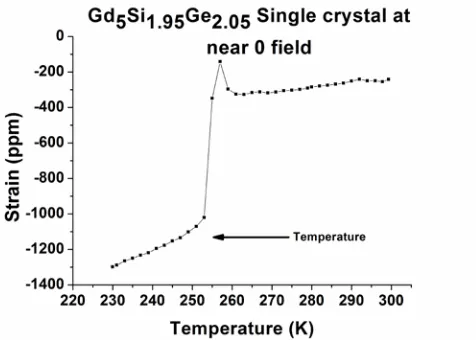
[image:4.612.316.563.274.456.2]Fig. 3. Magnetostrictive strain as a function of temperature for single crystal Gd5Si1.95Ge2.05 sample with nearly zero applied magnetic field showing a sudden increase in the strain of the order of 200 ppm near the field-induced first order phase transition.
Fig. 2. Magnetostrictive strain as a function of magnetic field strength for single crystalline Gd5Si1.95Ge2.05 sample for temperatures ranging from 275 K to 294 K. Note the sudden increase in the strain near the field induced first order phase transition temperatures
[image:4.612.321.559.523.693.2]Fig. 3 shows magnetostrictive strain as a function of temperature at near zero magnetic field strength for single crystalline Gd5Si1.95Ge2.05. It shows a sudden increase in the
strain of the order of 200 ppm close to its first order phase temperature. Fig. 4 shows magnetostrictive strain as a function of magnetic field strength at various temperatures for a polycrystalline Gd5Si1.95Ge2.05 sample. For the polycrystalline
sample the sudden increase in the strain is of the order of 40 ppm which is not as high as for the single crystalline sample due to the anisotropy of strain change related to grain orientations.
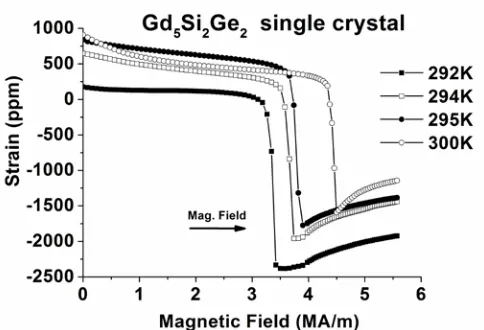
Fig. 5 and Fig. 6 show magnetostrictive strain as a function of temperature at nearly zero field and as a function of magnetic field strength for different temperatures for a single crystalline Gd5Si2Ge2 sample respectively. Fig. 7 and Fig. 8
[image:5.612.317.558.302.464.2]show magnetostrictive strain as a function of temperature and as a function of magnetic field strength for different temperatures for a polycrystalline Gd5Si2.09Ge1.91 sample.
[image:5.612.50.291.304.458.2]Fig. 5. Magnetostrictive strain as a function of temperature for single crystalline Gd5Si2Ge2 sample for temperatures ranging from 250 K to 325 K for nearly zero applied field. Note that there is no indication of fine structure in the measurement.
Fig. 8. Magnetostrictive strain as a function of magnetic field strength for polycrystalline Gd5Si2.09Ge1.91 sample for temperatures ranging from 280 K to 295 K without indicating any fine structure in the measurement.
Fig. 7. Strain as a function of temperature for polycrystalline Gd5Si2.09Ge1.91 sample in the temperature range of 225 K to 325 K without indicating any fine structure in the measurement at 0 applied field.
Fig. 6. Magnetostrictive strain as a function of magnetic field strength for single crystalline Gd5Si2Ge2 sample for temperatures ranging from 292 K to 300 K without showing any fine structure in the measurement.
Fig. 4. Magnetostrictive strain as a function of magnetic field strength for poly crystalline Gd5Si1.95Ge2.05 sample for temperatures ranging from 285 K to 295 K showing a strain change of the order of 40 ppm close to the transition.
[image:5.612.313.557.529.692.2] [image:5.612.48.259.530.691.2]
It can be seen from Figs. 5-8 that unlike the single
crystalline Gd5Si1.95Ge2.05 (Figs. 1-3) and polycrystalline
sample (Fig. 4) in these measurements there is no sudden increase in the strain close to the transition temperature. Out of the four samples measured, the anomaly in the magnetostrictive strain curves was observed only for the
composition Gd5Si1.95Ge2.05 (x=0.487) in both single
crystalline and polycrystalline samples. The anomaly was observed both for magnetostrictive strain versus magnetic field strength and magnetostrictive strain versus temperature measurements, indicating that it is likely not the result of an experimental error in one type of measurement. However this
anomaly was not observed when single crystalline Gd5Si2Ge2
(x=0.5) and polycrystalline Gd5Si2.09Ge1.91 (x=0.522) samples
were measured for both kinds of measurements using the same set of apparatus. This indicates that there is a fine structure in the magnetostrictive curve for the composition Gd5Si1.95Ge2.05
(x=0.487) near its first order phase transition temperature. An extensive search in literature show a similar fine structure in lattice parameters measurements near the first order phase transition along all three major axes, ‘a’, ‘b’ and ‘c’ in the
composition Gd5Si0.4Ge3.6 [13]. Magnetization measurements
on single crystalline Tb5Si2.2Ge1.8 also show similar fine
structures near the first order phase transition [14].
We suggest that this fine structure observation in the
magnetostriction curves for Gd5Si1.95Ge2.05 (x=0.487) is
indicative of differences in switching field strengths for different regions of the material which could be due to the presence of different microscopic inhomogeneous phase or Griffith’s phase. The presence of secondary phase in samples lead to variation in the transition temperature or critical field in field induced phase transition depending on the amount and distribution of the secondary phases. If the secondary phase is evenly distributed in the sample in larger quantities, the global average transition temperature of the sample is different from the single phase material. The transition temperature may not vary if the amount of secondary phase is low and is not distributed evenly. When the secondary phase is large and evenly distributed in the sample and if pure phase occurs locally over a larger grain in the sample, apart from showing variation in transition temperature, the sample will also show anomalies in the measurements. This secondary phase has been referred to as Griffiths-like phase in literature [15] and has been reported in Gd5(SixGe1-x)4 for x=0.1 and Tb5(SixGe1-x)4
for x=0.5 [16] and other similar systems recently [17]. Presence of Griffiths-like phase in a material depends on material preparation method hence some samples may show Griffiths phase while others samples even with the same composition may not show if they are prepared by different methods. First principles investigations are needed to confirm the presence of this phase in Gd5(SixGe1-x)4.
V. CONCLUSION
Fine structure was observed in the magnetostrictive strain as a function of magnetic field strength and temperature near its first order phase transition. This fine structure in magnetostriction was of the order of 200-300 ppm for single crystalline and 40 ppm for polycrystalline Gd5Si1.95Ge2.05
(x=0.487) samples. Observation of this fine structure in the
composition Gd5Si1.95Ge2.05 (x=0.487) is indicative of
differences in switching field strengths for different regions of the material which could be due to the presence of different phases in the sample.
ACKNOWLEDGMENT
Research at Ames Laboratory was supported by the Department of Energy-Basic Energy Sciences (Contract No:
DE-AC02-07CH11358).This work was also supported by the
Barbara and James Palmer Endowment at the Department of Electrical and Computer Engineering of Iowa State University and at Cardiff University by the Royal Society under a Wolfson Research Merit Fellowship.
The authors would like thank Dr. J. E. Snyder of Cardiff University for useful discussions.
REFERENCES
[1] V. K. Pecharsky and K. Gschneidner Jr., “Giant Magnetocaloric Effect in Gd5(Si2Ge2)”, Phys. Rev. Lett., vol. 78, pp. 4494-4497, 1997. [2] K. A. Gschneidner, Jr. and V. K. Pecharsky, “Magnetic refrigeration
materials (invited)”, J. Appl. Phys., vol. 85, pp. 5365-5368, 1999. [3] C. Magen, L. Morellon, P. A. Algarabel, M. R. Ibarra, Z. Arnold, J.
Kamarad, T. A. Lograsso, D. L. Schlagel, V. K. Pecharsky, A. O. Tsokol, K. A. Gschneidner Jr., “Hydrostatic pressure control of the magnetostructural phase transition in Gd5Si2Ge2 single crystals”, Phys. Rev. B, vol. 72, pp. 024416, 2005.
[4] M. Han, D. C. Jiles, J. E. Snyder, T. A. Lograsso, and D. L. Schlagel,
“Giant magnetostriction behavior at the Curie temperature of single crystal Gd5(Si0.5Ge0.5)4”, J. Appl. Phys., vol. 95, pp. 6945-6947, 2004. [5] R. L. Hadimani, P. A. Bartlett, Y. Melikhov, J. E. Snyder, D. C. Jiles,
“Field and temperature induced colossal strain in Gd5(SixGe1-x)4”, J. Magn. Magn. Mater., vol. 323, pp.532-534, 2011.
[6] R. L. Hadimani and D. C. Jiles, “Theory of Irrecoverable and Recoverable Resistivity in Gd5(SixGe1-x)4”, IEEE Magn. Lett., vol. 1, pp. 6000104, 2010.
[7] J. B. Sousa, M. E. Braga, F. C. Correia, F. Carpinteiro, L. Morellon, P. A. Algarabel, M. R. Ibarra, “Anomalous behavior of the electrical resistivity in the giant magnetocaloric compound Gd5(Si0.1Ge0.9)4”, Phys. Rev. B, vol. 67, pp. 134416, 2003.
[8] C. Zimm, A. Jastrab, A. Sternberg, V. K. Pecharsky, K. Gscheidner, Jr., M. Osborne and I. Anderson, “Description and Performance of a Near- Room Temperature Magnetic Refrigerator”, Adv. Cryog. Eng., vol. 43, pp. 1759, 1998.
[9] V. K. Pecharsky and K. A. Gschneidner, Jr., “Phase relationships and crystallography in the pseudobinary system Gd5Si4-Gd5Ge4”, J. Alloys Comp., vol. 260, pp. 98, 1997.
[10] A. O. Pecharsky, K. A. Gschneidner, V. K. Pecharsky, and C. E. Schindler, “The room temperature metastable/stable phase relationships in the pseudo-binary Gd5Si4–Gd5Ge4 system,” J. Alloys Comp., vol. 338, pp. 126-135, 2001.
[11] Ames Laboratory, U.S. Dept. Energy, “Single cystal synthesized at the Materials Preparation Center,” [Online], Available:
www.mpc.ameslab.gov.
[12] R. L. Hadimani, Y. Melikhov, J. E. Snyder, D. C. Jiles, “Field induced structural phase transition at temperatures above the Curie point in Gd5(SixGe1-x)4”, J. Appl. Phys., vol. 105, pp. 07A927, 2009.
[13] L. Morellon, J. Blasco, P. A. Algarabel, and M. R. Ibarra, “Nature of the first-order antiferromagnetic-ferromagnetic transition in the Ge-rich magnetocaloric compounds Gd5(SixGe1-x)4”, Phys. Rev. B, vol. 62, pp. 1022, 2000.
[14] M. Zou, V. K. Pecharsky, K. A. Gschneidner, “Magnetic phase transitions and ferromagnetic short-range correlations in single-crystal Tb5Si2.2Ge1.8”, Phys. Rev. B, vol. 78, pp. 914435, 2008.
[15] T. Vojta, “Rare region effects at classical, quantum and nonequilibrium phase transitions”, J. Phys. A: Math. Gen., vol. 39, pp. R143, 2006. [16] A. M. Pereira, L. Morellon,C. Magen,J. Ventura,P. A. Algarabe, M. R.
Ibarra, J. B. Sousa, and J. P. Araúj, “Griffiths-like phase of magnetocaloric R5(SixGe1−x)4 (R=Gd, Tb, Dy, and Ho)”, Phys. Rev. B, vol. 82, pp. 172406, 2010.
[17] N. Pérez, F. Casanova, F. Bartolomé, L. M. García, A. Labarta, and X. Batlle, “Griffiths-like phase and magnetic correlations at high fields in Gd5Ge4”, Phys. Rev. B, vol. 83, pp. 184411, 2011.