Workshop Report
New molecular methods to assess biodiversity.
Potentials and pitfalls of DNA metabarcoding: a
workshop report
Maria Kahlert, Anders Alfjorden, Katherine Apunte-Ramos , Bonnie Bailet, Javier Pérez Burillo , Andrea Greta Carrera Gonzalez , David Castro , Cecilia Di Bernardi, Verena Dully, Judit Fekete , Larissa Frühe, Raquel González , Eirini Gratsia, Jasna Hanjalić , Jasmina Kamberović , Ann-Marie Kelly , Carlotta Meriggi, Ilkka Nousiainen , Sarah B. Ørberg, James Orr, Cintia O. Quintana , Athina Papatheodoulou , Jasmina Sargac, Muhammad Shahbaz , Kálmán Tapolczai , Katarina Tosic , Isa Wallin, Maša Zupančič , Patrik Bohman , Pier Luigi Buttigieg , Norbert Häubner , Florian Leese , Jan Niklas Macher , Sari Peura , Tomas Roslin , Malin Strand , Olle Terenius, Valentin Vasselon , Alexander M. Weigand
‡ Swedish University of Agricultural Sciences, Department of Aquatic Sciences and Assessment, PO Box 7050, 750 07 Uppsala, Sweden
§ Uppsala University, Uppsala, Sweden | University College Ghent, Ghent, Belgium
¶ Universidad Regional Amazónica Ikiam, Tena, Ecuador
# Swedish University of Agricultural Sciences, Department of Aquatic Sciences and Assessment, Uppsala, Sweden ¤ Universitat Rovira i Virgili, Tarragona, Spain
« Institute of Agrifood Research and Technology (IRTA), Tarragona, Spain » Swedish University of Agricultural Sciences, Umeå, Sweden
˄Swedish University of Agricultural Sciences, Department of Ecology, Grimsö, Sweden
˅University of Kaiserslautern, Kaiserslautern, Germany ¦ University of Pannonia, Veszprém, Hungary
ˀDanube Research Institute, Debrecen, Hungary
ˁLaboratorios Tecnológicos de Levante, S.L, Valencia, Spain
₵University of Valencia, Valencia, Spain
ℓ Hellenic Centre for Marine Research, Crete, Greece
₰University of Sarajevo - Institute for genetic engineering and biotechnology, Sarajevo, Bosnia and Herzegovina ₱University of Tuzla, Faculty of Natural Sciences and Mathematics, Tuzla, Bosnia and Herzegovina
₳University College Dublin, Dublin, Ireland
₴Estonian University of Life Sciences, Tartu, Estonia
₣ Aarhus University, Department of Bioscience, Silkeborg, Denmark
₮School of Natural Sciences, Trinity College Dublin, The University of Dublin, Dublin, Ireland ₦Department of Biology, University of Southern Denmark, Odense M, Denmark
₭Open University of Cyprus, Environmental Conservation and Management Unit, Nicosia, Cyprus
₲Swedish University of Agricultural Sciences , Uppsala, Sweden
‽Swedish University of Agricultural Sciences, Department of Soil Sciences, Uppsala, Sweden
₩Hungarian Academy of Sciences (MTA) - Premium Postdoctoral Research Program, Budapest, Hungary
₸University of Pannonia, Department of Limnology, Veszprém, Hungary ‡‡ Danube Delta National Institute for Research and Development, Tulcea, Romania §§ Faculty of Biology, University of Belgrade, Belgrade, Serbia
|| Swedish University of Agricultural Sciences, Department of Aquatic Resources, Öregrund, Sweden ¶¶ National Institute of Biology, Ljubljana, Slovenia
‡ § |,¶ #
¤,« |,¶ » ˄ ˅
¦,ˀ ˅ ˁ,₵ ℓ ₰
₱ ₳ # ₴ ₣
₮ ₦ ₭ ₲ ‽
₩,₸ ‡‡,§§ || ¶¶ ##
¤¤ «« »» ˄˄ ˅˅
## ¦¦,ˀˀ § ˁˁ ₵₵
Reviewable v1 ## Swedish University of Agricultural Sciences, Uppsala, Sweden
¤¤ Max Planck Institute for Marine Microbiology, Bremen, Germany «« Swedish Agency for Marine and Water Management, Gothenburg, Sweden »» University of Duisburg-Essen, Essen, Germany
˄˄Naturalis Biodiversity Center, Leiden, Netherlands
˅˅Swedish University of Agricultural Sciences, Department of Forest Mycology and Plant Pathology, Uppsala, Sweden ¦¦ Swedish University of Agricultural Sciences, Swedish Species Information Centre, Uppsala, Sweden
ˀˀSweBOL, Uppsala, Sweden
ˁˁAFB, Pôle R&D « ECLA » - Site INRA UMR CARRTEL, Thonon-Les-Bains, France
₵₵Musée National d'Histoire Naturelle, Luxembourg, Luxembourg
Corresponding author: Maria Kahlert ([email protected]), Florian Leese ([email protected])
Received: 08 Aug 2019 | Published: 08 Aug 2019
Citation: Kahlert M, Alfjorden A, Apunte-Ramos K, Bailet B, Pérez Burillo J, Carrera Gonzalez AG, Castro D, Di Bernardi C, Dully V, Fekete J, Frühe L, González R, Gratsia E, Hanjalić J, Kamberović J, Kelly A-M, Meriggi C, Nousiainen I, Ørberg SB, Orr J, Quintana CO, Papatheodoulou A, Sargac J, Shahbaz M, Tapolczai K, Tosic K, Wallin I, Zupančič M, Bohman P, Buttigieg PL, Häubner N, Leese F, Macher JN, Peura S, Roslin T, Strand M, Terenius O, Vasselon V, Weigand AM (2019) New molecular methods to assess biodiversity. Potentials and pitfalls of DNA metabarcoding: a workshop report. Research Ideas and Outcomes 5: e38915. https://doi.org/10.3897/rio.5.e38915
Abstract
This report presents the outcome of the joint work of PhD students and senior researchers working with DNA-based biodiversity assessment approaches with the goal to facilitate others the access to definitions and explanations about novel DNA-based methods. The work was performed during a PhD course (SLU PNS0169) at the Swedish University of Agricultural Sciences (SLU) in Uppsala, Sweden. The course was co-organized by the EU COST research network DNAqua-Net and the SLU Research Schools Focus on Soils and Water (FoSW) and Ecology - basics and applications. DNAqua-Net (COST Action CA15219, 2016-2020) is a network connecting researchers, water managers, politicians and other stakeholders with the aim to develop new genetic tools for bioassessment of aquatic ecosystems in Europe and beyond. The PhD course offered a comprehensive overview of the paradigm shift from traditional morphology-based species identification to novel identification approaches based on molecular markers. We covered the use of molecular tools in both basic research and applied use with a focus on aquatic ecosystem assessment, from species collection to the use of diversity in environmental legislation. The focus of the course was on DNA (meta)barcoding and aquatic organisms. The knowledge gained was shared with the general public by creating Wikipedia pages and through this collaborative Open Access publication, co-authored by all course participants.
Keywords
Date and place
The intensive, week-long PhD course workshop was held from 25 to 29 of March 2019 at the Swedish University of Agricultural Sciences (SLU) in Uppsala, Sweden. The entire course period, including the individual and independent contributions before and after the workshop, lasted from March 8 to May 31 2019 (Fig. 1).
Introduction
This workshop report gives an overview of the outcomes of the SLU PhD course PNS0169 held in March 2019. As we assume that the course content, i.e. a basic introduction to DNA (meta)barcoding and its application in environmental monitoring and assessment, is of interest to a broader audience, we decided to share this information by editing and creating public Wikipedia pages, and a Suppl. material 1 with common terms. To explain the background and to summarize the actual work within the course, we publish the course content and outcome as a workshop report.
The course was co-organized by the EU COST Action DNAqua-Net (CA15219), a transdicsiplinary and international network that aims to develop new genetic tools for
th th
th st
Figure 1.
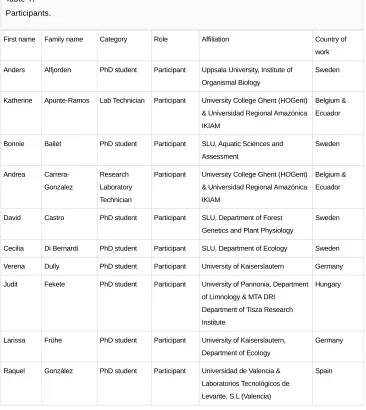
bioassessment of aquatic ecosystems in Europe and beyond, and the SLU Research Schools Focus on Soils and Water (FoSW) and Ecology - basics and applications. The course attracted 27 participants from 14 countries, and teachers were researchers from SLU and other organisations, among them from DNAqua-Net (Fig. 2, Table 1). The schedule included drafting content for the Wikipedia page on DNA barcoding as well as on metabarcoding of different organism groups, and creating definitions for some common terms (find the syllabus here) used in organism identification (traditional and molecular). The resulting texts were further developed into full Wikipedia pages and into this workshop report, both during the intense course week at SLU in Uppsala and as joint homework after the course.
First name Family name Category Role Affiliation Country of work Anders Alfjorden PhD student Participant Uppsala University, Institute of
Organismal Biology
Sweden
Katherine Apunte-Ramos Lab Technician Participant University College Ghent (HOGent) & Universidad Regional Amazónica IKIAM
Belgium & Ecuador
Bonnie Bailet PhD student Participant SLU, Aquatic Sciences and Assessment
Sweden
Andrea Carrera-Gonzalez
Research Laboratory Technician
Participant University College Ghent (HOGent) & Universidad Regional Amazónica IKIAM
Belgium & Ecuador
David Castro PhD student Participant SLU, Department of Forest Genetics and Plant Physiology
Sweden
Cecilia Di Bernardi PhD student Participant SLU, Department of Ecology Sweden Verena Dully PhD student Participant University of Kaiserslautern Germany Judit Fekete PhD student Participant University of Pannonia, Department
of Limnology & MTA DRI Department of Tisza Research Institute
Hungary
Larissa Frühe PhD student Participant University of Kaiserslautern, Department of Ecology
Germany
Raquel González PhD student Participant Universidad de Valencia & Laboratorios Tecnológicos de Levante, S.L (Valencia)
Spain
Table 1.
Eirini Gratsia PhD student Participant Hellenic Centre for Marine Research, Institute of Marine Biology, Biotechnology and Aquaculture
Greece
Jasna Hanjalić PhD student Participant University of Sarajevo - Institute for Genetic Engineering and Biotechnology
Bosnia and Herzegovina
Jasmina Kamberović Senior researcher
Participant University of Tuzla, Faculty of Natural Sciences and Mathematics
Bosnia and Herzegovina Ann-Marie Kelly PhD student Participant University College Dublin Ireland Carlotta Meriggi PhD student Participant SLU, Aquatic Sciences and
Assessment
Sweden
Ilkka Nousiainen PhD student Participant Estonian University of Life Sciences Estonia Cintia Organo Post-doc Participant University of Southern Denmark,
Department of Biology
Denmark
James Orr PhD student Participant Trinity College Dublin Ireland Athina Papatheodoulou PhD student Participant Open University of Cyprus,
Environmental Conservation and Management Unit
Cyprus
Javier Pérez Burillo PhD student Participant Universitat Rovira i Virgili, Dept. of Geography & IRTA
Spain
Jasmina Sargac PhD student Participant SLU, Aquatic Sciences and Assessment
Sweden
Muhammad Shahbaz Post-doc Participant SLU, Department of soil and environment
Sweden
Kálmán Tapolczai Post-doc Participant University of Pannonia Hungary Katarina Tosic PhD student Participant Danube Delta National Institute for
Research and Development, Tulcea Romania
Isa Wallin PhD student Participant SLU, Dept. of Aquatic Resources Sweden Maša Zupančič MSc student Participant National Institute of Biology Slovenia Sarah B. Ørberg PhD student Participant Aarhus University, Department of
Bioscience
Denmark
Patrik Bohman Senior researcher
Teacher SLU, Dept. of Aquatic Resources Sweden
Norbert Häubner Investigator Teacher The Swedish Agency for Marine and Water Management, SwAM (HaV)
Florian Leese Professor Teacher University of Duisburg-Essen Germany Björn Lindahl Professor Teacher SLU, Dept. of Soil SciencesSweden Sweden Jan-Niklas Macher Senior
researcher
Teacher Naturalis Biodiversity Center, Leiden
The Netherlands
Sari Peura Associate
professor
Teacher SLU, Dept. of Forest Mycology and Plant Pathology
Sweden
Tomas Roslin Professor Teacher SLU, Dept. of Ecology Sweden Malin Strand Associate
professor
Teacher SLU, ArtDatabanken Sweden
Olle Terenius Senior researcher
Teacher Uppsala University Sweden
Valentin Vasselon Senior researcher
Teacher AFB, Thonon-les-Bains INRA France
Maria Kahlert Associate professor
Organisator & Teacher
SLU, Dept. of Aquatic Science and Assessment
Sweden
Figure 2.
Aims
The main aim of the course was to give the students an insight into the paradigm shift from traditional morphology-based species identification to novel organism-identification approaches based on molecular markers. The course topics also included basic understanding of DNA (meta)barcoding and its potentials and pitfalls. In a broad sense, the course also aimed to educate the public, including interested stakeholders, by using the joint efforts of the students and teachers to create public information on the course topics. The aim of the course was to provide an overview of identification tools and methods currently used in environmental monitoring and research, including recent advances and challenges. The course touched on aquatic organisms, freshwater and marine, and provided additional sources for more information regarding certain organism groups as well as tools and methods. During the course, the students actively acquired information about the ongoing paradigm shift in identifying aquatic organisms for biodiversity and environmental assessment. With this information, the students should now be able to critically evaluate studies that utilized DNA-based taxonomy, and to judge in which contexts DNA-based results might differ from traditionally obtained ones. The students also got the opportunity to work on their own project as a supplementary, optional part of the course. While the course had an aquatic focus, the methodology is universal, and non-aquatic approaches were covered as well.
Key outcomes and discussions
The knowledge gained about the paradigm shift from traditional morphology-based species identification to the use of novel molecular methods was summarized by creating public Wikipedia pages, a Glossary, and this collaborative Open Access publication coauthored by all workshop participants.
Wikipedia pages
Instead of ordinary examinations, the course required an active participation in creating or editing Wikipedia pages about DNA barcoding. To ensure their content quality, the PhD students and senior researchers (the teachers) worked jointly on those pages during and after the course. In this way we aimed at high quality and relevant content to inform the public, stakeholders and other researchers about the ongoing paradigm shift in identifying aquatic organisms for biodiversity and environmental assessment, and to learn about advances and challenges. In combination with a Glossary, which was also created as a course outcome, we hope that our work can help not only the participants of the course, but also a broader public, to gain knowledge about DNA (meta)barcoding and its application potential. The edited or newly created Wikipedia pages are:
• DNA barcoding
• Algae DNA barcoding
• Fish DNA barcoding
• Aquatic macroinvertebrate DNA barcoding
• DNA barcoding in diet assessment
Glossary: terms related to traditional and molecular identification
During the course participants discussed terms related to traditional and molecular identification and the PhD students defined these terms in discussions with the teachers in their own words, or based on existing definitions from other sources. We hope that this Glossary (Suppl. material 1) can provide a good introductory overview of both traditional and molecular terms often used in the context of taxonomic identification.
Funding program
1. COST Action CA15219, 2016-2020 ("DNAqua-Net").
2. Faculty funding for SLU Research Schools of the Swedish University of Agricultural Sciences.
Grant title
1. DNAqua-Net.
2. SLU NJ-faculty research shools.
Hosting institution
Swedish University of Agricultural Sciences (SLU) in Uppsala, Sweden
Author contributions
All authors contributed jointly to the content of this report.
Conflicts of interest
Supplementary material
Suppl. material 1: Glossary: terms related to traditional and molecular bioassessment
Authors: PhD students of the SLU course PNS0169, in 2019
Data type: Glossary with definitions in students' own words
Brief description: Given terms related to traditional and molecular identification, the PhD students were asked to define them in their own words using external sources. Terms were defined by the course participants under supervision of the senior researchers. Please use the glossary as a first help and overview, not as an authoritative source. Be assured, there are many definitions out there!