Drymaria veliziae
(Caryophyllaceae), a new species
from the Andes of Cajamarca (North Peru)
Daniel B. Montesinos-Tubée1,2,3, Carolina Tovar4, Gustavo Iberico-Vela5,
Juan Montoya-Quino5, Isidoro Sanchez-Vega5†
1 Naturalis Biodiversity Centre, Darwinweg 2, 2333 CR Leiden, The Netherlands 2 Instituto Científico Mi-chael Owen Dillon, Av. Jorge Chávez 610, Cercado, Arequipa, Perú 3 Instituto de Ciencia y Gestión Ambiental de la Universidad Nacional de San Agustín de Arequipa, Calle San Agustín 108, Arequipa-Perú 4 Royal Bota-nic Gardens, Kew, The Jodrell Laboratory, Royal BotaBota-nic Gardens, Kew, Surrey TW9 3DS, UK 5 Universidad Nacional de Cajamarca, Herbario CPUN, Departamento de Biología, Cajamarca, Perú
Corresponding author:Daniel B. Montesinos-Tubée ([email protected])
Academic editor:G.G. del Galdo | Received 29 October 2019 | Accepted 20 January 2020 | Published 24 February 2020
Citation: Montesinos-Tubée DB, Tovar C, Iberico-Vela G, Montoya-Quino J, Sanchez-Vega I (2020) Drymaria veliziae
(Caryophyllaceae), a new species from the Andes of Cajamarca (North Peru). PhytoKeys 140: 47–56. https://doi. org/10.3897/phytokeys.140.47738
Abstract
A new species from the Northern Peruvian Andes (Cajamarca department), Drymaria veliziae sp. nov., is proposed in the present paper. It grows in the high-elevation montane grasslands and it is morphologically similar to D. auriculipetala from which it differs in having elliptic-ovate leaves, blade margin bases glandular, large number of stipules arranged in a pedicel form at the leaf axis and by the short and glandular pedicels. A detailed description, original photographs and a location map are provided, as well as an updated diagnostic key of Drymaria Ser. Frutescens. The IUCN status of the new species is assessed as Endangered (EN).
Keywords
Andes, Cajamarca, new species, Caryophyllaceae
Introduction
The genus Drymaria Willd. ex Schult. (Caryophyllaceae Juss.) contains 48 species mainly distributed in subtropical regions of the Western Hemisphere (see the most recent revision of the genus by Duke 1961), whereas one species (Drymaria cordata http://phytokeys.pensoft.net
Copyright D.B. Montesinos-Tubée et al. This is an open access article distributed under the terms of the Creative Commons Attribution License (CC BY 4.0), which permits unrestricted use, distribution, and reproduction in any medium, provided the original author and source are credited.
Daniel B. Montesinos-Tubée et al. / PhytoKeys 140: 47–56 (2020) 48
Willd. ex Schult.) is widespread, occurring in Asia, Africa, Oceania, and Madagascar (Villarreal and Estrada 2008). Duke (1961) recognised 17 Series but they were not val-idly published because Latin diagnoses were not given (nomina nuda; see Art. 38.2 Ex. 1 of ICN, Turland et al. 2018) (see Hartman 2005 and Villarreal and Estrada 2008). After Duke (l.c.), no studies have been made on Peruvian Drymaria taxa.
Concerning the molecular data, those available for Drymaria are included in the large phylogenetic study of Caryophillaceae by Greenberg and Donoghue (2011), but here no Andean species of Drymaria were involved.
On the basis of some authors (Macbride 1937; Brako and Zarucchi 1993) and our ongoing studies (Montesinos-Tubée in prep.), 24 Drymaria species (including 18 infraspecific taxa) are expected to occur in the Peruvian Andes.
As part of the ongoing floristic and taxonomic studies on Peruvian Flora (Montes-inos-Tubée 2013; Montes(Montes-inos-Tubée and Kool 2015; Montes(Montes-inos-Tubée et al. 2018), we found an interesting population belonging to the genus Drymaria which, however, cannot be identified with any of the currently known species. We, therefore, decided to propose a new species for Science.
Material and methods
Specimens of Drymaria, housed in many South American and other herbaria (B, CUZ, F, HSP, HUT, HUSA, K, L, LP, LPB, MOL, P, SI, SGO, USM, WAG; acronyms ac-cording to Thiers 2019+), were studied by the first author (DBM-T). Additionally, field surveys were carried out. Specimen information (including digital images) were searched using online sources such as GBIF (2019), JSTOR Global Plants (2019), Tropicos (2019) and herbarium databases of several herbaria.
Morphological characters were studied using a NSZ-405 1X-4.5X stereomicro-scope and an AmScope M100CLED 40×-1000× compound microstereomicro-scope. Conservation assessments were undertaken using the IUCN Red List Criteria (IUCN 2019). The monograph by Duke (1961) was used as the basic reference to describe the new species.
Results and discussion
Drymaria veliziae Montesinos, sp. nov. urn:lsid:ipni.org:names:77206319-1 Figs 2, 3
Type. Peru. Cajamarca: Cajamarca: Encañada: Chanta baja, on sandy clay loam soils amongst shrub species and tussock grasslands, close to agricultural lands, 3295 m elev., slope of 60% and rock cover of 35%, 6°49’56’’S, 78°30’20’’W (DMS). 06 June 2009,
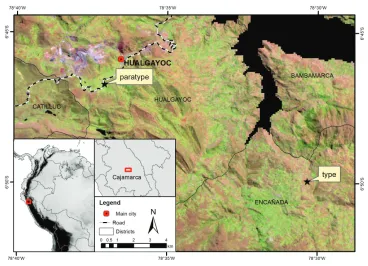
Figure 1. Location map of the type and paratype collection localities. Background: LANDSAT 5TM satellite image (June 2007) where light brown-pink areas represent Jalca grasslands, light green areas are agricultural fields and purple represents mining areas.
Diagnosis.Drymaria veliziae is similar to D. auriculipetala Mattf. from which it differs in having glands covering the stems and pedicels, leaves with elliptic-ovate form, shorter in size (4–5.5 mm vs. 5–15 mm in D. auriculipetala), by the leaves arranged in fascicules (vs. simple opposite leaves), stipules in numbers of 14–20 per axis (vs. 2–4
in D. auriculipetala), pedicel size (1–2 mm long vs. 5–40 mm) and by the capsule size
being smaller (1.4–1.6 mm vs. 3–4 mm).
trans-Daniel B. Montesinos-Tubée et al. / PhytoKeys 140: 47–56 (2020) 50
Figure 2. Holotype of Drymaria veliziae (CPUN-22705!).
Figure 3. A. Internode and leaf arrangements B glandular stems C crown of stipules at the leaf axis
Daniel B. Montesinos-Tubée et al. / PhytoKeys 140: 47–56 (2020) 52
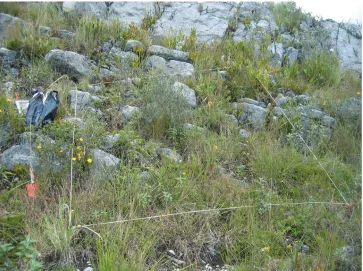
Figure 4. Quadrat where the new species was found. Chanta baja, Encañada District, 3295 m elev. Photo by Carolina Tovar.
5–6 mm long × 2–2.2 mm width, glabrous, elliptic-ovate, apex apiculate and aristate, basally truncate, 3–5 nerved; petals 5, 5–7 mm long × 1.8–2.2 mm width, bifid about half their length, elliptic, apex rounded, 1–1.2 mm width, 8–10 nerved, constricted at the junction of the lobes; stamens 5, 2–2.2 mm long, anthers oblong, 0.2–0.3 mm long; ovary roundish, 1–1.4 mm long, slightly exceeded by the anthers; style 1–1.2 mm long, trifid about half its length, stigmatic branches twisted or coiled. Capsule ovoid, 1.4–1.6 mm long, 5–8 seeded. Seeds roundish, reniform, 0.6–0.9 mm long × 0.6–0.8 mm wide, granulate, ventral surface with roundish-acute tubercles, black to dark brown in colour.
Paratype: Peru: Cajamarca: Hualgayoc: Hualgayoc, less than 1 km from the Gold-field mine, surrounded by agricultural Gold-fields downslope, found on sandy clay loam soils, 3715 m elev., 6°46’43’’S (DMS) and 78°37’5’’W (DMS), 100% slope and 5% rock cover. 01 June 2009, C. Tovar 909 (CPUN–22858!).
Ecology and distribution: Drymaria veliziae grows on steep mountain cliffs (slope 60–100%) on sandy clay loam soils at an elevation of 3295–3715 m on the eastern slopes of the Jalca, on the headwaters of the Llaucano River, tributary of the Marañon River. Climatic characteristics for the localities of the type and paratype, extracted from the CHELSA climatology (Karger et al. 2017), show mean annual temperatures in these areas are 8.5–11.5°C, with minimum temperatures estimated between 1.8 and 5°C. Total annual precipitation ranges from 900 to 1200 mm with driest months receiving 16–28 mm. Other species found in the two localities were Hieracium perua-num Fr. (Asteraceae), Hypochaeris taraxacoides (Meyen & Walp.) Ball (Asteraceae) and
Calamagrostis spp. (Poaceae). In the type locality of Drymaria veliziae (Fig. 4), it has
been observed that it grows associated with shrubs (e.g. Coreopsis senaria S.F. Blake & Sherff (Asteraceae), Achyrocline celosioides (Kunth) DC. (Asteraceae), Ageratina
cuter-vensis (Hieron.) R.M. King & H. Rob. (Asteraceae)), tussock grasses (Calamagrostis
and Festuca spp. (Poaceae)) and an orchid (e.g. Masdevallia spp.), amongst others. The
locality of the paratype, being at higher altitude, had less species richness and associated species with D. velizzii were Geranium peruvianum Hieron. (Geraniaceae), Calceolaria
concava Molau (Calceolariaceae), Chrysactinium acaule (Kunth) Wedd. (Asteraceae),
Euphorbia huanchahana (Klotzsch & Garcke) Boiss. (Euphorbiaceae), amongst others.
Taxonomical notes. On the basis of the classification proposed by Duke (1961),
Drymaria veliziae would belong to the ser. Frutescens Duke sharing the leaf shape
(lin-ear to lanceolate) glandular pedicels, the number of sepal nervadures (3–5) and petals bifid which are not tapered to the claw.
Drymaria veliziae is morphologically similar to D. auriculipetala Mattf. (1936:
438–439) but differs in having glands covering the stems and pedicels, leaves with ellip-tic-ovate form, shorter in size, by the leaves arranged in fascicules (vs. simple opposite leaves), stipules larger numbers per axis, shorter pedicel size and smaller capsule size.
Furthermore, Drymaria veliziae differs from D. stereophylla Mattf. (1936: 436–437) by the plant habit, the glabrous surface of the leaves (vs. presence of glands and puberu-lent trichomes in D. stereophylla), bifid or trifid stipules (vs. entire), shorter stamen size (2–2.2 mm vs. 4–6 mm), shorter style size (1–1.2 mm vs. 1–2.5 mm), capsule size short-er (1.4–1.6 vs. 2.5–3.5 mm) and seed size (0.6–0.9 vs. 0.9–1.3 mm in D. stereophylla).
The new species is further differentiated from D. stellarioides Willd. ex Schult. (1819: 406) by the stipule form (bifid to trifid vs. entire), shorter bract size (2.5–3 mm vs. 3–5 mm in D. stellarioides), sepals glabrous (vs. glabrous to densely glandular-puberulent) and shorter capsule size and form (1.4–1.6 mm, ovoid vs. 3–5 mm long, ellipsoid).
Daniel B. Montesinos-Tubée et al. / PhytoKeys 140: 47–56 (2020) 54
1 Pedicels and sepals present and glabrous, sepals (3-)5-nerved ...2 – edicels and sepals present or absent, glabrous or glandular, sepals 3-nerved....3 2 Leaves imbricate, closely appressed to the stems, 2–6 mm long, 1–1.5 mm
broad, basally clasping and pungently acute; the sepals mostly 5-nerved; pet-als tapered to the claw ...D. frutescens
– Leaves not imbricate, 4–12 mm long, 2–6 mm broad, apically acute to aristately acuminate; the sepals 3–4-nerved; petals not tapered to the claw .... ...D. stereophylla
3 Pedicels and sepals usually glandular, leaves glabrous, apically aristate-attenu-ate, aristate and basally cuneate; stipules present; seeds with domical or coni-cal tubercles ...4 – Pedicels and sepals glabrous to densely glandular-puberulent; leaves apically
acute and marginally entire, densely glandular-puberulent; stipules entire, ap-parently fused or occasionally absent; seeds without domical tubercles ... ...D. stellarioides
4 Bracts absent, simple opposite leaves, pedicels 5–40 mm long, stipules copi-ously shorter than the leaves; glabrous pedicels and stems, short number of pedicels per axis (2–4) ...D. auriculipetala
– Bracts present; leaves arranged in fascicules; pedicels 1–2 mm long, glands covering the stems and pedicels; leaves with elliptic-ovate form, large number of pedicels per axis (14–20) ...D. veliziae
Conservation status. Only the two localities referring to holotype and paratype are currently known for Drymaria veliziae (these localities are separated by about 12 km). The surrounding areas are characterised by various types of human activities, for example, agriculture, land conversion, forestry with exotic species, slash burning, natu-ral resource extraction, amongst others (Figure 1). Land use change occurred between 1987 and 2007 with a reduction of the 25% of grasslands and an increasing of land-scape fragmentation (see Tovar et al. 2013). The type specimen was collected on a Jalca patch surrounded by agricultural fields (Vicia faba L. (Fabaceae), Solanum tuberosum
L. (Solanaceae), Zea mays L. (Poaceae)), while the paratype was collected in a smaller patch less than 1 km distant from a mining area developed after 1987. A total of 110 vegetation plots were sampled across the Jalca in 2007 (Tovar et al. 2012) and the new species was found in only two of them. Using the criteria B1a and B1b of the IUCN (2019), we assessed D. veliziae as Endangered species (EN).
Acknowledgements
CONDESAN and the Universiteit van Amsterdam for their financial support to carry out the fieldwork that led to this collection. Thanks also to E. Cabrera (Cajamarca, Peru) and C. Aguilar (Cajamarca, Peru) for their assistance in the collection and to V. Campos (Herbario Nacional de Cajamarca, Cajamarca, Peru) for his help in the Herbarium of Cajamarca. We are also grateful to J. Duivenvoorden (Amsterdam, The Netherlands) and A. Cleef from the University of Amsterdam (Amsterdam, The Neth-erlands) for their supervision, support and advice during the project in which the spe-cies was collected. We finally thank M. Way and A. Di Sacco (Royal Botanic Gardens, Kew, UK) for providing the magnified lens and L. Hudson (Royal Botanic Gardens, Kew, UK) and K. Zevallos (Arequipa, Peru) for their help with the editing of pictures.
References
Brako L, Zarucchi J (1993) Catalogue of the Flowering Plants and Gymnosperms of Peru. Monographs in Systematic Botany from the Missouri Botanical Garden 45: 1–1286. Duke JA (1961) Preliminary revision of the genus Drymaria. Annals of the Missouri Botanical
Garden 48(3): 173–268. https://doi.org/10.2307/2394953
GBIF (2019) Global Biodiversity Information Facility. https://www.gbif.org/es/ [accessed: 10 December 2019]
Greenberg AK, Donoghue MJ (2011) Molecular systematics and character evolution in Caryo-phyllaceae. Taxon 60(6): 1637–1652. https://doi.org/10.1002/tax.606009
Hartman RL (2005) Drymaria. In: Flora of North America Editorial Committee (Eds) 1993+. Flora of North America North of Mexico 12+ vols. New York and Oxford, vol. 5, 9–14. IUCN (2019) The IUCN Red List of Threatened Species. Version 2019-2.
http://www.iucn-redlist.org [accessed: 18 July 2019]
Global Plants JSTOR (2019) JSTOR Global Plants. http://plants.jstor.org/ [accessed: 15 Oc-tober 2019]
Karger DN, Conrad O, Bohner J, Kawohl T, Kreft H, Soria-Auza RW, Zimmermann N, Linder HP, Kessler M (2017) Climatologies at high resolution for the earth’s land surface areas. Scientific Data 4(1): 170122. https://doi.org/10.1038/sdata.2017.122
Macbride JF (1937) Caryophyllaceae, Flora of Peru. Publications of Field Museum of Natural History, Botanical Series 13: 617–626.
Mattfeld J (1936) Einige neue Drymaria-Arten aus Peru. Notizblatt des Königl. Botanischen Gartens und Museums zu Berlin 13(118): 436–444. https://doi.org/10.2307/3995022 Montesinos-Tubée DB (2013) Paronychia ubinensis (Caryophyllaceae: Paronychioideae) a new
species from Moquegua, South Peru. Phytotaxa 124(1): 50–54. https://doi.org/10.11646/ phytotaxa.124.1.6
Montesinos-Tubée DB, Kool A (2015) Arenaria acaulis (Caryophyllaceae), a new species from South Peru. Phytotaxa 220(1): 77–82. https://doi.org/10.11646/phytotaxa.220.1.7 Montesinos-Tubée DB, Cano A, García-Llatas L, Ju Y, Kool A (2018) Paronychia sanchez-vegae
Daniel B. Montesinos-Tubée et al. / PhytoKeys 140: 47–56 (2020) 56
Schultes JA (1819) Caroli a Linné equitis Systema Vegetabilium secundum Classes, Ordenes, Genera, Species cum characteribus, dipferentiis et synonimiis. Stuttgardtiae 5: 406. Thiers B (2016) Index Herbariorum: A global directory of public herbaria and associated staff.
New York Botanical Garden's Virtual Herbarium. http://sweetgum.nybg.org/ih
Tovar C, Duivenvoorden JF, Sánchez-Vega I, Seijmonsbergen AH (2012) Recent changes in patch characteristics and plant communities in the Jalca grasslands of the Peruvian Andes. Biotropica 44(3): 321–330. https://doi.org/10.1111/j.1744-7429.2011.00820.x
Tovar C, Seijmonsbergen AC, Duivenvoorden JF (2013) Monitoring land use and land cover change in mountain regions: An example in the Jalca grasslands of the Peruvian Andes. Landscape and Urban Planning 112: 40–49. https://doi.org/10.1016/j.landurb-plan.2012.12.003
Tropicos (2019) Tropicos.org. Missouri Botanical Garden. Available from: http://www.tropi-cos.org/ [accessed: 10 October 2019]
Turland NJ, Wiersema JH, Barrie FR, Greuter W, Hawksworth DL, Herendeen PS, Knapp S, Kusber W-H, Li D-Z, Marhold K, May TW, McNeill J, Monro AM, Prado J, Price MJ, Smith GF (2018) International Code of Nomenclature for algae, fungi, and plants (Shenz-hen Code) adopted by the Nineteenth International Botanical Congress S(Shenz-henz(Shenz-hen, China, July 2017. Koeltz Botanical Books. https://doi.org/10.12705/Code.2018