The Thirty-Third AAAI Conference on Artificial Intelligence (AAAI-19)
Tackling Sparse Rewards in Real-Time
Games with Statistical Forward Planning Methods
Raluca D. Gaina, Simon M. Lucas, Diego P´erez-Li´ebana
Queen Mary University of London, UK{r.d.gaina, simon.lucas, diego.perez}@qmul.ac.uk
Abstract
One of the issues general AI game players are required to deal with is the different reward systems in the variety of games they are expected to be able to play at a high level. Some games may present plentiful rewards which the agents can use to guide their search for the best solution, whereas others feature sparse reward landscapes that provide little informa-tion to the agents. The work presented in this paper focuses on the latter case, which most agents struggle with. Thus, modi-fications are proposed for two algorithms, Monte Carlo Tree Search and Rolling Horizon Evolutionary Algorithms, aiming at improving performance in this type of games while main-taining overall win rate across those where rewards are plen-tiful. Results show that longer rollouts and individual lengths, either fixed or responsive to changes in fitness landscape fea-tures, lead to a boost of performance in the games during test-ing without betest-ing detrimental to non-sparse reward scenarios.
1
Introduction
When testing Artificial Intelligence agents on multiple dis-tinct games in a general game playing black box setting, the main difficulty the players face is being able to correctly judge and differentiate situations. Most games cannot be fully explored until the end due to their complexity in ac-tion space, state space or both.
If the algorithm is targeted at a particular game, human knowledge about the problem can be integrated into the heuristic function in order to effectively guide the search in the right direction, even if no “natural” rewards (from the game) are observed by the agent. However, the lack of do-main knowledge in general video game playing poses a sig-nificant challenge on how to bias or guide the search effec-tively in the case of a mostly flat reward landscape (Perez, Samothrakis, and Lucas 2014).
The main goal of this paper is to analyze potential im-provements on agents for sparse reward games, but still keep a similar overall performance in those games where rewards are found more often. We study this in the context of Statisti-cal Forward Planning algorithms: Monte Carlo Tree Search and Rolling Horizon Evolution. These offer high perfor-mance and rapid adaptation for general video game playing.
Copyright c2019, Association for the Advancement of Artificial Intelligence (www.aaai.org). All rights reserved.
In this paper we propose modifications that alter how far the agents can simulate into the future in two different ways. First, we increase the length of the simulations the algo-rithms are allowed to make (while stretching the budget per game tick accordingly) to test if the agents are able to solve sparse rewards problems better when they are able to see further ahead. And second, we dynamically vary the length of the simulations within a predefined budget per game tick, depending on the flatness of the reward landscape, in order to examine the algorithm’s ability to adapt to the various types of problems proposed.
Two base methods are evaluated on20real-time games in the General Video Game AI Framework (GVGAI), Monte Carlo Tree Search (MCTS) and Rolling Horizon Evolution-ary Algorithms (RHEA), which have recently proven most competitive in this domain. Additionally, all algorithms and variations are evaluated on 5 further deceptive games, the same analysed in (Anderson et al. 2018).
2
Literature Review
The problem tackled in this paper refers to the variety of reward landscapes in games and how most current gen-eral methods are not equipped to handle this. Anderson et al. (Anderson et al. 2018) highlight deceptive reward sys-tems in games (i.e. by introducing score gains which guide the AI player away from winning the game), using agents from the General Video Game AI Competition (GVGAI) to show that AI game players can be easily tricked into not finding the optimal solution. Companez et al. (Companez and Aleti 2016) look at enhancements for Monte Carlo Tree Search in Tic-Tac-Toe variations meant to overcome such deceptive issues, highlighting a particular situation where the agent should be able to self-sacrifice in the short run in order to obtain a larger gain in the long run.
values identified by the algorithms, such as puzzle elements or enemy (possibly random) Non-Player Characters (NPC) which may negatively impact state value estimation. They also observe the lower performance of most algorithms on sparse reward games, but their study is limited in terms of overcoming the issues highlighted.
Different authors use macro actions to explore the space in physics based games, where one single action may not have much effect on the environment (Perez-Liebana, Rohlf-shagen, and Lucas 2012; Li´ebana et al. 2017). Simply re-peating the same actionM times (similar to the concept of frame skipping in Reinforcement Learning) proved very ef-fective in the Physical Traveling Salesman Problem (Perez-Liebana, Rohlfshagen, and Lucas 2012), but it did not work in all physics based games tested in the GVGAI Frame-work (Li´ebana et al. 2017) due to the coarseness resultant, indicating that a dynamic approach may be better.
One approach to deal with sparse reward landscapes specifically is presented in (Gaina et al. 2017a). Vodopivec describes the use of dynamic rollout increase, proportional to the iteration number, and weighted rollouts in his Monte Carlo Tree Search (MCTS) based entry in the 2016 GVGAI Two-Player track. The purpose of this addition is specified as combining quick reaction to immediate threats with better exploration of areas farther away, if time budget allows. This is an interesting general approach, but computation time is potentially wasted if there are no close rewards to guide the search before rollouts become long enough to retrieve inter-esting information.
Another approach (Guo et al. 2016) is to combine Deep and Reinforcement Learning on Atari games to learn, from the reward landscape, a bonus function that modifies the UCT policy on MCTS. The authors showed that it’s possible to learn from raw perception and improve the performance of MCTS agents in some of these games, by using policy-gradient for reward design.
Finally, a complementary set of methods, often referred to as intrinsic motivation, encourage exploration in ways that ignore rewards and focus instead on properties of the state space (or state-action space). The aim is to encourage the agent to explore novel or less visited parts of the state space, or areas that maximise the agent’s affordances (Guckels-berger, Salge, and Colton 2016). For non-trivial games, most possible states are never visited due to the vast state space, so statistical feature-based approximations can be used to estimate the novelty of a state (Bellemare et al. 2016). The rollout length adaptation method described here may com-plement intrinsic motivation methods, but this has not been investigated yet.
3
Background
This section gives background information on the frame-work (General Video Game AI) and base methods (Rolling Horizon Evolutionary Algorithms and Monte Carlo Tree Search) used in the experiments.
3.1
General Video Game AI Competition Games
The General Video Game AI Framework and Competition (GVGAI) (Perez-Liebana et al. 2015; Gaina, Perez-Liebana,
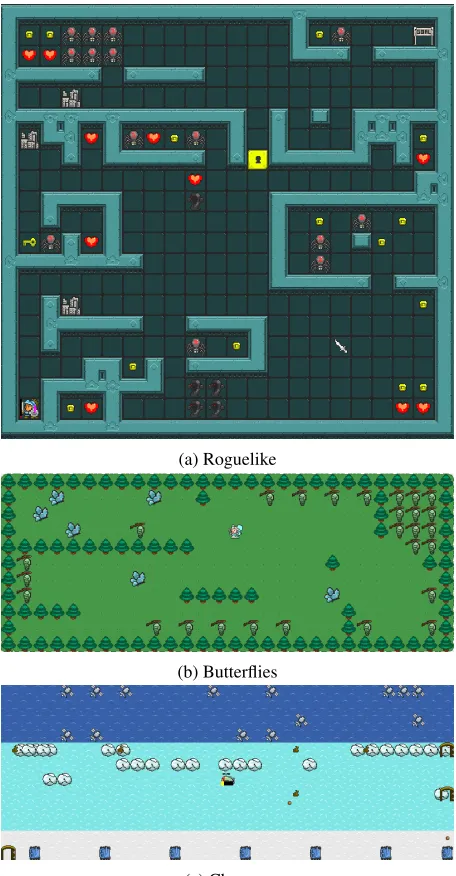
(a) Roguelike
(b) Butterflies
(c) Chopper
Figure 1: Games in General Video Game AI Framework.
and Lucas 2016) offers various challenges within the field of General Video Game Playing (Levine et al. 2013). There are currently over 160 2D grid-based games in the framework, varying from puzzles to shooters to adventure games. All are written in the Video Game Description Language (Schaul 2014) and are differentiable by several features, such as game object types (NPCs, resources), observability (full or partial) or, in the case of two-player games, player rela-tion (cooperative or competitive). Each game consists of a problem to be solved and there are different winning condi-tions based on the objectives of the game (e.g. reaching the exit/goal, collecting all treasure, killing all monsters). See Figure 1 for examples of games.
agents, which only have access to an object describing the current game state (offering observations of the world and other information such as the avatar state, game score, game tick and game winner, if the game has ended). Additionally, agents may simulate future possible states of the games via a Forward Model. However, copying and advancing game states are the most time-expensive actions performed by agents and should be used in such a way to maximise in-formation gain.
A subset of 20different games is used in this paper, as analysed in (Gaina et al. 2017b). This set of games com-prises of a varied selection regarding game difficulty and game features, as well as including10deterministic and10
stochastic games. As in this paper we are focused on explor-ing fitness landscapes, it is interestexplor-ing to distexplor-inguish between the different reward systems:
1. Sparse rewards: Crossfire, Camel Race, Escape, Hungry Birds, Wait for Breakfast, Modality
2. Dense rewards: Digdug, Lemmings, Roguelike, Chop-per, Chase, Bait, Survive Zombies, Missile Command, Plaque Attack, Infection, Aliens, Butterflies, Intersection, Seaquest
Sparse reward games feature little to no rewards during the entirety of the game. For example, in “Camel Race” the agent competes against 3 other NPC-controlled camels to make it from one end of the level to the other, while avoid-ing obstacles. The agent is only rewarded 1 point for finish-ing the race first. In contrast, dense reward games contain an abundance of rewards. For example, in “Aliens” (adap-tation of the well known “Space Invaders”), the agent re-ceives points for each alien they kill, as well as for destroy-ing protective bases. Many aliens and bases are present in each level, thus the agents may gather many points and use the reward system to guide their search.
Additionally, the score is not always increasing linearly. In games such as “Lemmings” or “Plaque Attack”, the player is more likely to lose points, but still be doing well and able to win, or even having to lose points in order to win. There may also be games in which winning and gaining the most points are two conflicting goals: in “Butterflies”, the player gets points by catching butterflies (random NPCs) and wins when all the butterflies have been caught; however, there are also cocoons in the levels, which can spawn more butterflies if the random NPCs collide with them; therefore, the player would get most points by delaying their win, while not allowing for all cocoons to be opened (in which case the game would end in a loss).
3.2
Monte Carlo Tree Search
Monte Carlo Tree Search (MCTS) repeats several iterations during one game tick as depicted in Figure 2, after which it recommends an action to play (in our implementation, this is the most visited action). MCTS begins by navigat-ing the tree usnavigat-ing the Upper Confidence Bound applied to Trees (UCT) policy (to balance between exploration and ex-ploitation) until it encounters a node not yet fully expanded. It then adds a new child of this node to the tree and performs
Figure 2: Monte Carlo Tree Search (Browne et al. 2014).
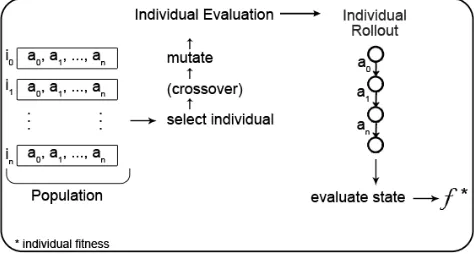
Figure 3: Rolling Horizon Evolutionary Algorithm (Gaina et al. 2017b).
a Monte Carlo rollout (randomly sampling actions and sim-ulating game states using the Forward Model) until either the end of the game or the set rollout depth is reached. The final state is evaluated with a heuristic and its value backed up the tree, updating all nodes visited during the iteration. Our implementation does not store game states in the nodes, but only statistics (Q-value, total number of visits and visits per action).
3.3
Rolling Horizon Evolution
Rolling Horizon Evolutionary Algorithm (RHEA) (Gaina et al. 2017b; Gaina, Lucas, and Li´ebana 2017a; 2017b), first introduced in (Perez-Liebana et al. 2013) is a method used in games as a planning game-playing agent. This technique evolves sequences of actions to be played in the game by iterating over randomly sampled solutions and applying, in our implementation, random mutation to flip one of the ac-tions in the sequence to a new random value; and uniform crossover to combine individuals in interesting ways (after a tournament of size2determining the parents involved in crossover). The best individual at each generation is carried forward unchanged through elitism.
of the respective individual. This process is repeated within the budget during one game tick. At the end of the evolution, the best action is recommended to be played in the game (here, the first action of the best individual).
It is interesting to note the exploration differences of MCTS and RHEA. In binary reward games (e.g. puzzles), it is often the case that a more precise sequence of actions is needed to solve the problem. MCTS explores nodes close to the root most, due to incrementally building the tree, de-termining better confidence bounds than for states further away. RHEA spreads exploration across the entire space by evolving whole sequences. Therefore, RHEA is able to bet-ter sample the large solution space (and find a good overall solution), while MCTS is focused on finding good solutions close to the root and randomly sampling from there.
4
Baseline Methods
For the experiments presented in this paper, an instance of each of the algorithms described in Section 3 is used. The Rolling Horizon Evolutionary Algorithm employs random initialization and a shift buffer for population management, which refers to keeping the population between game ticks instead of discarding it and reinitializing; the first action of all individuals is removed, all other actions shifted one posi-tion to the left and a new random acposi-tion is added at the end. Additionally, Monte Carlo rollouts are added at the end of the traditional individual evaluation. This is the best RHEA variant described in literature (Gaina, Lucas, and Li´ebana 2017b).
It is important to notice that this work focuses on improv-ing domain-agnostic algorithms on games with sparse re-wards. Other agents submitted to the GVGAI Competition (i.e. YOLOBOT (Joppen et al. 2017), the winner of sev-eral editions) obtain higher performance than the methods explored here, but also count on stronger heuristics (mostly adapted to respond well to GVGAI games) and combine sev-eral algorithms (tree search, A*, best first search, etc.). The focus of this paper is to explore improvements in simpler, game-agnostic algorithms taking their vanilla form as base-line to analyze the effects of the proposed modifications.
Initial experiments attempted to add a tree shifting be-haviour in MCTS as well, the equivalent of the shift buffer in RHEA (the method already uses Monte Carlo rollouts, there-fore the two algorithms are comparable in that sense). How-ever, this enhancement heavily impacted the algorithm’s per-formance in a negative way. As a result, we considered that the comparison would be most fair if both algorithms were at their best. Our experiments feature the sample MCTS as provided in the GVGAI Framework.
Moreover, we applied the same configuration of param-eters to both RHEA and MCTS: a population size of 10
for RHEA, rollout lengthLof14, budget of1000Forward Model (FM) calls1. In experiments where extreme rollout
1
Forward Model calls were used instead of the typical time bud-get in GVGAI for two reasons. First, it would ensure consistency in results irrespective of the machine used to run the experiments. Second, it would make our results comparable with previous liter-ature employing similar budget constraints.
lengths are employed (see Section 5.1), we still evaluate40
individuals for RHEA and 40 iterations for MCTS by in-creasing the FM call budget accordingly.
Both baseline algorithms make use of the same state eval-uation function to determine the value of an action (or se-quence of actions). This function is shown in Equation 14, whereH+is a large positive integer andH−is a large neg-ative integer, both surpassing any rewards the agents may receive from any game. What this translates to is that agents will greatly favour winning (and avoiding a loss, respec-tively), but they will attempt to maximize the current game score if the game state reached is not final, in order to guide their search. The heuristic function is kept intentionally sim-ple and general in order to focus results on the variations within the algorithms’ decision making process.
f =score +
H+, if win
H−, if loss (1)
5
Experiments
This section details the two different modifications: an crease in the method’s lookahead (with appropriately in-creased budgets) and dynamic changes in its lookahead (when constrained to a set budget).
5.1
Extreme Length Rollouts
This experiment is not feasible in real-time in current regular machines, but as technology advances quickly, the computa-tional power increases as well. Therefore, it is worth explor-ing whether longer rollouts do produce better results, given an appropriately increased budget as well to keep evaluat-ing40individuals for RHEA and40iterations for MCTS, as is the case in the default parameter configuration with1000
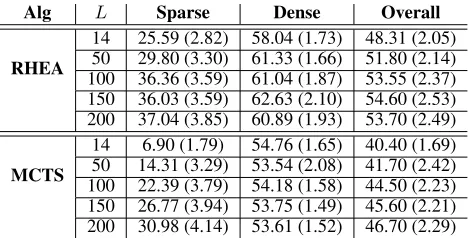
FM rollout budget. The longest length previously explored was24in (Gaina et al. 2017b), therefore we are considering up to4times this length (see Table 1 for details on specific lengthsL, their associated budgets areL×60).
One could expect agents employing extreme length roll-outs to spot rewards farther ahead more easily and create better plans to reach said rewards, therefore increasing per-formance in games with sparse rewards or distant goals. The agents may exhibit poor performance in quick reaction games, as they may ignore immediate threats or rewards and instead focus on longer term goals.
5.2
Dynamic Length Rollouts
This experiment will look instead at dynamically adjusting the length of the rollouts within the 1000FM calls budget (therefore feasible in real time). The objective is to obtain a more interesting behaviour comprised of quick reactions in situations where rewards are plentiful, and more exploratory longer lookaheads when rewards are sparse.
Algorithm 1Adjusting rollout length dynamically Require: t: current game tick
Require: f itnessLandscape: the fitness landscape (all fit-ness values) observed in the previous game tick Require: fLd: fitness landscape flatness
Require: L: rollout length Require: ω: adjustment frequency
Require: SD−: lowerfLdlimit forLincrease
Require: SD+: upperfLdlimit forLdecrease
Require: MD: rollout length modifier
Require: M IND: minimum value forL
Require: M AXD: maximum value forL 1: iftmodω= 0then
2: iff itnessLandscape=nullthen 3: fLd←SD−
4: else
5: fLd←δ(f itnessLandscape) .get standard deviation
6: iffLd< SD−then
7: L←L+MD
8: else iffLd> SD+then
9: L←L−MD
10: BOUND(L, M IND, M AXD) 11: functionBOUND(L, M IND, M AXD) 12: ifL < M INDthen
13: L←M IND
14: else ifL > M AXDthen
15: L←M AXD
returnL
tick (fLd); this is therefore ignored if the first game tick is currently observed (therefore no fitness landscapes were pre-viously recorded; Lines 2-3). The fitness landscape is a vec-tor with all fitness values observed in one game tick by any individual in the population (RHEA) or any rollout (MCTS), and itsflatnessis calculated as the standard deviation (δ) of all the elements of this vector (Line 5).
The lengthLis then increased by the depth modifierMD =5 iffLd falls below the lower limit (SD− =0.05), or is decreased byMD iffLd is above the upper limit (SD+ =
0.4) (see Lines 6-9). The length is capped to always stay between a minimum (1) and a maximum (half of the maxi-mum number of FM calls; Line 10). This translates to shorter rollouts when the fitness values observed are highly varied (therefore more sampling and processing of the current situ-ation is needed to determine the right course of action) and longer rollouts when the fitness landscape is flat, to encour-age exploration of solutions farther ahead which would give the agent more information to judge which would be the best move. The values for the different variables (ω,SD−, SD+) were manually tuned for best performance of both
al-gorithms on a random subset of5games.
One can reasonably expect dynamic rollouts to improve the overall performance, as agents could possibly adapt bet-ter to different situations requiring distinct skills.
Alg L Sparse Dense Overall
RHEA
14 25.59 (2.82) 58.04 (1.73) 48.31 (2.05) 50 29.80 (3.30) 61.33 (1.66) 51.80 (2.14) 100 36.36 (3.59) 61.04 (1.87) 53.55 (2.37) 150 36.03 (3.59) 62.63 (2.10) 54.60 (2.53) 200 37.04 (3.85) 60.89 (1.93) 53.70 (2.49)
MCTS
14 6.90 (1.79) 54.76 (1.65) 40.40 (1.69) 50 14.31 (3.29) 53.54 (2.08) 41.70 (2.42) 100 22.39 (3.79) 54.18 (1.58) 44.50 (2.23) 150 26.77 (3.94) 53.75 (1.49) 45.60 (2.21) 200 30.98 (4.14) 53.61 (1.52) 46.70 (2.29)
Table 1: Average win rate for long rollouts variations. Dis-tinction is made between sparse and dense rewards games, with the final column averaging over all games. Budget for each algorithm isL×60.
6
Results and Discussions
The results reported in this section mainly focus on the win rate achieved by the algorithms. Each method played 100 runs per game, 20 in each of the 5 levels2. Fisher’s exact test is used to test the significance of win rate differences.
6.1
Extreme Length Rollouts
Overall, results suggest that the general trend is the longer the rollouts, the better. However, there is a point where the improvement halts in RHEA (see last column in Table 1). When looking at the different reward systems, the improve-ment is only noticeable in sparse reward games, whereas the performance in incremental games remains fairly constant; one exception is “Bait” which increases significantly from
16.5%to37.4%for RHEA withL=150,p 0.001(this game is a special incremental scoring system game case fea-turing puzzle elements; see Section 3.1 for games split by score system). A similar trend is observed for MCTS: signif-icant improvement in win rate in sparse reward games (from
14.31%to30.98%,p0.001), while performance in dense reward games remains constant; thus the performance gain in sparse reward games is not detrimental to the rest of the problems. However, we do notice a striking drop in perfor-mance for MCTS in the incremental game “Chopper”, where the algorithm falls from100%win rate to4%withL=200; the same is not observed in RHEA, suggesting MCTS to be worse at dealing with immediate threats when considering farther ahead rewards.
Figure 4 shows the win rate of both RHEA and MCTS variants with long rollouts in the sparse reward games. It is interesting to observe that in the game “Escape” both meth-ods increase their performance until they peak (atL=100for RHEA andL=150for MCTS), following which the winrate drops again. In most other games we see a steady increase as rollout length goes up. This could suggest that the rollout length should not be pushed to too high values and instead more carefully considered based on the problem at hand.
2
(a) RHEA
(b) MCTS
Figure 4: Win rate in sparse rewards games for RHEA (top) and MCTS (bottom) with extreme length rollouts. Shadowed areas indicate the standard error.
6.2
Dynamic Length Rollouts
The two algorithms tested in this study show very differ-ent reactions to dynamic variations of their rollout length. This adjustment halves win rate in RHEA (from48.60%to
21.01%,p0.001), but it improves performance in MCTS, from40.40%to44.00%overall,p= 0.022.
The explanation for the large drop in win rate suffered by RHEA is the use of the shift buffer. In fact, it is reasonable that altering previously evolved sequences of actions by cut-ting or increasing them (with new random actions added at
0 30 60 90 120 150 180 210 240 270 300 330 360
Game tick
0.0 0.1 0.2 0.3 0.4 0.5
Fitness landscape flat value
1520 25 30 35 40
Rollout length
fLd
SD SD+
L
Figure 5: Variations in dynamic rollout length (blue) and fitness landscape flatness (orange) for RHEA agent in the game “Butterflies”, level 0. Note that the scale for rollout length is on the secondary (right) Y axis.
the end) changes the sequence (and importantly, the pheno-type) too much for the algorithm to be able to handle. This theory was tested and it showed that, by removing the shift buffer, dynamically adjusted rollout lengths in RHEA lead to a39.55win rate. This is still lower than the baseline method, but it is at the level of the default MCTS method without dy-namic rollouts, suggesting that this adjustment does have the potential of improving performance, with possibly tweaked (or dynamically adjusted as well) parameters.
Table 2 summarises the win rates of the two methods and their variations on the set of 20 games. Looking more in depth at the two types of reward systems paints an interest-ing picture. The performance of RHEA remains similar in sparse reward games when dynamic rollouts are employed, whereas the noticeable drop in performance comes from the side of dense reward games, notably “Chopper”, from100%
to56.57%, and “Intersection”, from100%to43.43%. This indicates dynamic rollouts to be harmful for RHEA in envi-ronments with immediate rewards. RHEA tends to shorten the rollout length in such games (see Algorithm 1) and that has been shown to reduce its performance (as seen in (Gaina et al. 2017b)); we hypothesize the drop in win rate to be most likely due to sequences becoming too short for RHEA to be able to cope with.
However, MCTS sees a similar story as in the case of extreme length rollouts: the performance in sparse reward games is significantly improved (from 6.90% to19.70%), with no detriment to the rest in the set. Some notable exam-ples here are “Escape”, which sees an increase in win rate from0%to29.29%, and “Wait for Breakfast”, from4%to
42.42%. This suggests dynamic rollouts to be greatly bene-ficial to MCTS in sparse rewards landscapes.
al-Alg Sparse Dense Overall RHEA 25.59 (2.82) 58.04 (1.73) 48.31 (2.05) RHEA-dyn 10.61 (2.61) 25.47 (2.06) 21.01 (2.22) MCTS 6.90 (1.79) 54.76 (1.65) 40.40 (1.69) MCTS-dyn 19.70 (3.37) 54.47 (1.89) 44.04 (2.33)
Table 2: Win rates for RHEA and MCTS, vanilla and dy-namic variants (non-shift RHEA). Distinction is made be-tween sparse and dense reward systems, with the last column averaging win rates over all games.
gorithm is expected to adjust its rollout length depending on its assessment of the fitness landscape. It is interesting to note that the rollout length does match the shape of the fit-ness landscape flatfit-ness. The fact that the algorithm reduces its rollout length after a peak at game tick255suggests that RHEA is able to successfully use the longer rollouts to ad-just its search and find the more interesting parts of the level to win the game.
6.3
Deceptive Games
The last experiment was to test these methods on the de-ceptive games presented by Anderson et al. (Anderson et al. 2018). It is expected that the adjusted variants would per-form better than the baseline, as they are less biased, have more information or better adapt to various situations, spectively, when making decisions. The most interesting re-sults on the5games tested are as follows.
• decepticoins: RHEA-dynamic performs
signifi-cantly better than all other RHEA variations, in both win rate and score (55.56% win rate, a significant 40% im-provement over baseline). All MCTS variations achieve a
79.8%win rate, although the extreme rollout length varia-tions complete the games the fastest (200ticks faster than the baseline on average).
• flower: All algorithms achieve 100% win rate, but MCTS with long rollouts is overall significantly better than the baseline in score, with over200points improve-ment for all rollout lengths.
• invest: No algorithm manages to solve this game, but all fitness exploratory variations of the algorithms are sig-nificantly better than the baseline in score (100-300point improvement for MCTS,10-100points for RHEA). • sistersavior: The win rate in this game is on
av-erage very low (3.03% ±1.08), with4 algorithms un-able to solve it: baseline MCTS, MCTS-dynamic, RHEA-150 and RHEA-200. The highest win rate is achieved by MCTS-100 (10.26%±4.86), followed closely by RHEA-50 with7.69% ±4.27win rate.
• waferthinmintsexit: All algorithms achieve100%
win rate. RHEA-dynamic is significantly better in score than the baseline,2.68 (±0.36)to1.16 (±0.11)points. RHEA-dynamic performed much better than the baseline method in most of the GVGAI games tested. There was not much difference observed in some games in terms of win
rate, all variations achieving either 100%or 0% victories, although there were overall improvements in either win rate or game score in all cases over the baseline methods. This indicates our modified methods to be more robust to decep-tive reward systems.
7
Conclusion
This paper looks at analysing various ways to explore the fitness landscapes in 20 games from the General Video Game AI Framework (GVGAI), for two different algo-rithms, Monte Carlo Tree Search (MCTS) and Rolling Hori-zon Evolutionary Algorithm (RHEA). Two experiments are carried out to this extent: increasing the rollout length (to
50,100,150and200from the baseline14) and dynamically adjusting the rollout length based on the flatness of the fit-ness landscapes, in order to allow for quick reactions in busy environments or more exploration in sparse rewards scenar-ios. All methods are also tested on a set of human-crafted deceptive reward games to analyze whether their fitness ex-ploration methods lead to better results in such games.
Overall, modified methods are shown to perform better than the baseline methods in sparse reward games, without affecting success rates in dense reward games. One excep-tion is RHEA with dynamic rollouts, which halves win rate from 48.60% to 21.05%. Further analysis into this aspect suggested that this was due to the shift buffer enhancement added to the RHEA variant, which is unable to cope with the change in phenotype between game ticks where the se-quence length is varied. By removing the shift buffer, the performance of RHEA with dynamic rollouts becomes com-parable to baseline MCTS, at39.55%win rate.
The algorithms reacted well to the increase in rollout length, their performance increasing with the length in sparse reward games, while performance in dense reward games was kept fairly constant; there were two exceptions to this rule in the games “Butterflies” for both methods and “Chopper” for MCTS only, where increased rollout length is actually detrimental. This is thought to be due to the im-mediate rewards needed to be collected in this game which may be ignored when the rollout length becomes too large. When the rollout length was dynamically adjusted, RHEA and MCTS reacted differently, RHEA seeing a general de-crease in performance in games based on dense reward sys-tems, whereas MCTS saw an increase in performance in sparse reward games. This shows that RHEA is more sen-sitive to games requiring quick decision making, whereas MCTS benefits from the adjustments which aid in its tradi-tionally poor exploration in binary games.
It is worthwhile mentioning that, although these experi-ments employ the GVGAI framework, the applicability of the findings extend beyond these games. In particular, this work focuses on modifications to overcome the presence of sparse rewards, an issue present not only in other games such as some in the Atari Learning Environment (Bellemare et al. 2013) and more complex games, but also in other real life scenarios, such as engineering or robotics.
proposed in this study, including different metrics (game score, GVGAI generality score) or optimizing dynamic roll-out adjustment parameters. Additionally, the reactions of the methods to macro-actions in this environment and dynamic length macro-actions could be studied as well. Last but not least, more interesting problems with various features to their fitness landscapes will be introduced to the methods in order to correctly assess exactly why some algorithms react better to some situations than others.
8
Acknowledgements
This work was funded by the EPSRC Centre for Doctoral Training in Intelligent Games and Game Intelligence (IGGI) EP/L015846/1.
References
Anderson, D.; Stephenson, M.; Togelius, J.; Salge, C.; Levine, J.; and Renz, J. 2018. Deceptive Games. InEvoStar. Bellemare, M. G.; Naddaf, Y.; Veness, J.; and Bowling, M. 2013. The Arcade Learning Environment: An Evaluation Platform for General Agents. Journal of Artificial Intelli-gence Research47:253–279.
Bellemare, M.; Srinivasan, S.; Ostrovski, G.; Schaul, T.; Saxton, D.; and Munos, R. 2016. Unifying count-based ex-ploration and intrinsic motivation. In Lee, D. D.; Sugiyama, M.; Luxburg, U. V.; Guyon, I.; and Garnett, R., eds., Ad-vances in Neural Information Processing Systems 29. Cur-ran Associates, Inc. 1471–1479.
Browne, C.; Powley, E.; Whitehouse, D.; Lucas, S.; Cowl-ing, P.; Rohlfshagen, P.; Tavener, S.; Perez, D.; Samothrakis, S.; and Colton, S. 2014. A Survey of Monte Carlo Tree Search Methods. IEEE Trans. on Computational Intelli-gence and AI in Games4(1):1–43.
Companez, N., and Aleti, A. 2016. Can monte-carlo tree search learn to sacrifice? Journal of Heuristics22(6):783– 813.
Gaina, R. D.; Cou¨etoux, A.; Soemers, D. J.; Winands, M. H.; Vodopivec, T.; Kirchgessner, F.; Liu, J.; Lucas, S. M.; and Perez-Liebana, D. 2017a. The 2016 two-player gvgai com-petition. IEEE Transactions on Computational Intelligence and AI in Games.
Gaina, R. D.; Liu, J.; Lucas, S. M.; and Li´ebana, D. P. 2017b. Analysis of Vanilla Rolling Horizon Evolution Parameters in General Video Game Playing. InSpringer Lecture Notes in Computer Science, Applications of Evolutionary Computa-tion, EvoApplications, volume 10199, 418–434.
Gaina, R. D.; Lucas, S. M.; and Li´ebana, D. P. 2017a. Pop-ulation Seeding Techniques for Rolling Horizon Evolution in General Video Game Playing. In Proceedings of the Congress on Evolutionary Computation.
Gaina, R. D.; Lucas, S. M.; and Li´ebana, D. P. 2017b. Rolling Horizon Evolution Enhancements in General Video Game Playing. InProceedings of IEEE Conference on Com-putational Intelligence and Games.
Gaina, R. D.; Perez-Liebana, D.; and Lucas, S. M. 2016. General Video Game for 2 Players: Framework and
Compe-tition. InProceedings of the IEEE Computer Science and Electronic Engineering Conf.
Guckelsberger, C.; Salge, C.; and Colton, S. 2016. Intrinsi-cally Motivated General Companion NPCs via Coupled Em-powerment Maximisation. In Proc. of the Conference on Computational Intelligence and Games.
Guo, X.; Singh, S.; Lewis, R.; and Lee, H. 2016. Deep learn-ing for reward design to improve monte carlo tree search in atari games. arXiv preprint arXiv:1604.07095.
Horn, H.; Volz, V.; P´erez-Li´ebana, D.; and Preuss, M. 2016. MCTS/EA hybrid GVGAI players and game difficulty esti-mation. In2016 IEEE Conference on Computational Intel-ligence and Games (CIG), 1–8.
Joppen, T.; Moneke, M.; Schroder, N.; Wirth, C.; and Furnkranz, J. 2017. Informed Hybrid Game Tree Search for General Video Game Playing. IEEE Transactions on Computational Intelligence and AI in Games.
Levine, J.; Lucas, S. M.; Mateas, M.; Preuss, M.; Spronck, P.; and Togelius, J. 2013. General Video Game Play-ing. InArtificial and Computational Intelligence in Games, Dagstuhl Follow-Ups, volume 6, 1–7.
Li´ebana, D. P.; Stephenson, M.; Gaina, R. D.; Renz, J.; and Lucas, S. M. 2017. Introducing Real World Physics and Macro-Actions to General Video Game AI. In Proceed-ings of IEEE Conference on Computational Intelligence and Games.
Perez-Liebana, D.; Samothrakis, S.; Lucas, S. M.; and Rolf-shagen, P. 2013. Rolling Horizon Evolution versus Tree Search for Navigation in Single-Player Real-Time Games. In Proceedings of the Genetic and Evolutionary Computa-tion Conference (GECCO), 351–358.
Perez-Liebana, D.; Samothrakis, S.; Togelius, J.; Schaul, T.; Lucas, S.; Couetoux, A.; Lee, J.; Lim, C.-U.; and Thompson, T. 2015. The 2014 General Video Game Playing Compe-tition. InIEEE Transactions on Computational Intelligence and AI in Games, volume 99, 1.
Perez-Liebana, D.; Rohlfshagen, P.; and Lucas, S. 2012. The Physical Travelling Salesman Problem: WCCI 2012 Com-petition. In IEEE Congress on Evolutionary Computation (CEC), 1–8.
Perez, D.; Samothrakis, S.; and Lucas, S. 2014. Knowledge-based fast evolutionary mcts for general video game play-ing. InComputational Intelligence and Games (CIG), 2014 IEEE Conference on, 1–8. IEEE.