The Thirty-Third AAAI Conference on Artificial Intelligence (AAAI-19)
TransGate: Knowledge Graph Embedding with Shared Gate Structure
Jun Yuan,
1,2,3Neng Gao,
1,2Ji Xiang
1,2∗1Institute of Information Engineering, Chinese Academy of Sciences, Beijing, China
2State Key Laboratory of Information Security, Chinese Academy of Sciences, Beijing, China 3School of Cyber Security, University of Chinese Academy of Sciences, Beijing, China
{yuanjun,gaoneng,xiangji}@iie.ac.cn
Abstract
Embedding knowledge graphs (KGs) into continuous vec-tor space is an essential problem in knowledge extraction. Current models continue to improve embedding by focus-ing on discriminatfocus-ing relation-specific information from enti-ties with increasingly complex feature engineering. We noted that they ignored the inherent relevance between relations and tried to learn unique discriminate parameter set for each relation. Thus, these models potentially suffer from high time complexity and large parameters, preventing them from efficiently applying on real-world KGs. In this paper, we follow the thought of parameter sharing to simultaneously learn more expressive features, reduce parameters and avoid complex feature engineering. Based on gate structure from LSTM, we propose a novel model TransGate and develop shared discriminate mechanism, resulting in almost same space complexity as indiscriminate models. Furthermore, to develop a more effective and scalable model, we reconstruct the gate with weight vectors making our method has com-parative time complexity against indiscriminate model. We conduct extensive experiments on link prediction and triplets classification. Experiments show that TransGate not only out-performs state-of-art baselines, but also reduces parameters greatly. For example, TransGate outperforms ConvE and R-GCN with 6x and 17x fewer parameters, respectively. These results indicate that parameter sharing is a superior way to further optimize embedding and TransGate finds a better trade-off between complexity and expressivity.
Introduction
Knowledge graphs (KGs) such as WordNet (Miller 1995) and Freebase (Bollacker et al. 2008) have been widely adopted in various applications, like web search, Q&A, etc. KGs are large-scale multi-relational structures and usually organized in the form of triplets. Each triplet is denoted as (h, r, t), wherehandtare head and tail entities, respectively, andris the relation betweenhandr. For instance, (Beijing,
CapitalOf,China) denotes the fact that the capital ofChina
isBeijing.
Although existing KGs already have consisted of billions of triplets, but they are far from completeness. Thus, the
∗
Corresponding author
Copyright c2019, Association for the Advancement of Artificial Intelligence (www.aaai.org). All rights reserved.
knowledge graph completion (KGC) has emerged an im-portant open research problem (Nickel, Tresp, and Kriegel 2011). For example, it is shown by (Dong et al. 2014) that more than 66% of the person entities are missing a birthplace in Freebase and DBLP. The aim of KGC task is to predict re-lations and determine specific-relation type between entities based on existing triplets. Due to the extremely large data size, an effective and scalable solution is crucial for KGC task (Liu, Wu, and Yang 2017).
Various KGC methods have been developed in recent years, and the most successful methods are representa-tion learning based methods which encode KGs into low-dimensional vector spaces. Among these methods, TransE (Bordes et al. 2013) is a simple and effective model and regards every relation as translation between the heads and tails. We denote embedding vector with the same letters in boldface. When(h, r, t)holds, the embeddinghis close to the embeddingtby adding the embeddingr, that ish+r≈t. Indiscriminate models, like TransE, can scale to real-world KGs (Xu et al. 2017a), due to the limited num-ber of parameters and low computational costs. However, indiscriminate models often learn less expressive features (Dettmers et al. 2018), leading to either low parameter effi-ciency or low accuracy. In fact, an entity may have multiple aspects which may be related to different relations (Lin et al. 2015). Therefore, relation-specific information discrimi-nation of entities is the key to improving embeddings.
Many discriminate models (Lin et al. 2015; Ji et al. 2015; 2016) have been proposed recently and usually outperform indiscriminate models on public data sets. We note that cur-rent methods always assumed the independence between re-lations and tried to learn unique discriminate parameter set for each relation. Although there are always thousands of relations in a KG, but they are not independent from each other (Bordes et al. 2013). For example, among WordNet, the most frequently encoded relation is the hierarchical re-lation and each hierarchical rere-lation has its inverse rere-lation, e.g.hyponym/hypernym.
As a result, current discriminate models potentially suf-fer from following three problems, which all prevent current models from efficiently applying on real-world KGs.
pa-rameter size will be more than 33GB and half papa-rameters are discriminate parameters. Second, current discriminate mod-els explore increasingly complex feature engineering to im-prove embedding, resulting in high time complexity. In re-ality, one nature of correlated relations is semantic sharing (Trouillon et al. 2016), which can be used to improve the discrimination. Third, due to the large parameter size and complex design, current models have to introduce more hy-per parameters and adopt pre-training to prevent overfitting. Please refer to Table 1 and “Related Work” for details.
To optimize embedding and reduce parameters simultane-ously, we follow the thought of parameter sharing and pro-pose a novel method TransGate. Unlike previous methods tried to learn relation-specific discriminate parameter set, TransGate discriminates relation-specific information with only two shared gates for all relations. Hence, TransGate has almost same space complexity as TransE on real-world KGs. Furthermore, shared gates share statistical strength across different relations to optimize embedding without complex feature engineering.
We conduct extensive experiments on link prediction and triplets classification on large-scale public KGs, namely Freebase and WordNet. TransGate achieves better perfor-mance than ConvE (Dettmers et al. 2018) and R-GCN (Michael Sejr et al. 2018) with 6x and 17x fewer parameters, respectively. Unlike many of the related models that require pre-training, TransGate is a self-contained model and does not need any extra hyper parameter to prevent overfitting.
Our specific contributions are as follows:
• We identify the significance of inherent relevance be-tween relations, which is largely overlooked by existing literature. We follow the thought of parameter sharing to learn more expressive features and reduce parameters at the same time.
• Based on gate structure from LSTM (Hochreiter and Schmidhuber 1997), we propose TransGate and develop shared discriminate mechanism to avoid large discrimi-nate parameters.
• To develop a more effective and scalable model, we re-construct standard gate with weight vectors. In this way, we reduce calculation brought by matrix-vector multipli-cation operations and decrease the time complexity to the same order as TransE.
• Experiments show that TransGate not only delivers sig-nificant improvements compared to state-of-art baselines, but also reduces parameters greatly. These results indicate that parameter sharing is a superior way to further opti-mize embedding and our method finds a better trade-off between complexity and expressivity.
Related Work
Indiscriminate Models
Indiscriminate models usually focus more on the scalability on real-world KGs. But they often have either low parameter efficiency or low accuracy (Dettmers et al. 2018).
TransE. As mentioned in Introduction section, TransE (Bordes et al. 2013) encodes entities and relations in the
same space Rm. Then it regards each relation as
transla-tion between the heads and tails and wants h+ r ≈ t when (h, r, t) holds. Hence, TransE assumes score function fr(h, t) =||h+r−t||L1/L2is low if (h,r,t) holds, and high
otherwise.
DistMult.DistMult (Yang et al. 2015) has the same time and space complexity as TransE. DistMult uses weighted element-wise dot product to define the score function fr(h, t) =Phkrktk. Although DistMult has better overall
performance than TransE, but it is unable to model asym-metric relations.
ComplEx. ComplEx (Trouillon et al. 2016) makes use of complex valued embeddings and Hermitian dot product to address the antisymmetric problem in DistMult. As men-tioned in its paper, though ComplEx doubles the parameter size of TransE, but TransE and DistMult perform better on symmetry relations.
CombinE.CombinE (Tan, Zhao, and Wang 2017) consid-ers triplets features from two aspects: relationrp≈hp+tp
and entityrm≈hm−tm. The score function isfr(h, t) =
||hp+tp−rp||2L1/L2+||hm−tm−rm||
2
L1/L2. CombinE
doubles the parameter size of TransE, but does not yield sig-nificant boost in performance on link prediction.
Discriminate Models
Discriminate models focus more on precision. They usually contain two stages: relation-specific information discrimina-tion and score computadiscrimina-tion.
TransH. TransH (Wang et al. 2014) maps entity em-bedding into relation hyperplanes to discriminate relation-specific information. The score function is defined as fr(h, t) =||h−wTrhwr+r−(t−wTrtwr)||L1/L2, where
wris the normal vector ofr’s relation hyperplane.
TransR/CTransR. TransR (Lin et al. 2015) learns a map-ping matrixMrfor each relation. It maps entity embedding
into relation space to realize the discrimination. The score function isfr(h, t) = ||Mrh+r−Mrt||L1/L2. CTransR
is an extension of TransR. It clusters diverse head-tail entity pairs into groups and sets a relation vector for each group.
TranSparse. TranSparse (Ji et al. 2016) replaces transfer matrix in TransR by two sparse matrices for each relation. And it uses two sparse degree hyper parameters,θhr andθtr,
to reduce parameters of mapping matrices.
TransD. TransD (Ji et al. 2015) constructs two mapping matrices dynamically for each triplet by setting projection vector for each entity and relation, that isMrh = h>prp+
Im×n,Mrt=t>prp+Im×n. The score function isfr(h, t) =
||Mrhh+r−Mrtt||L1/L2. TransD obtains the state-of-art
performance on triplets classification.
Neural Tensor Network (NTN). NTN (Socher et al. 2013) learns a 3-way tensor and two transfer matrices for each relation as discriminate parameter set. NTN constructs a neural network to discriminate information. The score function is defined asfr(h, r, t) =uTrf(h
>Mˆ
rt+Mr1h+
Mr2t+br), whereMˆr∈Rm×m×s, andf()istanhoperation.
To prevent overfitting, current discriminate models intro-duce more hyper parameters and require pre-trained data from prerequisite models. In addition, they often explore linear discrimination to avoid high time complexity of non-linear operation. Table 1 lists the details of several models. TransGate achieves non-linear discrimination with relative low time and space complexity by shared gates.
Other Models
A number of works attempt to improve knowledge graph embedding in different ways. Some models explore different loss function to improve embeddings. Zhou et al. (Zhou et al. 2017) propose a limit-based scoring loss function to provide lower scoring of a golden triplet. ManifoldE (Xiao, Huang, and Zhu 2016) proposes a manifold-based loss function to achieve precise link prediction. Additionally, some addi-tional information has been used to improve embedding. The NLFeat model (Toutanova and Chen 2015) is a log-linear model using simple node and link features. Jointly (Xu et al. 2017b) uses a gating mechanism to integrate representations of structure and text information of entities. RUGE (Guo et al. 2018) utilizes the soft-rule between triplets to enhance ComplEX. But the extraction of additional information is always the bottleneck.
Many researches attempt to introduce some novel tech-niques of deep learning into knowledge graph embedding. KBGAN (Cai and Wang 2018) introduces GAN to boost several embedding models. ProjE (Shi and Weninger 2017) uses a learnable combination operator to combine embed-dings and feeds combined embedembed-dings in a multi-class clas-sifier to handle complex relations. Large candidate entity numberNcwill cause high time complexity, so ProjE has to
use candidate sampling to reduceNc. R-GCN (Michael Sejr
et al. 2018) and ConvE (Dettmers et al. 2018) introduces multi-layer convolution network in knowledge graph em-bedding. ConvKB (Dai et al. 2018) designs a simple con-volutional model and achieves the state-of-art results on link prediction. ConvKB concatenates head, tail and rela-tion vectors into a3×mmatrix, then feeds it into a convo-lution network. The score function is defined asfr(h, t) =
concat(g([h,r,t]∗Ω))w, where∗means convolution oper-ation;Ω ∈ Rτ×1×3is the set of filters;τ is the number of
filters;w∈Rτ m×1. To learn expressive features, the
magni-tude ofτis same as dimensionmin above three convolution models.
TransGate is a shallow model without using any addi-tional information. This make it scale to real-world KGs eas-ier.
Embedding with Shared Gate Structure
In this work, we follow the thought of parameter sharing and propose an effective and scalable method named TransGate. In this section we firstly introduce gate structure of LSTM. Then we describe the TransGate architecture, along with the training method. Last but not least, we make complexity analysis on TransGate compared with some baselines.
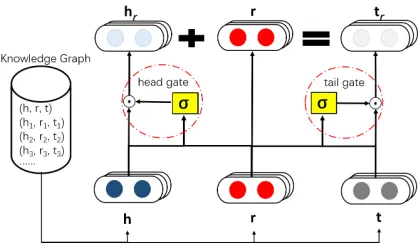
Figure 1: TransGate Architecture. TransGate discriminates relation-specific information with only two shared gates for all relations. Shared gates can share the statistical strength across different relations to optimize embedding.
Gate structure
Gate structure is the core mechanism of LSTM (Hochreiter and Schmidhuber 1997), which has been found extremely successful in many applications (J´ozefowicz, Zaremba, and Sutskever 2015). Gate is a way to optionally let information through. As marked in the red dashed circle in Figure 1, a gate is composed of a layer with sigmoid activation function and a Hadamard product operation.
The standard gate uses fully connected layer, which is shown as Equation 1. The sigmoid operation is applied element-wise and [,] means concatenate operation.
f=σ(b+W·[x,y]), (1)
wherexis the current input vector andyis the representation vector of the context.b,Ware respectively bias and weight matrix for the gate structure.
Sigmoid operation sets every element offbetween 0 and 1, describing how much information should be let through. Afterwards, a gate uses Hadamard product to filter informa-tion as Equainforma-tion 2
sf=sf, (2)
wheresis the vector that we want to filter,sf is the filtered
information vector, andmeans the Hadamard product. All the parameters of gate need to be learned during training. Therefore, theoretically, a gate can learn to adap-tively and nonlinearly filter information based on the input with fixed number of parameters. That is to say, we can train a gate making the filtered vectorsf related to various
x,y without extra parameters. In practice, this great abil-ity of gate structure has been shown in many researches (J´ozefowicz, Zaremba, and Sutskever 2015).
TransGate Architecture
The framework of TransGate is shown as Figure 1 and the detailed descriptions are as follow:
1. We embed every entity and relation into continues vector with same dimension.
2. To handle “one-relation-circle” structures (Zhang 2017)
1, TransGate sets two shared gates for head and tail
enti-ties, respectively.
3. We input both entity embedding and relation embedding into the sigmoid layer of gate, letting the discrimination determined by entity and relation together.2
4. Then we realize non-linear and adaptive relation-specific discrimination through multiplying sigmoid layer output and entity embedding element-wise.
5. Last, we build translation between discriminated infor-mation of heads and tails. Based on the score, we can determine whether the triplet is valid.
Next, we describe TransGate using standard gate with fully connected layer, or TransGate(fc). Considering a training setS of triplets (h, r, t), each triplet is composed of two entitiesh, t∈ Eand relationsr ∈R, whereEand Rare the set of entities and relations, respectively. Embed-dings are set as h,t,r ∈ Rm. And the parameters of two
gates are denoted asWh,Wt∈Rm×2mandbh,bt ∈Rm.
We define the relation-specific entity embedding vectors as
hr=hσ(Wh·[h,r] +bh), (3)
tr=tσ(Wt·[t,r] +bt). (4)
The fully connected layer interacts different embedding di-mensions and can make precise discrimination.
To develop a more effective and scalable model, we recon-struct the standard gate in our method. Theoretically, every dimension should be independent from each other in a well-trained embedding model. Hence, we replace matrix in gate with two weight vectors and proposeTransGate(wv). Cor-respondingly, the relation-specific entity embedding vectors are define as
hr=hσ(Vhh+Vrhr+bh), (5)
tr=tσ(Vtt+Vrtr+bt), (6)
where weight vectorsVh,Vt,Vrh,Vrt ∈R
m. In this way,
we can reduce the calculation by avoiding matrix-vector multiplication operations.
After discrimination, we build translation on relation-specific information and the score function is correspond-ingly defined as
fr(h, t) =||hr+r−tr||L1/L2, (7)
The score is expected to be lower for a golden triplet and higher for an incorrect triplet.
1
One-relation-circle means that some entities form a circle with the same relation in a KG. One-relation-circle will make the corre-sponding relation vectorrapproximate 0.
2
The discriminate operation should be an interactive process between an entity and a relation, because a relation may link to different types entities (Ji et al. 2015).
In practice, we enforce constraints on the norms of the embeddings and discriminated embeddings. That is to say, ∀h, t, r, we have||h||2= 1,||r||2= 1,||t||2= 1,||hr||2=
1and||tr||= 1. We make no constraint on weight matrices,
weight vectors and biases of gates.
TransGates can discriminate relation-specific information for different entities and relations with fixed and small num-ber of parameters. We note that when head gate and tail gate let all information through, TransGate will degenerate to TransE. This suggests that TransGate embraces TransE (Bordes et al. 2013), being a more general knowledge graph embedding framework.
Training
To learn such embeddings, we minimize a common used margin-based ranking criterion over the training set:
L= X
(h,r,t)∈S
X
(h0,r,t0)∈S0
[γ+fr(h, t)−fr(h0, t0)]+, (8)
where [x]+ , max(0, x), γ > 0 is a margin hyper
pa-rameter, the corrupted triplet setS0is composed of training triplets with the entities or relations replaced randomly. That is
S0={(h0, r, t)|h0∈E} ∪ {(h, r, t0)|t0 ∈E}
∪ {(h, r0, t)|r0∈R} (9)
The loss function 8 is used to encourage discrimination be-tween training triplets and corrupted triplets by favoring lower scores for training triplets than for corrupted ones.
We initialize the embeddings, weight matrices and weight vectors of gates through sampling from a truncated standard normal distribution. And we initialize the biases as vectors that all elements are 1. The training process of TransGate is carried out using Adam optimizer (Kingma and Ba 2015) with constant learning rate. The training process is stopped based on model’s performance on the validation set.
Complexity Analysis
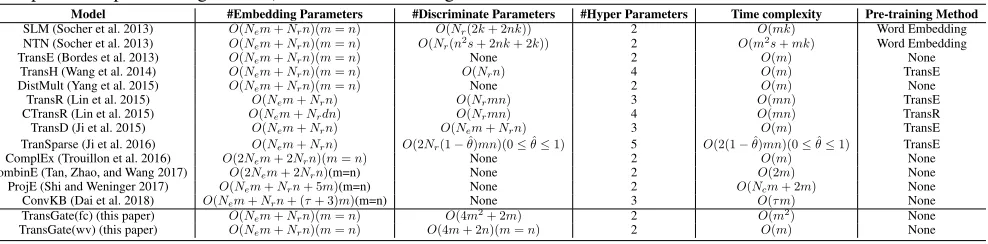
In Table 1, we compare the embedding parameter number, discriminate parameter number, hyper parameter number, time complexity of each iteration and pre-training methods of various baselines with our model.Ne,Nr represent the
number of entities, relations, respectively.Ncrepresents the
number of candidate entities. mis the dimension of entity embedding space andnis the dimension of relation embed-ding space.ddenotes the number of clusters of a relation. kis the hidden nodes’ number of a neural network andsis the number of slice of a tensor.θˆdenotes the average sparse degree of all transfer matrices.τ is the number of convolu-tional kernels.
From Table 1 we can see that:
1. The space complexity of TransGate is almost the same as TransE on real-world KGs. The discriminate parame-ters brought by the gates can be ignored compare to em-bedding parameters. Becausem Nr Neamong
existing KGs, so parameters of Embedding parametersparameters of standard gate =
4m+2
Table 1: Complexities (the number of embedding parameters, discriminate parameters and hyper parameters, time complexity in an epoch, and pre-training method) of several embedding models.
Model #Embedding Parameters #Discriminate Parameters #Hyper Parameters Time complexity Pre-training Method
SLM (Socher et al. 2013) O(Nem+Nrn)(m=n) O(Nr(2k+ 2nk)) 2 O(mk) Word Embedding
NTN (Socher et al. 2013) O(Nem+Nrn)(m=n) O(Nr(n2s+ 2nk+ 2k)) 2 O(m2s+mk) Word Embedding
TransE (Bordes et al. 2013) O(Nem+Nrn)(m=n) None 2 O(m) None
TransH (Wang et al. 2014) O(Nem+Nrn)(m=n) O(Nrn) 4 O(m) TransE
DistMult (Yang et al. 2015) O(Nem+Nrn)(m=n) None 2 O(m) None
TransR (Lin et al. 2015) O(Nem+Nrn) O(Nrmn) 3 O(mn) TransE
CTransR (Lin et al. 2015) O(Nem+Nrdn) O(Nrmn) 4 O(mn) TransR
TransD (Ji et al. 2015) O(Nem+Nrn) O(Nem+Nrn) 3 O(m) TransE
TranSparse (Ji et al. 2016) O(Nem+Nrn) O(2Nr(1−θ)mn)(0ˆ ≤θˆ≤1) 5 O(2(1−θ)mn)(0ˆ ≤θˆ≤1) TransE
ComplEx (Trouillon et al. 2016) O(2Nem+ 2Nrn)(m=n) None 2 O(m) None
CombinE (Tan, Zhao, and Wang 2017) O(2Nem+ 2Nrn)(m=n) None 2 O(2m) None
ProjE (Shi and Weninger 2017) O(Nem+Nrn+ 5m)(m=n) None 2 O(Ncm+ 2m) None
ConvKB (Dai et al. 2018) O(Nem+Nrn+ (τ+ 3)m)(m=n) None 3 O(τ m) None
TransGate(fc) (this paper) O(Nem+Nrn)(m=n) O(4m2+ 2m) 2 O(m2) None
TransGate(wv) (this paper) O(Nem+Nrn)(m=n) O(4m+ 2n)(m=n) 2 O(m) None
2. TransGate(wv) introduces non-linear discrimination with similar time complexity to TransE and TransD. Al-though time complexity of TransGate(fc) is higher than TransGate(wv), but it is still similar to TransR and Con-vKB.
3. Our methods introduce no more hyper parameter than TransE. Besides, TransGates do not need any hyper pa-rameter or pre-training to prevent overfitting. This makes TransGates can be trained easier.
4. Due to the low time complexity and less parameters, TransGates can easily be applied to real-world KGs, us-ing less computus-ing and memory resources.
Experiments
In this section, we empirically evaluate our proposed models on two key tasks: link prediction (Bordes et al. 2013) and triplets classification (Socher et al. 2013). We demonstrate that TransGates outperform baselines and deliver significant improvements on multiple benchmark data sets. We also in-vestigate the parameter efficiency of our methods. Results show that parameter sharing is a superior way to further op-timize embedding and TransGates find a better trade-off be-tween complexity and expressivity.
Data Sets
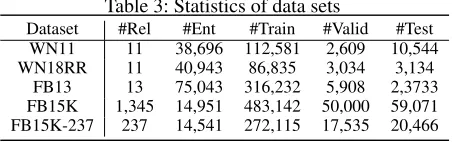
Link prediction and triplets classification are implemented on two large-scale knowledge graphs: WordNet (Miller 1995) and Freebase (Bollacker et al. 2008). WordNet pro-vides semantic knowledge of words. Entities in WordNet are synonyms which express distinct concepts. Relations in WordNet are conceptual-semantic and lexical relations. In this paper, we employ two data sets from WordNet: WN11 (Socher et al. 2013) and WN18RR (Dettmers et al. 2018). Freebase provides general facts of the world. For example, the triplet (Anthony Asquith, location, London) builds a re-lation oflocationbetween the name entityAnthony Asquith
and the city entityLondon. In this paper, we employ three data sets from Freebase: FB15K (Bordes et al. 2013), FB13 (Socher et al. 2013) and FB15K-237 (Toutanova and Chen 2015). Table 3 lists statistics of the five data sets.
WN18RR and FB15K-237 are correspondingly subsets of two common data sets WN18 (Bordes et al. 2013) and
FB15K. It is firstly discussed by (Toutanova and Chen 2015) that WN18 and FB15K suffer from test leakage through in-verse relations,i.e.many test triplets can be obtained simply by inverting triplets in the training set. To address this issue, (Toutanova and Chen 2015) generated FB15K-237 by re-moving redundant relations in FB15K and greatly reducing the number of relations. Likewise, (Dettmers et al. 2018) re-moved reversing relations in WN18. As a consequence, the difficulty of reasoning on these two data sets is increased dramatically. Since FB15K is still widely used, we also in-clude results on this data set.
Link Prediction
Link prediction aims to predict the missinghortfor a triplet
(h, r, t). In this task, the model is asked to rank a set of can-didate entities from the KG, instead of giving one best result. For each test triplet(h, r, t), we replace the head/tail entity by all possible candidates in the KG, and rank these entities in ascending order of scores calculated by score functionfr.
We follow the evaluation protocol in (Bordes et al. 2013) to report filtered results. Because a corrupted triplet, gener-ated in the aforementioned process of removal and replace-ment, may also exist in KG, and it should be considered as correct. In other words, we filtered out the correct triplets from corrupted triplets which exist in the training set.
We report three common measures as our evaluation met-rics: the average rank of all correct entities (Mean Rank), the mean reciprocal rank of all correct entities (MRR), and the proportion of correct entities ranked in top K (Hits@K). A good link predictor should achieve lowerMean Rank, higher
MRR, and higherHits@K.
Table 2: Experimental Results of Link Prediction.
Model WN18RR FB15K FB15K-237
MRR Mean Rank Hits@10(%) Hits@1(%) MRR Mean Rank Hits@10(%) Hits@1(%) MRR Mean Rank Hits@10(%) Hits@1(%)
TransE (Bordes et al. 2013) 0.226 3384 50.1 - 0.220 125 47.1 23.1 0.294 347 46.5 14.7
DistMult (Yang et al. 2015) 0.43 5110 49.0 39.0 0.654 97 82.4 54.6 0.241 254 41.9 15.5
TransD (Ji et al. 2015) - - 42.8 - 0.252 67 77.3 23.4 - - 45.3
-CombinE (Tan, Zhao, and Wang 2017) - - - - 0.283 - 85.2 55.4 - - -
-ComplEX (Trouillon et al. 2016) 0.44 5261 51.0 41.0 0.692 - 84.0 59.9 0.247 339 42.8 15.8
ANALOGY (Liu, Wu, and Yang 2017) - - - - 0.725 - 85.4 64.6 - - -
-KB-LRN (Garciaduran and Niepert 2017) - - - - 0.794 44 87.5 74.8 0.309 209 49.3 21.9
NLFeat (Toutanova and Chen 2015) - - - - 0.822 - 87.0 - 0.249 - 41.7
-RUGE (Guo et al. 2018) - - - - 0.768 - 86.5 70.3 - - -
-KBGAN (Cai and Wang 2018) 0.213 - 48.1 - - - 0.278 - 45.8
-R-GCN (Michael Sejr et al. 2018) - - - - 0.696 - 0.842 60.1 0.248 - 41.7 15.3
ConvE (Dettmers et al. 2018) 0.43 4187 52.0 40.0 0.657 51 83.1 55.8 0.325 244 50.1 23.7
ConvKB (Dai et al. 2018) 0.248 2554 52.5 - - - 0.396 257 51.7
-TransGate(fc) 0.409 3420 51.0 39.1 0.832 33 91.4 75.5 0.404 177 58.1 25.1
TransGare(wv) 0.396 3227 51.4 38.7 0.831 32 91.4 75.6 0.396 144 54.2 24.2
Table 3: Statistics of data sets
Dataset #Rel #Ent #Train #Valid #Test WN11 11 38,696 112,581 2,609 10,544 WN18RR 11 40,943 86,835 3,034 3,134
FB13 13 75,043 316,232 5,908 2,3733 FB15K 1,345 14,951 483,142 50,000 59,071 FB15K-237 237 14,541 272,115 17,535 20,466
The best configurations are as follow: on WN18RR,γ= 5,α= 0.1,m= 200,B= 120and takingL1dissimilarity;
on FB15K,γ= 1,α= 0.1,m= 200,B= 480and taking L1dissimilarity; on FB15K-237,γ= 4,α= 0.5,m= 200,
B= 480and takingL1dissimilarity.
From Table 2, we observe that: (1) TransGate(fc) and TransGate(wv) outperform all baselines on FB15K and FB15K-237 at every metric. (2) The performance of our methods on WN18RR are similar to TransE and near to the best model. (3) In terms ofHits10, TransGate(fc) achieves the best result with 58.1% on FB15K-237, while Trans-Gate(wv) achieves the second best result with 54.2%. On FB15K our methods both achieve the best accuracy at 91.4%. (4) In terms ofMean Rank, TransGate(wv) reduces the metric greatly by 31.1% on FB15K-237 and 27.3% on FB15K. TransGate(fc) also reduces the metric by 15.3% on FB15K-237 and 25% on FB15K. (5) In terms ofHits1, TransGate(fc) and TransGate(wv) outperform all baselines on FB15K and FB15K-237. This indicates the great ability of TransGates on precise link prediction.
WN18RR (Dettmers et al. 2018) has been removed re-versing relations and destroyed the inherent structure of WordNet, resulting in low relevance between relations. Thus, TransGates perform similar to TransE on WN18RR. However, our methods still achieve state-of-art results on FB15K and FB15K-237. It should be noted that parame-ter amount of gate structure is fixed and small, only 40.2K in TransGate(fc) and 0.6K in TransGate(wv). These results show the appropriateness of sharing discriminate parameters and the great ability of gate structure.
Triplets Classification
Triplets classification is a binary classification task, aiming to judge whether a given triplet(h, r, t)is correct or not. In this paper, we use three data sets WN11, FB13 and FB15K
to evaluate our models. The test sets of WN11 and FB13 provided by (Socher et al. 2013) contain positive and nega-tive triplets. As to FB15K, its test set only contains correct triplets. We construct negative triplets for FB15K following the same setting used for FB13 (Socher et al. 2013).
For triplets classification, we set a relation-specific thresh-oldδr.δris optimized by maximizing classification
accura-cies on the validation set. For a triplet(h, r, t), if the score obtained by fr is belowδr, the triplet will be classified as
positive, otherwise negative.
For WN11 and FB13, we compare TransGate with base-lines reported in (Ji et al. 2016) and (Zhou et al. 2017). Since FB15K is generated by ourselves, we use the codes provided by (Lin et al. 2015) to evaluate the data set instead of re-porting the results of (Zhou et al. 2017) directly.
In training, we use the same configurations for both Trans-Gate(fc) and TransGate(wv). We use learning rate α for Adam among{0.001, 0.01, 0.1}, the marginγamong{2, 4, 6, 10}, the embedding dimensionmamong{20, 50, 100}, and the batch size B among {120, 480, 1440}. The opti-mal configurations are determined by the validation set. On WN111, the best configurations are: γ = 10, α = 0.01, m = 100,B = 120and takingL1dissimilarity. On FB13,
the best configurations are:γ = 6,α = 0.001,m = 100, B = 1440and takingL1dissimilarity. On FB15K, the best
configurations are:γ = 6,α = 0.1,m = 100,B = 480
and takingL1dissimilarity. For three data sets, we traverse
training triplets for 400 rounds at most.
Table 4 shows the detailed evaluation results of triplets classification. From Table 4, we observe that: (1) On WN11, our methods outperform all baseline models, which obtains the accuracy of 87.3%. (2) On FB13, the accuracy of our methods are near to the best accuracy of TransD and higher than the other baselines. (3) On FB15K, TransGate(fc) achieves best result by 89.5%, while TransGate(wv) also achieves 89.3%. (4) TransGate(fc) performs better than TransGate(wv) on this task.
training time of TransE is 4.97min, while TransGate(wv) is 5.11min and TransGate(fc) is 9.69min. In contrast, as shown in (Lin et al. 2015), the training time of TransH and TransR are about 6 and 60 times more than TransE, respectively. These results provide evidence toward that time complexity of TransGate(wv) is similar to TransE in another aspect.
Table 4: Experimental Results of Triplets Classification(%)
Models WN11 FB13 FB15K
SE (Bordes et al. 2011) 53.0 75.2
-SME(bilinear) (Bordes, Glorot, and Weston 2012) 70.0 63.7
-LFM (Jenatton et al. 2012) 73.8 84.4
-SLM (Socher et al. 2013) 69.9 85.3
-NTN (Socher et al. 2013) 70.4 87.1 68.3
TransE (Bordes et al. 2013) 75.9 70.9 78.0
TransH (Wang et al. 2014) 77.7 76.5 74.9
TransR (Lin et al. 2015) 85.5 74.7 81.7
CTransR (Lin et al. 2015) 85.7 - 83.9
TransD (Ji et al. 2015) 85.6 89.1 85.3
TranSparse (Ji et al. 2016) 86.8 86.5 87.2 TransE-RS (Zhou et al. 2017) 85.2 82.8 82.0 TransH-RS (Zhou et al. 2017) 86.3 82.1 83.0
TransGate(fc) 87.3 88.8 89.5
TransGate(wv) 87.3 88.1 89.3
Parameter efficiency of TransGate
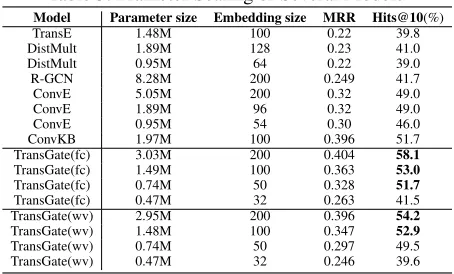
For in-depth investigation on expressivity, we look into the performance on link prediction of our methods with various parameter size on FB15K-237. Table 5 shows the detailed results along with several baselines.γis set to 4 during all TransGate training over different embedding size. From Ta-ble 5, we observe that
1. TransGates learn more expressive features than com-pared models, including deep models. TransGate(fc) with only 0.74M parameters and TransGate(wv) with only 1.48M parameters still surpass the best result at Hits@10. By contrast, multi-layer model R-GCN (Michael Sejr et al. 2018) achieves only 41.7%, and an-other deep model ConvE (Dettmers et al. 2018) yields 49.0%.
2. Our methods are highly parameter efficient and will grow much slower than all baselines. Since TransGates can outperform all baselines with smaller embedding size and fixed number of additional parameters. Trans-Gate(fc) achieves better performance at Hits@10 than ConvKB, ConvE, R-GCN with 1.5x, 6x and 17x fewer parameters. In other words, TransGate(fc) can outper-form all baselines with only 7.9GB parameters for the entirety of Freebase, while R-GCN will be more than 82GB and ConvE will be more than 56GB.
3. Moreover, the time complexity of TransGate(fc) is sim-ilar to ConvE and ConvKB,i.e. O(m2). TransGate(wv)
improves theHits@10from TransE by near 10% with same time complexity and half parameters of TransE. These results indicate that TransGate(wv) is more effec-tive and scalable than TransE on large-scale KGs.
In general, experimental results indicate that parameter sharing is a superior way to further improve embedding and TransGates find a better trade-off between complexity
and expressivity. Because TransGates not only reduce pa-rameters greatly, but also deliver a significant improvement. TransGate(fc) and TransGate(wv) have their own advan-tages: TransGate(fc) is more parameter efficient and Trans-Gate(wv) has lower time complexity. Researchers can use their advantages to tackle various problems.
Table 5: Prameter Scaling of Several Models Model Parameter size Embedding size MRR Hits@10(%)
TransE 1.48M 100 0.22 39.8
DistMult 1.89M 128 0.23 41.0
DistMult 0.95M 64 0.22 39.0
R-GCN 8.28M 200 0.249 41.7
ConvE 5.05M 200 0.32 49.0
ConvE 1.89M 96 0.32 49.0
ConvE 0.95M 54 0.30 46.0
ConvKB 1.97M 100 0.396 51.7
TransGate(fc) 3.03M 200 0.404 58.1
TransGate(fc) 1.49M 100 0.363 53.0
TransGate(fc) 0.74M 50 0.328 51.7
TransGate(fc) 0.47M 32 0.263 41.5
TransGate(wv) 2.95M 200 0.396 54.2
TransGate(wv) 1.48M 100 0.347 52.9
TransGate(wv) 0.74M 50 0.297 49.5
TransGate(wv) 0.47M 32 0.246 39.6
Conclusion and Future Work
In this paper, we focus on embedding knowledge graphs into continuous vector spaces for knowledge graph completion. We find that previous methods ignore inherent relevance be-tween relations and potentially suffer from huge parame-ters, preventing them from applying on real-world KGs effi-ciently. We follow parameter sharing to optimize embedding and reduce parameters simultaneously. We develop shared discriminate mechanism based on gate structure and pro-pose TransGate. To avoid matrix-vector multiplication oper-ations, we reconstruct standard gate by using the weight vec-tors and propose TransGate(wv). In this way, we decrease the time complexity to the same order as TransE. Exten-sive experiments on the tasks of link prediction and triplets classification show that parameter sharing is a superior way to further improve embedding and the great ability of gate structure in knowledge graph embedding. Because Trans-Gates not only reduce parameters greatly, but also deliver a significant improvement compared to state-of-art models. These results also show that our methods are better trade-off between complexity and expressivity.
In the future, we will explore following three research directions: (1) We will explore the better parameter shar-ing mechanism and try to solve more problems in knowl-edge graph embedding. (2) We will adopt more sophisti-cated techniques to enhance TranGate, such as incorporat-ing additional information, different loss functions and self-attention, etc. (3) Gate is a parameter efficient and fast op-erator, which can be composed into deep networks. We will extend TransGate to multi-layer model in the future.
Acknowledgement
References
Abadi, M.; Barham, P.; Chen, J.; Chen, Z.; Davis, A.; Dean, J.; Devin, M.; Ghemawat, S.; Irving, G.; Isard, M.; Kudlur, M.; Levenberg, J.; Monga, R.; Moore, S.; Murray, D. G.; Steiner, B.; Tucker, P. A.; Vasudevan, V.; Warden, P.; Wicke, M.; Yu, Y.; and Zheng, X. 2016. Tensorflow: A system for large-scale machine learning. InProceedings of USENIX, 265–283.
Bollacker, K.; Evans, C.; Paritosh, P.; Sturge, T.; and Taylor, J. 2008. Freebase:a collaboratively created graph database for structuring human knowledge. InProceddings of SIG-MOD, 1247–1250.
Bordes, A.; Weston, J.; Collobert, R.; and Bengio, Y. 2011. Learning structured embeddings of knowledge bases. In
Proceedings of AAAI.
Bordes, A.; Usunier, N.; Weston, J.; and Yakhnenko, O. 2013. Translating embeddings for modeling multi-relational data. InProceedings of NIPS, 2787–2795.
Bordes, A.; Glorot, X.; and Weston, J. 2012. Joint learning of words and meaning representations for open-text seman-tic parsing. InProceedings of AISTATS.
Cai, L., and Wang, W. Y. 2018. Kbgan: Adversarial learn-ing for knowledge graph embeddlearn-ings. In Proceedings of
NAACL.
Dai, Q. N.; Tu, D. N.; Nguyen, D. Q.; and Phung, D. 2018. A novel embedding model for knowledge base completion based on convolutional neural network. InProceedings of
NAACL.
Dettmers, T.; Pasquale, M.; Pontus, S.; and Riedel, S. 2018. Convolutional 2d knowledge graph embeddings. In Pro-ceedings of AAAI, 1811–1818.
Dong, X.; Gabrilovich, E.; Heitz, G.; Horn, W.; Lao, N.; Murphy, K.; Strohmann, T.; Sun, S.; and Zhang, W. 2014. Knowledge vault: A web-scale approach to probabilistic knowledge fusion. InProceedings of SIGKDD, 601–610. Garciaduran, A., and Niepert, M. 2017. Kblrn : End-to-end learning of knowledge base representations with latent, relational, and numerical features. InProceedings of UAI. Guo, S.; Wang, Q.; Wang, L.; Wang, B.; and Guo, L. 2018. Knowledge graph embedding with iterative guidance from soft rules. InProceedings of AAAI.
Hochreiter, S., and Schmidhuber, J. 1997. Long short-term memory.Neural Computation9(8):1735–1780.
Jenatton, R.; Roux, N. L.; Bordes, A.; and Obozinski, G. 2012. A latent factor model for highly multi-relational data. InProceedings of NIPS, 3167–3175.
Ji, G.; He, S.; Xu, L.; Liu, K.; and Zhao, J. 2015. Knowledge graph embedding via dynamic mapping matrix. In Proceed-ings of ACL, 687–696.
Ji, G.; Liu, K.; He, S.; and Zhao, J. 2016. Knowledge graph completion with adaptive sparse transfer matrix. In Proceed-ings of AAAI, 985–991.
J´ozefowicz, R.; Zaremba, W.; and Sutskever, I. 2015. An empirical exploration of recurrent network architectures. In
Proceedings of ICML, volume 37, 2342–2350.
Kingma, D., and Ba, J. 2015. Adam: A method for stochastic optimization. InProceedings of ICLR.
Lin, Y.; Liu, Z.; Zhu, X.; Zhu, X.; and Zhu, X. 2015. Learn-ing entity and relation embeddLearn-ings for knowledge graph completion. InProceedings of AAAI, 2181–2187.
Liu, H.; Wu, Y.; and Yang, Y. 2017. Analogical inference for multi-relational embeddings. InProceedings of ICML. Michael Sejr, S.; Thomas N, K.; Peter, B.; Rianne, v. d. B.; Ivan, T.; and Max, W. 2018. Modeling relational data with graph convolutional networks. InESWC.
Miller, G. A. 1995. Wordnet: a lexical database for english.
COMMUNICATIONS OF THE ACM38(11):39–41.
Nickel, M.; Tresp, V.; and Kriegel, H. P. 2011. A three-way model for collective learning on multi-relational data. InProceedings of ICML, 809–816.
Shi, B., and Weninger, T. 2017. Proje: Embedding pro-jection for knowledge graph completion. InProceedings of AAAI.
Socher, R.; Chen, D.; Manning, C. D.; and Ng, A. Y. 2013. Reasoning with neural tensor networks for knowledge base completion. InProceedings of NIPS, 926–934.
Tan, Z.; Zhao, X.; and Wang, W. 2017. Representation learn-ing of large-scale knowledge graphs via entity feature com-binations. InProceedings of CIKM, 1777–1786.
Toutanova, K., and Chen, D. 2015. Observed versus latent features for knowledge base and text inference. In Proceed-ings of CVCS.
Trouillon, T.; Welbl, J.; Riedel, S.; Gaussier, E.; and Bouchard, G. 2016. Complex embeddings for simple link prediction. InProceedings of ICML, volume 48, 2071–2080. Wang, Z.; Zhang, J.; Feng, J.; and Chen, Z. 2014. Knowl-edge graph embedding by translating on hyperplanes. In
Proceedings of AAAI, 1112–1119.
Xiao, H.; Huang, M.; and Zhu, X. 2016. From one point to a manifold: Knowledge graph embedding for precise link prediction. InProceedings of IJCAI.
Xu, H.; Yankai, L.; Ruobing, X.; Zhiyuan, L.; and Maosong, S. 2017a. Openke: An open-source framework for knowl-edge embedding. http://openke.thunlp.org/home.
Xu, J.; Qiu, X.; Chen, K.; and Huang, X. 2017b. Knowl-edge graph representation with jointly structural and textual encoding. InProceedings of IJCAI, 1318–1324.
Yang, B.; Yih, W.; He, X.; Gao, J.; and Deng, L. 2015. Em-bedding entities and relations for learning and inference in knowledge bases. InProceedings of ICLR.