The Thirty-Third AAAI Conference on Artificial Intelligence (AAAI-19)
Joint Representation Learning for Multi-Modal Transportation Recommendation
Hao Liu,
1Ting Li,
2Renjun Hu,
3Yanjie Fu,
4Jingjing Gu,
5Hui Xiong
1∗ 1The Business Intelligence Lab, Baidu Research, National Engineering Laboratory ofDeep Learning Technology and Application, Beijing, China,2National University of Defense Technology, Changsha, China 3SKLSDE Lab, Beihang University, Beijing, China,4Missouri University of Science and Technology, Missouri, USA
5Nanjing University of Aeronautics and Astronautics, Nanjing, China
[email protected], [email protected], [email protected] [email protected], [email protected], [email protected]
Abstract
Multi-modal transportation recommendation has a goal of recommending a travel plan which considers various trans-portation modes, such as walking, cycling, automobile, and public transit, and how to connect among these modes. The successful development of multi-modal transportation recom-mendation systems can help to satisfy the diversified needs of travelers and improve the efficiency of transport networks. However, existing transport recommender systems mainly focus on unimodal transport planning. To this end, in this paper, we propose a joint representation learning frame-work for multi-modal transportation recommendation based on a carefully-constructed multi-modal transportation graph. Specifically, we first extract a multi-modal transportation graph from large-scale map query data to describe the concur-rency of users, Origin-Destination (OD) pairs, and transport modes. Then, we provide effective solutions for the optimiza-tion problem and develop an anchor embedding for transport modes to initialize the embeddings of transport modes. More-over, we infer user relevance and OD pair relevance, and in-corporate them to regularize the representation learning. Fi-nally, we exploit the learned representations for online multi-modal transportation recommendations. Indeed, our method has been deployed into one of the largest navigation Apps to serve hundreds of millions of users, and extensive exper-imental results with real-world map query data demonstrate the enhanced performance of the proposed method for multi-modal transportation recommendations.
Introduction
Transport modes, such as walking, cycling, automobile, pub-lic transit, are means for traveling from an origin to a des-tination. Transportation mode recommendation refers to the effort of finding the most appropriate transport tools with awareness of user preferences (e.g., costs, times) and trip characteristics (e.g., purpose, distance). In this study, we in-vestigate this problem with large-scale navigation App data. In prior literature, a majority of work focuses on im-proving unimodal transport planning. For example, the stud-ies in (Dai et al. 2015; Rogers and Langley 1998; Chen, Shen, and Zhou 2011; Luo et al. 2013) aim at recommend-ing the most cost-effective drivrecommend-ing routes. The study in (Liu
∗
Corresponding author.
Copyright c⃝2019, Association for the Advancement of Artificial Intelligence (www.aaai.org). All rights reserved.
et al. 2014) optimizes bus routing strategies based on hu-man mobility patterns. However, in fact, a large number of transport planning requests involve the decision process of choosing an appropriate one from multiple available trans-port modes. According to statistics from Baidu Map1, one of the world’s largest navigation Apps, over ten million of users request the route planning information of at least two transport modes (e.g., driving and bus) for same OD pair every day. Intuitively, the transport mode preferences vary over different users and spatiotemporal contexts. For exam-ple, metros are more cost-effective than taxis for most urban commuters; economically disadvantaged people may prefer cycling and walking to others for local travel, if the trans-port options are inadequate. Such socio-economic person-alized effects in choosing transport modes present a unique challenge, but, meanwhile, a great potential for improving transportation route planning: if we can decide an appro-priate transport mode for a trip, it is easier to plan an op-timized route in the following. Unfortunately, there are lim-ited studies that intend to systematically address the multi-modal transportation recommendation problem:given a user and an OD pair, how to effectively identify the most appro-priate transport mode?
Smart transport mode recommendations have a number of advantages, including but not limited to reducing trans-port times, balancing traffic flows, reducing traffic conges-tion, and, ultimately, promoting the development of intelli-gent transportation systems. However, it is a non-trivial task to infer the most appropriate transport mode. Specifically, there are three major challenges.
The first challenge comes from the transport heterogene-ity. In particular, transport modes are heterogeneous in terms of the means of conveyance. For example, cycling and walk-ing are human-powered while bus and taxi are gasoline-powered. In addition, transport modes are heterogeneous in terms of infrastructures, e.g., walking require pedestrian lanes, and cycling require bike lanes. Moreover, transport modes are heterogeneous in terms of time-efficiency, cost, and comfortableness. Consequently, users choose different transport modes for different OD pairs. Then, one research issue is: how to incorporate the transport heterogeneity for multi-modal transportation recommendation? The second
1
challenge is that feedbacks in navigation Apps are incom-plete and implicit. In particular, due to privacy issues, when a user queries a transport plan from an origin to a destina-tion, the preference feedbacks, such as clicking and view-ing a routview-ing plan of a transport mode, are mostly implicit. Thus, for effective recommendations, it is critical to ad-dress the issue of incomplete and implicit feedbacks in data. The third challenge is geo-spatial locality. Despite the ex-ploratory nature of human mobility (Song et al. 2010), each user usually and repeatably visits a very small number of places (∼25) (Alessandretti et al. 2018). In other words, the frequently-traveled and preferred OD pairs are very limited for most users. As a result, it is challenging for the proposed method to learn robust transport mode preferences of users and OD pairs from the limited and localized feedback data.
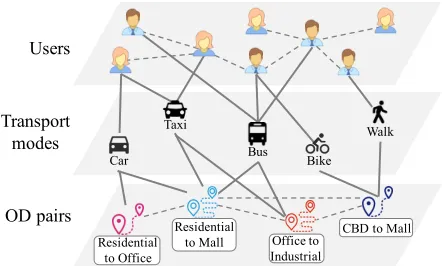
To tackle these challenges, we proposeTrans2Vec, a joint representation learning based framework for multi-modal transportation recommendation. Specifically, inspired by the recent success of word embedding (Mikolov et al. 2013) and network embedding (Cui et al. 2017), we first model users, OD pairs, and transport modes together into a multi-modal transportation graph and jointly learn the user prefer-ence and OD preferprefer-ence in a unified latent space. The rep-resentation of incomplete user and OD pair is curated since the preference can be learned by capturing the second order proximity from the multi-modal transportation graph. Be-sides, an anchor based method is proposed to model the het-erogeneity of transport modes. Moreover, we incorporate the user-user and OD-OD relevance to identify the interconnec-tions between users and between ODs to overcome the data sparsity and geo-spatial locality issues. Finally, we propose a simple yet effective method to support real-time transport mode recommendations in the online mapping service. Our major contributions are summarized as follows:
• We formally define the transport mode recommendations problem identified from a real-life scenario.
• We proposeTrans2Vec, a general framework for trans-port mode recommendations. Trans2Vecis a joint opti-mization framework that combines the historical travel behaviors and user/OD relevance for learning transport mode preference. An online recommendation method is also proposed to support the real-time recommendations.
• We conduct extensive experimental evaluations based on real-world datasets. The results demonstrate the effective-ness of our proposed framework.
• Trans2Vec has been deployed in a map and navigation App and serves hundreds of millions of users every day.
Preliminaries
We first introduce some important definitions and then for-malize our problem to investigate.
Assuming there is a setU of users, in which each user
u∈ U is associated with a vectorA(u)of demographic at-tributes, such as age, gender and job type. Besides, we par-tition a city into a setRof non-overlapping regions. Each regionr∈ Ris associated with a setP(r)of POIs, that rep-resent the functionalities of regions (Yuan, Zheng, and Xie
Office to Industrial
CBD to Mall Residential
to Mall Residential
to Office
Users
Transport modes
OD pairs
Car Taxi
Bus Bike
Walk
Figure 1: An illustrative example of a multi-modal portation graph. The nodes of the graph include users, trans-port modes, and OD pairs. Solid lines indicate observed user-mode and OD-mode edges, whereas dashed lines in-dicate the user-user and OD-OD relevance edges.
2012). Considering the existence of usersU and regionsR, we next define some essential concepts:
Definition 1 Origin-Destination (OD) Pair. An OD pair
od = (o, d)is a pair of regions in which there are travel demands fromo∈ Rtod∈ R. Be sure to note that, given an OD pair(o, d),o=dindicates an intra-region trip. We further denote the set of OD pairs byOD.
Definition 2 Transport Mode. A transport modem∈ Mis a mean by which passengers move from an origin to a des-tination. Typical transport modes are bike, bus, taxi, train, ferry, and airplane. Different transport modes yield different travel times, expenses, safety, and comfortableness. Conse-quently, both users and OD pair have personalized prefer-ences and appropriateness on specific modes. In this study, we focus on intra-city transport modes: bus, taxi, train, bi-cycle, and walk.
Definition 3 Travel Event. A travel eventq∈ Qis a triplet
⟨u, m, od⟩, which represents the useru∈ U travel between the OD pairod∈ ODby the transport modem∈ M.
Definition 4 Multi-modal Transportation Graph(MMTG). A multi-modal transportation graph is a heterogeneous undirected weighted graphG = (V,E), where V = U ∪ OD ∪ Mis a set of heterogeneous nodes, andE =Eum∪
Eodm∪ Euu∪ Eodod is a set of heterogeneous edges includ-ing user-mode edgesEum, OD-mode edgesEodm, user-user edgesEuu and OD-OD edgesEodod. When it is clear from the context, we directly refer a node inGto as a user, an OD pair or a mode.
User demographic
attributes OD POIs andstatistics Map database
OD relevance construction User relevance
construction Travel events
extraction MMTG
construction Joint learning
User
representation representationOD Transport moderepresentation Online
recommendations
Figure 2: TheTrans2Vecframework.
Definition 5 The Multi-modal Transportation Recom-mendation Problem. Given a multi-modal transportation graph G, a user u, and an OD pairod, we aim to recom-mend the most appropriate transport modem∈ Mfor the useruto travel between the OD pairod.
Methodology
In this section, we introduce the proposed analytic framework Trans2Vec. We first present an overview of
Trans2Vec, then detail each step of the proposed framework.
Framework Overview
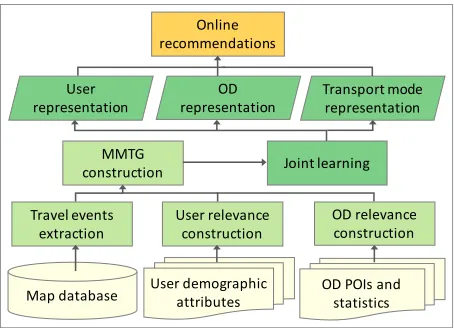
We study the multi-modal transportation recommendation problem via joint representation learning on multi-modal transportation graphs. Figure 2 shows an overview of the proposed analytic framework. It consists of three major tasks: (1) multi-modal transportation graph construction, (2) joint representation learning to capture the transport mode preferences of users and ODs, and (3) online transport mode recommendations.
Specifically, we construct a multi-modal transportation graph based on heterogeneous source data including a map database, user demographic attributes, and OD POIs infor-mation. The graph thus contains rich semantics, i.e., travel event occurrence and user/OD relevance. Second, we de-velop a joint representation learning method that, given the multi-modal transportation graphG, learns ad-dimensional (d ≪ |V|) latent representationxv for each nodev ∈ V. Our method exploits a novel anchor embedding strategy to model and maintain the heterogeneity of different transport modes and further incorporates user and OD relevance into the base embedding model. Finally, we propose a simple yet effective online recommendation method to recommend the most proper transport mode.
Base Model
The basic idea of the proposed method is from word and network embedding (Mikolov et al. 2013; Perozzi, Al-Rfou, and Skiena 2014), which assumes that semantically-related
words and correlated nodes have the similar context in sen-tences and network structures. We analogize travel events to sentences and random walks, in order to learn embeddings of users, OD pairs, and transport modes. If a user, an OD pair, and a transport mode co-occur in the same travel event, it implies both the user and the OD pair have certain prefer-ence for the transport mode. More specifically, a travel event
⟨u, m, od⟩ ∈ Qcan indicate that the embeddings of the user
uand the OD pairodshould be close to the embedding of the transport modem.
We denote the corresponding embeddings ofu,odandm
byxu,xod andxm, respectively. The user-mode and OD-mode relationships of all the travel events inQ are repre-sented in the form ofEum∪ Eodm. We then achieve the goal by maximizing the following objective function for all of the edges inEum∪ Eodm:
O0=
∑
(u,m)∈Eum
logσ(x⊤u·xm) + ∑
(od,m)∈Eodm
logσ(x⊤od·xm),
(1)
whereσ(x) = 1/(1 +e−x)is the sigmoid function.Note that the objective in Eq. (1) reaches a global optima when all the nodes have the same embeddings. The problem is that the captured preference is uninformative if we omit the disfavor information. To avoid converging to the mean-ingless trivial solution, we adopt the negative sampling strat-egy (Mikolov et al. 2013), such that for each(u, m)∈ Eum
(resp.(od, m) ∈ Eodm), we randomly sample another mode
m′ ∈ M, i.e., negative sample, and move the embeddingx u
(resp.xod) away fromxm′. Correspondingly, the objective function is rewritten as:
O0=
∑
(u,m)∈Eum
m′∼U (
logσ(x⊤u·xm) + logσ(−x ⊤ u·xm′))
+ ∑
(od,m)∈Eodm
m′∼U (
logσ(x⊤od·xm) + logσ(−x⊤od·xm′)).
(2)
In Eq. (2),U is a uniform distribution for generating nega-tive mode samples so thatU(m) = 1/|M|. As we can see, the trivial solution is not an optima anymore because the nega-tive sample terms also need to be maximized.
Transport Mode Anchor Embedding
dis-criminative embedding that reflects its inherent context in-formation.
More specifically, we maintain each transport mode as a fixed anchor vector in the latent space. The anchor vector will not be changed after initialization. In the learning proce-dure, only user and OD embeddings are optimized to maxi-mize Eq. (2). Consequently, as long as the anchor vectors are initialized properly, each user or OD pair will be allocated in an appropriate location in the hidden space that captures the distinct preference of the user or the OD pair for each transport mode.
In addition, the strategy provides great potential to in-corporate prior human knowledge regarding the transport modes into the initialization step of anchor vectors. For in-stance, compared with the transport modes of bus, train, and airplane, the mode of walk is more similar to the one of bike because: both walk and bike are human powered while bus, train, and airplane are gasoline-powered. Such human knowledge can be reflected in the distance between the an-chor vectors of the modes.
Along this line, we develop a data-driven approach to quantifying the relevance between transport modes:
rel(mi, mj) =
∑
vi∈ZFmi(vi)Fmj(vi) √
∑
vi∈ZFmi(vi)2 √
∑
vi∈ZFmj(vi)2
,
(3)
whereZ=U ∪ OD,Fmi(·)computes the frequency the input v∈ Zever co-occurred with transport modemiinQ.
After measuring the mode-mode pairwise relevance, we employ a greedy strategy to initialize transport mode an-chor embeddings. In particular, we first initialize the two transport modes of the highest relevance. In each of follow-ing iterations, we initialize the mode node of highest overall relevance with previously initialized mode nodes under the pairwise relevance order constraints. For example, assuming rel(mbus, mtaxi) > rel(mbus, mbicycle) > rel(mtaxi, mbicycle),
with anchor embedding xbus and xtaxi initialized, the
distance of anchor embedding xbicycle should satisfy
rel(xbus,xtaxi) > rel(xbus,xbicycle) and rel(xbus,xtaxi) >
rel(xtaxi,xbicycle), simultaneously. Note that each entry of
anchor embedding is initialized with an uniform distribution between[−1
2d,
1
2d]. As a result, transport modes frequently
co-used by same users and same ODs are closer to each other.
Modeling User and OD Relevance
In real life, the choice of transport mode is highly influenced by the characteristics of both users and OD pairs. For exam-ple, business users may prefer traveling by taxi than by bus for long-distance travel; on the other hand, the bus may be in general popular for urban commuter to go to work. That is, users (OD pairs) with similar characteristics would share similar transport mode preferences. Next, we propose meth-ods to measure the relevance of users and OD pairs and fur-ther incorporate the relevance to refine our framework.
Measuring user relevance. We collect the demographic attributes of users in order to measure the user-user rele-vance. In particular, the attributes of user uis represented
by a vectorA(u)where each dimension is a categorical de-mographic attribute. In practice, different attributes have dif-ferent impacts on the relevance of users regarding transport mode preference. We thus learn a vector wof weights by predicting transport modes taken by users via a linear regres-sion model, i.e.,arg minw,b∑(u,m,od)∈Q(w⊤A(u) +b−l(m))2,
where each transport modemis assigned a distinct random labell(m)in{1, . . . ,|M|}. Given two usersuandu′, the user relevancec(u, u′)is then given by:
rel(u, u′) =∑
i wiI
(
A(u)i,A(u′)i )
/∑
i
wi,
(4)
where subscriptimeans thei-th element of a vector,I(·)is a
0–1indication function which equals to 1 iff. the input cate-gorized attributes are the same. Since mode preferences are only shared by users having high relevance, we thus collect the set Euu of user relevance edges as {(u, u′)|u ∈ U, u′ ∈
N(u)}whereN(u)includes the top-Kmost relevant users of u. Note thatN(u)can be efficiently retrieved as theK-nearest neighbors in a KD-tree where each useruis represented by the Hadamard productw⊙A(u). Finally, we incorporate user relevance into our framework as constraints by maximizing the objective function below:
O1=− 1 2
∑
(u,u′)∈Euu (
x⊤u·xu′−rel(u, u′))2.
(5)
Measuring OD relevance. Considering that distance and travel purpose (e.g., home-work, home-commercial) are among the most influential factors for choosing transport modes, here we calculate the OD relevance from the above two perspectives. Given an OD pairod= (o, d), the distance distodis computed by Haversine formula. On the other hand,
the travel purpose is highly related to the functions of re-gionsoandd, which can further be captured by the region POI distribution (Yuan, Zheng, and Xie 2012). Specifically, a regionris modeled as a POI distribution vectorpr
com-puted from the POI setP(r); each dimension represents the number of POIs in a certain category such as residence, en-tertainment and transport station. The OD pair odis repre-sented as a concatenated vector of the above two views:
od=dod⊕po⊕pd.
(6)
Since the impact of each dimension also varies, we learned another vectorwof weights in exactly the same way as user relevance (we also reuse the notationwas this does not in-troduce confusion). The relevance between two OD pairsod andod′is computed as:
rel(od, od′) = exp{−||w⊙(od−od′)||}.
(7)
Note that Eqs. (4) and (7) differ from each other in the way computing relevance, as they are dealing with categorical and numerical features, respectively. Finally, we incorporate the OD relevance via maximizing the following objective:
O2=− 1 2
∑
(od,od′)∈Eodod (
x⊤od·xod′−rel(od, od′))2,
(8)
whereEodod ={(od, od′)|od∈ OD, od′ ∈ N(od)}is the set of
Algorithm 1:Joint learning algorithm ofTrans2Vec
Input:A multi-modal transportation graphG, number
dof dimensions, numberK, learning rateα, parametersβ1andβ2;
Output:xu/xod/xmforu/od/m∈ U/OD/M;
1 Initialize entries ofxu/xod/xmwith uniform[−21d,21d]; 2 Compute user and OD relevance with Eqs. (4) & (7);
3 iter←1; 4 repeat
5 foreach(u, u′)∈ Euudo
6 xu←xu−αβiter1 (
x⊤u ·xu′−rel(u, u′))xu′; 7 xu′ ←xu′−αβ1
iter (
x⊤u ·xu′−rel(u, u′))xu; 8 foreach(od, od′)∈ Eododdo
9 xod←xod−αβiter2(xod⊤·xod′−rel(od, od′))xod′; 10 xod′ ←xod′−αβ2
iter (
x⊤od·xod′−rel(od, od′))xod; 11 foreach(u, m)∈ Eumdo
12 Sample a transport modem′∼U;
13 xu←xu−iterα (
σ(x⊤u ·xm)−1 )
xm− α
iterσ(x ⊤
u ·xm′)xm′; 14 foreach(od, m)∈ Eodmdo
15 Sample a transport modem′∼U;
16 xod←xod−iterα (
σ(x⊤od·xm)−1 )
xm− α
iterσ(x ⊤
od·xm′)xm′; 17 iter←iter+ 1;
18 untilconverge;
19 returnxu/xod/xmforu/od/m∈ U/OD/M;
Model Training and Online Recommendations
The optimization objective of our method jointly consid-ers traditional heterogeneous network embedding, negative sampling, user-user graph regularization, and OD-OD graph regularization:O=O0+β1O1+β2O2,
(9)
whereβ1andβ2are hyperparameters that regularize the
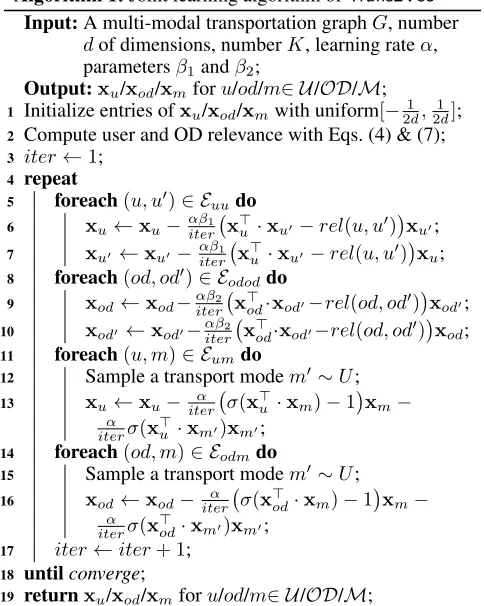
im-portance of user and OD relevance. We utilize stochastic gra-dient descent to train the embeddings. The overall learning process is presented in Algorithm 1.
After deriving the embeddings, we propose a real-time and effective method to compute the preference score of each transport modemgiven a useruand an OD pairod:
f(u, od, m) =γx⊤u·xm+ (1−γ)x⊤od·xm,
(10)
whereγis a hyperparameter to control the weights of user preference and OD preference. Finally, we rank the transport modes based on the computed scores and return the one with the highest score as the recommendation.
Experiments
Using large-scale real-life datasets, we present an extensive experimental study to evaluate: (1) the overall performance ofTrans2Vec, (2) the parameter sensitivity, (3) the transport mode relevance and (4) the robustness of our approach.
Notation Description BEIJING SHANGHAI
|Q| # of travel events 1,137,688 1,117,981
|U | # of users 318,879 316,060
|OD| # of ODs 375,165 350,904
|M| # of modes 5 5
Table 1: Statistics of datasets
Experimental Setups
Data description. We choose two datasets BEIJING and SHANGHAIto test our approach. Both of them are produced based on the map queries and user feedbacks on the Baidu Map, in the corresponding cities from April 1, 2018 till Au-gust 20, 2018. More specifically, a travel event is recorded if a user issues an OD query and clicks on a specific transport mode. We also use the POI and user profile data collected by the same navigation Apps to generate features of users and OD pairs. The statistics of our datasets are summarized in Table 1.
Evaluation metrics. We adopt the overallNDCG2, as well as the weighted precision (PREC), recall (REC) and F1
met-rics to evaluate the performance. For the last three weighted metrics, we first compute results at transport mode level and then combine the results scaled by the relative frequency of each transport mode. Also note that theNDCG metric takes the orders of all transport modes into consideration and the rest metrics only care about the top-1 recommended mode. Finally, theRECmetric is equivalent to the overall accuracy in our case as we recommend a transport mode for each travel event.
Baseline algorithms. We compare our full approach Trans2Vecwith two recommendations methods, two embed-ding learning methods and one variant ofTrans2Vec.
• LRuses logistic regression for transport mode recommen-dations, which, given a useru and an OD pairod, takes the user attribute vector ofA(u), the distancedod and the
fraction of historical rides using each transport mode byu and betweenodas input features.
• LTR is a LambdaMart (Burges 2010) learning-to-rank method whose input features are the same as LRexcept that it only uses the fraction of historical rides using the transport mode to rank.
• PTE(Tang, Qu, and Mei 2015) first learns user, OD and transport mode embeddings by treating{u, od}as the doc-ument and mode m as the label for each travel event
⟨u, m, od⟩, and utilizes logistic regression that takes the corresponding embeddings as input for recommendations.
• Metapath2Vec (Dong, Chawla, and Swami 2017) is the same to PTEexcept that it learns embeddings from ran-dom walks following meta-pathU–M–OD–M–U–. . ..
• BTrans2Vecis the base model ofTrans2Vecwhich does not incorporate user and OD relevance.
2
Algorithm BEIJING SHANGHAI
NDCG@5 PREC REC F1 NDCG@5 PREC REC F1
LR 0.804 0.704 0.589 0.633 0.848 0.682 0.657 0.658
LTR 0.824 0.667 0.662 0.664 0.830 0.671 0.666 0.668
PTE 0.770 0.493 0.518 0.499 0.807 0.564 0.610 0.585
Metapath2Vec 0.731 0.718 0.439 0.515 0.736 0.728 0.451 0.528
BTrans2Vec 0.876 0.682 0.736 0.704 0.878 0.695 0.754 0.718
Trans2Vec 0.893 0.700 0.770 0.711 0.891 0.708 0.778 0.719
Table 2: Overall performance
16 32 64 128 256 d
0.65 0.70 0.75 0.80 0.85 0.90
Metric score
NDCG@5 PREC RECF1
(a) Effect ofd
0 1 5 10 20 30 50 K
0.65 0.70 0.75 0.80 0.85 0.90
Metric score
NDCG@5 PREC RECF1
(b) Effect ofK
0.0 0.03 0.1 0.3 1.0 3.0
1
0.65 0.70 0.75 0.80 0.85 0.90
Metric score
NDCG@5 PREC RECF1
(c) Effect ofβ1
0.0 0.03 0.1 0.3 1.0 3.0
2
0.65 0.70 0.75 0.80 0.85 0.90
Metric score
NDCG@5 PREC RECF1
(d) Effect ofβ2
Figure 3: Parameter sensitivity on BEIJING
Implementations. We use the data from April through July for training, i.e., learning embeddings, counting his-torical numbers of rides and training models, and the rest data for testing. We use the recommended parameters for all baselines, and fixed learning rateα= 0.5and0.3forBEIJING andSHANGHAI, respectively, numberdof dimensions to 64, numberKof relevance neighbors to 5, and regularizing pa-rameters β1, β2 andγto 0.1, 0.3 and 0.5, respectively, by
default for ourBTrans2VecandTrans2Vec(we will report the sensitivity analysis later).
Experimental Results
Overall performance. In the first set of experiments, we evaluate the overall performance of all tested approaches for transport mode recommendation. We test the performance on bothBEIJINGandSHANGHAIdatasets using the four metrics. The results are reported in Table 2.
As can be seen, both our basic BTrans2Vec and com-pleteTrans2Vecapproaches achieve significantly better per-formance compared with the rest tested baselines on both datasets using all metric except PREC. Indeed, the NDCG@5,RECandF1of BTrans2Vecis already (5.1%, 5.0%, 8.9%, 14.3%)3, (12.2%, 8.1%, 18.1%, 30.0%) and (6.6%, 4.5%, 16.9%, 19.0%) higher than those of (LR,LTR, PTE, Metapath2Vec) on average on the two datasets, respectively. Moreover, using (NDCG@5,REC,F1), our completeTrans2Vec further outperforms BTrans2Vecby (1.5%, 2.9%, 0.4%) on average, respectively. These results indicate that our joint representation learning technique enhanced with the anchor embedding strategy is effective for capturing transport mode preference. And the incorporated user and OD relevances do have positive impacts for transport mode recommendation.
3
% refers to absolute percentage points throughout the paper.
On the other hand, our approaches are slightly worse in terms of PREC, compared with Metapath2Vec. While the RECofBTrans2VecandTrans2Vecare consistently much bet-ter than the one of Metapath2Vec. Indeed, BTrans2Vec and Trans2Vecstrike a better balance between thePRECandREC, as illustrated by performance evaluated by the more compre-hensive metricF1.
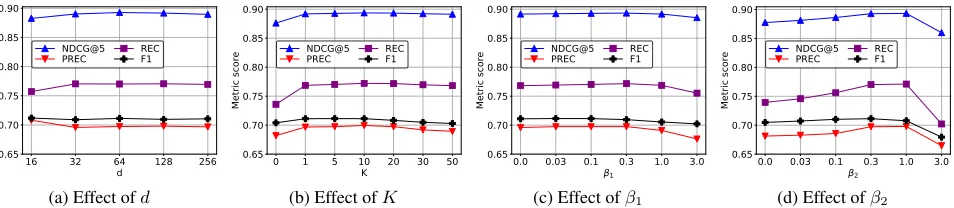
Parameter sensitivity. Due to the space constraints, here we report the impacts of the number dof dimensions, the numberKof relevance neighbors, and regularizing parame-tersβ1andβ1 onBEIJINGdata. The results onSHANGHAIare similar. Each time we vary a parameter, set others to their de-fault values, and evaluate the performance ofTrans2Vecusing all metrics.
To test the impacts of the number dof dimensions, we varydfrom 16 to 256. The results are reported in Fig. 3a. Overall, our approach is robust to the selection ofd. A small d is already sufficient for distinguishing transport modes considered in our case. Also note that when increasing d from 16 to 32, the REC increases at the cost of obtaining worsePREC.
To test the impacts of the numberKof relevance neigh-bors, we varyK from 0 to 50. The results are reported in Fig. 3b, including the ones ofBTrans2VecwithK= 0. There can be observed a remarkable improvement when varying Kfrom 0 to 1. The performance degenerates with largerK, especially forPREC, possibly because noises are introduced. Finally, we note that it suffices to use a smallK, e.g., 5 and 10.
To test the impacts of parameterβ1, we variedβ1from 0 to
3. The results are reported in Fig. 3c. When varyingβ1, the
Car Taxi Bus Walk Bicycle Car
Taxi
Bus
Walk
Bicycle
1.000 0.478 0.169 0.242 0.226
0.478 1.000 0.501 0.091 0.266
0.169 0.501 1.000 0.109 0.298
0.242 0.091 0.109 1.000 0.609
0.226 0.266 0.298 0.609 1.000 0.2
0.4 0.6 0.8 1.0
Relevance
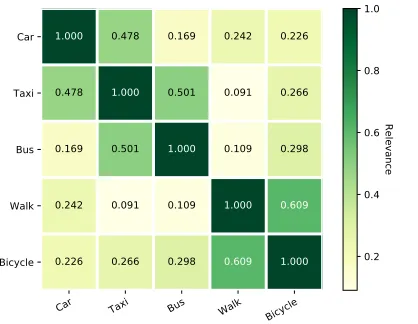
Figure 4: Pairwise transport mode relevance matrix
And we admit that the user relevance only has a minor im-provement, possibly because the correlation between avail-able user attributes and transport mode preference is not such strong compared the OD relevance.
To test the impacts of parameterβ2, we also varyβ2from 0
to 3. The results are reported in Fig. 3d. Again, when varying β1, all tested scores first increase and then decrease. And
whenβ2∈[0.3,1.0], incorporating OD relevance results in a
remarkable improvement.
Transport mode relevance. Figure 4 reports the pairwise transport mode relevance according to Eqn. 3. We can ob-serve that transport modes can be clustered into two groups: car, taxi, bus in one group and bus, walk, bicycle in another group. Bus, as the nexus of two groups, has relatively high relevance with taxi and bicycle. Such groups make sense since these two groups have significantly different charac-teristics in efficiency, cost, and environmental impact.
Robustness check. To evaluate the robustness of Trans2Vec, we first group users (resp. OD pairs) into four subgroups with K-means algorithm and then test the performance on each group of users (resp. OD pairs) based on our online recommendation method and the learned representations. Here we only report the results onBEIJING data, shown in Fig. 5, and, again, the results on SHANGHAI are similar. Observe that the performance of Trans2Vec is stable in different groups of users and OD pairs. Indeed, the standard derivative is less than 1.5% in all our tests using the four metrics. That is, ourTrans2Vecframework is robust for different transport mode recommendation scenarios.
Related Work
Transportation recommendation. Unimodal transporta-tion recommendatransporta-tion has been extensively studied in previ-ous work (Chen, Shen, and Zhou 2011; Luo et al. 2013; Bao et al. 2012; Ge et al. 2011). Personalized route planning was first considered in (Rogers and Langley 1998) to improve transportation recommendation quality, and PRP (Funke and Storandt 2015) computes personalized routes on huge road
NDCG@5 PREC REC F1 Metric 0.5
0.6 0.7 0.8 0.9 1.0
Metric score
group 1
group 2 group 3group 4
(a) Group by users
NDCG@5 PREC REC F1 Metric 0.5
0.6 0.7 0.8 0.9 1.0
Metric score
group 1
group 2 group 3group 4
(b) Group by OD pairs
Figure 5: Robustness check on BEIJING
networks in a real-time fashion. A few work (Liu 2011; Borole et al. 2013) discussed generating multi-modal short-est routes based on heterogeneous transportation network and real-time transit data. Although the algorithms men-tioned above improve the route recommendation satisfac-tion, these methods cannot be utilized for multi-modal trans-portation recommendation.
Network embedding. Network embedding (Cui et al. 2017) has become an emerging topic since the first semi-nal work DeepWalk (Perozzi, Al-Rfou, and Skiena 2014). DeepWalk is inspired from word representation learning method word2vec (Mikolov et al. 2013), which uses ran-dom walks in networks to stimulate sentences in language models. And after that random walks have been a general tool for learning embeddings, such as node2vec (Grover and Leskovec 2016) and metapath2vec (Dong, Chawla, and Swami 2017), to name a few. Almost at the same time as DeepWalk, LINE (Tang et al. 2015) is proposed to learn network embedding via preserving the first and sec-ond order pairwise proximities. Finally, network embedding has also found successful applications in various geospa-tial tasks such as POI recommendations (Feng et al. 2017; Chang et al. 2018), anomaly detection (Hu et al. 2016) and region function profiling (Yao et al. 2018; Fu et al. 2018; Wang et al. 2018a; Wang et al. 2018b).
In this work, we exploit network embedding in a new scenario, i.e., multi-modal transportation recommendation, which has not been studied earlier. In addition, consider-ing the distinct structure of our multi-modal transportation graph, we propose a novel anchor embedding strategy for maintaining transport mode embeddings.
Conclusions
Acknowledgments
This research is supported in part by grants from the National Natural Science Foundation of China (Grant No.91746301 and No.71531001).
References
Alessandretti, L.; Sapiezynski, P.; Sekara, V.; Lehmann, S.; and Baronchelli, A. 2018. Evidence for a conserved quantity in hu-man mobility.Nature Human Behaviour 1.
Bao, T.; Cao, H.; Chen, E.; Tian, J.; and Xiong, H. 2012. An un-supervised approach to modeling personalized contexts of mobile users.Knowledge and Information Systems31(2):345–370. Borole, N.; Rout, D.; Goel, N.; Vedagiri, P.; and Mathew, T. V. 2013. Multimodal public transit trip planner with real-time transit data.Procedia-Social and Behavioral Sciences104:775–784. Burges, C. J. 2010. From ranknet to lambdarank to lambdamart: An overview. Technical report.
Chang, B.; Park, Y.; Park, D.; Kim, S.; and Kang, J. 2018. Content-aware hierarchical point-of-interest embedding model for succes-sive poi recommendation. InIJCAI, 3301–3307.
Chen, Z.; Shen, H. T.; and Zhou, X. 2011. Discovering popular routes from trajectories. InProceedings of the 27th International Conference on Data Engineering, ICDE, 900–911.
Cui, P.; Wang, X.; Pei, J.; and Zhu, W. 2017. A survey on network embedding.CoRRabs/1711.08752.
Dai, J.; Yang, B.; Guo, C.; and Ding, Z. 2015. Personalized route recommendation using big trajectory data. InData Engineering (ICDE), 2015 IEEE 31st International Conference on, 543–554. Dong, Y.; Chawla, N. V.; and Swami, A. 2017. metapath2vec: Scalable representation learning for heterogeneous networks. In
Proceedings of the 23rd ACM SIGKDD International Conference on Knowledge Discovery and Data Mining, 135–144.
Feng, S.; Cong, G.; An, B.; and Chee, Y. M. 2017. Poi2vec: Ge-ographical latent representation for predicting future visitors. In
AAAI, 102–108.
Fu, Y.; Liu, G.; Ge, Y.; Wang, P.; Zhu, H.; Li, C.; and Xiong, H. 2018. Representing urban forms: A collective learning model with heterogeneous human mobility data.TKDE.
Funke, S., and Storandt, S. 2015. Personalized route planning in road networks. InProceedings of the 23rd SIGSPATIAL Inter-national Conference on Advances in Geographic Information Sys-tems, 45.
Ge, Y.; Liu, C.; Xiong, H.; and Chen, J. 2011. A taxi business intelligence system. InProceedings of the 17th ACM SIGKDD international conference on Knowledge discovery and data mining, 735–738.
Grover, A., and Leskovec, J. 2016. node2vec: Scalable feature learning for networks. InProceedings of the 22nd ACM SIGKDD International Conference on Knowledge Discovery and Data Min-ing.
Hu, R.; Aggarwal, C. C.; Ma, S.; and Huai, J. 2016. An embed-ding approach to anomaly detection. In32nd IEEE International Conference on Data Engineering.
Liu, Y.; Liu, C.; Yuan, N. J.; Duan, L.; Fu, Y.; Xiong, H.; Xu, S.; and Wu, J. 2014. Exploiting heterogeneous human mobility pat-terns for intelligent bus routing. InData Mining (ICDM), 2014 IEEE International Conference on, 360–369.
Liu, L. 2011. Data model and algorithms for multimodal route planning with transportation networks. Ph.D. Dissertation, Tech-nische Universit¨at M¨unchen.
Luo, W.; Tan, H.; Chen, L.; and Ni, L. M. 2013. Finding time period-based most frequent path in big trajectory data. In Pro-ceedings of the 2013 ACM SIGMOD international conference on management of data, 713–724.
Mikolov, T.; Sutskever, I.; Chen, K.; Corrado, G. S.; and Dean, J. 2013. Distributed representations of words and phrases and their compositionality. In Advances in neural information processing systems, 3111–3119.
Perozzi, B.; Al-Rfou, R.; and Skiena, S. 2014. Deepwalk: online learning of social representations. InThe 20th ACM SIGKDD In-ternational Conference on Knowledge Discovery and Data Mining. Rogers, S., and Langley, P. 1998. Personalized driving route rec-ommendations. InProceedings of the American Association of Ar-tificial Intelligence Workshop on Recommender Systems, 96–100. Song, C.; Koren, T.; Wang, P.; and Barab´asi, A.-L. 2010. Mod-elling the scaling properties of human mobility. Nature Physics
6(10):818.
Tang, J.; Qu, M.; Wang, M.; Zhang, M.; Yan, J.; and Mei, Q. 2015. LINE: large-scale information network embedding. InProceedings of the 24th International Conference on World Wide Web. Tang, J.; Qu, M.; and Mei, Q. 2015. Pte: Predictive text embedding through large-scale heterogeneous text networks. InProceedings of the 21th ACM SIGKDD International Conference on Knowledge Discovery and Data Mining.
Wang, P.; Fu, Y.; Zhang, J.; Li, X. L.; and Lin, D. 2018a. Learning urban community structures: A collective embedding perspective with periodic spatial- temporal mobility graphs.ACM Transactions on Intelligent Systems and Technology (TIST).
Wang, P.; Fu, Y.; Zhang, J.; Wang, P.; Zheng, Y.; and Aggarwal, C. 2018b. You are how you drive: Peer and temporal-aware rep-resentation learning for driving behavior analysis. InProceedings of the 24th ACM SIGKDD International Conference on Knowledge Discovery & Data Mining, 2457–2466.
Yao, Z.; Fu, Y.; Liu, B.; Hu, W.; and Xiong, H. 2018. Represent-ing urban functions through zone embeddRepresent-ing with human mobility patterns. InIJCAI, 3919–3925.
Yuan, J.; Zheng, Y.; and Xie, X. 2012. Discovering regions of different functions in a city using human mobility and pois. In