Theses
5-2018
Learning to Rank Relevant Files for Bug Reports
Using Domain knowledge, Replication and
Extension of a Learning-to-Rank Approach
Nasir Safdari
Follow this and additional works at:https://scholarworks.rit.edu/theses
This Thesis is brought to you for free and open access by RIT Scholar Works. It has been accepted for inclusion in Theses by an authorized administrator of RIT Scholar Works. For more information, please [email protected].
Recommended Citation
Reports Using Domain knowledge,
Replication and Extension of a
Learning-to-Rank Approach
by
Nasir Safdari
A Thesis Submitted in Partial Fulfillment of the
Requirements for the Degree of
Master of Science in Software Engineering
Supervised by
Dr. Mohamed Wiem Mkaouer
Department of Software Engineering
B. Thomas Golisano College of Computing and Information Sciences
Rochester Institute of Technology
Rochester, New York
The thesis “Learning to Rank Relevant Files for Bug Reports Using Domain
knowl-edge, Replication and Extension of a Learning-to-Rank Approach” by Nasir Safdari has
been examined and approved by the following Examination Committee:
Dr. Mohamed Wiem Mkaouer Assistant Professor
Thesis Committee Chair
Dr. Christian Newman Assistant Professor
Dr. Yasmin El-Glaly Assistant Professor
Dr. J. Scott Hawker Associate Professor
Dedication
Acknowledgments
Many people accompanied and supported me during the endeavor of my two-year Masters
studies. It is a pleasure for me to have now the opportunity to express my gratitude. First
of all, I would like to thank my supervisors, prof. Mohamed Wiem Mkaouer for his
encouragement, guidance and timely advices throughout my Masters thesis. I feel a deep
sense of gratitude for my family for their love, for their unconditional support, and for
believing in me whenever and wherever. Finally, I am grateful to everybody who
accompanied and supported the successful realization of this thesis, and I express my
Abstract
Learning to Rank Relevant Files for Bug Reports Using Domain
knowledge, Replication and Extension of a Learning-to-Rank
Approach
Nasir Safdari
Supervising Professor: Dr. Mohamed Wiem Mkaouer
Bug localization is one of the most important stages of the bug fixing process. Bad practices
make the debugging a tedious task. Investigating bugs can contribute up to a large portion
of the aggregate cost for a software project. An automated strategy that can provide a
ranked list of source code files with respect to how likely they contain the root cause of
the problem would help the development teams to decrease the search space and leads to
increase in the productivity. In this work, I have replicated the bug localization approach
presented in [26] that applies the learning-to-rank technique to rank the relevant files for
each bug. This technique applies domain knowledge by evaluating the textual similarity
between bug reports and source code files and API specification documents plus bug fixing
and code alteration history. For a given bug report, the ranking function is constructed
based on the linear combination of weighted features where the features are trained on
previously solved bug reports. In addition to replication of the mentioned technique, I have
extended the study by evaluating the role of different text preprocessing techniques such
as Stemming and Lemmatization and also a randomized selection of training folds on the
randomized selection of the training folds have an adverse effect on the performance of the
Contents
Dedication. . . iii
Acknowledgments . . . iv
Abstract . . . v
1 Introduction. . . 1
2 Background . . . 5
3 Related Work . . . 10
4 Problem Statement . . . 15
5 Methodology . . . 16
5.1 Ranking Model . . . 16
5.2 Experiment Setup . . . 17
5.2.1 Vector Space Model . . . 17
5.2.2 Text Preprocessing Methods and Cosine Similarity . . . 18
5.3 Feature Extraction . . . 19
5.3.1 Source Code Files Lexical Similarity . . . 20
5.3.2 API Specifications Lexical Similarity . . . 21
5.3.3 Collaborative Filtering Score . . . 22
5.3.4 Class Name Similarity . . . 23
5.3.5 File Alteration History . . . 24
5.3.6 Feature Values Normalization . . . 25
5.4 Dataset . . . 25
5.5 Training Steps . . . 26
5.5.1 Tuning the Capacity Parameters . . . 27
5.6 Evaluation Metrics . . . 29
6 Experimental Results . . . 31
7 Threats to Validity . . . 37
8 Conclusion . . . 38
List of Tables
List of Figures
2.1 Lifecycle of a bug . . . 7
5.1 System Architecture for training and testing [27] . . . 17
5.2 Tomcat Bug Report 30949 . . . 20
5.3 API specification for Member Interface from Tomcat project . . . 22
6.1 MAP Comparison with other state-of-the-art bug localization tools [26]. . . 32
6.2 Accuracy@k graph on Tomcat [26]. . . 32
6.3 Accuracy@k graph comparing the original study and the current one. . . . 33
6.4 Accuracy@k graph comparing Lemmatization vs. Stemming . . . 35
Chapter 1
Introduction
One of the most critical aspects of Software Engineering is Software Maintenance. It is
crucial to make sure that a software product is developed by following the proper
princi-ples and standards. For instance, in an organization it is common that a project is carried
on by a team of several members; each of them assuming an specific role. Depending on
the scope of the project, each task is assigned to an individual who has the required skills
and abilities in the role.
Once a software project is completed, it needs to be maintained in order to ensure its
qual-ity. Even though all the requirements are fulfilled, there is still room for improvement. In
almost all cases, there are instances in which someone needs to maintain the software to
keep or enhance its quality. For example, once a software product is released there is a
possibility that it can have any type of vulnerabilities or flaws. From here it comes the term
”software bug”. A bug can be injected intentionally or unintentionally for some reasons.
In fact, there are several ways to detect those bugs but it could be time-consuming if it is
manually done. To speed up the process some methods have been proposed to address that
issue.
In order to train a model to solve a ranking problem, Learning to Rank approach has been
proved to be an effective method[23, 26, 2]. This approach has been applied in several
domains such as search engines and information retrieval. In this study, a bug report can be
observed as a query and the source code files can be searched as a directory of documents.
Thus, searching the source code file/files that are known to be the root cause of a bug, can
Since in this approach, the source code files (directory of documents) can be ranked with
respect to how relevant they are to the root cause of a bug, the mentioned approach can be
viewed as a ranking problem. In order to evaluate the relevancy of the bug report to each
source code file, the ranking function is constructed based on the combination of weighted
features. Although a bug report might have some shared textual similarities with its
rele-vant source code files, mainly there is a vast difference between the natural language used
in the bug report and the programming language used in the source code[3]. This lexical
gap between the technical syntax used in the programming language and the natural
lan-guage used in the bug report can be bridged by using the API specification documents that
contain the formal explanation of the class and its methods relationships and
responsibili-ties.
Another practical solution to bridge the mentioned lexical gap is to parse the source code
files into each method, since in general, the size of a class might be quite large and it can
contain numerous methods. out of all those methods, it less often occurs that all of them
correspond to the cause of the bug, therefore, this process can help to find the cause in a
more precise manner. Furthermore, another domain that can help improve with the lexical
similarity between the source code files and bug report is the change history of the source
code file. It has been observed that if a source code file is involved with a high number of
flaws, it might be the cause of multiple bugs[28]. One crucial implication to take out from
the mentioned observation is that if the bug reports that are fixed before the current bug is
reported, the textual similarity between the former bug reports and the current bug report
describes the association between the files that have been fixed for similar bug reports. in
other words, textual similarity between the current bug report and the previously fixed bug
reports implies that those file/files that were fixed for the previous bug reports might be the
cause of the abnormal behavior described in the current bug report. The mentioned lexical
features were all dependent on the textual features of the query (bug report). Besides
bug-fixing frequency of each source code file are also calculated. those two features
pro-vide information about the file revision history that can help determine the faulty source
code files.
By applying the learning-to-rank approach, the weights for each feature can be
automati-cally trained on the bugs that are previously solved. In this process, the previously solved
bugs are used as the training set for a specific learning-to-rank algorithm that acts as a
ranking function which is able to learn the weights based on different values of the linear
combination of features. Unlike a previous study[28] that used a specific version of the
source code as the directory of the documents to be searched, by checking out the before
fix version of the source coed for each bug report, in this study the training data remains
more conforming as the search space to locate the root cause of each bug.
Bug reports are provided by users who face the abnormal behavior in the software. When
a user reports a bug, he/she writes a short explanation of how things went wrong while
trying to use specific features of the software. Those bug reports are in natural language
format and they must be preprocessed before using them in a learning to rank Algorithm.
In addition to the bug reports, source code file and API specification documents also need
to be preprocessed before they can be used as inputs for the learning-to-rank algorithm. In
general, one of the most important tasks in the text preprocessing stage is that words in a
corpus or a bag of word need to be reduced to their basic shape. How to process the words
to get to their basic shape affects the final results. There are different methods to reduce
each word to its basic shape and most common ones are: Stemming and Lemmatizing.
There will be more details about the text preprocessing methods in methodology section.
Since learning to rank is a supervised machine learning method, the data needs to be
di-vided into training, validation, and testing sets. there are different approaches to split the
dataset into those sets. How to split the dataset intensively affects the performance of the
algorithm and consequently the ultimate results in terms of precision and accuracy.
and extend the study by evaluating the effect of different natural text preprocessing
tech-niques and also a randomized selection of training folds on the overall performance of
learning to rank algorithm used in the original study.
The remainder of this thesis is organized as follows: Chapter 2 provides some background
information about the life cycle of a software bug. Chapter 3 discusses the related research.
Chapter 4 poses the problem statement. Chapter 5 explains the details of methodology used
in this study. Chapter 6 provides the results of the experiments. Chapter 7 talks about few
Chapter 2
Background
This section talks about the different activities involved in the bug life cycle. This process
starts when the development team receives the bug report and then the bug is assigned to
the specific team member who is more familiar with the connection between the bug report
and part of the source code that might be the cause of the abnormal behavior carried out
by the bug. Next the assigned team member/members will go through the bug localization
process and ultimately find the cause of the abnormal behavior and solve the problem.
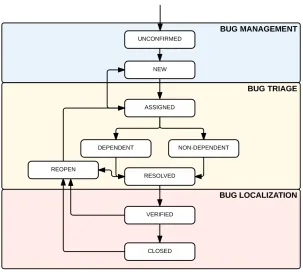
Fig-ure. 2.1 portrays the life cycle of a bug.
Bug management:
In software development, it is crucial to have a repository in which developers can report
a particular bug or issue. Not only does it help them keep track of bugs but also it helps
to recommend improvements to various bug reports. Since the bug repository is publicly
available to anyone, the quality of a particular software project can be enhanced. [12]
Bug triage:
It is the process in which bug reports are prioritized and assigned to an appropriate bug
fixer. When a bug report is received, several factors are taken into consideration in order
to process the request. First, a bug report can be classified based on its importance. If the
importance is higher, it will be highly considered to be fixed earlier than the other bugs.
Another crucial factor is severity, which also affects its importance. Combined together, it
leads to having the bug being prioritized from low to high priority.
Once a bug becomes resolved by the developer, the bug status makes a transition from
re-solved to be verified. After it is verified, then the bug is defined as closed so that no more
occurrences of the bug will be reported.
Bug tracking systems:
In software development, developers use a popular platform in which they can report the
different types of bugs that a software product can contain. It facilitates the bug tracking,
and at the same time help them fix those bugs in an efficient way. There are plenty of
rec-ognized bug tracking systems such as Bugzilla, RedMine, JIRA, and others.
Bugzilla:
For this study, Bugzilla is taken into consideration as the leading platform of Issue
Track-ing system. It is a defect trackTrack-ing system that allows software developers track and report
different types of bugs. Actually, it is a free repository and contains many useful features
that it became one of the most popular bug tracking systems used by many developers.
One of the advantages is that Bugzilla can be installed in most operative systems (OS). It
runs for Windows, Mac, and Linux. It facilitates the way in which bug fixers choose the
appropriate environment for deployment. Another plus is that it is totally free so it prevents
any extra cost.
Bugzilla classifies its features between users and administrators. Some essential features
include the ability to search for a specific bug in a Google-like search. It helps the user find
the bug following certain criteria. For instance, if the developer wants to look for the bug
which ID is ”123456”, he or she can input its ID to retrieve important information such
as: (reference:
https://bugzilla.readthedocs.io/en/latest/using/editing.html#life-cycle-of-a-bug)
• Status: It shows all the possible statuses of a particular bug. It helps the developer
distinguish whether the bug has been fixed or not.
Figure 2.1: Lifecycle of a bug
• Component: The various sections or modules that compose a software product are
defined as components.
• Version: It means that whenever a software product is revised to correct previous
errors, developers release a newly modified software.
• Hardware: It is where the bug was originally found.
• Importance: It is based on the grade of severity and priority.
• Target Milestone: Specifies to whom the bug is assigned to.
• Assigned To: As the name states, it is to whom the actual bug was assigned to.
• QA Contact: Here, the person in charge of fixing/posting the bug will be shown here.
• Whiteboard: In this field, developers specify words or terms to make the bug tracker
system more organized.
• Keywords. Essential words to identify the characteristics of a particular bug.
• Depends on: The bug which is dependent on another one.
• Blocks: It refers to the bug that blocks another one.
There are different types of status for a bug that are classified as ”Open bugs” and ”Closed
bugs”. For open bugs, the first one on the list isUNCONFIRMED, which means that there
is a bug recently added into the database and it is not marked as valid yet. Once here, the
bug state can transition to either CONFIRMED or RESOLVED. The CONFIRMED state
refers to a bug which has been validated and it can be IN PROGRESS if a developer is
working on it then it becomesRESOLVED.
For closed bugs, there is the RESOLVEDstate meaning that a decision has been done. In
this state, once it is verified by the QA, the bug can be either given reopened and get some
open status or verified and marked as VERIFIED. The VERIFIED is the final in the bug
status, and it is when the QA has made the appropriate decision to verify the bug.
There is a resolution set depending on the status of a bug. First, the FIXED resolution
indicates there is a fix for the bug that also has been tested. Next, when the responsible
person determines that a bug is not a bug, the resolution will be given to INVALID.
An-other resolution can be also when a bug does not have any possibility to be solved, then it
becomes WONTFIX. If there is a bug that is duplicate of another, then its resolution will
be marked asDUPLICATE. Finally, theWORKSFORME resolution is given when there is
no idea how to fix the particular bug, so if enough information is encountered then the bug
could be reopened. Ref. (https://bugs.eclipse.org/bugs/page.cgi?id=fields.html#bug status)
Bugzilla was developed by Mozilla. It is constantly maintained and updated based on any
feedback to the platform. Its key characteristics are that it decreases downtime, increases
Many popular software projects use Bugzilla as its bug defect tracker system. To
men-tion a few, there are: Eclipse, Linux Kernel, GNOME, KDE, Apache Project, LibreOffice,
Chapter 3
Related Work
Bug management:
Other works have studied crash reports as bug report characteristics that help keep track of
bugs. Authors in [24] emphasize about correlations in crash reports that can improve bug
management. In this work they propose five rules to detect correlated crash types
automat-ically, in which two of them are added to the present work. One rule based on the time
crash occurs, and the second one based on the textual similarity of crash types. Also, by
using crash correlation groups, they use an algorithm that helps locate and rank any buggy
files. In addition, they present a method that identifies bug duplicates. It is said that due to
the huge amount of crash reports generated, similar crash reports are grouped together in
order to speed up the process because sometimes crash reports may refer to the same bug.
They conduct the study on Firefox and Eclipse.
Authors in [10] mention that sometimes there are too many bug reports generated in bug
tracking systems from which a considerable percentage pertains to bug duplicates. So, their
approach tends to tackle that problem by proposing a method to classify the incoming bug
reports into the appropriate category; in this case the ones that are bug duplicates taken
into account the important features that a bug report contains for detection. In addition,
since several bug reports have contextual similarities such as two reports having the same
description but in different words, they propose a formal model to mitigate this issue. They
conduct their study using 29,000 bug reports from the Mozilla project.
in which the descriptions between two bug reports can be compared efficiently. In [7],
au-thors present three approaches: String-based, Corpus-based, and Knowledge-based. First,
for the String-based, the measures are classified into two categories. Character-based and
term-based, each one having seven algorithms to be used for analyzing the text. Second,
the Corpus-based similarity, which is a semantic similarity having six measures. It analyzes
the text based on a context from words already stored in a large dataset. Third,
Knowledge-based similarity which focuses on the degree of the semantic link among words and has
five measures. This one is grouped into two categories: similarity, and relatedness. In this
case, the semantic context is taken from semantic networks.
In this work [6], the authors point out that a huge amount of crash reports are generated
on a daily basis which makes it difficult to manage. To mitigate that problem, they
pro-pose a two-level group approach in which crash reports that are linked to the same bug
are grouped together. By doing so, it facilitates the triage process and reduces the time of
bug fixing. However, if a crash report refers to multiple bugs, it would become a tedious
process. So for each crash report, the stack traces are helpful to identify the bug to see
whether is a duplicate or not. In order to evaluate the similarity between stack traces of
the crash reports, they used the Levenshtein distance. They conduct an empirical study on
ten Firefox releases. It is mentioned that their approach helped decrease bug fixing time by
more than 5%.
Similar to research that has been conducted before, authors in [21] present an approach to
decrease the number of bug report duplicates by extending the BM25F formula for larger
queries. In the study, they increase the accuracy improvement by 10-27% in the recall rate.
Not only do they take into consideration the textual features, but also category features as
well in order to enhance the accuracy of the results. They studied the bug repositories from
Mozilla, Eclipse, and OpenOffice.
Bug triage:
information that means that each developer that have fixed bugs previously, have a
gener-ated historical information that contains all his/her activities of fixing bugs.
Some bug triage methods are effective when team size is moderate but they may not be
ef-fective when the project size increases. In order to solve that issue, authors [16] propose an
automated bug triage tool named BugFixer that facilitates the bug fixing process for larger
projects.
They conducted the study on three large-scale software projects (Eclipse, Mozilla,
Net-beans) plus two smaller projects. Based on the outcome, it shows that Bugfixer performs
better when having larger projects. So, traditional approaches have revealed that when it
happens, their methods do not achieve the expectations. It is mentioned that developer
ex-pertise cannot be learned from historical data. In some cases the tool performance may not
be efficient as expected since it may fail to provide good recommendation for some bug
reports.
Similar studies suggest a semi-automated approach to speed up the process of bug triage
when new bug reports are assigned to developers. Authors in [1] use machine learning to
rank a list of potential developers that can fix a bug. They used Bugzilla as the main bug
repository that includes two projects: Eclipse, and Firefox. To validate their approach, they
used a third project called GCC but the results were not promising since the outcome is
lower than the expected.
Bug localization:
Authors in [19] explain that when a software product is released, it is usual that several
bugs appear. Also, it is mentioned that in most cases developers submit bug reports that
later are detected as duplicates. Thus, in order to speed up the bug duplicate detection,
they developed a tool using NLP that helps in the detection of duplicates. For the tool,
there are various techniques used in the detection process such as tokenizing, stemming,
and stop words removal. However, it is stated that when the data that to be processed is
very large, the operation could be complex. One way to avoid that is to filter out data that
algorithm the bug reports are ranked based on their similarity so that only the high-ranked
are shown. For their case study, they analyzed defect reports at Sony Erickson Mobile
Communications using two approaches. In the first approach, they chose bug reports that
were classified as duplicates in each report using batch runs. In the second approach, they
conducted interviews with testers and analysts in order to evaluate their tool. It is concluded
that the tool is very useful even though only 40% of duplicates can be detected.
There is another approach when locating bugs. Authors in [25] propose an idea to locate
bugs at a code change level. It means that whenever there is a modification within the
code, developers can identify those changes that can help find the bug. They proposed a
tool named Locus which provides a better understanding of how bugs can be fixed faster
than the traditional approaches. Three ranking models are taken into consideration such
as the NL (Natural Language) Model, CE (Code Entity) Model, and Boosting Model. For
the NL, tokens are extracted from bug reports in which only the summary and description
sections are considered. Meanwhile in the CE, which refers to the code entity, components
such as package names, class names, and methods names are treated as single tokens before
preprocessing. Now for the boosting model, they used the algorithm used by Google and
adapted it according to the study. In this model, the goal is to find the highest
suspicious-ness score that leads to a file to be buggy.
Similarly, other authors [28] point out that locating source code that needs to be modified
can be tedious. For this reason, they propose a method named ”BugLocator” which is used
to locate targeted buggy-files. It is an automated process that reduces waiting time and
cost, and increases user satisfaction. According to their study, the method outperforms
bet-ter than other suggested approaches by using a large dataset of bugs from four open source
projects (Eclipse, AspectJ, SWT, and ZXing).
Many research works have been focused on either Information-Retrieval (IR) or Machine
Learning (ML) techniques for bug localization. Authors in [13], instead, propose a
com-bined approach to detect the most likely buggy files in projects which is advanced IR
over existing bug localization approaches. It is showed that their technique ranks higher
among other similar studies. DNN also addresses lexical mismatch that the other IR
tech-niques contain.
Other authors [20] propose a tool named BLUiR (Bug Localization using Structured
Infor-mation Retrieval), which improves the bug localization techniques. As shown in the results,
BLUiR outperforms better than any other tools. First, it takes a bug report as a query,
simi-lar to other approaches, and then extract the summary and description that later is tokenized.
Those tokens are converted into queries and are processed for the structured retrieval. Next,
the source code files are treated as documents, which later the Abstract Struct Tree is
ap-plied; elements such as classes, methods, variables, comments are tokenized and converted
to structured documents that later are indexed then sent to the Structured Retrieval. With
the process of bug reports and source files combined, a list of ranked files are generated.
In [5], in order to improve bug localization, authors present a technique that is based on
the bug report similarities using two approaches: at bug and source code level. However,
it needs to be combined with other techniques to be effective. For the bug description, it
mainly identifies what methods have relation with the bug report. Meanwhile in source
Chapter 4
Problem Statement
Either as a living creature or in the software world, bugs are not very popular. However,
they both are inevitable parts of their environments. Software development teams spend a
lot of time fixing bugs on a regular basis. Currently, the process of debugging and correcting
defects in a software is a tedious, time consuming, and expensive task. A lot of real-world
software projects get an expansive number of bug reports day by day, and addressing them
requires much time and effort. Maintenance of software is a resource-consuming
activ-ity; even with the increasing automation of software development activities, resources are
still scarce. It has been reported that most of the software cost is devoted to evolution and
system maintenance of existing source code [8]. Investigating bugs can contribute up to a
large portion of the aggregate cost for a software project. Therefore, there is a squeezing
requirement for automated strategies that makes development teams work easier. This issue
has persuaded extensive work proposing automated troubleshooting answers for different
cases. The debugging process summary is explained as when a developer is provided with
a bug report and then he/she must replicate the defect and perform several reviews of the
source code to find the root of the cause. In addition, bug reports can be very different since
they are provided by many people who are dealing with the software and any one of them
have different inputs for the bug reports, this makes the process of debugging even more
difficult.
An automated mechanism for estimating possible locations in the source code while
con-sidering how likely they are to contain the cause of the bug would help developers to reduce
Chapter 5
Methodology
5.1
Ranking Model
Learning-to-rank is a category of supervised machine learning algorithms that are used to
solve ranking problems in information retrieval[14]. In general, there are two stages of
learning to rank: first is the learning stage and second is the deployment (testing) stage.
This method works at the first stage by preparing the training set. more details on how
to prepare the training set are explained in section 6. The result of the learning stage are
the weights for the features that the algorithm learns to optimize. In general, the learning
to rank algorithm tries to construct a model to minimize the cost (error) by fitting weights
for the features that result in optimized ranking. At the deployment stage, for each bug
report (query), the learned weights are applied to the features and each source code file
(document) receives a score based on its feature values and then the list of the source code
files are sorted based on their scores.
f(r, s) = wTΦ(r, s) =
k
X
i=1
wi∗Φi(r, s) (5.1)
As formulated by equation 5.1 [26], for each bug report r and any source code file s in
the before-fix version of the source code, f(r,s) is a function that provides the final score
based on the weighted sum ofkfeatures. Φi(r, s)calculates the individual score based on
the relationship between r and s for each feature. The most important component in the
equation are parameters wi that are trained by a learning to rank algorithm on previously
Figure 5.1: System Architecture for training and testing [27]
5.2
Experiment Setup
5.2.1
Vector Space Model
The classic Vector Space Model (VSM) can be applied to convert the text into vectors of
term weights. The reason to convert the text into vectors is that, mainly machine learning
algorithms accept inputs in the form of matrices. We can take the bug report as a query and
source code files as the directory of the documents to be searched for, then VSM can be
used to convert the text of the bug report and source code files into vectors. Those vectors
of term weights can be represented as one-row matrix representing the textual features of
each bug report or source code file. In any documentd(bug report or source code file), the
term weightswt,dof each termtcontained indis calculated as:
In the above equation, T Ft,dis the number of times term tappears in document d. IDFt
is the inverse document frequency =log N
DFt. TF-IDF is one of the widely used methods to
convert text into vectors of term weights in information retrieval [15].
5.2.2
Text Preprocessing Methods and Cosine Similarity
A similar methodology explained in [12] was applied for text pre-processing. In order for
the bug reports and source code files to be converted into vectors of term weights, first they
need to be preprocessed and cleaned; put into a format that the machine learning algorithms
will accept. The first step is to tokenize each body of text by splitting it into its constituent
set of words. After that, punctuation and stop words are removed since they do not play
any role as features for the learning to rank algorithm. Next, all the words are converted
to lower case and then stemmed using the Porter Stemmer in the NLTK package. The goal
of stemming is to reduce the number of inflectional forms of words appearing in the bug
reports or source code files; it will cause words such as ”performance” and ”performing”
to syntactically match one another by reducing them to their base word– ”perform”. This
helps decrease the size of the vocabulary space and improve the volume of the feature space
in the corpus.
In addition to stemming, another method that is used to reduce the number of inflectional
words in bug reports and source code files is Lemmatization. In Lemmatization, the part
of the speech of a word should be first determined and the normalization rules will be
different for different part of speech. In this process, the inflections are chopped off based
on defined rules and it relies on some lexical knowledge base to provide the correct basic
form of words. while in stemming, it works like a sharp knife sometimes chopping off too
little or too much from the words. For instance, the plural word geese changes to goose
and words meanness and meaning remain untouched while stemming convert both of them
to ”mean”. Finally, each corpus is transformed into vector space model (VSM) using the
After converting the text in a bug reportror a source code filesinto vectors of term weights,
the standardcosine similaritymethod can be used to calculate the textual similarity between
a bug report and a source code file using their vectors of term weights.
CosineSim(r, s) =
− →r .−→s
||−→r|| ||−→s|| (5.3)
Equation 5.3 calculates how similar two documents are in the vector space by multiplying
the dot product of those two vectors and divide it by their magnitude. It is important to note,
this is a measure of orientation and not the magnitude. Here, the magnitude of each vector
of term weights in the documentdis not the only element in calculating the similarity. The
angle between two vectors determines the similarity of the two vectors. For instance, if
we have a vector that is quite long and another vector that is shorter and the angle between
those vectors are small, then Cosine similarity tends to ignore the high length and calculates
the measurement based on the angle between those two vectors. In practice, if we have a
document that contains the word ”book” 100 times and another document that contains
the same word 25 times, the Euclidean distance between the vector representation of term
weights of those two document will be higher but the angle will still be small since they
are pointing to the same direction, and that determines the similarity score when we are
comparing documents.
5.3
Feature Extraction
This section will discuss how features are extracted from the specific relationship of each
bug report with every single source code file in a software project. It is important to note
that in this study, a total of six different features that were discussed in the original paper
[26] extracted based on the domain knowledge understanding of how a bug report can be
related to a source code file. Out of those six features, the first three of them are using the
Figure 5.2: Tomcat Bug Report 30949
5.3.1
Source Code Files Lexical Similarity
Measuring the lexical similarity between the bug report and a source code file can help
understand the direct relationship of the textual features between the bug report and source
code files. It often occurs that the size of source code is large; it contains multiple methods
and different code blocks. While measuring the lexical similarity between a bug report and
source code file, it is a fact that the root cause for a bug is placed in one or few methods and
not the whole class. As a result, when the source code file is large, the length of its VSM
representation of term weights will be longer in compare to the same vector for the bug
report. This can result in a small cosine similarity score between the large file and the bug
report. This problem can be addressed by segmenting the source code file into each method
and then calculate the cosine similarity scores for each method and the whole class. after
that we can take the maximum of all those scores. This way, we can make sure that the
lexical similarity is calculated for each method and the whole class and the final score is
the maximum of those calculated scores. The VSM representation of a bug report contains
its both summary and description. the summary of a bug report includes a brief description
explanation of what went wrong when the user experienced the abnormal behavior in the
software. Figure. 5.2 shows a sample bug report from Tomcat project.
Φ1(r, s) = max({CosineSim(r, s)} ∪ {CosineSim(r, m)|m∈s}) (5.4)
As shown in equation 5.4, cosine similarity score is calculated for each method min
the files.
5.3.2
API Specifications Lexical Similarity
One way to improve the lexical similarity between two documents is to make sure that both
them are constructed in a similar format. for instance, source code is written in
program-ming languages like Java. In case the source code is not well documented by appropriate
comments, then the cosine similarity may not be able to direct us to the root cause of an
abnormal behavior explained in a bug report. Since bug reports are generally written in
natural language format (e.g. English), they are not in the same format as programming
languages. Bug reports sometimes contain some snippets of the source code, or the name
of a class or the name of a method but often, they explain the problem with the software in
natural language format and they do not provide relevant information that can be found by
measuring the textual similarity between the bug report and source code file. As a result,
we can see that the source code files lexical similarity explained in the previous section can
provide a good similarity score if those files come with enough comments or the bug report
provide enough source code snippets that correspond to the root cause files.
This lexical gap can be bridged by using the API specification documents of the
soft-ware project. It is a common practice for the development teams to write API specification
Figure 5.3: API specification for Member Interface from Tomcat project
The API specification documents can help the current and future development team
mem-bers to understand how different components are related and working together in the
soft-ware project. The API specifications are written in natural language, theretofore, they are
in the same format as bug reports and it can help bridge the lexical gap between the
pro-gramming language of source code files and natural language of bug reports. Fig. 2 is an
example of an API specification for Member interface in Tomcat project. This feature can
be computed as follows:
Φ2(r, s) =CosineSim(r, s.api) (5.5)
5.3.3
Collaborative Filtering Score
In collaborative filtering, the lexical similarity score between the bug reports can be used
to find the corresponding source code file/files for a newly reported bug report. It has been
process. This technique, collaborative filtering, has been used to improve the accuracy of
the recommender systems [16]. As a result, this approach can be used in our case which
is an information retrieval problem. For any given bug report r and a source code files,
the set of all bug reports that correspond specifically to filesand were fixed beforer was
reported, can be calledset(r,s). We can compute the collaborative filtering score as follows:
Φ3(r, s) =CosineSim(r, set(r, s)) (5.6)
5.3.4
Class Name Similarity
Sometimes the bug in software is captured by the professional users and when they
pro-vide the report, they trace the abnormal behavior and propro-vide some extra technical details.
Within the extra details, sometimes they mention the name of the class that might be
rele-vant to the root cause of the bug. As mentioned in the original study [26], the hypothesis
is that the length of the class name mentioned in the bug report is relative to how strong
this feature represent its value. In other words, when the class name is longer and more
specific, the feature must provide more accurate clues about the corresponding source code
files. Therefore, this feature is evaluated by the length of the class name mentioned in the
report and it is computed as follows:
Φ4(r, s) =
|s.class|, ifs.class∈r
0, otherwise
(5.7)
It is important to note that the value of the first three features mentioned in this study
are between 0 and 1 since the cosine similarity function always returns a number between
0 and 1 depending on how similar two documents are; 0 means not similar at all and 1
variable. In order to create a dataset that is scaled uniformly, all the values need be in the
same range, i.e.([0,1]). As a result, all the features will be normalized automatically. more
details about the normalization process will be provided at the end of this section.
5.3.5
File Alteration History
It has been observed that by evaluating the source code alteration history, we can achieve
information that can help detect and predict files that are more prone to cause bugs [18].
For instance, a source code file that has been fixed several times recently is more likely to
correspond to newly reported bugs.
Bug Fixing Recency
This feature applies this notion that if a source code file was fixed recently, it means that it
is more likely to contain more bugs. For a random bug report r,r.month is the month that
bug report rwas created. As explained in section 5.3, set(r,s) is the set of all bug reports
that correspond specifically to filesand were fixed beforerwas reported. The most recent
previously fixed bug report in theset(r,s)can be calledlatest(r,s). This feature is calculated
as follows:
Φ5(r, s) = (r.month−latest(r, s).month+ 1)
−1
(5.8)
This equation shows that bug fixing recency is implemented as the inverse of distance in
months between bug reportrandlatest(r, s). In other words, the value of this feature is 1 if fileswas fixed in the same month as bug reportrwas reported and it is 0.5 if fileswas
fixed one month beforerwas reported.
Bug Fixing Frequency
As described in section 5.3,set(r,s)is the set of all bug reports that correspond specifically
to filesand were fixed beforerwas reported. This feature is defined simply as the number
Φ6(r, s) = |set(r, s)| (5.9)
The value of this feature will also be quite variable. Therefore, it will be automatically
normalized as described in the next part.
5.3.6
Feature Values Normalization
Most of machine learning algorithms tend to perform better when the values in the dataset
are not in different extreme ranges. Comparing values that are not on the same scale leads
to bad results in a machine learning model. In this case, the first three features have values
between 0 and 1. In order to normalize values in the dataset, all features need to be in the
same range. For any arbitrary feature in the training dataset, let Φ.minbe the minimum observed value and Φ.max be the maximum observed value. While analyzing the data from the testing set, there might be feature values that are larger than Φ.max or smaller thanΦ.minand all data in the training and testing set will be normalized as follows:
ΦScaled=
0, ifΦ<Φ.min
Φ−Φ.min
Φ.max−Φ.min, ifΦ.min≤Φ≤Φ.max
1, ifΦ>Φ.max
(5.10)
5.4
Dataset
For this study, only bug reports that were in resolved fixed, verified fixed, or closed fixed
status from Tomcat project were used. Tomcat is a widely used open source web
using Bugzilla. It is a tool for issue tracking activities and user can provide their inputs
using Bugzilla while facing an abnormal behavior in the software. Moreover, Git is the
primary version control system for Tomcat project.
As mentioned briefly in the Introduction section, previous studies used a fixed code
revi-sion for their Bug Localization approaches. But it is a fact that bugs are found in different
versions of the source code. Using the fixed version of the source code can affect the
per-formance of the Bug Localization systems. Some of the problems using the fixed version
of the source code include: the future versions of a software can have important bug-fixing
information for older bugs. Furthermore, a file that corresponds to the root cause of a bug
may not even exist in the fixed version of the source code. For Tomcat project in this study,
a total number of 1054 bug reports are used for training and testing sets. The time range of
the reported bugs is from early 2002 to early 2014. The maximum, median, and minimum
number of files fixed per bug report are 94, 1, and 1 respectively. The median number of
Java files in difference versions of the project source code is 1552 an the number of API
specifications are 389 [26]. It is important to note that the exact version of the source code
for which the bugs were reported is not available all the times. As a result, the version of
the source code that was committed right before the fix was used in this study. It is most
reasonable to use the mentioned revision of the source code since the relevant fix had not
been pushed in the repository and the bug still existed in the version.
5.5
Training Steps
As explained in the Ranking Model section, the ranking function f(r,s), equation (1), is a
function that provides the final score based on the weighted sum of k features. Φi(r, s)
calculates the individual score based on the relationship between a given bug reportr and
each source code filesfor each feature.
f(r, s) = wTΦ(r, s) =
k
X
i=1
Each model parameterwi is trained using the learning-to-rank approach. The SVM rank
package [11] was suggested as an optimized implementation of the approach by the
origi-nal paper [26]. The SVM rank basically aims to solve an optimization problem. Here, the
optimization problem is to find values for wi such that the relevant files for each bug are
ranked at the top of the list. In other words, if file pis relevant to be the root cause of the
problem for bug report r and filen is not relevant to be the root cause of the problem for
the same bug, then the objective of the optimization approach is to find parameters wi for
each feature such thatf(p,r)>f(n,r).
5.5.1
Tuning the Capacity Parameters
Choosing the size of training set determines the performance of SVM rank. As mentioned
in the previous section, the number of relevant files for a bug is very small; The median
of relevant files is 1. Therefore, the size of the training set is affected by the number of
samples in the set and the number of irrelevant files used for each bug report. On the other
hand, note that the number of irrelevant files is also very large; The median number of Java
files in different versions of the project source code is 1552. Using all the irrelevant files
makes the training time unfeasible in terms of time complexity. After evaluating different
number of samples for the training set using the Mean Average Precision (MAP) and
Ac-curacy@k metrics, using the top 250 irrelevant files that have the highest Cosine similarity
score with the bug reportrresulted in the optimal range of performance for Tomcat project.
More details about the evaluation metrics will be provided in the next section.
Another factor that plays an important role in the ultimate performance of the system is
choosing the optimal value for C parameter in the SVM rank algorithm. For the general
SVM algorithm, choosing larger values forC, the optimization process chooses a smaller
margin hyperplane if that hyperplane performs better getting all the training samples
is no specific rule that provides guidance on choosing the optimal value forC parameter.
TheCparameter dominates the optimization process in the SVM algorithm on how much
misclassification rate can be avoided in the training sample. However, theCvalue in SVM
rank is correlated with the number of samples in the training set in general. An effective
way to make sure that the optimal value forCparameter is chosen is using the Gridsearch.
In this approach, differentCvalues are tested to achieve the highest performance.
5.5.2
Training Methods
One training method that is used in the original paper [26] suggests that the bug reports
must be sorted based on their reported time in chronological order. After that, the dataset
is split intok equal size folds,f old1, f old2, ..., f oldk; In this study,k is 10. The folds are
organized as f old1 having the oldest bug reports and f old10 having the most recent bug
reports. As mentioned before, for this study, 1054 bug reports from Tomcat project creates
the primary dataset, therefore, each fold will contain 105 samples. The intuition here is that
if the ranking model is trained on f oldk and tested on the previous fold, f oldk−1, it will have a better performance. Thus, the ranking model is always trained on the most recent
bug reports.
In addition to the mentioned training approach, choosing the training folds randomly is
also compared to evaluate the role of randomized selection of samples on the overall
per-formance of the ranking model. In related studies [4, 22], the authors applied the
random-ized selection of samples for the training set and they were able to improve the results of
the trained model relatively. The main objective of applying the randomized selection of
samples for the training set is to check if the intuition explained in the original paper on
creating disjoint training folds based on the sorted chronological order can really improve
the overall performance of the ranking model.
The purpose of training is to attain the weights for each feature in a specific fold. Testing a
fold. In other words, the value of each feature in the target fold will be multiplied by the
attained weight of that feature from the training fold. Finally, all the resulted values must
be added together for each filesand each bug reportr.
5.6
Evaluation Metrics
The ranking model explained in the Ranking Model section, computes the weighted scoring
function f(r, s), for any given bug report r and each source code file s. This process provides a list of ranked files for each bug report, called the system ranking. I order to
evaluate the results, the system ranking is compared with the actual ranking in which the
relevant files are at the top of the list. The metrics that are used to evaluate the overall
performance of the proposed approach are described as:
1. Accuracy@k: this metric describes the accuracy in the percentage of the ranking
model when it makes at least one correct recommendation in the top kranked files
for the bug reports.
2. Mean Average Precision (MAP): this metric is widely used in evaluating different
classifiers and also in information retrieval [15]. MAP measures the quality of the
information retrieval approach when a query might have several relevant documents.
M AP =
|Q|
X
q=1
AvgP(q)
|Q| , AvgP =
P rec@k
|K| (5.12)
P rec@k = number of relevant docs topk
k (5.13)
In equation 12, Q is the set of all queries; In this case all the bug reports. Average
relevant documents in the ultimate ranked list. Prec@k, equation 13, is the overall
Chapter 6
Experimental Results
One of the objectives of the experiments in this study is to replicate the bug localization
approach explained in the original paper [26]. It is very important to understand how
domain knowledge can help build features for the proper machine learning algorithm. It
is a sophisticated process to analyze and discover how different textual similarities and
file revision history between the bug report and specific components of a software project
can help find the relevant source code files for a bug. Feature engineering in this study
describes the process in which raw data turns into useful information that can be used as
effective inputs for the proper machine learning algorithm. This learning to rank approach
has been compared with three other state-of-the-art bug localization tools, BugLocator,
VSM, and Usual Suspects, and it has proved its superiority by achieving better results in
ranking the relevant files for each bug. At the time of this study, there is only one other
research [13], to the best of my knowledge, that took advantage of the same approach and
applied Deep Neural Networks as the ranking algorithm and the authors in the mentioned
research were able to improve the results of the ranking model. Figure 3. and Figure 4.
represent the comparison between Learning to Rank approach with three other
[image:42.612.162.456.629.689.2]state-of-the-art bug localization tools by MAP and Accuracy@k metrics in the original study.
Table 6.1: Comparison of average model parameters.
Tomcat Project w1 w2 w3 w4 w5 w6
Figure 6.1: MAP Comparison with other state-of-the-art bug localization tools [26].
[image:43.612.162.464.447.627.2]Figure 6.3: Accuracy@k graph comparing the original study and the current one.
One important point to note is that the authors in the original paper implemented this
bug localization approach in Java language. they ran the experiment on six large-scale
open-source Java projects; Those projects are: Eclipse UI, Tomcat, AspectJ, SWT, Birt,
and JDT. However, in this study the experiments are implemented in Python and because
of the time constraints, only Tomcat project was analyzed. Since the target projects are all
Java based, parsing the source code of those projects using Python had some limitations.
The authors in the original study applied the AST parser which is a tool designed to parse
merely Java source code, to segment each method from the Java files. On the other hand,
parsing the Java source code in Python was done using a library called Plyj; This library
has some limitations in terms of detecting specific methods native to Java. As a result, the
performance of the ranking model was slightly affected by the mentioned limitation in this
study. As it is shown in Figure 5. the limitation in parsing the Java source code in this study
has caused the ranking model to perform slightly different from the original study and the
0.5 from what the authors achieved previously. Thus the MAP for Tomcat project achieved
in this study is 0.44. In order to provide a better comparison between the studies, Table. 6.1
provides the average model parameters,wifor six different trained weights averaged over 9
folds. The value for each weight represents the importance of it in the ranking model and it
is clear that the first three features have the highest weigh and therefore they have a higher
significance.
In addition to replication of the bug localization approach, the other objective of the
exper-iments in this study is to address the following research questions:
RQ1: Does Lemmatization of the documents (i.e. bug reports and source code files)
make a positive effect on the cosine similarity score and consequently improve the overall
performance of the ranking model?
In the Text Preprocessing section, it was explained that in the Lemmatization process, the
inflections of a word in a document are chopped off based on specific rules and it depends
on some lexical knowledge-base to provide correct basic form of words. However, in
terms of computing the Cosine similarity between the bug report and source code file,
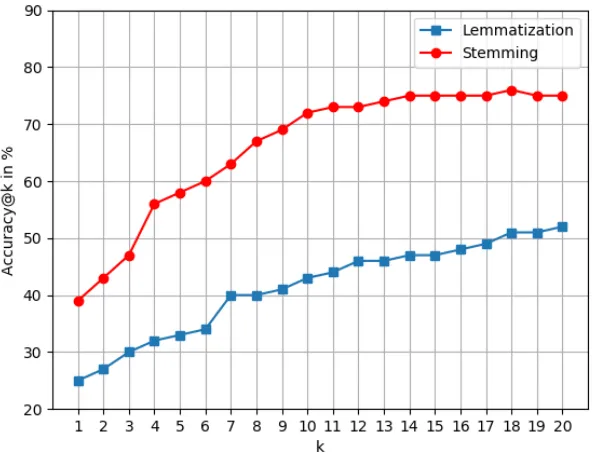
Lemmatization is not able to improve the Accuracy@k and MAP metrics and the overall
performance of the ranking model is also affected by this. In Figure 6. we can see how
Lemmatization affected the results of the ranking model in terms of Accuracy@k metric
and also the MAP achieved using Lemmatization is 0.23. This collapse in the results shows
that Lemmatization is not able to improve the cosine similarity between documents with
different formats (i.e. source code and bug report).
RQ2: Does the randomized selection of samples for the training folds improve the
overall performance of the ranking model?
To answer this question, instead of sorting the dataset and create folds in a chronological
order , 10 random folds were selected and the training was done in the order that the folds
were created. Thus, the training was done on the first fold and the learned weights were
Figure 6.4: Accuracy@k graph comparing Lemmatization vs. Stemming
training on random folds drastically affects the accuracy of the results. The Accuracy@k
is dropped to 54% for top 20 relevant documents. This low performance of random folds
implies that training on folds that are chronologically sorted have a positive effect on the
overall performance of the ranking model. When the ranking model is always trained on
the most recent bug reports, the learned weights better match the properties of the testing
Chapter 7
Threats to Validity
There are threats to the validity of this study that we elaborate as follows:
• The experiments in this study and the original paper were all ran on open source
Java-based projects. Sometimes the software development practices in open source
projects are different from those developed by well-managed software companies.
As future work for this study, commercial projects can be evaluated to check the
validity of this approach.
• This approach relies on good documenting practices; The source code needs to be
well documented with proper comments and the project must have enough API
spec-ification documents. As shown in Fig. 6.1, it is clear that projects like Birt and
AspectJ lack that characteristic and the achieved MAP is very low.
• Similar to the previous case, the bug reports need to provide important details that
can help the developers locate the cause of a bug in the project. If the bug report is
too short or does not include necessary information, then it will significantly affect
the performance of the ranking model.
• Tuning the capacity parameters for machine learning algorithms can vary based on
the structure of the dataset and the problem that needs to be solved. For instance,
SVM rank in this study has several parameters that work according to the input data
and the type of the problem. It is often hard to say that one algorithm works best for
Chapter 8
Conclusion
Once the development team receives a new bug, they need to find which file/files are the
root cause of the abnormal behavior. When the size of the project is large, developers need
to examine large number of files in order to locate the relevant file/files corresponding to
the bug. This process is often a tedious, costly, and time consuming task. In this study,
I replicated an automated bug localization technique [26] that utilizes domain knowledge
to build features that can be used as inputs for the learning-to-rank approach. The ranking
model is trained on the previously solved bug reports by evaluating the relationship between
bug report and different elements of a software project such as: textual features of the
source code and bug report itself, API specification documents, and file revision history.
In addition, I extended the research by evaluating different text preprocessing techniques
like, Stemming and Lemmatization and also randomized selection of the training folds
on the overall performance of the learning-to-rank algorithm. The experiments show that
Lemmatization and randomized selection of the training folds results in lower accuracy and
Bibliography
[1] John Anvik, Lyndon Hiew, and Gail C Murphy. Who should fix this bug? In
Proceed-ings of the 28th international conference on Software engineering, pages 361–370.
ACM, 2006.
[2] Tien-Duy B Le, David Lo, Claire Le Goues, and Lars Grunske. A learning-to-rank
based fault localization approach using likely invariants. InProceedings of the 25th
International Symposium on Software Testing and Analysis, pages 177–188. ACM,
2016.
[3] Nicolas Bettenburg, Sascha Just, Adrian Schr¨oter, Cathrin Weiss, Rahul Premraj, and
Thomas Zimmermann. What makes a good bug report? InProceedings of the 16th
ACM SIGSOFT International Symposium on Foundations of software engineering,
pages 308–318. ACM, 2008.
[4] Antoine Bordes, L´eon Bottou, Patrick Gallinari, and Jason Weston. Solving
multi-class support vector machines with larank. InProceedings of the 24th international
conference on Machine learning, pages 89–96. ACM, 2007.
[5] Steven Davies, Marc Roper, and Murray Wood. Using bug report similarity to
en-hance bug localisation. InReverse Engineering (WCRE), 2012 19th Working
Confer-ence on, pages 125–134. IEEE, 2012.
[6] Tejinder Dhaliwal, Foutse Khomh, and Ying Zou. Classifying field crash reports for
fixing bugs: A case study of mozilla firefox. InSoftware Maintenance (ICSM), 2011
[7] Wael H Gomaa and Aly A Fahmy. A survey of text similarity approaches.
Interna-tional Journal of Computer Applications, 68(13), 2013.
[8] Emily Hill, Lori Pollock, and K Vijay-Shanker. Exploring the neighborhood with dora
to expedite software maintenance. In Proceedings of the twenty-second IEEE/ACM
international conference on Automated software engineering, pages 14–23. ACM,
2007.
[9] Hao Hu, Hongyu Zhang, Jifeng Xuan, and Weigang Sun. Effective bug triage based
on historical bug-fix information. InSoftware Reliability Engineering (ISSRE), 2014
IEEE 25th International Symposium on, pages 122–132. IEEE, 2014.
[10] Nicholas Jalbert and Westley Weimer. Automated duplicate detection for bug tracking
systems. In Dependable Systems and Networks With FTCS and DCC, 2008. DSN
2008. IEEE International Conference on, pages 52–61. IEEE, 2008.
[11] Thorsten Joachims. Training linear svms in linear time. In Proceedings of the 12th
ACM SIGKDD international conference on Knowledge discovery and data mining,
pages 217–226. ACM, 2006.
[12] Pavneet Singh Kochhar, Ferdian Thung, and David Lo. Automatic fine-grained
is-sue report reclassification. InEngineering of Complex Computer Systems (ICECCS),
2014 19th International Conference on, pages 126–135. IEEE, 2014.
[13] An Ngoc Lam, Anh Tuan Nguyen, Hoan Anh Nguyen, and Tien N Nguyen. Bug
localization with combination of deep learning and information retrieval. InProgram
Comprehension (ICPC), 2017 IEEE/ACM 25th International Conference on, pages
218–229. IEEE, 2017.
[14] Tie-Yan Liu et al. Learning to rank for information retrieval. Foundations and
[15] Christopher D Manning, Prabhakar Raghavan, Hinrich Sch¨utze, et al. Introduction to
information retrieval, volume 1. Cambridge university press Cambridge, 2008.
[16] Prem Melville and Vikas Sindhwani. Recommender systems. In Encyclopedia of
machine learning, pages 829–838. Springer, 2011.
[17] Emerson Murphy-Hill, Thomas Zimmermann, Christian Bird, and Nachiappan
Na-gappan. The design of bug fixes. InProceedings of the 2013 International Conference
on Software Engineering, pages 332–341. IEEE Press, 2013.
[18] Foyzur Rahman and Premkumar Devanbu. How, and why, process metrics are better.
InSoftware Engineering (ICSE), 2013 35th International Conference on, pages 432–
441. IEEE, 2013.
[19] Per Runeson, Magnus Alexandersson, and Oskar Nyholm. Detection of duplicate
defect reports using natural language processing. InProceedings of the 29th
interna-tional conference on Software Engineering, pages 499–510. IEEE Computer Society,
2007.
[20] Ripon K Saha, Matthew Lease, Sarfraz Khurshid, and Dewayne E Perry. Improving
bug localization using structured information retrieval. InAutomated Software
Engi-neering (ASE), 2013 IEEE/ACM 28th International Conference on, pages 345–355.
IEEE, 2013.
[21] Chengnian Sun, David Lo, Siau-Cheng Khoo, and Jing Jiang. Towards more
accu-rate retrieval of duplicate bug reports. In Proceedings of the 2011 26th IEEE/ACM
International Conference on Automated Software Engineering, pages 253–262. IEEE
Computer Society, 2011.
[22] Dacheng Tao, Xiaoou Tang, Xuelong Li, and Xindong Wu. Asymmetric bagging and
random subspace for support vector machines-based relevance feedback in image
re-trieval. IEEE transactions on pattern analysis and machine intelligence, 28(7):1088–
[23] Yuan Tian, Dinusha Wijedasa, David Lo, and Claire Le Goues. Learning to rank
for bug report assignee recommendation. InProgram Comprehension (ICPC), 2016
IEEE 24th International Conference on, pages 1–10. IEEE, 2016.
[24] Shaohua Wang, Foutse Khomh, and Ying Zou. Improving bug management using
correlations in crash reports. Empirical Software Engineering, 21(2):337–367, 2016.
[25] Ming Wen, Rongxin Wu, and Shing-Chi Cheung. Locus: Locating bugs from
soft-ware changes. InAutomated Software Engineering (ASE), 2016 31st IEEE/ACM
In-ternational Conference on, pages 262–273. IEEE, 2016.
[26] Xin Ye, Razvan Bunescu, and Chang Liu. Learning to rank relevant files for bug
reports using domain knowledge. InProceedings of the 22nd ACM SIGSOFT
Inter-national Symposium on Foundations of Software Engineering, pages 689–699. ACM,
2014.
[27] Xin Ye, Razvan Bunescu, and Chang Liu. Mapping bug reports to relevant files: A
ranking model, a fine-grained benchmark, and feature evaluation. IEEE Transactions
on Software Engineering, 42(4):379–402, 2016.
[28] Jian Zhou, Hongyu Zhang, and David Lo. Where should the bugs be fixed?-more
accurate information retrieval-based bug localization based on bug reports. In
Pro-ceedings of the 34th International Conference on Software Engineering, pages 14–24.
![Figure 5.1: System Architecture for training and testing [27]](https://thumb-us.123doks.com/thumbv2/123dok_us/32826.2593/28.612.138.483.87.343/figure-architecture-training-testing.webp)

![Figure 6.1: MAP Comparison with other state-of-the-art bug localization tools [26].](https://thumb-us.123doks.com/thumbv2/123dok_us/32826.2593/43.612.162.464.447.627/figure-map-comparison-state-art-bug-localization-tools.webp)