The Thirty-Third AAAI Conference on Artificial Intelligence (AAAI-19)
Session-Based Recommendation with Graph Neural Networks
Shu Wu,
1,2Yuyuan Tang,
3Yanqiao Zhu,
4Liang Wang,
1,2Xing Xie,
5Tieniu Tan
1,21Center for Research on Intelligent Perception and Computing
National Laboratory of Pattern Recognition, Institute of Automation, Chinese Academy of Sciences
2University of Chinese Academy of Sciences
3School of Computer and Communication Engineering, University of Science and Technology Beijing
4School of Software Engineering, Tongji University
5Microsoft Research Asia
[email protected], [email protected], [email protected], [email protected], [email protected], [email protected]
Abstract
The problem of session-based recommendation aims to pre-dict user actions based on anonymous sessions. Previous methods model a session as a sequence and estimate user rep-resentations besides item reprep-resentations to make recommen-dations. Though achieved promising results, they are insuffi-cient to obtain accurate user vectors in sessions and neglect complex transitions of items. To obtain accurate item embed-ding and take complex transitions of items into account, we propose a novel method, i.e.Session-based Recommendation with Graph Neural Networks, SR-GNN for brevity. In the proposed method, session sequences are modeled as graph-structured data. Based on the session graph, GNN can cap-ture complex transitions of items, which are difficult to be revealed by previous conventional sequential methods. Each session is then represented as the composition of the global preference and the current interest of that session using an attention network. Extensive experiments conducted on two real datasets show that SR-GNN evidently outperforms the state-of-the-art session-based recommendation methods con-sistently.
1
Introduction
With the rapid growth of the amount of information on the Internet, recommendation systems become fundamental for helping users alleviate the problem of information overload and select interesting information in many Web applica-tions, e.g., search, e-commerce, and media streaming sites. Most of the existing recommendation systems assume that the user profile and past activities are constantly recorded. However, in many services, user identification may be un-known and only the user behavior history during an ongo-ing session is available. Thereby, it is of great importance to model limited behavior in one session and generate the recommendation accordingly. Conversely, conventional rec-ommendation methods relying on adequate user-item inter-actions have problems in yielding accurate results under this circumstance.
Due to the highly practical value, increasing research in-terests in this problem can be observed, and many kinds of proposals for session-based recommendation have been
Copyright © 2019, Association for the Advancement of Artificial Intelligence (www.aaai.org). All rights reserved.
developed. Based on Markov chains, some work (Shani, Brafman, and Heckerman 2002; Rendle, Freudenthaler, and Schmidt-Thieme 2010) predicts the user’s next behavior based on the previous one. With a strong independence as-sumption, independent combinations of the past components confine the prediction accuracy.
In recent years, the majority of research (Hidasi et al. 2016a; Tan, Xu, and Liu 2016; Tuan and Phuong 2017; Li et al. 2017a) apply Recurrent Neural Networks (RNNs) for session-based recommendation systems and obtain promis-ing results. The work (Hidasi et al. 2016a) proposes a recur-rent neural network approach at first, then the model is en-hanced by data augmentation and considering temporal shift of user behavior (Tan, Xu, and Liu 2016). Recently, NARM (Li et al. 2017a) designs a global and local RNN recom-mender to capture user’s sequential behavior and main pur-poses simultaneously. Similar to NARM, STAMP (Liu et al. 2018) also captures users’ general interests and current in-terests, by employing simple MLP networks and an attentive net.
Although the methods above achieve satisfactory results and become the state-of-the-arts, they still have some limi-tations.Firstly, without adequate user behavior in one ses-sion, these methods have difficulty in estimating user repre-sentations. Usually, the hidden vectors of these RNN meth-ods are treated as the user representations, such that recom-mendations can be then generated based on these represen-tations, for instance, the global recommender of NARM. In session-based recommendation systems, however, sessions are mostly anonymous and numerous, and user behavior im-plicated in session clicks is often limited. It is thus difficult to accurately estimate the representation of each user from each session.Secondly, previous work reveals that patterns of item transitions are important and can be used as a lo-cal factor (Li et al. 2017a; Liu et al. 2018) in session-based recommendation, but these methods always model single-way transitions between consecutive items and neglect the transitions among the contexts, i.e. other items in the ses-sion. Thus, complex transitions among distant items are of-ten overlooked by these methods.
v1→v2→v4→v3 v2→v5→v6→v7
v5→v4→v3→v6 ……
G
rap
h
N
eu
ral
N
etw
or
k
v1
v2
v4
v3
A
tte
nt
ion
N
etw
or
k
sg
sl
L
in
ear
T
ran
sfor
m
at
ion
sh
Sof
tm
ax
L
ay
er
v1
v2
v4
v5
v6
v3 v7 …
… …
v1
v4
v2
v5
v6
v3
v7
0.02
0.11 0.05
0.20
0.42 0.01
0.19
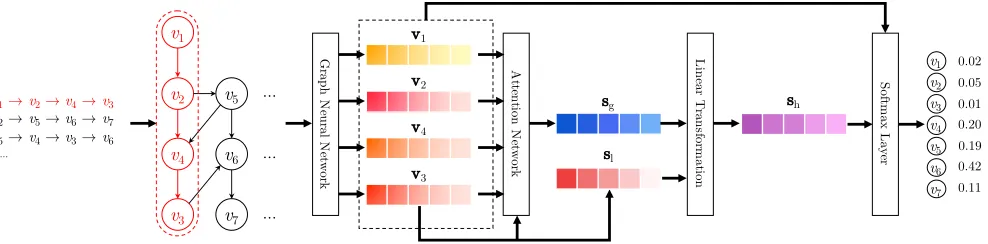
Figure 1: The workflow of the proposed SR-GNN method. We model all session sequences as session graphs. Then, each session graph is proceeded one by one and the resulting node vectors can be obtained through a gated graph neural network. After that, each session is represented as the combination of the global preference and current interests of this session using an attention net. Finally, we predict the probability of each item that will appear to be the next-click one for each session.
with Graph Neural Networks, SR-GNN for brevity, to ex-plore rich transitions among items and generate accurate latent vectors of items. Graph Neural Networks (GNNs) (Scarselli et al. 2009; Li et al. 2015) are designed for gener-ating representations for graphs. Recently, it has been em-ployed to model graph-structured dependencies for natu-ral language processing and computer vision applications flourishingly, e.g., script event prediction (Li, Ding, and Liu 2018), situation recognition (Li et al. 2017b), and image classification (Marino, Salakhutdinov, and Gupta 2017). For the session-based recommendation, we first construct di-rected graphs from historical session sequences. Based on the session graph, GNN is capable of capturing transitions of items and generating accurate item embedding vectors correspondingly, which are difficult to be revealed by the conventional sequential methods, like MC-based and RNN-based methods. Based on accurate item embedding vectors, the proposed SR-GNN constructs more reliable session rep-resentations and the next-click item can be inferred.
Figure 1 illustrates the workflow of the proposed SR-GNN method. At first, all session sequences are modeled as directed session graphs, where each session sequence can be treated as a subgraph. Then, each session graph is proceeded successively and the latent vectors for all nodes involved in each graph can be obtained through gated graph neural net-works. After that, we represent each session as a composi-tion of the global preference and the current interest of the user in that session, where these global and local session embedding vectors are both composed by the latent vectors of nodes. Finally, for each session, we predict the probabil-ity of each item to be the next click. Extensive experiments conducted on real-world representative datasets demonstrate the effectiveness of the proposed method over the state-of-arts. The main contributions of this work are summarized as follows:
• We model separated session sequences into graph-structured data and use graph neural networks to capture complex item transitions. To best of our knowledge, it presents a novel perspective on modeling in the session-based recommendation scenario.
• To generate session-based recommendations, we do not
rely on user representations, but use the session embed-ding, which can be obtained merely based on latent vec-tors of items involved in each single session.
• Extensive experiments conducted on real-world datasets show that SR-GNN evidently outperforms the state-of-art methods.
2
Related Work
In this section, we review some related work on session-based recommendation systems, including conventional methods, sequential methods based on Markov chains, and RNN-based methods. Then, we introduce the neural net-works on graphs.
Conventional recommendation methods.Matrix factor-ization (Mnih and Salakhutdinov 2007; Koren, Bell, and Volinsky 2009; Koren and Bell 2011) is a general approach to recommendation systems. The basic objective is to fac-torize a user-item rating matrix into two low-rank matrices, each of which represents the latent factors of users or items. It is not very suitable for the session-based recommenda-tion, because the user preference is only provided by some positive clicks. The item-based neighborhood methods (Sar-war et al. 2001) is a natural solution, in which item similari-ties are calculated on the co-occurrence in the same session. These methods have difficulty in considering the sequential order of items and generate prediction merely based on the last click.
Deep-learning-based methods. Recently, some predic-tion models, especially language models (Mikolov et al. 2013) are proposed based on neural networks. Among numerous language models, the recurrent neural network (RNN) has been the most successful one in modeling sen-tences (Mikolov et al. 2010) and has been flourishingly ap-plied in various natural language processing tasks, such as machine translation (Cho et al. 2014), conversation machine (Serban et al. 2016), and image caption (Mao et al. 2015). RNN also has been applied successfully in numerous appli-cations, such as the sequential click prediction (Zhang et al. 2014), location prediction (Liu et al. 2016), and next basket recommendation (Yu et al. 2016).
For session-based recommendation, the work of (Hidasi et al. 2016a) proposes the recurrent neural network ap-proach, and then extends to an architecture with parallel RNNs (Hidasi et al. 2016b) which can model sessions based on the clicks and features of the clicked items. After that, some work is proposed based on these RNN methods. Tan, Xu, and Liu (2016) enhances the performance of recurrent model by using proper data augmentation techniques and taking temporal shifts in user behavior into account. Jannach and Ludewig (2017) combine the recurrent method and the neighborhood-based method together to mix the sequential patterns and co-occurrence signals. Tuan and Phuong (2017) incorporates session clicks with content features, such as item descriptions and item categories, to generate recom-mendations by using 3-dimensional convolutional neural networks. Besides, A list-wise deep neural network (Wu and Yan 2017) models the limited user behavior within each session, and uses a list-wise ranking model to generate the recommendation for each session. Furthermore, a neural at-tentive recommendation machine with an encoder-decoder architecture, i.e. NARM (Li et al. 2017a), employs the at-tention mechanism on RNN to capture users’ features of sequential behavior and main purposes. Then, a short-term attention priority model (STAMP) (Liu et al. 2018) using simple MLP networks and an attentive net, is proposed to efficiently capture both users’ general interests and current interests.
Neural network on graphs.Nowadays, neural network has been employed for generating representation for graph-structured data, e.g., social network and knowledge bases. Extending the word2vec (Mikolov et al. 2013), an unsuper-vised algorithm DeepWalk (Perozzi, Al-Rfou, and Skiena 2014) is designed to learn representations of graph nodes based on random walk. Following DeepWalk, unsupervised network embedding algorithms LINE (Tang et al. 2015) and node2vec (Grover and Leskovec 2016) are most representa-tive methods. On the another hand, the classical neural net-work CNN and RNN are also deployed on graph-structured data. (Duvenaud et al. 2015) introduces a convolutional neu-ral network that operates directly on graphs of arbitrary sizes and shapes. A scalable approach (Kipf and Welling 2016) chooses the convolutional architecture via a localized ap-proximation of spectral graph convolutions, which is an ef-ficient variant and can operate on graphs directly as well. However, these methods can only be implemented on undi-rected graphs. Previously, in form of recurrent neural
net-works, Graph Neural Networks (GNNs) (Gori, Monfardini, and Scarselli 2005; Scarselli et al. 2009) are proposed to op-erate on directed graphs. As a modification of GNN, gated GNN (Li et al. 2015) uses gated recurrent units and em-ploys back-propagation through time (BPTT) to compute gradients. Recently, GNN is broadly applied for the different tasks, e.g., script event prediction (Li, Ding, and Liu 2018), situation recognition (Li et al. 2017b), and image classifica-tion (Marino, Salakhutdinov, and Gupta 2017).
3
The Proposed Method
In this section, we introduce the proposed SR-GNN1which applies graph neural networks into session-based recom-mendation. We formulate the problem at first, then explain how to construct the graph from sessions, and finally de-scribe the SR-GNN method thoroughly.
Notations
Session-based recommendation aims to predict which item a user will click next, solely based on the user’s current sequential session data without accessing to the long-term preference profile. Here we give a formulation of this prob-lem as below.
In session-based recommendation, let V =
{v1, v2, . . . , vm} denote the set consisting of all unique items involved in all the sessions. An anonymous session sequence s can be represented by a list s = [vs,1, vs,2, . . . , vs,n]ordered by timestamps, wherevs,i∈V represents a clicked item of the user within the sessions. The goal of the session-based recommendation is to predict the next click, i.e. the sequence label,vs,n+1for the session
s. Under a session-based recommendation model, for the session s, we output probabilitiesyˆ for all possible items, where an element value of vectoryˆis the recommendation score of the corresponding item. The items with top-K
values inyˆwill be the candidate items for recommendation.
Constructing Session Graphs
Each session sequencescan be modeled as a directed graph
Gs = (Vs,Es). In this session graph, each node represents an itemvs,i∈V. Each edge(vs,i−1, vs,i)∈ Esmeans that a user clicks itemvs,iaftervs,i−1in the sessions. Since sev-eral items may appear in the sequence repeatedly, we assign each edge with a normalized weighted, which is calculated as the occurrence of the edge divided by the outdegree of that edge’s start node. We embed every item v ∈ V into an unified embedding space and the node vector v ∈ Rd
indicates the latent vector of itemvlearned via graph neu-ral networks, wheredis the dimensionality. Based on node vectors, each sessionscan be represented by an embedding vector s, which is composed of node vectors used in that graph.
Learning Item Embeddings on Session Graphs
Then, we present how to obtain latent vectors of nodes via graph neural networks. The vanilla graph neural network is
1
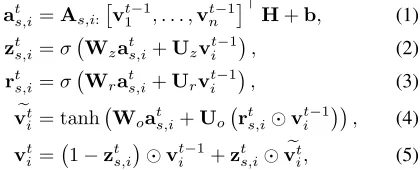
proposed by Scarselli et al. (2009), extending neural net-work methods for processing the graph-structured data. Li et al. (2015) further introduce gated recurrent units and pro-pose gated GNN. Graph neural networks are well-suited for session-based recommendation, because it can automat-ically extract features of session graphs with considerations of rich node connections. We first demonstrate the learning process of node vectors in a session graph. Formally, for the nodevs,iof graphGs, the update functions are given as fol-lows:
ats,i =As,i:
[
vt1−1, . . . ,vtn−1]⊤
H+b, (1)
zts,i =σ(
Wzats,i+Uzvit−1 )
, (2)
rts,i =σ(
Wrats,i+Urvti−1 )
, (3)
˜
vt
i = tanh (
Woats,i+Uo (
rts,i⊙vti−1)), (4)
vti =(
1−zts,i)
⊙vti−1+zts,i⊙v˜ti, (5)
whereH∈Rd×2dcontrols the weight,zs,iandrs,iare the reset and update gates respectively,[vt1−1, . . . ,vtn−1]is the list of node vectors in sessions,σ(·)is the sigmoid function, and⊙is the element-wise multiplication operator.vi ∈Rd
represents the latent vector of nodevs,i. The connection ma-trixAs ∈Rn×2ndetermines how nodes in the graph
com-municate with each other and As,i: ∈ R1×2n are the two
columns of blocks inAscorresponding to nodevs,i. Here As is defined as the concatenation of two
adja-cency matricesA(out)
s andA(in)s , which represents weighted connections of outgoing and incoming edges in the session graph respectively. For example, consider a session s = [v1, v2, v3, v2, v4], the corresponding graphGsand the ma-trixAsare shown in Figure 2. Please note that SR-GNN can support different connection matrices Afor various kinds of constructed session graphs. If different strategies of con-structing the session graph are used, the connection matrix Aswill be changed accordingly. Moreover, when there ex-ists content features of node, such as descriptions and cate-gorical information, the method can be further generalized. To be specific, we can concatenate features with node vector to deal with such information.
For each session graphGs, the gated graph neural network proceeds nodes at the same time. Eq. (1) is used for informa-tion propagainforma-tion between different nodes, under restricinforma-tions given by the matrixAs. Specifically, it extracts the latent vectors of neighborhoods and feeds them as input into the graph neural network. Then, two gates, i.e. update and reset gate, decide what information to be preserved and discarded respectively. After that, we constructs the candidate state by the previous state, the current state, and the reset gate as de-scribed in Eq. (4). The final state is then the combination of the previous hidden state and the candidate state, under the control of the update gate. After updating all nodes in ses-sion graphs until convergence, we can obtain the final node vectors.
Generating Session Embeddings
Previous session-based recommendation methods always assume there exists a distinct latent representation of user
Outgoing edges Incoming edges
1 2 3 4 1 2 3 4 1 0 1 0 0 0 0 0 0 2 0 0 1/2 1/2 1/2 0 1/2 0 3 0 1 0 0 0 1 0 0 4 0 0 0 0 0 1 0 0
v1 v2 v3
v4
Figure 2: An example of a session graph and the connection matrixAs
for each session. On the contrary, the proposed SR-GNN method does not make any assumptions on that vector. In-stead, a session is represented directly by nodes involved in that session. To better predict the users’ next clicks, we plan to develop a strategy to combine long-term preference and current interests of the session, and use this combined em-bedding as the session emem-bedding.
After feeding all session graphs into the gated graph neu-ral networks, we obtain the vectors of all nodes. Then, to represent each session as an embedding vectors∈ Rd, we
first consider the local embeddingslof sessions. For session
s= [vs,1, vs,2, . . . , vs,n], the local embedding can be simply defined asvnof the last-clicked itemvs,n, i.e.sl=vn.
Then, we consider the global embeddingsgof the session
graphGsby aggregating all node vectors. Consider informa-tion in these embedding may have different levels of priority, we further adopt the soft-attention mechanism to better rep-resent the global session preference:
αi=q⊤σ(W1vn+W2vi+c),
sg=
n ∑
i=1
αivi,
(6)
where parametersq∈RdandW1,W2∈Rd×dcontrol the
weights of item embedding vectors.
Finally, we compute the hybrid embeddingsh by taking
linear transformation over the concatenation of the local and global embedding vectors:
sh=W3[sl;sg], (7)
where matrixW3 ∈Rd×2dcompresses two combined
em-bedding vectors into the latent spaceRd.
Making Recommendation and Model Training
After obtained the embedding of each session, we compute the scorezˆifor each candidate itemvi ∈V by multiplying its embeddingviby session representationsh, which can be
defined as:
ˆ
zi=s⊤h vi. (8)
Then we apply a softmax function to get the output vector of the modelˆy:
ˆ
y= softmax (ˆz), (9)
whereˆz∈Rmdenotes the recommendation scores over all
candidate items and yˆ ∈ Rm denotes the probabilities of nodes appearing to be the next click in sessions.
Table 1: Statistics of datasets used in the experiments
Statistics Yoochoose 1/64 Yoochoose 1/4 Diginetica
# of clicks 557,248 8,326,407 982,961 # of training sessions 369,859 5,917,745 719,470 # of test sessions 55,898 55,898 60,858
# of items 16,766 29,618 43,097 Average length 6.16 5.71 5.12
be written as follows:
L(ˆy) =−
m ∑
i=1
yilog ( ˆyi) + (1−yi) log (1−yˆi), (10)
whereydenotes the one-hot encoding vector of the ground truth item.
Finally, we use the Back-Propagation Through Time (BPTT) algorithm to train the proposed SR-GNN model. Note that in session-based recommendation scenarios, most sessions are of relatively short lengths. Therefore, it is sug-gested to choose a relatively small number of training steps to prevent overfitting.
4
Experiments and Analysis
In this section, we first describe the datasets, compared methods, and evaluation metrics used in the experiments. Then, we compare the proposed SR-GNN with other com-parative methods. Finally, we make detailed analysis of SR-GNN under different experimental settings.
Datasets
We evaluate the proposed method on two real-world repre-sentative datasets, i.e.Yoochoose2andDiginetica3. The
Yoo-choose dataset is obtained from the RecSys Challenge 2015, which contains a stream of user clicks on an e-commerce website within 6 months. The Diginetica dataset comes from CIKM Cup 2016, where only its transactional data is used.
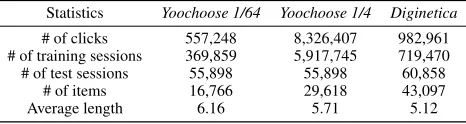
For fair comparison, following (Li et al. 2017a; Liu et al. 2018), we filter out all sessions of length 1 and items appearing less than 5 times in both datasets. The remain-ing 7,981,580 sessions and 37,483 items constitute the Yoo-choose dataset, while 204,771 sessions and 43097 items construct the Diginetica dataset. Furthermore, similar to (Tan, Xu, and Liu 2016), we generate sequences and cor-responding labels by splitting the input sequence. To be specific, we set the sessions of subsequent days as the test set for Yoochoose, and the sessions of subsequent weeks as the test set for Diginetiva. For example, for an input session s = [vs,1, vs,2, . . . , vs,n], we generate a series of sequences and labels([vs,1], vs,2),([vs,1, vs,2], vs,3), . . . , ([vs,1, vs,2, . . . , vs,n−1], vs,n), where[vs,1, vs,2, . . . , vs,n−1] is the generated sequence andvs,ndenotes the next-clicked item, i.e. the label of the sequence. Following (Li et al. 2017a; Liu et al. 2018), we also use the most recent frac-tions 1/64 and 1/4 of the training sequences of Yoochoose. The statistics of datasets are summarized in Table 1.
2
http://2015.recsyschallenge.com/challege.html 3
http://cikm2016.cs.iupui.edu/cikm-cup
Baseline Algorithms
To evaluate the performance of the proposed method, we compare it with the following representative baselines:
• POPandS-POPrecommend the top-Nfrequent items in the training set and in the current session respectively.
• Item-KNN(Sarwar et al. 2001) recommends items sim-ilar to the previously clicked item in the session, where similarity is defined as the cosine similarity between the vector of sessions.
• BPR-MF(Rendle et al. 2009) optimizes a pairwise rank-ing objective function via stochastic gradient descent.
• FPMC (Rendle, Freudenthaler, and Schmidt-Thieme 2010) is a sequential prediction method based on markov chain.
• GRU4REC (Hidasi et al. 2016a) uses RNNs to model user sequences for the session-based recommendation.
• NARM (Li et al. 2017a) employs RNNs with attention mechanism to capture the user’s main purpose and se-quential behavior.
• STAMP(Liu et al. 2018) captures users’ general interests of the current session and current interests of the last click.
Evaluation Metrics
• P@20(Precision) is widely used as a measure of predic-tive accuracy. It represents the proportion of correctly rec-ommended items amongst the top-20items.
• MRR@20(Mean Reciprocal Rank) is the average of re-ciprocal ranks of the correctly-recommended items. The reciprocal rank is set to 0 when the rank exceeds 20. The MRR measure considers the order of recommenda-tion ranking, where large MRR value indicates that cor-rect recommendations in the top of the ranking list.
Parameter Setup
Following previous methods (Li et al. 2017a; Liu et al. 2018), we set the dimensionality of latent vectorsd= 100 for both datasets. Besides, we select other hyper-parameters on a validation set which is a random 10% subset of the training set. All parameters are initialized using a Gaussian distribution with a mean of 0 and a standard deviation of 0.1. The mini-batch Adam optimizer is exerted to optimize these parameters, where the initial learning rate is set to 0.001 and will decay by 0.1 after every 3 epochs. Moreover, the batch size and the L2 penalty is set to 100 and10−5respectively.
Comparison with Baseline Methods
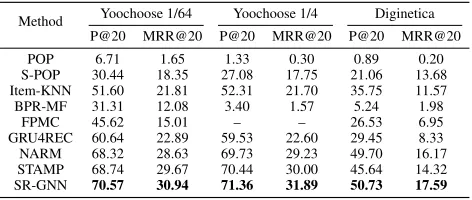
To demonstrate the overall performance of the proposed model, we compare it with other state-of-art session-based recommendation methods. The overall performance in terms of P@20 and MRR@20 is shown in Table 2, with the best results highlighted in boldface. Please note that, as in (Li et al. 2017a), due to insufficient memory to initialize FPMC, the performance on Yoochoose 1/4 is not reported.
Table 2: The performance of SR-GNN with other baseline methods over three datasets
Method Yoochoose 1/64 Yoochoose 1/4 Diginetica
P@20 MRR@20 P@20 MRR@20 P@20 MRR@20
POP 6.71 1.65 1.33 0.30 0.89 0.20
S-POP 30.44 18.35 27.08 17.75 21.06 13.68
Item-KNN 51.60 21.81 52.31 21.70 35.75 11.57
BPR-MF 31.31 12.08 3.40 1.57 5.24 1.98
FPMC 45.62 15.01 – – 26.53 6.95
GRU4REC 60.64 22.89 59.53 22.60 29.45 8.33
NARM 68.32 28.63 69.73 29.23 49.70 16.17
STAMP 68.74 29.67 70.44 30.00 45.64 14.32
SR-GNN 70.57 30.94 71.36 31.89 50.73 17.59
global session preference as well as the local interests. Ac-cording to the experiments, it is obvious that the proposed SR-GNN method achieves the best performance on all three datasets in terms of P@20 and MRR@20. This verifies the effectiveness of the proposed method.
The performance of traditional algorithms like POP and S-POP is relatively poor. Such simple models make recom-mendations solely based on repetitive co-occurred items or successive items, which is problematic in session-based rec-ommendation scenarios. Even so, S-POP still outperforms its opponents such as POP, BPR-MF, and FPMC, demon-strating the importance of session contextual information. Item-KNN achieves better results than FPMC which is based on Markov chains. Please note that, Item-KNN only utilizes the similarity between items without considering sequential information. This indicates that the assumption on the inde-pendence of successive items, which traditional MC-based methods mostly rely on, is not realistic.
Neural-network-based methods, such as NARM and STAMP, outperform the conventional methods, demon-strating the power of adopting deep learning in this do-main. Short/long-term memory models, like GRU4REC and NARM, use recurrent units to capture a user’s general inter-est while STAMP improves the short-term memory by uti-lizing the last-clicked item. Those methods explicitly model the users’ global behavioral preferences and consider tran-sitions between users’ previous actions and the next click, leading to superior performance against these traditional methods. However, their performance is still inferior to that of the proposed method. Compared with the state-of-art methods like NARM and STAMP, SR-GNN further consid-ers transitions between items in a session and thereby mod-els every session as a graph, which can capture more com-plex and implicit connections between user clicks. Whereas in NARM and GRU4REC, they explicitly model each user and obtain the user representations through separated ses-sion sequences, with possible interactive relationships be-tween items ignored. Therefore, the proposed model is more powerful to model session behavior.
Besides, SR-GNN adopts the soft-attention mechanism to generate a session representation which can automatically select the most significant item transitions, and neglect noisy and ineffective user actions in the current session. On the contrary, STAMP only uses the transition between the last-clicked item and previous actions, which may not be
suffi-cient. Other RNN models, such as GRU4REC and NARM, fail to select impactful information during the propagation process as well. They use all previous items to obtain a vec-tor representing the user’s general interest. When a user’s be-havior is aimless, or his interests drift quickly in the current session, conventional models are ineffective to cope with noisy sessions.
Comparison with Variants of Connection Schemes
The proposed SR-GNN method is flexible in constructing connecting relationships between items in the graph. We show another two connection variants in order to evaluate re-lationships between items in each session graph. Firstly, we aggregate all session sequences together and model them as a directed whole item graph, which is termed as the global graph hereafter. In the global graph, each node denotes a unique item, and each edge denotes a directed transition from one item to another. Secondly, we model all high-order relationships between items within one session as direct con-nections explicitly. In summary, the following two connec-tion schemes are proposed to compare with SR-GNN:
• SR-GNN with normalized global connections (SR-GNN-NGC) replaces the connection matrix with edge weights extracted from the global graph on the basis of SR-GNN.
• SR-GNN with full connections (SR-GNN-FC) represents all higher-order relationships using boolean weights and appends its corresponding connection matrix to that of SR-GNN.
The results of different connection schemes are shown in Figure 3. From the figures, it is seen that all three connection schemes achieve better or almost the same performance as the state-of-the-art STAMP and NARM methods, confirm-ing the usefulness of modelconfirm-ing sessions as graphs.
Compared with SR-GNN, for each session, SR-GNN-NGC takes the impact of other sessions into considerations in addition to items in the current session, which subse-quently reduces the influence of edges that are connected to nodes with high degree within the current session graph. Such a fusion method notably affects the integrity of the cur-rent session, especially when the weight of the edge in the graph varies, leading to performance downgrade.
In regard to SR-GNN and SR-GNN-FC, the former one only models the exact relationship between consecutive items, and the latter one further explicitly regards all high-order relationships as direct connections. It is reported that SR-GNN-FC performs worse than SR-GNN, though the ex-perimental results of the two methods are not of much dif-ference. Such a small difference in results suggests that in most recommendation scenarios, not every high-order tran-sitions can be directly converted to straight connections and intermediate stages between high-order items are still neces-sities. For instance, considering that the user has viewed the following pages when browsing a website:A → B → C, it is not appropriate to recommend pageC directly afterA
Yoochoose 1/64 Yoochoose 1/4 Diginetica 45
50 55 60 65 70 75
P@20 (%)
NARM STAMP SR-GNN SR-GNN-FC SR-GNN-NGC
(a) P@20
Yoochoose 1/64 Yoochoose 1/4 Diginetica 15
20 25 30
MRR@20 (%)
NARM STAMP SR-GNN SR-GNN-FC SR-GNN-NGC
(b) MRR@20
Figure 3: The performance of different connection schemes
Yoochoose 1/64 Yoochoose 1/4 Diginetica 45
50 55 60 65 70
P@20 (%)
SR-GNN-L SR-GNN-AVG SR-GNN-ATT SR-GNN
(a) P@20
Yoochoose 1/64 Yoochoose 1/4 Diginetica 15.0
17.5 20.0 22.5 25.0 27.5 30.0 32.5
MRR@20 (%)
SR-GNN-L SR-GNN-AVG SR-GNN-ATT SR-GNN
(b) MRR@20
Figure 4: The performance of different session representa-tions
Comparison with Different Session Embeddings
We compare the session embedding strategy with the follow-ing three approaches: (1) local embeddfollow-ing only L), (2) global embedding with average pooling (SR-GNN-AVG), and (3) global embedding with the attention mech-anism (SR-GNN-ATT). The results of methods with three different embedding strategies are given in Figure 4.
From the figures, it can be observed that the hybrid em-bedding method SR-GNN achieves best results on all three datasets, which validates the importance of explicitly incor-porating current session interests with the long-term prefer-ence. Furthermore, the figures show that SR-GNN-ATT per-forms better than SR-GNN-AVG with average pooling on three datasets. It indicates that the session may contain some noisy behavior, which cannot be treated independently. Be-sides, it is shown that attention mechanisms are helpful in extracting the significant behavior from the session data to construct the long-term preference.
Please note that GNN-L, a downgraded version of SR-GNN, still outperforms SR-GNN-AVG and achieves almost the same performance as that of SR-GNN-ATT, supporting that both the current interest and long-term preference are crucial for session-based recommendation.
Analysis on Session Sequence Lengths
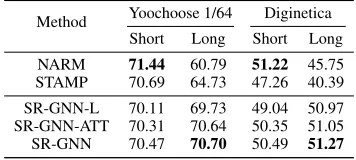
We further analyze the capability of different models to cope with sessions of different lengths. For comparison, we par-tition sessions of Yoochoose 1/64 and Diginetica into two groups, where “Short” indicates that the length of sessions is less than or equal to 5, while each session has more than 5 items in “Long”. The pivot value 5 is the closest integer to the average length of sessions in all datasets. The per-centages of session belonging to short group and long group
Table 3: The performance of different methods with different session lengths evaluated in terms of P@20
Method Yoochoose 1/64 Diginetica Short Long Short Long
NARM 71.44 60.79 51.22 45.75
STAMP 70.69 64.73 47.26 40.39
SR-GNN-L 70.11 69.73 49.04 50.97 SR-GNN-ATT 70.31 70.64 50.35 51.05 SR-GNN 70.47 70.70 50.49 51.27
are 0.701 and 0.299 on the Yoochoose data, and 0.764 and 0.236 on the Diginetica data. For each method, we report the results evaluated in terms of P@20 in Table 3.
Our proposed SR-GNN and its variants perform stably on two datasets with different session lengths. It demon-strates the superior performance of the proposed method and the adaptability of graph neural networks in session-based recommendation. On the contrary, the performance of NARM and STAMP changes greatly in short and long groups. STAMP explains such a difference according to replicated actions. It adopts the attention mechanism, so replicated items can be ignored when obtaining user repre-sentations. Similar to STAMP, NARM achieves good perfor-mance on the short group, but the perforperfor-mance drops quickly with the length of the sessions increasing, which is partially because RNN models have difficulty in coping with long se-quences.
Then we analyze the performance of GNN-L, SR-GNN-ATT, and SR-GNN with different session representa-tions. These three methods achieve promising results com-paring with STAMP and NARM. It is probably because that based on the learning framework of graph neural net-works, our methods can attain more accurate node vectors. Such node embedding not only captures the latent features of nodes but also models the node connections globally. On such basis, the performance is stable among variants of SR-GNN, while the performance of two state-of-art methods fluctuate considerably on short and long datasets. Moreover, the table shows that SR-GNN-L can also achieve good re-sults, although this variant only uses local session embed-ding vectors. It is maybe because that SR-GNN-L also im-plicitly considers the properties of the first-order and higher-order nodes in session graphs. Such results are also vali-dated by Figure 4, where both L and SR-GNN-ATT achieve the close-to-optimal performance.
5
Conclusions
experiments confirm that the proposed algorithm can con-sistently outperform other state-of-art methods.
Acknowledgements
The authors Shu Wu and Yuyuan Tang contribute to this work equally. Yanqiao Zhu is the corresponding author. This work is supported by National Natural Science Foundation of China (61772528) and National Key Research and Devel-opment Program (2016YFB1001000).
References
Cho, K.; Van Merri¨enboer, B.; Gulcehre, C.; Bahdanau, D.; Bougares, F.; Schwenk, H.; and Bengio, Y. 2014. Learning phrase representations using rnn encoder-decoder for statistical machine translation.EMNLP1724–1734.
Duvenaud, D.; Maclaurin, D.; Aguilera-Iparraguirre, J.; G´omez-Bombarelli, R.; Hirzel, T.; Aspuru-Guzik, A.; and Adams, R. P. 2015. Convolutional networks on graphs for learning molecular fingerprints. InNIPS.
Gori, M.; Monfardini, G.; and Scarselli, F. 2005. A new model for learning in graph domains. InIJCNN, volume 2, 729–734. Grover, A., and Leskovec, J. 2016. Node2vec: Scalable feature learning for networks. InKDD, 855–864.
Hidasi, B.; Karatzoglou, A.; Baltrunas, L.; and Tikk, D. 2016a. Session-based recommendations with recurrent neural networks. In ICLR.
Hidasi, B.; Quadrana, M.; Karatzoglou, A.; and Tikk, D. 2016b. Parallel recurrent neural network architectures for feature-rich session-based recommendations. InRecSys, 241–248.
Jannach, D., and Ludewig, M. 2017. When recurrent neural net-works meet the neighborhood for session-based recommendation. InRecSys, 306–310.
Kipf, T. N., and Welling, M. 2016. Semi-supervised classification with graph convolutional networks. InICLR.
Koren, Y., and Bell, R. 2011. Advances in collaborative filtering. InRecommender Systems Handbook. Springer. 145–186. Koren, Y.; Bell, R.; and Volinsky, C. 2009. Matrix factorization techniques for recommender systems.Computer42(8):30–37. Li, Y.; Tarlow, D.; Brockschmidt, M.; and Zemel, R. S. 2015. Gated graph sequence neural networks. InICLR.
Li, J.; Ren, P.; Chen, Z.; Ren, Z.; Lian, T.; and Ma, J. 2017a. Neural attentive session-based recommendation. InCIKM, 1419–1428. Li, R.; Tapaswi, M.; Liao, R.; Jia, J.; Urtasun, R.; and Fidler, S. 2017b. Situation recognition with graph neural networks. InICCV, 4183–4192.
Li, Z.; Ding, X.; and Liu, T. 2018. Constructing narrative event evolutionary graph for script event prediction.
Liu, Q.; Wu, S.; Wang, L.; and Tan, T. 2016. Predicting the next location: A recurrent model with spatial and temporal contexts. In AAAI, 194–200.
Liu, Q.; Zeng, Y.; Mokhosi, R.; and Zhang, H. 2018. Stamp: Short-term attention/memory priority model for session-based rec-ommendation. InKDD, 1831–1839.
Mao, J.; Xu, W.; Yang, Y.; Wang, J.; Huang, Z.; and Yuille, A. 2015. Deep captioning with multimodal recurrent neural networks (m-rnn).ICLR.
Marino, K.; Salakhutdinov, R.; and Gupta, A. 2017. The more you know: Using knowledge graphs for image classification. InCVPR, 20–28.
Mikolov, T.; Karafi´at, M.; Burget, L.; Cernock`y, J.; and Khudanpur, S. 2010. Recurrent neural network based language model. In INTERSPEECH, volume 2, 3.
Mikolov, T.; Sutskever, I.; Chen, K.; Corrado, G. S.; and Dean, J. 2013. Distributed representations of words and phrases and their compositionality. InNIPS, 3111–3119.
Mnih, A., and Salakhutdinov, R. 2007. Probabilistic matrix factor-ization. InNIPS, 1257–1264.
Perozzi, B.; Al-Rfou, R.; and Skiena, S. 2014. Deepwalk: Online learning of social representations. InKDD, 701–710.
Rendle, S.; Freudenthaler, C.; Gantner, Z.; and Schmidt-Thieme, L. 2009. Bpr: Bayesian personalized ranking from implicit feedback. InUAI, 452–461.
Rendle, S.; Freudenthaler, C.; and Schmidt-Thieme, L. 2010. Fac-torizing personalized markov chains for next-basket recommenda-tion. InWWW, 811–820. ACM.
Sarwar, B.; Karypis, G.; Konstan, J.; and Riedl, J. 2001. Item-based collaborative filtering recommendation algorithms. InWWW. Scarselli, F.; Gori, M.; Tsoi, A. C.; Hagenbuchner, M.; and Monfar-dini, G. 2009. The graph neural network model.TNN20(1):61–80. Serban, I. V.; Sordoni, A.; Bengio, Y.; Courville, A.; and Pineau, J. 2016. Building end-to-end dialogue systems using generative hierarchical neural network models. InAAAI, 3776–3784. Shani, G.; Brafman, R. I.; and Heckerman, D. 2002. An mdp-based recommender system. InUAI, 453–460.
Tan, Y. K.; Xu, X.; and Liu, Y. 2016. Improved recurrent neural networks for session-based recommendations. InDLRS, 17–22. Tang, J.; Qu, M.; Wang, M.; Zhang, M.; Yan, J.; and Mei, Q. 2015. Line: Large-scale information network embedding. In WWW, 1067–1077.
Tuan, T. X., and Phuong, T. M. 2017. 3d convolutional networks for session-based recommendation with content features. In Rec-Sys, 138–146.