R E V I E W A R T I C L E
Open Access
When to look at maps in navigation:
metacognitive control in environment
learning
Ruizhi Dai
*, Ayanna K. Thomas and Holly A. Taylor
Abstract
People learn environments through direct experience with the environment and/or through map study. Further, the different perspectives taken while learning an environment influence the knowledge acquired. After all, different information about an environment is readily available through route (e.g. by navigation) and survey (e.g. with maps) perspectives. Having a choice between direct experience and map use, or between different perspectives, suggests a role of metacognitive control in environment learning. That is, when in a new environment, learners may exercise metacognitive control by selectively choosing and implementing specific learning strategies, such as switching between perspectives. Strategy choice may depend on specific constraints, such as perspective, range of view, or amount of time to learn (to name a few). For example, people may check a map (e.g. on smartphones or GPS devices) to complement developing route knowledge. The present review discusses the role of metacognition in environment learning and outlines new directions for research to bridge these fields by examining how strategic metacognitive control over perspective switching affects environment learning. Such explorations can inform real-world environment learning and navigational aids design.
Keywords:Environment learning, Perspective switching, Metacognitive control
Significance
When people take either a survey (e.g. study a map) or a route perspective (e.g. navigate) while learning an unfamil-iar environment, their spatial knowledge differs. However, in the real world, people are not generally restricted to one perspective or the other when learning new environ-ments. With navigational aids, such as smartphones and devices using Global Positioning System (GPS), we can flexibly choose and switch between route and survey perspectives, rather than taking only one perspective. Al-though studies have explored how switching perspectives may affect environment learning (EL), the metacognitive aspect of perspective switching is presently poorly under-stood. Exploration of metacognitive processes in EL would allow us to better understand spatial knowledge develop-ment, to potentially target and facilitate real-world learn-ing of unfamiliar environments. Further, it could provide insights into navigational aid design. Considering findings
from EL and metacognitive control literature together, the present paper outlines new directions to bridge these fields and calls for studies to explore the role metacogni-tion plays in EL.
Introduction
Imagine that you have just moved to a new neighborhood and are trying to learn the environment. What will you do? Would you try to navigate within the neighborhood to learn routes and landmarks, study the information from a map, or take a walk with the help of your smartphone?
Environment learning (EL) is a process in which individ-uals encode spatial information (such as the spatial rela-tions between locarela-tions) within an environment. When learning a new environment, people typically take either a route perspective, which is a person-centered view from in-side the environment, or a survey perspective, which is a map-like, top-down view (Linde & Labov,1975; Thorndyke & Hayes-Roth, 1982). Previous research investigating EL suggests that the knowledge or representation developed may differ based on the perspective taken during learning * Correspondence:[email protected]
Department of Psychology, Tufts University, 490 Boston Avenue, Medford, MA 02155, USA
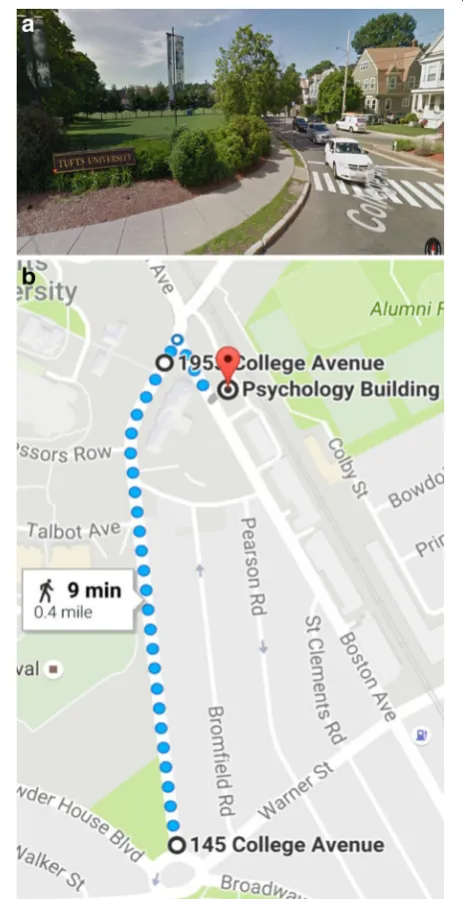
(Schneider & Taylor,1999; Taylor & Tversky,1992; Thorn-dyke & Hayes-Roth, 1982). However, active learners often alternate among different spatial information sources, including ground-level, first-person navigation within the environment (route perspective, see Fig. 1a), and naviga-tional aids, like maps on mobile devices (survey perspective, see Fig.1b). Modern technology, such as GPS and smart-phones, has made it easier to switch between route and survey perspectives. For example, you might check your location on a smartphone when feeling lost in your new neighborhood. Although understudied in the
environmental learning domain, these anecdotal observa-tions suggest a role of metacognition in navigation.
Metacognition, and specifically metacognitive control, involves the regulation or control of the learning process (Nelson & Narens, 1990, 1994). Predominantly within the verbal learning literature, research has demonstrated that learners tend to control what, when, and how to study; they also choose strategies to presumably enhance learning (Kornell & Finn,2016; Kornell & Metcalfe,2006; Tullis & Benjamin, 2012). In this review, we discuss the role of metacognitive control in EL. Towards this end, we first introduce theoretical models of metacognition, discuss previous literature on perspective switching in EL, and review factors that influence metacognitive control and EL. We then focus on research questions to explore the pos-sible relationship between metacognitive control and EL. We hypothesize that strategic control over perspective switching could affect spatial knowledge development. Future directions and possible applications are discussed.
Review
Metacognition: monitoring and control
Metacognition, usually described as“knowing about know-ing” (Metcalfe & Shimamura, 1994) and “cognition about cognition” (Flavell & Ross,1981), is commonly defined as the beliefs or knowledge about our cognition, and the regu-lation or control of cognition and learning (Allen & Armour-Thomas,1991; Cross & Paris,1988; Flavell & Ross,
1981; Schraw,1998).
Nelson and Narens (1990,1994) proposed that metacog-nition can be considered as two interacting components: (1) metacognitive monitoring, or consciously assessing learning and/or later retrievability; and (2) metacognitive control, or strategically regulating learning by implementing specific strategies. One dominant model of metacognition suggests that monitoring and control enable dynamic interactions between metacognitive and cognitive functions, in that metacognitive processes are informed by, and also modify cognitive processes (Nelson, 1996; Nelson & Narens, 1990, 1994; see also Winne, 2001). Further, re-search consistently demonstrates that monitoring affects control by, for example, influencing how participants allo-cate study time to reduce the discrepancy between a desired learning goal and the present state of learning (Dunlosky & Hertzog, 1998; Metcalfe & Kornell, 2005). For instance, learners allocate more time to items perceived as difficult, as these likely show the largest discrepancies between the present and desired state (Koriat, Ma’ayan, & Nussinson,
2006; Metcalfe & Kornell,2005). However, when study time is limited, learners devote more time to easier as opposed to difficult items, and choose easier items for restudy (Dunlosky & Hertzog,1998; Kornell & Finn, 2016; Son & Metcalfe, 2000; Thiede & Dunlosky, 1999). Regardless of
Fig. 1aAn example of route perspective display (Google Maps,
how regulation or control is implemented, this body of research demonstrates how metacognitive monitoring and control interact to strategically regulate learning.
Another model addressing the relationship between metacognitive monitoring and control comes from self-regulated learning research. According to Pintrich (2000), self-regulated learning is a process in which learners set learning goals, monitor cognition, and con-trol learning behaviors based on established goals and environmental features (Pintrich, 2000, p. 453). Pintrich described self-regulated learning as consisting of four primary elements: (1) planning, which includes target goal setting and activation of perceptions and prior knowledge; (2) monitoring, including metacognitive awareness and monitoring of current cognition; (3) controlling and regulating study by selecting cognitive strategies for learning and thinking; and (4)reacting and reflecting on the task (Pintrich, 2004; Schraw, Crippen, & Hartley, 2006). Within this framework, self-regulated learners actively use a variety of strategies such as plan-ning, organizing, self-monitoring, and self-evaluating to facilitate learning (Zimmerman, 1986). While these phases overlap with some of the processes proposed in Nelson and Naren’s framework, Pintrich’s model empha-sizes learners’autonomy in strategically engaging control of learning, as it highlights individuals’ active role in monitoring and control (Pintrich,2000).
Whereas metacognition has been carefully investigated within the context of verbal learning, research extending this examination to non-verbal domains is sparse at best. It is reasonable to assume that metacognitive processes predicted to dynamically interact with cognition, should extend to cognitive processes that underlie EL. Returning to our earlier example, when learning your new neighbor-hood, choices you make likely impact navigation and route learning. Based on Nelson and Narens (1994), being able to both accurately monitor how well you have learned the new neighborhood and select strategies to facilitate learn-ing, should affect how you study the new neighborhood. Specifically, when feeling lost in the new neighborhood (monitoring), you may refer to a digital map on your mobile device to figure out where to go next (control). Your learning outcome is determined by the accuracy of monitoring and the effectiveness of control. Pintrich’s model (2000) would predict that in self-regulated EL, you may actively plan ahead of time by setting up a study goal, e.g. study a map to later freely navigate in the environ-ment. You may then closely monitor your learning, for ex-ample by constantly asking yourself about landmark locations. The outcome of this monitoring may then lead you to select strategies for better learning. After then navi-gating through the environment, you may reflect on your performance, thinking of ways to further improve your memory for the neighborhood.
Consideration of different metacognition frameworks allows researchers to make different predictions regard-ing metacognition in navigational control, as well as the relationship between monitoring and control in naviga-tion. We discuss how future research may capitalize on these considerations at the end of this review.
Environment learning: different spatial perspectives
Environment learning can be achieved through map study or through direct experience with the environment, such as navigating between locations. People usually engage in EL in a goal-directed manner. For instance, when learning maps or navigating, individuals may have two main goals: to facilitate navigation between locations; or to remember the layout and the routes between landmarks. These different goals may affect the type of strategies adopted, further influencing what and how information is learned (Taylor, Naylor, & Chechile,1999).
Research has suggested that learning from maps or from navigation differs in many aspects. Maps usually show the environment’s overall layout, from a survey perspective or bird’s eye viewpoint. With maps, the reference is object-centered; while maps can be rotated, the orientation is usually stable (e.g. north-up). Through navigation, however, people experience the environment from their own first-person perspective. The reference system is viewer-centered and the orientation changes as the navigator turns. Additionally, maps and navigation emphasize different types of spatial relations. With maps, because they present an overview of the environ-ment, all landmark-to-landmark relations can be viewed directly. In contrast, when navigating usually only part of the environment can be seen directly. Thus, while some landmark-to-landmark relations can be learned directly while navigating, it is limited to those in the current visual field. Instead, self-to-landmark relations are readily apparent. In general, these differences dem-onstrate the distinction between survey (e.g. map learn-ing) and route (e.g. navigation) perspectives (Thorndyke & Hayes-Roth,1982).
Learning perspective impacts the spatial knowledge acquired (Evans & Pezdek, 1980; Sholl, 1987; Taylor et al.,1999; Thorndyke & Hayes-Roth,1982). For instance, Thorndyke and Hayes-Roth (1982) found that map learners more accurately estimated global spatial rela-tions and Euclidian (straight-line) distance between loca-tions; however, navigators more accurately judged local or self-to-landmark spatial relations and route distance. Similarly, when participants learned an unfamiliar cam-pus building from a map or from navigation, navigation learning led to better performance on tasks assessing route knowledge, whereas map learners performed bet-ter on tasks assessing survey knowledge (Taylor et al.,
knowledge differs after learning from navigation (route perspective) versus from maps (survey perspective). With a route perspective, we either consciously or inci-dentally acquire route knowledge including the sequential ordering of landmarks, landmark locations in relationship to the learner, and landmark appearance. When learning from a survey perspective, we gain information about glo-bal, configural relationships between landmarks (Buchner & Jansen-Osmann, 2008; Thorndyke & Hayes-Roth,
1982).
Learning from navigation versus maps also affects the orientation taken with respect to the environment. When navigating, people reorient with each turn, but with maps the map generally remains in the same orientation. This difference affects the orientation specificity of the spatial mental model. Knowledge representations acquired from navigation do not typically demonstrate fixed orientation effect; however, representations garnered from maps have been shown to be orientation-dependent (Evans & Pezdek,
1980). In the real world, the orientation difference in memory may impact the information one seeks when feel-ing lost or disoriented.
Studies also found different navigation performance after learning from route and survey perspective. For example, Brunyé, Gardony, Mahoney, and Taylor (2012) asked participants to study a large-scale virtual environment from different spatial perspectives. Route perspective learning better supported local or proximal navigation, whereas survey perspective learning better supported navigation between locations more distant from one another. Taken together, these findings suggest that the perspective taken during learning affects the spatial representation that develops (Buchner & Jansen-Osmann,2008; Thorndyke & Hayes-Roth,1982).
Most EL studies exploring how spatial information source and perspective impact spatial knowledge—which includes representations of route, survey, and landmark in-formation—limit learning to a single perspective. However, real-world EL is usually not restricted to one perspective. We suggest that multiple perspectives may not only facili-tate EL but may also be a preferred metacognitive strategy. Because survey and route perspectives provide different environment information, learners taking one perspective may strategically seek information from the other perspec-tive, particularly if they are monitoring their own learning process or run into unexpected information (e.g. a detour or a landmark in a location different from their expect-ation). Therefore, when given access to both perspectives, e.g. using a smartphone when navigating, learners may strategically control learning by switching perspectives, in a goal-directed manner. For instance, when the study goal is to simply navigate to a destination, learners may switch less frequently as compared with when they need to remember the layout for later retrieval.
Modern technology increasingly allows easy perspective switching during EL. However, most studies in spatial cog-nition have explored the nature of EL within perspectives independently, thereby disallowing metacognitive control over perspective selection. So far, less work has explored learning when switching or combining route and survey perspectives, especially when participant control is allowed.
To date, most of the work examining perspective switching in EL has focused on perspective differences between study and test. These studies consistently show better performance when the perspective tested matches the study perspective (Brockmole & Wang, 2003; Diwadkar & McNamara, 1997; Pazzaglia & Taylor, 2007; Shelton & McNamara, 1997,2004; Wang Q (2013): Per-ceptuo-motor associations in spatial knowledge: Encoding or retrieval effect?, unpublished). Consistent withTransfer Appropriate Processing (Morris, Bransford, & Franks,
1977), participants who study an environment by navigat-ing tend to perform better on tasks assessnavigat-ing route know-ledge, such as navigating between landmarks (Brunyé et al., 2012; Pazzaglia & Taylor, 2007). Map-learners show better performance on survey tasks, such as estimating Euclidian distances (Brunyé et al., 2012; Thorndyke & Hayes-Roth, 1982; Taylor et al., 1999). When the tested perspective differs from the studied perspective, there is usually a cost to performance (Brockmole & Wang,2003; Taylor et al., 1999; Thorndyke & Hayes-Roth, 1982). These findings are consistent with the metacognition literature, which suggests that expectation about an upcoming test impact learning (Thomas & McDaniel,
2007). Learners who expect one type of test (recall or recognition) encode information consistent with this expectation (cf. Neely & Balota, 1981). In addition, when given a choice between recall or recognition as a form of self-testing, participants choose to study in a manner consistent with the expected test (Kang SHK (2009): The influence of test expectancy, test format, and test experience on study strategy selec-tion and long-term retenselec-tion, unpublished). Therefore, anticipation or knowledge of how spatial information will be used might impact learning strategies, includ-ing the perspective studied.
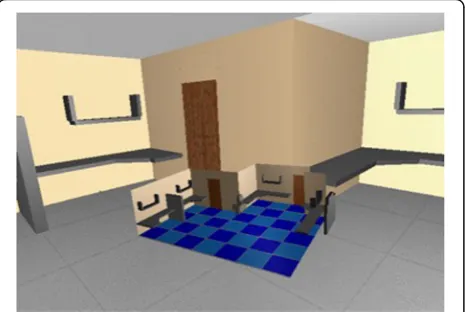
Few studies have explored learning from combined, or alternating between, route and survey perspectives. One study asked participants to learn an unfamiliar large-scale virtual environment from a video showing either one or both route and survey perspectives (Fig. 2 shows a split-screen display with both perspectives; Brunyé et al.,
Jones, 1999; Stoakley, Conway, & Pausch, 1995). The WIM display, typically used in first-person video games, shows a smaller top-down view (i.e. a map with the updated position of the learner) somewhere within a full-screen route perspective display. Importantly, in both Brunyé et al. (2012) and the WIM studies, per-spective switching was neither forced nor directly measured. Showing both perspectives simultaneously did not ensure switches between the perspectives. Thus, it remains unknown whether participants switched or not, and if they did switch, how often and when switching happened.
The few studies that have explicitly explored the ef-fect of perspective switching during learning have mixed findings. For example, using verbal spatial de-scriptions, Lee and Tversky (2001, 2005) explored the effect of perspective switching during learning on read-ing times and comprehension. Participants studied a paragraph describing an environment either from a route perspective, using terms of a viewer-centered ref-erence (e.g. “left/right”), or a survey perspective, using object-centered reference terms (e.g. cardinal terms like
“west/east”). The paragraph’s last sentence was either from the same (non-switching) or the opposite perspec-tive (switching). Costs in the form of increased reading times and response times and decreased accuracy were found in both survey-to-route and route-to-survey switching conditions. Additionally, switching from route-to-survey appeared more difficult (Lee & Tversky,
2001, 2005). Such asymmetry in perspective switching demands may affect how learners monitor and control the way they gather spatial information.
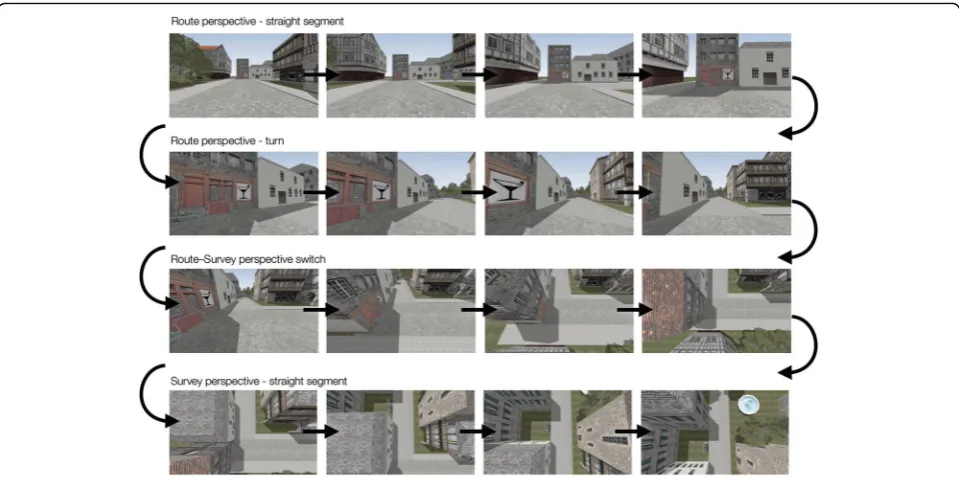
A recent investigation of perspective switching gave participants the opportunity to visually switch perspectives during virtual environment learning (McGahan, 2014). The study aimed to examine how switching perspectives during study affected memory of the environment (Fig.4
provides an example of a route to survey switch). In Experiment 1, participants were forced to switch once, either from route to survey or the reverse. In Experiment 2, participants could control switching. It was found that forced switching did not improve memory for landmarks and their locations. However, self-controlled switching improved recognition and recall of the landmarks and location information, without increasing total study time. This suggests that metacognitive control may facilitate environment learning.
The role of metacognitive control in EL
While the role of metacognitive control in EL has received little attention, the few relevant studies suggest its poten-tial importance. Further, previous research has shown that factors influencing metacognitive control also affect EL. As one example, motivational factors such as learning goals and outcome expectations affect how learning is regulated and influence the information represented in memory after EL. Previous findings suggest that having a mastery goal (e.g. to build up skills or knowledge of the studied materials) affects study time allocation (Son & Metcalfe, 2000; Thiede & Dunlosky, 1999). Other goals
Fig. 2The combination of survey and route display in Brunyé et al. (2012)
have also been observed to affect how learners regulate their learning. For instance, participants may choose to study easy items or prefer easy tasks, when: (1) the goal is externally oriented, such as to maximize reward or show their success (Wolters, 2003); or (2) participants want to expend less effort on a task, or reduce the cost associated with a task (Goldsmith, Koriat, & Pansky,2005; Thorkildsen & Nicholls,1998).
For EL, goals affect representations developed from maps and navigation (Gauvain & Rogoff,1986; Magliano, Cohen, Allen, & Rodrigue, 1995; Taylor et al., 1999). In EL, goals are often induced through instructions. A route goal may ask participants to learn the fastest routes be-tween locations while a survey goal may ask participants to learn the environment layout. These instructions im-pact performance in a perspective consistent way (Magliano et al.,1995; Taylor et al.,1999). More interest-ingly, learning format (e.g. navigation versus map) and learning goal interacted. Map learners encoded route in-formation, when directed by a route goal; similarly, navi-gators encoded survey information when directed to study a building layout. Therefore, learning goals can play an important role in spatial representation development, pos-sibly by directing learners’strategic selection over different sources of spatial information (Shelton & McNamara,
1997,2004; Taylor et al.,1999; Wang, 2013). Prior experi-ence or pre-existing knowledge also affects metacognition and EL. Metacognition studies suggest that pre-existing knowledge impacts metacognitive control, possibly by in-fluencing participants’ monitoring process (Frank &
Kuhlmann, 2017; Mueller & Dunlosky, 2017; Mueller, Dunlosky, & Tauber, 2016). According to Koriat (2000), pre-existing knowledge about the learning, and knowledge about the learners themselves, may jointly influence how learners monitor and control the learning process. For ex-ample, knowing how well one has mastered vocabulary for the Scholastic Assessment Test (SAT), and what strengths he may have as a learner (e.g. he may be good at remembering words), could lead to different judgments of the learning process and, in turn, affect how he studies or restudies vocabulary for the Graduate Record Examina-tions (GRE). Research has also explored how meta-strategic knowledge affects decisions about which strategies to use. Learners who possess knowledge about potentially useful learning strategies can select strategies to facilitate learning (Pressley, Levin, & Ghatala, 1984; Reder & Ritter, 1992). For example, an instructor may regularly use retrieval practice to learn the names of stu-dents in her class. Taken together, these findings suggest that individuals’ knowledge and/or experience affects metacognitive judgments-making, which could, in turn, impact regulation.
For EL, experience with an environment can influence learning from different spatial perspectives (Brunyé et al.,
2012; Brunyé & Taylor, 2008; Pick & Lockman, 1981; Thorndyke & Hayes-Roth,1982). With more exposure to an environment, people tend to develop a more survey-like representation. For example, more experienced taxi drivers demonstrate better survey knowledge com-pared with their passengers (Appleyard, 1970; Maguire,
Woollett, & Spiers,2006). In addition, with moderate ex-posure to an environment, map-learners were better than navigators in estimating Euclidian distances and making relative location judgments; however, this map-learning advantage disappeared with increased environment experi-ence (Thorndyke & Hayes-Roth,1982). Similarly, Brunyé et al. (2012) asked participants to study an unfamiliar virtual environment from a video. Participants’ knowledge of the environment was examined by navigating between 10 suc-cessive landmarks. The slope of improvement in partici-pants’ navigation performance, from Trial 1 to 10, was assessed. They found that accumulated navigation experience, gained over the course of 10 successive trials, supported spatial memories of the routes, landmarks, and overall layout of the environment. These knowledge gains, in turn, enabled mental perspective-switching to access information needed for the navigation task. In other words, the spatial representations allowed for greater cognitive flexibility. Such flexible representation could efficiently guide route planning (detours). In addition, they found that cognitive load for learning from different perspectives may be asymmetric. Compared with a survey perspective, learn-ing an environment from a route perspective might require more time to reach the same levels of representational flexi-bility (Brunyé et al.,2012). This finding has implications for metacognitive control in EL. Those taking a route perspec-tive may invoke different learning sources (i.e. maps on cell-phones or GPS devices), if available, thus taking greater metacognitive control over their environment learning. This may also suggest that, to be able to flexibly navigate between locations, learners may switch perspectives more often when learning from a route perspective than when learning from a survey perspective.
Finally, previous studies suggested that self-efficacy beliefs affect metacognitive control in learning (Linnen-brink & Pintrich, 2003; Zimmerman, Bandura, & Martinez-Pons, 1992). For a learner to successfully use potential strategies, knowledge about the strategies alone is not enough; the learner must believe that he/ she can use the strategies. Previous literature exploring the effect of self-efficacy beliefs on learners’ use of strategies has found positive relationships between the two. High self-efficacy relates positively to more extensive use of cognitive strategies, such as strategically organizing, planning, and monitoring as well as controlling of study process (Bandura, Barbaranelli, Caprara, & Pastorelli, 1996, 2001; Bandura, Caprara, Barbaranelli, Gerbino, & Pastorelli, 2003; Zimmerman & Bandura, 1994). For example, individuals with high self-efficacy demonstrate more effective monitoring over the learning process, suggesting that self-efficacy does affect metacognitive processes (Pajares, 2008). Additionally, self-efficacy may relate to other factors such as learners’ interest or value of the task (Linnenbrink & Pintrich,2003),
which may also lead to more engagement in studying and better learning (Pintrich & Schunk,1996).
In the context of EL, individuals vary widely in strategy preference and ability. Studies have found individual differ-ences in route or survey knowledge development (Ishikawa & Montello, 2006; Wolbers & Hegarty, 2010) and in per-spective preference during learning (Hegarty, Richardson, Montello, Lovelace, & Subbiah,2002; Pazzaglia & De Beni,
2001). Participants report different preferences for spatial perspectives, which may further affect how they study un-familiar environments (Pazzaglia & De Beni,2001). People also differ in the strategies used when studying maps or navigating (Baldwin & Reagan,2009; Kozlowski & Bryant,
1977; Pazzaglia & De Beni, 2001). Baldwin and Reagan (2009), for example, found that individuals with a good or bad self-reported sense of direction (SOD) differed in strategies used in learning. Poor SOD individuals relied more on verbal resources, whereas good SOD participants relied more heavily on visuospatial information. These findings indicate that differences in preference and spatial abilities could affect a learner’s strategic choice of informa-tion source when learning an environment. A learner’s self-efficacy or preference may affect how long they choose to study from a particular perspective. Therefore, research into how self-efficacy and strategy preference impact metacognitive processes could directly inform how learners exercise control over EL.
The aforementioned factors (goals, experience, or know-ledge of the environment, preference and self-efficacy beliefs) are important in the context of the current review, because these factors may individually, or interactively, contribute to how learners control their learning of unfamiliar environments. Although not directly examined in those studies, the aforementioned factors seem to influ-ence learning by affecting learners’choice over strategies or different sources of information, therefore suggesting that metacognitive control may play an important role in learning unfamiliar environments.
driving, we may have access to a GPS device that could provide both visual (maps) and auditory (verbal tion) information. We may, at the same time, get instruc-tions from other sources, such as a passenger who is familiar with the environment. Studying new environ-ments in the real-world, therefore, may involve learning from different sources, sometimes from multimedia situa-tions. To provide some background information in exist-ing literature that addresses this issue, we discuss, in the next section, research and findings exploring learning in more complex multimedia environments.
Learning in interactive (multimedia or hypermedia) environments
First introduced by Ted Nelson (1965), a multimedia or hypermedia learning environment is an open-ended envir-onment that enables learning from multimedia resources, including video, audio, graphics, and texts (Burton, Moore, & Holmes, 1995). In such interactive learning environ-ments, participants are usually given more control over their study process than single media learning sources. For example, they can manipulate how information is presented and can interact with these representations in different ways to facilitate learning (Azevedo, 2005; Lawless & Brown,1997; Scheiter & Gerjets,2007). With the boom in technological development, learning from highly interactive multimedia or hypermedia environments has become com-monplace. Although previous research has not focused on multimedia EL, a brief review of multimedia/hypermedia learning results can provide insights into how cognitive and metacognitive functions may be affected in complex learn-ing situations.
In general, research exploring learning in interactive multimedia/ hypermedia environments has yielded mixed results. Some studies suggest an advantage of be-ing able to manipulate the information and representa-tions. This self-controlled exploration facilitates learning and knowledge transfer, possibly by drawing students’ interest, heightening self-efficacy, and providing more constructive information processing (Jacobson & Spiro,
1995; Kozma, 1991; Rouet & Levonen, 1996). In con-trast, studies also suggest that unrestricted interactions with multimedia/hypermedia systems without proper guidance may hinder learning (Kozma,1991; Scheiter & Gerjets, 2007). The complexity of such systems may leave students feeling disoriented in hyperspace (Astleitner & Leutner,1995; Foss,1989), distracted by irrelevant infor-mation (Anderson & Lebiere, 1998), and suffering from cognitive overload (Conklin,1987; Niederhauser, Reynolds, Salmen, & Skolmoski,2000; Scheiter & Gerjets,2007).
Findings of how hypermedia/multimedia learning envi-ronments affect metacognitive processes have also been mixed. Research has shown that structured hypermedia
environments can foster metacognitive abilities and skills (Azevedo, 2005; Azevedo, Johnson, Chauncey, & Burkett,
2010). For example, Azevedo and colleagues embedded adaptive scaffolds in their hypermedia learning systems that prompt students to monitor learning and progress towards the study goal. These structured hypermedia environments successfully fostered students’metacognitive skills (see Aze-vedo,2005for an overview). Conversely, cognitive overload and disorientation caused by such learning environments may hamper metacognitive monitoring and subsequently control over learning (Niederhauser et al.,2000; Scheiter & Gerjets, 2007). For instance, using hyperlinks extensively likely consumes cognitive resources, making it harder to strategically choose which content to read and/or deter-mine an effective reading order (Niederhauser et al.,2000).
Taken together, hypermedia/multimedia environments can successfully promote learning if used in a structured way. An important message from this for EL is that learners should have access to metacognitive and cognitive skills to cope with the processing demands complex envi-ronments pose (Scheiter & Gerjets, 2007). For example, studies examining perspective switching in EL should consider the demands of highly interactive environments, to avoid disorientation, distraction, and cognitive overload. Many multimedia technologies designed to facilitate real-world EL, such as a GPS device providing visual and auditory information, should consider presenting informa-tion in a way that reduces cognitive load. Doing so could lead to cognitive and metacognitive benefits.
Perspective switching in real-world environment learning
People engage in the complex task of learning new environ-ments regularly. We study environenviron-ments as pedestrians, as drivers, and/or with maps. Although people take different approaches to real-world EL, goals they have for learning the environment likely play a role. For instance, when learning a new environment, a pedestrian and a driver may form a more route-based mental representation to meet their goal of getting to a destination. In contrast, a soldier who needs to learn an unfamiliar battlefield, may develop a representation of the environment with both first-person route perspective and overall survey perspective informa-tion. Having two types of information would allow the sol-dier to both follow a particular mission plan and undertake an unplanned retreat.
Because different learners have different learning goals, a better understanding of whether and how learners may strategically control perspective taking seems important to understand and facilitate real-world EL. On one hand, the rapid development of modern technologies has made the question more salient, because switching between differ-ent perspectives has become much easier. On the other hand, a deeper understanding of the mechanisms under-lying real-world perspective-switching can provide prac-tical guidance to technology design, such as navigational aids that provide the information and switch perspectives based on navigators’ need. However, studies to date have largely not examined metacognitive control in EL, much less whether learners with different goals differ in ap-proaches to perspective switching. Therefore, the current review calls for further exploration of metacognition in EL, in hopes of providing useful implications to the design of navigational aids to better target needs from different learners and promote environment learning.
Future directions
As discussed, most EL research did not enable participants to freely control which information to study, therefore limiting participants’ ability to choose and/or switch between spatial perspectives. To examine how metacogni-tion affects how participants switch between different perspectives in EL, future work should give participants control over the learning process. We now discuss a few empirical questions that may be important in advancing our understanding of metacognitive control over perspec-tive switching in EL.
When/where do participants switch between perspectives in EL?
Although a few studies examined whether changing per-spectives affected EL, perspective switching was neither dir-ectly tested nor recorded. Therefore, it remains unknown whether, when, and where participants strategically switch during learning. Initial work should focus on this basic point. For this basic question, learners could have access to both perspectives simultaneously (similar to the Brunyé et al.,2012split-screen video). Eye movements could then re-veal whether and how many times participants switch between the perspectives. Examining purposeful switching, learners could switch perspectives on demand (akin to using a mobile device). This could be accomplished by pressing a key to switch or using available gestural com-mands with a Hololens.
In addition, different models of metacognition, as previously presented, may predict different switching patterns in EL. For instance, according to Nelson and Narens (1994), the way participants strategically switch between perspectives (control) should be affected by their monitoring of the learning process. In this case, the
effectiveness of switching patterns would be impacted by the accuracy of the monitoring. Further, the goal of the EL task should impact control. For example, if the goal is simply to find the shortest route between point A and point B, the control processes implemented should be qualitatively different than if the goal is to remember the landmarks on a specific route. Pintrich (2000), on the other hand, may predict that in self-regulated EL, learners would actively make plans to study, which could, in turn, impact the way they gather spatial infor-mation, possibly making switching less frequently. Ex-ploring switching patterns when learning new environments could be a way to test whether different models of metacognition can be extended to the field of EL and, therefore, provides an interesting possible direction.
What factors affect perspective switching in EL?
The basic question above begs some immediate follow-up questions, ones that draw on influential factors shared by both metacognitive and EL processes. For example, if participants do switch between perspectives, what contexts or motivations trigger switching (e.g. environment com-plexity, learning goals, metacognitive monitoring, individual differences in spatial skills)? To address context, virtual environments could vary landmark similarity, intersection complexity, or field of view range. Different learning goals could change motivations for interacting with an environ-ment. Additionally, think-aloud protocols or direct ques-tions, such as“Why did you decide to switch to the other display?” could explore metacognitive and motivational factors impacting perspective switching. In addition, using individual difference measures, such as the Santa Barbara Sense of Direction Scale (Hegarty et al., 2002) or the Scale on Sense of Direction and Spatial Representation (Pazzaglia, Cornoldi, & De Beni, 2000) and tying these to contextual factors and metacognitive monitoring should provide insights into how these factors interact. These factors may individually or jointly affect patterns of perspective switching and the different patterns could, in turn, affect EL. Results from studies such as these can pro-vide useful guidance for navigational aid design.
How do monitoring and control interact in environmental learning?
which maps onto different underlying processes as com-pared to verbal information (e.g. Thomas, Bonura, Tay-lor, & Brunyé,2012). It remains unknown as to whether learners are able to monitor and exercise control over processes associated with EL. As one example, learners may be less able to effectively monitor automatic pro-cesses of extracting spatial relationships that are often associated with EL (e.g. Thomas et al., 2012). Similar to the verbal metacognition work, future studies could as-sess the relationship between participants’ learning ef-fectiveness ratings and their actual performance in navigation tasks or map-drawing tasks. The effectiveness of control can be determined by assessing whether par-ticipants do better when they can control the learning process themselves, compared with when they cannot, such as presenting the opposite perspective from that selected (adopted from Kornell & Metcalfe,2006).
On the other hand, research in metacognition has sug-gested that control, in reverse, also affects monitoring. Metacognitive judgments, such as judgment-of-learning (JOL) and feeling-of-knowing (FOK) ratings, are based on the feedback from the control process, such as how fast or how fluent to retrieve a learned item (Benjamin, Bjork, & Schwartz, 1998; Hertzog, Dunlosky, Robinson, & Kidder, 2003; Koriat, 1993; Koriat et al.,2006). How-ever, whether monitoring is control-based in EL has not been examined. It would be interesting and meaningful for future studies to explore whether and how switching between perspectives influences monitoring judgments such as JOL and FOK in EL. Such explorations will fur-ther extend our understanding of the role metacognition may play in EL.
Conclusion
In this paper, we reviewed models of metacognition and different lines of research in the EL literature on perspec-tive switching. Based on this literature, we point out an important issue: while research has examined whether changing perspectives affects EL, the metacognitive aspect of how learner controls the learning remains less well-understood. Little is known about whether, when, and where participants might strategically switch perspec-tives, when given control over learning. Although meta-cognitive control and EL share some influencing factors, what is still missing in the literature is whether metacogni-tive control plays a role in EL by influencing perspecmetacogni-tive switching during study. Therefore, it will be a promising future direction to bridge the fields of metacognition and EL, by directly examining how strategic control over perspective switching affects EL. Such exploration allows us to better understand the relationship between metacog-nition and EL and has important implications to facilitate EL and navigational aids design.
Abbreviations
EL:Environment learning; FOK: Feeling-of-knowing; GPS: Global Positioning System; JOL: Judgment-of-learning; SOD: Sense of direction; WIM: World-in-miniature
Authors’contributions
RD drafted the manuscript. AT and HT contributed substantially to the conception of the article and the revision of the manuscript. Both AT and HT have given approval to publish the current version of the manuscript.
Ethics approval and consent to participate
Not applicable.
Consent for publication
Not applicable.
Competing interests
We declare that none of the authors have any competing interests in the manuscript.
Publisher’s Note
Springer Nature remains neutral with regard to jurisdictional claims in published maps and institutional affiliations.
Received: 3 February 2018 Accepted: 18 August 2018
References
Allen, B. A., & Armour-Thomas, E. (1991). Construct validation of metacognition.
Journal of Psychology,127(2), 203–211.
Anderson, J. R., & Lebiere, C. (1998).The atomic components of thought. Mahwah, NJ: Erlbaum.
Appleyard, D. (1970). Styles and methods of structuring a city.Environment and Behavior,2, 100–117.
Astleitner, H., & Leutner, D. (1995). Learning strategies for unstructured hypermedia—A framework for theory, research, and practice.Journal of Educational Computing Research,13(4), 387–400.
Azevedo, R. (2005). Using hypermedia as a metacognitive tool for enhancing student learning? The role of self-regulated learning.Educational Psychologist,40(4), 199–209.
Azevedo, R., Johnson, A., Chauncey, A., & Burkett, C. (2010). Self-regulated learning with MetaTutor: Advancing the science of learning with MetaCognitive tools. In M. Khine & I. Saleh (Eds.),New science of learning: Computers, cognition, and collaboration in education(pp. 225– 247). Amsterdam: Springer.
Baldwin, C. L., & Reagan, I. (2009). Individual differences in route-learning strategy and associated working memory resources.Human Factors: The Journal of the Human Factors and Ergonomics Society,51(3), 368–377.
Bandura, A., Barbaranelli, C., Caprara, G. V., & Pastorelli, C. (1996). Multifaceted impact of self-efficacy beliefs on academic functioning.Child
Development,67(3), 1206–1222.
Bandura, A., Barbaranelli, C., Caprara, G. V., & Pastorelli, C. (2001). Self-efficacy beliefs as shapers of children's aspirations and career trajectories.Child Development,72(1), 187–206.
Bandura, A., Caprara, G. V., Barbaranelli, C., Gerbino, M., & Pastorelli, C. (2003). Role of affective self-regulatory efficacy in diverse spheres of psychosocial functioning.Child Development,74(3), 769–782.
Benjamin, A. S., Bjork, R. A., & Schwartz, B. L. (1998). The mismeasure of memory: When retrieval fluency is misleading as a metamnemonic index.Journal of Experimental Psychology: General,127, 55–68.
Brockmole, J. R., & Wang, R. F. (2003). Changing perspective within and across environments.Cognition,87(2), B59–B67.
Brunyé, T. T., Gardony, A., Mahoney, C. R., & Taylor, H. A. (2012). Going to town: Visualized perspectives and navigation through virtual environments.
Computers in Human Behavior,28(1), 257–266.
Brunyé, T. T., & Taylor, H. A. (2008). Extended experience benefits spatial mental model development with route but not survey descriptions.Acta Psychologica,127(2), 340–354.https://doi.org/10.1016/j.actpsy.2007.07.002. Buchner, A., & Jansen-Osmann, P. (2008). Is route learning more than serial
Burton, J. K., Moore, M. D., & Holmes, G. A. (1995). Hypermedia concepts and research: An overview.Computers in Human Behavior,11(3–4), 345–369. Conklin, J. (1987). Hypertext: An Introduction and Survey.IEEE Computer,20(9),
17–41.
Cross, D. R., & Paris, S. G. (1988). Developmental and instructional analyses of children’s metacognition and reading comprehension.Journal of Educational Psychology,80(2), 131–142.
Darken, R. P., & Cevik, H. (1999). Map usage in virtual environments: Orientation issues. InProceedings of the IEEE Virtual Reality, (pp. 133–140). Houston: IEEE. Diwadkar, V. A., & McNamara, T. P. (1997). Viewpoint dependence in scene
recognition.Psychological Science,8(4), 302–307.https://doi.org/10.1111/j. 1467-9280.1997.tb00442.x.
Dunlosky, J., & Hertzog, C. (1998). Training programs to improve learning in later adulthood: Helping older adults educate themselves.Metacognition in Educational Theory and Practice,249, 276.
Efklides, A. (2014). How does metacognition contribute to the regulation of learning? An integrative approach.Psychological Topics,23(1), 1–30. Evans, G. W., & Pezdek, K. (1980). Cognitive mapping: Knowledge of real-world
distance and location information.Journal of Experimental Psychology: Human Learning and Memory,6, 13–24.
Flavell, J. H., & Ross, L. (1981).Social cognitive development: Frontiers and possible futures. New York, NY: Cambridge University Press.
Foss, C. L. (1989). Tools for reading and browsing hypertext.Information Processing and Management,25(4), 407–418.
Frank, D. J., & Kuhlmann, B. G. (2017). More than just beliefs: Experience and beliefs jointly contribute to volume effects on metacognitive judgments.Journal of Experimental Psychology: Learning, Memory, and Cognition,43(5), 680. Gauvain, M., & Rogoff, B. (1986). Influence of the goal on children's exploration
and memory of large-scale space.Developmental Psychology,22, 72–77. Goldsmith, M., Koriat, A., & Pansky, A. (2005). Strategic regulation of grain size in
memory reporting over time.Journal of Memory and Language,52(4), 505–525. Google Maps. (2018a). Tufts University. Retrieved fromhttps://www.google.com/
maps/@42.4013072,-71.1171753,3a,75y,46.38h,100.36t/data= !3m6!1e1!3m4!1sfPy1EpNAnEs3cA1zOfGssw!2e0!7i13312!8i6656.
Google Maps. (2018b). Tufts University. Retrieved fromhttps://www.google.com/ maps/dir/145+College+Ave,+Somerville,+MA+02144/Psychology+Building,+ Boston+Avenue,+Medford,+MA/@42.4037387,-71.1181163,17z/data= !4m19!4m18!1m10!1m1!1s0x89e376df3e384f9b:0x22903e69f4f296d5!2m2!1d-71.116559!2d42.4016604!3m4!1m2!1d-71.117092!2d42.406373!3s0x89e376dc 4765bcb3:0x435aeb5fe2080ee5!1m5!1m1!1s0x89e376dc6daca679: 0xb1ffe164d38dd259!2m2!1d-71.1160605!2d42.4062639!3e2.
Hegarty, M., Richardson, A. E., Montello, D. R., Lovelace, K., & Subbiah, I. (2002). Development of a self-report measure of environmental spatial ability.
Intelligence,30, 425–447.
Hertzog, C., Dunlosky, J., Robinson, A. E., & Kidder, D. P. (2003). Encoding fluency is a cue used for judgments about learning.Journal of Experimental Psychology: Learning, Memory, and Cognition,29, 22–34.
Ishikawa, T., & Montello, D. R. (2006). Spatial knowledge acquisition from direct experience in the environment: Individual differences in the development of metric knowledge and the integration of separately learned places.Cognitive Psychology,52, 93–129.
Jacobson, M. J., & Spiro, R. J. (1995). Hypertext learning environments, cognitive flexibility, and the transfer of complex knowledge: An empirical investigation.
Journal of Educational Computing Research,12(4), 301–333.
Karpicke, J. D. (2009). Metacognitive control and strategy selection: deciding to practice retrieval during learning.Journal of Experimental Psychology: General,138(4), 469.
Koriat, A. (1993). How do we know that we know? The accessibility model of the feeling of knowing.Psychological Review,100, 609–639.
Koriat, A. (2000). The feeling of knowing: Some metatheoretical implications for consciousness and control.Consciousness and Cognition,9(2), 149–171. Koriat, A., Ma'ayan, H., & Nussinson, R. (2006). The intricate relationships between
monitoring and control in metacognition: lessons for the cause-and-effect relation between subjective experience and behavior.Journal of Experimental Psychology: General,135(1), 36.
Kornell, N., & Finn, B. (2016). Self-regulated learning: An overview of theory and data. In J. Dunlosky & S. Tauber (Eds.),The Oxford Handbook of Metamemory. New York, NY: Oxford University Press.
Kornell, N., & Metcalfe, J. (2006). Study efficacy and the region of proximal learning framework.Journal of Experimental Psychology: Learning, Memory, and Cognition,32(3), 609.
Kozlowski, L. T., & Bryant, K. J. (1977). Sense-of-direction, spatial orientation, and cognitive maps.Journal of Experimental Psychology: Human Perception and Performance,3, 590–598.
Kozma, R. B. (1991). Learning with media.Review of Educational Research,
61(2), 179–211.
Lawless, K. A., & Brown, S. W. (1997). Multimedia learning environments: Issues of learner control and navigation.Instructional Science,25(2), 117–131. Lee, P. U., & Tversky, B. (2001). Costs of switching perspectives in route and survey
descriptions. InProceedings of the 23th annual conference of the cognitive science society, (pp. 574–579). Mahwah, NJ: Lawrence Erlbaum Associates.
Lee, P. U., & Tversky, B. (2005). Interplay between visual and spatial: The effect of landmark descriptions on comprehension of route/survey spatial descriptions.Spatial Cognition and Computation,5(2&3), 163–185. Linde, C., & Labov, W. (1975). Spatial networks as a site for the study of language
and thought.Language,51(4), 924–939.https://doi.org/10.2307/412701. Linnenbrink, E. A., & Pintrich, P. R. (2003). The role of self-efficacy beliefs in
student engagement and learning in the classroom.Reading & Writing Quarterly,19(2), 119–137.
Magliano, J. P., Cohen, R., Allen, G. L., & Rodrigue, J. R. (1995). The impact of a wayfinder’s goal on learning a new environment: Different types of spatial knowledge as goals.Journal of Environmental Psychology,15, 65–75. Maguire, E. A., Woollett, K., & Spiers, H. (2006). London taxi drivers and bus
drivers: A structural MRI and neuropsychological analysis.Hippocampus,
16, 1091–1101.
Metcalfe, J., & Kornell, N. (2005). A region of proximal learning model of study time allocation.Journal of Memory and Language,52(4), 463–477. Metcalfe, J., & Shimamura, A. P. (1994).Metacognition: Knowing about knowing.
Cambridge, MA: MIT Press.
Morris, C. D., Bransford, J. D., & Franks, I. J. (1977). Levels of processing versus transfer appropriate processing.Journal of Verbal Learning and Verbal Behavior,16, 519–533. Mueller, M. L., & Dunlosky, J. (2017). How beliefs can impact judgments of
learning: Evaluating analytic processing theory with beliefs about fluency.Journal of Memory and Language,93, 245–258.https://doi.org/ 10.1080/17470218.2015.1058404.
Mueller, M. L., Dunlosky, J., & Tauber, S. K. (2016). The effect of identical word pairs on people's metamemory judgments: What are the contributions of processing fluency and beliefs about memory?The Quarterly Journal of Experimental Psychology,69(4), 781–799.https://doi.org/10.1080/17470218.2015.1058404. Neely, J. H., & Balota, D. A. (1981). Test-expectancy and semantic-organization
effects in recall and recognition.Memory & Cognition,9(3), 283–300. Nelson, T. H. (1965).A file structure for the complex, the changing and the
indeterminate,Proceedings Association for Computing Machinery. 20th National Conference(pp. 84–100). New York, NY: ACM.
Nelson, T. O. (1996). Consciousness and metacognition.American psychologist,
51(2), 102.
Nelson, T. O., & Narens, L. (1990). Metamemory: A theoretical framework and new findings. In G. H. Bower (Ed.),The Psychology of Learning and Motivation, (Vol. 26, pp. 125–141). New York: Academic Press.
Nelson, T. O., & Narens, L. (1994). Why investigate metacognition? In J. Metcalfe, & A. P. Shimamura (Eds.),Metacognition: Knowing about knowing, (pp. 1–27). Cambridge, MA: MIT.
Niederhauser, D. S., Reynolds, R. E., Salmen, D. L., & Skolmoski, P. (2000). The influence of cognitive load on learning from hypertext.Journal of Educational Computing Research,23, 237–255.
Pajares, F. (2008). Motivational role of self-efficacy beliefs in self- regulated learning. In D. H. Schunk & B. J. Zimmerman (Eds.),Motivation and self regulated learning: Theory, research, and applications, (pp. 111–139). Mahwah, NJ: Lawrence Erlbaum Associates.
Pazzaglia, F., Cornoldi, C., & De Beni, R. (2000). Differenze individuali nella rappresentazione dello spazio e nell’abilità di orientamento: Presentazione di un questionario autovalutativo.Giornale Italiano di Psicologia,27(3), 627–650. Pazzaglia, F., & De Beni, R. (2001). Strategies of processing spatial information
in survey and landmark-centered individuals.European Journal of Cognitive Psychology,13, 493–508.
Pazzaglia, F., & Taylor, H. A. (2007). Perspective, instruction, and cognitive style in spatial representation of a virtual environment.Spatial Cognition and Computation,7(4), 349–364.https://doi.org/10.1080/13875860701663223. Pick, H. L., & Lockman, J. J. (1981). From frames of reference to spatial
Pintrich, P. R. (2000). The role of goal orientation in self-regulated learning. In M. Boekaerts, P. R. Pintrich, & M. Zeidner (Eds.),Handbook of self-regulation, (pp. 451–502). San Diego, CA: Academic Press. https://doi.org/10.1016/B978-012109890-2/50043-3.
Pintrich, P. R. (2004). A conceptual framework for assessing motivation and self-regulated learning in college students.Educational Psychology Review,
16(4), 385–407.
Pintrich, P. R., & Schunk, D. H. (1996).Motivation in education: Theory, research, and practice. Englewood Cliffs, NJ: Prentice Hall.
Pressley, M., Levin, J. R., & Ghatala, E. S. (1984). Memory strategy monitoring in adults and children.Journal of Verbal Learning and Verbal Behavior,23, 270–288. Reder, L. M., & Ritter, F. (1992). What determines initial feeling of knowing?
Familiarity with question terms, not with the answer.Journal of Experimental Psychology: Learning, Memory, and Cognition,18, 435–451.
Rouet, J. F., & Levonen, J. J. (1996). Studying and learning with hypertext: Empirical studies and their implications. In J. F. Rouet, J. J. Levonen, A. Dillon, & R. J. Spiro (Eds.),Hypertext and cognition, (pp. 9–23). New York, NY: Lawrence Erlbaum.
Ruddle, R., Payne, S., & Jones, D. (1999). The effects of maps on navigation and search strategies in very-large-scale virtual environments.Journal of Experimental Psychology: Applied,5, 54–75.
Scheiter, K., & Gerjets, P. (2007). Learner control in hypermedia environments.
Educational Psychology Review,19(3), 285–307.
Schneider, L. F., & Taylor, H. A. (1999). How do you get there from here? Mental representations of route descriptions.Applied Cognitive Psychology,13(5), 415–441.
Schraw, G. (1998). Promoting general metacognitive awareness.Instructional Science,26(1 2), 113–125.
Schraw, G., Crippen, K. J., & Hartley, K. (2006). Promoting self-regulation in science education: Metacognition as part of a broader perspective on learning.
Research in Science Education,36, 111–139.
Shelton, A. L., & McNamara, T. P. (1997). Multiple views of spatial memory.
Psychonomic Bulletin & Review,4(1), 102–106.
Shelton, A. L., & McNamara, T. P. (2004). Orientation and perspective dependence in route and survey learning.Journal of Experimental Psychology: Learning, Memory, and Cognition,30(1), 158–170.https://doi.org/10.1037/0278-7393.30.1.158. Sholl, M. J. (1987). Cognitive maps as orienting schemata.Journal of Experimental
Psychology: Learning, Memory, and Cognition,13, 615–628.
Son, L. K., & Metcalfe, J. (2000). Metacognitive and control strategies in study-time allocation.Journal of Experimental Psychology Learning Memory and Cognition,26(1), 204–221.
Stoakley, R., Conway, M., & Pausch, R. (1995). Virtual Reality on a WIM: interactive worlds in miniature. InProceedings of CHI 95, (pp. 265–272). New York, NY: ACM Press.
Taylor, H. A., Naylor, S. J., & Chechile, N. A. (1999). Goal-specific influences on the representation of spatial perspective.Memory and Cognition,27(2), 309–319. Taylor, H. A., & Tversky, B. (1992). Spatial mental models derived from survey and
route descriptions.Journal of Memory and Language,31(2), 261–292. Thiede, K. W., & Dunlosky, J. (1999). Toward a general model of self-regulated study:
An analysis of selection of items for study and self-paced study time.Journal of Experimental Psychology: Learning, Memory, and Cognition,25(4), 1024. Thomas, A. K., Bonura, B. M., Taylor, H. A., & Brunyé, T. T. (2012). Metacognitive
monitoring in visuospatial working memory.Psychology and Aging,27(4), 1099. Thomas, A. K., & McDaniel, M. A. (2007). The negative cascade of incongruent
generative study-test processing in memory and metacomprehension.
Memory & Cognition,35(4), 668–678.
Thorkildsen, T. A., & Nicholls, J. G. (1998). Fifth graders’achievement orientations and beliefs: Individual and classroom differences.Journal of Educational Psychology,90(2), 179.
Thorndyke, P. W., & Hayes-Roth, B. (1982). Differences in spatial knowledge acquired from maps and navigation.Cognitive Psychology,14(4), 560–589. Tullis, J. G., & Benjamin, A. S. (2012). The effectiveness of updating metacognitive
knowledge in the elderly: Evidence from metamnemonic judgments of word frequency.Psychology and Aging,27, 683–690.
Winne, P. H. (2001). Self-regulated learning viewed from models of information processing. In B. J. Zimmerman, & D. H. Schunk (Eds.), Self-regulated learning and academic achievement: theoretical perspective, (pp. 153–189). New York, NY: Longman.
Wolbers, T., & Hegarty, M. (2010). What determines our navigational abilities?
Trends in Cognitive Sciences,14, 138–146.
Wolters, C. A. (2003). Regulation of motivation: Evaluating an underemphasized aspect of self-regulated learning.Educational Psychologist,38(4), 189–205. Zimmerman, B. J. (1986). Development of self-regulated learning: Which are the
key subprocesses?Contemporary Educational Psychology,16, 307–313. Zimmerman, B. J., & Bandura, A. (1994). Impact of self-regulatory influences on writing
course attainment.American Educational Research Journal,31(4), 845–862. Zimmerman, B. J., Bandura, A., & Martinez-Pons, M. (1992). Self-motivation for