Adv. Radio Sci., 9, 179–185, 2011 www.adv-radio-sci.net/9/179/2011/ doi:10.5194/ars-9-179-2011
© Author(s) 2011. CC Attribution 3.0 License.
Advances in
Radio Science
Channel equalization using watermark as a training sequence
M. K. Samee and J. G¨otze
Information Processing Lab, Dortmund University of Technology, Otto-Hahn-Str. 4, 44227 Dortmund, Germany
Abstract. In this paper blind equalization algorithms based
on digital watermarking are presented. Training sequence is sent along with the data in the form of watermark. Robust CDMA based watermarking algorithm is used to watermark the data. Watermark, which is spread over the data, does not consume extra bandwidth. So with the help of extracted wa-termark channel can be equalized just by using simple mean square algorithm. Two algorithms for equalization are pro-posed in this paper. In algorithm I the receiver does not re-quire to know training sequence in advance. Using algorithm II, the sender does not require to send training sequence ei-ther, and data can still be equalized using simple LMS algo-rithm at low computational complexity.
1 Introduction
Intersymbol Interference (ISI) is a very common type of distortion which a signal undergoes during transmission (Proakis, 2000). Trained equalization is a technique widely used to cope with ISI. A training sequence is sent over the channel and with the help of received and already known training sequence channel is equalized. Traditional trained equalization scheme works with simple algorithms like Least Mean Squares (LMS) (Haykin, 1996). Most crucial draw-back of traditional trained equalization is that it consumes ex-tra bandwidth. To save the bandwidth, some blind equaliza-tion techniques, which do not require training sequences, are used to equalize channels. These blind equalization schemes are usually based on computationally complex algorithms like Constant Modulus Algorithm (CMA) (Litwin, 1999). So the cost of saving bandwidth is increased computational complexity.
Correspondence to: M. K. Samee
Digital Watermarking is a well known technique used for authentication, copyrights protection and applications like avoiding illicit copying etc. Watermark is simply a sequence of some bits which is hidden in host data (e.g. videos, images and someother multimedia data). If some meaningful water-mark is embedded in host data waterwater-marking can be used for some other purposes as well. Tracing watermarks are used for blind quality assessment for multimedia communication in (Campisi, 2003). A multipurpose public-key cryptosystem based on image watermarking is developed in (Ding, 2008). End-to-end QoS provision and control in wireless commu-nication by means of digital watermarking is presented in (Benedetto, 2006). Digital watermarking is used for dynamic and adaptive equalization in (Maity, 2007; Neto, 2006) re-spectively. However in (Maity, 2007; Neto, 2006) receiver should know the watermark (training sequence) in advance, which is not required in proposed scheme.
In comparison to blind equalization, traditional trained equalization is known to be computationally efficient. But the most crucial drawback of trained equalization is that it consumes extra bandwidth. Another disadvantage is that the receiver must have prior information of the original train-ing sequence. There are some blind equalization algorithms, where training sequences are not used and data can still be equalized (Litwin, 1999; Zarzoso, 2005). To design a blind equalization algorithm convergence of the algorithm and computational complexity are two important issues. Con-stant Modulus Algorithm (CMA) (Litwin, 1999) is one of well known algorithm used for blind equalization. Disadvan-tage for CMA is its slow convergence. Therefore, researchers tried to lessen the computational complexity of CMA and tried to make convergence faster (Sun, 2007; Dabeer, 2003). In this work, a completely different approach to blind equalization is taken by using digital watermarking. The proposed method does not require training sequences to be known in advance and works with standard trained equaliza-tion algorithms (e.g. LMS) at low computaequaliza-tional complexity.
180 M. K. Samee and J. G¨otze: Channel equalization using watermark as a training sequence
Furthermore, proposed scheme can simultaneously be used for blind equalization and usual watermarking applications (Podilchuk, 2001).
Proposed schemes can be looked from two different view-points. First, how watermarking can be used for blind equal-ization (the receiver is not required to know the training se-quence). Second, how digital watermarking can be used to correct errors in transmitted images. Additionally the proposed algorithms can simultaneously be used for blind equalization and usual watermarking applications. In this paper, two watermarking based equalization algorithms are presented, for two different scenarios:
1. when channel specific training sequence or specific watermark is required,
2. when watermark/training sequence can be any sequence (can be a part of data).
In algorithm I, training sequence is embedded in the data in the form of watermark. This training sequence is also sent over the channel. On receiving side, the watermark is ex-tracted and with the help of received training sequence and extracted watermark channel can be equalized. In this al-gorithm receiver does not required to know the training se-quence in advance. Consider the following scenario; An im-age (data) distributor distributes watermarked imim-ages (data) containing different watermarks to several clients. Distrib-utor also sends the watermark along with the watermarked image (data) through the channel. On the receiving sides, re-ceivers only have a watermark extractor (all the rere-ceivers use the same extracting software). Therefore, the receivers can extract the watermark and use it as a reference training se-quence. The watermark which distributor has sent through the channel can be treated as received training sequence. Now, the channel can be estimated and hence received, er-roneous, watermarked images can be corrected.
In algorithm II, a chunk of data, which is a part of the data actually to be transmitted through the channel, is used as a watermark. This chunk is embedded in the data as a watermark. With the help of received chunk and extracted chunk (extracted watermark) the channel can be equalized blindly. Watermarking algorithm used for these blind equal-ization schemes, must have the following two qualities:
– Robust (to withstand distortions due to transmission). – Carry enough payload (which can be used as training
sequence).
CDMA based spread spectrum watermarking scheme (Samee, 2007) fulfills the above requirements. The main ad-vantage of spread spectrum watermarking is that each wa-termark bit is embedded in a number of pixels. Because of that it is proved to be robust in transmission. By using multi-ple orthogonal spreading codes, CDMA based watermarking
scheme can carry more payload (large watermark). Normal-ized Least Mean Square (NLMS) algorithm (Haykin, 1996) is used in this scheme for equalization. Other equalization al-gorithms e.g. Least Mean Square (LMS) and Recursive Least Square (RLS) can also be used.
This paper is organized as follows: Sect. 2 presents an overview of previously described CDMA based watermark-ing algorithm. In Sect. 3 blind equalization scheme uswatermark-ing digital watermarking is described. Section 4 presents the ex-perimental results and Sect. 5 concludes this paper.
2 Overview of the watermarking scheme
An oblivious watermarking scheme is presented in (Samee, 2007), which is further improved by using by-part interleav-ing in (Samee, 2008). In this watermarkinterleav-ing scheme every bit of the watermark is hidden in mutually similar frequency coefficients in the DCT domain. These specially selected fre-quency coefficients are preferably in middle frefre-quency range. Every vector of the modified frequency coefficients ij0 is formed according to:
ij0 =ij+α[b1s1+b2s2+...+bksk] (1) whereijis a vector of similar frequency coefficients,bi is a
watermark bit,αis the gain factor andsi are the spreading codes. Watermark bits can be extracted by using:
bi=sign<ij0,si> if |ij·siT|<|αsi·siT| (2) For complete description of the watermarking scheme see (Samee, 2007). This scheme is proved to be robust against many intentional and unintentional attacks. Transmission of watermarked image through a channel can be seen as an un-intentional attack. The watermark easily survives the trans-mission attack by using this watermarking scheme. The use of multiple spreading codes makes this scheme able to carry large watermark.
3 Watermarking-based blind equalization
Figure 1 shows how trained equalization works. In order to equalize the data receiver must know the reference training sequence in advance. Errore(n)is calculated with the help of received training sequence and reference training sequence. Now by minimizinge(n), the inverse of the channel is es-timated and weights (taps)w(n)are updated. The received data can be equalized by usingw(n).
Figure 2 shows algorithm I for blind equalization, where a training sequence is hidden (or superimposed) in the data by using digital watermarking. After transmission, if this hidden training sequence is extracted from the received data without much errors, the extracted training sequence can be used as reference training sequence (which is supposed to be provided by the sender).
M. K. Samee and J. G¨otze: Channel equalization using watermark as a training sequence 181
Samee: Channel Equalization Using Watermark as a Training Sequence
3
Channel Training Sequence Data Received training sequence data Received + e(n) w(n) d(n) + − Equalizer control algorithm Adaptive Corrected data
Fig. 1.
Traditional trained equalization technique.
reference training sequence (which is supposed to be
pro-vided by the sender).
Channel + e(n) w(n) − + d(n) Extracted watermarkReceived Watermark Watermarked image Received watermarked Corrected watermarked image watermark control algorithm Adaptive image extractor Equalizer/ Watermark
Fig. 2.
Algorithm I for blind equalization.
Fig. 3 shows algorithm II for blind equalization, where a
selected chunk of data is hidden (or superimposed) in the
en-tire stream of data (Fig. 4 ). After transmission, this hidden
chunk of data is extracted from the received data. This
ex-tracted chunk can be used as a reference training sequence
and the received chunk can be used as a received training
se-quence. Thus
e
(
n
)
can be calculated and NLMS algorithm
can be used to update
w
(
n
)
. Hence received data can be
equalized blindly.
For equalization Normalized LMS algorithm is used. This
algorithm works as follows [Haykin (1996)]:
P arameter
:
M
=
number of taps
a
=
positive constant
˜
µ
=
adaption constant (step-size parameter)
0
<
µ <
˜
2
Channel + e(n) w(n) − + d(n) Extracted Received watermarked Corrected watermarked image watermark control algorithm Adaptive Watermarked image Received image Equalizer/ extractor Watermark selected part
Fig. 3.
Algorithm II for blind equalization.
Selected chunk Stream of data
Chunk spread over the stream of data
Fig. 4.
Selecting a chunk of data and hidding it in the stream of
data.
Initialization
. If prior knowledge on the tap-weight vector
ˆ
w
(
n
)
is available, use it to select an appropriate value for
ˆ
w
(0)
. Otherwise, set
w
ˆ
(0) =
0
.
Data
(
a
)
Given
:
u
(
n
) :
M-by-1 tap-input vector at time n
d
(
n
) :
desired response at time n
(
b
)
To be computed
:
w
ˆ
(
n
+ 1) =
estimate of tap-weight
vector at time n+1
Computation
:
n
= 0
,
1
,
2
,...
e
(
n
) =
d
(
n
)
−
w
ˆ
H(
n
)
u
(
n
)
ˆ
w
(
n
+ 1) =
w
ˆ
(
n
) +
µ
˜
a
+
∥
u
(
n
)
∥
2u
(
n
)
e
∗
(
n
)
(3)
Normalized LMS is a modified version of LMS algorithm.
LMS algorithm also works fine in proposed blind
equaliza-tion method. However simulaequaliza-tions have shown that
Normal-ized LMS algorithm works slightly better than LMS
algo-rithm. LMS algorithm experiences a gradient noise
ampli-fication problem when
u
(
n
)
is large, because the correction
applied to the tap-weight vector
w
ˆ
(
n
)
at iteration
n
+ 1
is
di-rectly proportional to the tap-input vector
u
(
n
)
. In
normal-ized LMS algorithm correction applied to tap-weight vector
ˆ
w
(
n
)
at iteration
n
+ 1
is normalized with respect to squared
Euclidean norm of tap-input vector
u
(
n
)
at iteration
n
. That
is why it is called “normalized” LMS.
Fig. 1. Traditional trained equalization technique.
Samee: Channel Equalization Using Watermark as a Training Sequence
3
Channel
Training Sequence Data Received training sequence data Received + e(n) w(n) d(n) + − Equalizer control algorithm Adaptive Corrected dataFig. 1.
Traditional trained equalization technique.
reference training sequence (which is supposed to be
pro-vided by the sender).
Channel
+ e(n) w(n) − + d(n) Extracted watermarkReceived Watermark Watermarked image Received watermarked Corrected watermarked image watermark control algorithm Adaptive image extractor Equalizer/ WatermarkFig. 2.
Algorithm I for blind equalization.
Fig. 3 shows algorithm II for blind equalization, where a
selected chunk of data is hidden (or superimposed) in the
en-tire stream of data (Fig. 4 ). After transmission, this hidden
chunk of data is extracted from the received data. This
ex-tracted chunk can be used as a reference training sequence
and the received chunk can be used as a received training
se-quence. Thus
e
(
n
)
can be calculated and NLMS algorithm
can be used to update
w
(
n
)
. Hence received data can be
equalized blindly.
For equalization Normalized LMS algorithm is used. This
algorithm works as follows [Haykin (1996)]:
P arameter
:
M
=
number of taps
a
=
positive constant
˜
µ
=
adaption constant (step-size parameter)
0
<
µ <
˜
2
Channel
+ e(n) w(n) − + d(n) Extracted Received watermarked Corrected watermarked image watermark control algorithm Adaptive Watermarked image Received image Equalizer/ extractor Watermark selected partFig. 3.
Algorithm II for blind equalization.
Selected chunk Stream of data
Chunk spread over the stream of data
Fig. 4.
Selecting a chunk of data and hidding it in the stream of
data.
Initialization
. If prior knowledge on the tap-weight vector
ˆ
w
(
n
)
is available, use it to select an appropriate value for
ˆ
w
(0)
. Otherwise, set
w
ˆ
(0) =
0
.
Data
(
a
)
Given
:
u
(
n
) :
M-by-1 tap-input vector at time n
d
(
n
) :
desired response at time n
(
b
)
To be computed
:
w
ˆ
(
n
+ 1) =
estimate of tap-weight
vector at time n+1
Computation
:
n
= 0
,
1
,
2
,...
e
(
n
) =
d
(
n
)
−
w
ˆ
H
(
n
)
u
(
n
)
ˆ
w
(
n
+ 1) =
w
ˆ
(
n
) +
µ
˜
a
+
∥
u
(
n
)
∥
2
u
(
n
)
e
∗
(
n
)
(3)
Normalized LMS is a modified version of LMS algorithm.
LMS algorithm also works fine in proposed blind
equaliza-tion method. However simulaequaliza-tions have shown that
Normal-ized LMS algorithm works slightly better than LMS
algo-rithm. LMS algorithm experiences a gradient noise
ampli-fication problem when
u
(
n
)
is large, because the correction
applied to the tap-weight vector
w
ˆ
(
n
)
at iteration
n
+ 1
is
di-rectly proportional to the tap-input vector
u
(
n
)
. In
normal-ized LMS algorithm correction applied to tap-weight vector
ˆ
w
(
n
)
at iteration
n
+ 1
is normalized with respect to squared
Euclidean norm of tap-input vector
u
(
n
)
at iteration
n
. That
is why it is called “normalized” LMS.
Fig. 2. Algorithm I for blind equalization.
Samee: Channel Equalization Using Watermark as a Training Sequence
3
Channel
Training Sequence Data Received training sequence data Received + e(n) w(n) d(n) + − Equalizer control algorithm Adaptive Corrected dataFig. 1.
Traditional trained equalization technique.
reference training sequence (which is supposed to be
pro-vided by the sender).
Channel
+ e(n) w(n) − + d(n) Extracted watermarkReceived Watermark Watermarked image Received watermarked Corrected watermarked image watermark control algorithm Adaptive image extractor Equalizer/ WatermarkFig. 2.
Algorithm I for blind equalization.
Fig. 3 shows algorithm II for blind equalization, where a
selected chunk of data is hidden (or superimposed) in the
en-tire stream of data (Fig. 4 ). After transmission, this hidden
chunk of data is extracted from the received data. This
ex-tracted chunk can be used as a reference training sequence
and the received chunk can be used as a received training
se-quence. Thus
e
(
n
)
can be calculated and NLMS algorithm
can be used to update
w
(
n
)
. Hence received data can be
equalized blindly.
For equalization Normalized LMS algorithm is used. This
algorithm works as follows [Haykin (1996)]:
P arameter
:
M
=
number of taps
a
=
positive constant
˜
µ
=
adaption constant (step-size parameter)
Channel
+ e(n) w(n) − + d(n) Extracted Received watermarked Corrected watermarked image watermark control algorithm Adaptive Watermarked image Received image Equalizer/ extractor Watermark selected partFig. 3.
Algorithm II for blind equalization.
Selected chunk Stream of data
Chunk spread over the stream of data
Fig. 4.
Selecting a chunk of data and hidding it in the stream of
data.
Initialization
. If prior knowledge on the tap-weight vector
ˆ
w
(
n
)
is available, use it to select an appropriate value for
ˆ
w
(0)
. Otherwise, set
w
ˆ
(0) =
0
.
Data
(
a
)
Given
:
u
(
n
) :
M-by-1 tap-input vector at time n
d
(
n
) :
desired response at time n
(
b
)
To be computed
:
w
ˆ
(
n
+ 1) =
estimate of tap-weight
vector at time n+1
Computation
:
n
= 0
,
1
,
2
,...
e
(
n
) =
d
(
n
)
−
w
ˆ
H
(
n
)
u
(
n
)
ˆ
w
(
n
+ 1) =
w
ˆ
(
n
) +
µ
˜
a
+
∥
u
(
n
)
∥
2
u
(
n
)
e
∗
(
n
)
(3)
Normalized LMS is a modified version of LMS algorithm.
LMS algorithm also works fine in proposed blind
equaliza-tion method. However simulaequaliza-tions have shown that
Normal-ized LMS algorithm works slightly better than LMS
algo-rithm. LMS algorithm experiences a gradient noise
ampli-fication problem when
u
(
n
)
is large, because the correction
applied to the tap-weight vector
w
ˆ
(
n
)
at iteration
n
+ 1
is
di-rectly proportional to the tap-input vector
u
(
n
)
. In
normal-ized LMS algorithm correction applied to tap-weight vector
ˆ
w
(
n
)
at iteration
n
+ 1
is normalized with respect to squared
Euclidean norm of tap-input vector
u
(
n
)
at iteration
n
. That
Fig. 3. Algorithm II for blind equalization.
Samee: Channel Equalization Using Watermark as a Training Sequence 3
Channel Training Sequence Data Received training sequence data Received + e(n) w(n) d(n) + − Equalizer control algorithm Adaptive Corrected data
Fig. 1.Traditional trained equalization technique.
reference training sequence (which is supposed to be pro-vided by the sender).
Channel + e(n) w(n) − + d(n) Extracted watermarkReceived Watermark Watermarked image Received watermarked Corrected watermarked image watermark control algorithm Adaptive image extractor Equalizer/ Watermark
Fig. 2.Algorithm I for blind equalization.
Fig. 3 shows algorithm II for blind equalization, where a selected chunk of data is hidden (or superimposed) in the en-tire stream of data (Fig. 4 ). After transmission, this hidden chunk of data is extracted from the received data. This ex-tracted chunk can be used as a reference training sequence and the received chunk can be used as a received training se-quence. Thuse(n) can be calculated and NLMS algorithm can be used to updatew(n). Hence received data can be equalized blindly.
For equalization Normalized LMS algorithm is used. This algorithm works as follows [Haykin (1996)]:
P arameter: M =number of taps
a=positive constant
˜
µ=adaption constant (step-size parameter)
0<µ <˜ 2
Channel + e(n) w(n) − + d(n) Extracted Received watermarked Corrected watermarked image watermark control algorithm Adaptive Watermarked image Received image Equalizer/ extractor Watermark selected part
Fig. 3.Algorithm II for blind equalization.
Selected chunk Stream of data
Chunk spread over the stream of data
Fig. 4. Selecting a chunk of data and hidding it in the stream of data.
Initialization. If prior knowledge on the tap-weight vector
ˆ
w(n) is available, use it to select an appropriate value for
ˆ
w(0). Otherwise, setw(0) =ˆ 0.
Data
(a)Given: u(n) :M-by-1 tap-input vector at time n
d(n) :desired response at time n
(b)To be computed: w(ˆ n+ 1) = estimate of tap-weight vector at time n+1
Computation:n= 0,1,2,... e(n) =d(n)−wˆH(n)u(n)
ˆ
w(n+ 1) =w(ˆ n) + µ˜
a+∥u(n)∥2u(n)e
∗(n) (3)
Normalized LMS is a modified version of LMS algorithm. LMS algorithm also works fine in proposed blind equaliza-tion method. However simulaequaliza-tions have shown that Normal-ized LMS algorithm works slightly better than LMS algo-rithm. LMS algorithm experiences a gradient noise ampli-fication problem whenu(n)is large, because the correction applied to the tap-weight vectorw(ˆ n)at iterationn+ 1is di-rectly proportional to the tap-input vectoru(n). In normal-ized LMS algorithm correction applied to tap-weight vector
ˆ
w(n)at iterationn+ 1is normalized with respect to squared Euclidean norm of tap-input vectoru(n)at iterationn. That is why it is called “normalized” LMS.
Fig. 4. Selecting a chunk of data and hidding it in the stream of
data.
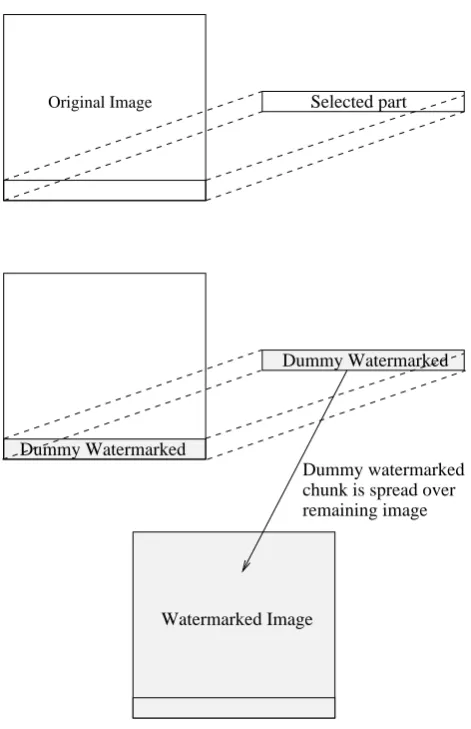
Figure 3 shows algorithm II for blind equalization, where a selected chunk of data is hidden (or superimposed) in the entire stream of data (Fig. 4 ). After transmission, this hid-den chunk of data is extracted from the received data. This extracted chunk can be used as a reference training sequence and the received chunk can be used as a received training se-quence. Thuse(n)can be calculated and NLMS algorithm can be used to update w(n). Hence received data can be equalized blindly.
For equalization Normalized LMS algorithm is used. This algorithm works as follows Haykin (1996):
182 M. K. Samee and J. G¨otze: Channel equalization using watermark as a training sequence
4
Samee: Channel Equalization Using Watermark as a Training Sequence
3.1
Implementation Problem
A very crucial problem arose while implementing proposed
scheme using digital watermarking. A part of an image is
selected, and later it is spread over the whole image
form-ing watermarked image. Obviously, watermarked image is
slightly different from the original image. When this
water-marked image is transmitted, channel can not be equalized.
Because, the extracted watermark is a part of the original
im-age and received part is from watermarked imim-age. Hence
both of them are different and the channel can not be
equal-ized using extracted watermark and received part of the
wa-termarked image.
One of the simplest solutions to this problem is to hide
the selected part in the remaining image (other than selected
part). However, this simple solution causes problems for
usual watermarking applications, like copyrights protection
etc., and for blind equalization. From general watermarking
applications point of view, it is not good to leave a reference
to the original image. Watermark should be spread over the
whole image. If reference to the original image is present in
the watermarked image, some denoising algorithm can detect
watermark as noise. So watermark can be removed easily.
Therefore, this scheme can not be used for usual
watermark-ing applications.
This problem is solved by watermarking selected portion
with some dummy bits first and then hide this dummy
water-marked selected portion into remaining image (Fig. 5). Now
this watermarked image has same level of noise over whole
image and has no reference to the original image. Therefore,
this watermarked image can simultaneously be used for blind
equalization as well as for usual watermarking applications.
Dummy Watermarked
Dummy Watermarked
Watermarked Image
chunk is spread over remaining image Dummy watermarked
Original Image Selected part
Fig. 5.
Forming a watermarked image, considering implementation
problem.
3.2
Possible Security Issue
As watermark is a part of the watermarked image, it can
be considered as a possible security issue. By using
pro-posed scheme, watermark can be any part of watermarked
image, which is very difficult to locate for an evedropper.
Furthermore, because of proposed implementation scheme
noise level (watermark intensity) is same over the whole
im-age. So it is difficult to distinguish between selected part,
watermark, and remaining watermarked image.
4
Experimental Results
In all the experiments 512
×
512 (8 bits/pixel, gray scale)
im-ages (Lena Fig. 6(a) and Milk drop Fig. 6(b)) are used. 512
bits long watermark is hidden in 3rd, 4th, 5th and 6th rows
of 8
×
8 blocks of DCT coefficients [Samee (2007)]. Two
spreading codes, each of length 512, are used to spread the
watermark bits. All the images are watermarked at 40dB
(here
α
= 0
.
01
). The quality of an image is measured in
terms of Peak Signal to Noise Ratio (PSNR).
P SN R
= 10
log
255
2
M SE
dB
(4)
Using MATLAB, these images are transmitted over four
different channels:
channel 1:
{
0.986, 0.845, 0.237, 0.123+0.310i
}
channel 2:
{
0.986, 0.845, 0.537, 0.323, 0.123
}
channel 3:
Frequency-flat (single path) Rayleigh
fading channel, sample time
1
×
10
−
5
and
maximum Doppler shift 0.09 Hz.
channel 4:
Frequency-flat (single path) Rician fading
channel, sample time
1
×
10
−
5
, maximum
Doppler shift 0.99 Hz and Rician factor
equal to 1.
(a) Lena image.
(b) Milk drop.
Fig. 6.
Original Lena and Milk drop images.
4.1
Algorithm I
First of all, training sequence is embedded in an image as
watermark. 512 bits long training sequence (watermark) is
Fig. 5. Forming a watermarked image, considering implementation
problem.
P aramet er: M=number of taps a =positive constant
˜
µ=adaption constant (step-size parameter) 0<µ <˜ 2
Initialization: if prior knowledge on the tap-weight vector ˆ
w(n) is available, use it to select an appropriate value for
ˆ
w(0). Otherwise, setwˆ(0)=0.
Data:
(a) Given: u(n):M-by-1 tap-input vector at time n d(n):desired response at time n
(b) To be computed: wˆ(n+1)=estimate of tap-weight vector at time n+1
Table 1. BER in extracted watermarks using algorithm I.
Received images Equalized images channels Lena Milk drop Lena Milk drop
% % % %
1 8.2 8.59 0 0
2 16.8 16.8 0 0
3 0.39 10.16 0 0
4 2.54 10.55 0 0
Comput at ion:n=0,1,2,... e(n)=d(n)−wˆH(n)u(n)
ˆ
w(n+1)=wˆ(n)+ µ˜
a+ ku(n)k2u(n)e
∗(n) (3)
Normalized LMS is a modified version of LMS algorithm. LMS algorithm also works fine in proposed blind equaliza-tion method. However simulaequaliza-tions have shown that Normal-ized LMS algorithm works slightly better than LMS algo-rithm. LMS algorithm experiences a gradient noise ampli-fication problem whenu(n)is large, because the correction applied to the tap-weight vectorwˆ(n) at iterationn+1 is directly proportional to the tap-input vectoru(n). In normal-ized LMS algorithm correction applied to tap-weight vector
ˆ
w(n)at iterationn+1 is normalized with respect to squared Euclidean norm of tap-input vectoru(n)at iterationn. That is why it is called “normalized” LMS.
3.1 Implementation problem
A very crucial problem arose while implementing proposed scheme using digital watermarking. A part of an image is selected, and later it is spread over the whole image form-ing watermarked image. Obviously, watermarked image is slightly different from the original image. When this water-marked image is transmitted, channel can not be equalized. Because, the extracted watermark is a part of the original im-age and received part is from watermarked imim-age. Hence both of them are different and the channel can not be equal-ized using extracted watermark and received part of the wa-termarked image.
One of the simplest solutions to this problem is to hide the selected part in the remaining image (other than selected part). However, this simple solution causes problems for usual watermarking applications, like copyrights protection etc. From general watermarking applications point of view, it is not good to leave a reference to the original image. Wa-termark should be spread over the whole image. If reference to the original image is present in the watermarked image, some denoising algorithm can detect watermark as noise. So watermark can be removed easily. Therefore, this scheme can not be used for usual watermarking applications.
M. K. Samee and J. G¨otze: Channel equalization using watermark as a training sequence 183
Table 2. Lena received and equalized using algorithm I.
PSNR Erroneous bits
channels Received Equalized Received Equalized
dB dB % %
1 29.0929 77.5595 8.94 0.01
2 28.9833 69.6869 12.2 0.09
3 22.0178 Infinite 33.58 0.00
4 13.8834 42.9292 9.29 0.00
Table 3. Milk drop received and equalized using algorithm I.
PSNR Erroneous bits
channels Received Equalized Received Equalized
dB dB % %
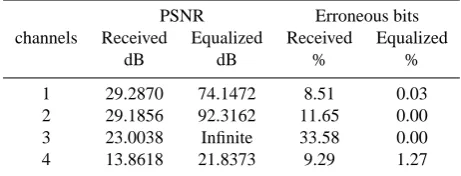
1 29.2870 74.1472 8.51 0.03
2 29.1856 92.3162 11.65 0.00
3 23.0038 Infinite 33.58 0.00
4 13.8618 21.8373 9.29 1.27
This problem is solved by watermarking selected portion with some dummy bits first and then hide this dummy water-marked selected portion into remaining image (Fig. 5). Now this watermarked image has same level of noise over whole image and has no reference to the original image. Therefore, this watermarked image can simultaneously be used for blind equalization as well as for usual watermarking applications.
3.2 Possible security issue
As watermark is a part of the watermarked image, it can be considered as a possible security issue. By using pro-posed scheme, watermark can be any part of watermarked image, which is very difficult to locate for an evedropper. Furthermore, because of proposed implementation scheme noise level (watermark intensity) is same over the whole im-age. So it is difficult to distinguish between selected part, watermark, and remaining watermarked image.
4 Experimental results
In all the experiments 512×512 (8 bits/pixel, gray scale) im-ages (Lena Fig. 6a and Milk drop Fig. 6b) are used. 512 bits long watermark is hidden in 3rd, 4th, 5th and 6th rows of 8×8 blocks of DCT coefficients (Samee, 2007). Two spread-ing codes, each of length 512, are used to spread the water-mark bits. All the images are waterwater-marked at 40 dB (here α=0.01). The quality of an image is measured in terms of Peak Signal to Noise Ratio (PSNR).
Table 4. BER in extracted watermarks using algorithm II.
Received images Equalized images channels Lena Milk drop Lena Milk drop
% % % %
1 4.76 8.93 0 0
2 6.75 10.52 0 0
3 0.2 4.37 0 0
4 24.40 17.26 0 0
Table 5. Lena received and equalized using algorithm II.
PSNR Erroneous bits
channels Received Equalized Received Equalized
dB dB % %
1 26.8461 87.1311 9.67 0.00
2 26.8677 86.5184 13.04 0.00
3 22.5406 102.3162 33.60 0.00
4 12.3285 88.8920 8.06 0.00
PSNR=10log255
2
MSE dB (4)
Using MATLAB, these images are transmitted over four different channels:
channel 1: {0.986, 0.845, 0.237, 0.123+0.310i}
channel 2: {0.986, 0.845, 0.537, 0.323, 0.123}
channel 3: Frequency-flat (single path) Rayleigh fading channel, sample time 1×10⁻⁵and maximum Doppler shift 0.09 Hz.
channel 4: Frequency-flat (single path) Rician fading channel, sample time 1×10⁻⁵, maximum
Doppler shift 0.99 Hz and Rician factor equal to 1.
4.1 Algorithm I
First of all, training sequence is embedded in an image as watermark. 512 bits long training sequence (watermark) is sent over the channel followed by the watermarked image. On the receiving side, watermark is extracted from the wa-termarked image. The extracted watermark has a few erro-neous bits (table 1) but the BER is good enough to use it as a reference training sequence. Normalized LMS with 8 weights, µ˜ =0.01 and wˆ(0)=0 are used. The calculated
weightsw(n)ˆ are used to equalize the received image. Re-ceived and corresponding equalized Lena images are shown in Fig. 7. Errors and PSNR values of received and equalized