computer-implementation as a
partial creativity
in a music performance system
Ren´e Mogensen
Birmingham Conservatoire/Birmingham City University, UK
Abstract. I analyse two specific cases of “improvising” music systems with the aim of developing some insights into what might constitute the “computational creativity” in each of these two implementations. First, I outline my working understandings of computational creativity and improvisation, giving a formal framework with which I subsequently examine my analyses of the two computer implementations: George E. Lewis’sVoyagerand my ownFavola. I complement the formal framework with soft systems analysis in order to map the role of the implementations in the concert performance situations. Through this approach I evaluate each of these implementations as apartial creativityin the context of the “human activity system” of the performance situation.
Keywords: machine improvisation, computational creativity, partial cre-ativity, analysis
1
Introduction
There is no definitive understanding of what “computational creativity” is, or might be, and so plenty of unanswered methodological questions appear when one attempts to evaluate the “creativity” of computational systems. For example: should computational creativity be compared to human creativity?1 Arguably, this kind of comparison may be a category mistake.2
The present research develops an approach for evaluation of two specific cases of “creative” computational music systems by invoking a formalist framework
1 This was a contentious topic in the recent CSMC16 conference. See some discussion of this in my conference review (Mogensen, 2017).
2
which is complemented by soft systems analysis of the performance context. This framework does not necessitate comparison between human and computational creativity and it does allow for human and computational systems to be co-creative in improvised music performances.
I first outline a working understanding of computational creativity, with which I subsequently analyse two implementations: 1. George E. Lewis’s Voy-ager from 1987 and 2. my “improvising computer accompanist” entitled Favola
from 2015. With this approach I attempt to evaluate the “creativity” of these in the context of the “human activity system”3of the performance situation. From these analyses I develop the idea of a partial creativity; by this term I mean that any creativity in the computational implementation is emergent through its position in a human activity system. In other words, the implementation is necessary, but not sufficient for the creative output of the music performance situation and the performance situation is necessary for the emergence of the partial creativity of the implementation.
I have previously described my implementation of “an experimental impro-vising computer accompanist, which I namedFavolaand which is based on a cre-ative transformation of my analytical view of George E. Lewis’sVoyager(1987) system” (Mogensen, 2016a, p. 1).4In the previous work I attempted “to invoke a semiotic basis for evaluation of the resulting music” (Mogensen, 2016a, p. 2). In the present article I re-examine the analysis of Lewis’s Voyager (Mogensen, 2016a, pp. 2–4), in section 4. In section 5 I expand the analytical view of his work with soft systems analysis, placing Voyager in the “human activity system” of the performance situation. Previously, I argued that the “question of evaluating
Favola as a convincing part of the human activity system, in terms of how it contributes to the musical experience, becomes a question of how convincingly it fulfills the roles of Rowe’s player- and instrumental paradigms” (Mogensen, 2016a, p. 8).5 However, in section 5, given my working understanding of “cre-ativity”, I return to the analytical perspective that Favola is part of a human activity system, in an attempt to argue for a partial creativity in the music performance situation particular to this work.
3
“Human activity system” is an expression borrowed from soft systems analysis as used by Wilson (2001, pp. 9–10).
4
I made a speculative high-level mapping of components and functionalities in George E. Lewis’sVoyageraccording to published information about the work (Lewis, 2000). Transformations of this analysis resulted in an algorithm that I could implement in an interactive improvising computer accompanist, which I callFavola (Mogensen, 2016a).
5
RegardingVoyager, Lewis argued for the concept of “an automatic composing program that generates complex responses to the musician’s playing” (2016), and I take this to be animprovising computational system.Favola is specifically constructed to improvise pitch structures using additive synthesis, and so I argue that its potential creativity would also be considered as improvisation albeit with a limited palette of sounds. As an accompanistFavolais intended to function as a co-improviser, and this may be examined asco-creativity (Kantosalo & Toivonen, 2016) which resonates with the soft systems analysis approach; this allows a view of the entire performance system as being “creative”, as is discussed in section 6. In section 7, given the idea of co-creativity, I return to the semiotic and musicological approaches from the previous analysis (Mogensen, 2016a, pp. 6–8) and briefly examine the intertextual situation of Favola in light of the idea of
partial creativity in a machine improviser.
2
A working understanding of “computational creativity”
To outline a working understanding of “computational creativity” for the present context, I adapt and modify Geraint A. Wiggins’s (2006)“preliminary framework for description, analysis and comparison of creative systems” (p. 449). The idea of “creativity” was formalised by Wiggins as explorations in, and transforma-tions of, “conceptual spaces”. Wiggins formalised his interpretation of the ideas of Margaret Boden (2004) who proposed that “conceptual spaces are structured styles of thought” (p.4). To support the analyses of Voyager and Favola an overview of the relevant parts of Wiggins’s formalisation is proposed in Z-style schema notation6: I summarise Wiggins’s (2006) Axioms (pp. 451–452) in Fig-ure 1 and his approach to determining ‘creative output’ (pp. 452–453) in FigFig-ure 2. In Wiggins’s formalism “creativity” is seen as searches in a conceptual space (C), which is a subset of the universe of possible concepts (U).7Wiggins (2006) described two levels of creativity within his formal system as: 1. “exploratory creativity” and 2. “transformational creativity” (pp. 453–454). Given this frame-work I will examine the implementations ofVoyager andFavola with emphasis on “exploratory creativity”.
6 Briefly, the Z schema notation includes a declarations part above the central hori-zontal line and predicates below the horihori-zontal line. In Figure 1 the declarations are interpreted as follows: C is a concept space of type Σ in the universe of possible conceptsU.C is a concept type andc1,c2 are instances ofC and>is the empty concept, all of which may be within a concept spaceC. “The central horizontal line can be read ‘such that’.” The axiomatic predicates (below the line in Figure 1) “ap-pearing on separate lines are assumed to be conjoined together, that is to say, linked with the truth-functional connective∧” (Diller, 1990, 6). “The Z language is both a formal language and a specification language” (Diller, 1990, 3). I am not provid-ing complete Z specifications here, but have found the notation style convenient for presenting the argument in this article.
U :Possible concepts
Σ:Concept space type C :Concept type
C :Instance of Σ >:Empty concept c1,c2 :Instances of C
> ∈U
∀c1,c2∈U|c16=c2 ∀C|C ⊆U
∀C|> ∈C
Figure 1– My summary of Wiggins’s four Axioms.
Wiggins proposed an approach to evaluating concepts, discovered through the searches, which is summarised in Figure 2: aLanguage (L) gives the basis for a Search strategy (T) and Constraints (R) on the conceptual space (C), along with Evaluation criteria (E), that are related to form part of the input to a decision function which consists of aninterpreter hh., ., .iiand anevaluator
[[.]]. To this model I have addedMotivated activity (M) as a “motor” to drive the generation of output over time (t). I am using this model in the special case of musical improvisation and so the conceptual space, or “structured style of thought” in Boden’s words, does not necessarily consist of abstract concepts. Rather, I argue, the search space consists of sounds, which might be concep-tualised, but which are physical phenomena. Sounds by necessity have a time dimension, and therefore some driver through time is necessary, for the search and evaluation function to be applicable in this special case of creative systems. I will outline a working understanding of “improvisation” in section 3.
3
A working understanding of “improvisation” as
creativity
Lewis (2000) argued that his Voyager system “is a nonhierarchical, interactive musical environment that privileges improvisation” (p. 33). I argue that as an expert improviser, Lewis has encoded his own analytical view of improvisation in the software forVoyager. Furthermore, any “creativity” which may be emer-gent inFavola, during the performance context, is specifically expressed through “improvisation” and so a working understanding of improvisation for the present discussion will help to ground the argumentation.
Creative Output
L :Language
R:Constraints on concept space
T :Search strategy
E :Value definition
M :Motivated activity t:Time
hh., ., .ii:Wiggins0s interpreter function
[[.]] :Wiggins0s evaluator function
R,T,E ∈L [[E]]
hhR,T,EiiM(t)
Figure 2 – My adaptation of Wiggins’s “[e]valuating members of the conceptual space”.
1). These concepts of “improvisation” both resonate very well with the working understanding of computational creativity from section 2: Wiggins’s expression ofexplorations of conceptual spaces seems analogous to Smith’s and Dean’s “ex-plorative process”, and Berkowitz’s “restraints” can be exemplified by Wiggins’s constraints (R) on concept spaces.
Smith and Dean (1997) furthermore proposed that “[i]n its purest form an improvisation involves the simultaneous conception and performance of a work of art” (p.26). They sought “to connect the process of creativity in improvisation with the work created and its reception: and to emphasise exactly the process-product interchanges” (p. 29).
I argue that, as members of a concept family8of improvisational “creativity”, the computer systems in Voyager and Favola are co-creative with human per-formers; the co-creativity is dependent on the creativity of the human performers, but the music resulting from the system is emergent from the co-creativity of the hybrid human-computer situation; the activities of the human performers on their own would be insufficient to generate the same results.
4
Speculative analysis of Lewis’s
Voyager
system
Based on recordings9 and Lewis’s published description I made a speculative analysis of the software functionality in Voyager (Mogensen, 2016a), which is
8 Different parts of what we call “creativity” may “share what Wittgenstein called ‘family resemblances’ ” and so the concept family name “creativity” can be un-derstood “as a family name for a series of capacities that have some overlapping similarities as well as some significant differences” (Cunningham, 2000, p. 67). 9 A series of recordings are available on the internet, in which Lewis (trombone) and/or
summarised with minor adaptations in Figures 3 and 4. The analysis of Voy-ager is understood as follows10: I represent Lewis’s 64 “players” asA[1..64] and the system assigns these players into Lewis’s “behavioural groups” which I call
B[1..n]. I indicate n behavioural groups since Lewis does not state how many there are. The assignments of players A[1..64] into behavioural groupsB[1..n] are made dynamically by the software, recalculated at time t every 5 to 7 sec-onds, according to a parameter derived from analysis of pitch input (from the musician), and this parameter (at timet) is represented asM(t).11 As a result, any one particular groupB(s,t), where 16s6n at timet, may be calculated as the set of functionsfs with inputs from the playersA(p,t) and pitch analysis
M(t) at time t. Lewis (2000) mentioned that the system chooses among “15 melody algorithms”, “150 microtonally specified pitchsets”, and a number of MIDI parameter ranges, and assigns these choices to the “behavioural groups” (p. 35). I represent these choices asK(t),P(t) andL(t).
Voyager Behaviour Group A:Voyager player K:Melody algorithm P :Pitch set
L:Parameter ranges M :Analysis musician input R:Random generator
f :Lewis0s assignment function t:Clock time
B(t) =S64
p=1f
Ap(t),C(t),K(t),P(t),L(t),Rp(t),B(t−1)
Figure 3– My summary of aVoyager Behaviour Group.
It seems likely that some randomising parameter, perhaps with individual weightings for each player, would occur inVoyager, and so I represent this ran-dom element R(p,t) for each player A(p) which might be applied within any or all fs functions, with recalculations at each timet. It also seems likely that Lewis’s algorithm will take into account what has just been played, in order to determine what the next activity is to be for the electronic part, and so finally I
10With a few minor modifications, this analysis is equivalent to the one I have pre-viously described (Mogensen, 2016a), but here I use schema notation since this fa-cilitates a concise exposition of the relation to the formal model of computational creativity from section 2.
Voyager Orchestra
B:Voyager Behaviour Group O:Sound(MIDI)output t:Clock time
n:Number of Behaviour Groups O=Sn
s=1
Bs(t)
Figure 4– My summary ofVoyager’s Orchestra.
includeB(s,t−1) as an additional input intofs. This analysis gives the schema in Figure 3 for each individual Behaviour Group s at timet, and the resulting “improvised action” to be implemented by the Electronic Orchestra at time t
is then represented by the set of the behavioural groups as shown in Figure 4, which is recalculated every 5 to 7 seconds.
If we interpretVoyager as a kind of exploratory search engine in a musical space then it will make sense to relate my interpretation of theVoyager system to the formalisation in Figure 2. This relation is summarised in Figure 5 with four explanatory details as follows:
1. The language (L) is the Forth Music Language (FORMULA), which Lewis (2000) used to code theVoyager system (p. 35).
2. The constraints on the concept space (R) are defined by: MIDI instru-ments (EMU Proteus/2),K,P,L.
3. The search strategy (T) is contained in: (f,R,A)
4. The value definition (E) is summarised by Lewis’s statement thatVoyager
“is a nonhierarchical, interactive musical environment that privileges improvi-sation”(NHIE). While this expression is in English, which is not part ofL, I presume that Lewis has encoded his stated priorities into theVoyager system.
The analysis of the musician’s playing could arguably enter intoE as well, since reactions by the musician to sounds output by the computer, can be in-terpreted as musical “valuation” of that computer output; Lewis’s approach to interpretation of the musician’s musical actions is encoded in the Voyager sys-tem. Wiggins’s exploratory function can then be expressed in more detail12 for the specific case of Voyager as shown in Figure 6.
The creation of Voyager by Lewis could be considered to be an example of “transformational creativity” since the expression, or “structured style of thought”, which Voyager encodes was new at the time (1987) and could be said to have transformed theC of improvising computer-implementations at the time. However, it would seem that the improvisational output of Voyager is exploratory within the conceptual space created by Lewis in this system. Alter-natively, was the first performance withVoyager transformational, since it was a new style of improvisation?
12
Voyager Creative Output
L :Language=Forth Music Language code
R:Constraints on concept space= (MIDI instruments,K,P,L) T :Search strategy= (f,R,A)
E :Value definition=nonhierarchical improvisation environment(NHIE) M :Motivated activity = (A,M)
t:Time
hh., ., .ii:Wiggins0s interpreter function
[[.]] :Wiggins0s evaluator function
R,T,E ∈L [[E]]
hhR,T,EiiM(t)
Figure 5– Putting myVoyageranalysis into the schemaCreative Output (Figure 2).
Voyager Creative Output = [[NHIE]]
hh(MIDI instruments,K,P,L),(f,R,A),(NHIE)iiA,M(t)
Figure 6– Putting myVoyageranalysis into the creative output function from Figure 2.
Arguably, each performance by Voyager is new, in the sense that it never repeats itself precisely. But is each performance “valued” as a creative perfor-mance, where Voyager fulfils Boden’s (2004) definition of creativity, and has “the ability to come up with ideas or artefacts that are new, surprising and valuable” (p. 1)? Boden (2004) furthermore argues for a graduated scale of “how creative” something is and for asking in “just which ways” is something cre-ative (p. 2)? However, I argue that within the present working understanding of improvisation as creativity, the partial creativities examined here are not more or less creative, instead they form necessary parts of a human activity system, where the system as a whole has emergent creativity. With this view the imple-mentations are creative in “the ways” in which they function in the performance system.
If we accept improvisation as being creative, at least potentially, then in the general case this will tend towards what Gilbert Ryle (1976) argued13:
What comes to pass on one occasion has, with all its concomitants, origins, and details, never taken place before and will never take place again. It may be and usually is completely unremarkable; as unsurpris-ing when it happens as it had been unanticipated before it happened. The world and what occurs in it are, with a few exceptions, neither like chaos nor yet like clockwork... It follows that the things that we say and
do in trying to exploit, avoid or remedy that small minority of the par-ticular partly chance concatenations that happen to concern us cannot be completely pre-arranged. To a partly novel situation the response is necessarily partly novel, else it is not a response. (p. 73)
So Ryle can be interpreted as arguing that all human activity is improvised and all improvisation isnew. Perhaps Boden’s “value” of thenew, in the special case of music, is socially determined and so is entangled with the human activity system which can be named “culture”. At the scale of “culture”, creativity can then be modelled as nodes in the cultural inter-text.14 I return to this idea in section 7.
5
Soft systems analysis of Lewis’s
Voyager
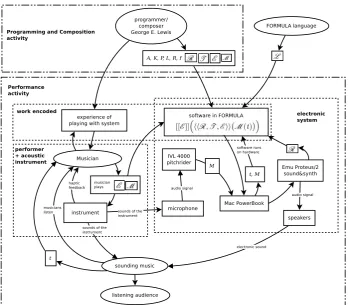
I interpreted the performance of Voyager as a “human activity system” and I adapted the method ofSoft Systems Analysisas discussed by Checkland (1981), Flood and Carson (1993) and Wilson (2001).15 Soft systems analysis is an ap-proach that calls for diagrammatic visual mapping of the elements and the con-nections between elements of a system.16Flood and Carson (1993) distinguished between “structural” and “behavioural” modelling approaches to system iden-tification (p. 71). When applying Flood’s and Carson’s view to the music per-formance situation, a basic premise would be that there exists a collection of physical and conceptual elements necessary for a performance of a musical work to exist, which we can identify following a structural modelling approach. This necessary collection of elements will vary from work to work, according to in-struments and equipment needed, musicians and technicians required, and the physical media which carry the information about the composition.
Soft systems diagrams show the “objects” and the routes which “influences” can take between these objects (Flood & Carson, 1993). I applied this concept in my soft system diagram of the performance situation of Lewis’s Voyager as shown in Figure 7, based on published information from Lewis.17 In this dia-gram physical and conceptual “objects” are named within rectangles, persons
14See Allen (2011) for a discussion of the concept of the cultural “inter-text”. 15
Other examples of soft systems analysis of the performance situation of music works include an article by Mogensen, Deletaille, and Roudier (2014) and parts of my dissertation (Mogensen, 2016b).
16Soft systems analysis has mainly been developed for applications in economics, busi-ness studies and other social system modelling. Some adaptations of the method are necessary: the CATWOE test of “Root Definitions” (Wilson, 2001, pp. 24-28) had to be redefined for the current research in music performance systems. These systems have sets of purposes and structures that differ from those of most business or sociological systems models. In a larger cultural context, the CATWOE test may be applicable to modelling music works, but the current research is at a low-level “resolution” where the involved processes of the system are taken to be essentially self-contained, and the basic purpose of the system is taken as a given: to realise an improvisation in a performance space.
17
within ovals and arrows indicate what I interpret to be directions of “influences” between these objects, all within the performance situation of the work.
I place the components from Figure 5 in the soft system diagram and use this to illustrate an interpretation of the “partial creativity” aspect ofVoyager. I argue that both E and M are at least partially determined by the musician performance through the transmission ofM; in effect the musician activity both motivates and restricts the computational search by his improvised choices: this is indicated in Figure 7 as the arrow from the “performer” segment to the “work encoded” segment. I argue that a similar contribution of motivations and re-strictions might be transmitted from the output of the computer system to the improvised activities of the musician, via the musician listening to and being sen-sitive to the sounding music in the performance space; in short, such exchange is “interaction” between the musician and computer system in the musical context. This idea of interaction between musician and computer system is analogous to interaction between two musicians in a group performance: using examples from jazz music and improvised theater, R. Keith Sawyer (2006) argued that “the key characteristics of group creativity are improvisation, collaboration, and emergence” (p. 153). Sawyer (2006) used the term “group flow” to indicate an “emergent property of the [performing] group... [which] can inspire musicians to play things that they would not have been able to play alone, or that they would not have thought of without the inspiration of the group” (p. 158). Group flow “depends on interaction among performers and it emerges from this process” (p. 159). In the context ofVoyagerI speculate that there is the possibility of “group flow” between the musician and the computer system and hence the possibility of human-computer “group creativity”.
6
Favola
: a partial creativity in a co-creative context
As I have discussed previously (Mogensen, 2016a, pp. 4–5) I used a creative transformation of my analysis of Voyager as a basis for the new improvising computer accompanistFavola.18 The details of my creative transformation are not essential for the present line of argument, instead I summarise my Favola
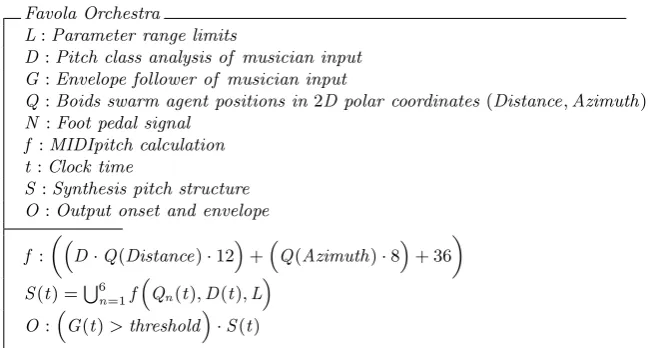
algorithm in Figure 9: briefly, I used a six agentboids flocking algorithm19that motivate pitch and spatialisation of six note-structures played via additive syn-thesis. The analyses of the pitch classes played by the musician are also used as input to transform the synthesis parameters.
In a similar way to the analysis of Voyager, in section 4, I can interpret
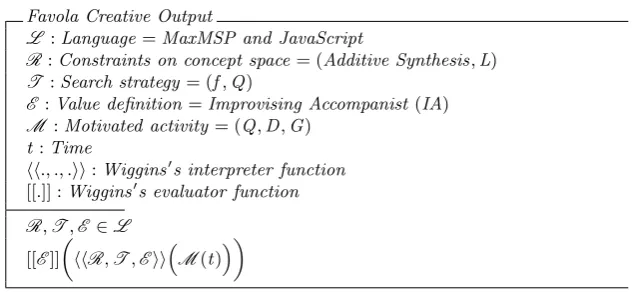
Favola as an exploratory search engine in a musical space and as such it will be useful to place the components of the system into the formal model from section 2. Figure 8 relates my interpretation of the Favola system to the formalisation from Figure 2, with four explanatory details as follows:
18I have revised the expression of my analysis here to accommodate the schema nota-tion and the line of argument of the present article.
1. Constraints on concept space (R) are defined by: (Additive Synthesis,L) 2. Search strategy (T) is contained in: (f,Q)
3. Value definition (E) is summarised by:Improvising Accompanist (IA)
4. The Favola Creative Output can then be expressed for Favola as shown in Figure 10.
Favola Creative Output
L :Language=MaxMSP and JavaScript
R:Constraints on concept space= (Additive Synthesis,L) T :Search strategy= (f,Q)
E :Value definition=Improvising Accompanist (IA) M :Motivated activity = (Q,D,G)
t:Time
hh., ., .ii:Wiggins0s interpreter function
[[.]] :Wiggins0s evaluator function
R,T,E ∈L [[E]]
hhR,T,EiiM(t)
Figure 8– Putting myFavola analysis into the schemaCreative Output from Figure 2.
Previously (e.g., Mogensen, 2016a), I argued that “the proposition thatFavola
has the role of computeraccompanist implies that the improvisational language of the human performer is defining for the overall character of the improvised music in a specific performance”. So, “[i]n other words, the evaluation ofFavola’s output is only possible in the context of specific performances that includes hu-man improvisers” (Mogensen, 2016a, pp. 7–8). Within the interactive system, as mapped in the soft systems analysis in Figure 11, “Favola has a dual aspect: firstly, as a ‘player’ producing, in musical terms, an independent voice in the musical performance which can be called ‘accompaniment’ to the human im-proviser; secondly, as an ‘extension’ of the human instrumental performance”20 (Mogensen, 2016a, pp. 7–8). This supports the argument that Favola is not “creative” in the human sense, but can be understood as a partial creativity
which functions within a co-creative role in conjunction with a musician in the performance system.
The output of theVoyager Orchestra(Figure 4) tends to sound substantially more complex in rhythmic and orchestrational terms than the output of the
Favola Orchestra (Figure 9). Lewis maintained that Voyager would generate output even without human performer input and so could function as a solo
20
Favola Orchestra
L:Parameter range limits
D :Pitch class analysis of musician input G:Envelope follower of musician input
Q:Boids swarm agent positions in 2D polar coordinates(Distance,Azimuth)
N :Foot pedal signal f :MIDIpitch calculation t:Clock time
S:Synthesis pitch structure O:Output onset and envelope f :
D·Q(Distance)·12+Q(Azimuth)·8+ 36
S(t) =S6
n=1f
Qn(t),D(t),L
O:G(t)>threshold·S(t)
Figure 9– My summary of theFavolasystem.
Favola Creative Output = [[IA]]
hh(Additive Synthesis,L),(f,Q),(IA)iiQ(t),D(t),G(t)
improviser, and this might also be a result of the greater potential complexity of its output. While complexity is not necessarily an indicator of creativity, one might ask whether the higher level of complexity might imply thatVoyager is a more complete creativity than thepartial creativity ofFavola?
However, to try to quantify something as more or less creative in this context may be a mistake. The termpartial, as I use it in this relation, refers to the aspect that the computational creativity is insufficient by itself for the creative output to emerge; so the computational creativity is dependent on being active within the human activity system in order for the system creativity to emerge. To evaluate whether the solo output of Voyager can qualify it as a (non-partial) creativity will demand further analysis of specific instances of the generated music, which is beyond the present scope.
7
Conclusion
Peter G¨ardanfors (2000) proposed geometric representation of “conceptual spaces” as complementary to the symbolic and associationist methodologies that “attack cognitive problems on different levels”21 (p. 1). This implies the possibility of
partial creativityin computational systems. It may be that there is no single pro-cess that can represent “creativity”, whether in humans or elsewhere. Instead “creativity” may be an example of one of Wittgenstein’s concept families, and thus cover “a series of capacities that have some overlapping similarities as well as some significant differences” (Cunningham, 2000, p. 67).
It should be pointed out that my addition of M : Motivated activity to Wiggins’s formal framework is significant, at least in the special case of a machine improviser. Wiggins’s model does not seem to make explicit what will motivate explorative creativity: why would the system enter input into theinterpreter and
evaluation functions ofCreative Output (from Figure 2) without any motivation to do so? The implicit reason is that the human programmer has told the system to do so, in effect the motivation exists as imperatives built into the system. I hypothesise that other possible approaches to “motivation” may support other “computational creativities” and this is a topic that demands further work. In the cases of Voyager and Favola part of the motivation M comes from the imperatives of the programming and part from the musical improvisations of the performing musicians as discussed in sections 5 and 6.
As mentioned in footnote no. 2, self-generated motivation may indicate a category difference between human creativity and computational creativity. If there is such a category difference then, in the case of the partial creativity within a human activity system, it may be that the self-generated motivation
necessarilyresides in the human performers, and cannot sufficiently reside within the computational system (the computer-implementation). On the other hand, motivation may be a purely human function, which may not be necessary for computational creativity, and by introducing it into the model of computational
21
creativity I may be entangling two different types of “creativities”: more work is needed to resolve this.
My use ofpartial creativity indicates a computational “creativity” that may, or may not, emerge within a human activity system. The system as a whole may have emergent creativity, but this creativity indicates a family of necessary ca-pacities which, however, are individually insufficient for emergence: in the special case of improvised music, creativity may emerge as “group flow” which is depen-dent on individual activities of group participants, whether these participants are musicians or computer-implementations such asVoyager or Favola.
The algorithm of Favola is examined as a model which simulates creative musical accompaniment and there is no implication of any presence of human-like cognitive process inFavola. WithFavolaI have encoded a limited analytical view of improvised accompaniment, as a transformation of Lewis’s encoding of improvisation in Voyager. I argued that “[t]he effectiveness of the improvising computer accompanist is largely dependent on the character of the music impro-vised by the human performer”. (Mogensen, 2016a, p. 8) However, with some analysis of test performances I also found that “the algorithm derived from my transformed analysis of Lewis’sVoyager can have an engaging musical effect in an improvisation context”. (Mogensen, 2016a, p. 8)
As a necessary part of a system that performs engaging music,Favola, along with it’s performance context, can be understood as an intertextual node in the network of a larger cultural inter-text.22 This node is then informed by my encoding of the generative structure in Figure 9. Furthermore, it is informed by Lewis’sVoyager, through my transformation of analysis (from Figures 3 and 4) which gives the basis for the implementation ofFavola.
If one expands the human activity system view to a cultural scale, where musical culture is an intertextual network, one might argue that a performance which includes Favola, as a node in that network, is a partial creativity in the ongoing “creative” morphology of the inter-text. This view would take creativity and partial creativity as emergent properties at the societal-cultural level, rather than at the level of an individual computational agent or human being. Given this view, I speculate that Boden’s “historical creativity” (“H-creativity”) may best be understood at the societal level as something emergent from the inter-textual network. Boden’s “psychological creativity” (“P-creativity”) may then be considered as partial creativities at the societal level.23 But such scaling of the ‘partial creativity’ idea will have consequences that are beyond the scope of the present article, so it will remain a subject for future work.
22
See Allen (2011) for discussion of “intertextuality” and “inter-text”.
References
Allen, G. (2011). Intertextuality (2nd ed.). Abingdon: Routledge.
Berkowitz, A. L. (2010). The improvising mind. New York, NY: Oxford Uni-versity Press.
Boden, M. A. (2004). Creative mind. http://www.mylibrary.com?ID=2664: Routledge.
Checkland, P. B. (1981). Systems thinking, systems practice. Chichester: John Wiley and Sons.
Cunningham, S. (2000). What is a mind? an integrative introduction to the philosophy of mind. Indianapolis, IN: Hackett Publishing Company, Inc. Diller, A. (1990). Z, an introduction to formal methods. Chichester: John Wiley
and Sons Ltd.
Flood, R. L., & Carson, E. R. (1993). Dealing with complexity (2nd ed.). New York, NY: Plenum Press.
G¨ardenfors, P. (2000). Conceptual spaces, the geometry of thought. Cambridge, MA: MIT Press.
Kantosalo, A., & Toivonen, H. (2016). Modes for creative human-computer collaboration: Alternating and task-divided co-creativity. InProceedings of the seventh international conference on computational creativity (pp. 77–84). Paris: Sony CSL.
Lewis, G. E. (2000). Too many notes: Computers, complexity and culture in ‘Voyager’. Leonardo Music Journal,10, 33-39.
Lewis, G. E. (2016). Sound. Retrieved March 11, 2016, fromhttp://www.ubu .com/sound/lewis.html
Mogensen, R. (2016a, June). Swarm algorithm as an impro-vising accompanist: an experiment in using transformed analysis of George E. Lewis’s ‘Voyager’. In Proceedings of CSMC16.
https://csmc2016.wordpress.com/proceedings/.
Mogensen, R. (2016b). Typology of relations between acoustic instruments and electronics in concert music: an analysis- and composition-based ap-proach(PhD diss.). Birmingham Conservatoire/Birmingham City Univer-sity, Birmingham.
Mogensen, R. (2017, March). Review of CSMC16: What is computational ‘cre-ativity’ and how can it be evaluated in the context of music? Journal of Creative Music Systems,1(2), http://dx.doi.org/10.5920/JCMS.2017.07. Mogensen, R., Deletaille, N., & Roudier, A. (2014, November). The arpeggione
and fortepiano of the 1820s in the context of current computer music.Early Music,XLII(4), 545-554.
Reynolds, C. W. (1987). Flocks, herds, and schools: A distributed behav-ioral model. In M. C. Stone (Ed.),Siggraph ’87 proceedings (Vol. Com-puter Graphics 21(4), p. 25-34). (accessed Oct. 23, 2011): available online: http://www.red3d.com/cwr/boids/.
Sawyer, R. K. (2006). Group creativity: musical performance and collaboration.
Psychology of Music,34(2), 148–165.
Smith, H., & Dean, R. T. (1997). Improvisation hypermedia and the arts since 1945. Amsterdam: Harwood Academic Publishers.
Wiggins, G. A. (2006). A preliminary framework for description, analysis and comparison of creative systems. Knowledge-Based Systems, 19(7), 449– 458.
![Figure 2 – My adaptation of Wiggins’s “[e]valuating members of the conceptualspace”.](https://thumb-us.123doks.com/thumbv2/123dok_us/524972.2052315/5.595.149.479.122.268/figure-adaptation-wiggins-s-e-valuating-members-conceptualspace.webp)