A Game Theoretic Framework
for Congestion Control in Named
Data Networking
ITC 4/46
Journal of Information Technology and Control
Vol. 46 / No. 4 / 2017 pp. 605-618
DOI 10.5755/j01.itc.46.4.15680 © Kaunas University of Technology
A Game Theoretic Framework for Congestion Control in Named Data Networking
Received 2016/07/13 Accepted after revision 2017/11/14
http://dx.doi.org/10.5755/j01.itc.46.4.15680
Corresponding author: [email protected]
Jinfa Yao, Baoqun Yin, Xiaobin Tan, Yizhao Bao
University of Science and Technology of China, Department of Automation, 230027, Hefei, China e-mail: [email protected]
As an essential building block of the Named Data Networking (NDN) architecture, congestion mechanism has been the focus of much attention. The unique features of NDN architecture bring forward distinct requirements for congestion control from its Internet Protocol (IP) counterpart. In this paper, we present a game theoretic framework for flow rate control in NDN based on the concept of Nash bargaining solution from cooperative game theory, and propose a distributed flow-aware hop-by-hop congestion control mechanism on a solid analytical basis. In addition, we developed a possible implementation in the ndnSIM simulator and performed extensive simulations and performance evaluations to study the behavior of our scheme. We have seen that the proposed congestion control mechanism performs as designed, and significantly enhances the network performance.
KEYWORDS: cooperative game theory, congestion control, Nash bargaining, named data networking.
1. Introduction
The growing cumbersome architecture of current Internet and its inefficiency in terms of adapting to current network usage patterns push the research communities to quest for a more elegant design for the future Internet. Recently, Named Data Network-ing (NDN) [23] has been proposed as a clean-slate networking paradigm, which aims to directly address the challenges that arise from the incompatibility
between communication models by shifting the In-ternet away from a host-centric paradigm to a more content-centric one, where data is uniquely identified by a name for addressing and caching.
distinguish NDN from current Internet Protocol (IP) networks is that NDN networks are able to self-regu-late traffic flows without relying on transport proto-cols. As suggested by NDN project group, the trans-port layer in traditional IP networks is removed out of the NDN architecture. Instead, NDN adopts adap-tive forwarding [21] as the naadap-tive transmission con-trol mechanism. Besides, content delivery in NDN is performed in a pull-based fashion. To receive data, the requester needs to send out the Interest packets to trigger the corresponding data packets delivery on the reverse path followed by the requests. Due to the strict one-to-one relationship between Interest pack-et and data packpack-et, flow balance is inherently held hop by hop in NDN networks. However, this property only enforces the basic transmission principle and is far from perfect.
Without a doubt, congestion is a fundamental issue for any data delivery networks and has been widely studied within the context of IP networks in the past decades. However, for content-oriented architectures where in-network caching and multipath forwarding are pervasive, as in the case of NDN, the existing con-gestion control mechanisms cannot be directly suit-able for the following reasons. Firstly, in contrast with the push-based communication model of TCP/IP, NDN architecture advocates the pull-based paradigm where communication is driven by user requests. The inherent flow balance mechanism allows one to prevent the congestion caused by data packets in the downstream direction through pacing the Interest packet transmission rate at the requester side. Hence, it is convinced that the receiver-based congestion control mechanism is a better choice for NDN than the provider-driven one. Secondly, due to scalabil-ity and deployabilscalabil-ity, end-to-end schemes received more attention than hop-by-hop mechanisms in the context of host- and connection-based networks. However, NDN’s location-independent, name-based routing protocol and its characteristic of extensive content multi-homing make it difficult to identify the Interest packets belonging to a specific source-des-tination pair. In addition, the extensive computation and onerous per-flow state management required for implementing flow-aware mechanisms is considered to be too costly for today’s routers. However, the state-ful forwarding plane in NDN routers makes per-In-terest forwarding state available at each hop, which
provides native support for flow-based control. Final-ly, as content delivery in NDN operates at the level of data chunks, each content item is segmented into a sequence of data chunks. Then according to the one-to-one principle, i.e., each Interest packet requests a particular data chunk, multiple Interest packets need to be transmitted in order to request large-sized con-tents, which may lead to uplink congestion as well. Therefore, it is inappropriate to neglect the fraction of traffic caused by Interest packets especially in the case of bidirectional flows. From the discussions above, it is clear that hop-by-hop flow-aware Inter-est packet rate control mechanisms are natural can-didates for congestion control in NDN architecture when we seek to realize the optimal data delivery performance. Note that, in this paper, we use the ter-minology “flow” to represent the stream of Interest packets and data packets that share the same object name regardless of the corresponding receivers and repositories. The granularity of the flow, however, de-pends on the length of the name prefix.
Although there is now a rapidly growing literature in the context of NDN, the problem of congestion con-trol in NDN still remains open. In this paper, we fo-cus on developing a practical algorithm that allows a NDN router to dynamically adapt the transmission rate of Interest packets to the available network re-sources, with the objectives of proportionally fair resource allocation among the concurrent flows and low degree of implementation complexity. To achieve these goals, we formulate a game theory-based opti-mization framework for the congestion control prob-lem in NDN environment with the constraints im-posed on both Interests and data traffic in both uplink and downlink directions. The rationale for consider-ing the interdependence between Interests and con-tents is that both Interests and concon-tents contribute to congestion [2, 20]. By decomposing the Lagrange function of the primal problem, we get the explicit ex-pression of the dual problem. Then using the gradient projection method, the optimal solution of the dual problem is approached and a distributed, hop-by-hop, flow-aware congestion control algorithm is proposed, which has been shown to be efficient under a variety of network scenarios through simulations.
NDN. In Section 3 we first present the necessary notations and assumptions, and then construct our optimization problem for fair flow rate allocation. Furthermore, we show that the optimal solution can be drawn in a distributed manner. In Section 4 we discuss a possible implementation of the proposed mechanism and some crucial issues of other related system functions. The balance of the paper includes preliminary simulations of the proposed mechanism in Section 5, and concluding remarks in Section 6.
2. Related Work
In recent years, much research effort has been put into the NDN area. A fair amount of NDN congestion control schemes have been put forward in the liter-ature. According to the role responsible for reacting to network congestion, these schemes can be broadly classified into three categories: receiver-based mech-anism, hop-by-hop control mechanism and the inte-gration of both. Readers are referred to [17] for a sur-vey of these approaches.
As aforementioned, in the context of NDN, or more generally of a pull-based network, receiver-based mechanisms are obviously more appropriate than their sender-driven counterparts in terms of traffic control. In [5], the authors design a receiver-driven Interest Control Protocol(ICP), which regulates the Interest expression rate at the receivers in a TCP-like win-dow-based Additive Increase Multiplicative Decrease (AIMD) fashion. The RAAQM scheme described in [6] is an extended version of ICP, which enables mul-tipath control by using a per-route mechanism to es-tablish distinct congestion windows for controlling the Interest rate of each flow. The CCTCP [19] is also a receiver-driven timeout-based mechanism, but the receiver uses a special mechanism, “Anticipated In-terests”, to predict the location of content on the path and maintains a separate retransmission time out for each anticipated source. Different from above implicit congestion control methods, Explicit Control Proto-col (ECP) [18] adopts an explicit congestion detection and notification method, where receivers adjust their Interest sending rate according to the explicit conges-tion informaconges-tion detected and fed back by the routers. The limitation of receiver-based congestion control mechanisms lies in two aspects: time lag of endpoints loss detection and hardness of handling traffic burst
correctly. As an alternative or in conjunction with re-ceiver-driven mechanisms, hop-by-hop approaches provide a way to avoid congestion proactively and response to congestion effectively on time when con-gestion occurs. In [15], a hop-by-hop Interest shaping mechanism (HoBHIS) was first introduced for CCN congestion control, where Interest shaping rate is dy-namically adjusted based on the instantaneous queue occupancy, available capacity for data packets, as well as the response delay. A further work has been carried out in [16] to take advantage of an explicit feedback mechanism to control the client behavior and prevent a potential risk of network congestion. A populari-ty-based control scheme [14] was designed for NDN, which reacts to congestion by sending Interests for the expected data to be retrieved in the near future based on predicting the content popularity. The neu-ral network based congestion control methods [3, 8] utilize the designed neural network to predict adap-tively the existence of the congestion on links given the status of the network and avoid it.
Being aware of the deformities of the above two kinds of mechanisms, some researchers argued that NDN congestion control should be implemented by considering both parts of the data consumers and the network side. In the recent paper [7], a hybrid mechanism, HR-ICP, is proposed, which couples the receiver-driven congestion control ICP with hop-by-hop Interest shaping, to realize faster congestion avoidance and guarantee efficient bandwidth sharing. A similar work presented in [13] introduces a traffic control framework taking into account the Interest forwarding strategies at the consumers and the rout-ers based on per-flow fair bandwidth sharing. The proposal in [22] discusses a Chunk-switched Hop Pull Control Protocol (CHoPCoP), which uses a ran-dom early marking to explicitly signal network con-gestion, besides a per-hop fair share Interest shaping and a receiver-side Interest control method.
refer to as HIS scheme, to achieve high link utilization without congestive data loss. However, the HIS scheme does not distinguish between flows. Although a scheme of this kind is simpler to implement than a scheme that requires monitoring and controlling traffic on a per flow basis, we believe that it is necessary to supplement NDN with flow-aware mechanisms in order to achieve opti-mal network resource utilization. The reason is that, in such architecture as the case of NDN where the sources are priori unknown and may vary over time subject to in-network cache dynamics and on-the-fly request for-warding mechanisms, the response delay that each flow suffers may vary largely, which would have significant effects on the network performance.
The work presented in this paper focuses on NDN con-gestion control, which is inspired by the work in [20], and differs in the following aspects. First, we cast the congestion control problem within a game theoretic framework. To the best of our knowledge, our work is the first attempt to tackle the congestion control problem by leveraging the game theory in the context of NDN. Second, we develop a hop-by-hop congestion control mechanism with the objective of proportion-ally fair resource allocation among concurrent flows by taking into account the flow characteristics. The rationale for this consideration is to provide a flexible mechanism to cater to heterogeneous applications. Third, our proposal brings an additional benefit of providing the concurrent flows with some protection against misbehaving receivers.
3. Problem Formalization
In this section, we first describe the network model and develop an optimization framework, then use this
framework to explain decomposition. In order to aid the discussion in this section, we start with the intro-duction the notations used in this paper, which are summarized in Table 1.
3.1. The Model
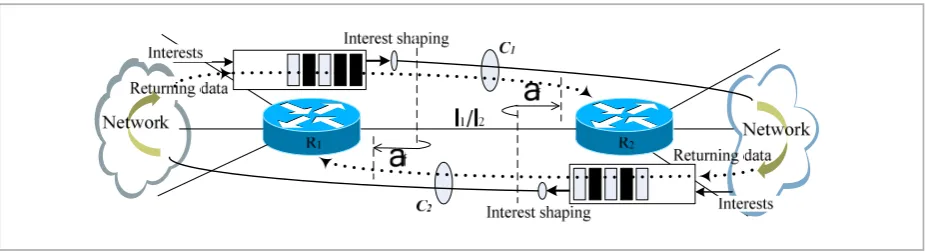
We consider the traffic situation between a pair of NDN routers, denoted by R1and R2, which are
direct-ly connected via two unidirectional links 1iandi2 in
the opposite direction, as depicted in Figure 1. Each link i is assumed to have a finite capacity, denoted by Ci(i = 1, 2), which are static parameters. In addition,
we define Fi the set of request flows (i.e. the Interest
streams) triggered by router Ri between the router
pair of interest. In our model, only the stream of In-terest packets is shaped to pace their transmission, while the data packets are passed directly to the link
Table 1
Notations
Notation Description
Ri Router i (i = 1, 2)
i Links connecting a pair of routers
Ci Capacity of link i
Fi The set of request flows triggered by router R
i between the router pair of interest r i
f Interest arrival rate of flow f on router i
x I
f (x Df) Link Interest (data) rate of flow f
ρ i
f Average size ratio of data to Interest of flowobserved at router i f
af Average response time of flow by the downstream router f measured
Figure 1
output queue without shaping. We define r i
f the
Inter-est packet arrival rate of flow f ∈Fi on the output
inter-face corresponding to the link i (i = 1, 2) under steady
state. The variables x I
f and x Dfdenote the Interest
shaping rate and data rate of flow f, respectively. The average size ratios between data packet and Interest packet of flow f in each direction are assumed to be
ρ 1
fandρ 2f . In addition, we introduce the variable af to
represent the average instantaneous response delay suffered by the downstream router for retrieving the content f from the upstream one.
3.2. Optimization
To derive the optimization problem of the model de-scribed above, we make the common assumption that the utility, denoted by Uf (·), associated with flow f is an increasing, strictly concave, and continuously dif-ferentiable function of the Interest shaping rate x I f
over the range x I
f > 0 [9]. We further assume that the
routers are individually maximizing the utilities of the flows in the request set it triggered. These utilities could mean different things to the routers, which we will discuss later. Another critical issue in network resources share is fairness, which has come to be seen as a required attribute to any well-designed conges-tion control mechanism. Although several definiconges-tions of fairness arise from various disciplines, in this pa-per, we consider the notion of proportional fairness [10]. In addition, from an implementation perspec-tive, we particularly prefer that the functionalities of different routers be separated, with minimal commu-nication overheads.
Based on above considerations, we borrow the con-cept of Nash bargaining [12] from cooperative game theory to define the optimal allocation of Interest shaping rate among flows. The reasons for this moti-vation are briefly summarized as follows. First, Nash bargaining scheme ensures that the joint system achieves a unique fixed operating point which takes both fairness and efficiency into account. Second, the Nash bargaining solution, obtained by maximizing the Nash product, is known to be Pareto optimal and pro-portionally fair from the economic theory viewpoint. Third, the Nash solution structure allows a modular implementation, which is indeed what we appreciate. So far, we have discussed all the necessary basics of our model. We now define the flow rate allocation op-timization problem for our NDN congestion control
as follows, where the routers jointly solve the Nash product problem with linear constraints.
maximize
1 2
( )
f
I f f
U x ∈
∏
F F. (1)
subject to
1 2
1
I D k k
x x C
∈ ∈
+ ≤
∑
∑
F F
i i .
(2)
1 2
2
D I k k
x x C
∈ ∈
+ ≤
∑
∑
F F
i i
. (3)
0≤ x I
i ≤r 1i, ∀i ∈F1. (4)
0≤ x I
k≤r 2k, ∀k∈F2. (5)
where constraint (2) and (3) specify that the total flow rate in each direction is subject to the link capacity. Apparently, it is also required that the Interest shaping rate of a certain flow should not be more than its real demand and must be nonnegative. We characterize these constraints in (4) and (5). As the utility function
Uf (·) is strictly concave and one can easily verify that
the constraint set is convex, hence problem (1) is a con-vex optimization problem and has a unique solution. In what follows, we would look into how decomposition can be used to jointly optimize the Nash product prob-lem with minimum communication overhead.
3.3. Decomposition and Solution
The idea of decomposition has been successfully used to solve large scale optimization problems and to solve separable problems in a decentralized manner [11]. Considering the objective of (1) which can be convert-ed to maximize
1 2log ( )
I f f f∈ U x
∑
F F , since theloga-rithmic function is monotonic, so the feasible solution space is unaffected. The introduction of the logarith- mic functions helps reveal the decomposition structure of the original problem. In addition, according to the flow balance principle in NDN and above definitions, one can be readily to obtain following relationship,
x D
f =ρf ∙x I f . Therefore, problem (1) can be rewritten as,
maximize
1 2
log ( )I
f f f
U x
∈
∑
F F .(6)
subject to
1 2
2 1
I I
k k k
x ρ x C
∈ ∈
+ ≤
∑
∑
F i F
1 2 1 2 I I k k
x x C
ρ
∈ ∈
+ ≤
∑
∑
F F
i i i . (8)
0≤ x I
i≤r 1i, ∀i ∈F1. (4)
0≤ x I
k≤r 2k, ∀k∈F2. (5)
Then we take a partial Lagrangian of (6) with respect
to the link capacity constraints as follows,A Game Theoretic Framework for Congestion Control in Named Data Networking
5
1 2 1
2 1 2
1 2 1 2 1 2 1 1 2 2
, , log ( ) +
= log ( )
log ( )
I I I
f f f
I I I
k k k
I I
I I
k k k k
f
k k
k
x U x C x
x C x x
U x x C
U x x C
i i i i ii i i i
i
1 2 1 2log ( ) I
I
I I I
f f f f
I f f
f
x U x f x
f x f (15)
where Iy(x) is an indicated function, which is given by
formula (16).
1,I
0,
if x y x otherwise
y (16)
By differentiating (15), we have (9)
where l and µ are Lagrange multipliers associated with the link capacity constraints, which can be interpreted as the link price reflecting the cost of overshooting the link capacity. Observe that the Interest shaping rates x I
f,
f ∈F1 (F2) can be separated in the Lagrangian function.
Therefore, we take a dual decomposition approach, then problem (6) is decomposed into the following two subproblems: the optimization problem GR1(l,µ), which
is performed on router R1, is given by (10),
(
)
{
(
)
}
1 1 1 ( ) 1 1, max log ( )
. . 0 , .
I
I I
R x t I
G U x x
s t x r
λ µ λ µρ ∈ = − + ≤ ≤ ∀ ∈
∑
F Fi i i i i i
i i i
(10)
and the one performed on router R2 is denoted as GR2(l,µ):
(
)
{
(
)
}
2 2 2 ( ) 2 2, max log ( )
0 . . . , I k I k I R x t k k k k
I k k
G U x x
s t x r k
λ µ µ λρ ∈ = − + ≤ ≤ ∀ ∈
∑
F F (11)The optimal solutions of problem (10) and (11) for a given pair of parameters l and µ define the dual func-tion D (l, µ). The dual problem is given as:
(
)
(
)
1 2,
min , ,
vars. 0, 0.
R
D G C C
λ µ λ µ λ µ λ µ λ µ = + + ≥ ≥
∑
i i (12)The dual problem described above can be easily solved based on a simple gradient projection method [4], which results that:
( )
( )
1 2 2 1 I I k k kd t t x x C
dtλ α ∈ ∈ ρ
= + −
i
∑
F i∑
F (13)
( )
( )
1 2 1 2 k I I kd t t x x C
dtµ β ∈ ρ ∈
= + −
i
∑
F i i∑
F (14)
where α(t) and β(t) are diminishing step sizes or small constant step sizes often used in practice, which will be discussed in Section 4. l(t) and µ(t) denote the im-plied cost at each iteration with l(0), µ(0)∈R+
arbi-trary, which can be taken to be 0.
Moreover, it is important to observe that the optimi-zation subproblems performed on each router can be further solved in a distributed manner as well. That is, each flow maximizes the local Lagrangian Lf :
( )
( )
(
)
( )
(
)
1 2 1 2log ( ) I
I
I I I
f f f f
I f f
f
x U x f x
f x λ µρ µ λρ = − + − + F F f (15)
where Iy(x) is an indicated function, which is given by
formula (16)
( )
1,I
0,
if x y x otherwise ∈ =
y . (16)
By differentiating (15), we have
1 2 1 2 ( ) I I ( ) ( ) ( ) I f f f I If f f
I f f I f f f
d U x
f f
dx U x
U x H f U x f (17)
where H(f) is given by (18).
( )
1( )
(
)
2( )
(
)
1 2
I +I f
H f = F f λ µρ+ f F f µ λρ+ . (18)
Then by applying the gradient algorithm to solve the utility maximization subproblem in (15), we can draw that at each time t, x I
( )
( )
( )( )
( )
I f f I
f f I
f f
U x
d x t t H f
dt γ U x
′
= −
(19)
where γf (t) are sequences which define the step-sizes
(or gains) associated with the iteration procedure.
4. Implementation and Deployment
In this section, we discuss some important issues re-lated to the practical implementation of our proposed algorithm. We argue that this section only serves as a guideline and different implementations might be possible for other specific considerations.
4.1. Parameters Choices of the Master Problem
As described in the previous section, the parame-ter α(t) in formula (13) is a variable corresponding to link i1. For the sake of simplicity, in this paper,
we assume that α(t) takes the following form, i.e.,
α(t) ≡1/C1, then the Lagrange multiplier l(t) can
be interpreted as the propagation delay of link i1,
as its evolution, i.e. the formula (13), is determined by a fluid queue evolution equation with input rate
1 2
2
I I
k k k
x ρ x
∈ + ∈
∑
i F i∑
F and service rate C1. Note that1
I
x ∈
∑
i F i and∑
k∈F2ρk k2xI respectively denote the aggregate Interest stream and data stream that are incident on local output interface, where x Ii (i ∈F1)
is the solution of the optimization problem (10) so it can be derived locally. Moreover, both ρ2
kand x I k(k ∈F2) can be estimated locally as well by measuring
the returning data sizes and the incoming Interest rate from the opposite direction. The same con-siderations are valid for the parameter β(t), so we have that β(t) ≡ 1/C2, and µ(t) can be seen as the
link delay associated with link i2. Let xIf,{ ( ) ( )t, t}
λ µ
(f ∈F1 or F2) be the optimal solutions to the problem GRi (l,µ), (i = 1, 2) for given l(t) and u(t). Then, the
updating iterations run at each router (i.e., R1 and R2) can be given by the following:
{ } { }
1 2
, ( ), ( ) 2 , ( ), ( ) 1
1 1
( 1) ( ) I t u t ( ) I t u t ( )
i k k
i k
t t C x t x t
C λ λ λ λ ρ + ∈ ∈ + = − − −
∑
F∑
F (20) { } { } 1 2 , ( ), ( ) , ( ), ( ) 1 2 2 1
( 1) ( ) I t u t ( ) I t u t ( )
i i k
i k
t t C x t x t
C λ λ µ µ ρ + ∈ ∈ + = − − −
∑
F∑
F (21) where 5
( )
( ) (17) ( ) f f I f f U x H f U x ′ = −where H(f) is given by (18).
where
( )
x + max ,0( )
x .
Moreover, in terms of information sharing, we append a novel tag that indicates the link information
.
Moreover, in terms of information sharing, we ap-pend a novel tag that indicates the link information to the data packets. After each update, the router over-rides the specified field in the data packets with the new value before forwarding the responding data. Notice that this is the only quantity which needs to be exchanged between the two routers in our model. Therefore, the communication overhead introduced by our approach is expected to be low.
4.2. Implementation of the Subproblems
In our decentralized model, each flow can optimize only its Interest shaping rate. One particular concern about our approach is the choice of the utility func-tion Uf (·). Different alternatives of the utility function
are possible as long as it satisfies the related assump-tions in the previous section. By adopting different form of Uf (·), we end up with different controller. For
instance, if we select
(
I( )
)
f f
U x t = 1 ( ) 2
( )
1
I f
x t
K e− H f and
( )
(
( )
)
22 I
f t K x tf
γ = , then we would derive a hop-by-hop window-based congestion control (i.e., a family of AIMD controllers) [6]. In this paper, for simplicity, we define the utility function of flow f as
( ) ( )
I I wff f f
U x = x .
Hence, for each flow, we can derive the following In-terest transmission rate control:
( )
,( )
fI
f f
w
x t Min r
H f
=
(22)
where wf denotes the weight of flow f. Alternative
choices of weights {wf } may be possible. Notice that
wf = adf r1−df, where dis a tunable factor. The parameter
dreflects how sensitive our proposed scheme is to the two different properties of flow. Hereafter, we simply assume that d = 0.5. According to our definition of wf,
it is required that each router needs to maintain an average response time estimation for each flow. To this end, we update the average estimated value of re-sponse time for each flow with exponential weighted moving average at every data packet reception, ex-cluding retransmitted packets. Note that, in practice,
x I
f(t) will be bounded by a finite constant (typically
depended on the network conditions, such as the out-put link capacity, the number of active flows, and so on), which can provide the least protection against misbehaving consumers.
In addition, to implement such a flow-aware Interest shaping rate control, we need one virtual tail-drop queue per flow identified by the name of the content at every output interface. Each virtual queue con-trols the Interest transmission rate according to the optimal solution of the subproblem individually. As previously mentioned, such a scheme seems feasible in the NDN context, because the structure of NDN forwarding engine provides an inherent support to maintain the necessary information. Further, notice that the number of active flows depends on the flow granularity which can be handled flexibly in different scenarios. However, how to determine the flow granu-larity is a problem of the trade-off between scalability and performance, and we defer it to our future work. Finally, we comment that our proposed congestion control mechanism is only a complement to the NDN architecture and should be coupled with other sig-nificant network functionalities, such as adaptive forwarding strategy, scheduling scheme, feedback mechanism, and caching policy, in order to achieve a satisfactory network performance. Moreover, although shaping mechanisms provide the network side with some degree of robustness against conges-tion, we argue that consumer strategies to react to congestion are also required to realize the maximum resource utilization objective. A sophisticated com-bination of these solutions might be appreciated but more comprehensive evaluations are needed. Howev-er, the details of all these above are beyond the scope of this paper. To simplify, in this paper, we assume that intermediate routers perform the best-route for-warding strategy. We further assume that Interests
belonging to the same flow are forwarded equiva-lently rather than routed/forwarded individually. As for scheduling discipline, we adopt the simple First Come First Serve (FCFS) algorithm, which serves packets in order of arrival. In addition, we implement the same congestion feedback mechanism proposed in [21]. That is, once there is an Interest packet that cannot be forwarded because of being dropped by the shaper, a congestion signal NACK would be created and forwarded to the downstream. For the caching policies, we adopt the leave copy everywhere scheme as the caching placement policy and the least recently used strategy as the caching replacement policy.
5. Performance Evaluation
In this section, we study the performance of the pro-posed mechanism using the ndnSIM [1] simulator. To this end, we carried out extensive simulations and comparisons with the methods in [5, 20] under a vari-ety of network scenarios. In what follows, we present a selected set of simulation results to illustrate the properties and benefits of our scheme.
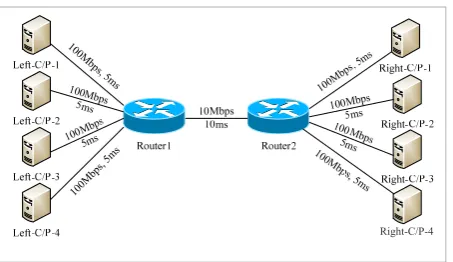
For what concerns the topology used for the evalu-ations, we consider the generic dumbbell topology shown in Figure 2, which is typically used for conges-tion control analysis. The raconges-tionales behind this are given as follows. First, in realistic networks, the data receiver and provider are generally connected by a path consisted of multiple links, however, to analyze congestion control mechanisms, one often ignores the existence of all the intermediate links, except for the bottleneck link that has the smallest bandwidth.
Figure 2
Network topology
100M bps, 5ms
100M bps, 5
ms
0 0.02 0.04 0.06 0.08 0.1 0.12
Case 1 Case 2 Case 3 Case 4
Int
ere
st
sha
pi
ng
ra
te
(M
bp
s) Flow 1 Flow 2 Flow 3
613
Information Technology and Control 2017/4/46
The dumbbell topology precisely provides such an approximation model for performance evaluation, which directly captures the bottleneck link. Second, this topology is believed to be, to some extent, repre-sentative of the behavior of a number of more general topologies, and allows us to explore the properties of our optimization model by manipulating the parame-ters (such as link delay, bandwidth, queue size, and so on). In fact, while the algorithms may exhibit slightly different behaviors in various topologies, some char-acteristics are common to many of them. Hence, a complete understanding of how the algorithms be-have in one topology provides insight into how it might behave in other topologies. On these grounds, we are convinced that the simple dumbbell topology with a single bottleneck link is sufficient to validate the effectiveness and efficiency of our proposed meth-od, and provides a natural starting point. In addition, all simulations assume the same average size ratio be-tween contents and Interests, that is, a fixed content payload of 1000 bytes and a fixed size of 25 bytes for Interest packet. In addition, the packet buffer in each router is set at 100 packets. Simulations in every net-work scenario were performed multiple times to get its average performance.
5.1. Fairness Analysis
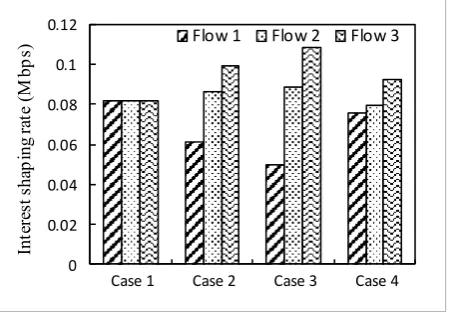
In the first scenario, we study the fairness property of our approach in the presence of unidirectional traffic. To this end, we launch three content retrievals, i.e., consumer Left-C/P-i (i = 1∼3) retrieves the data with name prefix /Right-C-P-i/k from the corresponding producer on the right side, denoted by flow i. Con-sumers generate Interest packets at a constant rate. The start time of each flow is randomly determined between 0s and 1s. Unless otherwise specified, the topological parameters are set according to the initial configuration shown in Figure 2. By configuring flows with different response time and Interest expression rate, we observe the performance achieved by our algorithm under homogeneous and heterogeneous flow conditions. We are interested in the fair Interest shaping rate for each flow achieved by Router1 under the steady state. Simulation results under this sce-nario are reported in Figure 3.
As shown in Figure 3, here we consider four different cases. In the first case, we set all flows with the same response time and Interest expression rate, i.e., 40ms
Figure 3
Fairness evaluation under unidirectional traffic scenarios
100M bps, 5
ms
0 0.02 0.04 0.06 0.08 0.1 0.12
Case 1 Case 2 Case 3 Case 4
Int
ere
st
sha
pi
ng
ra
te
(M
bp
s) Flow 1 Flow 2 Flow 3
and 500pkts/s. As we can see, the total bandwidth of bottleneck link is equally shared among the competing flows as expected. We then vary either the response time or the Interest expression rate of each flow while keeping the other remaining unchanged as in the first case to investigate the effects of the two proper-ties, respectively. In the second case, the link delays between Router2 and Right-C/P-1, Right-C/P-2, Right-C/P-3 are set to 5ms, 20ms and 35ms, respec-tively. In the third case, the Interest expression rates of each flow are 250pkts/s, 500pkts/s and 750pkts/s, respectively. As can be seen from the plot, our algo-rithm is able to converge to the theoretical optimal allowed rate suggested by formula (6) in both kinds of heterogeneous situations. In addition, it guarantees some degree of proportional fairness in terms of the throughput. In the last case, we vary the both proper-ties of the flows. To specify, for the response time, the link delays of the top three edge links on the right side are 5ms, 15ms and 5ms, respectively. Moreover, flows 1∼3 respectively issue Interest packets at a constant rate of 400pkts/s, 400 pkts/s and 600pkts/s. From the last two cases, we observe that our algorithm is in fa-vor of “small” flows, which means that it gives priority to satisfy the demand of smaller flows.
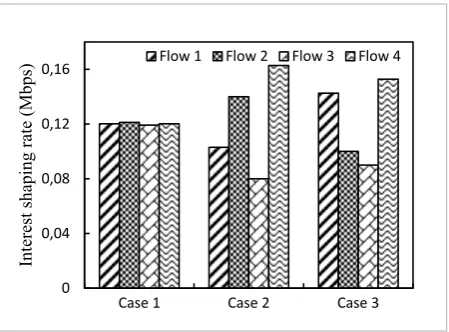
In the second scenario, we consider bidirectional traffic and experimented with a slight variant of the above topology for fairness analysis. Here, we imple-mented data flows between each Left-/Right- C/P-i
op-Table 2
Parameters setting
Flow
One-way delay Interest expression rate
(pkts/s) Link name Propagation delay (ms)
Case1 Case2 Case3 Case1 Case2 Case3
1 Router2 - Right-C/P-1 5 5 5 650 700 900
2 Router2 - Right-C/P-2 5 20 35 650 700 500
3 Router1 - Left-C/P-3 5 20 15 650 400 450
4 Router1 - Left-C/P-4 5 20 20 650 1000 850
posite direction. Each flow starts at a random time between 0 and 0.5s, and continues until the end of the evaluation. The specific parameters for the four flows in various cases are given in Table 2. Other parame-ters are the same as those in Figure 2. We compare the bargaining outcomes determined by the two routers under different cases.
Figure 4 illustrates the simulation results in this sec-ond simulation set. First, we observe that our scheme still works well in the presence of bidirectional traffic. As depicted in Figure 4, the same average behavior under both homogeneous and heterogeneous net-work settings shown in previous simulations of uni-directional flows is observed in this scenario, which can be theoretically proved based on the analysis in Section 3. The simulation results of Case2 also points out that our scheme is able to alleviate the potential unfairness caused by response delay or request rate.
Figure 4
Fairness evaluation under bidirectional traffic scenarios
0 0,04 0,08 0,12 0,16
Case 1 Case 2 Case 3
In
te
re
st
sh
ap
in
g
ra
te
(M
bp
s) Flow 1 Flow 2 Flow 3 Flow 4
Note that by choosing an appropriate value for pa-rameter d, one may reach appreciative outcomes for specific objectives. However, here we defer the analy-sis about the design of parameter d to our future work. Second, our shaping scheme achieves zero packet loss in all above cases, which improves the efficiency of data delivery by avoiding needless data transmission. To explore the potentials of our proposed scheme, we run a third set of simulations and compare the results with the HIS scheme [20]. The same dumbbell topol-ogy is used as in the previous evaluations. In this test, we consider a symmetrical topology. The symmetry here means that, for each Left- and Right-C/P pair, the edge links on both sides have the same link pa-rameters. We set the link delays between Router1 and Left-C/P-1, Left-C/P-2, Left-C/P-3, Left-C/P-4 to 5ms, 20ms, 15ms and 35ms, respectively. In addition, all edge links have a bandwidth of 100Mbps, and the parameters for the bottleneck link are propagation delay 10ms, bandwidth 10Mbps. Then we make the two parts of each Left-/Right-C/P-i (i = 1∼4) pair re-quest data from each other. The simulated permanent flows are as follows: consumer Left-C/P-i (i = 1∼4) re-spectively issues Interest packets with a constant rate of 1000pkts/s, 400pkts/s, 200pkts/s and 200pkts/s, denoted by flows 1∼4 (also referred to as Group One), while the Interest expression rate of consumer Right-C/P-1 is 1000pkts/s and the Right-C/P-2∼4 adopt the smart AIMD strategy to adjust their Interest ex-pression rate, denoted by flows 5∼8 (Group Two). We compare the behaviors of both schemes under the situations with misbehaving flows and different con-sumer strategies. Figure 5 shows the comparison of the test results.
Figure 5
Fairness evaluation against misbehaving receivers
0 0,04 0,08 0,12 0,16 0,2
1 2 3 4 5 6 7 8
Interest shaping
rate (Mbps)
Flow
HIS scheme Our scheme
approximate full use of the bandwidth of bottleneck link in both directions. However, as HIS scheme im-poses the same Interest rejection proportion on all concurrent flows in the same direction, hence the mis-behaving consumer, i.e., flow 1, occupies most of the available link bandwidth in comparison with flows 2∼4. This situation may become even worse when the honest consumers adopt the smart AIMD strategy but the misbehaving consumer still keeps requesting the contents greedily, as the results of flows in Group Two show. In contrast, we observe that our scheme pro-vides a better control of consumer misbehavior. This is attributed to the fact that our scheme inclines to satis-fy small flows preferentially. Accordingly, for flows in Group One set, the heavy flow is penalized and the hon-est consumers achieve almost the maximum through-put under our scheme. Even though there is some per-formance degradation in the second flow group due to effect of the consumer strategy, our scheme also out-performs the HIS scheme by providing fairness among competing flows in a more rational way.
5.2. Bottleneck Link’s Utilization
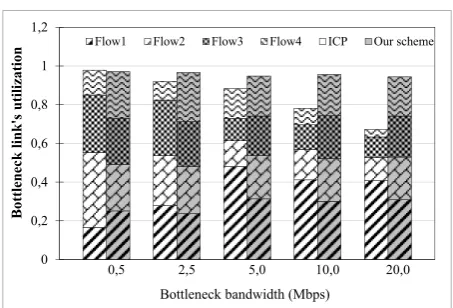
We then compare the proposed mechanism with ICP [5] in terms of the bottleneck link’s utilization. ICP is a pure receiver-based end-to-end scheme, where receivers detect congestion via timeout mechanism and regulate Interest expression rate according to a TCP-like AIMD principle individually without any congestion control at intermediate routers or servers. In this scenario, we conducted the simulations on the symmetrical dumbbell topology under bidirectional
traffic condition, with 5ms, 20ms, 20ms and 35ms link delay for the edge links on left side respectively, and 100Mbps for all edge links. We analyzed the perfor-mance of both mechanisms by varying the bandwidth of the bottleneck link. Figure 6 shows the selected re-sults out of our extensive simulations, where we only presented the bottleneck link’s utilization achieved in one of the directions, noting that a slight fluctuation at a range of up to 0.01 is applicable to the performance achieved in the other direction in all cases.
As can be seen from Figure 6, the ICP scheme suffers from severe performance degradation when we vary the
Figure 6
Bottleneck link’s utilization
0 0,2 0,4 0,6 0,8 1 1,2
0,5 2,5 5,0 10,0 20,0
Bottleneck
link
's
utilization
Bottleneck bandwidth (Mbps)
Flow1 Flow2 Flow3 Flow4 ICP Our scheme
bottleneck bandwidth from 0.5Mbps to 20 Mbps, where-as our proposed scheme is able to achieve almost full utilization of the bottleneck bandwidth in all cases. In addition, it is clear that the throughput ratio of concur-rent flows under ICP scheme becomes more and more deformed as the bottleneck bandwidth increases, which results from the heterogeneous RTTs. However, as the figure shows, our scheme achieves rather good through-put fairness as expected even though in the presence of heterogeneous RTTs. This also confirms the fairness analysis that we presented in the previous subsection.
5.3. Data Loss or Interest Rejection
or the Interest rejection rate on the bottleneck link. Figure 7 shows the performance comparison of our approach and ICP scheme.
As ICP infers congestion based on data packet loss, hence, we observe a non-ignorable data packet loss rate in all cases. Instead, noting that congestion is pro-actively prevented by early Interest rejection under our scheme, therefore, no data packet loss is observed on the bottleneck link, which also confirms the effec-tiveness of our scheme. Figure 7 shows how improve-ments in link bandwidth reduce data packet loss rates and Interest rejection rates. As can be seen from the plot, the benefits obtained from bandwidth
improve-Figure 7
Packet loss rate vs. Interest rejection rate
0.5 2.5 5 10 20
0 0.01 0.02 0.03 0.04 0.05 0.06 0.07
Bottleneck link bandwidth [Mbps]
D
at
a
/ I
nt
er
es
t d
is
ca
rd
ra
te
RTT=50ms RTT=100ms RTT=200ms RTT=500ms Packet loss rate Interest rejection rate
ments become smaller and smaller as bandwidth in-creases. In addition, the discard rate of data packet (or Interest) also decreases when we vary the bottle-neck link latency so that the RTT ranges from 50ms
to 500ms, which may be due to the throughput degra-dation under long RTT. Finally, we observe that the Interest rejection rates of our scheme is lower than the data packet loss rate of ICP except for the first case where the bottleneck bandwidth is 0.5Mbps, which is due to the fact that our scheme achieves a relatively higher link utilization.
5.4. Content Download Time
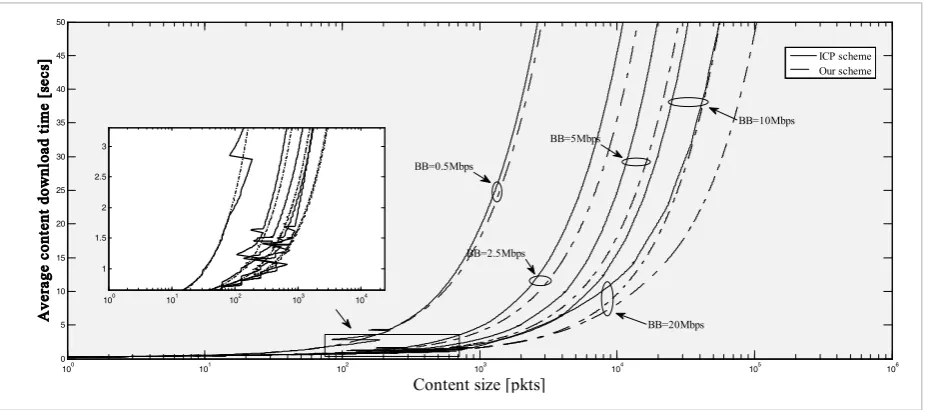
We examine the download performance of our approach and the ICP scheme under the given network conditions in Figure 8. The simulated flows’ RTTs were chosen to be a representative value of 100ms, and we presented the average results ob-tained from a number of simulation runs. As Figure 8 illustrates, our approach has a shorter content down-load time than ICP, regardless of the content size and the bottleneck bandwidth (BB). In particular, we observe that the performance gap between the two schemes become more and more significant as the bottleneck bandwidth increases. This is major-ly attributed to the fact that our approach manages to achieve a higher throughput due to more efficient utilization of the bottleneck bandwidth relative to
Figure 8
Average content download time
100 101 102 103 104 105 106
0 5 10 15 20 25 30 35 40 45 50
Content size [pkts]
A
ve
ra
ge
c
on
te
nt
d
ow
nl
oa
d
tim
e
[s
ec
s] ICP schemeOur scheme
100
101
102
103
104
1 1.5 2 2.5 3
BB=0.5Mbps
BB=5Mbps
BB=2.5Mbps
BB=20Mbps
ICP scheme. In addition, the fact that congestion is avoided by proactively dropping excessive Interest packets so that zero data packet loss rate is guaran-teed by our scheme also partially explains the phe-nomenon (noting that the folds for the ICP curves in the graph are due to data packet loss). Since early Interest packet drop squanders fewer network re-sources than late data packet loss due to reduction of redundant content transmission, and consequently results in smaller download time.
6. Conclusion and Future Work
In the present paper, we discussed the specific re-quirements for congestion control mechanisms in NDN environment, and aimed at developing an ef-fective hop-by-hop congestion mechanism that cor-responds to the new features introduced in NDN architecture. With this in mind, we model the NDN congestion control problem as a flow rate allocation optimization problem based on the game theory. We have also proposed a distributed asynchronous
al-gorithm to implement the solution. Simulations are conducted to validate the effectiveness and efficiency of our proposed approach, and the results demon-strate the benefits of the proposed hop-by-hop In-terest rate control scheme in improving network performance, such as network throughput, resource utilization and fairness. Comprehensive performance evaluations are planned in our future work, which in-clude an extension of our work to achieve the global optimization among all output interfaces as well as exploratory investigations on the satisfactory sophis-ticated forwarding strategies to combine with our mechanism. We will also explore the complexity and scalability of our scheme.
Acknowledgments
This work was supported in part by the National Nat-ural Science Foundation of China under grant Nos. 61233003, 61673360, in part by Research Fund for the Doctoral Program of Higher Education of China un-der grant No. 20123402110029 and in part by Natural Science Research Program of the Anhui High Educa-tion Bureau of China under grant No. KJ2012A286.
References
1. Afanasyev, A., Moiseenko, I., Zhang, L. ndnSIM: NDN Simulator for NS-3. University of California Technical Report, 2012.
2. Byun, D., Lee, B. J., Park, Y. Adaptive Interest Adjust-ment in CCN Flow Control. 2014 IEEE Global Commu-nications Conference (GLOBECOM), 2014, 1873-1877. https://doi.org/10.1109/GLOCOM.2014.7037081 3. Bazmi, P., Keshtgary, M., A Neural Network Based
Congestion Control Algorithm for Content-Cen-tric Networks. Journal of Advanced Computer Sci-ence and Technology, 2014, 3(2), 214-220. https://doi. org/10.14419/jacst.v3i2.3696
4. Bertsekas, D. P., Tsitsiklis, J. N. Parallel and Distributed Computation: Numerical Methods. Englewood Cliffs, NJ, Prentice Hall, 1989.
5. Carofiglio, G., Gallo, M., Muscariello, L. ICP: Design and Evaluation of an Interest Control Protocol for Con-tent-Centric Networking. 2012 IEEE Conference on Computer Communications Workshops (INFOCOM WKSHPS), 2012, 304-309.
6. Carofiglio, G., Gallo, M., Muscariello, L., Papali, M. Mul-tipath Congestion Control in Content-Centric Networks.
2013 IEEE Conference on Computer Communications Workshops (INFOCOM WKSHPS), 2013, 363-368. 7. Carofiglio, G., Gallo, M., Muscariello, L. Joint
Hop-by-Hop and Receiver-Driven Interest Control Pro-tocol for Content-Centric Networks. Proceedings of the second edition of the ICN Workshop on Informa-tion-Centric Networking, ACM, 2012, 37-42. https:// doi.org/10.1145/2342488.2342497
8. Karami, A. ACCPndn: Adaptive Congestion Control Protocol in Named Data Networking by Learning Ca-pacities Using Optimized Time-Lagged Feedforward Neural Network. Journal of Network and Computer Applications, 2015, 56, 1-18. https://doi.org/10.1016/j. jnca.2015.05.017
9. Kelly, F. P., Maulloo, A., Tan, D. Rate Control in Commu-nication Networks: Shadow Prices, Proportional Fair-ness and Stability. Journal of the Operational Research Society, 1998, 49, 237-252. https://doi.org/10.1057/pal-grave.jors.2600523
11. Mitrovic, D., Ivanović, M., Geler, Z. Agent-Based Dis-tributed Computing for Dynamic Networks. Informa-tion Technology and Control, 2014, 43(1), 88-97. https:// doi.org/10.5755/j01.itc.43.1.4588
12. Nash, J. F. The Bargaining Problem. Econometrica: Journal of the Econometric Society, 1950, 18 (2), 155-162. https://doi.org/10.2307/1907266
13. Oueslati, S., Roberts, J., Sbihi, N. Flow Aware Traffic Control for a Content-Centric Network. 2012 Proceed-ings IEEE INFOCOM, 2012, 2417-2425.
14. Park, H., Jang, H., Kwon, T. Popularity-Based Conges-tion Control in Named Data Networking. 2014 Sixth In-ternational Conference on Ubiquitous and Future Net-works (ICUFN), 2014, 166-171. https://doi.org/10.1109/ ICUFN.2014.6876774
15. Rozhnova, N., Fdida, S. An Effective Hop-by-Hop In-terest Shaping Mechanism for CCN Communications. 2012 IEEE Conference on Computer Communications Workshops (INFOCOM WKSHPS), 2012, 322-327. 16. Rozhnova, N., Fdida, S. An Extended Hop-by-Hop
Interest Shaping Mechanism for Content Centric Networking. IEEE GLOBECOM 2014, Austin, Tex-as, United States, 2014. https://doi.org/10.1109/GLO-COM.2014.7389766
17. Ren, Y., Li, J., Shi, S., Li, L., Wang, G., Zhang, B. Conges-tion Control in Named Data Networking – A Survey. Computer Communications, 2016, 86, 1-11. https://doi. org/10.1016/j.comcom.2016.04.017
18. Ren, Y., Li, J., Shi, S., Li, L., Wang, G. An Explicit Con-gestion Control Algorithm for Named Data Networking. 2016 IEEE Conference on Computer Communications Workshops (INFOCOM WKSHPS), 2016, 294-299. 19. Saino, L., Cocora, C., Pavlou, G. CCTCP: A Scalable
Re-ceiver-Driven Congestion Control Protocol for Content Centric Networking. 2013 IEEE International Con-ference on Communications (ICC), 2013, 3775-3780. https://doi.org/10.1109/ICC.2013.6655143
20. Wang, Y., Rozhnova, N., Narayanan, A., Oran, D., Rhee, I. An Improved Hop-by-Hop Interest Shaper for Con-gestion Control in Named Data Networking. ACM SIGCOMM Computer Communication Review, 2013, 43(4), 55-60. https://doi.org/10.1145/2534169.2491233 21. Yi, C., Afanasyev, A., Wang, L., Zhang, B., Zhang, L.
Adaptive Forwarding in Named Data Networking. ACM SIGCOMM Computer Communication Review, 2012, 42(3), 62-67. https://doi.org/10.1145/2317307.2317319 22. Zhang, F., Zhang, Y., Reznik, A., Liuc, H., Qi, C., Xue, C.
Providing Explicit Congestion Control and Multi-Hom-ing Support for Content-Centric NetworkMulti-Hom-ing Trans-port. Computer Communications, 2015, 69, 69-78. https://doi.org/10.1016/j.comcom.2015.06.019
23. Zhang, L., Afanasyev, A., Burke, J., Jacobson, V., Claffy, K., Crowley, P., Papadopoulos, C., Wang, L., Zhang, B. Named Data Networking. ACM SIGCOMM Computer Communication Review, 2014, 44(3), 66-73. https://doi. org/10.1145/2656877.2656887
As an essential building block of the Named Data Networking (NDN) architecture, congestion mechanism has been the focus of much attention. The unique features of NDN architecture bring forward distinct requirements for congestion control from its Internet Protocol (IP) counterpart. In this paper, we present a game theoretic framework for flow rate control in NDN based on the concept of Nash bargaining solution from cooperative game theory, and propose a distributed flow-aware hop-by-hop congestion control mechanism on a solid analytical basis. In addition, we developed a possible implementation in the ndnSIM simulator and performed extensive simulations and performance evaluations to study the behavior of our scheme. We have seen that the proposed congestion control mechanism performs as designed, and significantly enhances the network performance.
Kaip esminis įvardintų duomenų tinklaveikos (NDN) architektūros statybinis blokas, perkrovos mechanizmas yra susilaukęs daug tyrėjų dėmesio. Iš savo IP dublikato, unikalūs NDN architektūros bruožai pateikia išskir-tinius reikalavimus perkrovos kontrolei. Straipsnyje pristatoma žaidimo teorinė sistema, skirta srauto greičio reguliavimui NDN, sukurta remiantis Nash derybų sprendimo koncepcija iš bendradarbiaujančių žaidimų teo-rijos. Remiantis solidžiu analitiniu pagrindu, taip pat siūlomas paskirstytas, į srautą reaguojantis šuolinės per-krovos valdymo mechanizmas. Taip pat sukurtas galimas įgyvendinimas ndnSIM simuliatoriuje, atlikta daug išsamių simuliacijų ir veiklos analizių sukurtos schemos elgsenai ištirti. Siūlomas perkrovos valdymo mecha-nizmas veikia taip, kaip suprojektuotas, ir gerokai padidina tinklo našumą.