Elisabeth Brunner
c, d, Karla Lehle
a, f, Stephan W. Hirt
a, E, christof Schmid
E, f,
Marietta von Suesskind-Schwendi
a, c, dEverolimus’s Influence on Persistent Acute Rejection
After Experimental Lung Transplantation*
Wpływ ewerolimusu na przewlekłe ostre odrzucenie doświadczalnego
przeszczepu płuc
department of cardiothoracic Surgery, University Medical center Regensburg, University of Regensburg, Germany
A – research concept and design; B – collection and/or assembly of data; C – data analysis and interpretation;
D – writing the article; E – critical revision of the article; F – final approval of article; G – other
Abstract
Background. In lung transplantation, acute rejection episodes increase the risk of chronic rejection. Therefore treatment of acute rejection needs to be optimized for better long-term outcome of lung-transplantation and patient survival.
Objectives. The aim was to verify whether an inhibitor of the mammalian target of rapamycin (Everolimus) con-tained the extent of persistent acute rejection after left lung allo-transplantation in rats.
Material and Methods. Rats (f344-to-WKY) with a high grade of acute rejection were treated with methylpred-nisolone (10 mg/kg, postoperative days 14–16) alone or in combination with everolimus (2.5 mg/kg, postoperative days 14–30). The rats were killed on postoperative day 20 and 30. Infiltration of inflammatory cells (Ed1, cd11a, cd18) and activation of endothelial cells (IcaM-1) were measured by immunohistochemistry
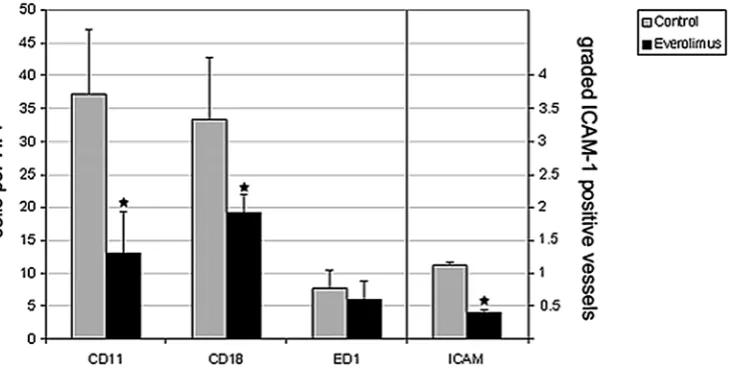
Results. Everolimus treatment significantly reduced the number of IcaM-1 positive small vessels (66%; p < 0.05) and suppressed the infiltration of leucocytes (cd11a (64%), cd18 (42%); p < 0.05) and macrophages (Ed1; 22%) in the allografts on POd 30. despite this clear anti-inflammatory effects, lung allografts still showed severe acute vascular rejection in combination with high grade small airway inflammation.
Conclusions. The shown anti-inflammatory effects of Everolimus could not delay the progression of acute rejec-tion in rat lung allografts (Adv Clin Exp Med 2013, 22, 3, 355–359).
Key words: lung transplantation, acute lung injury, Everolimus, rats, rejection, inflammation.
Streszczenie
Wprowadzenie. Ostre odrzucenie przeszczepionego płuca zwiększa ryzyko przewlekłego odrzucenia. dlatego leczenie ostrego odrzucenia musi być zoptymalizowane, aby osiągnąć lepszy długoterminowy wynik przeszczepie-nia płuc i przeżycia pacjenta.
Cel pracy. Sprawdzenie, czy inhibitor ssaczego celu rapamycyny (ewerolimus) chroni przed trwałym ostrym odrzuceniem po allogenicznym przeszczepieniu lewego płuca u szczurów.
Materiał i metody. Szczury (f344-WKY) o dużym stopniu ostrego odrzucania leczono metyloprednizolonem (10 mg/kg, dni po operacji 14–16) samym lub w połączeniu z ewerolimusem (2,5 mg/kg, dni po operacji 14–30). Szczury zabito w 20. i 30. dniu po operacji. Naciek komórek zapalnych (Ed1, cd11a, cd18) i aktywację komórek śródbłonka (IcaM-1) mierzono metodą immunohistochemiczną.
Wyniki. Leczenie ewerolimusem znacząco zmniejszyło liczbę IcaM-1 dodatnich drobnych naczyń (66%, p < 0,05) i ograniczyło naciek leukocytów (cd11a (64%), cd18 (42%), p < 0,05) i makrofagów (Ed1, 22%) w przeszczepach allogenicznych na POd 30. Mimo że allogeniczne przeszczepy płuc były pod wpływem wyraźnego działania prze-ciwzapalnego, nadal wykazywały ciężkie ostre odrzucenie naczyniowe w połączeniu z zaawansowanym zapaleniem drobnych dróg oddechowych.
adv clin Exp Med 2013, 22, 3, 355–359 ISSN 1899–5276
ORIGINaL PaPERS
© copyright by Wroclaw Medical University
underlying mechanisms are unknown [2]. Mean-while, it is clear that immunosuppressive drugs can spare or even induce certain immune cells. Such drug specific effects may be responsible for acute persistent-recurrent rejection [1]. The use of cer-tain immunosuppressants, like mTOR inhibitors (mammalian target of rapamycin, e.g. Everolimus) could optimize transplantation outcome.
Today, Everolimus is successfully used to pre-vent acute and chronic rejection after solid organ transplantation [3]. The authors hypothesized Everolimus [4] should inhibit the progression of persistent acute rejection after left lung allo-trans-plantation in rats by reducing graft infiltration in-flammatory cells (Ed1+, cd11a+, cd18+) and by inhibiting expression of the endothelial activation marker IcaM on graft vasculature.
Material and Methods
In the moderate allogeneic f344-to-WKY (n = 20) rat strain combination, both acute re-jection in the short term after LTx (up to post-operative day (POd) 30) and chronic rejection in the long term follow up can be analyzed [5]. Orthotopic left LTx was performed as described earlier [5]. The right lobes remained in the recipi-ent and served as internal controls. The rats were purchased from charles River (Sulzfeld, Germany; 280±30g). all animals received humane care in compliance with the European Union Guide for the care and Use of Laboratory animals (publi-cation No. 86/609/EWG) and permission from the local authorities was obtained. In order to test treatment options for acute rejection, rats in the control group (n = 10) received intraperitoneal methylprednisolone (MP, Urbason®, Hoechst aG,
frankfurt, Germany; 10 mg/kg body weight) injec-tions on POd 14–16. The rats in the Everolimus-group (n = 10) additionally received Everolimus (Novartis Pharma, Basel, Switzerland; 2.5 mg/kg body weight, intragastral on POd 14–30). cohorts
cording to the ISHLT working formulation [7]. The number of Ed1+, cd11a+ and cd18+ cells and the proportion of IcaM-1+ vessels was measured in five high power fields (HPf). IcaM-1 was graded: 1: < 25%, 2: 25–50%, 3: 50–75%, 4: > 75% positive vessels per HPf. The difference between the left and right lung of each animal was used to quantify the drug effect on acute rejection. Statistical analysis (SPSS 16.0.2, SPSS inc, chicago, IL) included analysis of variance (aNOVa) fol-lowed by a dunnett T3 post-hoc-test with p-values considered significant below < 0.05. cell numbers and graded IcaM positive vessels are presented as mean +/– STd per HPf.
Results
p ≤ 0.05) on POd30, as shown in figure 1. The pro-portion of activated vessels was significantly lower in the allografts of the Everolimus group (p ≤ 0.05), while the number of alveolar macrophages (Ed1) remained unchanged. However, the decrease in the number of infiltrated lymphocytes does not result in a decrease of the ISHLT-scoring of acute cellular rejection and lymphocytic bronchiolitis (Table 1).
Discussion
Persistent and recurrent acute rejection epi-sodes are major risk factors in lung transplant pa-tients leading to chronic rejection and graft fail-ure. The exact trigger remains unknown. Present data shows that the anti-inflammatory properties
of Everolimus cause a significant containment of inflammatory infiltration in allografts after experi-mental LTx.
The relevance of acute rejection as a risk fac-tor for the development of chronic rejection was already shown in the same rat left lung allo-trans-plantation model (f344-to-WKY) by Hirt et al. [8]. Both early (POd 9–11) and late (POd 14–16) ap-plication of a steroid bolus attenuated the extent of acute rejection on POd 20. However, only early therapy suppressed chronic rejection in the long-term follow-up. Late treatment of acute rejection could not prevent the development of extensive vascular fibrosis and bronchiolitis obliterans [8]. However, in experimental rats, late application of MP on POd 14–16 did not affect acute rejection. The reasons for this discrepancy might be breed-Table 1. Evaluation of acute vascular rejection and lymphocytic bronchiolitis (B) in control and Everolimus groups. Samples were graded according to the International Society for Heart and Lung Transplantation (ISHLT) [7]. (a0: no acute vascular rejection to a4: severe acute vascular rejection; B0: no airway inflammation to B2R: high-grade airway inflammation)
Tabela 1. Ocena ostrego naczyniowego odrzucenia i limfocytarnego zapalenia oskrzelików (B) w grupie kontrolnej i leczonej ewerolimusem. Próbki były klasyfikowane według Międzynarodowego Towarzystwa Transplantacji Serca i Płuc (ISHLT) [7]. (a0: brak ostrego odrzucenia do a4: naczyniowe ciężkie ostre naczyniowe odrzucenie; B0: brak zapalenia dróg oddechowych do B2R: zapalenie dróg oddechowych ciężkiego stopnia)
control
(Grupa kontrolna) Everolimus (Grupa leczona ewerolimusem) ISHLT-grade (mean) ISHLT-grade (mean)
POd 20 a4/B2R (n = 5) a4/B1R-B2R (n = 5) POd 30 a4/B2R (n = 5) a3-4/B1R-B2R (n = 5)
Fig. 1. Evaluation of lymphocytic cells (cd11a, cd18), macrophages (Ed1) and activated vessels (IcaM-1) during severe acute rejection (POd 30). White column: MP control group, black column: Everolimus group. There was a sig-nificant reduction of lymphocytic cells and activated vessels (*p < 0.05, error bar: SEM). cell number normalized to right (non-transplanted) lung. (IcaM-1 was graded: 1: < 25%, 2: 25–50%, 3: 50–75%, 4 > 75% positive vessels per HPf)
tion, the authors started Everolimus therapy on POd14. Moreover, Everolimus should be used with care early after transplantation, since it can cause severe side effects upon surgery (e.g. wound healing complications or weight loss) [10]. In the present model, Everolimus significantly reduced the infiltration of lymphocytes (cd11a, cd18) and reduced the expression of its corresponding endothelial receptor (IcaM-1) in small vessels of lung allografts. The underlying mechanisms might be the suppression of inflammatory mediators (IL-6, McP-1) and T-cell activating cytokines (IL-2,
mus [10], where the authors could show that only early application of Everolimus reduced the grade of acute rejection and the development of vascu-lopathy and bronchiolitis obliterans [10].
In conclusion, the anti-inflammatory effects of Everolimus are – even in combination with ste-roids – not sufficient to delay the progression of acute rejection in lung allografts. Summing up two of authors’ animal studies, they hypothesize that patients would benefit from Everolimus only if therapy is started before the occurrence of rejec-tion episodes.
References
[1] Zheng HX, Zeevi A, McCurry K, Schuetz E, Webber S, Ristich J, Zhang J, Iacono A, Dauber J, McDade K, Zaldonis D, Lamba J, Burckart GJ: The impact of pharmacogenomic factors on acute persistent rejection in adult lung transplant patients. Transpl Immunol 2005, 14, 1, 37–42.
[2] Girnita AL, McCurry KR, Iacono AT, Duquesnoy R, Corcoran TE, Awad M, Spichty KJ, Yousem SA, Burckart G, Dauber JH, Griffith BP, Zeevi A: HLa-specific antibodies are associated with high-grade and persistent-recurrent lung allograft acute rejection. J Heart Lung Transplant 2004, 23, 10, 1135–1141.
[3] Gabardi S, Baroletti SA: Everolimus: a proliferation signal inhibitor with clinical applications in organ transplan-tation, oncology, and cardiology. Pharmacotherapy 2010, 30, 10, 1044–1056.
[4] Lehle K, Birnbaum DE, Preuner JG: Predominant inhibition of interleukin-6 synthesis in patient-specific endo-thelial cells by mTOR inhibitors below a concentration range where cell proliferation is affected and mitotic arrest takes place. Transplant Proc 2005, 37, 1, 159–161.
[5] von Süßkind-Schwendi M, Ruemmele P, Schmid C, Hirt SW, Lehle K: Lung transplantation in the fischer 344-wistar kyoto strain combination is a relevant experimental model to study the development of bronchiolitis obliterans in the rat. Exp Lung Res 2012, 38, 3, 111–123.
[6] Hirt SW, You XM, Möller F, Boeke K, Starke M, Spranger U, Wottge HU: development of obliterative bron-chiolitis after allogeneic rat lung transplantation: implication of acute rejection and the time point of treatment. J Heart Lung Transplant 1999, 18, 6, 542–548.
[7] Stewart S, Fishbein MC, Snell GI, Berry GJ, Boehler A, Burke MM, Glanville A, Gould FK, Magro C, Marboe CC, McNeil KD, Reed EF, Reinsmoen NL, Scott JP, Studer SM, Tazelaar HD, Wallwork JL, Westall G, Zamora MR, Zeevi A, Yousem SA: Revision of the 1996 working formulation for the standardization of nomenclature in the diagnosis of lung rejection. J Heart Lung Transplant 2007, 26, 12, 1229–1242.
[8] Hirt SW, You XM, Möller F, Boeke K, Ernst M, Starke M, Spranger U, Wottge HU: Early treatment of acute rejection prevents chronic rejection in a rat model of allogenic left lung transplantation. Transplant Proc 1998, 30, 4, 1005–1006.
[9] Fujishiro J, Pech TC, Finger TF, Praktinjo M, Stoffels B, Standop J, Abu-Elmagd K, Tuerler A, Hirner A, Kalff JC, Schaefer N: Influence of immunosuppression on alloresponse, inflammation and contractile function of graft after intestinal transplantation. am J Transplant 2010, 10, 7, 1545–1555.
[10] von Suesskind-Schwendi M, Brunner E, Hirt SW, Diez C, Ruemmele P, Puehler T, Schmid C, Lehle K:
Address for correspondence:
Marietta von Suesskind-Schwendi Tel.: +49-(0)941-944 9901
E-mail: [email protected]
conflict of interest: None declared