_____________________________________________________________________________________________________
*Corresponding author: Email: [email protected];
Effect of Cooking Methods and Temperature on
Proximate and Amino Acid Composition of
Breakfast Sausage
D. O. Oshibanjo
1*, O. O. Olusola
2and O. A. Ogunwole
21
Department of Animal Production, University of Jos, Jos, Nigeria.
2
Departmentof Animal Science, University of Ibadan, Ibadan, Oyo State, Nigeria.
Authors’ contributions
This work was carried out in collaboration among all authors. Author DOO designed the study, performed the statistical analysis, wrote the protocol and wrote the first draft of the manuscript. Authors OOO and OAO managed the analyses of the study and read through the manuscript. All authors read and approved the final manuscript.
Article Information
DOI: 10.9734/EJNFS/2019/v9i430086 Editor(s): (1)Dr. Rasha Mousa Ahmed Mousa, Associate Professor, Department of Biochemistry, University of Jeddah, Jeddah,
Saudi Arabia. Reviewers: (1) Zuzanna Goluch, Wrocław University of Economics, Poland. (2)E. B. Bingol, Istanbul University, Turkey. Complete Peer review History:http://www.sdiarticle3.com/review-history/50442
Received 19 May 2019 Accepted 29 July 2019 Published 07 August 2019
ABSTRACT
Aims: The effect of cooking method and temperature on amino acid composition of breakfast sausage (BS) was undertaken in this study.
Methodology: Three batches of prepared BS from beef, were randomly allotted to three cooking methods (CM): (boiling, grilling and frying) each at cooking temperatures (CT) of 80, 90 and 100°C to attain internal temperature of 72°C in a completely randomized design. Samples from each treatment were oven-dried and assayed for amino acid and proximate composition using standard procedures. Data obtained was analysed using descriptive statistic and ANOVA at α0.05.
Results: Results showed that grilled sausage at 80°C had highest total amino acid profile (3.2%). Grilled sausage at 80°C had highest crude protein (25.58%). Grilled BS at 80°C recorded least fat content (15.99%). Grilled sausage at 80°C had the higher ash (6.66%) and least (1.40%) in boiled sausage at 90°C.
Conclusion: Therefore, breakfast sausage could be best grilled at 80°C due to maintain high amino acid profile, crude protein, ash and lower fat content.
Keywords: Cooking methods; amino acid; breakfast sausage; cooking temperatures.
1. INTRODUCTION
Meat can be consumed fresh, cured, dried or otherwise processed. About one third of all meat is processed, which means it has been changed from its original fresh cut [1]. Ham and sausage are the most popular processed meat products [1]. Sausages are made from chopped or comminuted lean meat and fat mixed with salt, spices and other ingredients, and then filled into a casing made of animal intestine or cellulose. Sausages can be classified based on country of origin or types of spices added [2]. An example of this is breakfast sausage, categorised under fresh sausage type.
Meat and its products become more edible and digestible when subjected to cooking [3]. During cooking, meat undergoes both physical and chemical changes, such as a decrease in the nutritional value, which are strongly dependent on protein denaturation and water loss Mora et al. [4] and Tornberg [5]. Heating time, temperature, cooking method and muscle composition are all important variables, which may influence the final desirable characteristics of the meat Alfaia et al. [6] and Christensen et al. [7]. It is well known that an increase in core temperature in meat will promote collagen shrinkage, reduce water holding capacity and increase cooking loss that influences its final quality and acceptability [8]. Although meat changes induced by cooking have been studied for many years and extensively discussed Offer [9] and Tornberg [5], only few reports have specifically dealt with the influence of different cooking conditions on the amino acid and mineral contents [10]. Therefore, the effect of three cooking methods (frying, boiling and grilling) and three cooking temperatures (80, 90 and 100°C) on proximate and amino acid profile of breakfast sausage was evaluated in this study.
2. MATERIALS AND METHODS
2.1 Experiment Site
The experiment was carried out at the Animal Product and Processing (Meat Science) Laboratory, Department of Animal Science, University of Ibadan, Ibadan.
2.2 Meat Source and Sausage
Preparation
Semi-membranous muscle from mature bull was purchased from the University abattoir,
immediately after slaughter. The large intestine of pig was also collected from the Pig slaughter slab at the Piggery Unit of the University Teaching and Research Farm while lard was purchased from Bodija market (Pig Unit) abattoir. The meat was cleaned; connective tissues and fat were properly trimmed out and was kept in the refrigerator 4 ±1°C overnight prior to sausage preparation. Meat and fat were run separately through an automated meat mincer, the meat through 6 mm plate and the fat through 4 mm plate. Then the rest of the meat and the other ingredients were thoroughly mixed and reground through a 4 mm plate.
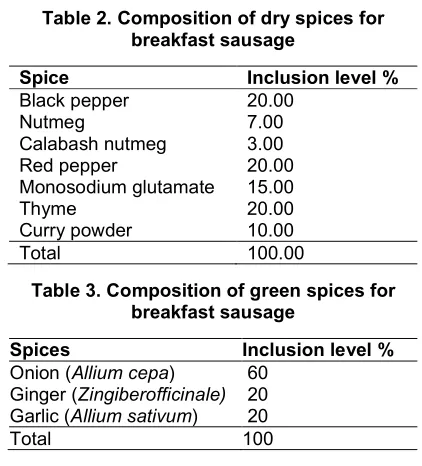
Salt, sodium nitrite, phosphate and sugar were dissolved in iced water, added to facilitate the mixing. The blended lard, soybean used as binder and dry spice (Table 2) were mixed. The green spices onion, ginger and garlic in ratio of 3:1:1 (Table 3) were finely chopped and ground for the preparation of green spice mixture. Green spice and dry spice mixture were poured simultaneously into the mixing bowl. All meat and non-meat ingredients were mixed together and ground again to desired consistency.
Table 1. Sausage composition
Ingredient Composition %
Beef 65.00
Lard 20.00
Binder 3.50
Curing salt * 2.00
Sugar 1.00
Phosphate 0.30 Ice water 4.00 Dry spices ** 2.00 Green spices *** 2.20
Total 100.00
* Sodium chloride and Sodium nitrite(99% and 1% respectively); ** Table 2; *** Table 3
The prepared sausage was stuffed into presoaked natural casing (pig intestine) that was presoaked in brine using an automated stuffer. The stuffed casings were divided into links (units) by twisting; each sausage link was 10 cm in length. The finished sausages were then packaged in Ziploc bags and frozen at -4°C.
2.3 Cooking Methods
water bath at three cooking temperature; 80, 90, and 100°C until internal temperature of 72°C was reached.
Table 2. Composition of dry spices for breakfast sausage
Spice Inclusion level %
Black pepper 20.00
Nutmeg 7.00
Calabash nutmeg 3.00 Red pepper 20.00 Monosodium glutamate 15.00
Thyme 20.00
Curry powder 10.00
Total 100.00
Table 3. Composition of green spices for breakfast sausage
Spices Inclusion level %
Onion (Allium cepa) 60 Ginger (Zingiberofficinale) 20 Garlic (Allium sativum) 20
Total 100
2.4 Amino Acid Composition
Essential amino acids were determined by the spectrophotometric method using Ninhydrin chemical reaction according to Moore and Stein [11].
2.5 Determination of Proximate
Composition
Proximate composition was done according to the procedure of [12].
2.6 Experimental Design
3 X 3 factorial arrangement in complete randomized design.
2.7 Statistical Analysis
Data were subjected to analysis of variance using [13]. Means were separated using Duncan’s Multiple Range Test option of the same software.
3. RESULTS AND DISCUSSION
3.1 Essential Amino Acid Score of Breakfast Sausage
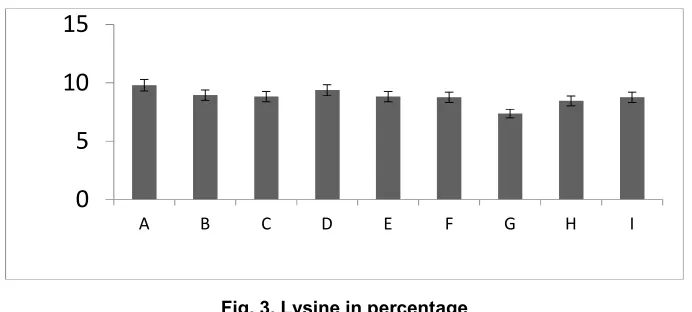
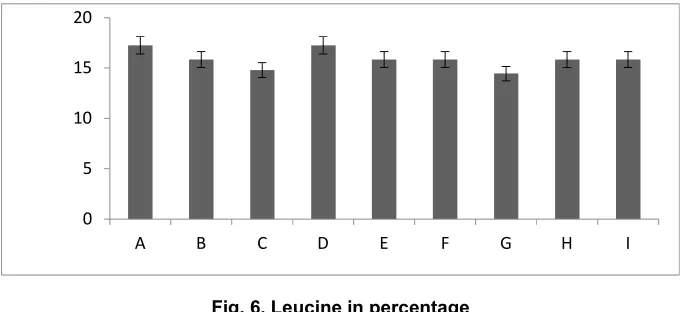
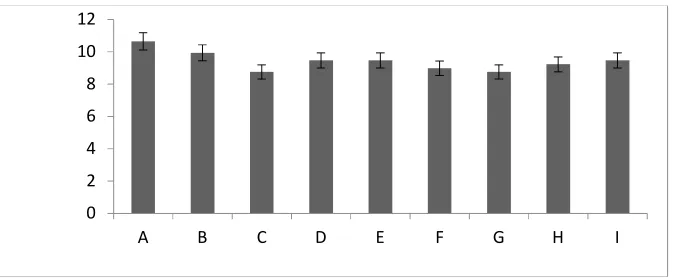
Presented in Figs. 1 to 12 was the essential amino acid profile of breakfast sausage cooked at different temperatures. From the result, it was
observed that grilled sausage at 80°C had the
highest total amino acid profile (3.2%), followed by fried sausage at 80°C (2.8%) while boiled sausage at 80°C had the lowest
value (2.5%).
Grilled sausage had highest amino acid profile among the three different cooking
methods (Fig. 2), followed by frying while boiling had the lowest rating. This could be due to higher water content found in boiled
sausage. Water molecules are highly polar and attracted to the muscle proteins by ionisable basic and acidic groups such as arginine,
histidine, lysine, glutamic acid. The meat protein was denatured by heat and a part of its
ionized basic or acid groups were broken. The
possible reason for this might be that the high temperature caused rapid denaturation of
meat protein when compared with low
temperature, resulting in loss of more water molecules [14]. Although, the boiling of
meat at 90 and 100°C showed increased amino acid contents when compared with that of 80°C. Boiling resulted in denaturation of proteins in meat and the denatured meat proteins could be easily hydrolyzed. When dissolved in hydrochloric acid for determination of amino
acids, the meat boiled for longer time with high content of denatured proteins easily
hydrolyzed resulting in high amino acid contents
than when boiled for shorter time. This perhaps accounted for the increased amino acid
contents with increase in boiling time. However, prolonged boiling at 100°C resulted in more protein loss in meat and therefore the amino acid contents in meat boiled for 100°C were less than that of meat boiled for 90°C. This observation agreed with that of [15] that an endothermic transition at a temperature range of 59.6 to 68.4°C for collagen in chicken breast patties resulted in an increase of soluble protein. The soluble protein dissolved in water causing decrease in protein content of chicken breast patties.
The amino acid score of breakfast sausage decreased with increased grilling and frying temperature. The possible reason is that grilling and frying led to formation of heterocyclic
aromatic amines [16] and a hard and dry surface on the meat [17], which made the meat proteins difficult to hydrolyze during amino acid analysis [18] and caused the meats
Fig. 1. Phenylalanine in percentage
A= Grilling 80°C, Grilling B= 90°C, C= Grilling 100°C, D= Frying 80°C, E= Frying 90°C, F= Frying 100°C, G= Boiling 80°C, H= Boiling 90°C, I= Boiling 100°C
Fig. 2. Isoleucine in percentage
A= Grilling 80°C, Grilling B= 90°C, C= Grilling 100°C, D= Frying 80°C, E= Frying 90°C, F= Frying 100°C, G= Boiling 80°C, H= Boiling 90°C, I= Boiling 100°C
Fig. 3. Lysine in percentage
A= Grilling 80°C, Grilling B= 90°C, C= Grilling 100°C, D= Frying 80°C, E= Frying 90°C, F= Frying 100°C, G= Boiling 80°C, H= Boiling 90°C, I= Boiling 100°C
3.2 Proximate Composition of Breakfast
Sausage Cooked at Different
Temperature
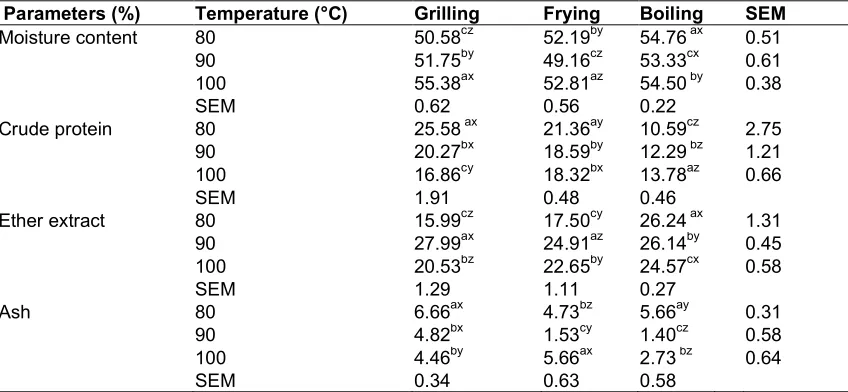
The summary presented in Table 4 gives the proximate composition of breakfast sausage
cooked at different temperature. The moisture content ranged from 49.16% to 55.38%. Grilled sausage at 800C had the highest crude protein (25.58%) followed by fried sausage (21.36%) with least crude protein in boiling (10.59%). The fat content of proximate composition of breakfast 0
2 4 6 8 10
A B C D E F G H I
0 5 10 15 20 25 30
A B C D E F G H I
0
5
10
15
sausage cooked at different temperature revealed significant differences in fat content but was not following a consistent pattern. The least fat content was recorded for sausage grilled at
80°C (15.99%).The ash content were statistically (p<0.05) different. Grilled sausage at 80°C had the highest ash content (6.66%) with least ash content in boiled sausage at 90°C (1.40%).
Fig. 4. Histidine in percentage
A= Grilling 80°C, Grilling B= 90°C, C= Grilling 100°C, D= Frying 80°C, E= Frying 90°C, F= Frying 100°C, G= Boiling 80°C, H= Boiling 90°C, I= Boiling 100°C
Fig. 5. Methionine in percentage
A= Grilling 80°C, Grilling B= 90°C, C= Grilling 100°C, D= Frying 80°C, E= Frying 90°C, F= Frying 100°C, G= Boiling 80°C, H= Boiling 90°C, I= Boiling 100°C
Fig. 6. Leucine in percentage
A= Grilling 80°C, Grilling B= 90°C, C= Grilling 100°C, D= Frying 80°C, E= Frying 90°C, F= Frying 100°C, G= Boiling 80°C, H= Boiling 90°C, I= Boiling 100°C
0 1 2 3 4 5 6
A B C D E F G H I
0 5 10 15 20
A B C D E F G H I
0 5 10 15 20
Fig. 7. Valine in percentage
A= Grilling 80°C, Grilling B= 90°C, C= Grilling 100°C, D= Frying 80°C, E= Frying 90°C, F= Frying 100°C, G= Boiling 80°C, H= Boiling 90°C, I= Boiling 100°C
Fig. 8. Tryptophan in percentage
A= Grilling 80°C, Grilling B= 90°C, C= Grilling 100°C, D= Frying 80°C, E= Frying 90°C, F= Frying 100°C, G= Boiling 80°C, H= Boiling 90°C, I= Boiling 100°C
Fig. 9. Alanine in percentage
A= Grilling 80°C, Grilling B= 90°C, C= Grilling 100°C, D= Frying 80°C, E= Frying 90°C, F= Frying 100°C, G= Boiling 80°C, H= Boiling 90°C, I= Boiling 100°C
3.2.1 Moisture content
The moisture content of breakfast sausage at 80 and 90°C across the cooking methods was significantly higher at 54.76 and 53.33%,
respectively while grilled sausage recorded highest moisture content at 100°C as shown in Table 4. This revealed that boiling had less influence on moisture content of breakfast sausage cooked at difference
0 2 4 6 8 10 12
A B C D E F G H I
0 2 4 6 8 10 12
A B C D E F G H I
0 2 4 6 8 10 12
temperature compared to grilling and frying that resulted in severe moisture loss
depending on the temperature and cooking time.
Fig. 10. Threonine in percentage
A= Grilling 80°C, Grilling B= 90°C, C= Grilling 100°C, D= Frying 80°C, E= Frying 90°C, F= Frying 100°C, G= Boiling 80°C, H= Boiling 90°C, I= Boiling 100°C
Fig. 11. Cycteine in percentage
A= Grilling 80°C, Grilling B= 90°C, C= Grilling 100°C, D= Frying 80°C, E= Frying 90°C, F= Frying 100°C, G= Boiling 80°C, H= Boiling 90°C, I= Boiling 100°C
Fig. 12. Essential amino acid score of breakfast sausage cooked at different temperature 0
2 4 6 8 10 12 14
A B C D E F G H I
0 0.2 0.4 0.6 0.8 1 1.2 1.4 1.6
Table 4. Proximate composition of breakfast sausage cooked at different temperature
Parameters (%) Temperature (°C) Grilling Frying Boiling SEM Moisture content 80 50.58cz 52.19by 54.76 ax 0.51
90 51.75by 49.16cz 53.33cx 0.61
100 55.38ax 52.81az 54.50 by 0.38
SEM 0.62 0.56 0.22
Crude protein 80 25.58 ax 21.36ay 10.59cz 2.75
90 20.27bx 18.59by 12.29 bz 1.21
100 16.86cy 18.32bx 13.78az 0.66
SEM 1.91 0.48 0.46
Ether extract 80 15.99cz 17.50cy 26.24 ax 1.31
90 27.99ax 24.91az 26.14by 0.45
100 20.53bz 22.65by 24.57cx 0.58
SEM 1.29 1.11 0.27
Ash 80 6.66ax 4.73bz 5.66ay 0.31
90 4.82bx 1.53cy 1.40cz 0.58
100 4.46by 5.66ax 2.73 bz 0.64
SEM 0.34 0.63 0.58
xyz...
Means on the same column with different superscripts are significantly different (p<0.05); abc... Means on the same row with different superscripts are significantly different (p<0.05); SEM: standard error mean
3.2.2 Crude protein
Crude protein of breakfast sausage cooked at different temperature revealed that, sausage grilled at 80°C had the highest value (25.58%) as shown in Table 4, followed by frying (21.36%) with least value observed for boiling (10.59%). The crude protein values revealed that as the cooking temperature increased, there was decreased crude protein in grilled and fried breakfast sausage while the reverse was the case for boiling. This could be as a result of protein denaturation ability of high temperature, time and the amount of water loss during cooking.
3.2.3 Ether extract and ash content
The fat content of breakfast sausage cooked at different temperature revealed significant
differences but did not follow a consistent pattern. The least fat content (15.99%) was recorded for grilled sausage at 80°C while ash content was (p<0.05) different as shown in Table 4, which followed the same pattern with crude protein. Grilling at 80°C had the highest value for ash which could be as a result of water loss, impact of temperature and cooking time. Since microwave cooking and grilling proceed in the absence of water (dry cooking methods), these cooking methods allowed for a high retention of ash than boiling (wet cooking method). Dal et al. [19] also found a decreased in ash content of rabbit meat after boiling and roasting. Similar ash
values for cooked meat (1.3 to 1.9 g/100 g) were reported by Farfán and Sammán [20].
4. CONCLUSION
Breakfast sausage grilled at 800C had the highest essential amino acid scores, crude protein and ash.
ACKNOWLEDGEMENTS
I acknowleged the technologies of the Animal Science Department of University of Ibadan, who provided assistance in the laboratory. There is no sponsors involvement to the authors for this study.
COMPETING INTERESTS
Authors have declared that no competing interests exist.
REFERENCES
1. Brown A. Understanding food: Principles and preparation: 2nd Edition Thomson Warsworth, Belmont; 2004.
2. FAO. Small-scale sausage production, food and agriculture organization of the United Nation, Rome. ISBN:92-5-102187-2; 2007.
4. Mora B, Curti E, Vittadini E, Barbanti D. Effect of different air/steam convection cooking methods on turkey breast meat: Physical characterization, water status and sensory properties. Meat Science. 2011; 88:489–497.
DOI:10.1016/j.meatsci.2011.01.033 5. Tornberg E. Effects on heat on meat
proteins-Implications on structure and quality of meat products. Meat Science. 2005;70:493–508.
DOI: 10.1016/j.meatsci.2004.11.021 6. Alfaia CMM, Alves SPA, Lopes AF,
Fernandes MJE, Costa ASH, Castro MLF, Fontes CMGA, Bessa RJB, Prates JAM. Effect of household cooking methods on fatty acids, conjugated isomers of linoleic acid and nutritional quality of beef intramuscular fat. Meat Science. 2010;84:769–777.
DOI: 10.1016/j.meatsci.2009.11.014 7. Christensen M, Purslow PP, Larsen LM.
The effect of cooking temperature on mechanical properties of whole meat, single muscle fibres and perimysial connective tissue. Meat Science. 2000;55: 301–307.
8. Chiavaro E, Rinaldi M, Vittadini E, Barbanti D. Cooking of pork longissimusdorsi at different temperature and relative humidity values: Effects on selected physico-chemical properties. Journal of Food Engineering. 2009;93:158−165.
9. Offer G. Progress in the biochemistry, physiology and structure of meat. Proceedings from the 30th European meeting of meat research workers, Bristol. 1984;87–93.
10. Wilkinson BHP, Lee E, Purchas RW, Morel PCH. The retention and recovery of amino acids from pork longissimus muscle following cooking to either 60°C or 75°C. Meat Science. 2014;96:361–365.
DOI: 10.1016/j.meatsci.2013.07.019 11. Moore S, Stein WH. A modified ninhydrin
reagent for the photometric determination
of amino acids and related compound. J. biol. chem. 1954;211:907-913.
12. AOAC, (Official Methods of Analysis. Association of Official Analytical Chemists, Washington D.C; 2016.
13. SAS. Statistical Analysis System Institute, User's Guide. 6th Edn. SAS Institute, North Carolina, USA; 2010.
14. Skog K, Steineck G, Augustsson K, Gerstad JM. Effect of cooking temperature on the formation of heterocyclic amines in fried meat products and pan residues. Carcinogenesis. 1995;16:861-867.
15. Murphy EW, Criner PE, Gray BC. Comparisons of methods for calculating retentions of nutrients in cooked foods. Journal of Agricultural Food Chemistry. 2008;23:1153–1157.
Available:https://doi.org/10.1021/jf60202a0 21
16. Oz F, Kaban G, Kaya M. Effects of cooking methods on the formation of heterocyclic aromatic amines of two different species trout. Food Chem. 2007;104:67-72. DOI: 10.1016/j.foodchem.2006.10.075 17. Fillion L, Henry C. Nutrient losses and
gains during frying: a review. Int. J. Food Sci. Nutr. 1998;49:157-168.
18. Yu TH, Wu CM, Ho CT. Volatile compounds of deep-oil fried, microwave-heated and oven-baked garlic slices. J. Agric. Food Chem., 1993;41:800-805. Available:https://doi.org/10.1021/jf00029a0 23
19. Dal Bosco AD, Castellini C, Bernardini M. Nutritional quality of rabbit meat as affected by cooking procedure and dietary vitamin E. Sensory and Nutritive Qualities of Food. 2001;66:1047–1051.
Available:https://doi.org/10.1111/j.1365-2621.2001.tb08233.x
20. Farfán NB, Sammán N. Retention of nutrients in processed cuts of Creole cattle. Journal of Food Composition and Analysis. 2003;16:459–468.
Available:http://www.redalyc.org/articulo.oa ?id=395940090024
© 2019 Oshibanjo et al.; This is an Open Access article distributed under the terms of the Creative Commons Attribution License (http://creativecommons.org/licenses/by/4.0), which permits unrestricted use, distribution, and reproduction in any medium, provided the original work is properly cited.
Peer-review history: