The role of segment interactions in pattern recognition between random
heteropolymers and disordered surfaces
Simcha Srebnika)
Department of Chemical Engineering, University of California, Berkeley, California 94720
共Received 22 November 1999; accepted 2 March 2000兲
Recent studies have shown that preferential adsorption of random heteropolymers on disordered multifunctional surfaces occurs when the statistics describing the monomer sequence and the statistics describing the distribution of sites on the surface are matched in a certain way. The polymers undergo a sharp transition from weak to strong adsorption, indicative of pattern recognition. In this work, we continue to study the behavior of random heteropolymers as they adsorb on disordered surfaces using a nonreplica mean-field model that accounts for distinct and competitive interactions both among the polymer segments as well as between the polymer segments and sites on the surface. We find that strong interactions between polymer segments and between segments and sites on the surface are dominated by energetically favorable contacts among the segments and between segments and surface sites, respectively. Our results indicate that the polymers strongly adsorb in conformations that allow for a very small number of contacts between the segments, implying that the polymers strongly adsorb in relatively flat and stretched conformations. © 2000 American Institute of Physics.关S0021-9606共00兲51620-1兴
I. INTRODUCTION
In the past several years, various experimental and the-oretical efforts have been made to understand pattern recog-nition in macromolecules 共see Ref. 1 for a review兲. Pattern recognition is an essential mechanism in many biological processes. For example, the specific sequence of amino acids of a protein is recognized by cell or virus surfaces also bear-ing a specific pattern of receptors.2–6 Through recognition, specific biological processes are carried out. In this article, we investigate some properties of such biological systems that can be exploited in synthetic systems. A coarse-grained picture of biopolymers and biological surfaces reveals spe-cific but aperiodic patterns of the multiple functional groups.7,8Thus, one possible speculation is that two ingredi-ents necessary for recognition in macromolecules could be multifunctionality 共two or more different monomers units兲 and a monomer sequence that exhibits a quenched disorder. The simplest macromolecules that bear these two features are random heteropolymers 共RHPs兲, which are synthetic poly-mers made up of two or more chemically different monomer units that are distributed along the chain backbone in a ran-dom sequence. However, unlike proteins that bear a specific pattern of the amino acid residues, the pattern of the mono-mers along the chain backbone of RHPs is statistical.
Adsorption studies of RHPs on statistically disordered surfaces suggest that these systems show pattern recognition similar to that seen in biological systems. The polymers un-dergo a sharp transition from weak to strong adsorption at a surface characterized by a certain statistical distribution of adsorbing sites, and thus are able to discriminate between surfaces.9–13 Very recently, kinetic studies of pattern
recog-nition have shown that disordered heteropolymers with cer-tain statistics will quickly find a compatible pattern-matched region on the surface and will strongly adsorb on that region.14 Such studies raise obvious possibilities for design-ing surfaces that can ‘‘recognize’’ statistical patterns of syn-thetic RHPs and adsorb them strongly. This may be profit-ably exploited in a range of applications including the development of sensors, viral inhibition agents,2–5 chromato-graphic materials,3and molecular templates.15–18
In this article, we explore the role of multifunctionality and quenched disorder in pattern recognition using a simple analytical theory. The model was first introduced in this con-text by Chakraborty et al.12 to study pattern recognition be-tween ideal RHPs 共theta solvent conditions兲and multifunc-tional disordered surfaces. In this work, we generalize the model to RHPs with distinct and competitive interactions among the segments. We model RHPs with two different types of monomer units, where similar segments form ener-getically favorable contacts and different segments form en-ergetically unfavorable contacts. In addition, the monomers interact with the different sites on the surface to form ener-getically favorable or unfavorably contacts. Kinetic studies of pattern recognition between RHPs and disordered surfaces have found that although the RHPs will adsorb on nonpattern-matched regions of the surface, these states are short-lived compared with the strongly adsorbed, pattern matched states共these results are relevant for surface interac-tions on the order of kT).14 Therefore, once formed, the energetically favorable contacts do not fluctuate for time scales relevant to our problem.
Analysis of the four different types of contacts around the adsorption transition suggests the conformations that the polymers adopt at the adsorbed and desorbed states. This analytical approach also enables separate calculations of the
a兲Correspondence should be sent to Division of Environmental Chemistry– School of Applied Science, Hebrew University, Jerusalem 91904, Israel.
9655
energy and the entropy gaps between the desorbed and ad-sorbed states of the RHPs separately, revealing the thermo-dynamic state of the RHPs in the vicinity of the adsorption transition. We find that when interactions among segments are weak, the bare polymer is free to fluctuate among many conformations ruled mostly by unfavorable contacts among the segments. In this situation, increasing surface disorder strengths are needed to strongly adsorb the polymer as the interactions among the segments are increased. Furthermore, the strongly adsorbed RHPs have only a few interactions among the polymer segments, suggesting that the RHPs ad-sorb in flat and stretched conformations. Conversely, when the interactions among the polymer segments are very strong, the RHP is in a low entropy state in absence of the surface, and thus it undergoes the adsorption transition at lower surface site coverage with increasing interactions among the segments. This explains phenomena seen earlier in MC simulations, where the competition between interac-tions among the polymer segments and interacinterac-tions between the surface and the segments resulted in a nonmonotonic plot of the adsorbed fraction of monomers as a function of inter-actions among segments.13
The article is organized as follows. In Sec. II we develop the model. In Sec. III we analyze and discuss our results. We summarize and conclude in Sec. IV.
II. MODEL DEVELOPMENT
We consider a model of two-letter RHPs with symmetric compositions and short-range correlation for sequence fluc-tuations. The specific interactions among the polymer seg-ments are measured by the parameter b. We take b to be less than zero, which is tantamount to Flory’s chi parameter,F,
being greater than zero, and discourages A – B contacts in the absence of the surface. In other words, A – A and B – B inter-actions lead to good contacts which are energetically favor-able, and A – B interactions lead to energetically unfavorfavor-able, or bad contacts. We study the behavior of an infinitely dilute solution of such RHPs as it interacts with a disordered mul-tifunctional surface. We model a surface that is overall neu-tral and has two types of adsorbing sites that are randomly distributed. Such surfaces can be characterized statistically and are relatively easy to prepare.2–6,19One type of site in-teracts favorably with A-type segments and unfavorably with B-type segments, while the other types of site interacts fa-vorably with B-type segments and unfafa-vorably with A-type segments. Therefore, we can characterize the system by four types of contacts: energetically favorable 共or good兲and en-ergetically unfavorable 共or bad兲 contacts between the RHP segments and surface sites, an contacts formed among the RHP segments. The fluctuations of good contacts are consid-ered negligible for time scales considconsid-ered in this problem.
A. Energy
For a given number of total contacts with the surface, p, of which q are good, and total number of contacts due to interactions among the segments, p
⬘
, of which q⬘
are good, the energy isE
kBT⫽
q␦E⫹pE1⫹q
⬘
␦E⬘
⫹p⬘
E1⬘
, 共1兲where kB is Boltzmann’s constant, T is the temperature, ␦E
and ␦E
⬘
are the energy differences between good and bad segment–surface and segment–segment contacts, respec-tively, E1 and E1⬘
are energies that correspond to badsegment–surface and segment–segment contacts, respec-tively. E1
⬘
and ␦E⬘
can be related to the distinct segment interaction parameter, b. By definition, b⫽(VAA⫹VBB⫺2VAB)/4, where Vi j are the interactions between i and
j-type segments. For our model of RHPs, VAA and VBB are
energetically favorable while VAB is unfavorable (b⬍0), or
in the notation of Eq.共1兲, b⫽(E0
⬘
⫹E0⬘
⫺2E1⬘
)/4, where E0⬘
is the energy of making good segment–segment contacts. Since⌬E
⬘
⫽E0⬘
⫺E1⬘
, then b⫽12␦E
⬘
. We consider the case ofVAB⫽⫺VAA⫽⫺VBB, for which E1
⬘
⫽⫺E0⬘
⫽⫺b. Thus, wecan rewrite the energy as
E
kBT
⫽q␦E⫹pE1⫹2q
⬘
b⫺p⬘
b. 共2兲B. Entropy
In order to obtain an expression for the entropy, we must consider two general coexisting factors: the entropy loss that is due to adsorption onto sites on the surface, and the entropy loss that is due to the propensity to form segment–segment contacts. Chakraborty et al.12 derived an expression for the entropy loss共as a function of p and q兲due to the adsorption of the different polymer segments onto sites on the surface. Our model builds upon the above derivations and accounts for contacts formed due to specific interactions among the segments. We find an interesting dependence of the pattern recognition transition observed between RHPs and disor-dered surfaces on the interactions among the polymer seg-ments.
The contributions to the entropy can be divided into three main categories: the entropy of mixing, the entropy of adsorption, and the loop entropy. These different contribu-tions are discussed below.
共a兲The entropy of mixing, Smix, is the entropy
associ-ated with having p out of N segments on the surface, as well as having 2 p
⬘
polymer segments form p⬘
contacts away from the surface. In the limit of a long polymer chain, Smix,is given by
Smix
N ⫽⫺¯ ln pp ¯⫺共1⫺¯p兲ln共1⫺¯p兲⫺¯p
⬘
ln共2 p¯⬘
兲⫺共1⫺2 p¯
⬘
兲ln共1⫺2 p¯⬘
兲⫺¯p⬘
, 共3兲where p¯⫽p/N and p¯
⬘
⫽p⬘
/N. The first two terms account for contacts made with the surface and the remaining terms account for the formation of contacts due to interactions among the polymer segment.共b兲The entropy loss due to the adsorption of p segments on sites on the surface, Sads, involves two terms. First, there
loga-rithm of the surface site loading共given by12兲is necessary since the segments are only allowed to adsorb on sites on the surface.12 Thus,
Sads
N ⫽⫺p¯⫺共¯p⫺¯q兲ln
冉
12
l2
a
冊
, 共4兲where depends on the stiffness of the polymer and on conformational changes resulting from adsorption,20 l is the Kuhn segment length, and a is a constant.
共c兲Lastly, the loop entropy, Sloop, is the entropy
associ-ated with the formation of loops that begin and terminate on the surface, and loops that result from contacts among the polymer segments. The derivation of the former contribution to the loop entropy is described in detail in Ref. 12. Essen-tially, the two kinds of contacts with the surface, good and bad, lead to two kinds of loops when the chain is adsorbed. Since good contacts are formed by energetically favorable interactions with the surface, certain polymer segments must adsorb onto particular sites on the surface in making these contacts. Good contacts, therefore, are constrained by the surface and polymer disorder statistics, forming ‘‘quenched’’ surface loops. Loops formed through other contacts with the surface fluctuate freely by sampling many loop lengths and end-to-end distances on the surface; they are unconstrained and thus can anneal. These annealed surface loops fluctuate within the quenched surface loops with an unconstrained re-distribution and with the same concentration within each quenched surface loop.
In an analogous manner to the formation of surface loops, there is a loop entropy loss due to the formation of two kinds of loops associated with making contacts among the segments.21 Energetically favorable contacts form when segments of the same type interact. These contacts are con-strained only by the statistics determining the distribution of the different segment types along the chain backbone. Loops formed through these contacts do not fluctuate. Other types of contacts between segments are not energetically favorable, and are thus free to fluctuate, or anneal. The loop factor, P
⬘
, for a polymer chain of length n⬘
with an end-to-end distance d⬘
between two good contacts is easily derived to be22P
⬘
共n⬘
,d⬘
兲⫽ cn
⬘
3/2exp冋
⫺3d
⬘
2n
⬘
l2册
, 共5兲where c is a constant that depends on chain flexibility. The average loop length, n
⬘
, is simply the total number of seg-ments, N, divided by the number of good contacts, q⬘
. The distance of d⬘
depends on the sequence statistics since the contacts defining the two ‘‘loop’’ ends must be energetically favorable. The simplest case is of a Gaussian chain with short-ranged sequence correlation, d⬘
⬀n⬘
1/2l/22, where 22 is the variance in the polymer segment sequence distribution and equals 4 f (1⫺f ). For a symmetric distribution, f⫽1/2 and 22⫽1. Substituting expressions for n⬘
and d⬘
into Eq.共4兲, we can calculate the quenched loop entropy for q
⬘
loops asSq
⬘
N⫽¯ lnq 共Cq¯
⬘
3/2兲⫺3a
⬘
2
4 , 共6兲
where a
⬘
is a constant of proportionality.Unfavorable contacts among the segments form fluctu-ating annealed loops that are unconstrained共apart for a fixed total chain length兲, and are thus homopolymeric in nature. Hence, within the mean-field approximation, the entropy of formation of these ‘‘bad’’ contacts among the RHP segments can be calculated as the entropy of a homopolymer in the presence of a uniform external field that forces pa
⬘
contacts. For the present problem, pa⬘
is the number of energetically unfavorable contacts among the polymer segments and equals ( p⬘
⫺q⬘
). Grosberg et al.23studied the homopolymer problem, and found the entropy to scale as N2/3B4/3, where B is the second virial coefficient. In addition, they showed that the number of binary collisions scales as N1/2B. Combining these two results we can thus relate the annealed loop en-tropy, Sa⬘
, to the number of bad contacts forming such loops, pa⬘
, and find thatSa
⬘
⫽k pa⬘
4/3, 共7兲where k is a constant of proportionality.
The expression for the overall entropy loss is obtained by combining the entropy contributions of making the vari-ous types of loops on and away from the surface. To begin, we assume that within the quenched looped formed by good contacts with the surface live annealed loops that are formed by making bad contacts with the surface. We also assume that both quenched and annealed loops that are formed through contacts among the segments live within the quenched surface loops. Apart from the constraint of a fixed total chain length, the distribution of annealed segment loops and annealed segment–segment loops living in the quenched surface loops is unconstrained. This implies that the concen-tration of the different annealed loops is the same in each quenched surface loop. We can thus approximate the total loop probability factor for a quenched loop on the surface with annealed surface loops, annealed segment–segment loops, and quenched segment–segment loops living within it. The resulting expression for the entropy that accounts for all loop types is
Sloop
N ⫽¯ lnq 共cq¯
3/2兲⫹S
a共¯p⫺¯q兲⫺
aq¯2
2l212
⫹¯q
⬘
ln共cq¯3/2兲⫺3a⬘
2
4 ⫹Sa
⬘
共¯p⬘
⫺¯q⬘
兲, 共8兲where the first two terms are the entropy of quenched and annealed surface loops derived in Ref. 12, respectively.
C. Free energy
F
NkBT⫽
p
¯共E1⫹兲⫹¯q␦E⫺¯p
⬘
b⫹2q¯⬘
b⫹¯ ln pp ¯⫹共1⫺¯p兲ln共1⫺¯p兲⫹¯p
⬘
ln共2 p¯⬘
兲⫹共1⫺2 p¯
⬘
兲ln共1⫺2 p¯⬘
兲⫹¯p⬘
⫹¯p⫺共¯p⫺¯q兲⫻ln
冉
12l2
a
冊
⫹¯ lnq 共cq¯3/2兲⫺S
a共¯p⫺¯q兲⫹
aq¯2
2l212
⫺¯q
⬘
ln共cq¯⬘
3/2兲⫹3a⬘
2
4⫺k共¯p
⬘
⫺¯q⬘
兲4/3. 共9兲
The good and bad contacts with the surface sites 共among segments兲 are related by the probabilities of forming good surface 共segment兲contacts, as follows:
q
¯共
⬘
兲⫽Pg共⬘
兲¯p共⬘
兲, 共10兲where
P共g
⬘
兲⫽Pg共⬘
兲⬁ e⫺Fq共⬘兲
Pg共
⬘
兲⬁e⫺Fq共⬘兲⫹共1⫺P g共
⬘
兲⬁兲e⫺Fa共⬘兲. 共11兲Pg(
⬘
)⬁ is the probability of making a good contact at infinite temperature and is related to the surface共sequence兲statistics共see Ref. 12 for a deeper discussion of Pg⬁). For the present model, Pg
⬘
⬁ is simply equal to f, the fraction of A-type seg-ments since we are considering RHPs made up of chemically uncorrelated monomer units. Fq⬘
and Fa⬘
are the free energiesassociated with making quenched and annealed contacts among the segments, respectively.
The final step in the derivation of the free energy is to relate the contacts formed among the segments to the con-tacts made with the surface. The number of concon-tacts made through interactions among the segments is probably not in-dependent of the contacts made with the surface since it is likely that as the chain adsorbs, some contacts between the segments will be broken and new ones will be formed. The relationship beween the different kinds of contacts is as fol-lows: For p adsorbed segments, the total number of contacts among the segments is the sum of the probability of making a contact between segments adsorbed on the surface (␣s)
times the number of segments on the surface, and the prob-ability of making a contact among the segments away from the surface (␣b) times the number of segments that are not
adsorbed. Symbolically, this is written as
p
⬘
⫽p␣s⫹共N⫺p兲␣b. 共12兲␣s and␣b can be approximated as the probabilities of
find-ing two adjacent segments on the surface and among the segments away from the surface, respectively. These prob-abilities are simply the square of the density of segments in each respective case. The mean densities of segments on the surface (s) and away from the surface (b) are
s⬇
p
A, 共13兲
b⬇
N⫺p
V , 共14兲
where A is the projected area of the polymer,Rg 2
, where Rg
is the radius of gyration of the free polymer, and V is the volume of the polymer, 4/3Rg3.
Minimization of the free energy density of Eq.共9兲with respect to p¯ must be carried out self-consistently. We obtain p
¯
⬘
, q¯⬘
, q¯ , and free energies that correspond to values of p¯ numerically for fixed values of the distinct segment interac-tion parameter, b, and surface site loading,12. We repeat the iteration procedure for various values of 1, b, and otherparameters (c,, l, etc.兲.
III. RESULTS AND DISCUSSION
Our analytical model enables us to evaluate the role of distinct and competitive interactions among the segments on the adsorption behavior of RHPs on multifunctional statisti-cally disordered surfaces. An explicit calculation of the en-tropy state of the RHP at different stages along the adsorp-tion transiadsorp-tion explains physical phenomena seen earlier using computer simulations.13It has already been established that the adsorption of RHPs on multifunctional surfaces oc-curs in two steps.9–13First, there is a continuous adsorption transition as the surface site loading is increased. This tran-sition is followed by a sharp trantran-sition from weak to strong adsorption of the RHP at a threshold value of the surface site loading, characteristic of a pattern recognition transition. We find that the types of contacts made 共energetically unfavor-able or favorunfavor-able contacts among segments and with surface sites兲at the different stages of the adsorption transition shed light on the conformational behavior of the polymer.
First, in Fig. 1 we show a typical adsorption curve pre-dicted by our model for fixed segment interaction parameter, b 共when b⫽0, results of Ref. 12 are reproduced兲. At small values of 1, there are a few sites on the surface. At this
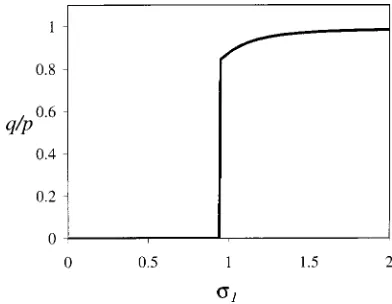
stage, the favorable interactions with the surface are not strong enough to overcome the entropy penalty of adsorp-tion, hence only a few segments if any adsorb. Therefore, for long chains, the fraction of good contacts with the surface is insignificant. Only after the RHP undergoes the sharp ad-FIG. 1. A typical plot of the fraction of total contacts with the surface that are good, q/ p, as a function of surface site density,1, for a fixed strength of distinct segment interactions 共in this case, b⫽⫺1). Other parameters have the following values in this and all other figures: ␦E⫽⫺2, ⑀E⬘
⫽2b, ⫹E1⫽1, E1⬘⫽⫺b, c⫽2, c⬘⫽2, al
2⫽4, a⬘⫽1, k⫽2, P g ⬁⫽P
g
⬘⬁
[image:4.612.338.534.50.202.2]sorption transition does the fraction of good contacts with the surface take on measurable values, and, in fact, the poly-mer’s adsorbed conformations are dictated by mostly good contacts with the surface. We also see that beyond the sharp transition q¯ /p¯ gradually approaches unity, suggesting that the polymer slowly folds into the most favorable adsorbed conformation. These results agree well with MC simulations, which predict a second continuous transition wherein the polymer freezes into a few conformations soon after the sharp adsorption transition.10,11,13 The effects of increasing the strength of interactions among the segments on the ad-sorption curves is discussed in the following paragraphs.
In Fig. 2 we plot the fraction of the total number of contacts formed among the segments that are good, q
⬘
/ p⬘
, as a function of the segment interactions parameter, b. Here, the variables are evaluated for small values of1, or when thereare a few sites on the surface, and the RHPs are not yet adsorbed. When兩b兩is small, corresponding to weak interac-tions among the segments, the fraction of contacts that are good is negligible. At a threshold value of 兩b兩, there is a sharp transition beyond which the majority of contacts made are good. Beyond the transition, the RHPs sample a few energetically favored conformations. As 兩b兩 is further in-creased, there is a continuous transition in which q
⬘
/ p⬘
ap-proaches unity and the RHPs slowly fold into the lowest energy state that is determined by the sequence statistics. Numerical calculations共not shown兲of p⬘
and q⬘
for values of 1 beyond the adsorption transition observed in Fig. 1,suggest that the total number of contacts formed among the segments is negligible for most values of b. At high surface site densities, the RHP is strongly adsorbed in conformations that are determined by the pattern of sites on the surface. The number of energetically favorable contacts with the surface is large and does not allow for the formation of many con-tacts among the polymer segments. Both nondynamic 共 un-published results兲 and dynamic simulations14 show that, in-deed, the RHPs strongly adsorb in relatively flat conformations such that contacts between the segments are physically hard to make.
In Fig. 3, a plot is shown of the surface site loading at which the sharp adsorption transition occurs, t, as a
func-tion of 兩b兩. The results are in good qualitative agreement
with simulation predictions by the authors 共see inset of Fig. 3兲.13We see an interference between the two frustrating me-diums,1and b. When the interactions among the segments
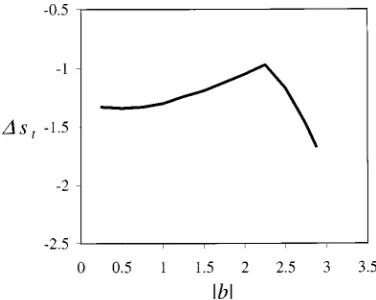
are weak, it becomes increasingly difficult to strongly adsorb the chain with increasing segment interaction strengths. For these values of兩b兩, the polymer adsorbs at increasing surface disorder strengths, which are needed to overcome the in-creasing interactions among the segments. However, for magnitudes of b exceeding the turning point seen in Fig. 3, the chain adsorbs more readily with increasing interaction strengths. A plot of the entropy gap between the states of the polymer before and after the sharp adsorption transition as a function of the magnitude of b clarifies the nonmonotonic behavior described above. By comparison with Fig. 3, we see that the maximum entropy gap in Fig. 4 corresponds to the magnitude of b at the turning point, btp, and the gap decreases with further increase of the interactions among the segments. Upon further comparison with Fig. 2, we see that btpis also the magnitude of the interaction between the
seg-ments required for the chain to undergo a sharp transition where mostly good contacts among the RHP segments are formed in absence of the surface. Therefore, for these mag-nitudes of b and beyond, the chain is already confined to a small number of conformations dictated by the strong seg-FIG. 2. Fraction of good segment–segment contacts, q⬘/ p⬘, as a function of
[image:5.612.76.272.51.203.2]the magnitude of the RHP segment interaction parameter, b.
FIG. 3. Density of sites at the sharp transition, t, as a function of the magnitude of the RHP segment interactions parameter, b; inset presents simulation results by the authors.
[image:5.612.348.530.54.205.2] [image:5.612.343.531.573.723.2]ment interactions even before it adsorbs. At this stage the entropy is already low, and therefore the penalty the RHPs experience upon adsorption is not very high. The favorable interactions made with the surface easily outweigh the lower entropy penalty, and the chain adsorbs more readily than for lower values of兩b兩.
IV. CONCLUSIONS
We studied the adsorption behavior of RHPs with dis-tinct and competitive interactions among the segments on disordered multifunctional surfaces. We presented a simple theory that accounts for the formation of four types of inter-actions. The segments of the RHPs interact favorably or un-favorably. Similarly, the polymer segments can adsorb onto sites of the surface through energetically favorable or unfa-vorable interactions. The theory allows for explicit calcula-tions of the relative fraction of these contacts as a function of the surface site loading and the strength of competitive inter-actions among the RHP segments 共as well as other param-eters of interest, e.g., chain flexibility, monomer size, etc.兲. Evaluation of the entropy gap between the strongly adsorbed state and the desorbed state of the RHPs explains the non-monotonic behavior seen in a plot of the magnitude of the polymer segment interactions as a function of the surface site loading at which the adsorption transition occurs. The pre-dicted adsorption behavior is in very good qualitative agree-ment with simulations.13 Furthermore, our results suggest that after the adsorption transition, the RHPs form many fa-vorable contacts with the surface but have a negligible num-ber of contacts among the segments. Therefore, when strongly adsorbed, the RHPs are found in flat and stretched conformations.
ACKNOWLEDGMENTS
The author acknowledges A. K. Chakraborty for guid-ance with this research. Financial support for this work was
provided by the National Science Foundation and the U.S.D.O.E. 共Basic Energy Sciences兲. Support from a NSF Doctoral fellowship is acknowledged.
1M. Muthukumar, Curr. Opin. Colloid Interface Sci. 3, 48共1998兲. 2A. Spalstein and G. M. Whitesides, J. Am. Chem. Soc. 113, 686共1991兲. 3
S. Mallik, S. D. Plunkett, P. K. Dhal, R. D. Johnson, D. Pack, D. Shnek, and F. H. Arnold, New J. Chim. 18, 299共1994兲.
4R. J. Todd, R. D. Johnson, and F. H. Arnold, J. Chromatogr., A 662, 13
共1994兲. 5
M. Mammen, G. Dahmann, and G. M. Whitesides, J. Med. Chem. 38, 4179共1995兲.
6R. D. Johnson, Z. G. Wang, and F. H. Arnold, J. Phys. Chem. 100, 5134
共1996兲.
7V. S. Pande, A. Yu. Grosberg, and T. Tanaka, Proc. Natl. Acad. Sci. USA
91, 12972共1994兲.
8A. Irba¨ck, C. Peterson, and F. Potthast, Proc. Natl. Acad. Sci. USA 91, 9533共1996兲.
9S. Srebnik, A. K. Chakraborty, and E. I. Shakhnovich, Phys. Rev. Lett. 77, 3157共1996兲.
10
D. Bratko, A. K. Chakraborty, and E. I. Shakhnovich, Chem. Phys. Lett.
280, 46共1997兲.
11D. Bratko, A. K. Chakraborty, and E. I. Shakhnovich, Comput. Theor. Polym. Sci. 8, 113共1998兲.
12
A. K. Chakraborty and D. Bratko, J. Chem. Phys. 108, 1676共1998兲. 13S. Srebnik, A. K. Chakraborty, and D. Bratko, J. Chem. Phys. 109, 6415
共1998兲.
14A. J. Golumbfskie, V. S. Pande, and A. K. Chakraborty, Proc. Natl. Acad. Sci. USA 96, 11707共1999兲.
15
S. Mann, S. L. Burkett, S. A. Davis, C. E. Fowler, N. H. Mendelson, S. D. Sims, D. Walsh, and N. T. Whilton, Chem. Mater. 9, 2300共1997兲. 16R. Makote and M. M. Collinson, Chem. Mater. 10, 2440共1998兲. 17E. Kra¨mer, S. Fo¨rster, C. Go¨ltner, and M. Antonietti, Langmuir 14, 2027
共1998兲.
18Y. Lu, G. Cao, R. P. Kale, S. Prabakar, G. P. Lo´pez, and C. J. Brinker, Chem. Mater. 11, 1223共兲1999.
19P. Berndt, G. B. Fields, and M. Tirrell, J. Am. Chem. Soc. 117, 9515
共1995兲. 20
C. A. J. Hoeve, E. A. DiMarzio, and P. Peyser, J. Chem. Phys. 42, 2558
共1965兲.
21We defined a ‘‘loop’’ of chain length n⬘as the distance along the chain backbone between two contacts among segments.
22S. Chandrasekhar, Rev. Mod. Phys. 15, 1共1943兲.
23A. Yu. Grosberg and A. R. Khokhlov, Statistical Physics of