This is an open access journal, and articles are distributed under the terms of the Creative Commons Attribution-Non Commercial-ShareAlike 4.0 License, which allows others to remix, tweak, and build upon the work non-commercially, as long as appropriate credit is given and the new creations are licensed under the identical terms.
© 2019 Journal of Advanced Pharmacy Education & Research | Published by SPER Publication
46
Effect of Quinoa seeds against Cisplatin toxicity in female rats
Hany Mohamed Ahmed Wahba
1*, Maha Hanafy Mahmoud
1, Hanaa Farouk El-Mehiry
21Nutrition and Food Science Dept., National Research Centre, 33 EL Bohouth St., Dokki, Giza, P.O.12622, Egypt. 2Home Economics Dept., Faculty of Specific
Education, Mansoura University, Egypt.
Correspondence:
Hany Mohamed Ahmed Wahba, Nutrition and Food Science Dept., National Research Centre, Dokki, Giza, Egypt. Email: [email protected]
ABSTRACT
Background and objectives: Cisplatin which is used widely for cancer patients as an effective chemotherapeutic drug was reported to exert many adverse effects on the body. This study aims to investigate the effect of quinoa seeds against cisplatin toxicity in female rats. Materials and methods: Thirty six female Wistar rats were used. Thirty of them were divided into five groups each of six rats and injected daily for 8 weeks intraperitoneally with cisplatin dose of 12 mg/kg b. wt./rat, while the remaining group was considered as the negative control and injected intraperitoneally by saline for the same period. The negative control group and the positive control group (injected with cisplatin) were fed on basal diet, the third, fourth, fifth and sixth groups were fed on basal diet + 10% or 20% or 30% or 40% quinoa seed powder, respectively. Results: The results revealed that rats consumed quinoa seed powder at different levels showed significant increase in concentration of serum testosterone, estrogen, follicle stimulating hormone (FSH) and luteinizing hormone (LH), compared to the positive control group. Also, administration of quinoa seed powder at different levels improved, lipid profile and antioxidant parameters in female rats. Conclusion: The quinoa seed powder is a potent polyphenol, mineral and vitamin rich source with great anti-inflammatory and antioxidant power which can be used to prepare a functional food that can counteract the symptoms of cisplatin toxicity and prevent its complications.
Keywords:Quinoa seeds, cisplatin, FSH, LH, testosterone, estrogen.
Introduction
Quinoa (Chenopodium Quinoa Willd) is a grain-like crop which is
traditionally used for nutrition and sustenance to Andean
indigenous cultures for centuries [1]. Recently, lights were
thrown on quinoa and it was described as “one of the 21st
century’s grains” as it is of a high nutritional value; it is a gluten
free and having therapeutic properties allowing it to be used as a
nutraceutical and a functional food [2]. The high nutritional value
of quinoa may be attributed to its unique chemical composition as it contains a protein of a high quantity and quality with a balanced essential amino acid pattern. Also, it contains vitamins such as vitamin E, C, B2, B6 and folic acid with relatively high
amounts [1]. Moreover, its mineral content is of a great value as
it contains calcium, magnesium, copper, iron, zinc and potassium with relatively high amounts compared to other grains and many of these minerals are of a good bioavailability
enough to form a balanced diet [3].
In addition to high nutritional value and being free of gluten, quinoa was also reported to have many health benefits. It can be used for both children and elderly, for lactose intolerance, those who are suffering from either anemia, or obesity, or diabetes or ciliac disease or dyslipidemia. It has a high antioxidant and anti-inflammatory potency and can be used as
anticancer, neuroprotective and immunomodulatory [1]. These
health benefits are due to its content of protein, minerals, vitamins and fiber in addition to its content of phytochemicals
and bioactive components [4]. Among the phytochemicals of
quioa are, It has been reported that quinoa is among the richest sources of phytoecdystroids containing from 138 to 570 µg/g. Phytoecdystroids are polyhydroxylated steroids involved in plant defense and they have a wide range of health benefits including anti-osteoporotic, anabolic performance enhancing,
anti-obesity and anti-diabetic [5].
Cisplatin is considered as one of the most potent chemotherapeutic drugs that is used widely with a high
successful rate for the treatment of different types of cancer [6]
including testicular cancer, ovarian cancer, soft tissue cancers, sarcoma cancers, cancers of muscles, bones and blood vessels
giving a very good prognosis [7, 8]. However, the use of cisplatin
has many side effects in the normal tissues. Among these side effects are sexual toxicity, hear losing (ototoxicity),
nephrotoxicity, neurotoxicity, nausea, vomiting,
myelosuppression and hepatotoxicity [6, 9, 10].
Access this article online
Website: www.japer.in E-ISSN: 2249-3379
How to cite this article: Hany Mohamed Ahmed Wahba, Maha Hanafy Mahmoud, Hanaa Farouk El-Mehiry. Effect of Quinoa seeds against Cisplatin toxicity in female rats. J Adv Pharm Edu Res 2019;9(3):46-52.
Journal of Advanced Pharmacy Education & Research | Jul-Sep 2019 | Vol 9 | Issue3 47
The aim of the present study is to investigate the effect of
quinoa seeds at different levels against cisplatin induced toxicity
in female rats.
Material and Methods
Materials
Quinoa seed (Chenopodium Quinoa Willd) was obtained from Agriculture Research Center, Giza, Egypt.
Experimental animals
Thirty six female Wistar rats weighing 125 ± 5 g were purchased from the Agricultural Research Centre, Giza, Egypt. Drugs and chemicals
Cisplatin solution (Platinol AQ) was obtained from Sigma-Aldrich Chemical Co. (St Louis, Mo, USA).
Kits used for determination of testosterone, estrogen, follicle stimulating, hormone (FSH) and luteinizing hormone (LH) based on ELISA technique were obtained from Fine Test, Wuhan Fine Biological Technology Co., Ltd., China. Diagnostic Kit used for estimation of plasma triacylglycerols was obtained from Stanbio Laboratory Company, Texas, (USA). Kits used for determination of total cholesterol, HDL-C, LDL-C in plasma were purchased from Chronolab Systems S.L., Barcelona, Spain. Kit used for cholinesterase detection was purchased from Quimica Clinic Aplicada S.A., Barcelona, Spain. Total antioxidant capacity (TAC) and superoxide dismutase (SOD) were measured with kits obtained from Biodiagnostic Co., Egypt.
Methods
Chemical analysisQuinoa seeds were analyzed for the moisture, protein, fat, ash, fiber and total carbohydrate contents as previously described in
AOAC [11].
Determination of some minerals
Some minerals content including zinc (Zn), calcium (Ca), magnesium (Mg) and iron (Fe) were determined in the diluted solution of ash using the atomic absorption spectrophotometer
(3300 Perkin-Elme) as described by AOAC [11]method.
Preliminary phytochemical screening of quinoa seed Detection of tannins and resins: Tannins and resins were
detected in the plant sample according to the method of
El-Badrawy [12].
Detection of saponins: Saponins were detected according to
the method of Trease [13].
Detection of terpenes: Terpenes were detected according
to the method of Finar[14].
Detection of flavonoids: Flavonoids were detected as
described in the method of Geissman[15].
Detection of carbohydrates and glycosides:
Carbohydrates and glycosides were detected by Molish test
according to the method of Blabaa, et al.[16].
Methods
Experimental design
Adult female Wistar rats were maintained under controlled hygienic conditions. The animal experiment was done in compliance with the Guidelines for animal Care and Ethics Committee of the NRC (Egypt). The weight of rats ranged
between120 to 140 g. The animals were allocated individually
in stainless steel cages. They were fed on the basal diet for 7 days before the beginning of the experiment for adaptation.
The basal diet which was prepared according to Reeves et
al.,[17]comprised of casein, corn starch, sucrose, cellulose, corn
oil, mineral mixture, vitamin mixture, DL-methionine and choline bitartarate (220, 539.5, 100, 50, 40, 35, 10, 3 and 2.5 g/kg) respectively, provided that protein content of casein was estimated as 54.6%. Animals were subjected to 12 hours light and 12 hours dark schedule. Then they were divided into six groups (6 rats each) and fed on the experimental diets for 8 weeks. The first group was kept as negative control group and fed on the basal diet only, while the other five groups were daily injected intraperitoneally with cisplatin in a dose of 12
mg/kg body weight according to Ateşşahin et al.,[18] to
induce toxicity. One of these groups was fed on basal diet only and served as positive control which was group 2. The third, fourth, fifth and sixth groups were fed on basal diet + either 10% or 20% or 30% or 40 quinoa seed powder, respectively. During the experimental period, the feed intake and the body weight were followed carefully and at the end of the experimental period, feed intake, body weight gain and feed efficiency ratio (FER) were calculated.
Biochemical analysis
After the end of the experimental period, overnight fasting blood samples were collected from suborbital vein. Serum was separated and kept at -70 Cº until analysis. Different biochemical parameters were analyzed as follows:
Determination of lipid profile
Serum total cholesterol (TC), triacylglycerols (TG) and high density lipoprotein-cholesterol (HDL-C) were determined as
described by Meiattini et al. [19], Scheletter and Nussel[20]
and Grove[21], respectively. However, low density
lipoprotein-cholesterol (LDL-C) was calculated according to Warnick et
al.[22] as shown in the following equation:
LDL-C = Total cholesterol – (HDL-C+ VLDL-C)
Where, VLDL-C (very low density lipoprotein-cholesterol) = Triacylglycerols /5
Determination of serum cholinesterase and antioxidant parameters
Cholinesterase (ChE) activity, superoxide dismutase (SOD)
activity and total antioxidant capacity (TAC) were determined
according to Knedel and Boottger[23], Nishikimi, et al.,[24]
and Koracevic, et al.[25], respectively.
Determination of serum sexual hormones
The concentration of serum testosterone, estrogen, follicle stimulating hormone (FSH) and Luteinizing hormone (LH) were determined by an enzyme-linked immunosorbent assay
(ELISA) technique according to manufacturer’s instructions
using ELISA Reader (ELISA Reader Model Start F, Awareness Technology, Inc., Palm City, FL, USA).
Statistical analysis
Data were analyzed statistically using the computerized
48 Journal of Advanced Pharmacy Education & Research | Jul-Sep 2019 | Vol 9 | Issue 3
Results and Discussion
Proximate composition on dry weight basis of
quinoa seed
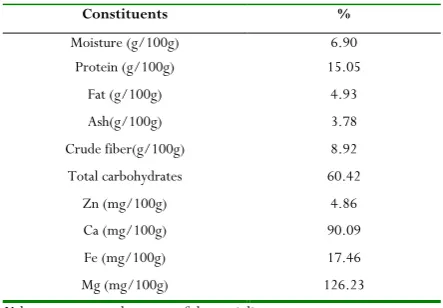
As shown in table (1) protein content (15.05 %) and total carbohydrates (60.42 %) were relatively high. The recorded values for fat, ash and fiber were; 4.93 %, 3.78 % and 8.92 %, respectively. Also, table (1) showed that quinoa seeds contain minerals as Mg, Ca, Fe and Zn (126.23, 90.09, 17.46 and 4.86 mg/100g, respectively). These results agreed more or less with
those found by Vilcacundo & Hernandez-Ledesma [1]. They also,
concluded from their study that protein and carbohydrate content of quinoa were relatively high compared with other cereals like rice and wheat. They added that quinoa seeds of high protein quality since it provides with many essential amino acids which meet the requirements for adults as stated by
WHO[26]. Regarding the mineral content of quinoa, it was said
to be of great importance since it contains not only relatively high amounts of calcium, magnesium, iron and zinc but also,
they are of good bioavailability [3].
Table 1: Proximate composition% on dry weight basis of quinoa seed
% Constituents
6.90 Moisture (g/100g)
15.05 Protein (g/100g)
4.93 Fat (g/100g)
3.78 Ash(g/100g)
8.92 Crude fiber(g/100g)
60.42 Total carbohydrates
4.86 Zn (mg/100g)
90.09 Ca (mg/100g)
17.46 Fe (mg/100g)
126.23 Mg (mg/100g)
Values are expressed as mean of three triplicates.
The phytochemical screening of quinoa seed
Data tabulated in Table (2) showed that quinoa seeds contained tannins, saponins, resins, terpenes and flavonoids. It was reported previously that quinoa seeds contain many bioactive components, among which are; saponins, terpenes, and flavonoids which seems to be in accordance with our findings
[1,4]. Among the phytochemical compounds in quinoa seeds, it
was said to contain phytosterols and phytoectysteroids [5, 27]. The
latter is found with the highest concentration in quinoa among all plants.
Table 2: Preliminary phytochemical screening of quinoa seed
Quinoa seed
Tannins Saponins Resins Terpenes Flavonoids
+ + + + +
Effect of different levels of quinoa seed
powder on feed intake, body weight gain and
FER
The positive control group, which is injected with cisplatin and not treated with quinoa seeds, showed significant decrease in
body weight gain, feed intake and FER compared to negative control group which may be due to the toxic effect of cisplatin (Table 3). Groups that received quinoa seed powder at different levels (10, 20, 30 and 40%) showed a significant improvement
in each of bodyweight gain, feed intake and feed efficiency ratio
(FER) compared to the positive control group. It is worth mentioning that the aforementioned parameters were more or less normalized in the two groups that received quinoa seeds powder at levels of 30% and 40% and they became insignificant with the control negative group. These results were in
agreement with those reported by Mladenovic et al.[28] &
Al-Shammar and El-Mehiry [29] who reported that the body
weight and feed intake of control positive group that was injected with cisplatin was significantly decreased as compared to the control negative group. They suggested that the differences in the food consumption pattern led to important differences in body weight gain at the end of experimental
period. Vega-Galvez [3] mentioned that quinoa is a very
nutritious source since it contains a good balance of carbohydrates, lipid, fiber, amino acids, minerals and vitamins. It seems that this may be the reason for restoring the reduction in body weight resulting from cisplatin injection.
Table 3: Body weight gain, feed intake and FER in all treated groups.
Groups body weight gain g
Feed intake
g/day FER
Negative control 103.01± 8.71 a 17.54±1.23 a 0.097±.008 a
Positive control 51.19 ±5.11 c 11.55±1.18 b 0.063±0.006 c
treated with quinoa
seed powder
10% 85.86 ±7.42 b 16.54±1.24 a 0.085±0.004 b
20% 93.72 ±7.31 b 16.63±1.27 a 0.083±0.002 b
30% 97.30 ±8.17 ab 17.12±1.71 a 0.091±0.002ab
40% 100.42 ±9.12 a 17.45±1.81 a 0.092±0.002 a
Values are represented by mean ± S.D. Mean values in each column having different superscript (a, b, c, d) are significant while, those that share similar superscripts are non-significant.
FER: Food efficiency ratio
Effect of different levels of quinoa seed
powder on lipids profile
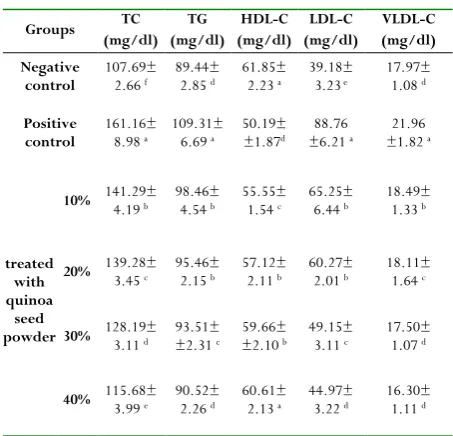
Table (4) showed that there was a significant increase of TC, TG, LDL-C and VLDL-C in positive control group when
compared to negative control group (p ˂0.05) while, a
Journal of Advanced Pharmacy Education & Research | Jul-Sep 2019 | Vol 9 | Issue3 49
the control positive group and the increase was gradual from the group of 10% up to the group that received the 40% quinoa seeds which become insignificantly changed compared to the negative control group. This can reflect the cardioprotective
effect of quinoa seed powder. Graf et al.,[30] mentioned that the
marked hypocholesterolemic effect of quinoa may be attributed to its content of saponins. Moreover, the fiber content of quinoa may contribute to its hypolipemic effect.
Table 4: Lipid profile of all treated groups.
Groups TC
(mg/dl) TG (mg/dl)
HDL-C (mg/dl)
LDL-C (mg/dl)
VLDL-C (mg/dl) Negative
control
107.69±
2.66 f 89.44± 2.85 d 61.85± 2.23 a 39.18±3.23 e 17.97±1.08 d
Positive control
161.16± 8.98 a
109.31± 6.69 a
50.19± ±1.87d
88.76 ±6.21 a
21.96 ±1.82 a
treated with quinoa
seed powder
10% 141.29± 4.19 b
98.46± 4.54 b
55.55± 1.54 c
65.25± 6.44 b
18.49± 1.33 b
20% 139.28± 3.45 c
95.46± 2.15 b
57.12± 2.11 b
60.27± 2.01 b
18.11± 1.64 c
30% 128.19±3.11 d 93.51± ±2.31 c 59.66± ±2.10 b 49.15± 3.11 c 17.50± 1.07 d
40% 115.68±3.99 e
90.52± 2.26 d
60.61± 2.13 a
44.97± 3.22 d
16.30± 1.11 d
Values are represented by mean ± S.D. Mean values in each column having different superscript (a, b, c, d, f) are significant while, those that share similar superscripts are non-significant. TC: total cholesterol, TG: total triglyceride, HDL-C: High density lipoprotein cholesterol, LDL-C: Low density lipoprotein cholesterol VLDL-C: very low density lipoprotein cholesterol
Effect of different levels of quinoa seed
powder on antioxidant parameters and
cholinesterase
Table (5) showed the effect of quinoa seed at different levels on total antioxidant capacity (TAC); activity of superoxide dismutase (SOD) and serum cholinesterase activity on cisplatin intoxicated groups and the control group. Treated group that was fed on 40% quinoa seed powder had the highest TAC level followed by groups that were fed on 30%, 20% and 10% quinoa seed powder, respectively compared to the positive control group. Also, the treated rat groups that were fed on 30% and 40% quinoa seed powder had the highest SOD activity compared to other groups except for the negative control group. However, data showed that cholinesterase activity recorded a higher level in the positive control group compared to the negative control group and there was a significant decrease in cholinesterase activity for all groups that received quinoa seeds compared to the positive control group. Total antioxidant capacity was previously reported to increase due to
ingestion of plant sources with high antioxidant content [31]
which is in agreement with our findings in the present study, since TAC was diminished in the group that received cisplatin,
while in all groups that received cisplatin and quinoa with different doses, an increase in TAC was noticed. This improvement was attributed to the antioxidant components in quinoa. Also, it was reported before that increasing the oxidative stress has led to decreasing the activity of SOD in rats
[32] and introducing antioxidant rich sources to the rats was able
to restore the decrease in SOD activity. This seems to be in accordance with the obtained data for SOD activity in the present study in which SOD activity was reduced in the group that received cisplatin and then this activity was returned back to near the normal levels of the control negative group by feeding rats on quinoa. This effect of quinoa may be attributed to its antioxidant properties due to the presence of antioxidant
polyphenolic compounds as reported by Park et al.,[33].
Cholinesterase activity was reported to be among the tests that
reflect liver function [34]. Elevated cholinesterase in the group
that was treated with cisplatin indicated impaired liver function and this elevation was reduced in the groups that received quinoa with different doses indicating the protective effect of quinoa against liver damage that may be attributed to the high
antioxidant content of quinoa [35].
Table 5: Antioxidant parameters and cholinesterase activity of all groups.
Groups TAC
(U/ml)
SOD (U/ml)
Cholinesterase (U/ml) Negative control 3.15±0.22 a 570.0±0.12a 131.73±13.61 d
Positive control 1.27±0.15 c 300.61±0.09c 164.70±25.75 a
treated with quinoa
seed powder
10% 1.98±0.15 b 327.99±0.02 b 148.00±14.58 b
20% 2.74±0.06 b 317.1±0.07 b 141.83±14.75c
30% 2.88±0.06 b 523.51±0.07 a 137.83±14.75c
40% 3.11±0.06 a 532.49±0.07 a 132.83±14.75c
Values are represented by mean ± S.D. Mean values in each column having different superscript (a, b, c, d,) are significant while, those that share similar superscripts are non-significant.
TAC: total antioxidant capacity, SOD: superoxide dismutase.
Effect of different levels of quinoa seed
powder on sex hormones
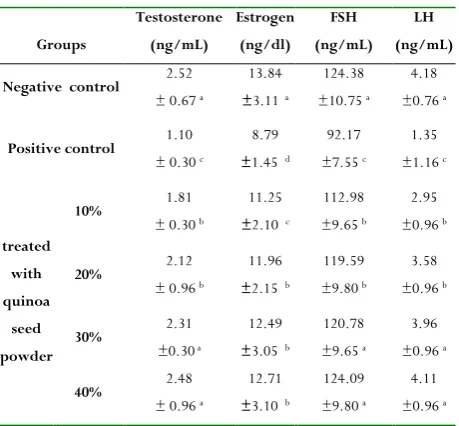
Serum levels of sex hormones in experimental rats were shown in Table (6). A decrease was noticed in testosterone, estrogen, follicle Stimulating hormone (FSH) and luteinizing hormone (LH) in rats of the positive control group compared to their corresponding values in the negative control group. Cisplatin as a chemotherapeutic drug was reported previously to have many side effects among which is the infertility as it affects sex hormones [8]. On the other hand, the group of rats that were fed
on 40% quinoa seed powder showed improving in these estimated hormones which were returned back to more or less the values of the negative control group. This showed the ability of quinoa seed to counteract the toxic effect of cisplatin on the sex hormones. Quinoa was analyzed before for its individual
content of polyphenolic compounds by HPLC [36]. They
50 Journal of Advanced Pharmacy Education & Research | Jul-Sep 2019 | Vol 9 | Issue 3
among which is quercetin. Yiğitaslan et al.,[37] have reported
that quercetin showed estrogen-like activity in female rats. This seems to be in agreement with our findings that quinoa was able to combat the toxic effect of cisplatin on rat estrogen.
Table 6: Sex hormones of all treated groups.
Groups
Testosterone (ng/mL)
Estrogen (ng/dl)
FSH (ng/mL)
LH (ng/mL)
Negative control 2.52
± 0.67 a
13.84
±3.11 a
124.38 ±10.75 a
4.18 ±0.76 a
Positive control 1.10
± 0.30 c
8.79
±1.45 d
92.17 ±7.55 c
1.35 ±1.16 c
treated with quinoa
seed powder
10% 1.81
± 0.30 b
11.25
±2.10 c
112.98 ±9.65 b
2.95 ±0.96 b
20% 2.12
± 0.96 b
11.96
±2.15 b
119.59 ±9.80 b
3.58 ±0.96 b
30% 2.31
±0.30 a
12.49
±3.05 b
120.78 ±9.65 a
3.96 ±0.96 a
40% 2.48
± 0.96 a
12.71
±3.10 b
124.09 ±9.80 a
4.11 ±0.96 a
Values are represented by mean ± S.D. Mean values in each column having different superscript (a, b, c, d,) are significant while, those that share similar superscripts are non-significant.
FSH: Follicle Stimulating hormone and LH: Luteinizing hormone
Conclusion
From the obtained results, it can be concluded that the chemotherapeutic drug; cisplatin exerts a toxic effect on rats as represented by altered pattern of sex hormones, altered lipid profile, increased cholinesterase activity, decreased total antioxidant capacity, and impaired SOD activity. Quinoa seed as a rich source of vitamins, minerals and polyphenols was able to restore all these altered parameters. Thus, quinoa seed can be used for preparing functional food for those cancer patients who are treated with cisplatin to minimize cisplatin toxicity and to prevent its complications.
Significance Statement
This study discovered that feeding rats with quinoa seeds that contain potent antioxidants was able to counteract the deleterious effect of cisplatin by restoring the studied biochemical and nutritional parameters. This will help the researchers to highlight the beneficial effect of quinoa seeds and to use it in preparing a variety of functional foods to combat the concomitant toxicity in cancer patients who are treated with cisplatin.
Author contribution:
Author (1): Put the idea for this work, shared in the animal experiment, shared in phytochemical analysis, shared in the biochemical analysis, shared in carrying out statistical analysis for the data and shared in writing and revising the article.
Author (2): Shared in the biochemical analysis, revised the statistical analysis and shared in writing and revising the article and made the article in the format of the journal.
Author (3): Shared in the animal experiment, shared in phytochemical analysis, shared in the biochemical analysis, shared in carrying out the statistical analysis for the data and shared in writing the article.
Conflict of interest:
There are no conflicts of interestsaponins, polysaccharides, polyphenols and phytoecdystroids.
References
1. Vilcacundo R., B. Hernandez-Ledesma, 2017.
Nutritional and biological value of quinoa (Chenopodium quinoa Willd). Current Opinion in
Food Science, 14:1–6.
2. Konishi Y., 2002. Nutritional characteristics of
pseudocereal amaranth and quinoa: alternative foodstuff for patients with food allergy. J Jpn Soc Nutr Food Sci, 55:299-302.
3. Vega-Ga´lvez A., M. Miranda, J. Vergara, E. Uribe, L.
Puente, E. A. Martı´nez, 2010. Nutrition facts and
functional potential of quinoa (Chenopodium quinoa Willd.), an ancient Andean grain: a review. J Sci Food Agric, 90: 2541-2547.
4. Navruz-Varli S, Sanlier N: 2016 Nutritional and health
benefits of quinoa (Chenopodium quinoa Willd.). J Cereal Sci, 69:371-376.
5. Graf, B.L., L.E. Rojo, J. Delatorre-Herrera, A.
Poulev, C. Calfio, I. Raskin, 2015b. Phytoecdysteroids and flavonoid glycosides among Chilean and commercial sources of Chenopodium quinoa: variation and correlation to physicochemical characteristics. J.
Sci. Food Agric., 96(2):633-43. doi:
10.1002/jsfa.7134.
6. Florea A.M., D. Büsselberg, 2011. Cisplatin as an
Anti-Tumor Drug: Cellular Mechanisms of Activity. Drug Resistance and Induced Side Effects. Cancers, 3:1351-1371. doi:10.3390/cancers3011351
7. Desoize, B.; Madoulet, C. Particular aspects of
platinum compounds used at present in cancer treatment. Crit. Rev. Oncol. Hematol. 2002, 42,
317–325.
8. William H. C., S. J. Christopher, 2009. Enhancing the
efficacy of cisplatin in ovarian cancer treatment –could
arsenic have a role? Journal of Ovarian Research, 2:2.
9. Böhlen D., F. C. Burkhard, R. Mills, R. W. Sonntag ,
U. E. Studer, 2001. Fertility and sexual function following orchiectomy and 2 cycles of chemotherapy for stage I high risk nonseminomatous germ cell cancer. J Urol. 165(2):441-4.
10. Barabas K., R. Milner, D. Lurie, C. Adin, 2008.
Journal of Advanced Pharmacy Education & Research | Jul-Sep 2019 | Vol 9 | Issue3 51
applications. Veterinary and Comparative Oncology,
6(1): 1 – 18.
11. A. O. A. C., 2000. Association of Official Agricultural
Chemists. Official Method of Analysis. 17th Ed. Vol. 11. Washington U.S. A.
12. El-Badrawy, E. E. (1996). Biochemical studies on some
natural plant products. Ph.D. Thesis, Fac. of Agric., Mansoura Univ., Egypt.
13. Trease, G. E., 1961. Textbook of
pharmacognosybillier, 8th edn. Tindall and Cox., London, 596.
14. Finar, L., 1968. Organic chemistry, 4th ed.
Longmanns green and Co., London.
15. Geissman, A., 1962. Chemistry of flavonoid
compounds. Macmillan and Co. New York, 72.
16. Blabaa, S., S. H. Hilal, A. Y. Zaki, 1976. Medicinal
plant constituents. 2nd end. General Organization for University and Schoolbooks, Cairo. 147-156.
17. Reeves, P. G., F. H. Nielsen and Jr. G. C. Fahey,
1993. AIN-93 purified diets for laboratory rodents: final report of the American Institute of Nutrition ad hoc writing committee on the reformulation of the AIN-76A rodent diet. J nutr., 123: 1939-1951.
18. Ateşşahin A., I. Karahan., G. Türk, S. Gür, S Yilmaz ,
A. O. Ceribaşi, 2006. Protective role of lycopene on
cisplatin-induced changes in sperm characteristics, testicular damage and oxidative stress in rats. Reprod Toxicol. 21(1):42-7.
19. Meiattini, F., L. Prencipe, F. Bardelli, G. Giannini, P.
Tarli, 1978. The
4-hydroxybenzoate/4-aminophenazone chromogenic system used in the enzymic determination of serum cholesterol. Clin. Chem., 24: 2161-2165.
20. Scheletter, G., E. Nussel, 1975. Quantitative
enzymatic Colorimetric determination of triglycerides in serum or plasma. Arbeitsmed Sozialmed Pracentimed., 10: 25.
21. Grove, T. H., 1979. Effect of reagent pH on
determination of high-density lipoprotein cholesterol by precipitation with sodium phosphotungstate-magnesium. Clin. Chem., 25: 560-564.
22. Warnick, G. R., R. H. Knopp, V. Fitzpatrick, L.
Branson, 1990. Estimating low-density lipoprotein cholesterol by the Friedewald equation is adequate for classifying patients on the basis of nationally recommended cutpoints. Clin. Chem., 36: 15-19.
23. Knedel, M, R. Boottger, 1967. A kinetic method for
determination of the activity of pseudo cholinesterase. Klin. Wochensch, 45: 325-327.
24. Nishikimi, M., N. A. Rao, K. Yagi, 1972. The
occurrence of superoxide anion in the reaction of reduced phenazine methosulfate and molecular oxygen. Biochem. Biophys. Res. Commun., 46: 849-854. https://doi.org/10.1016/S0006-291X(72)80218-3
25. Koracevic, D., G. Koracevic, V. Djordjevic, S.
Andrejevic, V. Cosic, 2001. Method for the measurement of antioxidant activity in human fluids. J ClinPathol., 54: 356-361
26. WHO, 2007. Protein and amino acid requirements in
human nutrition. WHO Technical Report Series 935.
27. Villacrés E., G. Pástor, MB. Quelal, I. Zambrano, S.
H. Morales, 2013. Effect of processing on the content of fatty acids, tocopherols and sterols in the oils of quinoa (Chenopodium quinoa Willd), lupine (Lupinus mutabilis Sweet), amaranth (Amaranthus caudatus L.) and sangorache (Amaranthus quitensis L.). Global Advanced Research Journal of Food Science and Technology, 2(4): 044-053.
28. Mladenovic, J. M., A.S. Stajn, Z. S. Saicic, 2012. Lipid
peroxidative damage on cisplatin exposure and alterations in antioxidant defense system in rat kidneys: a possible protective effect of selenium. Int J Mol Sci,
13: 1790–1803.
29. Al-Shammar A. M. N., H. F. El-Mehiry, 2016.
Amelioration of Cisplatin Induced Sexual Toxicity on Male Rats by Using Fortified of Flat Bread with Moringa Oleifera. Bulletin of the National Nutrition Institute of the Arab Republic of Egypt, 47:73-101.
30. Graf B. L., P. Rojas-Silva, L. E. Rojo, J.
Delatorre-Herrera, M. E. Baldeo´n, I. Raskin, 2015. Innovations in health value and functional food development of quinoa (Chenopodium quinoa Willd.). Comp Rev Food Sci Food Safety, 14:431-445.
31. El-Shobaki F.A., M. A. W. Hany, M. H. Mahmoud, Y.
I. Kazem, I. H. Badawy, A. S. Zahran, 2018. Formulation and evaluation of an adaptogenic formula to improve performance of athletes practicing anaerobic exercises. Journal of Biological Sciences, 18(5): 231-242.
32. Mahmoud M. H., M. A. W. Hany, M. H. Mahmoud,
F. M. Abu-Salem, 2018. Antagonizing the Hazardous Impact of Increased Oxidative Stress in Wistar Rats by Biscuits with Dried Orange Peel. Journal of Biological Sciences, 18(1): 21-31.
33. Park J. H., Y. J. Lee, Y. H. Kim, K. S. Yoon, 2017.
Antioxidant and Antimicrobial Activities of Quinoa (Chenopodium quinoa Willd.) Seeds Cultivated in Korea. Prev. Nutr. Food Sci., 22(3):195-202. https://doi.org/10.3746/pnf.22.3.195
34. Vaja R., N. Ghuman, 2018. Drugs and the liver.
Anaesthesia & Intensive Care Medicine, 19(1): 30-34. https://doi.org/10.1016/j.mpaic.2017.10.006
35. Sabullah M. K., S. A. Ahmad, M. Y. Shukor, A. J.
Gansau, M. A. Syed, M. R. Sulaiman, N. A. Shamaan, 2015a. Heavy metal biomarker: fish behavior, cellular alteration, enzymatic reaction and proteomics
52 Journal of Advanced Pharmacy Education & Research | Jul-Sep 2019 | Vol 9 | Issue 3
36. Tang Y., L. Xihong, B. Zhang, P. X. Chen, R. Liu, R.
Tsao, 2015. Characterisation of phenolics, betanins and antioxidant activities in seeds of three Chenopodium
quinoa Willd Genotypes. Food Chemistry, 166: 380–
388.
37. Yiğitaslan S., K. Erol, F. Y. Özatik, O. Özatik, S.
Şahin, Ç. Çengelli, 2016. Estrogen-like Activity of