M
AŁGORZATAP
AWLIKOWSKA, W
IESŁAWD
EPTUŁADynamics of Humoral Immunity Indices
and of Haematological Variables
in Rabbits Immunized with Chlamydophila psittaci
Dynamika wskaźników odporności humoralnej
oraz wskaźników hematologicznych
u królików immunizowanych
Chlamydophila psittaci
Department of Microbiology and Immunology, Faculty of Natural Sciences, University of Szczecin, Poland Adv Clin Exp Med 2006, 15, 2, 285–291
ISSN 1230−025X
ORIGINAL PAPERS
Abstract
Introduction. The research of humoral immunity in infection or immunization with Chlamydophila psittaciin sta−
tic models showed changes in parameters of this immunity.
Objectives.Evaluation of chosen parameters of humoral immunity in dynamic model in rabbits immunized with
Chlamydophila psittaci.
Material and Methods. The studies were performed on rabbits divided into two groups of 10 animals each. The
rabbits of first group were immunized with Chlamydophila psittaci– strain 6BC, and the animals of second group were control animals. Blood samples were examined 9 times every 7 days. The activity of myeloperoxidase in polymorphonuclear leukocytes (PMN), amount and activity of lysozyme, total amount of immunoglobulins (Ig), including those of IgG class were estimated in sera of rabbits immunized with Chlamydophila psittaci. Haemoglobin level, content of erythrocytes and leukocytes, blood differential count and titre of Chlamydia spp.− −specific antibodies were also established by complement−fixation technique.
Results. The results indicate that immunization of rabbits with the bacteria induces with a similar frequency
increase or decrease in 2 out of 6 examined parameters of humoral immunity (amount and activity of lysozyme) and rather a decrease than increase in 3 out of 8 examined haematological variables (count of neutrophiles, basophiles and monocytes). The alterations, mainly those in immune parameters, could be noted 5 weeks before appearance of Chlamydiaspp.−specific antibodies, which appeared on 49th–56thday of the experiment.
Conclusion.The alterations noted in parameters of humoral immunity, may turn to be useful in determining the
condition of macro−organisms in contact with Chlamydophila psittaci (Adv Clin Exp Med 2006, 15, 2, 285–291).
Key words:Chlamydophila psittaci, rabbit, immune indices, haematological indices.
Streszczenie
Wprowadzenie.Badania odporności humoralnej w zakażeniu lub immunizacji bakteriami Chlamydophila psitta−
ciw układach statycznych wykazały zmiany wskaźników tej odporności.
Cel pracy.Ocena zmian wybranych parametrów odporności humoralnej w układzie dynamicznym u królików im−
munizowanych Chlamydophila psittaci.
Materiał i metody.Badania przeprowadzono na królikach podzielonych na dwie grupy, po 10 zwierząt każda. Króli−
ki z pierwszej grupy immunizowano Chlamydophila psittaci– szczep 6BC, a zwierzęta z drugiej grupy były grupą kon− trolną. Krew do badań pobierano 9−krotnie w odstępach 7−dniowych. Oznaczano aktywność mieloperoksydazy w ko− mórkach polimorfonuklearnych (PMN) oraz ilość i aktywność lizozymu, ogólną ilość immunoglobulin (Ig), w tym Ig klasy G, w surowicy u królików immunizowanych Chlamydophila psittaci. Oznaczano także ilość hemoglobiny, licz− bę erytrocytów i leukocytów, obraz jakościowy krwi oraz miano swoistych przeciwciał anty−Chlamydia sp.
Wyniki. Z opisanych badań wynika, że immunizacja królików tą bakterią powoduje wzrost i spadek występujący
The species of Chlamydophila (Chl.) psittaci
belongs to Chlamydophila genus in the family of
Chlamydiaceae and Chlamydialesorder [1]. It in− cludes 8 serotypes, pathogenic for humans, many species of birds as well as for cattle, horses, turtles, hares and musk−rats [1].
Studies related to humoral immunity in hu− mans and animals infected or immunized with microbes belonging to Chlamydophila spp. and
Chlamydia spp. have demonstrated that the condi− tions augment activities of myeloperoxidase (MPO) [2, 3] and of peroxidase [4] in polymor− phonuclear leukocyte (PMN) and mononuclear leukocyte (MN). Also augmented amounts of lysozyme (LZM) [5, 6] and of other lysosomal enzymes (cathepsin D, acid phosphatase, β−glu− curonidase) [7] have been noted, as well as those of IFN−α, TNF−α, IL−1, IL−6, IL−12 [8–13]. Immunization of animals with the bacteria has been shown to elevate, although in an irregular fashion, levels of IgG, IgM and IgA class immunoglobulins in serum and in secretions (s−IgA in milk) [14–19]. The data presented in the papers [2–19] have indicated also that only individual parameters of humoral immunity were determined in mammals immunized with Chlamydia spp. and
Chlamydophilaspp. microbes.
Present studies aimed at evaluation of dynamic alterations in indices of specific and non−specific humoral immunity as well as in haematological and serological variables in rabbits (the standard animal in biological studies on humans and animals) immu− nized with Chlamydophila psittaci – strain 6BC (earlier termed Chlamydia psittaci– strain 6BC).
Material and Methods
The studies were performed on 20 mixed breed rabbits weighing each 2.5 kg to 4.0 kg, clas− sified as animals of CV−III group or conventional animals free of pathology [20]. The rabbits were kept in vivarium, in living and zoohygienic condi− tions consistent with the national standards [20] and were fed full portion LSK chow for rabbits.
Animals of the immunized group (10 rabbits) received intramuscular injection of Chlamydo− phila psittaci – strain 6BC (termed previously
Chlamydia psittaci– biotype 3–9) antigen, isolat− ed from a human individual infected from a parrot, of 50 µg protein/ml, dissolved in 1.0 ml sterile
saline, on the 1stand the 7thday of the experiment.
Animals of the control group (10 rabbits) were injected intramuscular in parallel with the same amount of sterile saline.
Blood for tests was sampled on the first day, i.e. before administration of Chl. psittaci– in the groups of immunized rabbits and control rabbits and, then, every seven days.
Determination
of Humoral Immunity
Activity of MPO in PMN cells was assayed according to the technique of Graham as described by Zawistowski [21], amount (concentration) of LZM in serum was established by plate diffusion technique against Micrococcus luteusaccording to the technique provided by Hankiewicz [22], while activity of LZM was established using the formu− la provided by Szmigielski [23]. The general immunoglobulin level was estimated according to McEwan [24] and serum IgG class immunoglobu− lins were estimated by the plate technique against the standards (ICN, USA).
Haematological Tests
Haemoglobin level, red blood cells (RBC) and white blood cells (WBC) levels and differential WBC count were estimated by the standard tech− niques.
Serological Studies
Presence of Chlamydia spp.−specific antibod− ies in rabbit sera was established by complement fixation technique, against the antigen as the stan− dard. The test was performed as recommended by the manufacturer instruction and complete inhibi− tion of haemolysis (++) at the dilution of 1 : 32 and higher was taken as indicating a positive titre [25].
Analysis of the Results
The immune and haematologic indices were evaluated in respect to the trends on changes in the course of the experiment, comparing results
Wnioski.Zmiany wskaźników odporności humoralnej mogą być przydatne do określania stanu makroorganizmu
po kontakcie zChlamydophila psittaci(Adv Clin Exp Med 2006, 15, 2, 285–291).
obtained in individual days of the experiment in immunized rabbits to those obtained in control rabbits and employing Student’s t−test at p ≤0.05 (Figs. 1–3).
Results
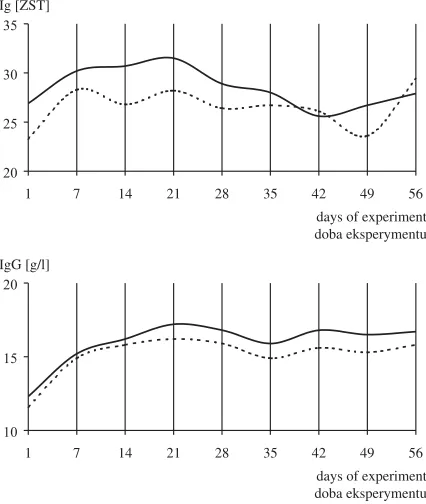
In analysis of the five studied immune para− meters in rabbits immunized with Chlamydophila psittaci– strain 6BC (Figs. 1–3), growing tenden− cies were noted even if significant alterations in forms of an increase or a decrease were recorded only in respect to the amount and activity of LZM; they could not be noted in MPO activities and total amounts of immunoglobulins or levels of IgG.
In analysis of MPO activities in the immu− nized rabbits their values exhibited a slightly increasing trend (Fig. 1), although the alterations were not significant. Amounts of LZM in serum also demonstrated an increasing tendency with extensive variation which proved to be significant. Decreases in the values were noted on the 14th, 21st
and 35th day and increase on the 49th day of the
studies. Activities of LZM behaved in a similar
fashion but significant alterations in the form of a decrease were noted in 14thday and 28thday while
augmented LZM activity was observed on the 7th
day (Fig. 1). Total amounts of serum Ig remained on a more less identical level (Fig. 1). On the other hand, IgG class immunoglobulins manifested a slightly growing trend (Fig. 1) but, similarly to total Ig levels, no significant differences were encountered.
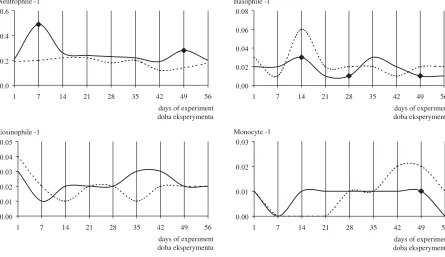
Out of the 8 haematological parameters (levels of haemoglobin, RBC, WBC, lymphocytes, neu− trophiles, eosinophiles, basophiles, monocytes) examined in rabbits immunized with Chlamy− dophila psittaci– strain 6BC (Figs. 2, 3), signifi− cant alterations developed only in levels on neu− trophiles, basophiles and monocytes. The changes
10 15 20
1 7 14 21 28 35 42 49 56
days of experiment doba eksperymentu IgG [g/l]
20 25 30 35
1 7 14 21 28 35 42 49 56
days of experiment doba eksperymentu Ig [ZST]
0.000 0.005 0.010 0.015
1 7 14 21 28 35 42 49 56
days of experiment doba eksperymentu LZM akt [a.v.]
0 2 4 6 8 10
1 7 14 21 28 35 42 49 56
days of experiment doba eksperymentu LZM [mg/l]
1.0 1.5 2.0 2.5
1 7 14 21 28 35 42 49 56
days of experiment doba eksperymentu MPO [a.v.] –
Fig. 1.Values of humoral immunity parameters in rab−
bits immunized with Chl. psittaci – strain 6BC and in control rabbits
Explanations:
— animals immunized with Chlamydophila psittaci –
strain 6BC; − − − − control animals; ♦significant differ− ences between immunized and control animals; a.v. – absolute value; MPO – myeloperoxidase; LZM – amount of lysozyme; LZM akt – activity of lysozyme
Ryc. 1. Wartości wskaźników odporności humoralnej
u królików immunizowanych Chl. psittaci – szczep 6BC i w grupie kontrolnej
Objaśnienia:
— zwierzęta immunizowane Chlamydophila psittaci
– szczep 6BC; − − − − zwierzęta z grupy kontrolnej;
Fig. 3.Haematological indices in rabbits immunized with Chl. psittaci– strain 6BC and in control rabbits
Explanations: — animals immunized with Chlamydophila psittaci – strain 6BC; − − − − control animals; ♦significant differences between immunized and control animals.
Ryc. 3. Wskaźniki hematologiczne u królików immunizowanych Chl. psittaci – szczep 6BC i w grupie kontrolnej
Objaśnienia: — zwierzęta immunizowane Chlamydophila psittaci – szczep 6BC; − − − − zwierzęta z grupy kontrolnej;
♦różnice istotne statystycznie między zwierzętami immunizowanymi a zwierzętami z grupy kontrolnej.
0.00 0.01 0.02 0.03
1 7 14 21 28 35 42 49 56
days of experiment doba eksperymentu Monocyte −1
0.00 0.02 0.04 0.06 0.08
1 7 14 21 28 35 42 49 56
days of experiment doba eksperymentu Basophile −1
0.00 0.01 0.02 0.03 0.04 0.05
1 7 14 21 28 35 42 49 56
days of experiment doba eksperymentu Eosinophile −1
0.0 0.2 0.4 0.6
1 7 14 21 28 35 42 49 56
days of experiment doba eksperymentu Neutrophile −1
Fig. 2. Haematological indices in rabbits immunized with Chl. psittaci– strain 6BC and in control rabbits
Explanations: — animals immunized with Chlamydophila psittaci – strain 6BC; − − − − control animals; ♦significant differences between immunized and control animals; Hb – haemoglobin; RBC – red blood cells; WBC – white blood cells.
Ryc. 2. Wskaźniki hematologiczne u królików immunizowanych Chl. psittaci – szczep 6BC i w grupie kontrolnej
Objaśnienia: — zwierzęta immunizowane Chlamydophila psittaci – szczep 6BC; − − − − zwierzęta z grupy kontrolnej;
♦różnice istotne statystycznie między zwierzętami immunizowanymi a zwierzętami z grupy kontrolnej; a.v. – wartość bezwzględna; Hb – hemoglobina; RBC – erytrocyty; WBC – leukocyty.
0.5 0.6 07 0.8 0.9 1.0
1 7 14 21 28 35 42 49 56
days of experiment doba eksperymentu Lymphocytes −1
4 5 6 7 8
1 7 14 21 28 35 42 49 56
days of experiment doba eksperymentu WBC 10 /l9
3.0 3.2 3.4 3.6 3.8 4.0
1 7 14 21 28 35 42 49 56
days of experiment doba eksperymentu RBC 10 /l12
5.5 6.0 6.5 7.0 7.5 8.0
1 7 14 21 28 35 42 49 56
involved an increase in neutrophile content on the 7thand 49thdays and decreases in basophile level
on the 14th, 28th and 49th days and in monocyte
level on the 49thday of observation.
In analysis of serological results the specific antibodies appeared already in the 7thday but dilu−
tions of 1 : 4 and 1 : 8 yielded titres of only 4+ and 1+. On subsequent days, i.e. on the 14th, 21stand
28th days they were detected in most of examined
rabbits on dilutions of 1 : 2 and 1 : 4 (4+). On the same days dilutions of 1 : 8, 1 : 16 and 1 : 32 yield− ed titres of 1+ to 2+. On the 35thday, sera of most
rabbits yielded 4+ titres in dilutions of 1 : 2, 1 : 4 and 1 : 8 3+ titres in dilution of 1 : 16 and most fre− quently 1+ titre in dilutions of 1 : 32. On days 42 to 56, 4+ titre was recorded in all the animals at dilutions of 1 : 2, 1 : 4, 1:8 and 1 : 16. On the remaining dilutions, 1 : 32 inhibition of haemoly− sis was graded at 1+ to 2+ and in the dilution 1 : 64 respectively at 2+ and 1+.
Discussion
Analysing results of the studies one should note that the absence in significant alterations in MPO activities cannot be unequivocally interpret− ed due to the lack of analogous studies in rabbits. It should, however, be observed that the result is distinct from those noted in humans infected with
Ch. trachomatis biotype LGV [3] or Ch. tracho− matisserotype L2[2], in whom augmented activi−
ty of MPO was noted in PMN cells [2, 3]. On the other hand, the alterations in the amount (increase on the 49th day, decrease on the 14th, 21stand 35th
days) and activity of LZM (increase on the 7thday,
decrease on the 14thand 28thdays) have confirmed,
although only the decreases, own results obtained earlier [26]. In the latter studies [26] on rabbits immunized with Ch. psittaci – strain 6BC, decreases in LZM amounts were recorded on the 14th, 21st, 35thand 56thdays and a lowered activity
of LZM on the 7th, 14thand 28thdays of the stud−
ies. However, it should be added that the studied failed to demonstrate that the employed strain 6BC of Chl. psittaciinduced increase in the amount and activity of LZM, which has been documented by the present experiment. It can be assumed that the strain probably induces alterations in the amount and activity of LZM but that they are not always equally intense. Nevertheless, the presented results indicate that the presently studied indices of non− −specific humoral immunity, such as MPO and LZM, represent elements of anti−chlamydial resis− tance while intensity and duration of their mani− festation reflect the type and strain of the bacteria. Participation and role of the non−specific humoral
immunity in anti−chlamydial resistance have also been confirmed by observations on other indices of non−specific immunity, such as peroxidase [4], acid phosphatase, β−glucoronidase, cathepsin D [7], IFN, TNF−α[9, 10, 13] as well as IL−1, IL−6, IL−12 [8, 10–12]. The studies [4, 7–13] demon− strate that infection or immunisation of mammals with Chlamydia spp. or Chlamydophila spp. induces increase in the level or activity of sub− stances which inhibit bacterial proliferation or lead to their destruction in cells of the macroorganism. They also prove that destruction of Chlamydia
spp. and Chlamydophila spp. engages not only oxygen−independent cidal systems such as, e.g., LZM or interleukins but also the oxygen−depen− dent systems like, e.g., MPO, peroxidase and reac− tive forms of oxygen. Involvement of the indices in defense against the intracellularly parasiting bacteria has been confirmed by observations on mice experimentally infected with Mycobacterium tuberculosis [27], in which the destruction processes targeted at the intracellular parasiting bacteria were found to be linked to substances such as TNF−α, IL−1, IL−6 and IL−8, as well as to reactive forms of oxygen and nitrogen. Thus, the results of earlier [26] and present investigations as well as results of other authors [4, 7–13, 26] prove that factors of non−specific humoral immunity rep− resent a significant protective element against intra− cellularly parasiting bacteria since act, i.a., directly at the site in which the microbes are present.
On the other hand, in evaluation of the results on serum immunoglobulin levels it should be noted that the presently examined strain 6BC of
Chl. psittaci has manifested its effect in the dynamic evolution of alterations even if it has induced no significant changes in total immuno− globulin levels or IgG levels. This has also been observed in the cattle naturally infected with
Ch. psittaci, in which augmented amounts of serum IgG1levels and lower IgM have been noted [14].
According to the authors, the serum immunoglob− ulins play principal role in protection against the infection with Ch. psittaci. The role of immuno− globulins in humans, guinea pigs, mice and goats, infected naturally or experimentally (this pertains laboratory animals) with Chlamydia trachomatis
References
[1] Deptuła W, Pawlikowska M, Travniček M:Chlamydophiloses in animals and in humans (in Polish). Medycyna
Wet 2002, 58, 337–340.
[2] Tosi MF, Hammerschlag MR:Chlamydia trachomatisselectively stimulates myeloperoxidase release but not
superoxidase production by human neutrophils. J Inf Dis 1988, 158, 457–460.
[3] Yong EC, Klebanoff SJ, Kuo C−C: Toxic effect of human polymorphunuclear leukocytes on Chlamydia tra−
chomatis. Infect Immun 1982, 37, 422–426.
[4] Yong EC, Chi EY, Chen WJ, Kuo C−C:Degradation of Chlamydia trachomatisin human polymorphonuclear
leukocytes: an ultrastructural study of peroxidase−positive phagolysosomes. Infect Immun 1986, 53, 427–431.
[5] Kondo LR, Hanna L, Keshishyan H:Reduction in Chlamydial infectivity by lysozyme. Proceed Soc Exp Biol
Med 1973, 192, 131–132.
[6] Welch WD, Polek W, Thrupp L:Effect of lysozyme on the in vitro infectivity of Chlamydia trachomatis.
Current Microbiol 1983, 8, 293–296.
[7] Mørland B, Byrne GI, Jones TC:The effect of intracellular Chlamydia psittacion lysosomal enzyme activites
in mouse peritoneal macrophages. Acta Path Microbiol Immunol Scand Sect. C 1987, 95, 291–293.
[8] Bobo L, Novak N, Mocha H, Vitale S, West S, Quinn TC:Evidence for a predominant proinflammatory con−
junctival cytokine response in individuals with Trachoma. Infect Immun 1996, 64, 3273–3279.
[9] De la Maza LM, Peterson EM, Goebel JM, Fennie CW, Czarniecki CW: Interferon induced inhibition of
Chlamydia trachomatis: dissociation from antiviral and antiproliferative effects. Infect Immun 1985, 47, 719–722.
[10] Holtmann H, Shemer−Avni Y, Wessel K, Sarov I, Wallach D: Inhibition of growth of Chlamydia trachomatisby
tumor necrosis factor is accompanied by increased prostaglandin synthesis. Infect Immun 1990, 58, 3168–3172.
[11] Paguirigan AM, Byrne GI, Becht S, Carlin JM: Cytokine mediated indoleamine 2,3−dioxygenase induction in
response to Chlamydia infection in human macrophages cultures. Infect Immun 1994, 62, 1131–1136.
[12] Rothermel CD, Schachter J, Lavrick P, Lipsitz EC, Francus T:Chlamydia trachomatisinduced production of
interleukin−1 by human monocytes. Infect Immun 1989, 57, 2705–2711.
[13] Williams DM, Grubbs BG, Pack E, Kelly K, Rank RG: Humoral and cellular immunity in secondary infection
due to murine Chlamydia trachomatis. Infect Immun 1997, 65, 2876–2882.
[14] Deptuła W, Ruczkowska J, Szenfeld J, Choroszy−Król I, Travniček M: Immunological status in the cattle with
inborn infection with Chlamydia trachomatisand Chlamydia psittaci(in Slovak). Veterinarni Med (Praha) 1990, 35, 73–80.
chomatis infection. Involvement of serum immu− noglobulins in infections with intracellularly para− siting bacteria is documented by the elevated serum IgG in mice experimentally infected with
Listeriasp., Orientia tsutsugamushi and Ehrlichia chaffeensis– the intracellular bacteria [27].
Evaluating the presently recorded relatively insignificant alterations in haematological patterns (elevated level of neutrophilic granulocytes and decreased content of basophilic granulocytes and of monocytes) in rabbits immunized with Chl. psittaci – strain 6BC, it should be disclosed that they confirm the pattern typical for the type of immunization in rabbits [30]. A similar pattern, manifested also by slight changes in leukocyte number, has been documented in patients with ornitosis [31, 32], in whom leukocyte levels increased at the start of the disease and decreased subsequently. The changes in white blood cells analogous to those described in patients with orni− tosis have been described in sheep naturally infect− ed with chlamydia [33], while in the naturally infected cattle only augmented leukocyte levels have been noted [34]. It should also be detected that the values of haematological parameters doc− umented for rabbits immunized with Chl. psittaci
– strain 6BC did not diverge far from physiologi− cal values [35], which may suggest that immu− nization of rabbits with those bacteria induces only
slight and relatively non−specific alterations in the parameters.
Analysis of positive antibody titres noted in the studied rabbits starting at 49thday after immu−
nization with Chl. psittaci corroborates observa− tions of other authors [30, 36], who demonstrated the antibodies in the 5th week after immunization
of rabbits with Chl. psittaci[30] and after 8 weeks in sheep with abortion due to Chl. abortusinfec− tion [36]. Specific antibodies detected already on the 7thday after immunization of rabbits with Chl.
psittaci have provided evidence for stimulation of lymphocytes B, which seems to confirm the gen− eral principle that in infection or immunization with bacterial antigens serum Ig synthesis devel− ops after 5–7–10 days [37].
[15] Rank RG, Batteiger BE: Protective role of serum antibody in immunity to chlamydial genital infection. Infect Immun 1989, 57, 299–301.
[16] Schmeer M, Perez−Martinez JA, Schnorr K, Storz J, Krauss H: Analysis of the IgG response of cattle to nat−
ural and experimental chlamydial infections. IV Int Symp Vet Lab Anim, Amsterdam 1978, 472–475.
[17] Schmeer N, Schnorr K, Perez−Martinez J, Storz J: Dominance of Chlamydia psittacispecific IgG2subclass in
the humoral immune responses of naturally and experimentally infected cattle. Vet Immunol Immunopathol 1987, 15, 311–322.
[18] Schmeer N, Krauss H, Apel J, Adami M, Müller HP, Schneider W: Analysis of caprine IgG1and IgG2sub−
classes response to Chlamydia psittaciinfection and vaccination. Vet Microbiol 1987, 14, 125–135.
[19] Skaug K, Otnaess A−B, Orstavik I, Jerve F:Chlamydial secretory IgA antibodies in human milk. Acta Path
Microbiol Immunol Scand Sect. C 1982, 90, 21–25.
[20]Information charts for technologic principles in animal husbandry. In: Laboratory animals (in Polish), informa− tional instruction materials of the Section for Laboratory Animals ZG SITR, Warszawa 1987, 2, 26–77.
[21] Zawistowski S: Histological technique, principles of histology and histology (in Polish). PZWL, Warszawa 1976.
[22] Hankiewicz J, Świerczek E: Comparative determination of lysozyme by plate diffusion and by nephelometric
technique (in Polish). Przegl Lek 1975, 32, 376–378.
[23] Szmigielski S:Evaluation of granulocyte system function in conditions of stimulation and inhibition (thesis of
habilitated doctor). Wojskowy Inst Med Lotn, Warszawa 1972.
[24] Mc Ewan AD, Fischer EW, Seleman IE, Penhale WI:A turbidirty test for the estinesica of immunoglobulin lev−
els in neonatal calf serum. Clin Chem Acta 1970, 27, 155–163.
[25]Instruction of the Main Veterinary Doctor, Main Veterinary Inspectorate, 25th November, 2004 (GIWzVIII.400/lab−50/2004) pertaining the serological diagnosis of chlamydiosis in cattle and enzootic abortion of ewes to use micromethod of complement fixation technique (in Polish).
[26] Pawlikowska M, Deptuła W, Travniček M, Stosik M: Amount and activity of lysozyme in rabbits immunised
with Chlamydia psittaciand Chlamydia trachomatis(in Polish). Proceedings of the conference on “Molecular biology in diagnosis of infectious diseases and in biotechnology”. SGGW, Warszawa 1998, 157–162.
[27] Ismail N, Olano JP, Feng H−M, Walker DH:Current status of immune mechanisms of killing of intracellular
microorganisms. FEMS Microbiol Lett 2002, 207, 111–120.
[28] Patel HC, Goh BT, Viswalingam ND, Treharne JD: Interpretation of Chlamydia trachomatis response in
chlamydial oculogenital infection. Genitourin Med 1995, 71, 94–97.
[29] Richmond SJ, Caul EO: Fluorescent antibody studies in chlamydial infections. J Clin Microbiol 1975, 1,
345–352.
[30] Pawlikowska M, Deptuła W: Adherence and ingesting capacity of peripheral blood granulocytes in rabbits
immunised with various antigens of Chlamydiasp. Cent Europ J Immunol 1999, 24, 293–298.
[31] Hencner Z: Ornitosis (in Polish). PZWL, Warszawa 1971.
[32] Koba S:Epidemiological and clinico−laboratory studies in the course of ornitosis in humans (in Polish, thesis of
habilitated doctor), Akademia Medyczna, Kraków 1971.
[33] Paszowska K:Pathomorphological and microbiological studies in sheep chlamydiosis (in Polish). In: Chlamydia
and chlamydioses in humans and animals – significance and diagnosis. WZWet, Gorzów Wlkp. 1986, 37–46.
[34] Deptuła W, Czymbor M, Szenfeld J: Immune response in bulls infected with chlamydia (in Polish). In: Chlamydia
and chlamydioses in humans and in animals: significance and diagnosis. WZWet, Gorzów Wlkp. 1986, 64–17.
[35] Moore DM:Hematology of rabbits. In: Schalm’s veterinary hematology. Eds.: BV Feldman, JG Zinkl, NC Jain,
Lippincott Williams & Wilkins, Baltimore 2000, 5thed., 1100–1110.
[36] Travniček M, Kovačova D, Bhide MR, Zubricky P, Čislakova L: Detection of IgG antibodies against
Chlamydophila abortusin sheep with reproductive diseases. Acta Vet Brno 2003, 72, 95–99.
[37] Roitt I, Brostoff J, Male D:Immunology. 4thed., Mosby, London 1996.
Address for correspondence:
Wiesław Deptuła
Department of Microbiology and Immunology University of Szczecin Felczaka 3c
71−412 Szczecin Poland
e−mail: [email protected]
Conflict of interest: None declared
Received: 21.07.2005 Revised: 16.09.2005 Accepted: 24.10.2005
Praca wpłynęła do Redakcji: 21.07.2005 r. Po recenzji: 16.09.2005 r.