Barbara Izmajłowicz
1, a, c, d, Jan Kornafel
2, e, f, Jerzy Błaszczyk
3, BMultiple Neoplasms Among Cervical Cancer Patients
in the Material of the Lower Silesian Cancer Registry
1 department of Oncology, Gynecological Oncology clinic, Wroclaw Medical University,Lower Silesian Oncology center in Wroclaw, department of Gynecological Radiotherapy I, Poland 2 department of Oncology, Gynecological Oncology clinic, Wroclaw Medical University, Poland 3 Lower Silesian Oncology center in Wroclaw, Lower Silesian cancer Registry Wroclaw, Poland
A – research concept and design; B – collection and/or assembly of data; C – data analysis and interpretation;
D – writing the article; E – critical revision of the article; F – final approval of article; G – other
Abstract
Background. according to the definition by the International agency for Research on cancer (IaRc), primary multiple neoplasms are two or more neoplasms of different histopathological build in one organ, or two or more tumors occurring in one patient, regardless of the time of their occurrence (synchronic – up to 6 months, meta-chronous – after 6 months), coming from an organ or a tissue and not being an infiltration from another neoplasm, a relapse or a metastasis.
Objectives. It was the aim of the study to analyze the frequency of the occurrence of multiple neoplasms among patients suffering from uterine cervix cancer, with a special interest in coexistent neoplasms, the time of their occurrence and total 5-year survivals.
Material and Methods. The data from the Lower Silesian cancer Registry concerning the years 1984–2009 formed the material of the present study.
Results. 5.3% of all cervix neoplasms occurred as multiple cancers. cervix neoplasms were 13.4% of multiple neoplasms. On average, cervical cancer occurred as a subsequent cancer in 6 patients yearly (60.7% of the occur-rences of cervical cancer were in the period of 5 years following treatment for the first neoplasm). 5-year survival in patients suffering from primarily multiple cervix neoplasms constituted 57% and was convergent with the results for all patients suffering from cervical cancer. cervical cancer as the first neoplasm occurred in 287 patients, on average in 11 patients annually. In the period of the first 5 years after the treatment of cervical cancer, there were 42.8% occurrences of other cancers. cervical neoplasms most frequently coexisted with cancers of the breast, lung and large intestine.
Conclusions. The frequency of the occurrence of multiple neoplasm among cervical cancer patients is increasing. Most frequently they coexist with other tobacco-related neoplasms, those related to HPV infections and with sec-ondary post-radiation neoplasms. These facts should be taken into consideration during post-treatment observa-tion and when directing diagnostic and prophylactic tests. Synchronic neoplasms require detailed diagnostics and planning of treatment by a team of specialists. The occurrence of primary multiple cervical neoplasms does not worsen the prognosis as compared to patients suffering exclusively from cervical cancer (Adv Clin Exp Med 2014, 23, 3, 433–440).
Key words: primary multiple neoplasms, synchronic neoplasms, metachronous neoplasms, cervical cancer.
adv clin exp Med 2014, 23, 3, 433–440 ISSN 1899–5276
ORIGINaL PaPeRS
© copyright by Wroclaw Medical University
according to the International agency for Re-search on cancer (IaRc), primary multiple neo-plasms are two or more neoneo-plasms occurring in one patient regardless the time of their occurrence (synchronic – up to 6 months, metachronous – af-ter 6 months), coming from an organ or a tissue and not being an infiltration from another neo-plasm, a relapse or a metastasis, or there are two
sults Program (SeeR), the number of people liv-ing with a cancer disease is increasliv-ing by 2% an-nually and in 2001 in the United States there were 10 m such people, i.e. 3.5% of the population [2]. according to the Polish National cancer Registry, in 2006 there were 320,000 people in Poland with cancer, which is approximately 1% of the popula-tion [5]. 5-year overall survival according to SeeR data presently constitutes 66% for men and 64.7% for women [6]. The effects of treatment in Poland are worse but improving and are currently 32.9% for men and 51.2% for women [7]. The data from the Lower Silesian cancer Registry indicates that from 1985 to 2005 5-year survival in men increased from 26.5% to 37.5% and from 42.5% to 52.3% in women [8].
according to the literature data, the frequency of the occurrence of primary multiple cancers var-ies from 0.73% to 11.7%, and the risk of their occur-rence increases with age [4, 9–11]. The SeeR reg-ister shows that 18% are multiple neoplasms [12]. compared to the total population, the risk of suf-fering from neoplasm in patients treated previously for cancer is approximately 14–20% higher [12, 13]. The risk of occurrence of a subsequent neoplasm in women with cervical cancer is 1.3– 2.6% for all neoplasms and for lung cancer it is as high as 7.8% [13–15].
The data from the Lower Silesian cancer Reg-istry indicates that in 1984–2009, in Lower Silesia, there were 249,157 new cases of malignant tumors including 114,220 in women [16]. In the period studied, primary multiple neoplasms were diag-nosed in 6160 patients (2.47% of new cases), in-cluding 3204 women. In 5969 patients, 2 neoplasms were diagnosed, in 187 patients 3 neoplasms were diagnosed and in 4 patients 4 neoplasms were di-agnosed. a permanent increase in the number and frequency of the occurrence of primary multiple neoplasms was observed in the analyzed period from 5 (0.1%) in 1984 to 598 (5.1%) in 2009. The data from the Lower Silesian cancer Registry shows that the frequency of concurrencies of multiple neoplasms decreases with the time from the diag-nosis of the first neoplasm. However, it is worth re-membering that during the first 5 years from diag-nosis of the first neoplasm, only half were multiple. Multiple neoplasms are slightly more frequent in women but the risk of suffering from multiple neo-plasms is higher in men. The most frequent can-cers which are followed by multiple neoplasms in women are breast, skin and endometrial cancers. Breast, lung and uterine neoplasms are the most
tant that the prognosis for patients with a second cancer is better than with the first. In 1984–2004, 5-year survival in women who suffered from a sec-ond cancer was 50.5% and was 3.6% better than in the case of the first one.
Material and Methods
detailed analysis of multiple malignancies in cervical cancer patients with special consideration of coexisting neoplasms, the time of their occur-rence and total 5-year survivals was the aim of the present study.
The data obtained from the Lower Silesian cancer Registry concerning multiple cervical can-cers were the material for the detailed analysis. The bases of comparisons were the size of groups and percentages of particular malignancies occur-ring among patients suffeoccur-ring from cervical cer. 8119 cases of cervical cancer (7.1 % of all can-cer among women) were recorded in the Register in the years 1984–2009. cervical cancer appeared as the first one in 287 patients among 3204 women suffering from multiple cancers and it appeared in 150 patients as the subsequent one, i.e. 5.4% of all cervix cancers appeared as multiple ones. cervical cancer constituted 13.6% of multiple neoplasms. Most frequently, cervix cancers appeared together with lung and breast cancers.
Results
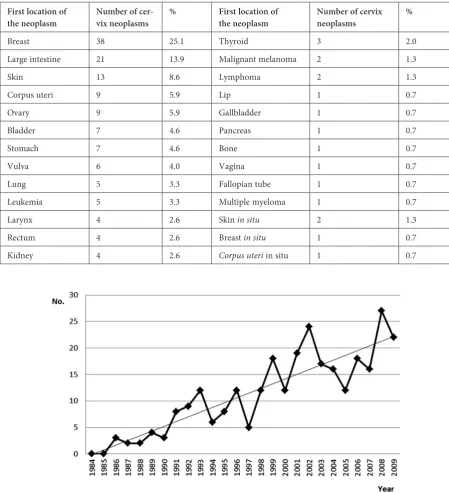
despite a permanent decrease of the number of new cervical cancer cases observed in the years 1984–2009, a distinct increase of multiple neo-plasms among cervical cancer patients in this peri-od was observed (fig. 1, 2).
In the years 1984–2009, cervical cancer oc-curred as a subsequent cancer on average in 6 pa-tients annually (from 0 to 14) and this frequency increased during the studied period (fig. 2).
all the cases of cervical cancer appeared dur-ing the period of seventeen years after the treat-ment of the first cancer treattreat-ment (Table 1). In the period of 5 years after treatment for the first neoplasms, there were 97 cases (64.7%) of cervi-cal cancer, the most in the first year (Table 1). In 22% of cases (33 patients) there were synchronic neoplasms.
Fig. 1. diminishing trend in cases of cervical neoplasm in the Lower Silesian cancer Registry in the years 1984–2009
Fig. 2. Growing trend in cases of cervical neoplasm as a subsequent cancer in the Lower Silesian cancer Registry in the years 1984–2009
Table 1. cases of cervix neoplasms in patients suffering from multiple cancers in the Lower Silesian cancer Registry in the years 1984–2009 in subsequent years after diagnosis of the first neoplasm
Year after the
first neoplasm Number of cases % of cases Year after the first neoplasm Number of cases % of cases
0 38 25.3 9 9 6
1 19 12.7 10 8 5.3
2 8 5.3 11 3 2
3 11 7.3 12 4 2.7
4 15 10.0 13 2 1.3
5 6 4 14 1 0.7
6 8 5.3 15 2 1.3
7 6 4 16 1 0.7
body, bladder, stomach and vulva cancers (Ta-ble 2). However, taking into account the frequency of occurrence of the first neoplasms, cervical can-cer occurred the most frequently in patients suffer-ing from vulva, rectum, lip, bone, lung and blad-der cancers.
In 101/150 patients suffering from primary multiple cervix neoplasms having 5 years of ob-servation, the 5-year total survivals were 57% and were convergent with the results in Lower Silesia for all patients suffering from cervical cancer dur-ing the studied period.
from 1984 till 2009 cervical cancer as the first malignancy occurred in 287 patients, on average in 11 patients annually and the frequency of the oc-currence of subsequent cancers in patients suffer-ing from cervical neoplasms grew in the studied period (fig. 3).
In the period of the first 5 years after treatment for cervical cancer, there were 123 cases (42.8%) of other malignancies, the majority during the first year (Table 3). In 38 patients (13.2% of cases), they were synchronic neoplasms.
Breast 38 25.1 Thyroid 3 2.0
Large intestine 21 13.9 Malignant melanoma 2 1.3
Skin 13 8.6 Lymphoma 2 1.3
corpus uteri 9 5.9 Lip 1 0.7
Ovary 9 5.9 Gallbladder 1 0.7
Bladder 7 4.6 Pancreas 1 0.7
Stomach 7 4.6 Bone 1 0.7
Vulva 6 4.0 Vagina 1 0.7
Lung 5 3.3 fallopian tube 1 0.7
Leukemia 5 3.3 Multiple myeloma 1 0.7
Larynx 4 2.6 Skin in situ 2 1.3
Rectum 4 2.6 Breast in situ 1 0.7
Kidney 4 2.6 Corpus uteri in situ 1 0.7
cancer of the breast, lung, large intestine, blad-der, ovary, uterine body, stomach, leukemia and larynx were the most frequent in patients treated primarily because of cervical neoplasm (Table 4). In total, in patients suffering from cervical neo-plasm, the subsequent neoplasms were found in 30 organ locations, and systemic cancers were also observed. In 279 of 287 patients, two multiple neo-plasms were diagnosed, in 8 of the 287, three types of cancer were observed (Table 4).
Discussion
In the studied material, cervical cancer ap-peared most commonly as a subsequent neo-plasm, together with vulvae, larynx, rectum, lung,
bladder, breast, large intestine, skin, uterine body, ovary and stomach malignancies. The cancers of breast, lung, large intestine, bladder, ovary, uter-ine body and leukemia were observed the most frequently in patients treated primarily because of cervical cancer.
These results are convergent with the data from the literature. The following are the most com-monly occurring pairs of malignancies, synchron-ic with cervix neoplasm: cervix-ovary, cervix-uter-ine body and cervix-kidney. and of metachronous malignancies: cervix-lung, cervix-stomach and cer-vix-large intestine [17]. almost 50% of neoplasms occurring together with gastrointestinal tumors are gynecological, among which 77.5% are cervical cancers [18]. Subsequent gynecological cancer oc-curs in 1.6% of patients with cervical cancer, 4.3% Table 3. cases of subsequent neoplasms in patients treated primarily due to cervical cancer in the Lower Silesian cancer Registry in the years 1984–2009 in subsequent years after the diagnosis of the first cancer
Year after contracting
cervix neoplasm Number of cases % of cases Year after contracting cervical cancer Number of cases % of cases
0 43 15 13 8 2.8
1 27 9.4 14 13 4.5
2 26 9 15 2 0.7
3 17 5.9 16 3 1
4 10 3.5 17 11 3.8
5 14 4.9 18 7 2.4
6 12 4.2 19 9 3.1
7 14 4.9 20 1 0.3
8 13 4.5 21 4 1.4
9 10 3.5 22 3 1
10 13 4.5 23 1 0.3
11 12 4.2 24 1 0.3
12 12 4.2 25 1 0.3
Table 4. Neoplasms which occurred after the treatment of cervical cancer
Subsequent location of the
neoplasms Number of neoplasms % Subsequent location of the neoplasm Number of neoplasms %
Breast 64 20.9 Corpus uteri 11 3.8
Lung 48 16.7 Stomach 11 3.8
Large intestine 34 11.5 Leukemia 9 2.8
Bladder 27 9 Larynx 6 2.1
Ovary 12 4.2 Kidney 6 2.1
out the diminished risk of suffering from breast cancer after treatment for cervical cancer, which is explained by different etiological factors, different socio-economic status and loss of ovarian function after cervical cancer treatment [20, 21]. However, other series of patients often indicate the coexis-tence of these cancers.
The common aetiology in patients of cervical cancer is the reason for the increased risk of suf-fering from lung, esophagus, bladder and kidney cancers – tobacco related cancers and vulvar and rectal cancer – HPV related [14, 20–22]. Stopping smoking by the cancer patient can decrease the risk of suffering from a subsequent cancer of this aetiology. On the other hand, the recently intro-duced vaccinations against HPV virus should di-minish the risk of getting not only cervical cancer but also vulvar cancer as well.
furthermore, frequent occurrence of bladder, large intestine and ovary cancers and leukemia in patients treated primarily because of cervical can-cer has been observed. Taking into consideration the fact that about 60% of cervical cancer patients are treated by pelvic area radiation, these cancers may be induced. The highest risk of leukemia is ob-served after 5–9 years following radiotherapy [2]. also, cisplatin used in the combination treatment of cervical cancer increases the risk of leukemia [2]. The large volume of radiated bone marrow applied in patients with cervical cancer increases the risk of leukemia by 11 times compared to patients in whom a small amount of bone marrow is radiat-ed with a high dose [2]. Solid neoplasms occur in the radiated area later than leukemia, most fre-quently after 10 years [2]. The relative risk (rela-tive risk, RR) of neoplasm occurrence for radiat-ed organs in the pelvis area is 1.2–5.4 for leukemia, 1–1.7 for colon, 1.1–1.8 for bladder 1.0–2.3 for ovaries, 1–1.2 for rectum, 1–1.01 for uterine body, 1–1.1 for bone and 1.2 for soft tissues, however an increased risk for uterine cervix has not been ob-served [2]. The risk of a subsequent cancer in the radiated area is higher in organs receiving a dose higher than 5Gy, and it falls together with the age of the radiated patients and with time after radia-tion [12]. The risk of secondary neoplasms after radiotherapy is higher for tobacco-related cancers, which in the case of radiation due to cervical car-cinoma refers to the increased risk of bladder can-cer developing [12]. It is generally estimated that about 8% of multiple secondary carcinomas are re-lated to former radiotherapy and about 5% of mul-tiple gynecological cancer cases [12, 19]. The risk
ondary neoplasms occur in the radiated area [23]. The risk of the development of secondary cancers should be taken into consideration during obser-vation of the patients after treatment, especially that their symptoms can frequently be the same as the side effects of radiotherapy and large intes-tine and bladder neoplasms after radiation due to cervical cancer. Taking into account the length of time of secondary neoplasm occurrence after ra-diation, the available data concerns convention-al techniques. Observation and risk assessment of secondary neoplasm occurrence is recommended in modern radiotherapy techniques.
In the studied material, in the period of the first 5 years following first cancer treatment, there were 60.7% cases of cervical neoplasms, and in patients treated primarily because of cervical neoplasm, in 42.8% other subsequent cancers occurred. ac-cording to data from the literature, metachronous cancers occur after 1–32 years, on average after 3–9 years, and about 50% in the first 5 years af-ter the first neoplasm treatment [15, 18, 23–25]. In the studied group in the situation when the cervi-cal neoplasm was a subsequent cancer, synchron-ic neoplasms constituted 22% and in the situation when the cervical neoplasm was the first, the syn-chronic cancers constituted 13.2%. according to the data from the literature, synchronic cancers are 21.4–33.3% of multiple neoplasms, and synchronic gynecological cancers occurring after cervical can-cer account for 9% of multiple cancan-cers, with 70% of those as vulvar cancers and 30% vaginal can-cers [18, 23, 25].
The high frequency of synchronic cancer oc-currence implies the necessity for good diagnos-tics of the neoplasm before commencing treatment and, in the case of confirmation of synchronic can-cer occurrence, treatment planning for both by a team of specialists. Optimal planning of treat-ment, even of advanced synchronic cancers, can bring good results (e.g. combination treatment with chemotherapy, radiotherapy and surgery in the case of breast cancer in stage IIIb of advance-ment and cervical carcinoma in stage Ib2) [26].
References
[1] IaRc (2004). International Rules for Multiple Primary cancers Icd-O Third edition. Internal Report No. 2004/02. Lyon: IaRc.
[2] Travis L: The epidemiology of second primary cancers. cancer epidemiol Biomarkers Prev 2006, 15, 2020–2026.
[3] Ng A, Travis L: Subsequent malignant neoplasms in cancer survivors. cancer J 2008, 14, 429–434.
[4] Gursel B, Meydan D, Ozbek N: Multiple primary malignant neoplasms from the black sea region of Turkey. J Int Res 2011, 39, 667–674.
[5] Didkowska J, Wojciechowska U:Liczba chorych na nowotwory złośliwe w Polsce w 2006 roku – chorobowość 5-letnia. Nowotwory 2011, 61, 332–335.
[6] SeeR program – National cancer Instittute, USa: http://www.seer.cancer.gov
[7] Wojciechowska U, Didkowska J, Zatoński W: Pięcioletnie przeżycia chorych na nowotwory złośliwe w Polsce. Nowotwory 2010, 60, 122–128.
[8] Błaszczyk J, Jagas M, Bębenek M: Przeżycia 5-letnie chorych na nowotwory złośliwe z lat 1985–2004 w woj. dolnośląskim, dolnośląski Rejestr Nowotworów, Wrocław 2011, 5–6.
[9] Demandante C, Troyer D, Miles T: Multiple primary malignant neoplasms: case report and a comprehensive review of the literature. am J clin Oncol 2003, 26, 79–83.
[10] Crocetti E, Buiatti E, Fallini P: Multiple primary cancer incidence in Italy. eur J cancer 2001, 37, 2449–2456.
[11] Salem A, Abu-Hiijih R, Abdelrahman F: Multiple primary malignancies: analysis of 23 patients with at least three tumors. J Gastrointest cancer 2011, Jun 25. [epub ahead of print]
[12] Berrington de Gonzales A, Curtis R, Gilbert E: Proportion of secondo cancers attributable to radiotherapy treat-ment in adults: a kohort study in US SeeR cancer registries. Lancet Oncol 2011, 12, 353–360.
[13] Levi F, Randimbison L, Te V: Multiple primary cancers in the Vaud cancer Registry, Switzerland, 1974–1989. Br J cancer 1993, 67, 391–395.
[14] Chaturvedi a, Engels E, Gilbert E: Second cancers among 104 760 survivors of cervical cancer: evaluation of long-term risk. J Natl cancer Inst 2007, 99, 1634–1643.
[15] Werner-Wasik M, Schmid C, Bornstein L: Increased risk of secondo malignant neoplasms outside radiation fields in patients with cervical carcinoma. cancer 1995, 75, 2281–2285.
[16] dolnośląski Rejestr Nowotworów, Komitet ds. epidemiologii, Raport 1/2011: nowotwory mnogie w dRN, www. dco. com. pl.
[17] Axelrod J, Fruchter R, Boyce J: Multiple primaries among gynecologic malignancies. Gynecol Oncol 1984, 18, 359–372.
[18] Cheng H, Chu Ch, Chang W: clinical analysis of multiple primary malignancies in the digestive system: a hospi-tal – based study. World J Gastroenterol 2005, 11, 4215–4219.
[19] Rose P, Herterick E, Boutselis J: Multiple primary gynecologic neoplasms. am J Obstet Gynecol 1987, 157, 261–267.
[20] Storm H, Ewertz M: Second cancer following cancer of the female genital system in denmark, 1943–1980. Natl cancer Inst Monogr 1985, 68, 331–340.
In the studied group of patients in whom cer-vical carcinoma was a subsequent cancer, 5 year survivals constituted 57%. In Lower Silesia, the to-tal 5-year overall survival rate in patients with cer-vical carcinoma also constituted 57% [8]. Thus, in the case of cervical carcinoma, the occurrence of multiple cancers does not worsen the prognosis. Generally the prognosis for all cancers is even bet-ter [8, 23]. It may be the result of keeping patients under medical observation and detection of subse-quent cancers in the earlier stages of advancement than in the average population [18]. The fact that the occurrence of a subsequent neoplasm does not worsen the prognosis is a reason to qualify patients with multiple cancers to radical treatment if the stage of advancement and general state of the pa-tient allow it. cases of efficient radical treatment of even more than two synchronic and metachronous neoplasms are known in literature [27–29]. These cases indicate the necessity for histopathologi-cal verification of subsequently appearing chang-es in order to run differential diagnostics of pos-sible metastasis or an independent cancer, which
fundamentally changes the treatment method and as a result influences prognosis.
[23] Senkus E, Konefka T, Nowaczyk M: Second Lower genital tract squamous cell carcinoma following cervical can-cer. a clinical study of 46 patients. acta Obstet Gynecol Scand 2000, 79, 765–770.
[24] Lee J, Moon W, Park S: Triple synchronous primary cancers of rectum, thyroid and uterine cervix detected during the workup for hematochezia. Inter Med. 2010, 49, 1745–1747.
[25] Kaczmarek A, Szydełko T: Nowotwory układu narządów moczowo-płciowych współistniejące z nowotworami innych narządów. Urol Pol 1989, 42, 1.
[26] Verstovsek S, Verschraegen C, Edwards C: Synchronous primary cancers of the breast and cervix: planning mul-tidisciplinary primary treatment (clinico-patological conference). am J clin Oncol 2000, 23, 99–103.
[27] Baykal C, Baykal Y, Taskiran C: an extraordinary case of four primary tumors in the same patient, involving the uterine cervix, lung, skin, and rectum. eur J Gynaecol Oncol 2002, 23, 451–452.
[28] Świątoniowski G, Brużewicz Sz, Kłaniewski T: Radykalne leczenie chorej z trzema niezależnymi nowotworami złośliwymi. Onkol Prak Klin 2008, 4, 107–109.
[29] Lee T, Myers R, Scharyj M: Multiple primary malignant tumors (MPMT): study of 68 autopsy cases (1963–1980). J am Geriatr Soc 1982, 30, 744–753.
Address for correspondence:
Barbara Izmajłowicz
department of Oncology, Gynecological Oncology clinic, Wroclaw Medical University Lower Silesian Oncology center in Wroclaw
department of Gynecological Radiotherapy I Hirszfelda 12
53-413 Wroclaw Poland
Tel.: +48 71 36 19 111 e-mail: [email protected]
conflict of interest: None declared