Issues
ISSN: 2146-4138
available at http: www.econjournals.com
International Journal of Economics and Financial Issues, 2017, 7(2), 283-291.
The Impact of Creative Accounting Techniques on the Reliability
of Financial Reporting with Particular Reference to Saudi
Auditors and Academics
Ahmed Yousif Adam Ismael*
Department of Business Administration, College of Science Humanitarian & Studies, Prince Sattam Bin Abdul-Aziz University,
Al-Aflaj, KSA. *Email: [email protected]
ABSTRACT
Creative accounting plays a significant role in financial reporting but it has been negatively correlated that means more managers involved in it may decrease the value of financial information, this study aims to shed light on the impact of creative accounting ethics techniques on the reliability of financial reporting from auditors and academics point of view. The data has been collected through a well-structured questionnaire is designed and will be distributed to a randomly chosen sample of certified auditors and accounting instructors in some universities. Descriptive and inferential statistics were used to generalize the results and conclude the findings. The result deduces that creative accounting techniques used by management negatively affect the reliability of financial reporting. The statutory auditor plays an important role in promoting creative accounting practice in such way that positively affect the reliability of financial reporting.
Keywords: Creative Accounting, Reliability, Financial Reporting
JEL Classifications: G2, M4
1. INTRODUCTION
In recent years there are many criticisms to accounting profession that it relies on some accounting methods which can provide unreliable and misleading information to the users of this information, which may cause collapse for some companies.
The practices and techniques of creative accounting contribute
to the breakdown of bigger companies such as Arther Anderson,
Enron, World Com, Parmalat, etc., (Norri, 2013; Ajibolade, 2008).
Financial accounting reports are produced to show the true and
fair state of financial statements of an entity in order to help
stakeholders in making appropriate decisions, however, current accounting practices allow different policies and professional judgments in determining the methods of measurement (Beshiru
and Prince, 2014). Accounting arose from the need to have a clear situation of everything happening economically and financially
in a company, which offered at the beginning prestige and trust of users of accounting information, however over time, more and more scandals that erupted because of infringement of regulations
(Voinea, 2013). The phenomenon of creative accounting can be
understood as the alteration of the economic reality of an entity
through techniques, options, lack of restraints allowed by the legal norms (Radu, 2013). The creative accounting is a tool to support the manager to promote and support the company’s image;
however, the manager used that information to support his
self-interest (Victoria, 2014).
The techniques of creative accounting can be used in an
unacceptable way in the preparation of the financial statements in
order to meet management needs with regard to the performance
of the company, and this leads to the misleading of financial statements (Balacia, 2008). The widespread corruption in the
society and the failure of organizations in every part of the world have once more increased the need for accounting professionals to adhere strictly to the codes of professional practice (Ogbonna
and Appah, 2012). This corruption has brought to greater scrutiny
the work of the accountant from both within the profession and
from outside (Aguolu, 2006). However, (Revsine, 1991); offers
managers and shareholders and argues that each can draw
benefits for ‘loose’ accounting standards that tool up managers with latitude in timing the reporting of income. The positive side
of the creative accounting refers to the application of the best options and the ultimate goal being that the information in the
financial statements reflects the true and fair view of the financial position (Victoria, 2014). Every profession has a built in the code
of ethics to compel ethical behavior on its members (Mathews and
Perera, 1996). Any organization that lacks ethical considerations
may not survive for a protracted time to achieve its desired goals
and objectives and that of its stakeholders (Ogbonna, 2010). Therefore accountants as professionals responsible for the preparation of financial reports need to adhere to the codes of
ethical accounting standards to produce reliable, relevant, timely,
accurate, understandable and comprehensive financial reports (Ogbonna and Appah, 2012). There are various shareholders need financial reports for decision making on the investment and financial aspect of the organization. So the financial reports
generated by accountants should be based on reliable information
in order to be understood by the users (Nzotta, 2008). Also, this idea confirmed by (Alexander and Britton, 2000); who noted that the fundamental objective of financial reports is to communicate
economic datum about resources and performance of the reporting entity useful to those having reasonable rights to such information.
2. THEORETICAL AND EMIRICAL
LITERATURE
From management authority, accountants exercise a set of accounting techniques to influence financial reports which known as the creative accounting. According to (Naser, 1993); creative accounting is the transformation of financial accounting figures from what they actually are, to what preparer’s desire by taking
advantage of the existing rules. According to (Oriol, 1999); the
creative accounting is a process whereby accountants use their knowledge of accounting rules to manipulate the figures reported in the accounts of a business. Creative accounting refers to the use
of accounting knowledge to influence the reported figures, while remaining within the jurisdiction of accounting rules and laws, so that instead of showing the actual performance of the company,
they reflect what the management deficiency (Ashok, 2015; Algodah et al., 2015).
Management may use different types of creative accounting
techniques to manipulate the result represented in the financial
statements which complying with all applied accounting standards
and other regulations. There are various methods used for creative
accounting which can fall into four categories: Different accounting
policies, abuse of judgment, artificial transactions (substance over form), and the timing of genuine transactions (Oriol, 1999; Kevin, 2003; Ashok, 2015). According to (Gabar, 2015; Adel and Adarhaman, 2015; Algray and Aseeri, 2013; Norri, 2013; Gaara et al., 2015; Vlora and Albulena, 2014); the techniques that
management used for creative accounting are: Window dressing,
off balance sheet finance, changes in accounting policies, profit smoothing, capitalizing expenses, contingent liabilities, changes
in depreciation policy, etc.
(Nwagboso, 2008); a spell that accounting is a profession that rests heavily on the need to exhibit a high sense of accountability
and skepticism, therefore all its members should be adherent by
a professional code of conduct. The basic principles of ethical
standards that accountants should adherent include integrity, objectivity, competence and due care, confidentiality and
professional behavior (Aguolu, 2006; Okezie, 2008; Nwagboso, 2008; Nwanyanwu, 2010); (Diana et al., 2014); show that more than half of the managers questioned answered that they had used accounting manipulation techniques to beautify the image of their companies even though they show a real life. (Kassem, 2012); conclude that the ethical practices of creative accounting are there basically to support the external auditors to enhance their efficiency and accuracy in finding any fraud. (Afolabi and Oluseye, 2013); conducted research on manufacturing firms of Nigeria and they concluded that financial reporting does have an
effect on managerial and investment decision making. (Yadav
et al., 2014); find out ways that assist in reducing the effect of creative accounting on the statement of financial position, by display quite positive picture of creative accounting practices. (Radu, 2013); explain that although there is a clear difference
between creative accounting and deliberate breaking of the law, bought phenomena appear in times of economic distress and are
based on the intent to deceive, consequently, even if the use of
creative accounting is not always illegal it shows that managers
which are under financial pressure look for solutions without obeying certain ethical standards. (Dumitrescu, 2014); derive
that companies proceed to smoothing results, which consists of
the presentation the trend of profit growth, than to show volatile profits that successively increase or decrease, dramatically. As (Gherai and Balaciu, 2011); predict in their literature, they find
that enterprise stake is at risk when it indulges in practices of
creative accounting, because these practices give firm only short term benefits, at the end, the enterprise would be surrounded with scandals. (Beshiru and Prince, 2014); clarify that creative accounting practices have a significant effect on commercial banks
distress in Nigeria and by implication adversely affect users of
accounting information. (Gaara et al., 2015) light that the misuse of creative accounting techniques leads the users of accounting
information care continuously concern about creative accounting.
(Gherai and Balaciu, 2011); found that most techniques of creative accounting designed for misleading financial statements and condense on self-interest. (Effiok and Eton, 2012); show that the application of creative accounting techniques through the manipulation of financial statements affects the share price and assets value. (Gabar, 2015); conclude that creative accounting techniques effect on the reliability of financial statements. (Alomery and Alameen, 2014); a spell that there is a negative effect of creative accounting techniques on the quality of financial reporting, especially with regard profit manipulation. (Khamangy and Sadeeg, 2015); conclude that the aim of financial information manipulation is to mislead the users of financial reporting through
providing information that affects their decisions. According to
(Effiok and Eton, 2012); manipulation of accounts may affect the
share price and market share of company, so macro manipulation does increase the risk of investor which may cause loss. (Osaze
case, it implies that most investors are not able to see through
the financial illusion of creative accounting. (Algray and Aseeri, 2013); find out that most of the creative accounting techniques do
not comply with generally accepted accounting principles.
The auditor responsibility is to audit the financial statements in accordance with relevant legal and regulatory requirements
and international standards on auditing, whereas the
directors’(accountants) responsibility to prepare the annual report and the financial statements in accordance with applicable accounting standards. (Kevin, 2003); stated that the auditor
responsibility is to report on the accounts, to identify whether they have been properly prepared and to provide an opinion on whether
they show a true and fair view. (Al Momani and Obeidat, 2013); investigate that to what extent auditor is ethically capable of detecting creative accounting practices, and to what extent
auditor’s ethics can affect the practices of creative accounting.
(Al Momanil and Obeidat, 2013; Gaara, 2012); show that the independence and integrity of external auditor has a bigger effect for discovering the creative accounting techniques. Indeed (Mitchell and Sikka, 1993); claim that audits are now used as
loss leaders in order to attract other more lucrative business and there is growing concern that the pursuit of commercial objectives
has had a detrimental impact on the quality of audit services. (Ali, 2008); illustrate that the primary responsibility of auditor is to explain in his report to shareholders whether the financial
statements give a true and fair view and not contained any creative
accounting. However, (Keith, 2010); argue that there is a strategic
interaction between auditors and management and that allows management to pick out the economically irrational outcome of
behaving ethically even when doing so defies their own financial self-interest. Therefore, (Ihsan, 2008); explain that the substantial
reason for Enron collapse that Arthur Anderson as an auditor does not take the absolute responsibility to prevent the company from creative accounting.
Corporate governance can control the practices of creative accounting because it works as an eye If companies can compound its number of outside directors, the social responsibility of company increases because it will be answerable to numerous of
people (Fizza and Qaisar, 2015). (Kevin, 2003) argue that the true
safeguard for good corporate governance lies in the application
of informed and independent judgment by the qualified executive and non-executive directors. (Dumitrescu, 2014); draw that the
connection between creative accounting and corporate governance has been much debated within the specialized literature as creative
accounting emerged amid the deficiency of corporate governance. (Yadav and Cuzdriorean, 2013); finds that involvement of outsiders
director may reduce the practices of creative accounting, and the
involvement of professionals in financials decision that can build a trust of stakeholders on enterprise, so, qualified accountants
can help companies about the use of creative accounting
techniques. (Yadav et al., 2014); also, find out the ways that
help to minify the effect of creative accounting on the statement
of financial position, they present quite a positive picture of creative accounting practices. According to (Sorin et al., 2012);
operation of corporate governance is depends on the structure of the corporation, directors, and their management participation.
So, the well-designed structure of audit denies the practices of creative accounting.
The primary objective of financial reporting is to communicate the economic events about the financial performance of the entity. According to (Nzotta, 2008); financial reporting is a critical issue
which affects the decision-making process of various individuals, corporate bodies, investors and policy makers. On that direction
(Nzotta, 2008); clarify that financial reporting assists the user in
rectifying the past and present performance of the organization and
its ability to maximize the wealth of the shareholders. (Glautier and Underdown, 2001); infer that the primary objective of financial
reporting is to communicate economic information about resources held by an entity and its performances to those having the right to such information. In order to be meaningful and meet its objective,
financial reporting should have higher quality. (Abbas et al., 2006); stated that the qualitative characteristics of accounting information
that affect the reliability reporting contain: Relevance, reliability,
understandability, and comparability (Belkaoui, 2002; Willekens, 2008; Courtis, 2005; Schipper and Vincent, 2004; Beuselinck, 2007; Greg and Mohamed, 2006; Dak, 2005).
Based on literature review, the following hypotheses were generated:
H1: There is a negative relationship between creative accounting techniques and the reliability of financial reports.
H2: There is a positive relationship between the roles of statutory
auditors in creative accounting practices and the reliability
financial reports.
H3: There is a positive relationship between the commitment to ethical standards and the reliability financial reports.
H4: There is a positive relationship between the qualitative
characteristic of accounting information and the reliability
financial reports.
3. METHDOLOGY
This study based on quantitative research design. Primary and secondary data has been used. The primary data were generated through a well-structured 100 questionnaires were distributed
randomly to some practitioners of accounting and auditing
profession in KSA environment; only 63 respondents have
been returned, with response rate of 63% to evaluate the impact
of creative accounting ethics techniques on the reliability of financial reporting from auditors and academics point of view. The questionnaire has been arbitrated by a qualified expert to give higher quality and to ensure the specificity and reliability of the questionnaire be realized. The result of the reliability test shows that the designed questionnaire is highly reliable.
In order to obtain a reliable data, the chosen scale items were translated from English into the Arabic language to reduce translation errors and reflect the real meaning and local
characteristic of accounting information. A five-point Likert scale
indicators were used, between 1 indicating strongly disagree and
5 indicating strongly agree.
4. ANALYSIS AND RESULT
4.1. Goodness of MeasuresThe study used several statistical procedures. The descriptive statistics, correlations, Chi-square Testand Cronbach’s alpha test
were conducted to examine the relationships among variables by using the SPSS 24.0 version. The results of the statistics analyses
are described as follows.
4.2. Respondents Demographic Characteristics
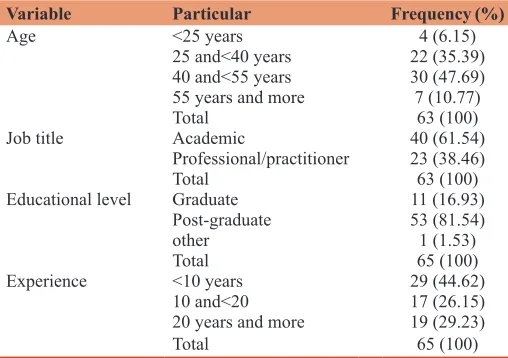
Table 1 presents the respondents demographic characteristics. The
table shows that: The respondents’ ages between (40 and <55 years) is the highest which represent (47.69%) followed by respondents’ those between (25 and <40 years) which represent (35.39%) then the respondents’ ages (55 years and more) which represent (10.77%) and lastly, the respondents ages (<25 years) which represent (6.15%). Regarding the respondents job title, the majority of them were academics (61.54%), followed by practitioner (38.46%). Concerning for the respondent’s educational level,
the majority of them were post-graduate education level which
represents (81.54%), followed by the level of graduate education (16.93%), and others (1.53%) as a lower ratio. As for the length
of respondents’ working experiences. The table shows that
respondents’ whom they have worked (<10 years) were the highest ratio which represents (44.62%) followed by those work (more than 20 years) which represent (29.23%), and those respondents from (10 <20 years) is a lower ratio which represents (26.15%).
4.3. Tests for Response Bias
A test of response bias has been conducted to confirm that there is no systematic response bias (Armstrong and Overton, 1977). To determine whether non-response bias was presented in the
study, academics respondents were compared with practitioners respondents along all the descriptive response items in the survey.
Accordingly, 40 were considered as academics respondents and 25 respondents were considered as practitioners’ responses and to be proxies for non-respondents. To represent academics versus practitioners’ responses, a multivariate chi-square test
was performed using the respondents’ characteristics in order
to decide whether significant differences exist between the two
groups. Table 2 presents the result of the test. It is clear from the table that no significant differences exist between the academics
and practitioners responses. For all the four characteristics of
respondents (age, educational level, experiences) the chi-square tests show no significant difference exist between the practitioners
and academics responses. It can be concluded that non-response bias is not a serious problem in this study. So, it is safety to join the responses as one sample.
4.4. Reliability Analysis
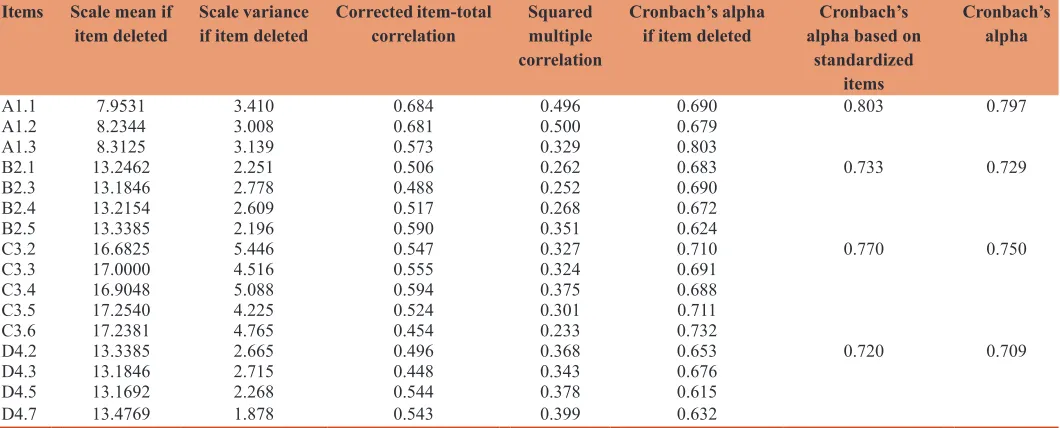
To test reliability this study used Cronbach’s alpha. According to Hair et al. (2010), the lower limit for Cronbach’s alpha is 0.70. The results of the reliability analysis summarized in Table 3
confirmed that all the items display a satisfactory level of reliability
(Cronbach’s alpha exceed the minimum value of 0.70). Therefore,
it can be concluded that the measures have an acceptable level of reliability. It is worth mentioning that some items are deleted to
increase the reliability to accepted level. The full items statements are displayed in Appendix A.
Table 4 shows the means and standard deviations of the four
components of creative accounting: Techniques of creative
accounting, the role of statutory auditors in creative accounting
practice, the commitment of ethical standards, and the qualitative characteristic of accounting information. The table shows that the Saudi Arabia accounting and auditing profession emphasized
more on the qualitative characteristic of accounting information (mean = 4.4308, standard deviation = 0.49115), followed by
the commitment of ethical standards (mean = 4.2462, standard
deviation = 0.52532), then the role of statutory auditors in creative accounting practice (mean = 4.4154, standard deviation = 0.50054), and the lowest components is the techniques of creative accounting (mean = 4.0744, standard deviation = 0.84678). Therefore, those four dimensions were achieved average mean (mean = 4.2917, standard deviation = 0.40214).
On the other hand also, Table 4 presents the bivariate correlation
matrix for the constructs operationalized in this study. The table
shows that no correlations near 1.0 (or approaching 0.8 or 0.9) were detected, which indicate that multicollinearity is not a significant
problem in this particular data set. Also, the table shows that the
average mean in the last column is positively and significantly correlated with the techniques of creative accounting (r = 0.625, P < 0.01), the role of statutory auditors in creative accounting practice (r = 0.680, P < 0.01), the commitment of ethical standards (r = 0.687, P < 0.01), the qualitative characteristic of accounting information (r = 0.770, P < 0.01) respectively.
4.5. Hypotheses Test
The results in Tables 5 and 6 for weighted mean and standard
deviation show that items statement A1.2 and A1.3 which related to
the techniques of creative accounting have weighted mean between (3.40 and 4.19) that means agree and item statement A1.1 has weighted mean between (4.20 and 5.00) that means strongly agree of the responses in the variable. Therefore, it can be concluded
Table 1: Respondents demographic characteristics
Variable Particular Frequency (%)
Age <25 years 4 (6.15)
25 and<40 years 22 (35.39) 40 and<55 years 30 (47.69) 55 years and more 7 (10.77)
Total 63 (100)
Job title Academic 40 (61.54)
Professional/practitioner 23 (38.46)
Total 63 (100)
Educational level Graduate 11 (16.93)
Post-graduate 53 (81.54)
other 1 (1.53)
Total 65 (100)
Experience <10 years 29 (44.62) 10 and<20 17 (26.15) 20 years and more 19 (29.23)
that the H1 (There is a negative relationship between creative accounting techniques and the reliability of financial reports)
full supported. Also, the tables for weighted mean and standard
deviation show that all items statement B2.1, B2.3, B2.4 and B2.5
which related to the role of statuary auditors in creative accounting
practice have weighted mean (between 4.20 and 5.00) that affirms strongly agree of the responses in the variable. Therefore, it can
be concluded that the H2 (there is a positive relationship between the roles of statutory auditors in creative accounting practice
and the reliability financial reports) full supported. The results
in Tables 5 and 6 for weighted mean and standard deviation show that items statement C3.5 and C3.6 which related to the
commitment of ethical standards have weighted mean between
(3.40 and 4.19) that means agree and item statement C3.2, C3.3, and C3.4 have weighted mean between (4.20 and 5.00) that assert strongly agree of the responses in the variable. Therefore, it can
be concluded that the H3 (There is a positive relationship between the commitment to ethical standards and the reliability financial reports) full supported. Further, the tables for weighted mean and standard deviation show that all items statement D4.2, D4.3,
D4.5 and D4.7 which related to the qualitative characteristic of accounting information have weighted mean (between 4.20 and 5.00) that confirm strongly agree of the responses in the variable. Therefore, it can be concluded that the H (There is a positive
Table 2: Chi-square Test for academic and practitioners responses Chi-square test for differences between
practitioners, academics, and both responses Categories Academics Practitioners Total Chi-square value Significant
Age of the respondents <25 years 2 2 4 13.985 0.030
25 and<40 years 16 6 22
40 and<55 years 19 11 30
55 years and more 3 4 7
Total 40 23 63
Educational level Graduate 3 8 11 19.625 0.033
Post-graduate 37 13 50
Other 0 1 1
Total 40 22 62
Experiences <10 years 17 9 26 22.082 0.005
10 and<20 11 6 17
20 years and more 10 8 18
Non-response 2 0 2
Total 40 23 63
Table 3: Item-total statistics and reliability statistics Items Scale mean if
item deleted Scale variance if item deleted Corrected item-total correlation Squared multiple correlation
Cronbach’s alpha
if item deleted alpha based on Cronbach’s standardized
items
Cronbach’s alpha
A1.1 7.9531 3.410 0.684 0.496 0.690 0.803 0.797
A1.2 8.2344 3.008 0.681 0.500 0.679
A1.3 8.3125 3.139 0.573 0.329 0.803
B2.1 13.2462 2.251 0.506 0.262 0.683 0.733 0.729
B2.3 13.1846 2.778 0.488 0.252 0.690
B2.4 13.2154 2.609 0.517 0.268 0.672
B2.5 13.3385 2.196 0.590 0.351 0.624
C3.2 16.6825 5.446 0.547 0.327 0.710 0.770 0.750
C3.3 17.0000 4.516 0.555 0.324 0.691
C3.4 16.9048 5.088 0.594 0.375 0.688
C3.5 17.2540 4.225 0.524 0.301 0.711
C3.6 17.2381 4.765 0.454 0.233 0.732
D4.2 13.3385 2.665 0.496 0.368 0.653 0.720 0.709
D4.3 13.1846 2.715 0.448 0.343 0.676
D4.5 13.1692 2.268 0.544 0.378 0.615
D4.7 13.4769 1.878 0.543 0.399 0.632
Table 4: Descriptive statistics and Pearson’s correlation
Items Mean±SD 1 2 3 4 5
1. Techniques of creative accounting (As) 4.0744±0.84678 1 0.024 0.051 0.244* 0.625** 2. Role of statutry auditors (Bs) 4.4154±0.50054 1 0.577** 0.548** 0.680** 3. Commitment of ethical standards (Cs) 4.2462±0.52532 1 0.506** 0.687** 4. Qualitative characteristic of accounting information (Ds) 4.4308±0.49115 1 0.770**
4. Average 4.2917±0.40214 1
relationship between the qualitative characteristic of accounting information and the reliability financial reports) full supported.
5. DISCUSSION
This part of study examines the discussion of relevant findings
of the research.
The creative accounting techniques used by management have a negative effect on the reliability of financial reporting. For the relationship between creative accounting techniques and reliability of financial reporting, inferential statistics shows that there is a significant negative interaction between predictor and the dependent variable, especially artificial treatment, off balance finance, and multiplicity of accounting policies (Table 6). This result is emphasized by (Fizza and Qaisar, 2015; Alomery and Alameen, 2014); who conclude that there is a negative effect of creative accounting techniques on quality of financial reporting. However, (Diana et al., 2014); show that more than half of the managers questioned answered that they had used accounting manipulation techniques to beautify the image of their companies even though they show a real life. Also, (Yadav et al., 2014) finds out the ways that helped to reduce the effect of creative accounting on the statement of financial position, by a presenting a quite positive picture of creative accounting practices. For
the connection between the role of the statutory auditor and
reliability of financial reporting, inferential statistics shows that there is a significant positive relationship between the role of the external auditor in promoting creative accounting practice (Proper planning, qualification, independence, and competence) and reliability of financial reporting. This result is in line with
a number of studies: (Al Momani and Obeidat, 2013; Osama, 2012; Mohammed and Mohammed, 2013); who are found that
the independence and integrity of statutory auditor has a greater
effect on the reliability of financial reporting. However, Keith (2010) argue that there is a strategic interaction between auditors
and management and that allows management to choose the economically irrational outcome of behaving ethically even
when doing so defies their own financial self-interest. Also, (Fizza and Qaisar, 2015) believe that corporate governance can
control the practices of creative accounting because it acts as an eye, If companies can increase its number of outside directors, the social responsibility of company boosts because it will be answerable to many of people. For the relationship between the
ethical standards and reliability of financial reporting, inferential statistics shows that there is a significant positive connection
between the commitment to ethical standards in accounting
profession (integrity, professional conduct, confidentiality, and objectivity) and reliability of financial reporting. This result is supported by. (Kassem, 2012); who conclude that the ethical
practices of creative accounting are there basically to help the
external auditors and accountant in providing reliable financial accounts. For the connexion between the qualitative characteristics of accounting information and reliability of financial reporting, inferential statistics shows that there is a significant positive correlation between the quality of accounting information (fair
presentation, accuracy, timing and consistency of accounting
policies) and reliability of financial reporting. This result is confirmed by. (Willekens, 2008; Courtis, 2005); who conclude that the qualitative characteristics of accounting information effect reliability of financial reporting.
5.1. Implications, Limitations and Suggestions for the Study
The results of this study have theoretical and practical implications
that could be of interest for directors, auditors, accounting
profession, regulators, and who in charge in governance. The
first theoretical contribution to good corporate governance focuses on the positive relationship between the role of statuary
auditor and the reliability of financial reporting. The second
theoreticalcontribution is the study provide a framework for Table 5: The weights of respondent’s answers
Opinion Weight Weighted mean Level
Strongly
disagree 1 From 1.00 to 1.79 Strongly disagree
Disagree 2 From 1.80 to 2.59 Disagree
Neutral 3 From 2.60 to 3.39 Neutral
Agree 4 From 3.40 to 4.19 Agree
Strongly agree 5 From 4.20 to 5.00 Strongly agree
Table 6: The weighted means and directions Item Strongly
disagree (%) Disagree (%) Neutral (%) Agree (%) Strongly agree (%) Weighted mean Standard deviation Direction
A1.1 1 (1.54) 3 (4.62) 5 (7.69) 24 (36.92) 32 (49.23) 4.28 0.91 Strongly agree A1.2 2 (3.08) 5 (7.69) 6 (9.23) 29 (44.62) 23 (35.38) 4.02 1.02 Agree A1.3 3 (4.69) 5 (7.81) 6 (9.38) 29 (45.31) 21 (32.81) 3.94 1.08 Agree B2.1 1 (1.54) 0 (0.0) 5 (7.69) 24 (36.92) 35 (53.85) 4.41 0.78 Strongly agree B2.3 0 (0.0) 0 (0.0) 2 (3.08) 30 (46.15) 33 (50.77) 4.48 0.56 Strongly agree B2.4 0 (0.0) 1 (1.54) 1 (1.54) 31 (47.69) 32 (49.23) 4.45 0.61 Strongly agree
B2.5 0 (0.0) 2 (3.0) 4 (6.2) 30 (46.2) 29 (44.6) 4.32 0.73 Strongly agree C3.2 0 (0.0) 0 (0.0) 1 (1.6) 24 (37.5) 39 (60.9) 4.59 0.53 Strongly agree C3.3 0 (0.0) 3 (4.7) 5 (7.8) 27 (42.2) 29 (45.3) 4.28 0.81 Strongly agree C3.4 0 (0.0) 0 (0.0) 4 (6.15 33 (50.77) 28 (43.08) 4.37 0.60 Strongly agree
C3.5 0 (0.0) 5 (7.7) 15 (23.1) 22 (33.8) 23 (35.4) 3.97 0.95 Agree
C3.6 0 (0.0) 2 (3.12) 14 (21.88) 28 (43.75) 20 (31.25) 4.03 0.82 Agree D4.2 0 (0.0) 0 (0.0) 2 (3.1) 36 (55.4) 27 (41.5) 4.38 0.55 Strongly agree D4.3 0 (0.0) 0 (0.0) 2 (3.1) 26 (40.0) 37 (56.9) 4.54 0.56 Strongly agree
creative accounting techniques that negatively affect the reliability of financial reporting. This study practically contributes to the accounting profession ethics literature by examining the importance and effect of exercising ethical standards on the reliability of financial reporting.
In spite of it’s theoretical and practical implications and contributions to the management accounting and reporting literature, this study is subject to some limitations that need be
considered. This study is based on participants’ responses to given
scenarios and there is a risk that the respondents may not have
answered the questionnaire honestly. The findings and discussion are limited to the propositions put forward in the questionnaire and
such a survey instrument provides limited opportunity to solicit
further meanings to participant’s responses. The major limitation of
this study is that the scope of the research is bounded and sampling
method used, thus limiting the generalizability of the results. The study only applied in KSA environment, this could result in an important limitation of the study. The study only considers the view of male gender. The more consideration of the study concentrates
on academics view.
The results of the current study open several avenues for
additional research. Oneimportant area is an evaluation of the effectiveness of the code of professional conduct in constraining
creative accounting. The findings of this report suggest that the most experienced members of the profession should be involved
in this project. Future research could map out the association of corporate governance features and creative accounting in the
KSA environment since no study was been conducted so far in
this respect.
6. CONCLUSION
This study explores the impact of creative accounting techniques on the reliability of financial reporting from auditors and academics point of view. Creative accounting techniques have a positive and negative effects. This study only considers the negative effects of creative accounting techniques on the reliability of financial reporting. The negative effects of creative accounting techniques
cannot be eliminated completely but it can be reduced to the
lower level. Therefore the study found that active corporate
governance principles can be used to control the practices of
creative accounting by using independent non-executive directors.
Also, the study concludes that the statutory auditor can play an effective role in reducing the effect of creative accounting
techniques on the reliability of financial reporting. Additionally
also, the study investigates the relationship between regulations and ethical standards, and creative accounting practice.
7. ACKNOWLEDGMENTS
The authors express appreciation Prince Sattam Bin Abdul-Aziz
University for providing the author with the relevant data and Dr. Mohamed Salih Yousif for his insightful and constructive comments on earlier drafts of this paper.
REFERENCES
Abbas, A.M., Graham, H., Magnus, O. (2006), International Financial
Reporting Standards. Hoboken, New Jersey, Canada: John Wiley & Sons, Inc.
Adel, M.H., Adarhaman, A.A. (2015), The Role of Forensic Accounting
in Practices Redaction of Creative Accounting Methods - Research
Field from the Viewpoint of Auditors in Auditing Offices. American
Academic Magazine. Vol. 18. USA. p123-136.
Afolabi, A., Oluseye, M. (2013), Effect of financial reporting on investment decision making of manufacturing firms in Nigeria. European Journal of Humanities and Social Sciences, 22(1), 1127-1142.
Aguolu, O. (2006), Ethics and integrity in the accounting profession. Nigerian Accountants, 41(3), 54-59.
Ajibolade, S.O. (2008), A survey of the perception of ethical behavior
of future Nigerian accounting professionals. Nigerian Accountants,
41(3), 54-59.
Al Momani, M.A., Obeidat, M.I. (2013), The effect of auditors’ ethics on their detection of creative accounting practices: A field study. International Journal of Business and Management, 8(13), 118-136. Alexander, D., Britton, A. (2000), Financial Reporting. 5th ed. London:
Thomson Learning.
Algodah, L.A., Alshanity, M.I., Albawagna, A.A. (2015), Creative
Accounting and Its Impact on the Informational Content of the Auditor’s Report from the Viewpoint of Financial Statements User.
The First International Scientific Conference, Albalga University.
p1-33.
Algray, M.M., Aseeri, A.A. (2013), The motivations and techniques of creative accounting in Saudi corporations. Journal of King Abdul Aziz University (Administration and Economics), 2, 107-168. Ali, M. (2008), The role of an Auditor to Prevent the Creative Accounting
Techniques, Ninth Research Conference.
Alomery, M.A., Alameen, M.A. (2014), Perceptions of external auditors
for the risk of creative accounting in Syrian stockholder companies:
An empirical study. Arbud for Studies and Researches, 3, 294-342. Armstrong, J.S., Overton, T.S. (1977), Estimating nonresponse bias
in mail surveys. Journal of Marketing Research, 14, 396-402.
Available from: http://repository.upenn.edu/ marketing papers/17.
DOI: 10.2307/3150783.
Ashok, K.G. (2015), Creative accounting. Indian Journal of Management Science (IJMS), 5(2), 59-64.
Balacia, O. (2008), Is Creative Accounting a form of Manipulation? Vol. 111. Section. Fainter. Oradea: Bonci Contrabiliate Tom. pXVII. Belkaoui, A.R. (2002), Accounting Theory. London: Thomson Learning. Beshiru, S., Prince, F.I. (2014), Nigerian commercial banks and creative
accounting practices. Journal of Mathematical Finance, 4, 75-83. Beuselinck, C.S. (2007), Financial reporting quality in private equity
backed companies: The impact of ownership concentration. Small Business Economics, 29, 261-274.
Courtis, J. (2005), Reliability of annual reports: Western and Asian
evidence. Accounting, Auditing and Accountability Journal,
8(2), 4-17.
Dak, C. (2005), Financial Accounting and Tax Principles. Oxford: CIMA
Publishing.
Diana, E.B., Bogdana, V., Feleagab, L. (2014), Colorful approach
regarding creative accounting. An introspective study based on the
association technique. Accounting and Management Information Systems, 13(4), 643-664.
Dumitrescu, A.S. (2014), Creative Accounting. Bucharest: Economic Publishing House. p35.
Journal of Business Research and Management, 3(1), 35-47. Fizza, T., Qaisar, A.M. (2015), Creative accounting and financial
reporting: Model development and empirical testing. International
Journal of Economics and Financial Issues, 5(2), 544-551. Gaara, O.A. (2012), The external auditor methods to detect fraud in the
financial statements. Journal of Business Studies, 2, 182-199. Gaara, O.A., Aladah, A.K., Abotamam, M. (2015), The effect of
financialists awareness about creative accounting practice on cash flow statement. Managerial Sciences Studies, 1, 227-246.
Gabar, S.N. (2015), The impact of creative accounting techniques on the reliability of financial data, field study on some public companies in
Irag. Algary for Managerial and Economic Science Journal, Alkofa University, 32, 238-264.
Gherai, D.S., Balaciu, D.E. (2011), From creative accounting and enron phenomenon to the current financial crisis. Annals Universities Apuleius Series Economic, 13(1), 34-41.
Glautier, M.W.E., Underdown, B. (2001), Accounting Theory and
Practice. 7th ed. Essex: Harlow Prentice Hall and Financial Times.
Greg, N., Mohamed, G. (2006), International Accounting Standards, Regulations, and Financial Reporting. Oxford: Elsevier Linacre
House, Jordan Hill.
Hair, J.F., Anderson, R.E., Tatham, R.L., Black, W.C. (2010), Multivariate
Data Analysis. 7th ed. Upper saddle River, NJ: Prentice Hall Inc.
Ihsan, S. (2008), The ethics of audit profession and its practitioners (Enron case). King Abdul Aziz University Review, 1, 255-291.
Kassem, R. (2012), Earnings management and financial reporting fraud: Can external auditors spot the difference? American Journal of Business and Management, 1(1), 30-33.
Keith, L.J. (2010), the game of fraudulent financial reporting: Accounting for ethics. Advances in Public Interest Accounting. Vol 15. Bingley, UK: Emerald Group Publishing Limited. p141-160.
Kevin, A. (2003), Uncovering Creative Accounting. London: Pearson
Education.
Khamangy, B., Sadeegy, M. (2015), The real of creative accounting practices in Algerian environment and how to exclude from financial reporting. The Journal of Algerian Enterprises, 8, 61-78.
Mathews, M.R., Perera, M.H.B. (1996), Accounting Theory and Development. South Milbourn: International Thomson Publishing
Company.
Mitchell, A., Sikka, P. (1993), Accounting for change: The institutions of accountancy. Critical Perspectives on Accounting, 4, 29-52. Mohammed, A.A., Mohammed, I.O. (2013), The effect of auditors’ ethics
on their detection of creative accounting practices: A field study. International Journal of Business and Management, 8(13), 118-136. Naser, K. (1993), Creative Financial Accounting: Its Nature and Use.
Hemel Hempstead: Prentice Hall.
Norri, M.B. (2013), The challenge of accounts controller for creative accounting techniques. The Journal of Administration and Economics, 96, 189-202.
Nwagboso, J. (2008), Professional Ethics, Skill, and Standards. Jos:
Inspirations Media.
Nwanyanwu, L.A. (2010), Internalization of ethics and professional practice in Nigeria: The accountant’s perspective. International Research Journal of Finance and Economics, 56, 82-87.
Nzotta, S.M. (2008), Accounting: Theory and Principles. Owerri:
Good-Davis Associate.
Ogbonna, G.N. (2010), Ethical considerations in corporate governance:
A survey of governance practices of corporate stakeholders in Nigeria. International Journal of Business Behaviour Sciences
Research, 1(1), 91-108.
Ogbonna, G.N., Appah, E. (2012), The Effect of Ethical Accounting
Standards on the Quality of Financial Reports of Banks in Nigeria.
Okezie, B.N. (2008), Audit and Assurance Services. Aba: Concept
Publishing.
Oriol, O. (1999), The Ethic of Creative Accounting. New Zealand:
Massey University.
Osazev, B., Henry, O. (2012), Creative accounting and firm’s market value in Nigeria. Kuwait Chapter of Arabian Journal of Business and Management Review, 2(3), 38-50.
Radu, V. (2013), The impact of creative accounting on financial audit, Studia Universitatis “Vasile Goldiş” Arad. Economics Series, 23(4), 56-62.
Revsine, L. (1991), the selective financial misrepresentation hypotheses. Accounting Horizons, 5(4), l6-27.
Schipper, K., Vincent, L. (2004), Earnings management. Accounting Horizon, 17, 97-110.
Sorin, B., Ramona, R.P., Adrian, G. (2012), A qualitative study regarding
the relationship between corporate governance and creative
accounting. Annals of Faculty of Economics, 1(2), 642-647. Victoria, F. (2014), An empirical study on the impact of creative accounting
policies on the performance of listed Romanian companies. Valahian
Journal of Economic Studies, 5(4), 41-48.
Vlora, B., Albulena, S. (2014), Effect of Creative Accounting on the
Company. 8th International Scientific Conference on Economic and
Social Development and 4th Eastern European ESD Conference:
Building Resilient Economy, Zagreb, Croatia.
Voinea, M.M. (2013), Accountability represent are normative a really economic? A.I. Cuza University. Intercultural Management, 15(2),
28-37.
Willekens, M. (2008), Effects of External Auditing in Privately Held
Companies: Empirical Evidence from Belgium. Working Paper Series.
Yadav, A.B., Cuzdriorean, D.D. (2013), Creative accounting,
measurement, and behavior. Annals’ Universities Apuleius Series
Economic, 15(1), 107-115.
Yadav, B., Kumar, A., Bhatia, B.S. (2014), Concept of creative accounting
and its different tools. International Journal of Management and
N The phrase Strongly
agree agree Neutral disagre Strongly disagree a. Techniques of creative accounting
1 The artificial treatment of financial events have a negative impact on the credibility of financial reports
2 The off balance finance have a negative impact on the credibility of financial
reports
3 The multiplicity of accounting policies and treatments have a negative impact on the credibility of financial reports
b. The role of statutry auditor in creative accounting practices
1 Proper planning for auditing helps in detecting the creative accounting practices 3 The professional qualification of auditor helps in detecting the creative
accounting practices
4 When the auditor be up todate with accounting work helps in detecting the creative accounting practices
5 The independence of auditor helps in detecting the creative accounting practices
c. Ethical standards
2 The integrity contribute to the credibility of financial reports
3 The commitment of professional conduct contribute to the credibility of financial
reports
4 The objectivity of accounting measurement contribute to the credibility of financial reports
5 Maintaining the confidentiality of company information contributes to the credibility of financial reports
6 Teaching ethics of creative accounting in educational institutions may increase the credibility of financial reports
d. Qualitative characteristics of accounting information
2 The fair presentation of accounting information have a positive impact on the credibility of financial reports
3 The aquaracy of accounting information have a positive impact on the credibility of financial reports
5 The timing of accounting information have a positive impact on the credibility of financial reports
7 The consistancy of accounting policies have a positive impact on the credibility of financial reports