225
Journal of Education, Teaching, and Learning is licensed under A Creative Commons Attribution-Non Commercial 4.0 International License.
The Development of Adobe Flash to Learning Dayak Traditional Music for
Students in Junior High School
Sartika Dewintha
1), Aloysius Mering
2), Indri Astuti
3)1)Universitas Tanjungpura, Pontianak, Indonesia
E-mail:[email protected]
2)Universitas Tanjungpura, Pontianak, Indonesia
E-mail:[email protected]
3)Universitas Tanjungpura, Pontianak, Indonesia
E-mail:[email protected]
Abstract.This study aims to describe the design of the development, appearance, and process of Adobe Flash learning
outcomes for learning traditional Dayak music for junior high schools. In this study involved media experts, material experts, design experts, fellow teachers, small, medium and large group trials. The subject of the trial was the eighth-grade students of Pontianak Public Middle School 10. Data obtained through interviews, observation and documentation studies. This study uses Research & Development research. The results of this study will later produce a product. Development research carried out combines the steps of Borg & Gall's development with the Dick and Carey model. The results showed that the media used was appropriate to be used as a learning medium for traditional Dayak music. The average level of feasibility based on the validator is that media experts have "feasible" eligibility criteria, "decent" material experts and "decent" design experts. Based on the results of the small group test scores "quite feasible," the trial group was "decent" and a large group test "feasible."
Keywords:Development; Flash; Dayak
I. INTRODUCTION
Traditional music learning requires interesting media. One example of a musical instrument that is scrutinized by researchers is traditional Dayak music which consists of melodic, rhythmic and harmonious musical instruments. Development is an effort to improve children's ability through education. This research is a development that produces a product. The resulting product is multimedia developed with Adobe Flash, in the hope that students can be more interested in learning traditional music. Traditional music is music that lives among people and inherits from generation to generation. Traditional music is one of the musical arts in every country, especially Indonesia. Traditional music usually has inherent characteristics with the characteristics of each region. Usually, traditional music uses its regional language and has its regional
226
introduced to the wider community, especially the younger generation. Dayak traditional music has unique musical instruments which in general are less recognized by the public. In general, Dayak instruments use rhythmic musical instruments, although they also have melodic and harmonious musical instruments.
In this research, researchers researched class VIII Pontianak 10 Public Middle School. Class VIII SMP Negeri 10 Pontianak has seven classes consisting of 39 students in each class. Researchers chose the study at this school because the Pontianak Public Middle School 10 uses the 2013 curriculum in which there are traditional musical instrument materials and Pontianak Public Middle School 10 also has facilities that support research researchers namely computers. Students found in Pontianak's SMP Negeri 10 school are also used to using computers so that it is easier for researchers to conduct research.
The reason researchers took the title of Adobe Flash Development for Learning Traditional Dayak Music for Junior High School Students is 1) Lack of children's knowledge of traditional music especially Dayak 2) Utilizing interesting media for children's learning media using Adobe Flash 3) Lack of available musical instruments traditional Dayak in schools, especially schools located in West Kalimantan, so that slowly can become extinct 4) Can be applied in schools with the 2013 curriculum on traditional musical instruments, so that children can learn traditional musical instruments.
The final goal of this research is to produce Adobe Flash for Learning Traditional Dayak Music for Junior High School Students equipped with its user guide book. To achieve the ultimate goal, the following objectives were obtained: 1) Designing Adobe Flash development for traditional Dayak music learning for junior high school students, 2) designing Adobe Flash display for traditional Dayak music learning for junior high school students, 3) Knowing the learning achievement of junior high school students in traditional Dayak learning after using Adobe Flash.
Hilrd and Brower in Thabroni, Muhammad (2011: 19) suggests learning relates to changes in a person's behavior towards a particular situation caused by repeated experiences in the situation, behavior changes cannot be explained or the basis of the tendency of the innate response, maturity or momentary conditions, such as fatigue, the influence of drugs, and so on. Learning theory is a theory that describes what is happening when the learning process takes place and when the learning process takes place. Learning theory consists of behavioristic, cognitive, constructivist, humanistic, cybernetics. According to the Big Indonesian Dictionary in Thabroni, Muhammad (2011: 18) learning comes from teaching words which means instructions given to people to be known or obeyed, while learning means processes,
ways, actions to make people or living things learn. So according to the above opinion it can be concluded that learning is an action from educators to students to share experiences and knowledge from students who do not know to know, have not mastered until mastered well. According to Meiliani, Risti (2014: 1) The design of learning is a satisfying way to make an activity work well, accompanied by various anticipatory steps to minimize the gap that occurs so that the activity reaches its intended goals.
The learning design consists of Model Dick and Carey, ASSURE, Jerold E. Kemp et al., Smith and Ragan, ADDIE. In this study, researchers used the Dick and Carey learning design. Sadiman, Arief (2011: 6) states that the media comes from the Latin language, medius and is a plural form of the word medium which means intermediary or introduction. Gagne in Sadiman, Arief (2011: 6) states that media are various types of components in the student environment that can stimulate them to learn. Based on technological developments, learning media can be grouped into four groups, namely the media of printed technology, audio-visual technology media, computer-based media, combined technology. Practical benefits in the use of learning media in the teaching and learning process (Arsyad, 2015: 26), namely 1) Learning media can clarify the presentation of messages and information so as to facilitate and improve learning processes and outcomes, 2) Learning media can improve and direct the child's attention so that they can cause learning motivation, more direct interaction between students and their environment and allow students to study individually according to their abilities and interests, 3) Learning media can overcome the limitations of senses, space and time.
227
M. Amarullah in Setiawan, Mudiyanti (2016: 2) states that flash is a software that can draw and animate it, and is easy to learn. Flash is not only used in making animation, but nowadays flash is also widely used for other purposes such as in game making, web building presentations, learning animations, even in filmmaking. According to Fatimah (2016: 24) Adobe Flash CS5 is a software that can produce presentations, games, movies, interactive CDs, as well as learning CDs, and to create interactive, interesting and dynamic websites. Adobe Flash CS5 can complete a website with a variety of animations, sounds, interactive animations and more so that users while listening to their explanations can see animated images, as well as read explanations in text form.
According to Putri, Nadya (2012: 319) Traditional music is music that was created and favored by the past society which until now is still developed and preserved for generations as a means of entertainment and regional identity. The development of traditional music is influenced by actors and artists, types of music and the wider community who hear and enjoy it. Regional music or traditional music is music that was born and developed from regions throughout Indonesia. In each region have different characteristics and types of music. Characteristics of this type of music are printed on the contents of songs and instruments (musical instruments).
According to Surjani Alloy (2014: 11) Today, the meaning of the Dayak term is increasingly expanded, renewed and more positive, so it is not surprising that then many Dayaks are proud to be Dayaks or some Dayaks once came out of Dayak now back to basic being a Dayak again. Media is a tool that helps students to achieve learning goals (Setijadi, 1994: 2). The selection of media is also important to achieve the intended learning objectives. Because media is made to facilitate students to understand the material to be taught by the teacher. Adobe Flash is the main software set used to combine all media content so that it becomes interactive multimedia (Oktariani, 2017: 37). Flash is designed to develop image media, music, teaching material content, videos, games, animation, and effects to develop the media to be more interesting.
Some of the previous relevant studies used by researchers are!) Previous research on Pelend Salendro Gamelan learning based on Interactive Multimedia using Adobe Flash for Public High School conducted by Dicky Kurniawan Indrapraja, a UPI Postgraduate student, 2) previous research on Interactive Multimedia Development Jepin Dance An Intersection Step for Junior High School Students conducted by Dwi Oktariani, a student of the Indonesian Education University's Art Education Study Program, 3) Ni Ketut Ningsih's research in a 2009 article which embodied the development of multimedia learning media for Balinese dance basic movements. The final product of this study is an
interactive CD of Balinese dance basic movement learning using Macromedia Flash software.
II. RESEARCH METHOD
This study uses Research & Development research. The results of this study will later produce a product. The main activity in this research is first to do research and literature study to produce a specific product design, and the second activity is the development, which is testing the effectiveness, the validity of the design that has been made, so that it becomes a tested product and can be used in the wider community to produce certain products used research that needs analysis and to test the effectiveness of the product so that it can function in the wider community, it is necessary to research to test the effectiveness of the product.
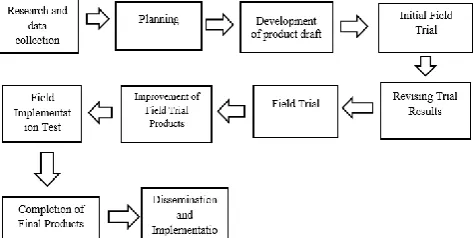
Fig. 1 Product Development Steps for Borg and Gall
228
summative evaluation. This development research researcher combines development research using Borg and Gall's steps, and the Dick and Carey module learning design can be seen in the following Figure 2:
Fig. 2 Adaptation of Development Research Models from Borg and Gall Combined with Dick and Carey
Models (Astuti, 2015: 90)
The stages of learning media development consist of three main sections will be explained as follows: 1) Pre-Research Stage, consisting of needs analysis (Need Assassement), Identifiable instructional Goals (analyzing learning objectives), Conducting Goal Analisys (Conducting Learning Analysis) , Identity Entry Behavior Characteristics, Write Performance Objectives (Formulating specific Objectives, Planning (learning media planning) 2) Media Development Phase consists of Developing preliminary form of product, Develop Criterion Reference Tests (Developing assessment instruments / Development of test items), Instructional Development Strategy (Developing Learning Strategies, Develop and Select Ainstructional Materials (Developing and selecting instructional materials), Design and Conduct Formative Evaluation (Designing and Implementing Formative Evaluations), Revising Learning Packages (Instructional Revise), 3) Test Try, Revision and Evaluation consists of Preliminary field testing, Main product revision, which is to make improvements to the initial product produced based on the results of the initial trial, Main field testing (medium scale trial), Operational product revision (revision of product operations ), Operational field testing (large scale trial), Final product revision (final product improvement)
The study was conducted at the junior high school in Pontianak City, SMP Negeri 10 Pontianak on WR Soepratman Street. The research subjects in this study were eighth-grade students from Pontianak 10 Junior High School 2017/2018 school year. Which consists of 8 classes, namely class VIII H which amounts to 24 people. Data collection techniques carried out by researchers are as follows by observation, interviews, indirect communication, documentaries, instruments for assessing observation
guidelines, interview guides, questionnaires, documentation guidelines. Data analysis techniques in this study are divided into qualitative and quantitative data analysis techniques. Qualitative Technique Analysis, data obtained from various sources using various data collection techniques (triangulation) and carried out continuously until the data is saturated. With this continuous observation, it causes very high data variations. Qualitative data analysis is inductive, i.e., an analysis based on the data obtained then developed into a hypothesis. Data collection, data presentation, and conclusion drawing. The steps are as follows, a) Analysis of research instrument validation, activities carried out to analyze these activities are, 1) Recording assessment of the results of the validation of material experts and media experts, 2) creating and analyzing the table of validation results by these experts 3) looking for the average of each criterion with the formula (Khabibah, 2006) b) Analysis of the results of the validation of teaching materials through the assessment of design, material and media experts.
III.RESULT AND DISCUSSION
A. Result
1. Adobe Flash development design for learning traditional Dayak music for junior high school students
a. Analyze learning objectives
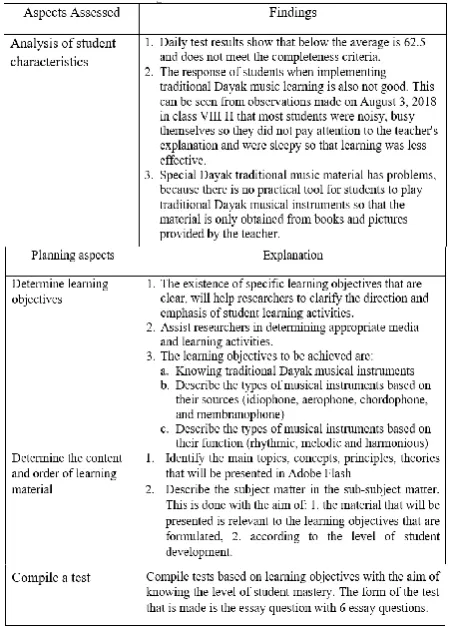
This research was conducted by analyzing the learning objectives. The learning objectives in this study were generated from the syllabus and also through a process of needs analysis based on the experiences of learning difficulties faced by students. Learning objectives according to the syllabus are that students can find traditional musical instruments through examples provided by the teacher and by listening to students can describe the basic techniques of playing traditional idiophone, aerophone, chordophone, and membranophone instruments in groups and students can understand the distribution of traditional musical instruments based on its function. Interview with the subject of Culture and Skills Art on Monday, July 30, 2018, and to one of the eighth-grade students on Thursday 2 August 2018 at SMP Negeri 10 Pontianak about the influence of traditional music material using media.
Table I
229
Product development, the next stage carried out in this research activity is to conduct the feasibility test of the results of the module development starting with validating by experts to find out and analyze the shortcomings of the initial module design that has been produced in the design stage, Adobe Flash media validation for Dayak music learning, has been carried out by 2 lecturers.
Fig. 3 Adobe Flash Learning Media Validation Data by Media Experts
Based on Figure 3 data from the media expert validation results show that Adobe Flash has an average value of 3.32 and is valid regarding coloring, word and language usage, screen display, presentation, images, animation and sound, and the benefits of Adobe Flash media. It can be seen from the validity criteria of learning media, 3 <Va media ≤ 4
Adobe Flash media validation for Dayak music learning has been carried out by one teacher
who teaches in junior high school and one lecturer.
Fig. 4 Adobe Flash Learning Media Validation Data by Material Experts
Based on the graph 4.2 the results of the validation of the material experts show that Adobe Flash has an average value of 3.75 and is valid from the aspect of content, presentation of material, linkages of material. It can be seen from the validity criteria of learning materials, 3> Va media ≤ 4.
Fig. 5 Adobe Flash Learning Media Validation Data by Design Experts
At the small group trial stage or referred to as the one to one trial, researchers use three students with different abilities. One child with low ability, one child with moderate abilities, and one child with high abilities. The three students will do the teaching and learning process with the product that researchers have prepared, namely Adobe Flash on learning traditional Dayak music. The researcher also provides student response questionnaires that will be filled by students to find out the shortcomings and student comments on Adobe Flash products.
This initial stage testing is carried out by students of class VIII D which later will be useful for revising the product. The following is the implementation of 1) observing the interest in learning and responses from students during class 2) giving questionnaires (questionnaire).
230
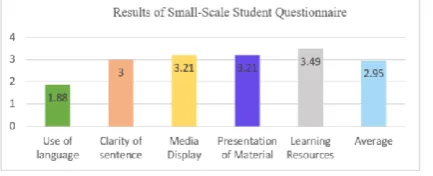
Fig. 6 Results of Questionnaire on Student Response to Adobe Flash with Small Scale Trial
Main product revision, make improvements to the initial product produced based on the results of the initial trial. After conducting a small group test, the researcher revised the initial product. Revisions are made to complement products that are still deemed incomplete when testing the small group. After revising, continued with the group trial, the process of the group trial stage was being carried out in the Computer laboratory room of SMP Negeri 10 Pontianak on Monday, July 30, 2018, at 7.40-8.20 WIB. The medium group trial consisted of 6 students who had different abilities, namely two people with low abilities, two people with moderate abilities and two people with high abilities. Then the student tries Adobe Flash products that have been provided by the researcher.
Fig. 7 Results of Questionnaire on Student Response to Adobe Flash with Medium Scale
Trial
Product operational revision at this stage the researcher revises the product operation based on the revision of the student's response which is still considered lacking in the medium scale trial. Make improvements to the products produced based on the results of the medium group trial. After testing the medium group, the researchers revised. After revised the researchers then conducted a large-scale trial, a large-scale trial was a trial at the last stage. At this stage, researchers used products that had been revised from the results of the revision of the medium scale trial. The large-scale trial of the researcher conducted on Wednesday, August 1, 2018, in the computer laboratory room in Pontianak 10 Public Middle School. At this stage, researchers used 24 students with different abilities, namely eight low-ability students, eight moderate-capable students, and eight high-ability students. Then the
student tries Adobe Flash products that have been provided by researchers.
Fig.8 Results of Questionnaire on Students' Response to Adobe Flash With Large-Scale
Trials
Final product revision (final product improvement) After conducting a large-scale trial, researchers conducted a final revision of Adobe Flash products based on the results of revisions to student responses that were still considered lacking in large-scale trials.
2. Learning achievement of Junior High School Students in Traditional Dayak Learning after using Adobe Flash
a. Cognitive acquisition results
The initial stage of the implementation began with the provision of pretest questions in the form of 6 questions. The research subjects were students of Pontianak State 10 Junior High School totaling 24 students. Pretest aims to measure the initial ability of students before learning traditional Dayak music material using Adobe Flash. The pretest was conducted on August 2, 2018, at 7:00 a.m. to 7.40 after the treatment, learning activities were carried out in SMP Negeri 10 Pontianak on August 3, 2018, and carried out as many as one meeting starting at 07.00-9.00.
The posttest was held on Friday, August 3, 2018, at 9.15-9.35 WIB in the classroom room of SMP Negeri 10 Pontianak, the result of the acquisition of the affection was to assess the affective of the students, the researcher assessed the questionnaire which had aspects. The distribution of student questionnaires was held on August 4 at 7:00 to 7:20 a.m. located in the classroom of Pontianak 10 Public Middle School. Student questionnaires were distributed to 24 students who had used Adobe Flash media before.
231
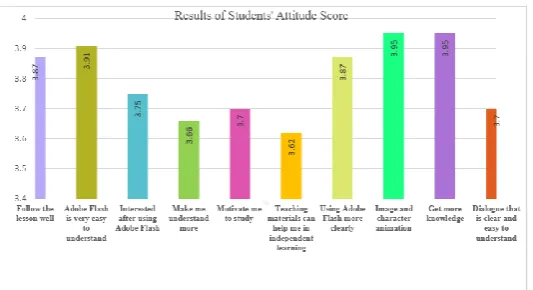
Fig. 10 Results of Value for Every Aspect of Student Attitudes
The average value of students' attitudes is 3.79 which can then be concluded that students like and are interested in Adobe Flash learning in learning traditional Dayak music in Pontianak 10 Public Middle School.
B. Discussion
Adobe Flash development design for traditional Dayak music learning. The Adobe Flash development that researchers use is the procedure used in research and development (R & D) with Dick and Carey design. Adobe Flash development activities require a good and systematic step in order so that the resulting process can be obtained maximally. The development design in a learning media is very important, to solve the problem of student learning difficulties. It is in line with the opinion of Meiliani, Risti (2014: 1) The design of learning is a satisfying way to make an activity run well, accompanied by various anticipatory steps to minimize the gap that occurs so that the activity reaches its intended goals.
The appearance of Adobe Flash is made in the storyboard by researchers; it is to make it easier to analyze the views on Adobe Flash. Adobe flash media consists of the external display, in the external display there is the writing "Learning Dayak Traditional Music" with the background of the Dayak traditional house, the Betang house and accompanied by the sound of sape'. The appearance in Adobe Flash makes children interested in learning it. Adobe flash media is made with various views to explain every traditional Dayak music material that makes it easy for students to learn, this is in line with the opinion of Gagne and Briggs (in Arsyad, 2015: 4) implicitly saying that learning media includes tools that are physically used to convey Contents of teaching materials, consisting of books, tape recorders, cassettes, video cameras, video recorders, films, slides (picture frames), photos, pictures, graphics, television, and computers.
Student learning outcomes are based on assessment of cognitive aspects and affective
aspects. Cognitive aspects were obtained from pretest and posttest students. Students experience significant changes in value for better grades. This is in line with Witherington's opinion in Thabroni, Muhammad (2011: 20) learning is a change in personality which expresses itself as a new pattern rather than a reaction in the form of skills, attitudes, habits, intelligence or understanding and according to Sardiman (2004: 26 -28) that the purpose of learning is to get knowledge that is characterized by thinking ability, the planting of concepts and skills that are physical and spiritual and the formation of mental attitudes and behavior of students, will not be separated from the matter of planting values.
IV.CONCLUSIONS AND SUGGESTIONS
In this study involved media experts, material experts and design experts as validators in Adobe Flash media. The test subjects in this study were eighth-grade students from Pontianak Public Middle School 10. After conducting the validator to the experts, this study was tested in small, medium and large groups. The results of the study show that the media used is suitable for use as a learning medium. The average level of feasibility based on the validator is the average value media expert that is "feasible," "decent" material expert and "decent" design, expert. Based on the results of the small group test scores "quite feasible," the trial group was "decent" and a large group test "feasible."
Suggestions for Adobe Flash development design, for other researchers, can make Adobe Flash development reference on learning traditional Dayak music for junior high school students to be further investigated. Suggestions for Adobe Flash Display, for researchers interested in the appearance of Adobe Flash on traditional Dayak music learning this research as a reference source in subsequent research, for art and culture subject teachers, in the teaching of arts and culture in order to make research using Adobe Flash as an art and cultural subject matter to add references in teaching material about local music so students can find regional music in their place, and students can participate in appreciating cultural arts in their respective regions. Suggestions for student learning that is learning to use Adobe Flash for learning traditional Dayak music can be used as alternative learning by the teacher to improve student learning outcomes.
REFERENCES
Arsyad, Azhar. 2011. Media Pembelajaran. Jakarta: PT Raja Grafindo Persada
232
Ilmu Pendidikan Universitas Tanjungpura Pontianak.
Astuti, Indri. 2015. Pengembangan Model Pembelajaran Konseling Kelompok dengan Pendekatan Konstruktivistik. Disertasi tidak diterbitkan. Jakarta: PPS UNJ.
Borg, W.R dan Gall, M.D. 1983. Educational
Research An Introduction. New York:
Longman
Dick, W, Carey L. J.O. 2001. The Systematic Design
on Instruction. Addison-Wesley Educational
Publisher Inc.
Fatimah. 2016. Pengembangan Media Pembelajaran
Menggunakan Software Adobe Flash
Professional CS6 Pada Materi Gula dan Hasil Olahnya Untuk Siswa Kelas X Jasa
Boga SMK Negeri 1 Sewon. Skripsi.
Yogyakarta: Fakultas Teknik Negeri Yogyakarta
Florus, Paulus.1992. Kebudayaan Dayak Aktualisasi
dan Transformasi. Pontianak: Institud
Dayakologi.
Gray, Mel. 2008. Viewing Spirituality in Social Work Through the Lens of Contemporary Social Theory. Australia: British Journal of Social Work.
Gustafon, Kent L dan Branch, Robert Meribe. 2002.
Survey Of Instructional Development
Models. New York: Eric Syracause. Indrapraja, Diecky Kurniawan. 2012. Pembelajaran
Pelog Salendro Berbasis Multimedia
Interaktif Untuk Peserta Didik Sekolah
Menengah Umum. (Tesis). Bandung: UPI
Jazuli, Porf, Dr. M. 2005. Paradigma Kontekstual
Pendidikan Seni. Semarang: Unesa
University Press.
Khabibah, Siti. 2006. Pengembangan Model Pembelajaran Matematika dengan Soal Terbuka Untuk Meningkatkan Kreatifitas
Siswa Sekolah Dasar Disertasi. Tidak
dipublikasikan. Surabaya: Program Pasca Sarjana Universitas Negeri Surabaya. Mack, Dieter. 2001. Pendidikan Musik Antara
Harapan dan Realitas. Bandung: Universitas
Pendidikan Indonesia
Maswan. 2017. Teknologi Pendidikan Penerapan Pembelajaran yang Sistematis. Yogyakarta: Pustaka Pelajar
Musjilah, Hanna Sri. 2004. Teori Musik. Yogyakarta: Universitas Negeri Yogyakarta
Ningsih, Ni Ketut. 2009. Pengembangan Media CD Pembelajaran Berbasis Multimedia Gerakan Dasar Tari Bali. Jurnal : JPTK, UNDHIKSA, Vol hlmm. 37-50
Oktariani, Dwi. 2017. Pengembangan Multimedia Interaktif Tari Jepin Langkah Simpang Bagi
Siswa Sekolah Menengah Pertama.
Bandung: Program Studi Pendidikan Seni
Pascasarjana Universitas Pendidikan Indonesia.
Prawiradilaga, Dewi Salma. 2012. Mozaik Teknologi Pendidikan, Jakarta: Universitas Negeri Jakarta
Pribadi, Benny. 2010. Model Desain Sistem Pembelajaran. Jakarta: Dian Rakyat
Purnomo, Eko. 2016. Seni Budaya Kurikulum 2013.
Jakarta: Kementerian Pendidikan dan Kebudayaan.
Putra, Nusa. 2015. Research and Development. Jakarta: PT Raja Grafindo Persada
Putri, Nadya. 2012. Efektivitas Penggunaan Media Video Untuk Meningkatkan Pengenalan Alat Musik Daerah Pada Pembelajaran IPS Bagi Anak Tunagrahita Ringan di SDLB 20 Kota Solok. Jurnal Ilmiah Pendidikan Khusus. Sadiman, Arief. 2011. Media Pendidikan Pengertian,
Pengembangan dan Pemanfaatannya.
Jakarta: PT Raja Grafindo Persada.
Setiawan, Mudiyanto. 2016. Aplikasi Pembelajaran Interaktif Berbasis Multimedia Untuk
Sekolah Dasar. Manado: Jurusan Teknik
Elektro-FT. UNSRAT
Schunk, Dale. 2012. Teori-teori Pembelajaran Perspektif Pendidikan. Yogyakarta: Pustaka Belajar
Setijadi. 1994. Pemilihan dan Pengembangan Media
Untuk Pembelajaran. Jakarta: PT. Raja
Grafindo Persada
Sugiyono. 2013. Cara mudah menyusun skripsi, tesis, dan disertasi. Yogyakarta: Alfabeta
________. 2016. Metode Penelitian Kuantitatif,
Kualitatif, dan RnD. Bandung: Alfabeta
Bandung.
________. 2016. Metode Penelitian Administrasi. Bandung: Alfabeta Bandung
Surjani, Alloy. 2014. Mozaik Dayak Keberagaman Subsuku dan Bahasa Dayak di Kalimantan Barat. Pontianak: Institut Dayakologi Surwanto, Harry. 2006. Seni Budaya Musik Untuk
SMP/MTs Kelas VIII KTSP. Jakarta: PT.
Galaxy Puspa Mega.
Thabroni, Muhammad. 2011. Belajar dan Pembelajaran Pengembangan Wacana dan
Praktik Pembelajaran Pembangunan
Nasional. Yogyakarta: Ar-ruzz Media.
Warsita, Bambang. 2008. Teknologi Pembelajaran, Landasan dan Aplikasinya. Jakarta: Rineka Cipta.
Widoyoko, Eko Putro. 2017. Teknik Penyusunan Instrumen Penelitian. Yogyakarta: Pustaka Belajar.