http://dx.doi.org/10.3765/sp.9.20
This is anearly accessversion of
Bergen, Leon, Roger Levy, Noah Goodman.2016. Pragmatic reasoning through semantic inference.Semantics and Pragmatics 9(20). http://dx.doi.org/10. 3765/sp.9.20.
This version will be replaced with the final typeset version in due course. NB: page numbers will change, so cite with caution.
©2016Bergen, Levy, & Goodman
Leon Bergen
Massachusetts Institute of Technology University of California, San DiegoRoger Levy
Noah Goodman Stanford University
Abstract A number of recent proposals have used techniques from game theory and Bayesian cognitive science to formalize Gricean pragmatic reasoning (Franke
2009,Frank & Goodman 2012,Goodman & Stuhlmüller 2013,Jäger 2012). We
discuss two phenomena which pose a challenge to these accounts of pragmatics: M-implicatures (Horn 1984) and embedded implicatures which violate Hurford’s constraint (Hurford 1974,Chierchia et al. 2012). While techniques have been de-veloped for deriving M-implicatures, Hurford-violating embedded implicatures pose a more fundamental challenge, because of basic limitations in the models’ architecture. In order to explain these phenomena, we propose a realignment of the division between semantic content and pragmatic content. Under this proposal, the semantic content of an utterance is not fixed independent of pragmatic inference; rather, pragmatic inference partially determines an utterance’s semantic content. We show how semantic inference can be realized as an extension to the Rational Speech Acts framework (Goodman & Stuhlmüller 2013). The addition oflexical uncertaintyderives both M-implicatures and the relevant embedded implicatures, and preserves the derivations of more standard implicatures. We use this principle to explain a novel class of implicature, non-convex disjunctive implicatures, which have several theoretically interesting properties. In particular, these implicatures can be preserved in downward-entailing contexts in the absence of accenting, a property which is predicted by lexical uncertainty, but which violates prior generalizations in the literature (Horn 1989,Fox & Spector Forthcoming).
Keywords:Pragmatics, Game theory, Hurford’s constraint, Embedded implicatures, Divi-sion of pragmatic labor, Bayesian modeling
1 Introduction
Theories of natural language semantics aim to provide a simple account of how peo-ple interpret expressions in their language. Attempts to provide such an account face a basic challenge: the interpretation of expressions frequently varies with linguistic and social context. An obvious response to such contextual variation is to posit that natural language expressions are highly polysemous. A naive implementation of this idea will have at least two deficiencies: the theory will need to be extremely complex to accommodate all of the possible meanings of each expression; and it will miss the systematic relationship between an expression’s context and its interpretation.
Gricean theories of pragmatics provide an elegant solution to these problems. They posit that the interpretation of an expression is not necessarily identical to its semantic content. Rather, this semantic content plays a specific role in the derivation of the expression’s interpretation. In typical circumstances, speakers and listeners regard each other as rational agents who share the goal of communicating informa-tion to each other. A speaker chooses an utterance by reasoning about the beliefs that a listener would form if they interpreted utterances according to their semantic content; the speaker will be more likely to choose an utterance that is effective at communicating their intended meaning. The listener, in turn, interprets an utterance by reasoning about which intended meanings would have made the speaker most likely to choose this utterance. Gricean pragmatic accounts thus factor the interpreta-tion of an expression into two parts: its semantic content, which determines its literal meaning, and cooperative social reasoning, which builds on this literal interpretation to determine the expression’s inferred meaning. By factoring out the role of semantic content in this manner, Gricean pragmatic accounts reduce the explanatory burden of semantic theories. Many facts about an expression’s interpretation will be determined by the communicative setting in which the expression is used, and not simply the expression’s semantic content.
Despite the promise and apparently broad empirical coverage of these theories, attempts at formalizing them have historically met with less success than formaliza-tion in other linguistic domains such as phonology, syntax, or semantics. Even more
successful models, such asGazdar(1979)’s, do not attempt to model the sophisticated
between literal semantic content and understood meaning, and in all Gricean theories these factors can potentially come into conflict (e.g., the opposition between Horn’s
(1984) Q and R principles). Our success at cooperative communication implies that
a calculus of how different factors’ influence is resolved in each communicative act is broadly shared within every speech community, yet extant theories generally leave this calculus unspecified and are thus unsatisfactory in predicting preferred utterance interpretation when multiple factors come into conflict. Mathematical formalization can provide such a calculus. Second, in the decades since Grice’s original work there has been a persistent drive toward conceptual unification of Grice’s original maxims
into a smaller set of principles (e.g.,Horn 1984,Levinson 2000,Sperber & Wilson
1986). Mathematical formalization can help rigorously evaluate which such efforts
are sound, and may reveal new possibilities for unification. Third, the appropriate mathematical formalization may bring pragmatics into much closer contact with empirical data, by making clear (often quantitative) and falsifiable predictions re-garding communicative behavior in specific situations that may be brought under experimental control. This kind of payoff from formalization has been seen in recent
years in related fields including psycholinguistics (Lewis & Vasishth 2005,Smith &
Levy 2013) and cognitive science (Tenenbaum et al. 2011). Fourth, the development of pragmatic theory necessarily has a tight relationship with that of semantic theory. A precise, formalized pragmatic theory may contribute to advances in semantic theory by revealing the nature of the literal meanings that are exposed to Gricean inference and minimizing the possibility that promissory appeals to pragmatics may leave key issues in semantics unresolved.
The last several years have, in fact, seen a number of recent accounts that are beginning to realize this potential by formalizing Gricean pragmatic reasoning using
game theory or related decision-theoretic frameworks (Parikh 2000,Franke 2009,
expressions. Finally, by bringing in linking assumptions regarding the relationship between probabilistic beliefs and action from mathematical psychology, some of these models have been tested against empirical data far more rigorously than has
been seen in previous work (Frank & Goodman 2012,Goodman & Stuhlmüller
2013,Degen et al. 2013).
This paper continues these efforts, using recursive probabilistic models to for-malize Gricean explanations of a sequence of increasingly complex pragmatic phenomena. We will begin by providing an account, in line with previous game-theoretic models, of scalar implicatures and a generalized class of these implicatures,
which we refer to as specificity implicatures. We will also demonstrate how this
rational speech acts modelprovides a solution to the symmetry problem for scalar
implicatures.
We will next turn to M-implicatures, inferences that assign marked interpreta-tions to complex expressions. We will show that the simple model of specificity implicatures does not derive M-implicatures, for reasons that are closely related to the multiple equilibrium problem for signaling games — a well-known problem in game theory. In order to derive even the simplest types of M-implicatures, we need to relax the traditional Gricean factorization of semantic content and pragmatic inference. In particular, the semantic content of expressions will not be determined in advance of pragmatic inference. Rather, the participants in a conversation will jointly infer this semantic content, as they are performing pragmatic reasoning.
Semantic inferenceplays an essential role in our derivation of M-implicatures.
By the term inference we refer to the use of data to estimate model parameters
which area prioriunknown; bysemantic inference, we are referring to the use of
probabilistic inference to resolve the semantic content of utterances. Thus, the end result of pragmatic reasoning results from inferences about the meaning of words, not only about the speaker’s intentions or beliefs. In order to represent the speaker and listener’s inferences about the semantic content of their language’s expressions,
we will introducelexical uncertainty, according to which the speaker and listener
begin their pragmatic reasoning uncertain about exactly how their language’s lexicon maps expressions to literal meanings. By extending the rational speech acts model with lexical uncertainty, we will be able to derive simple M-implicatures, in which complex expressions are assigned low probability interpretations. We will be able to derive a larger class of M-implicatures, in which complex utterances are assigned more generally marked interpretations, by relaxing the assumption that the speaker is knowledgeable.
will need to be sensitive to the compositional structure of the expressions that it is interpreting. We will extend the model so that it respects the compositional structure of expressions, and represents uncertainty about the semantic content of genuine elements of the lexicon — that is, atomic expressions — rather than whole expressions. When the model is extended in this manner, it will derive the embedded implicatures in question.
Though the determination of semantic content cannot be separated from prag-matic reasoning under our proposal — indeed, semantic inference will drive the derivation of the more interesting implicatures that we will consider — we will not have to abandon all of the explanatory advantages that factored Gricean accounts provide. Under our proposal, the explanatory burden of semantic theories will still be limited: they will need to account for approximately the same interpretive phenom-ena as they do under more traditional Gricean theories. As we will describe in more detail below, this is because the semantic content provided by semantic theories will still only play a limited functional role within our models. Our models primarily depart from traditional Gricean theories in their account of what role this semantic content will play.
The phenomena discussed in this paper differ with respect to their novelty in the pragmatics literature and whether they can be explained under previous pragmatic accounts. Specificity implicatures (and their special case, scalar implicatures) are entirely standard in the game-theoretic pragmatics literature, and our account of these implicatures is essentially identical to previous proposals. M-implicatures have also been looked at extensively in this literature, but unlike specificity implicatures, there is no canonical explanation for them. We introduce a novel pragmatic principle, lexical uncertainty, to explain these implicatures. The final set of phenomena we consider, non-convex disjunctive implicatures, have not yet been considered in the pragmatics literature, and cannot be derived within previous game-theoretic accounts. We show how to derive these implicatures through a natural extension of the lexical uncertainty principle, thereby demonstrating an improvement in empirical coverage over these previous models. Non-convex disjunctive implicatures have further theoretical interest, because they can be derived in downward-entailing contexts, and therefore serve as counterexamples to previous generalizations in the literature. We will show that lexical uncertainty both explains the phenomena which motivated these generalizations, and provides an account of these counterexamples.
The models that we present are undoubtedly incomplete in many respects, and
our goal is not to present a theory of pragmatics per-se. Rather, our goal is to
are therefore promising candidates for inclusion in more complete formal accounts of pragmatics. This is supported by an observation which will recur throughout
the paper: the proposed principles are conservative, in the sense that extending
simpler models with them preserves the major classes of implicatures derived by those simpler models. This supports the development of pragmatic theories in an incremental manner, and suggests that the ideas presented here may be incorporated into other accounts without disturbing the core predictions of those accounts.
2 The baseline rational speech-act theory of pragmatics
We begin by introducing the baseline rational speech-act theory of pragmatics (Frank
& Goodman 2012,Goodman & Stuhlmüller 2013), built on a number of simple foundational assumptions about speakers and listeners in cooperative communicative
contexts. We assume first a notion ofCOMMON KNOWLEDGE(Lewis 1969,Stalnaker
1978, Clark 1996) — information known by both speaker and listener, with this shared knowledge jointly known by both speaker and listener, knowledge of the knowledge of shared knowledge jointly known by both speaker and listener, and so
onad infinitum(or at least as many levels of recursion up as necessary in the recursive
pragmatic inference). Communication involves the transmission of knowledge which is not common knowledge: we assume that the speaker, by virtue of some observation that she has made, is in a particular belief state regarding the likely state of some conversationally relevant aspect of the world (or, more tersely, regarding the world). In engaging in a cooperative communicative act, the speaker and listener have the joint goal of bringing the listener’s belief state as close as possible to that of the speaker, by means of the speaker formulating and sending a not-too-costly signal to the listener, who interprets it. The lexicon and grammar of the speaker and listener’s language serve as resources by which literal content can be formulated. As pragmatically sophisticated agents, the speaker and the listener recursively model each other’s expected production decisions and inferences in comprehension.
More formally, let
O
be the set of possible speaker observations,W
the set ofpossible worlds, and
U
the set of possible utterances. Observationso2O
and worldsw2
W
have joint prior distributionP(o,w), shared by listener and speaker.The literal meaning of each utteranceu2
U
is defined by a lexiconL
, which isa mapping from each possible utterance-world pair to the truth value of the utterance in that world. That is,
(1)
L
(u,w) =⇢
0 ifw2/JuK
whereJuKis the intension ofu.1
The first and simplest component of the model is theLITERAL LISTENER, who
interprets speaker utteranceuby conditioning on it being true and computing via
Bayesian inference a belief state about speaker observation stateoand worldw. This
updated distributionL0onwis defined by:
(2) L0(o,w|u,
L
)µL
(u,w)P(o,w).To illustrate these definitions, consider a scenario in which the students in the class took a test, and the speaker has observed the test results for all of the students or none of them. In a simplified representation of this situation, there are two worlds,
W
={8,9¬8},corresponding to whether all of the students passed the test (8) or some but not all of
them passed (9¬8). There are three possible observations,
O
={8o,9¬8o,/0o},corresponding to whether the speaker observed that all of the students passed (8o),
observed both that some passed and that not all passed (9¬8o), or did not make any
relevant observations (/0o).2A possible joint probability distributionP(o,w)is given
by:
P(8o,8) =0.25
P(9¬8o,9¬8) =0.25
P(/0o,8) =0.25
P(/0o,9¬8) =0.25
There is probability 0.5 of all of the students passing the test, and given either state
of the world (8or9¬8), the speaker has probability 0.5 of observing that state.
Continuing this example, we could set
U
={some, all},with the intensions
JsomeK={8,9¬8} JallK={8}
1 Note that this definition of the lexicon departs from standard usage, as it assigns meanings to whole utterances rather than atomic subexpressions. This is a provisional assumption which will be revised in Section5.
The utterance “some" is therefore compatible with both worlds, while “all" is only
compatible with8.
After hearing the utterance “all", the literal listener will exclude all worlds which are incompatible with with the meaning of the utterance. The only world compatible
with this meaning is8, and therefore:
L0(8o,8|all) =0.5
L0(/0o,8|all) =0.5
Only two observation-world pairs include the world8, so these are each assigned
probability 0.5.
Social reasoning enters the model through a pair of recursive formulas that describe how the speaker and listener reason about each other at increasing levels
of sophistication. We will say that the speaker has recursion levelnif they reason
about a listener with recursion leveln 1; and that the listener has recursion leveln
if they reason about a speaker with recursion leveln. This definition grounds out in
the listener with recursion level 0, who has been defined in Equation2. We begin
with the speaker, who plans a choice of utterance based on theEXPECTED UTILITY
of each utterance, with utterances being high in utility insofar as they communicate to the listener all of the information that the speaker has about the world, and low in utility insofar as they are costly to produce.
The expected utility of utterance u for a recursion-level n speaker who has
observedois defined as
Un(u|o) =EP(w|o)logLn 1(o,w|u) c(u)
(3)
The termc(u)is the cost of utteranceu. Intuitively, utterances are costly insofar as
they are time-consuming or effortful to produce; in this paper, we remain largely agnostic about precisely what determines utterance cost, assuming only that utterance cost is strictly monotonic in utterance lengths (as measured in words). The term
EP(w|o)logLn 1(o,w|u)is the negative EXPECTED SURPRISAL over observations
and worlds given utteranceu, and can be expanded as follows:
EP(w|o)logLn 1(o,w|u) =
Â
w P(w|o)logLn 1(o,w|u)
(4)
The quantity logLn 1(o,w|u), theSURPRISAL, quantifies the residual information
left about the observationoand worldwafter the listenerLn 1hears utteranceu. The
is being left uncommunicated. The speaker uses the expected surprisal in Equation4
to consider all of the worlds which are consistent with his observation, and average over the surprisal in each of these worlds. The speaker wants to minimize the expected amount of information that is left uncommunicated, while simultaneously minimizing the cost of their utterance.
In the first part of this paper, we assume that for each world w2
W
, thereis a unique observation o2
O
consistent with this world. In this special case, itis common knowledge that the speaker knows the true world wwith probability
1, so that P(w|o)is 1 for that world and 0 for all other worlds. This entails that
we can ignore the world variablewin the speaker and listener equations, and the
expected surprisal reduces to the surprisal of the observation for the listener given the utterance. Under these conditions, (expected) utterance utility can be written as simply
Un(u|o) =logLn 1(o|u) c(u)
(5)
Section3.1shows how this formula can be used to derive scalar implicatures. The
assumption of speaker knowledgeability is relaxed in Section4.6.
We are now ready to state the speaker’s formula. The speaker’s conditional
distribution over utterances given the worldwunder consideration as the listener’s
possible interpretation is defined as
(6) Sn(u|o)µelUn(u|o),
wherel>0. This specification of the speaker formula uses theSOFTMAX FUNCTION
or LUCE-CHOICE RULE(Sutton & Barto 1998) to map from a set of utterance utilities
to a probability distribution over utterance choice. The INVERSE-TEMPERATURE
parameterlgoverns the speaker’s degree of “greedy rationality”. Whenl=1, the
probability that the speaker chooses utteranceuis proportional to the exponentiated
utility ofu. Aslincreases, the speaker’s distribution over utterance choices becomes
increasingly more strongly peaked toward utterances with high exponentiated utility. The Luce-choice rule is used extensively in psychology and cognitive science as a model of human decision-making, and in reinforcement learning in order design algorithms that balance maximizing behavior that is optimal in the short-run and
exploratory behavior that is beneficial in the long-run (Sutton & Barto 1998).
Finally, we turn to the listener’s recursive formula for interpreting utterances by reasoning about likely speaker choices. The listener’s higher-order interpretations are simply defined as
(7) Ln(o,w|u)µP(o,w)Sn(u|o).
That is, the listener uses Bayes’ rule to reconcile their prior expectations about world
constitute the heart of this basic model. Note the relationship between recursion
levels of the speaker and listener in Equations (3): the first speakerS1reasons about
the literal listener L0, the first pragmatic listener L1reasons aboutS1, the second
speakerS2 reasons about the first pragmatic listenerL1, and so forth. The model
we present here generalizes the rational speech-act model presented inGoodman &
Stuhlmüller(2013) by adding utterance costs and the possibility of recursion beyond
S1.
2.1 Auxiliary assumptions: alternative sets, but no lexical scales
As in much previous work in pragmatics (Grice 1989,Horn 1984,Gazdar 1979,
Levinson 2000), our models of pragmatic reasoning will rely heavily on the set of alternative utterances available to the speaker. That is, in deriving the implicatures for an utterance, our models will reason about why the speaker did not use the other utterances available to them. We will not be providing a general theory of the alter-native utterances that are reasoned about during the course of pragmatic inference. Rather, as is done in most other work in pragmatics, we will posit the relevant set of utterances on a case-by-case basis. As is discussed below, however, there are certain cases for which our models require fewer restrictions on the set of alternatives than most other models. These examples will provide suggestive — though not deci-sive — evidence that no categorical restrictions need to be placed on the alternatives set within our models, that is, that every grammatical sentence in a language can be considered as an alternative during pragmatic reasoning. The mechanisms by which this may be made possible are discussed below.
Our models’ treatment of lexical scales will represent a larger departure from the norm. By a “scale," we are referring to a totally ordered set of lexical items which vary along a single dimension; a typical example is the set of lexical items
<“some", “most", “all">, where each item (when used in a sentence) is logically
3 Specificity implicature in the baseline theory
To demonstrate the value of the baseline theory presented in Section2, we show here
how it accounts for a basic type of pragmatic inference: specificity implicatures, a generalization of scalar implicatures, in the case where it is common knowledge that the speaker knows the relevant world state. Specificity implicatures describe the inference that less specific utterances imply the negation of more specific utterances. For example, “Some of the students passed the test" is strictly less specific than “All of the students passed the test," and therefore the use of the first utterance implicates that not all of the students passed. This is of course an example of a scalar implicature, in that there is a canonical scale, ordered according to logical strength, which both “some" and “all" fall on.
Not all specificity implicatures are naturally described as scalar implicatures. For example, consider the utterance “The object that I saw is green" in a context in which there are two green objects, one of which is a ball and one of which has an unusual and hard-to-describe shape. In this context, the utterance will be interpreted as describing the strangely shaped object, because the speaker could have said “The
object that I saw is a ball" to uniquely pick out the ball (see Frank & Goodman
2012 for experimental evidence for these implicatures). That is, in this context,
there is an available utterance which is more specific than “green", and as a result “green" receives a specificity implicature which is the negation of the more specific utterance. It is important to note that neither “green" nor “ball" is strictly logically stronger than the other; it is only in a particular context that one can be strictly more descriptive than the other. Thus, these utterances do not fall on a scale which is
ordered according to logical strength.3
In general, specificity implicatures will arise in contexts in which there is a pair of utterances such that one utterance is more contextually specific than the other. To a first approximation, an utterance “A" is more contextually specific than “B" when the contextually-salient meanings consistent with “A" are a subset of those consistent with “B." The use of the less specific utterance “B" will result in the inference that “A" is false. It is this more general phenomenon that the model will be explaining.
3.1 Derivation of specificity implicatures
This model can be used to derive specificity implicatures as follows. A rational speaker will use as specific of an utterance as possible in order to communicate with the literal listener; a more specific utterance is more likely to be interpreted correctly
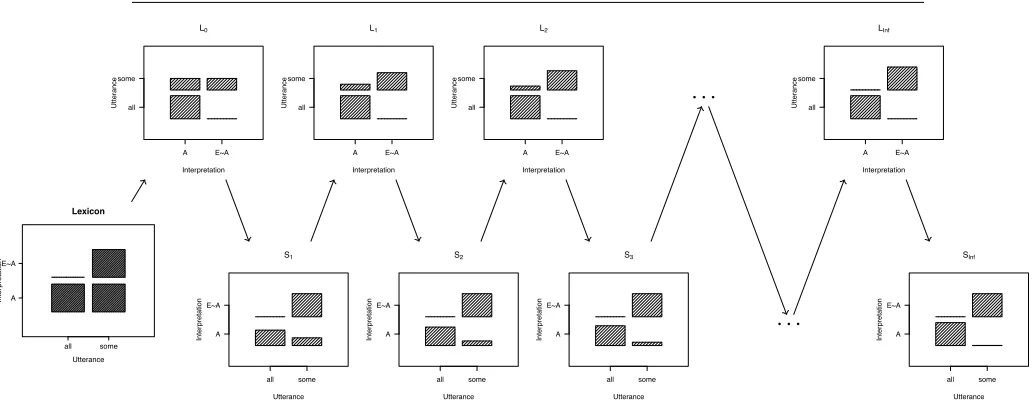
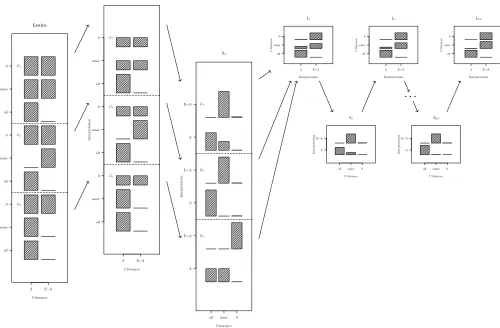
Lexicon all some A E~A Utterance Inter pretation L0 Interpretation Utter ance A E~A all some S1 Utterance Inter pretation all some A E~A L1 Interpretation Utter ance A E~A all some S2 Utterance Inter pretation all some A E~A L2 Interpretation Utter ance A E~A all some S3 Utterance Inter pretation all some A E~A . . . . . . LInf Interpretation Utter ance A E~A all some SInf Utterance Inter pretation all some A E~A
Figure 1: Somestrengthening with P(8) = 12, P(9¬8) = 12,c(all) =c(some) =0,
l=1. The lexicon panel indicates the truth value of utterances across each world.
The listener panels indicate the conditional probabilities over worlds, given each utterance. The speaker panels indicate the conditional probabilities over utterances, given each world. Arrows are used to indicate dependence across the panels. The
listenerL0uses the lexicon in order to compute conditional probabilities given an
utterance; the speakerS1uses the output of listenerL0in order to compute utterance
probabilities given each world; and so on. This figure, and several others in this form which appear later in the paper, are intended for readers who want to better understand the dynamics of the speaker-hearer recursion. The linguistic claims of the paper can be appreciated without relying on them.
by the literal listener. If the speaker does not use a specific utterance, then this is evidence that such an utterance would not have communicated her intended meaning.
The listenerL1knows this, and (given the assumption of speaker knowledgeability)
infers that the speaker must know that the more specific utterance is false. Therefore, a less specific utterance implies the negation of a more specific utterance for this listener.
To illustrate this reasoning, we will consider the simplest possible example in which specificity implicatures are possible. In this example, there are two utterances,
U
={some, all},and two meanings,
where the intensions of the utterances are as usual:
JsomeK={8,9¬8};
JallK={8}
Since it is common knowledge that the speaker knows the relevant world state, we can without loss of generality consider the observation and world variables to be
equal, so thato=w, and dropwfrom the recursive equations (2)– (7). This allows
the baseline model to be expressed as
L0(o|u,
L
)µL
(u,o)P(o),(8)
Un(u|o) =logLn 1(o|u) c(u),
(9)
Sn(u|o)µelUn(u|o),
(10)
Ln(o|u)µP(o)Sn(u|o),
(11)
for integers n > 0. For illustration, we take the prior on observations as
uni-form —P(9¬8) =P(8) = 12— the cost c(u) of both utterances as identical (the
specific value has no effect, and we treat it here as zero), and the softmax parameter
l=1.4
Figure 1 depicts the listener and speaker posteriors Ln(·|u) and Sn(·|o) at
in-creasing levels of recursionnfor these parameter values. The lexicon matrix depicts
the mapping of each possible utterance–world pair to a 0/1 value; this represents the truth value of each utterance across the worlds. Each speaker (respectively listener) matrix should be read as a conditional distribution of utterances given interpreta-tions (respectively interpretainterpreta-tions given utterances), with bar height proportional to conditional probability (hence each row in each speaker or listener matrix sums to probability mass 1):
Listenern
all Ln(8|all) Ln(9¬8|all)
some Ln(8|some) Ln(9¬8|some)
8 9¬8
Speakern
8 Sn(all|8) Sn(some|8)
9¬8 Sn(all|9¬8) Sn(some|9¬8)
all some
Crucially, while the literal listener interprets some, which rules out no worlds,
entirely according to the prior (and hence as equiprobable as meaning8and9¬8),
the speaker and listener both associatesomeincreasingly strongly with9¬8as the
pragmatic recursion depth increases.
One way to understand the fundamental reason for this behavior — the signature pattern of specificity implicature — is by considering the effect on one level of
recursive inference on the listener’s tendency to interpretsomewith unstrengthened
meaning 8. Let us denote Ln 1(8|some) by the probability p. Further, note that
lexical constraints on the literal listener mean that Ln(9¬8|all) =0 always. This
means that we can write, following Equations (9)–(11):
Ln 1
all 1 0
some p 1 p
8 9¬8
Un
8 0 logp
9¬8 • log(1 p)
all some
Sn
8 1+p1 1+pp
9¬8 0 1
all some
Ln
all 1 0
some 2p+p1 1+p
2p+1
8 9¬8
For all p>0, the strict inequality 2p+p1 <pholds; thereforeLnis less inclined than
Ln 1to interpretsomeas meaning8.
The above analysis assumed a uniform prior and l=1. The precise values
of listener and speaker inferences are affected by these choices. A more exhaus-tive analysis of the behavior of this recursive reasoning system under a range of parameter settings is beyond the scope of the present paper, but the qualitative pattern of specificity implicature — that when pragmatic reasoning is formalized
as recursive speaker–listener inference, more specific terms like all guide more
general terms like some toward meanings not covered by the specific term — is
highly general and robust to precise parameter settings. It is worth noting, however,
that the value “greedy rationality” parameterlaffects the strength of the implicature
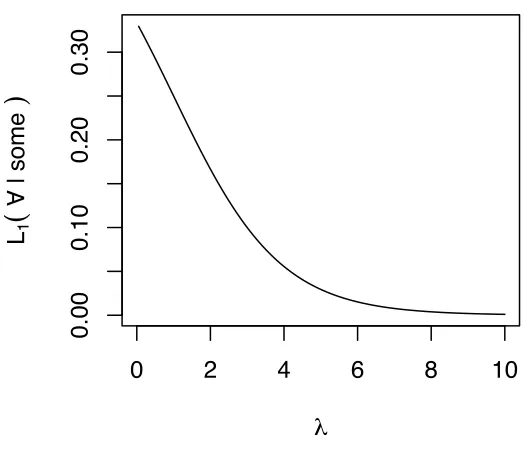
when recursion depth is held constant. Figure2shows the tendency of the first
prag-matic listenerL1to interpretsomeas meaning8(recall that for the literal listener,
L0(8|some) =L0(9¬8|some) =12 when the prior is uniform). This dependence onl
is due toL1modeling the first speakerS1’s degree of “greedy rationality”. As greedy
rationality increases, the strength of specificity implicature increases, to the extent
that the possibility of8interpretation forsomecan all but disappear after just one
round of iteration with sufficiently highl.
3.2 The symmetry problem
0 2 4 6 8 10
0.00
0.10
0.20
0.30
λ L1
(
∀
|
some
)
Figure 2: The degree ofsomestrengthening as a function of the “greedy rationality"
parameterl, with P(8) = 12, P(9¬8) = 12,c(all) =c(some) =0
the scale<“some", “all">, so that “some" implies the negation of “all." The
sym-metry problem describes a problem with constructing the scales for the implicature computations: there are multiple consistent ways of constructing the scales, and different scales will give rise to different implicatures. The only formal requirement on a scale is that items higher on it be logically stronger than those lower on it. A
possible scale for “some" is therefore<“some", “some but not all">. If this scale is
used, “some" will imply that “some but not all" is not true, that is, that “all" is true.
The rational speech act model provides a different solution to this problem, which places weaker requirements on the set of alternative utterances. For the previous example, the model can include both “all" and “some but not all" as alternatives, and still derive the correct implicatures. It does so by assigning higher cost to “some but not all" than to “all." Because “some but not all" is assigned a higher cost, it
is less likely to be used to communicatenot all than “all" is to communicateall.
Thus, when the listener hears the utterance “some," they will reason that the speaker
was likely to have intended to communicatenot all: if the speaker had intended to
communicateall, they would have used the utterance “all," but if they had intended
to communicatenot all, they would have been less likely to use “not all."
In general, this approach allows arbitrary sets of grammatical utterances to be considered as alternatives, without resulting in contradictory inferences, and while still preserving attested implicatures. The model will do this by assigning more complex utterances higher cost, and as a result weighing these more costly utterances less during pragmatic inference. Utterances that are more costly to the speaker are less likely to be used, because the speaker is rational. As an utterance becomes more and more costly, it becomes less and less salient to the speaker and listener as an alternative, and has less and less of an effect on the interpretation of other utterances.
4 Lexical uncertainty 4.1 M-implicatures
We will next consider a different type of pragmatic inference: M-implicatures. An M-implicature arises when there are two semantically equivalent utterances that differ in complexity. In general, the more complex utterance will receive a marked interpretation. The most straightforward way for an interpretation to be marked is for it to have low probability. Consider, for example, the following two sentences:
(1) John can finish the homework.
(2) John has the ability to finish the homework.
These two sentences (plausibly) have the same literal semantic content, but they will typically not be interpreted identically. The latter sentence will usually be interpreted to mean that John will not finish the homework, while the former example does
not have this implicature.Horn(1984) andLevinson(2000) cite a number of other
Though M-implicatures describe a linguistic phenomenon, the reasoning that generates these implicatures applies equally to ad-hoc communication games with no linguistic component. Consider a one-shot speaker-listener signaling game with
two utterances, SHORT andlong(the costs of these utterances reflect their names),
and two meanings, FREQ andrare; nothing distinguishes the utterances other than
their cost, and neither is assigned a meaning prior to the start of the game (so
that effectively both have the all-truemeaning). The speaker in this game needs to
communicate one of the meanings; which meaning the speaker needs to communicate is sampled according to the prior distribution on these meanings (with the meaning FREQ having higher prior probability). The listener in turn needs to recover the speaker’s intended meaning from their utterance. The speaker and listener will
communicate most efficiently in this game if the speaker uses long in order to
communicate the meaningrare, and SHORT in order to communicate FREQ, and
the listener interprets the speaker accordingly. That is, if the speaker and listener coordinate on this communication system, then the speaker will successfully transmit their intended meaning to the listener, and the expected cost to the speaker will be
minimized. Bergen et al. (2012) find that in one-shot communication games of
this sort, people do in fact communicate efficiently, suggesting that the pragmatic knowledge underlying M-implicatures is quite general and not limited to specific
linguistic examples.5
4.1.1 Failure of rational speech acts model to derive M-implicatures
Perhaps surprisingly, our baseline rational speech-act model of Sections 2–3 is
unable to account for speakers’ and listeners’ solution to the one-shot M-implicature
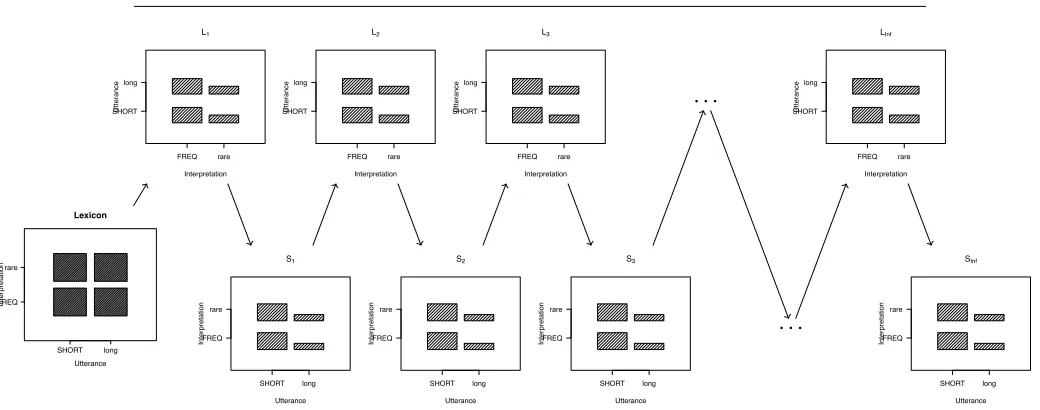
problem. The behavior of the baseline model is shown in Figure 3; the model’s
qualitative failure is totally general across different settings of prior probabilities,
utterance costs, andl. The literal listenerL0interprets both utterances identically,
following the prior probabilities of the meanings. Crucially, L0’s interpretation
distribution provides no information that speakerS1can leverage to associate either
utterance with any specific meaning; the only thing distinguishing the utterances’ expected utility is their cost. This leads to an across-the-board dispreference on the
part ofS1 for long, but gives no starting point for more sophisticated listeners or
speakers to break the symmetry between these utterances.
We will now formalize this argument; the following results will be useful in later discussions.
Lemma 1. Let u,u0be utterances, and suppose
L
(u,w) =L
(u0,w)for all worlds w.Then for all observations o and worlds w, L0(o,w|u,
L
) =L0(o,w|u0,L
).Proof. By equation2,
L0(o,w|u,
L
) = Â P(o,w)L
(u,w)o0,w0P(o0,w0)
L
(u,w0)(12)
= P(o,w)
L
(u0,w)Âo0,w0P(o0,w0)
L
(u0,w0)(13)
=L0(o,w|u0,
L
)(14)
where the equality in13follows from the fact that
L
(u,w) =L
(u0,w)for all worldsw.
Lemma 2. Let u,u0be utterances, and suppose that L0(o,w|u,
L
) =L0(o,w|u0,L
)for all observations o and worlds w. Then for all observations o, worlds w, and
n 0, Ln(o,w|u) =Ln(o,w|u0).
Proof. We will prove this by induction. Lemma1has already established the base
case. Suppose that the statement is true up ton 1 0.
We will first consider the utility for speakerSn. By equation3,
Un(u|o) c(u0) =EP(w|o)logLn 1(o,w|u) c(u) c(u0)
(15)
=EP(w|o)logLn 1(o,w|u0) c(u0) c(u)
(16)
=Un(u0|o) c(u) (17)
It follows from equation6that:
Sn(u|o) = e
lUn(u|o)
ÂuielUn(ui|o)
(18)
= e
l(Un(u0|o) c(u)+c(u0))
ÂuielUn(ui|o)
(19)
=Sn(u0|o)·el(c(u0) c(u))
(20)
In other words, for all observationso, the probability of the speaker usinguandu0at
Lexicon SHORT long FREQ rare Utterance Inter pretation L1 Interpretation Utter ance FREQ rare SHORT long S1 Utterance Inter pretation SHORT long FREQ rare L2 Interpretation Utter ance FREQ rare SHORT long S2 Utterance Inter pretation SHORT long FREQ rare L3 Interpretation Utter ance FREQ rare SHORT long S3 Utterance Inter pretation SHORT long FREQ rare . . . . . . LInf Interpretation Utter ance FREQ rare SHORT long SInf Utterance Inter pretation SHORT long FREQ rare
Figure 3: The failure of the basic model to deriveM-implicature (illustrated here
forP(FREQ) = 23,P(rare) = 13,l=3,c(SHORT) =1,c(long) =2). The listener
panels illustrate that the interpretation of each utterance is constant across each recursion depth. The speaker panels illustrate that the utterance distributions are also constant across each recursion depth.
We will now show the equivalence of listenersLn(·|u)andLn(·|u0). By equation
7,
Ln(o,w|u) = P(o,w)Sn(u|o)
Âo0,w0P(o0,w0)Sn(u|o0)
(21)
= P(o,w)Sn(u0|o)e
l(c(u0) c(u))
Âo0,w0P(o0,w0)Sn(u0|o0)el(c(u0) c(u))
(22)
=Ln(o,w|u0) (23)
Together, these lemmas show that if two utterances have the same literal mean-ings, then they will be interpreted identically at all levels of the speaker-hearer recursion in the rational speech acts model.
4.2 The multiple equilibrium problem
games (Rabin 1990,Cho & Kreps 1987). In a typical signalling game, a subset of the agents in the game each receive a type, where this type is revealed only to the agent receiving it; in the settings being considered in this paper, each speaker has a type, which is the meaning that they want to communicate. The goal of the listener is to correctly guess the type of the speaker based on the signal that they send.
To describe the multiple equilibrium problem for such games, we first need to introduce the relevant notion of equilibrium. Loosely speaking, the equilibria for a game describe the self-consistent ways that the game can be played. The simplest
equilibrium concept in game theory is the Nash equilibrium (Nash et al. 1950,
Myerson 1991,Fudenberg & Tirole 1991). For games with two agents A and B,
a pair of strategies (sA,sB), which describe how each agent will play the game,
are a Nash equilibrium if neither agent would benefit by unilaterally changing their
strategy; that is, the strategies are an equilibrium if, fixingsB, there is no strategy
for A that would improve the outcome of the game for A, and vice-versa.
The relevant notion of equilibrium for signalling games is the Bayesian Nash
equilibrium (Harsanyi 1967), which in addition to the requirements imposed by
the definition of the Nash equilibrium also imposes consistency constraints on the beliefs of the agents. In particular, given the prior distribution over types, and the agents’ strategies (which define the likelihood of taking actions given a player type), the agents must use Bayes’ rule to compute their posterior distribution over types after observing an action. Each agent’s strategy must also be rational given their beliefs at the time that they take the action, in the sense that the strategy must maximize their expected utility. The multiple equilibrium problem arises in a signalling game when the game has multiple Bayesian Nash equilibria. This occurs when the agents can devise multiple self-consistent communication systems given the constraints of the game. That is, given the assumption that the other agents are using the communication system, it will not be rational for one agent to unilaterally start using a different communication system.
The multiple equilibrium problem can be illustrated concretely using the game
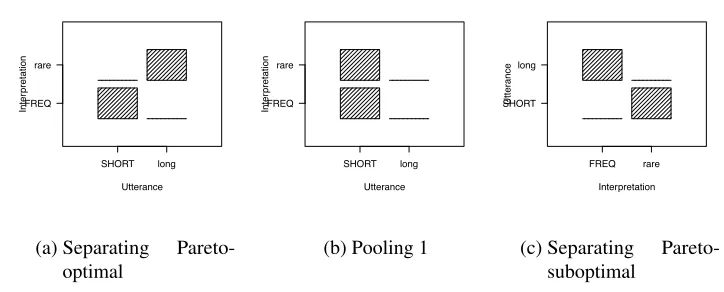
above. This game has two general classes of equilibria, illustrated in Figure4. In
the first class, which are called theseparating equilibria, successful communication
occurs between the speaker and listener, but their communication system may be suboptimal from an information-theoretic perspective. In the first such equilibrium,
the speaker chooseslongwhen they want to communicaterare, and SHORT when
they want to communicate FREQ (Figure4(a)). Given these strategies, the listener
knows how to interpret each utterance:longwill be interpreted asrare— conditional
on hearinglong, the only possibility is that it was produced by the agent wanting
to communicate rare— and similarly SHORT will be interpreted as FREQ. This
Utterance
Inter
pretation
SHORT long
FREQ rare
(a) Separating Pareto-optimal
Utterance
Inter
pretation
SHORT long
FREQ rare
(b) Pooling 1
Interpretation
Utter
ance
FREQ rare SHORT
long
(c) Separating Pareto-suboptimal
Figure 4: Multiple equilibria (speaker matrices) for the M-implicature signaling game
speaker wanting to communicaterareswitches to using SHORT, then they will be
interpreted as intending FREQ. A second separating equilibrium is also possible in this game. Under this equilibrium, the speaker-utterance pairs are reversed, so
that the agent intending to communicaterareuses SHORT, and the agent intending
FREQ useslong(Figure4(c)). This is inefficient — in expectation, it will be more
expensive than the previous equilibrium for the speaker — but it is nonetheless an equilibrium, because neither speaker can unilaterally change strategies without failing to communicate.
The second type of equilibrium in this game, known as apooling equilibrium, is
still more deficient than the inefficient separating equilibrium, and it is the one that is most closely related to the problem for our initial model of pragmatic inference. In one pooling equilibrium, the speaker chooses the utterance SHORT, independent
of the meaning that they want to communicate (Figure4(b)). Because the speakers
always choose SHORT, this utterance communicates no information about the speaker’s intended meaning, and the listener interprets this utterance according
to the prior distribution on meanings. Assuming that the utterance long is also
interpreted according to the prior, it will never be rational for the speaker to choose
this utterance.6Thus this is indeed an equilibrium.
These arguments demonstrate that under the standard game-theoretic signalling model, speakers and listeners are not guaranteed to arrive at the efficient com-munication equilibrium. Rather, there is the possibility that they will successfully communicate but do so inefficiently, with cheaper utterances interpreted as referring to less likely meanings. There is also the possibility that they will fail to commu-nicate at all, in the case that all speakers choose the cheapest available utterance. However, M-implicatures demonstrate that at least in certain cases, people are able to systematically coordinate on the efficient strategies for communication, even when semantics provides no guide for breaking the symmetries between utterances. Thus, there is something to account for in people’s strategic and pragmatic reasoning beyond what is represented in standard game-theoretic models or in our initial model of pragmatic reasoning.
In recent work in linguistics, there have generally been three approaches to accounting for these reasoning abilities. The first approach uses the notion of a
focal pointfor equilibria (Parikh 2000). On this approach, people select the efficient
equilibrium in signalling games because it is especially salient; the fact that it is salient makes each agent expect other agents to play it, which in turn makes each agent more likely to play it themselves. While this approach does derive the efficient equilibrium for communication games, it is not entirely satisfactory, since it does not provide an independent account of salience in these games — precisely the feature which allows the agents to efficiently communicate under this approach.
An alternative approach has been to derive the efficient equilibrium using
evo-lutionary game theory, as inVan Rooy (2004),De Jaegher(2008). These models
show that given an appropriate evolutionary dynamics, inefficient communication systems will evolve towards more efficient systems among collections of agents. While these models may demonstrate how efficient semantic conventions can evolve among agents, they do not demonstrate how agents can efficiently communicate in one-shot games. Indeed, in the relevant setting for M-implicatures, the agents begin with an inefficient communication system — one in which the semantics of their utterances does not distinguish between the meanings of interest — and must suc-cessfully communicate within a single round of play. There is no room for selection pressures to apply in this setting.
Finally,Franke(2009),Jäger(2012), andFranke & Jäger(2014) have derived
semantic content — an optimal speaker will never use it. As a result, in the naive IBR model, the speaker chooses the expensive utterance with probability 0, and no coherent inference can be drawn by the listener if they hear this utterance; interpreting this utterance would require them to condition on a probability 0 event.
Franke(2009) andJäger(2012) show how to eliminate this problem in the IBR model and correctly derive M-implicatures. They propose a constraint on how listeners interpret probability 0 utterances, and show that this constraint results in the efficient equilibrium. This proposal cannot be extended to the rational speech acts model, because it relies on the expensive utterance being used with probability 0; in the rational speech acts model, agents are only approximately rational, and as a result, every utterance is used with positive probability.
As in the rational speech acts model, agents are only approximately rational in the IQR model, and the IBR derivation of M-implicatures similarly does not extend
to this model.Franke & Jäger(2014) therefore provide an alternative extension of the
IQR model which derives M-implicatures. Under this proposal, agents who receive low utility from all of their available actions engage in more exploratory behavior.
In a Horn game, the speaker who wants to communicate the meaningrarestarts
out with a low expected utility from all of their actions: no matter which utterance they choose, the listener is unlikely to interpret them correctly. As a result, this speaker will engage in more exploratory behavior — that is, behave less optimally with respect to their communicative goal — and will be more likely to choose the suboptimal expensive utterance. This is sufficient to break the symmetry between the cheap and expensive utterances, and derive the M-implicature.
Unlike the proposed modification of the IBR model,Franke & Jäger(2014)’s
4.3 The lexical-uncertainty model
In the previous version of the model, it was assumed that the lexicon
L
used bythe speaker and listener was fixed. For every utteranceu, there was a single lexical
entry
L
(u,·)that gave the truth function foru. This fixed lexicon determined howthe literal listener would interpret each utterance.
In the current version of the model, we introduce lexical uncertainty, so that
the fixed lexicon is replaced by a set of lexicaLover which a there is a probability
distributionP(
L
). This distribution represents sophisticated listeners’ and speakers’uncertainty about how the literal listener will interpret utterances. (Alternative
formulations of lexical uncertainty may be clear to the reader; in AppendixBwe
describe two and explain why they don’t give rise to the desired pragmatic effects.) Introducing lexical uncertainty generalizes the previous model; the base listener
L0remains unchanged from equation2, that is, this listener is defined by:
L0(o,w|u,
L
)µL
(u,w)P(o,w)(24)
for every lexicon
L
2L. The more sophisticated speakers and listeners,SnandLnforn 1, are defined by:
U1(u|o,
L
) =EP(w|o)logL0(o,w|u,L
) c(u),(25)
S1(u|o,
L
)µelU1(u|o,L),(26)
L1(o,w|u)µP(o,w)
Â
L2L
P(
L
)S1(u|o,L
),(27)
Un(u|o) =EP(w|o)logLn 1(o,w|u) c(u) forn>1,
(28)
Sn(u|o)µelUn(u|o) forn>1,
(29)
Ln(o,w|u)µP(o,w)Sn(u|o) forn>1.7
(30)
7 It is possible to define the lexical-uncertainty model more concisely by replacing Equations (25)–(30) with the following three equations:
Un(u|o,w,L) =EP(o|w)logLn 1(o,w|u,L) c(u).
(i)
Sn(u|o,w,L)µelUn(u|o,w,L),
(ii)
Ln(o,w|u,L)µ
Â
L02L
P(o,w)P(L0)Sn(u|o,w,L0),
(iii)
Once the first marginalization over lexica occurs at theL1level, higher-level speaker and listener
These equations differ from the baseline model in several respects. In Equations
25and 26, the speakerS1is parameterized by a lexicon
L
, which determines thespeaker’s beliefs about how their utterances will be interpreted. That is, this speaker
believes that the listenerL0will use this lexicon to interpret their utterances. The
definition of the listenerL1in Equation27is the most important difference between
the current and baseline models. The listenerL1in the baseline model (Equation7)
is certain about the speakerS1’s beliefs about the lexicon; for this listener, there is
a single lexicon which determines the speaker’s beliefs about the literal meanings
of utterances. In the current model, the listener L1(Equation 27) has uncertainty
about which lexicon the speakerS1is using. For each possible lexicon
L
2L, thelistener considers how the speaker would behave given this lexicon. To interpret an utterance, the listener first considers how likely the speaker would have been to choose this utterance given each lexicon, and then accounts for her uncertainty by marginalizing (taking a weighted average) over the lexica. The definitions of
the higher-order speakers and listeners, in Equations28-30, are the same as in the
baseline model.
In order for the normalization of Equation 24 and the expected surprisal of
Equation25to be well-defined we must place two restrictions on each
L
2L.i. Each utterance must receive a non-contradictory interpretation. Formally, for
each utteranceuand each lexicon
L
2Lthere must exist a worldwsuch thatL
(u,w) > 0.ii. For any observation there is an utterance which includes the speaker’s belief
state in its support. Formally, for each observationoand each lexicon
L
2Lthere exists (at least) one utteranceusuch that
L
(u,w) > 0 for anywwithP(w|o)>0.
Satisfying the first of these restrictions is straightforward. We have considered four
approaches to constructingLthat satisfy the second restriction, each of which result
in qualitatively similar predictions for all of the models considered in this paper. In
the first of these approaches, the global constraint of restrictioniiis simply imposed
on each lexicon by fiat; any lexicon which does not satisfy this condition is assigned probability 0. In the second of these approaches, the truth-conditional semantics
of each utterance is slightly weakened. When an utterance u is false at a world
statew, we define
L
(u,w) =10 6 (or any smaller, positive number). In this case,each utterance always assigns at least a small amount of mass to each world state,
immediately satisfying restrictionii. In the third approach we assume that there is
some, much more complex, utterance that could fully specify any possible belief
state. That is, for anyothere is an utterance uo such that
L
(uo,·)coincides withexpensive, so that the speaker is arbitrarily unlikely to use them; they still serve to make the expected surprisal well-defined. This approach captures the intuition that real language is infinitely expressive in the sense that any intended meaning can be conveyed by some arbitrarily complex utterance. The fourth approach is a
simplification of the previous one: we collapse theuointo a single utteranceunull
such that
L
(unull,w) = 1 for every worldw. Againunull is assumed to be the mostexpensive utterance available. In the remainder we adopt this last option as the clearest for presentational purposes. In the models we consider in the remainder
of this paper,unull never becomes a preferred speaker choice due to its high cost,
though it is possible that for other problemsunull may turn out to be an effective
communicative act. We leave the question of whether this is a desirable feature of our model for future work.
The above restrictions leave a great deal of flexibility for determining L; in
practice we adopt the largestL that is compatible with the base semantics of our
language. If we begin with a baseSEMANTIC LEXICON,
L
S, for the language (thatis, the lexicon that maps each utterance to its truth function under the language’s
semantics) we can defineLby a canonical procedure of sentential enrichment: Call
the utterance meaning
L
(u,·) a valid refinement ofL
S if: 8wL
S(u,w) =0 =)L
(u,w) =0, and, 9wL
(u,w)>0. More informally, these conditions state thatutterance meaning
L
(u,·)is a valid refinement if it logically implies the semanticmeaning
L
S(u,·), and if it is non-contradictory. Define ˜Lto consist of all lexicaL
such that each utterance meaning is a valid refinement of the meaning in
L
S; definetheENRICHMENTLof
L
Sto be ˜Lwith an additional utteranceunull added to eachlexicon, such that
L
(unull,w) = 1 for every worldw.4.4 Specificity implicature under lexical uncertainty
Before demonstrating how the lexical-uncertainty model derives M-implicature
(which we do in Section4.5), in this section we walk the reader through the operation
of the lexical-uncertainty model for a simpler problem: the original problem of specificity implicature, which the revised lexical-uncertainty model also solves.
The setup of the problem remains the same, with (equal-cost) utterance set
U
={some, all}, meanings
W
={8,9¬8}, and literal utterance meanings — semanticlexicon
L
S in the terminology of Section4.3—JsomeK={8,9¬8},JallK={8}.The enrichment procedure givesLconsisting of:
L
1=8 < :
JallK ={8}
JsomeK ={9¬8,8}
JunullK ={9¬8,8} 9 =
;
L
2=8 < :
JallK ={8}
JsomeK ={9¬8}
JunullK ={9¬8,8} 9 =
;
L
3=8 < :
JallK ={8}
JsomeK ={8}
and we make the minimal assumption of a uniform distribution overL: P(
L
1) =P(
L
2) =P(L
3) = 13. Note that somecan be enriched to either 9¬8 or to 8, andbefore pragmatic inference gets involved there is no preference among either those two or an unenriched meaning.
Lexica Utterance In te rp re tat ion
A E⇠A
all some 0 all some 0 all some 0 L3 L2 L1 L0 Utterance In te rp re tat ion A E⇠A all some 0 all some 0 all some 0 L3 L2 L1 S1 Utterance In te rp re tat ion
all some 0
A
E⇠A
A
E⇠A
A
E⇠A
L3 L2 L1 L1 Interpretation Ut te ran ce
A E⇠A
all some 0 S2 Utterance In te rp re tat ion
all some 0
A
E⇠A
L2 Interpretation Ut te ran ce
A E⇠A
all some 0 . . . LInf Interpretation Ut te ran ce A E⇠A all some 0 SInf Utterance In te rp re tat ion
all some 0
A
E⇠A
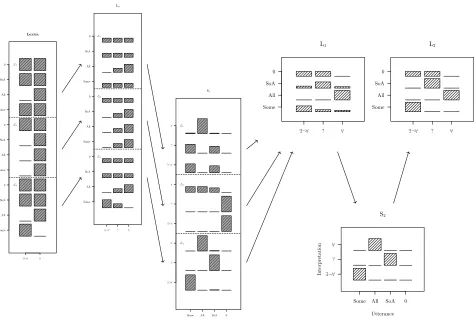
Figure 5: Specificity implicatures under lexical uncertainty, shown here with P(8) =
1
2, P(9¬8) = 12,c(all) =c(some) =1,c(/0) =5,l=1. The first column shows the
three admissible lexica in this example. The second column illustrates the behavior
of the listenerL0, with each row corresponding to a listener who is using a particular
lexicon. The third column shows the speakers who correspond to these listeners.
There is only a single distribution for listenerL1, as this listener computes utterance
We can now compute the behavior of the model. Since it is common
knowl-edge that the speaker knows the relevant world state, we can once again leto=w
and dropwfrom the recursive equations, so that the lexical-uncertainty model of
Equations (24)–(30) can be expressed as
L0(o|u,
L
)µL
(u,o)P(o),(31)
U1(u|o,
L
) =logL0(o|u,L
) c(u),(32)
S1(u|o,
L
)µelU1(u|o,L),(33)
L1(o|u)µP(o)
Â
L2L
P(
L
)S1(u|o,L
),(34)
Un(u|o) =logLn 1(o|u) c(u) forn>1,
(35)
Sn(u|o)µelUn(u|o) forn>1,
(36)
Ln(o|u)µP(o)Sn(u|o) forn>1.
(37)
Figure5shows the listener and speaker posterior distributions at varying levels of
recursion. At theL0literal-listener andS1first-speaker levels, different inferences
are drawn conditional on the lexicon entertained: the three lexica
L
1throughL
3arestacked top to bottom in the leftmost panel, and the dependencies among
lexicon-specific inferences are indicated with arrows between panels. Up throughS1, each
lexicon-specific recursive inference chain operates indistinguishably from that of the baseline model, except that an enriched lexicon rather than the base semantic lexicon of the language is used throughout.
The specificity implicature first appears at the level of the listenerL1, who is
reasoning about the speakerS1. The listener computes their posterior distribution
over the speaker’s intended meaning by marginalizing over the possible lexica that
the speaker may have been using (Equation (34)). As can be seen in the second
column of the third panel of Figure5,L1’s posterior supports three different possible
interpretations ofsome. Under the lexicon in whichsomehas been enriched to mean
8(bottom subpanel),someshould be interpreted to categorically mean8; under the
lexicon in whichsomehas been enriched to mean9¬8 (middle subpanel),some
should be interpreted to categorically mean9¬8. Under the lexicon in whichsome
remains unenriched,someshould be preferentially interpreted as9¬8due to blocking
of 8 by all, exactly as in the baseline model. Thus in the final mixture of lexica
determining the overall interpretive preferences ofL1, there is an overall preference
of some to be interpreted as 9¬8; this preference can get further strengthened
through additional speaker–listener iterations, exactly as in the baseline model. Thus specificity implicatures are still derived under lexical uncertainty.
It is important to note that the specificity implicature is not primarily driven by
a high degree of uncertainty about the lexical content of “some" after hearing this
utterance — much more uncertainty than they have about theintended interpretation
of “some." As described above, if the listener hears “some," then there are multiple hypotheses about the speaker’s communicative intent and their lexicon which will rationalize the choice of this utterance. Moreover, there are multiple lexica which
are consistent with the speaker intending to communicate the world 9¬8by this
utterance. The speaker will use “some" to communicate9¬8if the lexical entry for
“some" is9¬8, and also if the entry is unenriched. As a result, even restricting to
cases in which the listenerL1has inferred that the speaker intends to communicate
9¬8, this listener will be uncertain about whether the lexical entry for “some" has
been enriched. Pragmatic inference in this model thus involves resolution of the
lexicon, but is notidenticalto lexical resolution.
4.5 Derivation of M-implicature under lexical uncertainty
We now show how lexical uncertainty allows the derivation of one-shot M-implicatures. We consider the simplest possible M-implicature problem of two possible mean-ings to be communicated — one higher in prior probability (FREQ) than the other (rare) — that could potentially be signaled by two utterances — one less costly (SHORT) than the other (long). The semantic lexicon of the language is completely unconstrained:
L
S= ⇢JSHORTK ={FREQ,rare}
JlongK ={FREQ,rare}
Each utterance has three possible enrichments —{FREQ,rare},{FREQ}, and{rare}— leading
to nine logically possible enriched lexica. We make the minimal assumption of taking
Lto be this complete set of nine, illustrated in the first panel of Figure6, and putting
a uniform distribution overL.
Because utterance costs play no role in the literal listener’s inferences, L0 is
completely symmetric in the behavior of the two utterances (second panel of
Fig-ure6). However, the variety in lexica gives speakerS1resources with which to plan
utterance use efficiently. The key lexica in question are the four in which the meaning
of only one of the two utterances is enriched:
L
2,L
3,L
4, andL
7.L
2andL
7offer thespeaker the partial associationslong–rareand SHORT–FREQ, respectively, whereas
L
3andL
4offer the opposite:long–FREQ and SHORT–rare, respectively. Crucially,the former pair of associations allows greater expected speaker utility, and thus
undergo a stronger specificity implicature inS1, than the latter pair of associations.
This can be seen most clearly in the contrast between
L
2andL
3. The speakerS1 forms a stronger association oflongtorarein
L
2 than oflongto FREQ inL
3.intention. A speaker using
L
2 can communicaterareprecisely by usinglong, andwill not be able to effectively communicate this meaning by using the vague utterance
SHORT. Thus, this speaker will be relatively likely to use longto communicate
rare. In contrast,longwill communicate FREQ precisely under
L
3, but this meaningcan also be communicated effectively with the utterance SHORT. Thus, the speaker
using
L
3will be less likely to chooselong.When the first pragmatic listenerL1takes into account the variety ofS1behavior
across possible lexica (through the marginalization in Equation (34)), the result is a
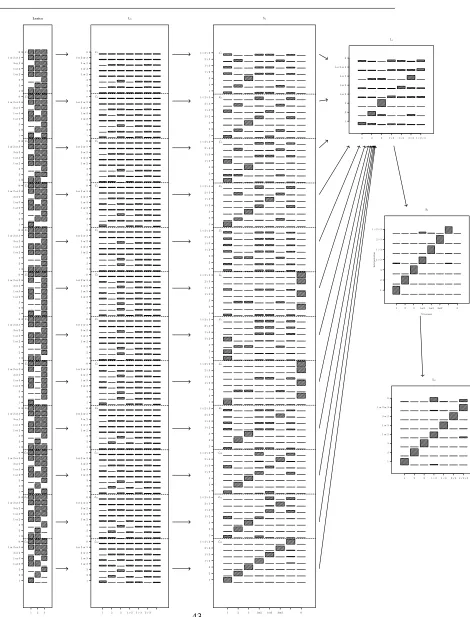
weak but cruciallong–rareassociation. Further levels of listener–speaker recursion
amplify this association toward increasing categoricality. (The parameter settings
in Figure6are chosen to make the association at theL1level relatively visible, but
the same qualitative behavior is robust for all finitel>1.) Simply by introducing
consideration of multiple possible enrichments of the literal semantic lexicon of the language, lexical uncertainty allows listeners and speakers to converge toward the M-implicature equilibrium that is seen not only in natural language but also in
Le xic a FR EQ rar e L9 L8 L7 L6 L5 L4 L3 L2 L1 L0 FR EQ rar e S HO R T lon g 0 S HO R T lon g 0 S HO R T lon g 0 S HO R T lon g 0 S HO R T lon g 0 S HO R T lon g 0 S HO R T lon g 0 S HO R T lon g 0 S HO R T lon g 0 L9 L8 L7 L6 L5 L4 L3 L2 L1 S1 S HO R T lon g 0 FR EQ rar e FR EQ rar e FR EQ rar e FR EQ rar e FR EQ rar e FR EQ rar e FR EQ rar e FR EQ rar e FR EQ rar e L9 L8 L7 L 6 L5 L4 L 3 L2 L1 L1 FR EQ rar e S HO R T lon g 0 S2 S HO R T lon g 0 FR EQ rar e L2 FR EQ rar e S HO R T lon g 0 S3 S HO R T lon g 0 FR EQ rar e L3 FR EQ rar e S HO R T lon g 0 S4 S HO R T lon g 0 FR EQ rar e L4 FR EQ rar e S HO R T lon g 0 S5 S HO R T lon g FR EQ rar e Figure 6: Deri ving M-implicatures with P ( FREQ )=
2 3,
P
(
rare
)=
1 3,l
4.6 Ignorance as a marked state
The lexical-uncertainty model introduced earlier in this section provided a novel means by which speakers and listeners in one-shot communication games align forms and meanings in terms of what can be thought of as two different types of markedness: cost of forms and prior probabilities, or frequencies, of meanings. Perhaps remarkably, a third type of markedness emerges as a side effect of this model that can explain a particularly vexing class instance of implicature, most famously exemplified by the sentence pair below:
(3) Some or all of the students passed the test.
(4) Some of the students passed the test.
As discussed in Section 3, (4) has a specificity implicature that strengthens the
literal meaning of “some” to an understood meaning of “some but not all”. The
implicatures of(3)differ crucially in two ways. First, as noted byGazdar(1979: see
alsoChierchia et al. 2012),(3)lacks the basic specificity implicature of(4). Second,
(3)seems to possess anignoranceimplicature: namely, that the speaker is not sure
whether or not all the students passed the test.
Accounting for why the specificity implicature is lacking and how the ignorance implicature comes about has become a problem of considerable prominence in
recent semantic and pragmatic theory (Fox 2007,Russell 2012,Meyer 2013,Fox
2014). This is for several reasons. First, the sentence in (3) violates Hurford’s
constraint (Hurford 1974), according to which a disjunction is infelicitous if one
of its disjuncts entails the other. In this case, because “all" entails “some," the constraint incorrectly predicts that the sentence should be infelicitous. For closely related reasons, neo-Gricean theories — as well as the rational speech acts model
from Section2— cannot derive the implicatures associated with this sentence. A
disjunction which violates Hurford’s constraint will be semantically equivalent to one of its disjuncts (that is, the weaker one); in this case, the expression “some or all" is semantically equivalent to “some." As previously discussed, the rational speech acts model, and neo-Gricean models more generally, cannot derive distinct pragmatic interpretations for semantically equivalent expressions. To the best of our knowledge, there has been only one previous formal derivation of this class of
implicatures, using an extension of the Iterated Best Response model (Jäger et al.
2013).
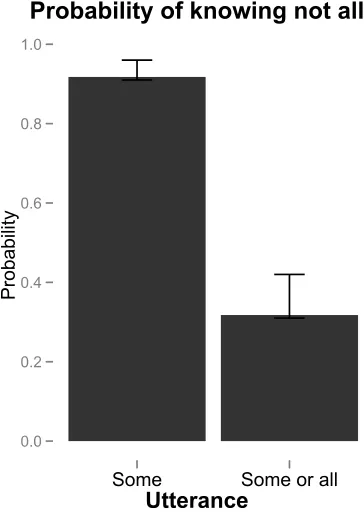
4.6.1 An empirical test of ignorance implicature
sentences like(3)possess ignorance implicatures have been introspective judgments by the authors of research articles on the phenomenon in question. It is therefore worth briefly exploring exactly how this claim might be more objectively tested and thus verified or disconfirmed. In our view, the claim that “some or all” sentences
such as(3)possess an ignorance implicature that corresponding sentences such as
(4) do not should make the following empirically testable prediction. Consider a
sentence pair like ((3)–(4)), differing only in TARGET QUANTIFIER“some or all”
versus “some.” For the “some or all" variant, comprehenders should be less likely to conclude that the speaker knows (a) exactly how many of the objects have the
relevant property or (b) thatnot allof the objects have the relevant property. To test
this prediction, we ran a brief experiment that involved presenting speakers with paragraphs of the following type, each in one of two variants:
Letters to Laura’s company almost always have checks inside. Today Laura received 10 letters. She may or may not have had time to check all of the letters to see if they have checks. You call Laura and ask her how many of the letters have checks inside. She says, "{Some/Some or all} of the letters have checks inside."
Participants were asked two questions:
• How many letters did Laura look inside? Answers to this question
con-firmed (a) above: significantly more participants answered10in the “some”
condition than in the “some or all” condition.
• Of the letters that Laura looked inside, how many