747 http://sites.google.com/site/ejplantbreeding
Research Article
Combining ability analysis in quality protein maize (
Zea mays
L.) for grain
yield and its component traits
Ravi V. Mural* and Chikkalingaiah
Department of Genetics and Plant Breeding, University of Agricultural Sciences, Bangalore – 650065, Karnataka, India * E-mail: [email protected]
(Received: 6 Jan 2012; Accepted: 19 Apr 2012)
Abstract:
A study was undertaken to estimate combining ability effects in maize for different characters in a line × tester programme comprising 70 hybrids produced by crossing 14 lines and 5 testers. The interaction of line × tester was highly significant for twelve traits studied except for protein content. Significant general and specific combining ability variance were observed for all characters except protein content. The variance due to SCA was higher than GCA indicating the predominance of non-additive type of gene action. The ratio of GCA:SCA variance was lower than unity for all characters indicating predominance of non - additive gene action over additive gene action. Among the lines, genotype QPM 3 was found to be the best general combiner with better mean performance for most yield contributing traits followed by QPM 1 and QPM 187. Among the testers, T 323-8 was found to be the best general combiner with better mean performance for most of the yield contributing traits followed by T 209 and T 295 genotypes. Among the crosses, QPM 35 × T 295 was superior with positive significant SCA effects and better mean performance for grain yield and plant height. Similar superior positive significant SCA effects with better mean performance were also observed in QPM 6 × T 295 (ear length, test weight and grain yield per plant) and QPM 43 × T 193-2 (ear length and grain yield per plant).
Key Words
Maize, Combining ability, GCA, gene action, QPM, SCA.
Introduction
Maize (Zea mays L.) is the third most important cereal crop of India after rice and wheat. It is a member of grass family Poaceae, tribe Maydeae and is highly cross pollinated crop. It has assumed greater significance due to its demand for food, feed and industrial utilization. Nearly 49 % of the maize produced is being utilized as raw material in the poultry feed industry. Maize being a C-4 plant and fertilizer responsive has very high yielding ability coupled with higher amount of cross pollination. Hence, offers tremendous scope for the plant breeders for genetic improvement. Single Cross Hybrid cultivars have played a vital role in increasing acreage and productivity of maize. Combining ability is the relative ability of a genotype to transmit its desirable performance to its progenies. Combining ability analysis is not only the quickest method of understanding the genetic nature of quantitatively inherited traits, but also gives essential information
about the selection of parents which in turn throws better segregants. The variance due to general combining ability (gca) is usually considered to be an indicator of the extent of additive type of gene action, whereas specific combining ability (sca) is taken as the measure of non- additive type of gene actions. The present study was undertaken to estimate the combining ability of parents and hybrids, nature and magnitude of gene action for total protein, yield and yield components in maize by adopting Line x Tester analysis. The combining ability variance analysis was based on the method developed by Kempthorne (1957).
Material and Methods
Experimental material comprised fourteen lines and five testers. The testers were crossed with each line and thus 70 F1s were produced. The nineteen parents
along with 70 F1s were grown in randomized
748 http://sites.google.com/site/ejplantbreeding
Agricultural Research Station, Mandya.Each entry was planted in two row of 4.5 m length with a spacing of 75 cm between rows and 30 cm between plants. Recommended cultural practices were followed to raise a good crop. Observations were recorded on twelve quantitative characters. Data related to days to 50% tasseling and days to 50% silking were recorded on plot basis while data related to other characters were recorded on five randomly selected plants leaving border plants of each row. The mean of five plants was used for all statistical analysis and the data was subjected for analysis of general and specific combining ability analysis as per the procedure of Kempthorne (1957).
Results and Discussion
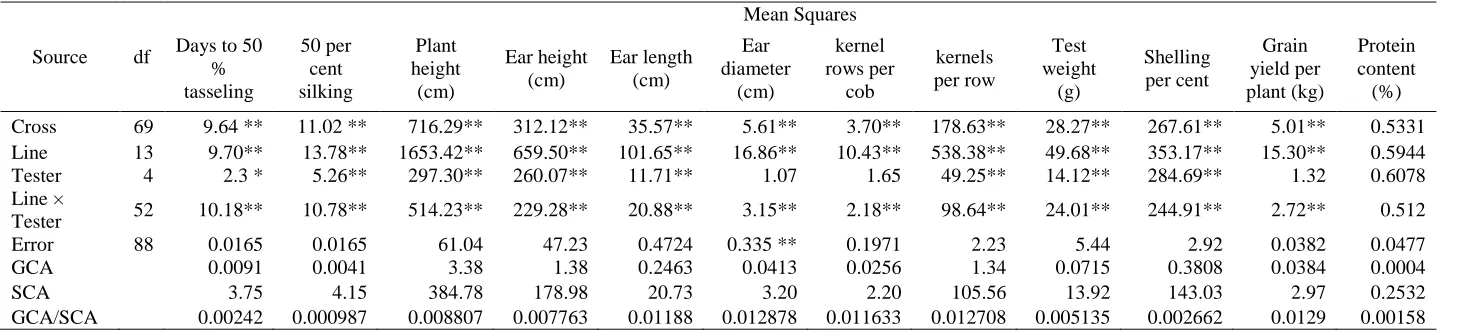
The analysis of variance revealed significant differences among the parents and hybrids for all the traits studied. Variance due to lines was highly significant for all the characters except for protein content and Variance due to testers was highly significant for all the characters except for ear diameter, kernel rows per cob, grain yield per plant and protein content. Variance due to interaction effects of lines and testers were highly significant for all the characters except for protein content (Table 1). Obviously due to the diverse nature of the line and testers the crosses between them were also found to be significant for all the characters. The significant variance of line x tester interaction indicated the importance of specific combining ability. The mean squares due to lines were of a larger magnitude than those of testers and line x tester for all characters except protein content indicating greater diversity among the lines than the testers. The non -significance of protein content in genotypes studied could be because of the reason that all QPM lines have the same source of gene controlling protein content in Maize i.e.,Opaque 2.
The magnitude of specific combining ability variances was much greater than those of general combining ability variances for all the characters, which indicated the pre-ponderance of non-additive gene action for all the characters observed. The role of non additive gene action for grain yield and other traits have been reported earlier by Prasad and Pramod Kumar (2003), Subramaniyan and Subbraman (2006), Jayakumar and Sundram (2007), Vijayabharathi et al., (2009) and Premlatha et al., (2011).
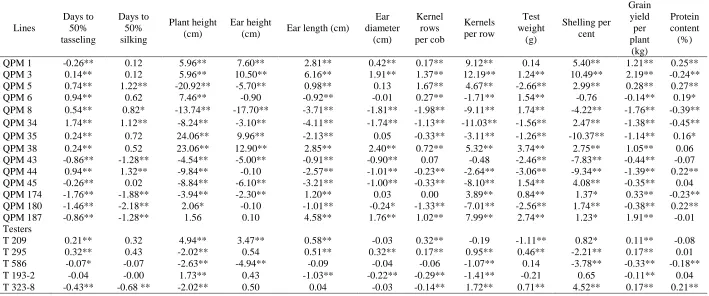
The GCA effect of parents is presented in Table 2. The estimates of GCA showed that all the lines have
exhibited positive and significant GCA effects for days to 50% tasseling, ear length and grain yield per plant. QPM 5, QPM 8, QPM 34, QPM 43, QPM 44, QPM 174, QPM 180 andQPM 187 have positive and significant GCA effects for days to 50% silking. All the lines exhibited positive and significant GCA effects except QPM 187, QPM 43, QPM 1 and QPM 6 for plant height, number of kernels per row, test weight and shelling per cent respectively. All the lines except QPM 5, QPM 6, QPM 35 and QPM 174 exhibited positive and significant gca effects for ear diameter. For protein content lines viz., QPM 3, QPM 5, QPM 174, QPM44, QPM 1, QPM 180, QPM 8 and QPM 34 exhibited positive and significant SCA effects at 1% level of significance while, lines viz., QPM 35 and QPM 6 exhibited positive and significant SCA effects at 5% level of significance, remaining lines did not exhibit significant effect with respect to this trait. Among fourteen lines QPM 3, QPM 1 and QPM 187 were the best general combiners since they exhibited high GCA effects for maximum number of characters. Among the testers, T 323-8, T 209 and T 295 were observed best combiners for most of the traits i.e., for Days to 50% tasseling, plant height, number of kernel rows per cob, number of kernels per row, test weight, shelling per cent and grain yield per plant. With respect to ear length and ear diameter T 193-2 and T295 were found to be the best combiners. T 323-8 and T 586 were the best combiners for protein content.
749 http://sites.google.com/site/ejplantbreeding
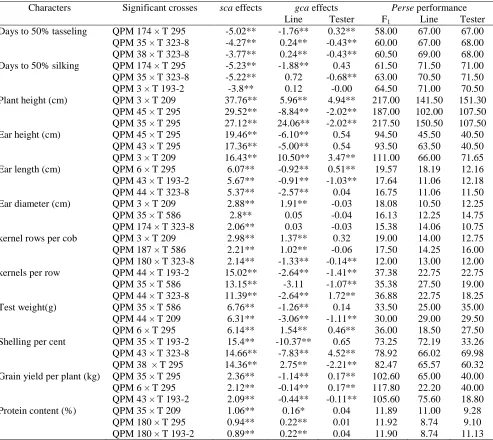
the crosses viz., QPM 6 × T 295 (cob length), QPM 3 × T 209 (cob diameter), QPM 3 × T 209 (grain rows per cob), QPM 44 × T 193-2 (grains per row) and QPM 35 × T 586 (100 grain weight) and QPM 35 × T 193-2 (Shelling per cent). QPM 35 × T 209 (11.89), QPM 180 × T 295(11.92) and QPM 180 × T 193-2 (11.90) expressed maximum SCA effects along with high per se performance for total grain protein content. Pal and Prodhan (1994), Rao et al., (1996), Mahto and Gunguli (2003), Malik et al., (2004), Premlatha and Kalamani (2009) also found high grain yield with high SCA.
Conclusion
Three crosses namely, QPM 35 × T 295, QPM 6 × T 295 and QPM 43 × T 193-2 that’s showed high SCA effects for grain yield and these cross involved parents having positive and significant GCA effects. These lines can be exploited for the development of single cross hybrids as non-additive gene action was observed for most of the traits in these lines. Further they can also be used for population improvement programme through reciprocal recurrent selection for development of inbreds.
Acknowledgement: The help rendered by the AICRP on maize programme at ZARS Mandya is greatefully acknowledged.
References
Amiruzzaman, M., Islam, M.A., Hassan, L. and Rohman, M.M. 2010.Combining Ability and Heterosis for Yield and Component Characters in Maize.
Academic J. Plant Sci., 3(2): 79-84.
Jayakumar, J. and Sundram, T. 2007.Combining ability studies for grain yield and other yield components in maize.Crop Res., 33: 179-186. Kempthorne, O. 1957.An Introduction to Genetic Statistics,
John Willy and Sons, Inc. New York, pp. 545. Mahto, R.N. and Ganguli, D.K. 2003. Combining ability
analysis in inter varietal crosses of maize (Zea mays L.). Madras Agric. J., 90: 29-33.
Malik, S.I., Malik, H.N., Minhas, N.M. and Munir, M. 2004. General and Specific combining ability studies in maize. Int. J. Agri. Biol., 6: 856-859. Pal, A. K and Prodhan, H. S. 1994.Combining ability
analysis of grain yield and oil content along with some other attributes in maize (Zea mays
L.).Indian J. Genet., 54: 376-380.
Prasad, S.K. and Pramod Kumar. 2003. Line x tester analysis for combining ability in maize. J. Res. (RAU).,13: 68-72.
Premlatha, M. and Kalamani, A. 2009.Heterosis and combining ability studies for grain yield and its related traits in maize (Zea mays L.).Mysore J. Agric, Sci., 43: 62-66.
Premlatha, M., Kalamani, A and Nirmalakumari A. 2011.Heterosis and Combining Ability for Grain Yield and Quality in Maize (Zea Mays
L.).Advances in Environmental Biology.,5(6): 1264-1266.
Rao, G.P., B. Rai, S., Singh, V. and Saah, J. P. 1996.Heterosis and combining ability in inter- varietal crosses of maize. Madras Agric. J., 83: 291-295.
Sundararajan, R. and Senthil Kumar.P. 2011.Studies on combining ability through line x tester Analysis in maize (Zeamays L.).Plant Archives.,11(1): 75-77.
Subramanian, A. and Subbraman, N. 2006.Combining ability analysis for yield and its contributing traits in maize.Indian J. Agric. Res., 40: 131-134. Vijayabharathi, A., Anandakumar, C.R. and Gnanamalar,
750 http://sites.google.com/site/ejplantbreeding
Table 1. Analysis of variance for combining ability under Line x Tester design
Source df
Mean Squares Days to 50
% tasseling
50 per cent silking
Plant height (cm)
Ear height (cm)
Ear length (cm)
Ear diameter
(cm)
kernel rows per
cob
kernels per row
Test weight
(g)
Shelling per cent
Grain yield per plant (kg)
Protein content (%) Cross 69 9.64 ** 11.02 ** 716.29** 312.12** 35.57** 5.61** 3.70** 178.63** 28.27** 267.61** 5.01** 0.5331 Line 13 9.70** 13.78** 1653.42** 659.50** 101.65** 16.86** 10.43** 538.38** 49.68** 353.17** 15.30** 0.5944 Tester 4 2.3 * 5.26** 297.30** 260.07** 11.71** 1.07 1.65 49.25** 14.12** 284.69** 1.32 0.6078 Line ×
751 http://sites.google.com/site/ejplantbreeding
Table 2. General combining ability effects of QPM parental lines
Lines
Days to 50% tasseling
Days to 50% silking
Plant height (cm)
Ear height
(cm) Ear length (cm)
Ear diameter
(cm)
Kernel rows per cob
Kernels per row
Test weight
(g)
Shelling per cent
Grain yield per plant
(kg)
Protein content (%)
QPM 1 -0.26** 0.12 5.96** 7.60** 2.81** 0.42** 0.17** 9.12** 0.14 5.40** 1.21** 0.25** QPM 3 0.14** 0.12 5.96** 10.50** 6.16** 1.91** 1.37** 12.19** 1.24** 10.49** 2.19** -0.24** QPM 5 0.74** 1.22** -20.92** -5.70** 0.98** 0.13 1.67** 4.67** -2.66** 2.99** 0.28** 0.27** QPM 6 0.94** 0.62 7.46** -0.90 -0.92** -0.01 0.27** -1.71** 1.54** -0.76 -0.14** 0.19* QPM 8 0.54** 0.82* -13.74** -17.70** -3.71** -1.81** -1.98** -9.11** 1.74** -4.22** -1.76** -0.39** QPM 34 1.74** 1.12** -8.24** -3.10** -4.11** -1.74** -1.13** -11.03** -1.56** 2.47** -1.38** -0.45** QPM 35 0.24** 0.72 24.06** 9.96** -2.13** 0.05 -0.33** -3.11** -1.26** -10.37** -1.14** 0.16* QPM 38 0.24** 0.52 23.06** 12.90** 2.85** 2.40** 0.72** 5.32** 3.74** 2.75** 1.05** 0.06 QPM 43 -0.86** -1.28** -4.54** -5.00** -0.91** -0.90** 0.07 -0.48 -2.46** -7.83** -0.44** -0.07 QPM 44 0.94** 1.32** -9.84** -0.10 -2.57** -1.01** -0.23** -2.64** -3.06** -9.34** -1.39** 0.22** QPM 45 -0.26** 0.02 -8.84** -6.10** -3.21** -1.00** -0.33** -8.10** 1.54** 4.08** -0.35** 0.04 QPM 174 -1.76** -1.88** -3.94** -2.30** 1.20** 0.03 0.00 3.89** 0.84** 1.37* 0.33** -0.23** QPM 180 -1.46** -2.18** 2.06* -0.10 -1.01** -0.24* -1.33** -7.01** -2.56** 1.74** -0.38** 0.22** QPM 187 -0.86** -1.28** 1.56 0.10 4.58** 1.76** 1.02** 7.99** 2.74** 1.23* 1.91** -0.01 Testers
752 http://sites.google.com/site/ejplantbreeding
Table 3. Crosses with desirable sca, gca effects and per se performance of parents for various characters inQPM Maize hybrids
Characters Significant crosses sca effects gca effects Perse performance Line Tester F1 Line Tester
Days to 50% tasseling QPM 174 × T 295 -5.02** -1.76** 0.32** 58.00 67.00 67.00 QPM 35 × T 323-8 -4.27** 0.24** -0.43** 60.00 67.00 68.00 QPM 38 × T 323-8 -3.77** 0.24** -0.43** 60.50 69.00 68.00 Days to 50% silking QPM 174 × T 295 -5.23** -1.88** 0.43 61.50 71.50 71.00 QPM 35 × T 323-8 -5.22** 0.72 -0.68** 63.00 70.50 71.50 QPM 3 × T 193-2 -3.8** 0.12 -0.00 64.50 71.00 70.50 Plant height (cm) QPM 3 × T 209 37.76** 5.96** 4.94** 217.00 141.50 151.30
QPM 45 × T 295 29.52** -8.84** -2.02** 187.00 102.00 107.50 QPM 35 × T 295 27.12** 24.06** -2.02** 217.50 150.50 107.50 Ear height (cm) QPM 45 × T 295 19.46** -6.10** 0.54 94.50 45.50 40.50
QPM 43 × T 295 17.36** -5.00** 0.54 93.50 63.50 40.50 QPM 3 × T 209 16.43** 10.50** 3.47** 111.00 66.00 71.65 Ear length (cm) QPM 6 × T 295 6.07** -0.92** 0.51** 19.57 18.19 12.16 QPM 43 × T 193-2 5.67** -0.91** -1.03** 17.64 11.06 12.18 QPM 44 × T 323-8 5.37** -2.57** 0.04 16.75 11.06 11.50 Ear diameter (cm) QPM 3 × T 209 2.88** 1.91** -0.03 18.08 10.50 12.25 QPM 35 × T 586 2.8** 0.05 -0.04 16.13 12.25 14.75 QPM 174 × T 323-8 2.06** 0.03 -0.03 15.38 14.06 10.75 kernel rows per cob QPM 3 × T 209 2.98** 1.37** 0.32 19.00 14.00 12.75 QPM 187 × T 586 2.21** 1.02** -0.06 17.50 14.25 16.00 QPM 180 × T 323-8 2.14** -1.33** -0.14** 12.00 13.00 12.00 kernels per row QPM 44 × T 193-2 15.02** -2.64** -1.41** 37.38 22.75 22.75 QPM 35 × T 586 13.15** -3.11 -1.07** 35.38 27.50 19.00 QPM 44 × T 323-8 11.39** -2.64** 1.72** 36.88 22.75 18.25 Test weight(g) QPM 35 × T 586 6.76** -1.26** 0.14 33.50 25.00 35.00 QPM 44 × T 209 6.31** -3.06** -1.11** 30.00 29.00 29.50 QPM 6 × T 295 6.14** 1.54** 0.46** 36.00 18.50 27.50 Shelling per cent QPM 35 × T 193-2 15.4** -10.37** 0.65 73.25 72.19 33.26 QPM 43 × T 323-8 14.66** -7.83** 4.52** 78.92 66.02 69.98 QPM 38 × T 295 14.36** 2.75** -2.21** 82.47 65.57 60.32 Grain yield per plant (kg) QPM 35 × T 295 2.36** -1.14** 0.17** 102.60 65.00 40.00 QPM 6 × T 295 2.12** -0.14** 0.17** 117.80 22.20 40.00 QPM 43 × T 193-2 2.09** -0.44** -0.11** 105.60 75.60 18.80 Protein content (%) QPM 35 × T 209 1.06** 0.16* 0.04 11.89 11.00 9.28