Complex health care interventions: Characteristics relevant
for ethical analysis in health technology assessment
Abstract
Complexity entails methodological challenges in assessing health care interventions. In order to address these challenges, a series of
charac-Kristin Bakke Lysdahl
1Bjørn Hofmann
1,2teristics of complexity have been identified in the Health Technology Assessment (HTA) literature. These characteristics are primarily identified
and developed to facilitate effectiveness, safety, and cost-effectiveness 1 Centre for Medical Ethics, University of Oslo, Oslo, Norway
analysis. However, ethics is also a constitutive part of HTA, and it is not given that the conceptions of complexity that appears relevant for
ef-fectiveness, safety, and cost-effectiveness analysis are also relevant 2 The Norwegian University of Science and Technology, Gjøvik, Norway
and directly applicable for ethical analysis in HTA. The objective of this article is therefore to identify and elaborate a set of key characteristics of complex health care interventions relevant for addressing ethical aspects in HTA. We start by investigating the relevance of the character-istics of complex interventions, as defined in the HTA literature. Most aspects of complexity found to be important when assessing effective-ness, safety, and efficiency turn out also to be relevant when assessing ethical issues of a given health technology. However, the importance and relevance of the complexity characteristics may differ when address-ing ethical issues rather than effectiveness. Moreover, the moral chal-lenges of a health care intervention may themselves contribute to the complexity. After identifying and analysing existing conceptions of complexity, we synthesise a set of five key characteristics of complexity for addressing ethical aspects in HTA: 1) multiple and changing perspec-tives, 2) indeterminate phenomena, 3) uncertain causality, 4) unpredict-able outcome, and 5) ethical complexity. This may serve as an analytic tool in addressing ethical issues in HTA of complex interventions.
Keywords:complex intervention, complex technology, ethics, ethical analysis, health technology, health technology assessment
Introduction
The assessment of health care technology has been ex-panded towards ever more complex interventions, which poses a range of practical and methodological challenges. Examples of complex interventions are stroke units, strategies for implementing guidelines, community-based programmes to prevent heart disease, school-based in-terventions to reduce smoking or avoid teenage preg-nancy, and cognitive behavioural therapy for depression [1]. To understand what makes such interventions chal-lenging in Health Technology Assessment (HTA), we first need to know what we mean bycomplex health care in-tervention. The term need to be explained in a few more words than a simple definition can provide. The examples imply thatinterventionis defined broadly as a catch-all term, that includes clinical treatment, health care pro-grams, health services delivery, and health policy [2]. It may be more difficult to grasp thecomplexitythat con-nects these examples, as it is difficult even for research-ers to agree on how to conceptualize complexity [3].
The origin of the word complexity is the Latincomplexus, where com means ‘together’ and plectere means ‘to wave’ or ‘braid’, i.e. it has to do with “how things are connected with each other, and how these interactions work together” [4]. One key feature of interaction between connected things is a lack of predictability, and uncer-tainty and ambiguity is what distinguishes complexity from complicatedness, partly due to the capacity to adapt to changing conditions [5]. Sturmberg and Marine provide a simple illustration of the difference: an airplane is complicated, but not complex, because we can trust that the many parts work together in a predictable way while a “children’s birthday is complex because the many actors behave rather unpredictably and the behaviour of a party can change abruptly – unforeseen or unpredictably – with any minor changes in its environment” [4].
feature of only one of these aspects, as the complexity of aspects are often interlinked. A few examples are given in the following to illustrate and explain complexity as a feature of various aspects.
One important aspect of complex health care interven-tions is the central position of acting persons (rather than devices etc.), which interact with each other and the en-vironment. The behaviour of others and thecontext influ-ences people’s choices and actions. For instance, in in-terventionslike stop smoking campaigns the smoker’s actions depend on e.g. their health status, and the actions of the clinical staff are guided by e.g. the trial protocol [6]. Likewise, the environment influences the cooperation between professional groups and care providers [7]. Shiell et al. argue that complexity is a property of a health caresystem, which is “adaptive to changes in its local environment, is composed of other complex systems (for example, the human body), and behaves in a non-linear fashion (change in outcome is not proportional to change in input)” [8].
A specific disease, like diabetes (type 1), can also be described as complex because the outcome is unpredict-able and highly dependent on the patient’s behaviour, characteristics, preferences, and context. Additionally, the disease can be defined in many ways, a variety of treatment options exist, and a wide range of health pro-fessionals, who are supposed to interact, are involved. Complexity can further increase in cases of multiple co-morbidities, as the different treatments and other import-ant concerns may be interacting or conflicting. Palliative care services are an example of the latter.
How we investigatecomplex interventions can also be described as complex, but Petticrew et al. [9] emphasise that investigation of a complex interventions does not always require complex approaches. Narrowly focused research questions are legitimate, and could be investi-gated in parallel with complex analysis, but the researcher should never ignore aspects of complexity in the interven-tion being assessed [9]. Complex interveninterven-tions can also entail specific obligations on the reviewers, e.g. to exam-ine how the influence and power of different parties affect implementation [2].
The methodological challenges with assessing effective-ness, safety, and cost-effectiveness of complex interven-tions have recently received much interest in the HTA lit-erature [9]. One important aspect of these challenges is the combining of natural and social sciences. This interest has resulted in a series of articles on implications of complexity of interventions for systematic reviews (e.g. in the November issue 2013 of the Journal of Clinical Epidemiology). Hence, there exist useful overviews of aspects of complexity to address when assessing safety, effectiveness, and cost-effectiveness. However, specific challenges may occur in ethical analysis in HTA as well, and the aspects of complexity relevant in systematic re-views may be more or less relevant in ethical analysis. Moreover, complexity may pose specific (additional) moral challenges for ethical analyses in HTA, and moral issues may themselves add to the complexity.
The aim of this study is to establish a set of characteris-tics of complex health care interventions relevant for ad-dressing ethical aspects in HTA. In other words, charac-teristics that should be taken into account in ethical analysis of complex health interventions, independent of the choice of methodological approach for the analysis. The differences between the many approaches for ethical analysis [10] is not of interest here. Our point of departure is that they all aim to illuminate moral impact of imple-menting health technologies, and embedded values in the technology that may challenge moral norms and val-ues in society [11]. To establish this set of characteristics we will first assess whether or not the characteristics of complex interventions described in the literature on (systematic reviews in) HTA are relevant for ethical ana-lysis. Then, we will identify and elaborate the key charac-teristics of complex interventions most relevant for ethical analysis in HTA. Finally, we will indicate some implications of these characteristics for ethical analysis in HTA and beyond.
Identified characteristics of
complex interventions in the HTA
literature
Two notable publications in the HTA literature provide comprehensive lists of characteristics of complexity. First, the framework for development and evaluation of RCTs for complex interventions provided by the UK Medical Research Council (MRC), which lists the following charac-teristics (direct quotes except for the numbering) [12]:
1. Number of interacting components within the experi-mental and control interventions
2. Number and difficulty of behaviours required by those delivering or receiving the intervention
3. Number of groups or organisational levels targeted by the intervention
4. Number and variability of outcomes
5. Degree of flexibility or tailoring of the intervention permitted [12]
Second, the work of Petticrew and colleagues extend the list with the following 7 characteristics (direct quotes ex-cept for the order and numbering) [9]:
6. Self-organization, adaptivity, and evolution over time 7. Nonlinear relationships (cannot be arranged along
a simple input–output line); phase changes 8. Feedback loops, (e.g., where changes in behavior
create the conditions for behavior to change further and where uptake in cycling results in more cyclists, which means that cycling becomes the norm, encour-aging more people to take up cycling)
10. Multiple mediators and moderators of effect such as the background characteristics and environment of the patient
11. Connectivity, where individual components of an in-tervention are linked together in a system, so they influence each other
12. Interaction with context and the capability created from this interaction; very susceptible to effect of different contexts (e.g., policy timing, organizational culture and leadership, resource allocation, staffing levels and capabilities, interpersonal relationships)
The work of the MRC has been influential and is included in the summary of the literature in the field by Petticrew et al. [9]. While the MRC’s report focuses on the charac-teristics of the intervention itself, Petticrew and col-leagues’ review adds characteristics of the intervention’s causal pathway. (Characteristics of the intervention itself includes number 1,3, 5 and 6, while the others character-ise the causal pathway [9], except for number 4 which was not included in the overview from Petticrew et al.). Keeping in mind the centrality of unpredictability in complexity, one may, of course, ask whether some of the characteristics are justified. The MRC characteristics fo-cus on numbers and difficulties, which make interventions more complicated, but not necessarily more complex. For instance, “Number of interacting components” (no.1) is not a characteristic of complexity if the interactions are perfectly predictable. A reason for including them can be that complicated aspects of these characteristics can increase the likelihood of unpredictability in the specific context of health care. The unpredictability entailed in other characteristics is more evident, for instance in “Self-organization, adaptivity, and evolution over time” (no. 6). The characteristics of complexity are identified mainly because they challenge the relevance or usefulness of existing methods for effectiveness and cost-effectiveness assessment in HTA. One example is the difficulty of inte-grating heterogeneous evidence, i.e. including data from different (quantitative and qualitative) study designs. However, such issues are not as pertinent in ethical analysis, where a range of information sources (qualitative and theoretical research, policy documents etc.) are regularly included without any difficulties. However, as our analysis will show, several of these characteristics can still be relevant for ethical analysis for other reasons.
What is the relevance of the
identified characteristics of
complexity for ethical analysis in
HTA?
In the following we explore the complexity characteristics further and give a few examples of ethical issues they can raise. As some of the characteristics of complexity listed above are ethically relevant in similar ways, we will assess them together under the same subheading (be-low). We use exact quotes in the subheadings to make
the link to the original characteristics clear; otherwise we adjust the terminology to better fit an ethical analysis. Throughout the analysis, identified and conceptualized overarching aspects are highlighted in bold letters, in order to make the steps towards a synthesis of ethically relevant complexity characteristics transparent.
1. Number of interacting components
A health care intervention may consist of different kind of components; material (device), procedural, theoretical, organisational, stakeholders etc. From an ethical point of view, a number of actors/stakeholders may be particu-larity important because it means that the intervention and its outcome can be influenced by individual human phenomena, “how people see, understand and experience the intervention in relation to their bodies, beliefs, atti-tudes, knowledge, skills and values” [13]. Besides the human features, the parts that form a complex interven-tion can be e.g. material, theoretical, social, and proced-ural in nature [13]. E.g. a complex intervention like palli-ative care is diverse in terms of elements: content (e.g. pain relief, psychological support etc.), theoretical basis (e.g. holistic vs. task-oriented care), providers’ profes-sions, and setting (e.g. hospital, home care). The many elements (human and other) mean that the intervention can be viewed frommultiple and changing perspectives, which is relevant for ethical analysis because it may cause a conflict of interest, and represent a challenge to democracy and justice. How should the different perspec-tives be reflected in a fair and transparent manner? Moreover, the interaction between components may call for awareness of power asymmetries, and the importance of trust.
2. Number and difficulty of behaviours required by those delivering or receiving the intervention
Various interventions that require variable and dynamic behaviours from actors indicate that the intervention is not well defined/delimited, i.e. anindeterminate phenom-ena. If different actors understand the intervention (and its elements) differently and find their tasks difficult, this will influence their actions, which in turn constitute com-ponents of the intervention. Again, palliative care can serve as an example, where e.g. decision-making can be challenging due to patients’ reduced decision-making capacity, professional (culture dependent) reluctance towards withdrawing/withholding aggressive or futile treatment, and finally, difficult cooperative tasks between the many health providers involved. This example illus-trates the relevance of ethical questions like (patient and professional) autonomy, responsibility diffusion, accom-panied by questions of overtreatment, futility and re-source allocation.
3. Number of groups or organisational levels targeted by the intervention
throughmultiple and changing perspectives(see point 1). This calls for awareness of transdisciplinarity [14], and the interconnections between systems and the single technologies involved. A relevant ethical question is “de-termining responsibility and liability for errors and dam-ages”, which is much more difficult in complex interven-tions [15]. Besides, one can ask whether the intervention is equally feasible, accessible and beneficial to all tar-geted groups.
4. Number and variability of outcomes
There may be many, variable, unexpected, new, and emergent outcomes, i.e. outcomes areunpredictable. This means that the type, as well as the size and the time of outcomes are uncertain. Unintended or unforeseen uses and outcomes appear to be typical for health tech-nologies [16]. As fairly simple techtech-nologies, such as blood pressure regulating drugs, may have unintended out-comes (on erectile dysfunction), this beout-comes even more so for complex technologies. Accordingly, we cannot be sure about benefits, risks and costs of the intervention, which are crucial for applying ethical principles such as beneficence, nonmaleficence, and justice [17], as well as equity and solidarity. Besides, it is possible that the outcomes may disfavour or harm particularly vulnerable groups of people, threaten dignity, and cause stigmatisa-tion.
5. Degree of flexibility or tailoring of the intervention permitted and 6. Self-organisation, adaptivity, and evolu-tion over time
These two characteristics (flexibility/tailoring and self-or-ganisation/adaptivity) point to an intervention that is hard to delimit and define as its characteristics can be tempor-al and unpredictable, i.e. it can be described as an inde-terminate phenomenon. This indeterminacy, e.g. depend-ent on patidepend-ent preferences, context characteristics, health policy issues etc., is ethically relevant because it may af-fect the aim, structure, and outcome of the intervention. Moreover, we may raise the question of the moral legitim-acy of (alterative) use of the intervention, and acceptabil-ity of the tailoring process (e.g. the role of patient prefer-ences).
7. Nonlinearity; phase changes, 8. Feedback loops, 9. Synergy and symbolic value, 10. Mediators and mod-erators, and 12. Interaction with context
In these 5 characteristics the focus is moved from vari-ation and uncertainties in outcome (see point 4), to causal pathways that may bring about this unpredictabil-ity, which we may labeluncertain causality. E.g. non-linear interactions means that “small, random changes can lead to large changes in that system” [14], and the sym-bolic value of an intervention may alter the implementa-tion process substantially. Moreover, unclear causality may result from uncertainty in several ways, e.g., in terms of known probabilities for given outcomes (risk), unknown probabilities for given outcomes (uncertainty), unknown outcomes and hence, unknown probabilities, (ignorance)
[18]. Additionally, some relationships are uncertain due to unclear or value-laden conceptions and classifications (indeterminacy). Beyond the methodological challenges they pose for effectiveness analysis, all these types of uncertainty are relevant for the ethical analysis. E.g. they pose challenges with respect to the value of risk (risk aversion) and knowledge (value of knowledge). They are also relevant because they illustrates the value-ladenness of methodological choices in HTA and of the social com-mitment involved. E.g. not taking moral, socio-cultural, professional, or legal values and norms into account in a specific context for the intervention in the planning and execution of the HTA, increases the risk of causing harm and injustice.
11. Connectivity, where individual components of an in-tervention are linked together in a system, so they influ-ence each other
Connectivity between components are ethically relevant for similar reasons as given in point 1 – multiple and changing perspectives, i.e. when components are inter-acting, linked together and influence each other, some key issues appear: (a)symmetries of power, free will, control and decision-making. These issues are in turn particularly relevant for normative questions of responsi-bilities, blame, and acceptance of risk.
In summary, several characteristics of complexity identi-fied for the assessment of complex interventions in the HTA literature are relevant also for ethical analysis in HTA, and for a variety of ethical reasons. Throughout the ana-lysis, we have identified four overacting characteristics considered relevant for ethical analysis in HTA. In the following, we suggest adding the characteristic ethical complexity, which appears to be relevant for assessing ethical aspects of complex interventions.
Ethical complexity characteristics
As revealed above, various forms of complexity may imply ethical challenges, i.e., complexity of a health care inter-vention may serve as a source of ethical questions the analysis need to address. However, ethical aspects may themselves contribute to an intervention’s complexity, when ethical complex questions are involved. There are many ways this can happen. Here we mention only two circumstances that can add to suchethical complexity. The two aspects of ethical complexity described below should not be understood as mutually exclusive in the sense that they cannot both appear when assessing a health care intervention. Still they represent to different ways ethical issues can contribute to complexity of an intervention.
engage-ment, debate and controversy is high, and complexity-thinking should accordingly include awareness of “broader societal involvement” [14]. There are many ex-amples of rather simple interventions (e.g., with a low number of components etc.), that have the potential to cause (more or less expected) controversy: non-invasive prenatal diagnosis, bariatric surgery, expensive cancer drugs et cetera. Cochlear implants exemplify an interven-tion that caused considerable debate in the deaf com-munity. This unexpected scepticism was first identified as a concern for upholding Deaf culture and sign lan-guage. Later the issue of a problematic rehabilitation process and the harmful effects related to the idea of normalisation appeared [19]. The key point here is that the case illustrates how socio-cultural and ethical values may give rise to complexity in the decision-making process following the HTA. Hence, it is important that ethical analysis in HTA uncovers potential fundamental ethical, social, and cultural values at stake, and contributes to the handling of conflicting concerns.
The second aspect of ethical complexity regards interven-tion where contradicinterven-tions between basic (ethical) prin-ciples are embedded. Implementation of new diagnostic technology may serve as an example. The development of radiological technologies has increased the ability to detect (and subsequently treat) people’s physical dis-eases. At the same time, this technology is also increas-ingly used to psychologically comfort people’s health anxiety. If one believes that physical and mental diseases belong to different spheres, governed by different prin-ciples, or that technology developed for diagnostics does not automatically have therapeutic (anxiolytic) functions, one is faced with an antitomy. Antitomies are contradic-tions between two apparently equally valid principles, which are hard to solve as they require shifting refer-ences, perspectives, or paradigms [20]. Similarly, one can argue that implementation of clinical guidelines in-volves a contradiction between two profound ethical principles: (professional) autonomy and heteronomy. Guidelines pose restrictions on the professionals’ actions (heteronomy) and at the same time facilitates the profes-sionals’ (autonomous) actions towards the goals of health care. Ethical complexity from contradictions between basic principles also includes contradictions “between inferences correctly drawn from such principles” [20]. Some contradictions may seem unresolvable (aporias), such as e.g. the moral status of the foetus in the assess-ment of prenatal tests or reproductive technologies. The ethical analysis should elucidate possible contradictions that are hard to solve/insolvable and differentiate these from contractions that are (more easily) resolvable: e.g. those resolvable through clarification of ambiguity of concepts. This will inform whether and how challenges of contractions can be met. Such a task may require philosophical qualifications.
Summary of complexity
characteristics
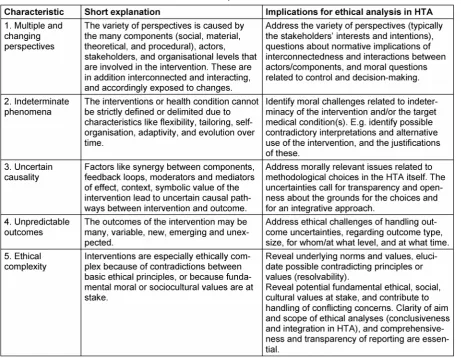
The investigation indicates that it is possible to amend, synthesise, and elaborate the many characteristics of complexity into some general/overarching characteristics relevant for ethical analysis in HTA. Table 1 lists five main characteristics, with a short explanation based on the analysis above. In addition, we indicate some implications of these characteristics for ethical analysis in HTA, which might be useful when assessing/choosing the ethical approach.
Discussion
The nature of complex health care interventions makes it challenging to define, characterise and delimit. It can in fact be argued that most health care interventions are complex to some extent, since hospitals and primary care services are examples of complex systems [6]. However, several characteristics of particularly high-level complex interventions are identified in the literature. In this ana-lysis, we synthesised a set of five characteristics con-sidered relevant for ethical analysis in HTA: multiple and changing perspectives, indeterminate phenomena, uncer-tain causality, unpredictable outcome and ethical com-plexity.
Clearly, the inclusion of other publications on the complex-ity of health care interventions could have given different outcomes. However, an initial broader literature search revealed that the two key articles covered most frequently, identified characteristics of complexity. Moreover, we do not claim that the five characteristics are mutually exclus-ive criteria of complexity. Surely, they can be interrelated and overlapping. Ethical complexity can be influenced by, for instance, the multiple perspectives, indeterminacy and unpredictability involved.
Table 1: Summary of most relevant characteristics of complexity for addressing moral issues in HTA and some implications for ethics analysis in HTA
determinants of health is clearly initiated by the ethical concern of equity [21], [22], and the relevant interven-tions will score high on many complex characteristics (can be hard to define, can cause unintended, unpredict-able outcome etc.). The question is whether these inter-ventions also can be characterised asethically complex. On the one hand, equity is clearly the ethical concern, and there may be no evident contradictions between the principle of equity and other basic (ethical) principles. On the other hand, the understanding of equity, fairness and justice varies. Moreover, peoples’ integrity may be violated by implementation of an intervention that e.g. is aiming to change their lifestyle. Consequently, interventions in-volving social determinants can potentially cause public controversy, and be characterised as ethically complex. The aspects of complexity identified as relevant for the assessment of complex health care interventions may of course be relevant for addressing ethical issues in health care in general. All 5 characteristics appear important for ethical analysis in health care settings in general. The reason this article is restricted to ethical analysis in HTA, is that this is where a method for ethical analysis is espe-cially needed [10], [23].
The analysis shows that the complexity of an invention may be ethically relevant in many ways, and indicates that this poses high demands on the ethical analysis in
HTA. Hence, we consider the analysis a warranted first step in investigations of how to deal with complex inter-ventions in analyses of ethical issues in HTA. How to im-plement the characteristics in the assessment of complex interventions in practice is the next step. Here, we only suggest a synthesised set of complexity characteristics that are important to have in mind when addressing eth-ical issues in the HTA of complex interventions, for in-stance as a tool for assessing the applicability of existing ethical approaches.
Conclusion
1) multiple and changing perspectives, 2) indeterminate phenomena, 3) uncertain causality, 4) unpredictable outcome, and 5) ethical complexity. This may serve as an analytic tool in addressing ethical issues in HTA of complex health care interventions.
Notes
Acknowledgement
This paper is written within the research project INTEG-RATE HTA funded by the European Commission (Grant agreement no. 306141). We would like to thank members of the project team: Eva Rehfuess and James B. Chilcott for increasing our understanding of complexity, and Wija Oortwijn, Louise Brereton and Pietro Refolo for feedback on early drafts of the manuscript.
Competing interests
The authors declare that they have no competing in-terests.
References
1. Campbell M, Fitzpatrick R, Haines A, Kinmonth AL, Sandercock P, Spiegelhalter D, Tyrer P. Framework for design and evaluation of complex interventions to improve health. BMJ. 2000 Sep;321(7262):694-6. DOI: 10.1136/bmj.321.7262.694
2. Pawson R, Greenhalgh T, Harvey G, Walshe K. Realist review – a new method of systematic review designed for complex policy interventions. J Health Serv Res Policy. 2005 Jul;10 Suppl 1:21-34. DOI: 10.1258/1355819054308530
3. Wong G. Is complexity just too complex? J Clin Epidemiol. 2013 Nov;66(11):1199-201. DOI: 10.1016/j.jclinepi.2013.06.019
4. Sturmberg JP, Martin CM. Handbook of Systems and Complexity in Health. New York: Springer; 2013. DOI: 10.1007/978-1-4614-4998-0
5. Glouberman S, Zimmerman B. Complicated and complex systems: what would successful reform of medicare look like? Privy Council, Commission on the Future of Health Care in Canada; 2002. (Discussion paper; 8).
6. Shepperd S, Lewin S, Straus S, Clarke M, Eccles MP, Fitzpatrick R, Wong G, Sheikh A. Can we systematically review studies that evaluate complex interventions? PLoS Med. 2009
Aug;6(8):e1000086. DOI: 10.1371/journal.pmed.1000086
7. Hasson H. Systematic evaluation of implementation fidelity of complex interventions in health and social care. Implement Sci. 2010;5:67. DOI: 10.1186/1748-5908-5-67
8. Shiell A, Hawe P, Gold L. Complex interventions or complex systems? Implications for health economic evaluation. BMJ. 2008 Jun;336(7656):1281-3. DOI:
10.1136/bmj.39569.510521.AD
9. Petticrew M, Anderson L, Elder R, Grimshaw J, Hopkins D, Hahn R, Krause L, Kristjansson E, Mercer S, Sipe T, Tugwell P, Ueffing E, Waters E, Welch V. Complex interventions and their implications for systematic reviews: a pragmatic approach. J Clin Epidemiol. 2013 Nov;66(11):1209-14. DOI:
10.1016/j.jclinepi.2013.06.004
10. Assasi N, Schwartz L, Tarride JE, Campbell K, Goeree R. Methodological guidance documents for evaluation of ethical considerations in health technology assessment: a systematic review. Expert Rev Pharmacoecon Outcomes Res. 2014 Apr;14(2):203-20. DOI: 10.1586/14737167.2014.894464
11. Saarni SI, Hofmann B, Lampe K, Lühmann D, Mäkelä M, Velasco-Garrido M, Autti-Rämö I. Ethical analysis to improve decision-making on health technologies. Bull World Health Organ. 2008 Aug;86(8):617-23. DOI: 10.2471/BLT.08.051078
12. Craig P, Dieppe P, Macintyre S, Michie S, Nazareth I, Petticrew M; Medical Research Council Guidance. Developing and evaluating complex interventions: the new Medical Research Council guidance. BMJ. 2008 Sep 29;337:a1655. DOI: 10.1136/bmj.a1655
13. Clark AM. What are the components of complex interventions in healthcare? Theorizing approaches to parts, powers and the whole intervention. Soc Sci Med. 2013 Sep;93:185-93. DOI: 10.1016/j.socscimed.2012.03.035
14. Lessard C. Complexity and reflexivity: two important issues for economic evaluation in health care. Soc Sci Med. 2007 Apr;64(8):1754-65. DOI: 10.1016/j.socscimed.2006.12.006
15. Manzeschke A, Weber K, Fangerau H, Rother E, Quack F, Dengler K. An ethical evaluation of telemedicine applications must consider four major aspects – a comment on Kidholm et Al. Int J Technol Assess Health Care. 2013 Jan;29(1):110-1. DOI: 10.1017/S0266462312000773
16. Hofmann B. Toward a procedure for integrating moral issues in health technology assessment. Int J Technol Assess Health Care. 2005;21(3):312-8. DOI: 10.1017/S0266462305050415
17. Beauchamp TL, Childress JF. Principles of biomedical ethics. 5th ed. New York: Oxford university press; 2001.
18. Wynne B. Uncertainty and environmental learning: Reconceiving science and policy in the preventive paradigm. Glob Environ Change. 1992;2(2):111-27. DOI:
10.1016/0959-3780(92)90017-2
19. Kermit P. Enhancement technology and outcomes: what professionals and researchers can learn from those skeptical about cochlear implants. Health Care Anal. 2012 Dec;20(4):367-84. DOI: 10.1007/s10728-012-0225-0
20. Hofmann B. The paradox of health care. Health Care Anal. 2001;9(4):369-86. DOI: 10.1023/A:1013854030699
21. Bambra C, Gibson M, Sowden A, Wright K, Whitehead M, Petticrew M. Tackling the wider social determinants of health and health inequalities: evidence from systematic reviews. J Epidemiol Community Health. 2010 Apr;64(4):284-91. DOI: 10.1136/jech.2008.082743
22. Tugwell P, Petticrew M, Kristjansson E, Welch V, Ueffing E, Waters E, Bonnefoy J, Morgan A, Doohan E, Kelly MP. Assessing equity in systematic reviews: realising the recommendations of the Commission on Social Determinants of Health. BMJ. 2010;341:c4739. DOI: 10.1136/bmj.c4739
23. Hofmann BM. Why ethics should be part of health technology assessment. Int J Technol Assess Health Care. 2008;24(4):423-9. DOI: 10.1017/S0266462308080550
Corresponding author: Kristin Bakke Lysdahl
Centre for Medical Ethics, University of Oslo, Postboks 1130, Blindern, 0318 Oslo, Norway
Please cite as
Lysdahl KB, Hofmann B. Complex health care interventions: Characteristics relevant for ethical analysis in health technology assessment. GMS Health Technol Assess. 2016;12:Doc01. DOI: 10.3205/hta000124, URN: urn:nbn:de:0183-hta0001245
This article is freely available from
http://www.egms.de/en/journals/hta/2016-12/hta000124.shtml
Published:2016-03-24
Copyright