ISSN 0975-928X
Research Note
Discriminant function method of selection in groundnut (
Arachis hypogaea
L.)
Babariya C. A., Dobariya K. L.⃰, Sapovadiya M. H. and Vavdiya P. A. Main Oilseeds Research Station
Junagadh Agricultural University-362001 (Gujarat) *[email protected]
(Received: 24 Jan 2014; Accepted:31 Jan 2014)
Abstract
One hundred diverse genotypes of groundnut were evaluated for 15characters in order to construct selection indices. The characters, which had desirable correlation as well as moderate to high direct effect on pod yield per plant were considered as selection index criterion. The pod yield per plant (X1) along with its five components viz., days to maturity (X2), number of pods per plant (X3), kernel yield per plant (X4), biological yield per plant (X5) and harvest index (X6) were utilized for the construction of selection indices. The discriminant function had higher genetic gain and relative efficiency over straight selection for pod yield alone. The relative efficiencies of selection indices constructed in combinations of two or more characters were ranged from 105.90 to 536.06%, while genetic advance ranged from 12.75 to 64.58g. There was an increase in genetic gain and relative efficiency with inclusion of an additional trait in the character combination. A selection index consisting of pod yield per plant, days to maturity, number of pods per plant, kernel yield per plant and biological yield per plant and an index involving pod yield per plant, number of pods per plant, kernel yield per plant and biological yield per plant registered higher genetic gain and relative efficiency. These indices could be advantageously exploited in the groundnut breeding programmes for isolating high yielding genotypes.
Keywords: Groundnut, yield, discriminant function
Groundnut (Arachis hypogaea L.) is one of the most economic oilseed crops of the world. It is considered as the world’s fourth largest source of edible oil and third most important source of vegetable protein (Desai et al., 1999 ) Yield in crops is a quantitative trait and has a complex genetic control mechanism and hence, direct selection is not much effective on it. Since the economic part of groundnut known as pod is developed under the soil, the prediction of its performance based on aerial morphological characters is almost difficult (Weiss, 2000).The most desirable approach to improve characteristics such as pod yield is simultaneous selection based on related traits (Bos and Caligri, 2007). This can be done using selection index, which is multiple regressions of genotypic values on phenotypic values of several traits (Falconer, 1989). The use of selection index is superior in improving complex traits (Hasel and Lush, 1942). Furthermore, the selection indices approach aimed at determining the most suitable combination of traits with the intention of indirectly improving the pod yield in groundnut was well documented (Shettar, 1974; Bandyopadhyay et al. 1985 and Dobariya et al., 2008).
The plant breeder has certain desired plant characteristics in his mind while selecting for particular genotype and for this he applies various weights to different traits for arriving on decisions. The better way of exploiting genetic correlations with several traits having high heritability is to construct an index which combines information on all the characters associated with yield. This suggests the use of selection index, which gives
proper weight to each of the two or more characters to be considered. Selection index was proposed for the first time by Smith (1936) on the basis discriminant function of Fisher (1936). Hazel and Lush (1943) and Robinson et al. (1951) showed that the selection based on such an index is more efficient than selecting individually for the various characters. Keeping these facts in view the present study was undertaken in order to construct selection indices for efficient selection in groundnut breeding programme.
ISSN 0975-928X
Application of discriminant function as a basis for making selection on several characters simultaneously is aimed at discriminating the desirable genotypes from undesirable ones on the basis of their phenotypic performance. A model suggested by Robinson et al. (1951) was used for the construction of selection indices and the development of a required discriminant function. For the construction of selection indices, the characters, which had desirable correlation as well as moderate to high direct effect on pod yield per plant, were considered. In this context, the pod yield per plant (X1) along with its five components
viz., days to maturity (X2), number of pods per plant (X3), kernel yield per plant (X4), biological yield per plant (X5) and harvest index (X6) were identified and considered for the construction of selection indices.
Sixty three selection indices were constructed in all possible combinations of five yield contributing characters and pod yield per plant. Their respective genetic advances were calculated and relative efficiency of different discriminant functions in relation to the straight selection for pod yield was compared.
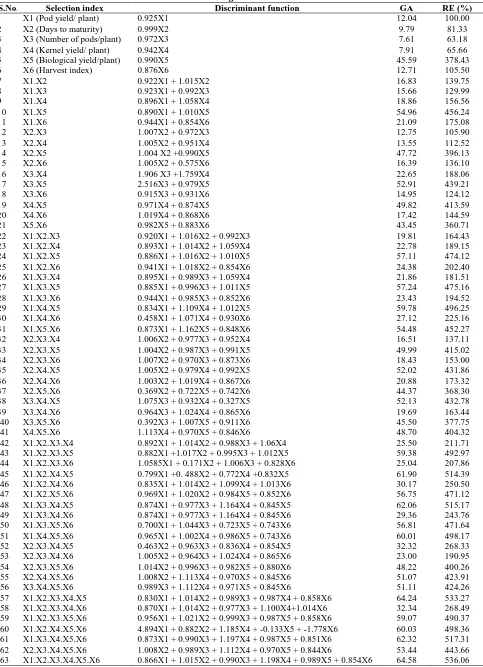
A total of 63 selection indices (Table 2) based on six characters constructed in all possible combinations revealed that the selection efficiency was not higher over straight selection for pod yield per plant when selection was based on individual components except selection index made-up of biological yield per plant. The results suggested that the selection indices containing single trait were not efficient to bring genetic improvement in groundnut for pod yield. This is due to the fact that yield is a cumulative effect of several traits and hence, selection for single trait is not expected to explain fully the genotypic variation for pod yield. However, it was believed that when two or more single-trait based indices were merged, the relative efficiency of the resulted index was better than using each of the single traits independently. Hazel and Lush (1943) also stated that the superiority of selection based on index increased with an increase in the number of characters under selection. In the present study also, the geneticadvance and relative efficiency assessed for different indices increased considerably when selection was based on two or more characters. The relative efficiencies of selection indices constructed in combinations of two or more characters were ranged from 105.90 to 536.06%, while genetic advance ranged from 12.75 to 64.58g. The maximum genetic advance (GA) and relative efficiency (RI) in single character discriminant function were 45.59g and 378.43%, respectively which however, increased to 54.96g and 456.24%, respectively in two character combinations and 59.78g and 496.25%, respectively in three character combinations. Thus, there was an increase in the genetic gain as well as
relative efficiency with inclusion of an additional trait in the character combinations. In four character combinations, the highest genetic advance and relative efficiency were 62.06g and 515.10%, respectively. In five character combinations, the highest genetic advance and relative efficiency were 64.24g and 533.27%, respectively whereas, the maximum genetic advance and relative efficiency in case of six character combinations were 64.58g and 536.06%, respectively. Abraham (1990), Dobariya et al.
(2008) and Bhosale (2011) were also with the same opinion that an increase in characters results in an increase in genetic gain and that the selection indices improve the efficiency of selection than the straight selection for yield alone.
ISSN 0975-928X
considerably when biological yield per plant was involved in an index, which suggested that the improvement in pod yield may be possible through improvement in biological yield per plant in groundnut.
Further, there was a consistent increase in the relative efficiency of the succeeding index with simultaneous inclusion of each character. Ideally all possible combinations of traits have to be examined so as to identify the combinations that contribute the most to the selection index. However, in practice, the plant breeder might be interested in maximum possible gain and relative efficiency with minimum number of characters in a selection index. From practical plant breeding point of view, however, the easiest and a relatively efficient index is the one which contains traits that are relatively easier to record in a better precision in the field and these records are collected in routine activity of research (Bos and Caligri, 2007). In such a case, selection index consisting of pod yield per plant, days to maturity, number of pods per plant, kernel yield per plant and biological yield per plant (X1.X2.X3.X4.X5) followed by a selection index involving pod yield per plant, number of pods per plant, kernel yield per plant and biological yield per plant (X1.X3.X4.X5) or pod yield per plant, days to maturity, kernel yield per plant and biological yield per plant (X1.X2.X3.X5) could be advantageously exploited in the groundnut breeding programmes. The results of the present study also revealed that the discriminant function method of making selection in plants appeared to be the most useful than the straight selection for pod yield alone and hence, due weightage should be given to the important selection indices while making selection for yield advancement in groundnut.
References
Abraham, M. J. (1990). Correlation, path and discriminant function analysis in groundnut grown on a P-deficient acidic soil. Crop Improv.,17: 34-37.
Bandyopadhyay, A.; Arunachalam, V. and Venkaiah, K. (1985). Efficient selection intensity in early generation index selection in groundnut (Arachis hypogaea L.). Theor. Appl. Genet.,
71: 300-304.
Bhosale, S. D. (2011). Character association, selection indices and genetic divergence in groundnut (Arachis hypogaea L.). Unpublished M.Sc. (Agri.) thesis submitted to the Junagadh Agricultural University, Junagadh.
Bos, I. and Caligri, P. (2007). Selection Methods in Plant Breeding; 2nd Edn., Springer.
Dobariya, K. L.; Odedra, R. K.; Jivani, L. L.; Ponkia, H. P. and Khanpara, M. D. (2008). Selection indices for yield improvement in groundnut (Arachis hypogaea L.). Intl. J. of Bioscience Reporter.,6: 299-302.
Desai, B. B.; Kotecha, P. M. and Salunkhe, D. K. (1999). Science and Technology of Groundnut: Biology, Production, Processing and Utilization. Naya Prokash, Calcutta. pp. 2-4.
Falconer, D. S. (1989). Introduction to Quantitative Genetics. Olivia and Boyd, London.
Fisher, R. A. (1936). The use of multiple measurements in taxonomic problems. Ann. Eugen., 7: 179. Hazel, L. N. and Lush, J. L. (1943). The efficiency of
three methods of selection. J. Hered., 33: 393-399.
Robinson, H. F.; Comstock, R. E. and Harvey, P. H. (1951). Genotypic and phenotypic correlations in corn and their implications in selection.
Agron. J., 43: 282-287.
Shettar, B. I. (1974). Variability pattern and formulation of selection index for yield in groundnut
(Arachis hypogaea L.). Mysore J. Agric. Sci.,
8: 296-297.
Smith, H. F. (1936). A discriminant function for plant selection. Ann. Eugen., 7: 240-250.
ISSN 0975-928X
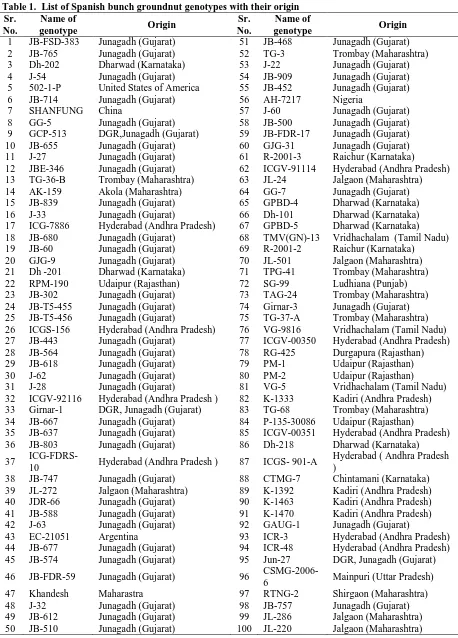
Table 1. List of Spanish bunch groundnut genotypes with their origin Sr.
No.
Name of
genotype Origin
Sr. No.
Name of
genotype Origin
1 JB-FSD-383 Junagadh (Gujarat) 51 JB-468 Junagadh (Gujarat)
2 JB-765 Junagadh (Gujarat) 52 TG-3 Trombay (Maharashtra)
3 Dh-202 Dharwad (Karnataka) 53 J-22 Junagadh (Gujarat)
4 J-54 Junagadh (Gujarat) 54 JB-909 Junagadh (Gujarat)
5 502-1-P United States of America 55 JB-452 Junagadh (Gujarat)
6 JB-714 Junagadh (Gujarat) 56 AH-7217 Nigeria
7 SHANFUNG China 57 J-60 Junagadh (Gujarat)
8 GG-5 Junagadh (Gujarat) 58 JB-500 Junagadh (Gujarat)
9 GCP-513 DGR,Junagadh (Gujarat) 59 JB-FDR-17 Junagadh (Gujarat)
10 JB-655 Junagadh (Gujarat) 60 GJG-31 Junagadh (Gujarat)
11 J-27 Junagadh (Gujarat) 61 R-2001-3 Raichur (Karnataka)
12 JBE-346 Junagadh (Gujarat) 62 ICGV-91114 Hyderabad (Andhra Pradesh)
13 TG-36-B Trombay (Maharashtra) 63 JL-24 Jalgaon (Maharashtra)
14 AK-159 Akola (Maharashtra) 64 GG-7 Junagadh (Gujarat)
15 JB-839 Junagadh (Gujarat) 65 GPBD-4 Dharwad (Karnataka)
16 J-33 Junagadh (Gujarat) 66 Dh-101 Dharwad (Karnataka)
17 ICG-7886 Hyderabad (Andhra Pradesh) 67 GPBD-5 Dharwad (Karnataka) 18 JB-680 Junagadh (Gujarat) 68 TMV(GN)-13 Vridhachalam (Tamil Nadu)
19 JB-60 Junagadh (Gujarat) 69 R-2001-2 Raichur (Karnataka)
20 GJG-9 Junagadh (Gujarat) 70 JL-501 Jalgaon (Maharashtra)
21 Dh -201 Dharwad (Karnataka) 71 TPG-41 Trombay (Maharashtra)
22 RPM-190 Udaipur (Rajasthan) 72 SG-99 Ludhiana (Punjab)
23 JB-302 Junagadh (Gujarat) 73 TAG-24 Trombay (Maharashtra)
24 JB-T5-455 Junagadh (Gujarat) 74 Girnar-3 Junagadh (Gujarat)
25 JB-T5-456 Junagadh (Gujarat) 75 TG-37-A Trombay (Maharashtra)
26 ICGS-156 Hyderabad (Andhra Pradesh) 76 VG-9816 Vridhachalam (Tamil Nadu) 27 JB-443 Junagadh (Gujarat) 77 ICGV-00350 Hyderabad (Andhra Pradesh)
28 JB-564 Junagadh (Gujarat) 78 RG-425 Durgapura (Rajasthan)
29 JB-618 Junagadh (Gujarat) 79 PM-1 Udaipur (Rajasthan)
30 J-62 Junagadh (Gujarat) 80 PM-2 Udaipur (Rajasthan)
31 J-28 Junagadh (Gujarat) 81 VG-5 Vridhachalam (Tamil Nadu)
32 ICGV-92116 Hyderabad (Andhra Pradesh ) 82 K-1333 Kadiri (Andhra Pradesh) 33 Girnar-1 DGR, Junagadh (Gujarat) 83 TG-68 Trombay (Maharashtra) 34 JB-667 Junagadh (Gujarat) 84 P-135-30086 Udaipur (Rajasthan)
35 JB-637 Junagadh (Gujarat) 85 ICGV-00351 Hyderabad (Andhra Pradesh)
36 JB-803 Junagadh (Gujarat) 86 Dh-218 Dharwad (Karnataka)
37
ICG-FDRS-10 Hyderabad (Andhra Pradesh ) 87 ICGS- 901-A
Hyderabad ( Andhra Pradesh )
38 JB-747 Junagadh (Gujarat) 88 CTMG-7 Chintamani (Karnataka)
39 JL-272 Jalgaon (Maharashtra) 89 K-1392 Kadiri (Andhra Pradesh)
40 JDR-66 Junagadh (Gujarat) 90 K-1463 Kadiri (Andhra Pradesh)
41 JB-588 Junagadh (Gujarat) 91 K-1470 Kadiri (Andhra Pradesh)
42 J-63 Junagadh (Gujarat) 92 GAUG-1 Junagadh (Gujarat)
43 EC-21051 Argentina 93 ICR-3 Hyderabad (Andhra Pradesh)
44 JB-677 Junagadh (Gujarat) 94 ICR-48 Hyderabad (Andhra Pradesh)
45 JB-574 Junagadh (Gujarat) 95 Jun-27 DGR, Junagadh (Gujarat)
46 JB-FDR-59 Junagadh (Gujarat) 96
CSMG-2006-6 Mainpuri (Uttar Pradesh)
47 Khandesh Maharastra 97 RTNG-2 Shirgaon (Maharashtra)
48 J-32 Junagadh (Gujarat) 98 JB-757 Junagadh (Gujarat)
49 JB-612 Junagadh (Gujarat) 99 JL-286 Jalgaon (Maharashtra)
ISSN 0975-928X
Table 2. Selection index, discriminant function, expected genetic advance in yield and relative efficiency from the use of different selection indices in groundnut
S.No. Selection index Discriminant function GA RE (%)
1 X1 (Pod yield/ plant) 0.925X1 12.04 100.00
2 X2 (Days to maturity) 0.999X2 9.79 81.33
3 X3 (Number of pods/plant) 0.972X3 7.61 63.18
4 X4 (Kernel yield/ plant) 0.942X4 7.91 65.66
5 X5 (Biological yield/plant) 0.990X5 45.59 378.43
6 X6 (Harvest index) 0.876X6 12.71 105.50
7 X1.X2 0.922X1 + 1.015X2 16.83 139.75
8 X1.X3 0.923X1 + 0.992X3 15.66 129.99
9 X1.X4 0.896X1 + 1.058X4 18.86 156.56
10 X1.X5 0.890X1 + 1.010X5 54.96 456.24
11 X1.X6 0.944X1 + 0.854X6 21.09 175.08
12 X2.X3 1.007X2 + 0.972X3 12.75 105.90
13 X2.X4 1.005X2 + 0.951X4 13.55 112.52
14 X2.X5 1.004 X2 +0.990X5 47.72 396.13
15 X2.X6 1.005X2 + 0.575X6 16.39 136.10
16 X3.X4 1.906 X3 +1.759X4 22.65 188.06
17 X3.X5 2.516X3 + 0.979X5 52.91 439.21
18 X3.X6 0.915X3 + 0.931X6 14.95 124.12
19 X4.X5 0.971X4 + 0.874X5 49.82 413.59
20 X4.X6 1.019X4 + 0.868X6 17.42 144.59
21 X5.X6 0.982X5 + 0.883X6 43.45 360.71
22 X1.X2.X3 0.920X1 + 1.016X2 + 0.992X3 19.81 164.43
23 X1.X2.X4 0.893X1 + 1.014X2 + 1.059X4 22.78 189.15
24 X1.X2.X5 0.886X1 + 1.016X2 + 1.010X5 57.11 474.12
25 X1.X2.X6 0.941X1 + 1.018X2 + 0.854X6 24.38 202.40
26 X1.X3.X4 0.895X1 + 0.989X3 + 1.059X4 21.86 181.51
27 X1.X3.X5 0.885X1 + 0.996X3 + 1.011X5 57.24 475.16
28 X1.X3.X6 0.944X1 + 0.985X3 + 0.852X6 23.43 194.52
29 X1.X4.X5 0.834X1 + 1.109X4 + 1.012X5 59.78 496.25
30 X1.X4.X6 0.458X1 + 1.071X4 + 0.930X6 27.12 225.16
31 X1.X5.X6 0.873X1 + 1.162X5 + 0.848X6 54.48 452.27
32 X2.X3.X4 1.006X2 + 0.977X3 + 0.952X4 16.51 137.11
33 X2.X3.X5 1.004X2 + 0.987X3 + 0.991X5 49.99 415.02
34 X2.X3.X6 1.007X2 + 0.970X3 + 0.873X6 18.43 153.00
35 X2.X4.X5 1.005X2 + 0.979X4 + 0.992X5 52.02 431.86
36 X2.X4.X6 1.003X2 + 1.019X4 + 0.867X6 20.88 173.32
37 X2.X5.X6 0.369X2 + 0.722X5 + 0.742X6 44.37 368.30
38 X3.X4.X5 1.075X3 + 0.932X4 + 0.327X5 52.13 432.78
39 X3.X4.X6 0.964X3 + 1.024X4 + 0.865X6 19.69 163.44
40 X3.X5.X6 0.392X3 + 1.007X5 + 0.911X6 45.50 377.75
41 X4.X5.X6 1.113X4 + 0.970X5 + 0.846X6 48.70 404.32
42 X1.X2.X3.X4 0.892X1 + 1.014X2 + 0.988X3 + 1.06X4 25.50 211.71
43 X1.X2.X3.X5 0.882X1 +1.017X2 + 0.995X3 + 1.012X5 59.38 492.97
44 X1.X2.X3.X6 1.0585X1 + 0.171X2 + 1.006X3 + 0.828X6 25.04 207.86
45 X1.X2.X4.X5 0.799X1 +0. 488X2 + 0.772X4 +0.832X5 61.90 514.39
46 X1.X2.X4.X6 0.835X1 + 1.014X2 + 1.099X4 + 1.013X6 30.17 250.50
47 X1.X2.X5.X6 0.969X1 + 1.020X2 + 0.984X5 + 0.852X6 56.75 471.12
48 X1.X3.X4.X5 0.874X1 + 0.977X3 + 1.164X4 + 0.845X5 62.06 515.17
49 X1.X3.X4.X6 0.874X1 + 0.977X3 + 1.164X4 + 0.845X6 29.36 243.76
50 X1.X3.X5.X6 0.700X1 + 1.044X3 + 0.723X5 + 0.743X6 56.81 471.64
51 X1.X4.X5.X6 0.965X1 + 1.002X4 + 0.986X5 + 0.743X6 60.01 498.17
52 X2.X3.X4.X5 0.463X2 + 0.963X3 + 0.836X4 + 0.854X5 32.32 268.33
53 X2.X3.X4.X6 1.005X2 + 0.964X3 + 1.024X4 + 0.865X6 23.00 190.95
54 X2.X3.X5.X6 1.014X2 + 0.996X3 + 0.982X5 + 0.880X6 48.22 400.26
55 X2.X4.X5.X6 1.008X2 + 1.113X4 + 0.970X5 + 0.845X6 51.07 423.91
56 X3.X4.X5.X6 0.989X3 + 1.112X4 + 0.971X5 + 0.845X6 51.11 424.26
57 X1.X2.X3.X4.X5 0.830X1 + 1.014X2 + 0.989X3 + 0.987X4 + 0.858X6 64.24 533.27 58 X1.X2.X3.X4.X6 0.870X1 + 1.014X2 + 0.977X3 + 1.100X4+1.014X6 32.34 268.49 59 X1.X2.X3.X5.X6 0.956X1 + 1.021X2 + 0.999X3 + 0.987X5 + 0.858X6 59.07 490.37 60 X1.X2.X4.X5.X6 4.894X1 + 0.882X2 + 1.185X4 + -0.133X5 + -1.778X6 60.03 498.36 61 X1.X3.X4.X5.X6 0.873X1 + 0.990X3 + 1.197X4 + 0.987X5 + 0.851X6 62.32 517.31 62 X2.X3.X4.X5.X6 1.008X2 + 0.989X3 + 1.112X4 + 0.970X5 + 0.844X6 53.44 443.66 63 X1.X2.X3.X4.X5.X6 0.866X1 + 1.015X2 + 0.990X3 + 1.198X4 + 0.989X5 + 0.854X6 64.58 536.06