Vol. 14, No. 3, 2017, 473-487
ISSN: 2279-087X (P), 2279-0888(online) Published on 31 October 2017
www.researchmathsci.org
DOI: http://dx.doi.org/10.22457/apam.v14n3a15
473
Annals of
Interval–valued Fuzzy Bridges and Interval–valued
Fuzzy Cutnodes
Ann Mary Philip
Department of Mathematics, Assumption College Changanassery – 686101, Kerala, India.
E-Mail: [email protected]
Received 2 October 2017; accepted 25 October 2017
Abstract. In this paper, we define strength of a path, strength of connectedness between any two vertices and strongest path joining any two vertices in an interval–valued fuzzy graph (IVFG). Then we define interval–valued fuzzy bridges (IVF bridges) and interval– valued fuzzy cutnodes (IVF cutnodes) Also, we obtain necessary and sufficient conditions for an arc to be an IVF bridge and a vertex to be an IVF cutnode.
Keywords: Interval-valued fuzzy bridge, Interval-valued fuzzy cutnode. AMS Mathematics Subject Classification (2010): 05C72
1. Introduction
Graph theory has so many applications in almost all real world problems. But since the world is full of uncertainty, fuzzy graph has a separate importance in many real life applications. The first definition of fuzzy graph was by Kaufmann [16] in 1973. But it was Rosenfeld [35] who considered fuzzy relations on fuzzy sets and developed the theory of fuzzy graphs as a generalization of Eulers graph theory in 1975. The works of Bhattacharya[9], Bhutani [10], Bhutani and Battou [11], Bhutani and Rosenfeld [12,13, 14], Mordeson [18], Mordeson and Nair [19,20], Mordeson and Peng [21], Sunitha and Vijayakumar [43-46], Nagoor Gani and Ahmed [22], Nagoor Gani and Malarvizhi [23], Nagoor Gani and Radha [24,25] form the foundation of all researches in fuzzy graph theory. In [42], Sunitha and Sunil Mathew made a very good survey of the researches done so far in fuzzy graph theory. Samanta and Pal introduced fuzzy tolerance graphs [36], fuzzy k-competion graphs and p-competition fuzzy graphs [37], fuzzy threshold graphs [38] and bipolar fuzzy hypergraphs [39].
474
IVFGs and investigated some properties. They also introduced the notion of interval-valued fuzzy complete graphs and presented some properties of self complementary and self weak complementary interval-valued fuzzy complete graphs. Akram also introduced interval–valued fuzzy line graphs [2] and bipolar fuzzy graphs [1]. Talebi and H. Rashmanlou [47] studied on isomorphism of IVFGs. Rashmanlou and Jun [29] defined the three new operations, direct product, semi strong product and strong product of IVFGs and discussed its properties on complete IVFGs. Debnath [28] introduced domination in IVFGs. Rashmanlou and Pal defined Irregular IVFG [26], Balanced IVFG [30] and Antipodal IVFG [31] and studied its properties. Also, they studied on the properties of highly irregular IVFG [33] and defined isometry on IVFG [32]. Akram, Alshehri and Dudek [4] introduced certain types of IVFG such as balanced IVFGs, neighbourly irregular IVFGs, neighbourly total irregular IVFGs, highly irregular IVFGs, highly total irregular IVFGs. Again Akram, Yousaf and Dudek [7] studied on the properties of self centered IVFGs. Pal, Samanta and Rashmanlou [27] defined the degree and total degree of an edge in the Cartesian product and composition of two IVFG and obtained some results. Mohideen [8] studied on strong and regular IVFGs. Narayanan and Maheswari [34] introduced strongly edge irregular and strongly edge totally irregular IVFG and made a comparative study between the two. Talebi, Rashmanlou and Ameri [48] studied on product IVFGs. Total regularity of the join of two IVFGs was discussed in [40]. Again regular and edge regular IVFGs were studied in [41].
Bridges and cutnodes is a very important concept in graph theory. Rosenfeld [35] obtained fuzzy analogs of bridges and cutnodes. Further it was studied by Bhattacharya [9]. Again Sunitha and Vijayakumar studied about the properties of fuzzy bridges and fuzzy cutnodes [44]. It was also studied by Mordeson and Nair [20]. Strength of the paths in IVFGs were discussed by Rashmanlou and Pal [31]. Again it was studied by Akram, Yousaf and Dudek [7]. Akram and Alsheri defined intuitionistic fuzzy bridges and intuitionistic fuzzy cutnodes in [3]. Again Akram and Farooq defined bipolar fuzzy bridges and bipolar fuzzy cutnodes in [6]. Bipolar fuzzy bridges and bipolar fuzzy cutnodes were also characterized by Mathew, Sunitha and Anjali [17].
In this paper, we define IVF bridges and IVF cutnodes and study its various properties.
2.Basic concepts
Graph theoretic terms and results used in this work are either standard or are explained as and when they first appear. We consider only simple graphs. That is, graphs with multiple edges and loops are not considered.
Definition 2.1. [35] Let be a non empty set. A fuzzy graph is a pair of functions
: , where is a fuzzy subset of and is a symmetric fuzzy relation on . That is, : → 0,1 and : × → 0,1 such that , ≤ ∧ for all , in
where ∧ denotes minimum of .
475
Remark 2.1. (i) The interval number , is identified with the number ∈ 0,1. (ii) 0,1 denotes the set of all interval numbers.
Definition 2.3. [5] For interval numbers = , and = ,
• !", = !"#, $, !"#, $
• !%, = !%#, $, !%#, $
• + = + − . , + − .
• ≤ ⇔ ≤ ≤
• = ⇔ = =
• < ⇔ ≤ ≠
• + = +, = +, + ,ℎ. . 0 ≤ + ≤ 1.
Then 0,1, ≤,∨,∧ is a complete lattice with 0,0 as the least element and 1,1 as the greatest. Here ∨ denotes maximum and ∧ denotes minimum.
Definition 2.4. [5] The interval–valued fuzzy set 0 in is defined by
0 = #%, 1%, 1%: % ∈ $ where 1% and 1% are fuzzy subsets of such that 1% ≤ 1% for all % ∈ . We shall sometimes denote the IVFS 0 by
1%, 1%.
For any two IVFSs 0 = 1%, 1% and 2 = 3%, 3% in , we define • 0 ∪ 2 = 56%, !%71%,
3%8, !%71%, 3%89 : % ∈ :
• 0 ∩ 2 = 56%, !"71%,
3%8, !"71%, 3%89 : % ∈ :
Definition 2.5. [5] If ∗= , = is a graph, then by an interval–valued fuzzy relation 2 on the set = we mean an IVFS such that 3%> ≤ !"71%, 1>8
3%> ≤ !"71%, 1>8 for all %> ∈ = .
Definition 2.6 [5] By an interval – valued fuzzy graph of a graph ∗= , =, we mean a pair = 0, 2, where 0 = 1, 1 is an IVFS on and 2 = 3, 3 is an IVFR on =.
Definition 2.7 [26] The negative degree of a vertex ∈ is defined by =
∑@A∈B3. Similarly, positive degree of a vertex ∈ is defined by =
∑@A∈B3.Then the degree of the vertex ∈ is defined as
= , .
476
Definition 2.9. [5] An IVFG = 0, 2 is said to be a complete interval–valued fuzzy graph if 3%> = !"71%, 1>8 and 3%> = !"71%, 1>8 for all
%, > ∈ .
Theorem 2.1 [4] Let = 0, 2 be an IVFG on a graph ∗= , = such that ∗=
, = is an odd cycle. Then is a RIVFG if and only if 2= 3, 3 is a constant function.
Theorem 2.2. [26] Let = 0, 2 be an IVFG on a graph ∗= , = such that
∗= , = is an even cycle. Then is a RIVFG if and only if either 2= 3, 3 is a constant function or alternate edges have same membership values.
3. Strongest path, IVF bridge, IVF cutnode
Definition 3.1. A path P in an interval – valued fuzzy graph is a sequence of distinct vertices , , E… G such that either one of the following conditions is satisfied.
1. 37HI8 > 0 and 37HI8 > 0 for some ", K. 2. 37HI8 = 0 and 37HI8 > 0 for some ", K.
A path L: , , E… G in is called a cycle if = G and ≥ 3. When = 3, we have E.
Definition 3.2. An IVFG is said to be connected if any two nodes are joined by a path.
Definition 3.3. Let L: O, , … G be a path in an IVFG . The μ strength of the path
L is defined as QRSL = ⋀ 3HUG SH, H and the μstrength of the path L is defined as QRVL = ⋀ 3GHU VH, H. Then the strength (μμstrength) of the path L is defined as
QRSRVL = WQRSL, QRVLX where ⋀ stands for minimum.
Definition 3.4. Let be any two vertices of an IVFG . Then the maximum of the strength of various paths connecting is called the μ strength of connectedness between and is denoted by 3SY, . Similarly, the maximum of the strength of various paths connecting is called the μ strength of connectedness between and is denoted by 3VY, .
Notation. Let be an IVFG. The strength of connectedness between any two vertices
can also be denoted as NCONN], and the strength of connectedness between can also be denoted as PCONN], .
477
Remark 3.1. In crisp graph theory and fuzzy graph theory, strongest path joining any two vertices always exist. But in interval- valued fuzzy graph theory, the strongest path joining any two vertices does not always exist. It exists if and only if the strength of connectedness and strength of connectedness between corresponds to the same path.
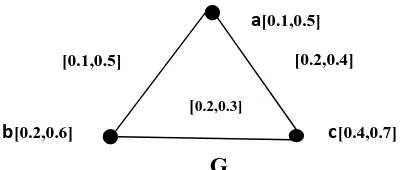
Example 3.1. The following diagram presents an IVFG.
The following table gives all possible − paths in and its strengths and strengths.
Path strength strength
L: , 0.1 0.5
L: , ^, 0.2 0.3
Now, 3SY, = NCONN], = 0.2 and 3VY, = PCONN], = 0.5
and this corresponds to two different paths. So by definition there does not exist a strongest path between .
Definition 3.6. An arc , of an IVFG is called a μ bridge if the deletion of , reduces the strength of connectedness between some pair of vertices of and is called a μ bridge if the deletion of , reduces the strength of connectedness between some pair of vertices of .
An arc , of an IVFG is called an interval valued fuzzy bridge (IVF bridge) if it is both a bridge and a bridge.
Definition 3.7. A node , of an IVFG is called a μ cutnode if the deletion of , reduces the strength of connectedness between some other pair of vertices of and is
[0.1,0.5] [0.2,0.4] a[0.1,0.5]
b[0.2,0.6] c[0.4,0.7]
G
Figure 3.1: An example to show that strongest path between any two vertices does not always exist in the case of IVFGs.
[0.2,0.3]
478
called a μ cutnode if the deletion of , reduces the strength of connectedness between some other pair of vertices of .
A node , of an IVFG is called an interval valued fuzzy cutnode (IVF cutnode) if it is both a cutnode and a cutnode.
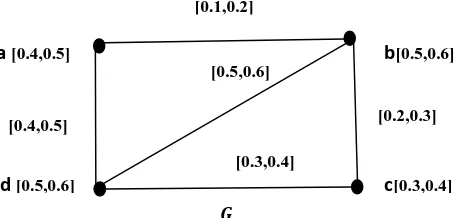
Example 3.2. Consider the IVFG given below.
The following table gives all possible − paths in and its strengths and strengths.
Path strength strength
L: , 0.1 0.2
L: , , 0.4 0.5
LE: , , ^, 0.2 0.3
Now, 3SY, = NCONN], = 0.4 and 3VY, = PCONN], = 0.5.
Clearly, L: , , is the strongest − path in . Also, we can see that the removal of the arc , reduces the and strength of connectedness between .
∴ , is an IVF bridge. Again the removal of the node reduces the and strength of connectedness between .∴ is an IVF cutnode.
Remark 3.2. An IVF bridge of an IVFG need not be a bridge of ∗. In example 3.2, , is an IVF bridge, but it is not a bridge of ∗ since even after its removal ∗ is still connected.
Definition 3.8. A maximum spanning tree of a connected IVFG = 0, 2 is an interval valued fuzzy spanning subgraph c = 0, d such that c∗ is a tree and for which
∑@fAeS, and ∑@fAeV, are maximum.
a [0.4,0.5]
d [0.5,0.6] c[0.3,0.4]
g
Figure 3.2: Example to explain terms in definitions 3.1- 3.7
b[0.5,0.6]
[0.2,0.3] [0.5,0.6]
[0.3,0.4] [0.1,0.2]
[0.4,0.5]
479
Theorem 3.1. Let be an IVFG and if 3S, 3V is a constant for every edge of , then
NCONN], and PCONN], will be constants for any two vertices of . Proof: Let be an IVFG and let 3S, 3V. = ^, ^ for every edge . of where
^ ^ are constants. Let be any two vertices of . Then for every − path
L of ,QRSL = ^and QRVL = ^. Then by the definition of the and strength of connectedness, NCONN], = ^, a constant and PCONN], = ^, a constant.
Definition 3.9. An arc , of an IVFG is called N − weakest if 3, <
3
%, > where %, > is any other arc of different from , and is called P − weakest if 3, < 3%, > where %, >is any other arc of different from , An arc , of an IVFG is called the weakest arc of if it is both N − weakest and
P − weakest
Theorem 3.2. The following statements are equivalent 1) , is an IVF bridge
2) NCONN]@,A, < 3, and PCONN]@,A, < 3, 3) , is neither the N- weakest nor P-weakest arc of any cycle. Proof.
2 ⟹ 1
For that we show that ~1 ⟹ ~2. Suppose , is not an IVF bridge. Then we have 3 cases.
Case 1. , is not a bridge. Then NCONN]@,A, = NCONN], ≥
3,
Case 2. , is not a bridge. Then PCONN]@,A, = PCONN], ≥
3,
Case3., is neither a bridge nor a bridge.
Then NCONN]@,A, = NCONN], ≥ 3, and PCONN]@,A, =
PCONN], ≥ 3, .
Cases (1), (2) and (3) together implies ~2.
1 ⟹ 3
For that we show that ~3 ⟹ ~1. Suppose ~3 holds.Then there arises 3 cases. Case 1. , is a N – weakest arc of a cycle. Then any path L involving the arc , can be coverted into a path Lo not involving the arc , such that QRSLo≥QRSL
using the rest of the cycle as a path from to . Hence , cannot be a bridge and hence it cannot be an IVF bridge.
Case 2. , is a P – weakest arc of a cycle. Then any path L involving the arc , can be coverted into a path Lo not involving the arc , such that QRVLo≥QRVL
480
Case 3. Arc , is both N – weakest and P - weakest.Then any path L involving the arc
, can be coverted into a path Lo not involving the arc , such that QRSLo≥ QRSL and QRVLo≥ QRVL using the rest of the cycle as a path from to . Hence
, cannot be a bridge and bridge and hence it cannot be an IVF bridge.
3 ⟹ 2
We show that ~2 ⟹ ~3. When we consider ~2, 3 cases arise.
Case 1. Suppose NCONN]@,A, ≥ 3, . Then there is a − path L not involving , such that QRSL ≥ 3, . This path L together with , forms a cycle of which , is the N-weakest arc.
Case 2. Suppose PCONN]@,A, ≥ 3, . Then there is a − path L not involving , such that QRVL ≥ 3, . This path L together with , forms a cycle of which , is the P-weakest arc.
Case 3. Suppose NCONN]@,A, ≥ 3, and PCONN]@,A, ≥ 3, . Then there is a − path L not involving , such that QRSL ≥ 3, and
QRVL ≥ 3, . This path L together with , forms a cycle of which , is the weakest arc.
Cases (1), (2) and (3) together implies ~3.
Remark 3.3. From theorem 3.2, we can conclude that N – weakest and P – weakest arcs of cycles cannot be IVF bridges and thus we have the following corollary.
Corollary 3.1. Let = 0, 2 be an IVFG such that ∗ is a cycle and let p=
⋀3, and p= ⋀3, , then all the arcs , such that 3, > pand
3, > p are IVF bridges.
Example 3.3. Consider the IVFG given below such that ∗ is a cycle
Here p= 0.1 and p= 0.4. Clearly , and , ^ are IVF bridges.
Theorem 3.3. Let = 0, 2 be an IVFG and let , be an IVF bridge. Then
NCONN], = 3, and PCONN], = 3, .
a [0.2,0.8]
d[0.4,0.9] c[0.3,0.7]
g
Figure 3.3: Example to illustrate Corollary 3.1
b[0.3,0.9]
[0.3,0.5] [0.2,0.6]
481
Proof: For any arc , , we have NCONN], ≥ 3, and PCONN], ≥
3, . Suppose that , is an IVF bridge. Also suppose that NCONN], > 3, and PCONN], > 3, . Then there exists a strongest − path L with
QRSL > 3, and QRVL > 3, and all the arcs %, > of this strongest path
have 3%, > > 3, and 3%, > > 3, . Now this path L together with the
arc , forms a cycle in which , is the weakest arc contradicting that , is an IVF bridge. Hence, our assumption is wrong and the only possibility is that
NCONN], = 3, and PCONN], = 3,
The following example shows that the converse of the above theorem is not true
Example 3.4. In the following IVFG, , and %, , are the only IVF bridges and
NCONN], , = 3, , , PCONN], , =
3
, , and NCONN], % =
3, % , PCONN], % = 3, % , but , , and , % are not IVF bridges.
Remark 3.4. It follows from theorem 3.2 and theorem 3.3 that an arc , is an IVF bridge if and only if it is the unique strongest − path.
Theorem 3.4. Let = 0, 2 be an IVFG and let , be an IVF bridge. Then
NCONN]@,A, < NCONN], and PCONN]@,A, < PCONN], .
Proof: Clearly follows from Theorem 3.2 and Theorem 3.3.
In the next theorem, we give the conditions to be satisfied by an IVFG to have atleast one IVF bridge.
Theorem 3.5. Let = 0, 2 be an IVFG and any two edges . and . of are such
that their membership degrees satisfies the following two conditions: 1. 3S. ≠ 3S. and 3V. ≠ 3V.
2. If 3S. < 3S., then 3V. < 3V. and if 3S. > 3S., then
3V. > 3V..
Then has atleast one IVF bridge.
u [0.3,0.5]
x [0.4,0.5] w[0.5,0.6]
v[0.4,0.6]
[0.1,0.2] [0.3,0.4]
[0.3,0.4] [0.1,0.2]
g
482
Proof: Let be an IVFG satisfying the conditions of the above theorem. Choose any edge O, O such that 3O, O = !%#3, ; , "r .s. tu $.
Clearly, 3O, O = !%#3, ; , "r .s. tu $ since we are considering
only those IVFGs satisfying the above two conditions. Now there exists atleast one edge
, distinct from O, O such that 3, < 3O, O and 3, < 3O, O.
We claim that O, O is an IVF bridge of . For, the deletion of the edge O, O
decreases the and strength of connectedness between O O. In otherwords,
NCONN]@v,AvO, O < 3
O, O and PCONN]@v,AvO, O < 3
O, O. Then
by theorem 3.2, O, O is an IVF bridge of .
Corollary 3.2. Let = 0, 2 be an IVFG as given in theorem 3.5. Then an edge , for which 3, and 3, are maximum is an IVF bridge of .
The converse of corollary 3.2 is not true which is clear from the following example.
Example 3.5.
Here ; is an IVF bridge. But, 3, 3, is not maximum.
Next we give two theorems on IVF cutnode without proof.
Theorem 3.6. Let = 0, 2 be an IVFG such that ∗ is a cycle. Then a node of is an IVF cutnode if and only if it is a common node of two IVF bridges.
Theorem 3.7. If , is common node of atleast two IVF bridges, then , is an IVF cutnode.
The following example shows that the converse of the above theorem is not true.
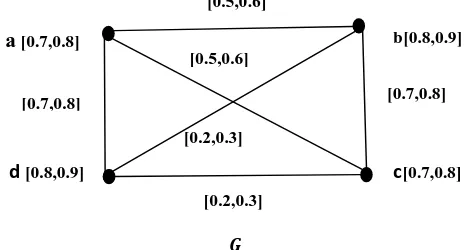
Example 3.6. In the following IVFG, is an IVF cutnode. But , and (b, c) are the only IVF bridges.
g
Figure 3.5: Example to show converse of corollary 3.2 is not true. b[0.7,0.9]
a[0.6,0.8]
c[0.8,0.9] [0.4,0.5]
[0.3,0.4]
d[0.8,0.9] [0.8,0.9]
483
Theorem 3.8. Let be an IVFG such that ∗ is a cycle. If 3S, 3V is a constant for every edge of , then does not have an IVF bridge. Also, it does not have an IVF cutnode.
Proof: Since ∗ is a cycle, there exist two distinct paths between any two vertices. Again since 3S, 3V is a constant for every edge of , deletion of an edge does not reduce the strength of connectedness between any two vertices. So does not have an IVF bridge and hence by theorem 3.6, also does not have an IVF cutnode.
Theorem 3.9. A RIVFG on an odd cycle does not have an IVF bridge. Hence it does not have an IVF cutnode.
Proof: Let = 0, 2 be a RIVFG on an odd cycle. Then by theorem 2.1, 3S, 3V is a constant for every edge of and by above theorem does not have an IVF bridge and hence an IVF cutnode.
Theorem 3.10. Let = 0, 2 be a RIVFG on an even cycle ∗= , =. Then either does not have an IVF bridge or it has wx2 IVF bridges where w = |=|. Also, does not have an IVF cutnode.
Proof: Let = 0, 2 be a RIVFG on an even cycle ∗= , =. Then by theorem 2.2, either 3S, 3V is a constant for every edge of or alternate edges have same membership values.
Case 1. 3S, 3V is a constant. Then by theorem 3.8, does not have an IVF bridge and hence an IVF cutnode.
Case 2. Alternate edges have same membership values. Then by corollary 3.1, those edges with greater membership values are IVF bridges of . There are wx2 such edges
a [0.7,0.8]
d [0.8,0.9] c[0.7,0.8]
g
Figure 3.6. Example to show that converse of theorem 3.7 is not true
b[0.8,0.9]
[0.7,0.8] [0.5,0.6]
[0.2,0.3] [0.5,0.6]
[0.7,0.8]
484
where w = |=|. Hence has wx2 IVF bridges. But then no vertex is a common vertex of two IVF bridges. So by theorem 3.6, does not have an IVF cutnode.
Theorem 3.11. An arc , is an IVF bridge of = 0, 2 if and only if , is in every MST of .
Proof: Let , be an IVF bridge of . Then arc , is the unique strongest − path and hence is in every MST of .
Conversely, let , be in every MST c of and assume that , is not an IVF bridge. Then by theorem 3.2, three cases arise.
Case 1. , is the N- weakest arc of some cycle in .Then NCONN], > 3,
and PCONN], ≥ 3, which implies that , is in no MST of .
Case 2. , is the P- weakest arc of some cycle in . Then PCONN], > 3,
and Then NCONN], ≥ 3, which implies that , is in no MST of .
Case 3. , is both the N- weakest and P-weakest arc of some cycle in Then
NCONN], > 3, and PCONN], > 3, and hence , is in no
MST of .
Corollary 3.3. Let be a connected IVFG with|| = . The has atmost − 1 IVF bridges.
Proof: Follows directly from the above theorem.
Theorem 3.12. A node , is an IVF cutnode of an IVFG if and only if , is an internal node of every MST of .
Corollary 3.4. Every IVFG has atleast two nodes which are not IVF cutnodes of .
3. Conclusion
In this paper, we have defined the strength of connectedness between two vertices of an IVFG and extended the notion of bridges and cutnodes to IVFGs. Then we have obtained some conditions to be satisfied by an IVFG to have atleast one IVF bridge. Also we have obtained characterizations of IVF bridges and IVF cutnodes.
Acknowledgements. The author is extremely grateful to the reviewers and the Editor-in-Chief for their valuable comments and suggestions for improving the paper.
REFERENCES
1. M.Akram, Bipolar fuzzy graphs, Information Sciences, 181 (2011) 5548-5564. 2. M.Akram, Interval–valued fuzzy line graphs, Neural Computing Applications, 21
485
3. M.Akram and N.O.Alsheri, Intuitionistic fuzzy cycles and intuitionistic fuzzy trees, The Scientific World Journal, 2014 (2014), Article ID 305836, 11 pages.
4. M.Akram , N.O.Alsheri and W.A.Dudek, Certain types of interval – valued fuzzy graphs, Journal of Applied Mathematics, Volume 2013 (2013), Article ID 857070, 11 pages.
5. M.Akram and W.A.Dudek, Interval–valued fuzzy graphs, Computers and Mathematics with Applications, 61 (2011) 289-299.
6. M.Akram and A.Farooq, Bipolar fuzzy trees, New Trends in Mathematical Sciences, 3 (2016) 58-72.
7. M.Akram, M.Murthaza Yousaf and W.A.Dudek, Self centered interval–valued fuzzy graphs, Africa Mathematika, 26 (2015) 887-898.
8. B.A.Mohideen, Strong and regular interval-valued fuzzy graphs, Journal of Fuzzy Set Valued Analysis, 3 (2015) 215-223.
9. P.Bhattacharya, Some remarks on fuzzy graphs, Pattern Recognition Letters, 6 (1987) 297-302.
10. K.R.Bhutani, On automorphisms of fuzzy graphs, Pattern Recognition Letters, 9 (1989) 159-162.
11. K.R.Bhutani and A.Battou, On M-strong fuzzy graphs, Information Sciences, 155 (2003) 103-109.
12. K.R.Bhutani and A.Rosenfeld, Geodesics in fuzzy graphs, Electronic Notes in Discrete Mathematics, 15 (2003) 51-54.
13. K.R.Bhutani and A.Rosenfeld, Fuzzy end nodes in fuzzy graphs, Information Sciences, 152 (2003) 323-326.
14. K.R.Bhutani and A.Rosenfeld, Strong arcs in fuzzy graphs, Information Sciences, 152 (2003) 319-322.
15. J.Hongmei and W.Lianhua, Interval-valued fuzzy subsemigroups and subgroups associated by interval-valued fuzzy graphs; 2009 WRI Global Congress on Intelligent Systems, 2009, 484- 487.
16. A.Kaufman, Introduction a la Theorie des Sous-emsembles Flous, Masson et Cie 1, (1973).
17. S.Mathew, M.S.Sunitha and N.Anjali, Some connectivity concepts in bipolar fuzzy graphs, Annals of Pure and Applied Mathematics, 7 (2) (2014) 98-108.
18. J.N.Mordeson, Fuzzy line graphs, Pattern Recognition Letters, 14 (1993) 381-384. 19. J.N.Mordeson and P.S.Nair, Cycles and cocycles of fuzzy graphs, Information
Sciences, 90 (1996) 39-49.
20. J.N.Mordeson and P.S.Nair, Fuzzy Graphs and Fuzzy Hypergraphs, Physica-verlag, Heidelberg, (2000).
21. J.N.Mordeson and C.S.Peng, Operations on fuzzy graphs, Information Sciences, 79 (1994) 159-170.
22. A.Nagoor Gani and M.Basheer Ahmed, Order and size in fuzzy graph, Bulletin of Pure and Applied Sciences, 22E (1) (2003) 145-148.
23. A.Nagoor Gani and J.Malarvizhi, Isomorphism on fuzzy graphs, International Journal of Mathematical, Computational, Physical, Electrical and Computer Engineering, in press.
486
25. A.Nagoor Gani and K.Radha, On regular fuzzy graphs, Journal of Physical Sciences, 12 (2008) 33-40.
26. M.Pal and H.Rashmanlou, Irregular interval-valued fuzzy graphs, Annals of Pure and Applied Mathematics, 3(1) (2013) 56-66.
27. M.Pal, S.Samanta and H.Rashmanlou, Some results on interval-valued fuzzy graphs; International Journal of Computer Science and Electronics Engineering, 3(3) (2015) 205-211.
28. P.Debnath, Domination in interval-valued fuzzy graphs, Annals of Fuzzy Mathematics and Informatics, in press.
29. H.Rashmanlou, Y.B.Jun, Complete interval-valued fuzzy graphs, Annals of Fuzzy Mathematics and Informatics, 6(3) (2013) 677-687.
30. H.Rashmanlou and M.Pal, Balanced interval-valued fuzzy graphs, Journal of Physical Sciences, 17 (2013) 43-57.
31. H.Rashmanlou and M.Pal, Antipodal interval-valued fuzzy graphs, International Journal of Applications of Fuzzy Sets and Artificial Intelligence, 3 (2013) 107-130. 32. H. Rashmanlou and M. Pal, Isometry on interval-valued fuzzy graphs, International
Journal on Fuzzy Mathematical Archive, 3 (2013) 28-35.
33. H.Rashmanlou and M.Pal, Some properties of Highly Irregular interval-valued fuzzy graphs, World Applied Sciences Journal, 27(12) (2013) 1756-1773.
34. S.Ravi Narayanan and N.R.Santhi Maheswari, Strongly edge irregular interval-valued fuzzy graphs, International Journal of Mathematical Archive, 7(1) (2016) 192-199.
35. A.Rosenfeld, Fuzzy Graphs, Fuzzy Sets and their Applications. In: Zadeh, L.A., Fu, K.S., Shimura, M.(eds.), Academic Press, New York (1975),77-95.
36. S.Samanta and M.Pal, Fuzzy tolerance graphs, International Journal of Latest Trends in Mathematics, 1(2) (2011) 57-67.
37. S.Samanta and M.Pal, Fuzzy k-competition graphs and p-competition fuzzy graphs, Fuzzy Information and Engineering, 5(2) (2013) 191-204.
38. S.Samanta and M.Pal, Fuzzy threshold graphs, CIIT International Journal of Fuzzy Systems, 3 (12) (2011) 360-364.
39. S.Samanta and M.Pal, Bipolar fuzzy hypergraphs, International Journal of Fuzzy Logic Systems, 2(1) (2012) 17-28.
40. S.Sebastian and Ann Mary Philip, On total regularity of the join of two interval valued fuzzy graphs, International Journal of Scientific and Research Publications, 6(12) (2016) 45-55.
41. S. Sebastian and Ann Mary Philip, Regular and Edge regular interval valued fuzzy graphs, Journal of Computer and Mathematical Sciences, 8(7) (2017) 309-322. 42. M.S.Sunitha and S.Mathew, Fuzzy graph theory: A survey, Annals of Pure and
Applied Mathematics, 4 (1) (2013) 92-110.
43. M.S.Sunitha and A.Vijayakumar, Complement of a fuzzy graph, Indian Journal of Pure and Applied Mathematics, 33 (9) (2002) 1451-1464.
44. M.S.Sunitha and A.Vijayakumar, A characterization of fuzzy trees, Information Sciences, 113 (1999) 293–300.
487
46. M.S.Sunitha and A.Vijayakumar, Some metric aspects of fuzzy graphs, Proceedings of the conference on Graph connections, Cochin University of Science & Tech, Cochin, India, January 28-31(1998) 111-114.
47. A.A.Talebi and H.Rashmanlou, Isomorphism on interval-valued fuzzy graphs, Annals of Fuzzy Mathematics and Informatics, 6(1) (2013) 47-58.