Journal of Management and Innovation, 3(1), Spring 2017
Copyright Creative Commons 3.0
Multi-generational Differences in Perception of Coercive
Power in the Workplace:
Senior Executive Coercive Power
by
Paul Bailo
Mercy College
Abstract
The purpose of this research study was to investigate the perception of coercive power between Generation X born between 1965 and 1980, and Generation Y born between 1981 and 2000, within an organization’s workplace environment, to determine whether differences existed in their perception of coercive power - Senior Executive Coercive Power: Participants perceive senior executives use coercive power more than supervisors to motivate performance and increase organization efficiency.
Journal of Management and Innovation, 3(1), Spring 2017
Copyright Creative Commons 3.0
Significance of the Study
The understanding and perceptions of generational differences can assist in the
development of more collaborative work environments. This development of a more
collaborative work environment can be obtained by enabling managers to leverage
their strengths of each generational member. The outcome can lead to efficiency,
decreased conflicts, increased productivity, improved team dynamites and enhanced
employee retention. A more collaborative work environment will also lead to an
increase in teammate job satisfaction. By increasing our understanding and
perceptions of generational differences in the work place organizations will have the
ability to reduce conflicts and be more efficient. This new understanding of
generational differences will reduce turnover and improve employee retention.
Understanding of generational differences will also increase commitment, increase
employee job satisfaction, more effectively motivate employees, increase
productivity, improve communication, decrease conflict, and improve team efficiency
and effectiveness. (Patota, 2007)
Furthermore, although job performance has been abundantly studied allowing
scholars to understand the predictive nature of job performance to organizational
variables such as retention, commitment and absenteeism (Muchinsky, 2001), the
research on generations and job performance remains ambiguous (Jurkiewicz,
Journal of Management and Innovation, 3(1), Spring 2017
Copyright Creative Commons 3.0
understanding, shed some light on this ambiguity. Ultimately, the current study
contributes to academic research in that it fills a gap and continues to augment the
understanding between coercive power, job productivity and Generation X,
Generation Y within the workforce.
John French and Bertram Raven, social psychologists conducted an astonishing study
concerning power in 1959. French and Raven stated that power is divided into five
separate and unique forms:
Coercive Power
Reward Power
Legitimate Power
Referent Power
Expert Power
Power and leadership are very closely related and linked together. These five forms
of power concept reveal how the different forms of power affect a person’s leadership
and more importantly a leader’s success. Leaders in organizations frequently utilize
the forms of power listed. Leaders throughout organizations use different forms of
Journal of Management and Innovation, 3(1), Spring 2017
Copyright Creative Commons 3.0
One of the key components of power is the concept of coercive power. The meaning
behind this is someone if forcing another person to do something that may be against
that person has will or desire to carry out this activity. The fundamental goal of
coercion is compliance. According to the fathers of power theory, French and Raven
have identified other forms of power that can be utilized in a coercive fashion. These
other forms of power are withholding expertise, withholding rewards, or using
referent power to intimidate social barring. All form the basis of power.
A limited amount of empirical research exists regarding coercive power and the role
of power in any predictive relationships involving Generation X and Generation Y.
Based on these limitations of information, this study provides new and original
findings that expand the fields of inquiry. This study checks for the effects of coercive
power on Generation X and Generation Y as first suggested by (French and Raven
1959).
Coercive Power
Coercive power is a form of influence which emphasizes negative rather than positive
reinforcement (Molm, 1997). It is characterized by the concept of forced compliance
(Morgan and Hunt 1994). Coercion is defined as governing by force (Webster’s 1988).
The Institute for Management Excellence (2002) defines coercive power as “the
Journal of Management and Innovation, 3(1), Spring 2017
Copyright Creative Commons 3.0
advantages of coercive power include rapid action, and absolute compliance, while
disadvantages include resentment, fear, desire to withdraw from the situation, and
the need for constant surveillance. In contrast to Plato’s (360 B.C.) idealism in the
story of Atlantis offered earlier, Aristotle (350 B. C.) argues that compulsion or forced
compliance is required. He argues that coercive power is inevitable and necessary;
that individual morality must be reinforced by law and governance (Aristotle, 350 ).
In The Nicomachean Ethics (Aristotle, 350), Aristotle suggests that there is more to
governance than reliance on man’s virtues. While virtues such as trust may exist in
men, Aristotle suggests that it is difficult for a large number of men to reach these
high levels of such virtues (Aristotle 350 B. C.). According to Plato, only the fear of
punishment prevents a human being from breaking the law and unilaterally doing
evil for the sake of his own self-interest (Plato, 350). Thus, some form of compulsion
or coercive power is necessary to achieve order (Aristotle, 350).
Aristotle felt that coercive power was a positive aspect of governance. However not
all parties agree with its benefits. In relational exchange, the parties upon which
coercive power is being enforced may tolerate, but disagree with, the use of coercion.
Unlike the shared constructs of trust, commitment and cooperation, the use of
coercive power is unilateral rather than mutual; one firm exercising a differential
Journal of Management and Innovation, 3(1), Spring 2017
Copyright Creative Commons 3.0
of the party employing it, rather than for the mutual benefit of the relationship. Thus
coercive power is outside the elements included within the elements of a mutual
bi-lateral relationship. When actions are unibi-lateral rather than mutual, one firm may
decide to act in a self-serving manner (Hardin 1968).
The study is a constructivist located project that seeks to extend our understanding
of the nature and meaning of the lived experiences of a particular generational cohort
namely, Generation X and Generation Y, within the context of the twenty-first century
U.S. workforce; and, how they perceive coercive power as impacting their workplace
performance.
RESEARCH METHODS
This research will utilize mixed methods research integrating quantitative and
qualitative approaches. Mixed methods research is more specific in that it includes
the mixing of qualitative and quantitative data, methods, methodologies, and/or
paradigms in my research study.
The research will be conducted in a written survey that will be administered to a target audience.
SAMPLE
The group to be surveyed in writing consists of:
Segment: MBA Candidates Sample Size: 400 plus
Journal of Management and Innovation, 3(1), Spring 2017
Copyright Creative Commons 3.0
Instrument
The written survey had an open comment section to add richness to the research.
These personal comments will provide clarifications and enhance the richness of
responses in writing.
Participants will rate items on a 1-5 Likert scale with 1 - SA for Strongly Agree 2- A for Agree
3- N for Neutral 4- D for Disagree
5 - SD for Strongly Disagree. Data Collection
The data collection began with the use of Qualtrics at New York University Data
Services Lavatory. The research survey was designed, created, and distributed via
Qualtrics to my 404 participants. The survey data was collected for 2 months. It
consisted of a total of 19 questions including an open-ended comment field to be used
for content analysis. Qualtrics is the leading global provider of data collection and
analysis products for academic research. It offers an all-in-one platform to capture
real-time insights and draw solid conclusions. The Qualtrics platform allows a
researcher to construct a survey, distribute it to respondents, and statistically
analyze and report on the results.
French and Raven's (1959) typology consisting of reward, referent, legitimate,
expert, and coercive powers has served as the basis for more empirical testing than
Journal of Management and Innovation, 3(1), Spring 2017
Copyright Creative Commons 3.0
employed French and Raven's typology, only a small number of researchers have
used the typology in relation to Generation X and Generation Y; most of the research
utilizing the typology has been conducted within other types of settings, making
extrapolation of findings problematic.
Survey Design
The multi-generational coercive power perception study employs a comparative
research design and a quantitative research strategy. An online web survey for
measuring coercive power perception was used as the main instrument for gathering
data. This survey was conducted in the format of a self-completion questionnaire
through Qualtrics, an online software provider, which has been used in several
studies (Parket, 2012).
Studies that use a self-completion questionnaire survey have the tendency for lower
response rates compared to other formats of surveys, such as structured interviews
(Bell, 2011). According to Mangione (1995), 60 to 70 percent response rates to
self-completion questionnaires would be an “acceptable” expectation, whereas 70 to 85
percent response rates could be considered “very good”.
This dissertation sets the stage for further discussions on coercive power and work
place performance across Generation X and Generation Y by attempting to discover
the strongest correlations (or lack of) between the Generation X and Generation Y
Journal of Management and Innovation, 3(1), Spring 2017
Copyright Creative Commons 3.0
Research Findings
This study focused on the perception of coercive in the work environment. The
group of participants were from four categories:
Generation X males
Generation X females
Generation Y males
Generation Y females
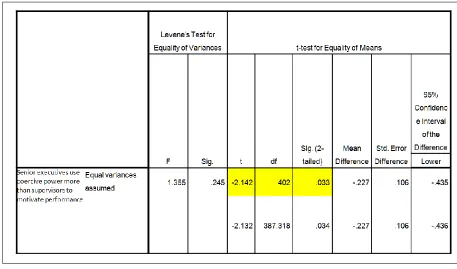
Senior Executive Coercive Power: Participants perceive senior executives use
coercive power more than supervisors to motivate performance.
Finding: Senior Executive Coercive Power: Participants perceive senior executives
use coercive power more than supervisors to motivate performance.
Evidence: The Sig.(2-tailed) of .033 is only slightly smaller than .05. It's significant but
not very significant.
It is statistically significant, however does not give a full picture of what is happening
with the responses in relation organization’s perception of coercive power and the
impact on employee performance. It is an indicator, again, that participants are
suggesting that senior executives view coercive power a particular way: motivate
performance. How they view it is not entirely clear without follow up questions, but
it’s the basis for why follow up would be very elucidating. A value less than .05 means
Journal of Management and Innovation, 3(1), Spring 2017
Copyright Creative Commons 3.0
condition vary much more than the scores in your second condition. Put scientifically,
it means that the variability in the two conditions is significantly different, however
not by much statistical significant, but underwhelming.
We cannot read too much into this because we don't know the context beyond the
participant’s belief that executives view it to have an impact on performance.
Significance: The low significance, between participants in the perception of how
senior executives use coercive power more than supervisors to motivate
performance are a finding from this research. Additional details are found in
Journal of Management and Innovation, 3(1), Spring 2017
Copyright Creative Commons 3.0
Journal of Management and Innovation, 3(1), Spring 2017
Copyright Creative Commons 3.0
Journal of Management and Innovation, 3(1), Spring 2017
Copyright Creative Commons 3.0
Journal of Management and Innovation, 3(1), Spring 2017
Copyright Creative Commons 3.0
Summary
Senior Executive Coercive Power: Participants perceive senior executives use
coercive power more than supervisors to motivate performance. Statically
significant, however underwhelming in its significance. The analysis statistically
supports these findings.
These findings have ramifications in a time of rapidly changing technology, efforts
to pursue a sustainable work environment, changes in work patterns and a new
generation of employees are entering the labor force in large numbers. It is critical
that leaders, organizations and workers understand the perception of coercive power
Journal of Management and Innovation, 3(1), Spring 2017
Copyright Creative Commons 3.0
REFERENCES
Abshire, D. (2007). Trustworthy leaders. Leadership Excellence, 24(4), 20. Adams, S. J. (2000). Generation X: How understanding the population leads to
better safety programs. Professional Safety, 45(1), 26-29.
Adler, H. (2007). Key leader characteristics. Leadership Excellence, 5, 5.
Barford, I. & Hester, P. (2011). ANALYSIS OF Generation Y Workforce Motivation Using Multiattribute Utility Theory, A Publication of the Defense Acquisition University.
Bass, B. M. (1990). Bass and Stogdill’s handbook of leadership: Theory, research, and managerial applications (3rd ed.). New York: The Free Press.
Calhoun, G., Griffith, J., & Sinioris, M. (2007). The foundation of leadership in Baldridge winning organizations. Modern Healthcare, 37, 9–20. Daboval, J. M. (1998). A comparison between Baby Boomer and Generation X
employees’ bases and foci of commitment (Doctoral dissertation). Retrieved from Dissertations & Theses: Full Text database. (Publication No. AAT 9823312).
Eisner, S. P. (2005). Managing Generation Y. SAM Advanced Management Journal, 70(4), 4-15.
Firestone, R., Dr. (2009, April 12). Personal Power. Psychology Today website:
https://www.psychologytoday.com/blog/the-human-experience/200904/personal-power
Hultman, K. (2006). Leadership as genuine giving. Organization Development Journal, 24(1), 41–56. Retrieved July 27, 2008, from Business Source Complete database.
Janiszewski, R. D. (2004). Motivational factors that influence Baby Boomers. Jeffries, F. L., & Hunte, T. L. (2004). Generations and motivation: A connection
worth making. Journal of Behavioral & Applied Management, 6(1), 37-70. Joseph, J. (2003). National Business Ethics Survey 2003: How employees view
ethics in their organizations. Washington, DC: Ethics Resource Center. Karp, H., Sirias, D., & Arnold, K. (1999). Teams: Why Generation X marks the spot.
Journal for Quality & Participation, 22(4), 30-33
Keith, K. M. (2008). The case for servant leadership. Westfield, IN: Greenleaf Center for Servant Leadership.
Kennedy, C. (2006). In favour of execution. Director, 59(12), 20.
Kupperschmidt, B. R. (2000). Multigeneration employees: Strategies for effective management. Health Care Manager, 19(1), 65-76.
Latham, G. P. (2007). Work motivation: History, theory, research, and practice. Thousand Oaks, CA: Sage Publications, Inc.
Journal of Management and Innovation, 3(1), Spring 2017
Copyright Creative Commons 3.0
Marshall, C., & Rossman, G. B. (1995). Designing qualitative research. Thousand Oaks, CA: Sage.
Maslow, A. (2008). A theory of human motivation. In J. S. Ott, S. J. Parkes, & R. B. Simpson, Classic readings in organizational behavior (4th ed., pp. 148-156). Belmont, CA: Thomson Wadsworth. (Original work published in 1943) McCall, J. J. (2002). Leadership and ethics: Corporate accountability to whom, for
what, and by what means? Journal of Business Ethics, 38(1/2), 133–140. Merritt, J. (2004). Welcome to ethics. Business Week, 3904, 90.
Nadler, D. A., & Tushman, M. L. (1999). The organization of the future: Strategic imperatives and core competencies for the 21st century. Organizational Dynamics, 28(1), 45–60.
O’Bannon, G. (2001). Managing our future: The Generation X factor. Public Personnel Management, 30(1), 95-109.
O’Connor, D., & Yballe, L. (2007). Maslow revisited: Constructing a road map of human nature. Journal of Management Education, 31(6), 738-756. doi:10.1177/1052562907307639
Peterson, R., Smith, D., & Martorana, P. (2006). Choosing between a rock and a hard place when data are scarce and the questions important: Reply to
Hollenbeck, DeRue, and Mannor (2006). Journal of Applied Psychology, 91(1), 6–8.
Pfeffer, J. (1998). The human equation: Building profits by putting people first. Boston: Harvard Business School Press.
Pinchot, G., & Pinchot, E. (1993). The end of bureaucracy and the rise of the intelligent organization. San Francisco: Berrett-Koehler.
Quinine, T. (2007). Spiritual leadership within the service industry: A
phenomenological study interpreting the spiritual leadership experiences of eight business executives. Dissertation Abstracts International, 68 (04). (UMI No. 3264282)
Rahim, M. Afzalur; Antonioni, David; Psenicka, Clement. International Journal of Conflict Management. 2001, Vol. 12 Issue 3, p191. 21p
Schein, E. (1992). Organizational culture & leadership. Retrieved February 5, 2005, from http://www.tnellen.com/ted/tc/schein/html
Vredenburgh, D., & Brender, Y. (1998). The hierarchical abuse of power in organizations. Journal of Business Ethics, 17, 1337–1347.
Washington, R. R. (2007). Empirical relationships between theories of servant, transformational, and transactional leadership. Academy of Management Proceedings, 1–6. Retrieved December 13, 2007, from Business Source Complete database.
Williams, M. E. (2001). Theory-driven comparative analysis: Dead on the gurney or lost in the shuffle? Studies in Comparative International Development, 35(3), 112– 131.
Journal of Management and Innovation, 3(1), Spring 2017
Copyright Creative Commons 3.0
Yeaton, K. (2008, April). Recruiting and managing the ‘why?’ generation: Generation Y. The CPA Journal, 78(4), 68-72.