TEACHING INNOVATION THROUGH COLLABORATIVE LEARNING
TO GENERATE A MODEL OF MOTIVATION
R. Gurbutt
University of Bolton (UNITED KINGDOM)
Abstract
Innovation and leadership education requires students to develop their creative approaches to thinking, especially in healthcare settings that are resource constrained, outcome focused and subject to continual change. Public healthcare settings are often complex, resource limited busy environments subject to workforce shortages that are challenging for front line healthcare leaders, especially when it comes to leading others through change. A leadership and innovation module undertaken by advanced practitioners included a segment on motivating others. A novel approach was designed to help students to move from surface learning through a lecture approach and towards gaining deeper learning through immersion in research activity to generate a model of motivation relevant to a healthcare setting.
The intervention was a day long activity in which 30 students were invited to participate in research study to develop a model of motivation. This had three key steps: generating a description of motivation, inductively generating a model of motivation and finally representing that as a conceptual model and critically discussing it. The tutor role was as facilitator and the students co-produced a model. An individual semi-structured qualitative questionnaire about motivation was completed before the session and also an evaluation questionnaire on completion. Ethical approval was granted by the University of Bolton Faculty research ethics chair.
The activity added value to the students' learning in several ways: research design, reflexivity and real world application. It introduced students to research enquiry, including identifying potential questions, devising a methodology and generating an answer to the question. This illustrated a process that they would encounter if they progressed to undertake an empirical dissertation. Students gained deeper insights into their standpoint and how they shaped data interpretation as well as triangulation to confirm meaning attributed to stages during data analysis. Deeper learning was developed through a critical discussion of the concepts, their interrelationships and application of the class generated model to the real world of healthcare practice. In this way students developed critical thinking skills about approaches to motivating others. Subsequent learning introduced existing motivation models and a focus for critical discussion of their merits in relation to the class generated version. Student evaluation demonstrated a range of benefits gained through the experience including peer learning, transferable skills and developing critical thinking.
Learning about innovation demands tutor modelling of innovative practice - in this case facilitating healthcare students to learn through a collaborative research process, so that value is added to classroom sessions and students can take forward both subject knowledge and critical thinking development as well as a learning approach that could be used by themselves to develop this within their own teams.
Keywords: Motivation, collaborative learning, innovation
1
INTRODUCTION
a: ‘process of mobilising a large collection of individuals, groups and organisations toward a vision of a fundamentally new future state,’ (NHS England 2017) [2] and whilst change is not a goal in itself it does
have to engage the workforce who are subject to change. In an ideal scenario this would be a negotiated and engaged process but the history of the NHS reveals another story, where successive short term policies have focused on predominantly top down changes aimed at reducing costs, improving quality amidst successive organizational restructures and the introduction of managerialism [3]. Gorsky’s [4] historical survey commented that the right wing conservative period that championed business and market processes in health and social care introduced: ‘a more ‘thrusting’ style of management was
introduced, strengthening the hands of bureaucrats over clinicians’ and that post 1979 there is: ’little evidence of beneficial change’ following successive upheavals. This has not gone without an impact on the workforce, often detrimental. The importance of staff wellbeing was publicized in the Boorman report in 2009 [5] and a range of initiatives that followed aimed at developing healthy workplaces in the belief that a healthy workforce translates into better patient care. The negative impact of ‘unhealthy workplaces’ is remarked on in a later Kings’ Fund leadership publication [6] making a link between engagement and demoralizing staff: ‘if senior managers impose a command and control culture that
demoralizes staff and robs them of the authority to make decisions, poor care will follow.’ Indeed workforce motivation had been previously reported by the King’s Fund that: ‘Good morale and motivation are essential both for a healthy workforce, and for effective implementation of the Government’s plans’. [7] In a context of staff burnout, sickness and challenges recruiting staff to fill vacant posts the latest NHS draft workforce strategy [8] seeks to plan a way forward in the context of uncertainty shaped by driving forces of Increased demand, changing expectations, generational differences across the workforce and a significant growth temporary agency staff. It is in this context there is a substantial challenge for frontline staff to deliver high quality care, whilst satisfying performance and financial targets as well as maintain their own professional development. Given that the NHS has experienced yet another crisis [9] it places exacting demands on any front line team leader to motivate others to work effectively in such a turbulent and unstable context. Whilst the 2016 NHS Survey optimistically reported a claim that ‘The motivation levels for NHS staff are traditionally high and have improved since 2011’
[10] this has to be interpreted in the light of other evidence. A 2015 King’s Fund (blog) [11] reported staff morale as a ‘top concern for Chief Executives’ and that ‘36 per cent of NHS staff reported that during the past 12 months they had felt unwell as a result of work-related stress’ and that 38% worked
additional unpaid hours. The nurses’ professional body, the Royal College of Nursing [12] responded to workforce challenges and called for: ‘appropriately educated, skilled, competent and motivated nurses’ and noted individual experiences in narrative accounts about the impact of poor staffing levels on motivation that: ‘Most days I feel low and completely demoralized’. The NHS Improvement organization’s recently published toolkit [13] similarly included a goal to ‘improve motivation’. This extended into educational involvement around core values of high quality care organisations and directly relates to post-graduate education for staff already working in or aspiring to front line leadership and management roles. The five cultural elements of this NHS Improvement toolkit (1 Vision and values 2. Goals and performance 3. Support and compassion 4. Learning and innovation 5. Teamwork) offers yet another framework that serves to draw attention to some familiar and core elements of team leadership whilst skirting round the challenging problem of motivating others in such a time of crisis, change and uncertainty. Indeed it is the realization of having to work in an era of such turbulence and change that necessitates a need to revisit how motivation is understood and how learning about it can be developed. Several existing motivation theories fall into two categories: (content – what motivates people, and process – how people are motivated) and Porter and Lawler [14] offer an integrated model that has more utility in so far as it depicts motivation as intrinsic and extrinsically driven with a range of variables influencing what happens. Given the challenges in front line health and social care, the recognition of the need to redouble efforts to develop healthy supportive workplaces and to engender distributed leadership directs attention towards motivation - that is helping front line staff to understand what it is and what it includes in practice. To that end thought was given to redesign the learning experience of post graduate health and social care students with the intention of developing deep learning about motivation in a way that would shape practice outside of the classroom.
A classroom learning intervention was designed that would add value to their leaning experience through participant immersion in a small scale research project to produce a motivation model as a basis for critical discussion, prior to moving onto learning about other existing motivation theories. This aligned to a University strategy that Championed Teaching Intensive Research Informed education [15]and a Faculty strategy designed to support implementation of pedagogic research development and student engagement around teaching excellence affording ‘Opportunities for students to engage in active research’ and also ‘Staff scholarly activity and research informing the curriculum, learning and assessment’ [16].
2
METHODOLOGY
The aim of the study was to examine motivation as a feature of leadership and innovation through the perspectives of NHS practitioners as university students. The objectives were to
1 To undertake a survey on dimensions of practitioner motivation 2 To develop an in –class model of motivation.
3 Explore students’ views on learning about motivation through the classroom intervention
The sample population was group of 26 nurses working in the NHS who were undertaking a leadership and innovation module as part of a higher education programme at the University of Bolton. With a range of 9 to 30 years registered experience and ages ranging from 26-55.
Ethical approval was gained via the Faculty Research Ethics Chair. Participants were invited to participate in research study to develop a model of motivation. They were issued with an information sheet about the study and a research ethics consent form that explained what they were invited to do and how the data would be managed and used. It included a consent form that was signed to indicate their acceptance and understanding of what was required. In the eventuality that some students did not want to participate they had the option of joining the tutor as co-facilitators in the exercise and so would not be involved in data generation themselves. All students agreed to participate so that was not an issue.
The classroom intervention was a day long activity in October 2017 that had three key steps (i) generating a narrative description of motivation, (ii) inductively generating a model of motivation and finally (iii) representing that as a conceptual model prior to a stage of critical discussion about motivation. The tutor role was as facilitator supporting the students collaboratively produce a model.
The first stage involved distribution of an anonymous individual semi-structured qualitative questionnaire about motivation. This was completed at the start of the session as was an anonymous evaluation questionnaire on their learning experience that was distributed at the end of the session.
3
RESULTS
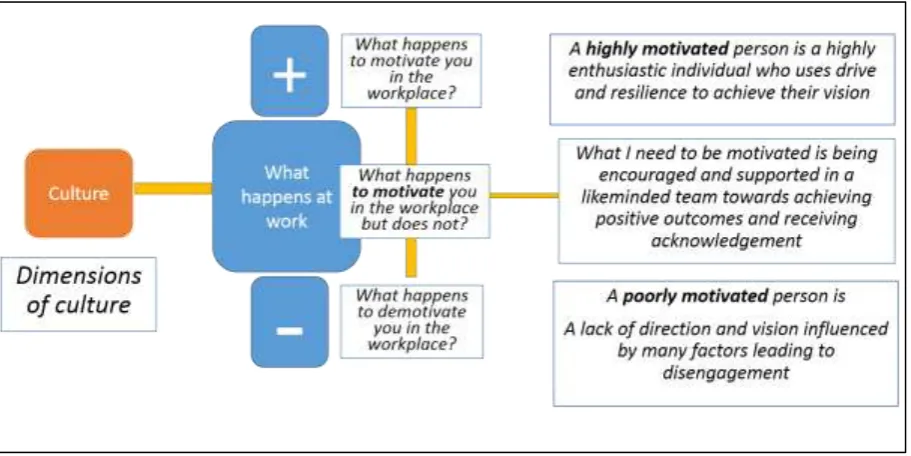
The model represented a polarity between highly and poorly motivated individuals and spanning these was a range of factors thought to either motivate or demotivate someone. All of this was located within a context described by a series of dimensions of culture and is illustrated in Fig. 1.
Students defined motivation by synthesising a range of descriptors into a statement which was: ‘Motivation is the belief, enthusiasm, passion and drive focused to achieve goals’ and it had 5 dimensions: ‘Drive, Passion, Goals, Belief, Enthusiasm.’ As such it characterised an individual and intrinsic drive of motivation embodying a demonstrable definition of outcomes or goals.
The polarity between descriptions of highly and poorly motivated people was explored. A highly motivated person was: ‘a highly enthusiastic individual who uses drive and resilience to achieve their vision’ whereas apoorly motivated person was one who had: ‘a lack of direction and vision, and who was: ‘influenced by many factors leading to disengagement.’ Their behaviour was expressed as:
‘Apathetic, lack[ed] of direction, and exhibited negativity, and emotional factors’. The poorly motivated person was more prone to see problems rather than solutions, not see a way forward and was more likely to disengage through lack of a longer term vision.
Students’ explanations of the reasons why there might be different levels of motivation in the workplace produced insights into context as a determining or shaping factor. This was divided between these factors external to the organisation and those from within it. The former included external influences and circumstances and the latter touched on the internal workplace culture. The individual was a part of this and personal factors were also cited that affected performance. These included: ‘Personal, Work culture,
Attitudes, Incentives, Work / life experience, Lazy’.
Exploring the dimensions of culture and motivation further, culture in the workplace was a potent medicating factor in motivation and was described as having several facets, notably: ‘A hierarchical organisation’ incorporating: ‘a directional approach to leadership’ with a: ‘lack of resources’ for the work
and favouring: ‘target driven’ behaviours and risk aversion. This prescriptive characteristic of the local
culture adopted a reactive rather than proactive approach to work, was bureaucratic in nature yet did have some variations between large and small teams. Some were described as having: ‘no hierarchy, a good team ethic with sub division cliques’ whilst others were bleaker with: ‘no escape, [feeling] lonely, isolated and busy with a lack of autonomy and being risk averse’. Motivation was linked to aspiration
but some workplace cultures dampened enthusiasm of self-motivating individuals. This was most marked in comments describing the behaviour of some who held positional power in the local organisation as: ‘lions led by donkeys’, and questioning: ‘How can you soar like eagles when being led by turkeys?’ What is interesting about this is that the group had a large percentage of participants who had over two decades of experience and had already worked in team leading roles and so it suggested that for some there was workplace disregard for their perspectives and contribution to vision and direction. Triangulation with the pre-exercise questionnaire written responses about dimensions of motivation showed that there was a theme of having a contribution to make but that being disregarded or overlooked.
Moving onto personal experiences of motivation addressing the question ‘What happens to motivate you in the workplace?’ showed responses clustered into 6 themes: (i) Recognition, (ii) Financial, (iii) Development, (iv) Operational support, (v) Communication, (vi) teamwork and these could be further grouped into motivating self and motivating with others. This revealed both extrinsic motivating factors and also peer support and inclusion as a vehicle of intrinsic motivation. In contrast, the responses to:
‘What happens to demotivate you in the workplace?’Weredivided into what was lacking (Appreciation, support, listening, openness resources, time, and direction) and cultural pressures: (Unrealistic demands, constant change and a culture of blame). The lacking factors were weighted towards valuing communication and dialogue that valued listening over being disregarded. The resource constraints of the workplace were resonant of the current trends in UK health and social care that has undergone a succession of efficiency cost measures and workforce reductions.
Having identified elements of what did and did not motivate identified, students moved onto explore motivational steps taken by employers that did not work for staff. These were around a process driven approach (Root cause analysis - as a tool intended to develop learning through practice analysis) and staff surveys [an anonymous feedback loop). Rewards (such as ‘employee of the month’) did not
incentivise the students and neither did the offer of rewards when participants were: ‘not able to take the rewards provided’, even pre-arranged celebrations were demotivating when they were deemed to be: ‘arranged at poor venues’ almost as if the low budget approach was synonymous with devaluing the
highlighted the importance of communication with motivation there were types of formal communication (‘monthly staff meetings, a staff magazine, Team talk, Tea with chief executive’) that were information giving, often one way, but not specifically directed at individual engagement and dialogue.
Overall, when discussing what they personally required to motivate them in the workplace it hinged on being in a team with similar values and agreed goals. As a collective the importance of feedback on individual and team progress was important to continue to add energy to the pace and direction of travel.
A final stage in developing the model was to get the participants to review it and then imagine themselves as being in a different leader / manager role where others would be looking to them to be motivated and motivate others. This stage was planned to spur on applied practice-based critical thinking. It was clearly more challenging for the participants and whilst the engagement in the activity of creating the model allowed time to express a range of emotions about their work experiences, they now had to use the model to become part of the solution rather than perpetuating what was known about the problem. This juncture in the development of the model brought the day to a close and provided points for reflection to carry forward into subsequent learning during the module. Overall, the model that was developed in class was a valuable, locally relevant and shared representation of wide ranging class based discussions that facilitated students to identify and visualise elements of motivation and then progress to apply it as a tool to inform their practice. A theory based lecture followed on from this class exercise that contrasted the model with existing motivation theories so that students could critique what was already reported in peer reviewed literature in relation to their locally derived model. The model that was developed is shown in Fig 1.
Figure 1 A diagram of the motivation model
3.1 Learning
Having completed the exercise what and how the students had learned was explored as a means of evaluating how useful the intervention had been to develop their learning about motivation. An anonymous 5 question post-exercise evaluation questionnaire was distributed and completed by the participants.
Responses to the question: ‘What have you learned about the topic motivation?’ revealed that participants reported that they had learned about motivation but different individuals had taken different topics of learning away from the session. These included: motivating factors, definitions and ways of motivating others. A common shared point in the feedback was the interaction that facilitated listening to other perspectives and having an opportunity to discuss personal insights. The multifaceted dimensions of motivation was described as not having a ‘magic wand’, i.e. there was not a single theoretical perspective that provided a satisfactory answer on how to motivate others.
between other participants’’ experiences. One response summarized a group perspective that these shared experiences showed that individuals were: ‘not alone in my thoughts’.
When asked what else they would want to find out after the session a range of topics were identified that could be divided into people in social contexts: (workplace culture and compassion fatigue) and knowledge base (leadership, motivation theory, change).
The applied learning was an intended outcome of the session as the overall aim of the education was to develop students’ knowledge base with a view to translating into developments in how they approached practice. Praxis, the application of learning to practice, was explored and the learning was reported as having motivated some participants to specific actions including: ‘it gives you the motivation to approach others in a different way’ and some planned: ‘to adapt [their] approach to the individual’ i.e.
personalizing their approach to the diversity encountered within teams. For others the model had helped them to gain a broader perspective on motivating others which they called: ‘looking at a bigger picture.’
At a micro level others found support in being able to approach motivating others in small achievable steps that they called: ‘bitesize rather than everything at once’. Common across many of the responses was an emphasis on good communication and engagement with others – social informal rather than formal operation communication.
Participants found it harder to describe ‘how’ rather than ‘what’ they had learned and this centered on interaction as a learning process. They valued of sharing and group work, listening to other ideas and discussing differences. Through this interactive process there was space to recognize and acknowledge other peoples’ ideas.
3.1.1 Discussion
The findings demonstrated that student learning in an interactive group context can still retain an individual tailored characteristic. There was evidence of diverse learning points that different students took from the session. Indeed the value of interaction in itself should not be overlooked, not as a filler where some might perceive that they should be taught ‘knowledge’, but the essential vehicle through which experiential knowledge is brought to the fore in discussion. A consequence of this was that students found support through their peers in being able to recognise shared experiences and concerns and so worked counter to the fragmented and isolated front line working experiences that often typify front line clinical practice. In a context of continual change and associated workforce pressures the opportunity to spend a full day in discussion also provided a cathartic benefit and that needed to be understood as a facilitator in terms of its educational value. The learning outcomes require knowledge to be identified and applied to a real world scenario but that should not be confined to an academic assessment (in this case a presentation and written assignment). Rather, the learning that was occurring through interaction was also serving to encourage and motivate (some) participants to take their learning forward and try out different approaches in practice. That was the desired outcome beyond the module to facilitate students to make a transition beyond being ‘consumers’ of existing knowledge (theories of motivation) to critical application of it and engagement with thinking about how to become involved in the process of creating new knowledge.
Engaging students in classroom- based research gave them a lived experience to demystify what it involved through a process of immersion. This gave them insights into the overarching process of enquiry involving an explicit design, ethical obligations, data generation and generating findings. Through showing students this process and animating it through immersion and discussion value was added to their education that transcended previous approaches of just teaching theory and discussing its application in health and social care. A facet of their development was to highlight that research is work that demands academic skills, knowledge, governance and resources to be successfully completed and this was aligned to the four domain researcher development framework (Vitae) [17].
4
CONCLUSIONS
Education design should rally the creative efforts of teachers to facilitate students acquiring knowledge, critical thought about its qualities, characteristics and applications along with identifying associated skills and competencies. This paper reported on one classroom exercise that was designed to be an engaging and creative experience for students where the role of the teacher become predominantly that of facilitator. . This case example of a classroom intervention in a module designed to teach innovation and leadership that included motivation as a topic, sought to show how an innovative approach to education can lead students away from surface learning (what is sufficient knowledge to know to pass an assignment) and onto deeper learning (developing professional wisdom with a critical and discerning application of knowledge). It also illustrates how an opportunity to facilitate student activity can be developed to generate shared learning that is supportive and encouraging for students as they move beyond class and back into practice. This does require being confident enough as a tutor for students to spend a prolonged part of the curriculum time engaging in discussion activities. The relevance of learning to professional practice was also discussed and increased the need for fresh theoretical perspectives to be generated in the contemporary era and setting of a complex and turbulent NHS instead of dated perspectives encountered in literature representative of different times and assumptions.
Learning about innovation demands tutors who are equally innovative, in this case, classroom practice including a collaborative research process. The activity gained more positive outcomes than mere topic learning, adding value through research learning, shaping student expectations about how learning can occur and prompting self-initiated extension learning. It also enhanced peer support through discussion and affirmation of experiences, developed critical thinking about subject matter and spurred individuals onto informed practice through encouraging students to develop this within their own teams.
ACKNOWLEDGEMENTS
Thanks to J.E. Howarth, Dean: Faculty of Health and Wellbeing, University of Bolton for funding support.
REFERENCES
[1] NHS England, Five Year Forward View, 2014, Accessed 16 1 2017, Retrieved from: https://www.england.nhs.uk/wp-content/uploads/2014/10/5yfv-web.pdf
[2] NHS England, Leading Large Scale Change: A practical guide, p 6, 2017
[3] Department of Health, The NHS Plan: a plan for investment, a plan for reform, 2000, Accessed 16 1 2017, Retrieved from:
http://webarchive.nationalarchives.gov.uk/+/http://www.dh.gov.uk/en/Publicationsandstatistics/P ublications/PublicationsPolicyAndGuidance/DH_4002960
[4] M. Gorsky, “The British National Health Service 1948–2008: A Review of the Historiography”,
Social History of medicine, 2008 Dec; 21,3, pp.437–460.
[5] S. Borman, NHS Health and Well being Review, Department of Health, 2009, Accessed 16 1 2017, Retrieved from
http://webarchive.nationalarchives.gov.uk/20130103004910/http://www.dh.gov.uk/en/Publication sandstatistics/Publications/PublicationsPolicyAndGuidance/DH_108799
[6] The Kings’ Fund, Staff Engagement: Six building blocks for harnessing the creativity and enthusiasm of staff, King’s Fund, Feb. 2015, Accessed 16 1 2017, Retrieved from:
https://www.kingsfund.org.uk/publications/staff-engagement#_-leadership
[7] B. Finlayson, “Counting the smiles: Morale and Motivation in the NHS”. King’s Fund, Accessed 16 1 2017, Retrieved from:
https://www.kingsfund.org.uk/sites/default/files/field/field_publication_file/counting-smiles-morale-motivation-nhs-belinda-finlayson-kings-fund-1-march-2002.pdf
[8] Health Education England, Facing the Facts, Shaping the Future A draft health and care workforce strategy for England to 2027, 2017, Accessed 16 1 2017, Retrieved from:
[9] UK Parliament, Urgent Question on NHS winter crisis: 8 January 2018, Accessed 16 1 2017, Retrieved from: http://www.parliament.uk/business/news/2018/january/urgent-question-on-nhs-winter-crisis-8-january-2018/
[10] NHS England Staff Survey Co-ordination Centre NHS StaffSurvey Results 2016, Accessed 16 1 2017, Retrieved from: http://www.nhsstaffsurveys.com/Page/1006/Latest-Results/2016-Results/
[11] King’s Fund Blog “Are we supporting or sacrificing NHS Staff?” 22 October 2015, , Accessed 16 1 2017, Retrieved from: www.kingsfund.org
[12] Royal College of Nursing, The UK nursing labourmarket review 2017, RCN, London.
[13] NHS Improvement, Culture and leadership programme, phase 1, 2016, Accessed 16 1 2017, Retrieved from:
https://improvement.nhs.uk/uploads/documents/01-NHS101-toolkits_150816_L.pdf
[14] Porter, L. W., & Lawler, E. E. Managerial Attitudes and Performance. Homewood, IL: Richard D. Irwin, Inc. 1968.
[15] University of Bolton, Defining TIRI and teaching excellence 2017-8 Annex 5 , Accessed 16 1 2017, Retrieved from:
http://www.bolton.ac.uk/Quality/RM/AnnualMonitoring/Documents/Annex-5-Defining-TIRI-and-Teaching-Excellence-2017-18.pdf
[16] University of Bolton, Strategic Plan 2015-2020, Accessed 16 1 2017, Retrieved from:
https://www.bolton.ac.uk/AboutUs/Resources/StrategicPlan.pdf
[17] Vitae, Researcher Development Framework 2011 Accessed 16 1 2017, Retrieved from: