The Thirty-Third AAAI Conference on Artificial Intelligence (AAAI-19)
Weakly-Supervised Hierarchical Text Classification
Yu Meng, Jiaming Shen, Chao Zhang, Jiawei Han
University of Illinois at Urbana-Champaign, Urbana, IL, USA{yumeng5, js2, czhang82, hanj}@illinois.edu
Abstract
Hierarchical text classification, which aims to classify text documents into a given hierarchy, is an important task in many real-world applications. Recently, deep neural models are gaining increasing popularity for text classification due to their expressive power and minimum requirement for fea-ture engineering. However, applying deep neural networks for hierarchical text classification remains challenging, be-cause they heavily rely on a large amount of training data and meanwhile cannot easily determine appropriate levels of doc-uments in the hierarchical setting. In this paper, we propose a weakly-supervised neural method for hierarchical text classifi-cation. Our method does not require a large amount of training data but requires only easy-to-provide weak supervision sig-nals such as a few class-related documents or keywords. Our method effectively leverages such weak supervision signals to generate pseudo documents for model pre-training, and then performs self-training on real unlabeled data to iteratively refine the model. During the training process, our model fea-tures a hierarchical neural structure, which mimics the given hierarchy and is capable of determining the proper levels for documents with a blocking mechanism. Experiments on three datasets from different domains demonstrate the efficacy of our method compared with a comprehensive set of baselines.
Introduction
Hierarchical text classification, which aims at classifying text documents into classes that are organized into a hierarchy, is an important text mining and natural language processing task. Unlike flat text classification, hierarchical text classi-fication considers the interrelationships among classes and allows for organizing documents into a natural hierarchical structure. It has a wide variety of applications such as se-mantic classification (Tang, Qin, and Liu 2015), question answering (Li and Roth 2002), and web search organization (Dumais and Chen 2000).
Traditional flat text classifiers (e.g., SVM, logistic regres-sion) have been tailored in various ways for hierarchical text classification. Early attempts (Ceci and Malerba 2006) dis-regard the relationships among classes and treat hierarchical classification tasks as flat ones. Later approaches (Dumais and Chen 2000; Liu et al. 2005; Cai and Hofmann 2004)
Copyright c2019, Association for the Advancement of Artificial Intelligence (www.aaai.org). All rights reserved.
train a set of local classifiers and make predictions in a top-down manner, or design global hierarchical loss functions that regularize with the hierarchy. Most existing efforts for hierarchical text classification rely on traditional text clas-sifiers. Recently, deep neural networks have demonstrated superior performance for flat text classification. Compared with traditional classifiers, deep neural networks (Kim 2014; Yang et al. 2016) largely reduce feature engineering efforts by learning distributed representations that capture text seman-tics. Meanwhile, they provide stronger expressive power over traditional classifiers, thereby yielding better performance when large amounts of training data are available.
Motivated by the enjoyable properties of deep neural net-works, we explore using deep neural networks for hierar-chical text classification. Despite the success of deep neural models in flat text classification and their advantages over traditional classifiers, applying them to hierarchical text clas-sification is nontrivial because of two major challenges.
The first challenge is thatthe training data deficiency pro-hibits neural models from being adopted. Neural models are data hungry and require humans to provide tons of carefully-labeled documents for good performance. In many practical scenarios, however, hand-labeling excessive documents often requires domain expertise and can be too expensive to realize. The second challenge is todetermine the most appropriate level for each document in the class hierarchy. In hierarchical text classification, documents do not necessarily belong to leaf nodes and may be better assigned to intermediate nodes. However, there are no simple ways for existing deep neural networks to automatically determine the best granularity for a given document.
In this work, we propose a neural approach named
WeSHClass, for Weakly-Supervised Hierarchical Text
guided by the spherical distribution. In the refinement step, we iteratively bootstrap the global model on real unlabeled documents, which self-learns from its own high-confident predictions.
WeSHClassautomatically determines the most appro-priate level during the classification process by explicitly modeling the class hierarchy. Specifically, we pre-train a local classifier at each node in the class hierarchy, and ag-gregate the classifiers into a global one using self-training. The global classifier is used to make final predictions in a top-down recursive manner. During recursive predictions, we introduce a novel blocking mechanism, which examines the distribution of a document over internal nodes and avoids mandatorily pushing general documents down to leaf nodes.
Our contributions are summarized as follows:
1. We design a method for hierarchical text classification us-ing neural models under weak supervision.WeSHClass
does not require large amounts of training documents but just easy-to-provide word-level or document-level weak supervision. In addition, it can be applied to different clas-sification types (e.g., topics, sentiments).
2. We propose a pseudo document generation module that generates high-quality training documents only based on weak supervision sources. The generated documents serve as pseudo training data which alleviate the training data bottleneck together with the subsequent self-training step.
3. We propose a hierarchical neural model structure that mirrors the class taxonomy and its corresponding training method, which involves local classifier pre-training and global classifier self-training. The entire process is tailored for hierarchical text classification, which automatically determines the most appropriate level of each document with a novel blocking mechanism.
4. We conduct a thorough evaluation on three real-world datasets from different domains to demonstrate the effec-tiveness ofWeSHClass. We also perform several case studies to understand the properties of different compo-nents inWeSHClass.
Problem Formulation
We study hierarchical text classification that involves tree-structured class categories. Specifically, each category can belong to at most one parent category and can have arbitrary number of children categories. Following the definition in (Silla and Freitas 2010), we consider non-mandatory leaf pre-diction, wherein documents can be assigned to both internal and leaf categories in the hierarchy.
Traditional supervised text classification methods rely on large amounts of labeled documents for each class. In this work, we focus on text classification under weak supervision. Given a class taxonomy represented as a treeT, we ask the user to provide weak supervision sources (e.g., a few class-related keywords or documents) only for each leaf class inT. Then we propagate the weak supervision sources upwards in
T from leaves to root, so that the weak supervision sources of each internal class are an aggregation of weak supervision sources of all its descendant leaf classes. Specifically, given
M leaf node classes, the supervision for each class comes from one of the following:
1. Word-level supervision: S = {Sj}|Mj=1, where Sj =
{wj,1, . . . , wj,k}represents a set ofkkeywords correlated
with classCj;
2. Document-level supervision: DL = {DL
j}|Mj=1, where
DL
j = {Dj,1, . . . , Dj,l} denotes a small set of l (l
corpus size) labeled documents in classCj.
Now we are ready to formulate the hierarchical text classifi-cation problem. Given a text collectionD={D1, . . . , DN},
a class category treeT, and weak supervisions of eitherS orDLfor each leaf class inT, the weakly-supervised hierar-chical text classification task aims to assign the most likely labelCj ∈ T to eachDi∈ D, whereCjcould be either an
internal or a leaf class.
Pseudo Document Generation
To break the bottleneck of lacking abundant labeled data for model training, we leverage user-given weak supervision to generate pseudo documents, which serve as pseudo training data for model pre-training. In this section, we first intro-duce how to leverage weak supervision sources to model class distributions in a spherical space, and then explain how to generate class-specific pseudo documents based on class distributions and a language model.
Modeling Class Distribution We model each class as a high-dimensional spherical probability distribution which has been shown effective for various tasks (Zhang et al. 2017). We first train Skip-Gram model (Mikolov et al. 2013) to learn
d-dimensional vector representations for each word in the corpus. Since directional similarities between vectors are more effective in capturing semantic correlations (Banerjee et al. 2005; Levy, Goldberg, and Dagan 2015), we normalize all thed-dimensional word embeddings so that they reside on a unit sphere inRd. For each classCj ∈ T, we model
the semantics of classCjas a mixture of von Mises Fisher
(movMF) distributions (Banerjee et al. 2005; Gopal and Yang 2014) inRd:
f(x|Θ) =
m
X
h=1
αhfh(x|µh, κh) =
m
X
h=1
αhcd(κh)eκhµThx,
whereΘ = {α1, . . . , αm,µ1, . . . ,µm, κ1, . . . , κm},∀h ∈
{1, . . . , m},κh≥0,kµhk= 1, and the normalization
con-stantcd(κh)is given by
cd(κh) =
κd/h2−1
(2π)d/2I
d/2−1(κh)
,
whereIr(·)represents the modified Bessel function of the
first kind at orderr. We choose the number of components in movMF for leaf and internal classes differently:
• For each leaf classCj, we set the number of vMF
com-ponentm = 1, and the resulting movMF distribution is equivalent to a single vMF distribution, whose two parame-ters, the mean directionµand the concentration parameter
• For each internal classCj, we set the number of vMF
componentmto be the number of its children classes. Re-call that we only ask the user to provide weak supervision sources at the leaf classes, and the weak supervision source ofCjare aggregated from its children classes. The
seman-tics of a parent class can thus be seen as a mixture of the semantics of its children classes.
We first retrieve a set of keywords for each class given the weak supervision sources, then fit movMF distributions using the embedding vectors of the retrieved keywords. Specifically, the set of keywords are retrieved as follows: (1) When users provide related keywordsSjfor each classj, we use the
aver-age embedding of these seed keywords to find top-nclosest keywords in the embedding space; (2) When users provide documentsDjLthat are correlated with classj, we extractn
representative keywords fromDLj using tf-idf weighting. The parameternabove is set to be the largest number that does not result in shared words across different classes. Compared to directly using weak supervision signals, retrieving relevant keywords for modeling class distributions has a smoothing effect which makes our model less sensitive to the weak supervision sources.
LetXbe the set of embeddings of thenretrieved keywords on the unit sphere, i.e.,
X ={xi∈Rd|xidrawn fromf(x|Θ),1≤i≤n},
we use the Expectation Maximization (EM) framework (Banerjee et al. 2005) to estimate the parametersΘof the movMF distributions:
• E-step:
p(zi=h|xi,Θ(t)) =
α(ht)fh(xi |µ(ht), κ(ht))
Pm
h0=1α (t)
h0fh0(xi|µ(t)
h0, κ (t)
h0)
,
whereZ={z1, . . . , zn}is the set of hidden random
vari-ables that indicate the particular vMF distribution from which the points are sampled;
• M-step:
α(ht+1)=
1
n
n
X
i=1
p(zi=h|xi,Θ(t)),
rh(t+1)=
n
X
i=1
p(zi=h|xi,Θ(t))xi,
µ(ht+1)= r
(t+1)
h
kr(ht+1)k,
Id/2(κ (t+1)
h )
Id/2−1(κ (t+1)
h )
= kr
(t+1)
h k
Pn
i=1p(zi=h|xi,Θ(t))
.
where we use the approximation procedure based on New-ton’s method (Banerjee et al. 2005) to derive an approx-imation of κ(ht+1) because the implicit equation makes obtaining an analytic solution infeasible.
Language Model Based Document Generation After ob-taining the distributions for each class, we use an LSTM-based language model (Sundermeyer, Schl¨uter, and Ney 2012) to generate meaningful pseudo documents. Specifi-cally, we first train an LSTM language model on the entire corpus. To generate a pseudo document of classCj, we
sam-ple an embedding vector from the movMF distribution ofCj
and use the closest word in embedding space as the beginning word of the sequence. Then we feed the current sequence to the LSTM language model to generate the next word and attach it to the current sequence recursively1. Since the
be-ginning word of the pseudo document comes directly from the class distribution, the generated document is ensured to be correlated toCj. By virtue of the mixture distribution
modeling, the semantics of every children class (if any) of
Cj gets a chance to be included in the pseudo documents,
so that the resulting trained neural model will have better generalization ability.
The Hierarchical Classification Model
In this section, we introduce the hierarchical neural model and its training method under weakly-supervised setting.Local Classifier Pre-Training
We construct a neural classifierMp (Mpcould be any text
classifier such as CNNs or RNNs) for each classCp∈ T if
Cphas two or more children classes. Intuitively, the classifier
Mpaims to classify the documents assigned toCpinto its
children classes for more fine-grained predictions. For each documentDi, the output ofMpcan be interpreted asp(Di∈
Cc|Di∈Cp), the conditional probability ofDibelonging
to each children classCcofCp, givenDiis assigned toCp.
The local classifiers perform local text classification at internal nodes in the hierarchy, and serve as building blocks that can be later ensembled into a global hierarchical clas-sifier. We generateβ pseudo documents per class and use them to pre-train local classifiers with the goal of provid-ing each local classifier with a good initialization for the subsequent self-training step. To prevent the local classifiers from overfitting to pseudo documents and performing badly on classifying real documents, we use pseudo labels instead of one-hot encodings in pre-training. Specifically, we use a hyperparameterαthat accounts for the “noises” in pseudo documents, and set the pseudo labell∗i for pseudo document
D∗
i (we useD∗i instead ofDito denote a pseudo document)
as
l∗ij=
(1−α) +α/m D∗
i is generated from classj
α/m otherwise
(1) wheremis the total number of children classes at the cor-responding local classifier. After creating pseudo labels, we pre-train each local classifierMpof classCpusing the pseudo
documents for each children class ofCp, by minimizing the
KL divergence loss from outputs Y ofMp to the pseudo
1
labelsL∗, namely
loss=KL(L∗kY) =X
i
X
j
l∗ijlog
l∗ij
yij
.
Global Classifier Self-Training
At each levelkin the class taxonomy, we need the network to output a probability distribution over all classes. Therefore, we construct a global classifierGkby ensembling all local
classifiers from root to level k. The ensemble method is shown in Figure 1. The multiplication operation conducted between parent classifier output and children classifier output can be explained by the conditional probability formula:
p(Di∈Cc) =p(Di ∈Cc∩Di ∈Cp)
=p(Di ∈Cc |Di∈Cp)p(Di∈Cp),
whereDiis a document;Ccis one of the children classes of
Cp. This formula can be recursively applied so that the final
prediction is the multiplication of all local classifiers’ outputs on the path from root to the destination node.
Level 0 Root) Local Classifier
Level 1 (Politics) Local Classifier
Level 1 (Sports) Local Classifier
Level 2
(Military) (Gun Control)Level 2 (Hockey)Level 2 Level 2(Tennis) (Basketball)Level 2 p(Di2P olitics) = 0.05 p(Di2Sports) = 0.95
p(Di2M ilitary|Di2P olitics) = 0.34 p(Di2Basketball|Di2Sports) = 0.8
0.34 0.66 0.1 0.1 0.8
p(Di2M ilitary) = 0.05⇥0.34 = 0.017 p(Di2Basketball) = 0.95⇥0.8 = 0.76
Figure 1: Ensemble of local classifiers.
Greedy top-down classification approaches will propagate misclassifications at higher levels to lower levels, which can never be corrected. However, the way we construct the global classifier assigns documents soft probability at each level, and the final class prediction is made by jointly consider-ing all classifiers’ outputs from root to the current level via multiplication, which gives lower-level classifiers chances to correct misclassifications made at higher levels.
At each levelkof the class taxonomy, we first ensemble all local classifiers from root to levelkto form the global classifierGk, and then useGk’s prediction on all unlabeled
real documents to refine itself iteratively. Specifically, for each unlabeled documentDi,Gkoutputs a probability
distri-butionyijofDibelonging to each classjat levelk, and we
set pseudo labels to be (Xie, Girshick, and Farhadi 2016):
l∗∗ij =
y2
ij/fj
P
j0y2ij0/fj0,
(2)
wherefj=Piyijis the soft frequency for classj.
The pseudo labels reflect high-confident predictions, and we use them to guide the fine-tuning ofGk, by iteratively (1)
computing pseudo labelsL∗∗based onGk’s current
predic-tionsYand (2) minimizing the KL divergence loss fromYto
L∗∗. This process terminates when less thanδ%of the
docu-ments in the corpus have class assignment changes. SinceGk
is the ensemble of local classifiers, they are fine-tuned simul-taneously via back-propagation during self-training. We will demonstrate the advantages of using global classifier over greedy approaches in the experiments.
Blocking Mechanism
In hierarchical classification, some documents should be clas-sified into internal classes because they are more related to general topics rather than any of the more specific topics, which should be blocked at the corresponding local classifier from getting further passed to children classes.
When a documentDiis classified into an internal class
Cj, we use the outputqofCj’s local classifier to determine
whether or notDishould be blocked at the current class: if qis close to a one-hot vector, it strongly indicates thatDi
should be classified into the corresponding child; ifqis close to a uniform distribution, it implies thatDiis equally relevant
or irrelevant to all the children ofCj and thus more likely
a general document. Therefore, we use normalized entropy as the measure for blocking. Specifically, we will blockDi
from being further passed down toCj’s children if
−log1m
m
X
i=1
qilogqi> γ, (3)
wherem≥2is the number of children ofCj;0≤γ≤1is a
threshold value. Whenγ= 1, no documents will be blocked and all documents are assigned into leaf classes.
Inference
The hierarchical classification model can be directly applied to classify unseen samples after training. When classifying an unseen document, the model will directly output the prob-ability distribution of that document belonging to each class at each level in the class hierarchy. The same blocking mech-anism can be applied to determine the appropriate level that the document should belong to.
Algorithm Summary
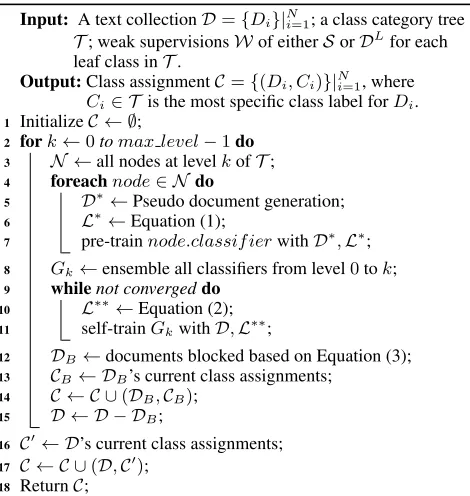
Algorithm 1 puts the above pieces together and summarizes the overall model training process for hierarchical text clas-sification. As shown, the overall training is proceeded in a top-down manner, from root to the final internal level. At each level, we generate pseudo documents and pseudo la-bels to pre-train each local classifier. Then we self-train the ensembled global classifier using its own predictions in an iterative manner. Finally we apply blocking mechanism to block general documents, and pass the remaining documents to the next level.
Experiments
Experiment Settings
Algorithm 1:Overall Network Training. Input: A text collectionD={Di}|N
i=1; a class category tree
T; weak supervisionsWof eitherSorDL
for each leaf class inT.
Output:Class assignmentC={(Di, Ci)}|N i=1, where
Ci∈ T is the most specific class label forDi.
1 InitializeC ← ∅;
2 fork←0tomax level−1do
3 N ←all nodes at levelkofT; 4 foreachnode∈ Ndo
5 D∗←Pseudo document generation; 6 L∗←Equation (1);
7 pre-trainnode.classif ierwithD∗,L∗;
8 Gk←ensemble all classifiers from level0tok; 9 whilenot convergeddo
10 L∗∗ ←Equation (2); 11 self-trainGkwithD,L∗∗;
12 DB←documents blocked based on Equation (3); 13 CB ← DB’s current class assignments;
14 C ← C ∪(DB,CB); 15 D ← D − DB;
16 C0← D’s current class assignments; 17 C ← C ∪(D,C0);
18 ReturnC;
Table 1: Dataset Statistics.
Corpus name (level# classes1+ level2) # docs Avg. doc length
NYT 5 + 25 13,081 778
arXiv 3 + 53 230,105 129
Yelp Review 3 + 5 50,000 157
• The New York Times (NYT): We crawl13,081 news articles using the New York Times API2. This news corpus
covers5super-categories and25sub-categories.
• arXiv:We crawl paper abstracts from arXiv website3and
keep all abstracts that belong to only one category. Then we include all sub-categories with more than1,000 doc-uments out of3largest super-categories and end up with
230,105abstracts from53sub-categories.
• Yelp Review:We use the Yelp Review Full dataset (Zhang, Zhao, and LeCun 2015) and take its testing portion as our dataset. The dataset contains50,000documents evenly distributed into5sub-categories, corresponding to user ratings from1star to5stars. We consider1and2stars as “negative”,3stars as “neutral”,4and5stars as “positive”,
so we end up with3super-categories.
Table 1 provides the statistics of the three datasets; Table 2 and 3 show some sample sub-categories ofNYTandarXiv
datasets. We use Micro-F1 and Macro-F1 scores as metrics for classification performances.
Baselines We compare our proposed method with a wide range of baseline models, described as below:
2
http://developer.nytimes.com/
3
https://arxiv.org/
Table 2: Sample subcategories of NYT Dataset.
Super-category (# children) Sub-category
Politics (9) abortion, surveillance, immigration, . . . Arts (4) dance, television, music, movies Business (4) stocks, energy companies, economy, . . .
Science (2) cosmos, environment Sports (7) hockey, basketball, tennis, golf, . . .
Table 3: Sample subcategories of arXiv Dataset.
Super-category (# children) Sub-category
Math (25) math.NA, math.AG, math.FA, . . . Physics (10) physics.optics, physics.flu-dyn, . . .
CS (18) cs.CV, cs.GT, cs.IT, cs.AI, cs.DC, . . .
• Hier-Dataless(Song and Roth 2014): Dataless hierarchi-cal text classification4can only takeword-level supervi-sion sources. It embeds both class labels and documents in a semantic space using Explicit Semantic Analysis (Gabrilovich and Markovitch 2007) on Wikipedia articles, and assigns the nearest label to each document in the se-mantic space. We try both the top-down approach and bottom-up approach, with and without the bootstrapping procedure, and finally report the best performance.
• Hier-SVM(Dumais and Chen 2000; Liu et al. 2005): Hier-archical SVM can only takedocument-levelsupervision sources. It decomposes the training tasks according to the class taxonomy, where each local SVM is trained to distin-guish sibling categories that share the same parent node.
• CNN(Kim 2014): The CNN text classification model5
can only takedocument-levelsupervision sources.
• WeSTClass(Meng et al. 2018): Weakly-supervised neural text classification can take bothword-leveland document-levelsupervision sources. It first generates bag-of-words pseudo documents for neural model pre-training, then boot-straps the model on unlabeled data.
• No-global: This is a variant ofWeSHClasswithout the global classifier, i.e., each document is pushed down with local classifiers in a greedy manner.
• No-vMF: This is a variant ofWeSHClasswithout using movMF distribution to model class semantics, i.e., we ran-domly select one word from the keyword set of each class as the beginning word when generating pseudo documents.
• No-selftrain: This is a variant ofWeSHClasswithout self-training module, i.e., after pre-training each local clas-sifier, we directly ensemble them as a global classifier at each level to classify unlabeled documents.
Parameter Settings For all datasets, we use Skip-Gram model (Mikolov et al. 2013) to train100-dimensional word embeddings for both movMF distributions modeling and clas-sifier input embeddings. We set the pseudo label parameter
4
https://github.com/CogComp/cogcomp-nlp/tree/master/ dataless-classifier
5
α= 0.2, the number of pseudo documents per class for pre-training β = 500, and the self-training stopping criterion
δ = 0.1. We set the blocking thresholdγ = 0.9forNYT
dataset where general documents exist andγ = 1for the other two.
Although our proposed method can use any neural model as local classifiers, we empirically find that CNN model al-ways results in better performances than RNN models, such as LSTM (Hochreiter and Schmidhuber 1997) and Hierar-chical Attention Networks (Yang et al. 2016). Therefore, we report the performance of our method by using CNN model with one convolutional layer as local classifiers. Specifically, the filter window sizes are 2,3,4,5 with20feature maps each. Both the pre-training and the self-training steps are performed using SGD with batch size256.
Weak Supervision Settings The seed information we use as weak supervision for different datasets are described as fol-lows: (1) When the supervision source isclass-related key-words, we select3keywords for each leaf class; (2) When the supervision source islabeled documents, we randomly samplecdocuments of each leaf class from the corpus (c= 3
forNYTandarXiv;c= 10forYelp Review) and use them as given labeled documents. To alleviate the randomness, we repeat the document selection process10times and show the performances with average and standard deviation values.
We list the keyword supervisions of some sample classes forNYTdataset as follows:Immigration(immigrants, im-migration, citizenship);Dance(ballet, dancers, dancer); En-vironment(climate, wildlife, fish).
Quantitative Comparision
We show the overall text classification results in Table 4.
WeSHClassachieves the overall best performance among all the baselines on the three datasets. Notably, when the supervision source isclass-related keywords,WeSHClass
outperformsHier-DatalessandWeSTClass, which shows thatWeSHClasscan better leverage word-level supervision sources in hierarchical text classification. When the supervi-sion source islabeled documents,WeSHClasshas not only higher average performance, but also better stability than the supervised baselines. This demonstrates that when training documents are extremely limited,WeSHClasscan better leverage the insufficient supervision for good performances and is less sensitive to seed documents.
Comparing WeSHClass with several ablations, No-global,No-vMF andNo-self-train, we observe the effec-tiveness of the following components: (1) ensemble of local classifiers, (2) modeling class semantics as movMF distribu-tions, and (3) self-training. The results demonstrate that all these components contribute to the performance of WeSH-Class.
Component-Wise Evaluation
In this subsection, we conduct a series of breakdown ex-periments onNYTdataset usingclass-related keywordsas weak supervision to further investigate different components in our proposed method. We obtain similar results on the other two datasets.
Pseudo Documents Generation The quality of the gener-ated pseudo documents is critical to our model, since high-quality pseudo documents provide a good model initializa-tion. Therefore, we are interested in which pseudo document generation method gives our model best initialization for the subsequent self-training step. We compare our document gen-eration strategy (movMF + LSTM language model) with the following two methods:
• Bag-of-words (Meng et al. 2018): The pseudo documents are generated from a mixture of background unigram dis-tribution and class-related keywords disdis-tribution.
• Bag-of-words + reordering: We first generate bag-of-words pseudo documents as in the previous method, and then use the globally trained LSTM language model to reorder the pseudo documents by greedily putting the word with the highest probability at the end of the current sequence. The beginning word is randomly chosen.
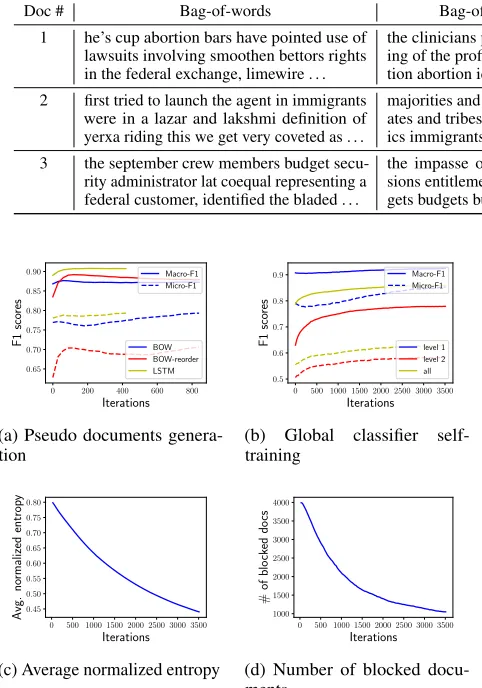
We showcase some generated pseudo document snippets of class “politics” forNYTdataset using different methods in Table 5. Bag-of-words method generates pseudo documents without word order information; bag-of-words method with reordering generates text of high quality at the beginning, but poor near the end, which is probably because the “proper” words have been used at the beginning, but the remaining words are crowded at the end implausibly; our method gener-ates text of high quality.
To compare the generalization ability of the pre-trained models with different pseudo documents, we show their sub-sequent self-training process (at level1) in Figure 2(a). We notice that our strategy not only makes self-training converge faster, but also has better final performance.
Global Classifier and Self-training We proceed to study why using self-trained global classifier on the ensemble of local classifiers is better than greedy approach. We show the self-training procedure of the global classifier at the final level in Figure 2(b), where we demonstrate the classification accu-racy at level1(super-categories), level2(sub-categories) and of all classes. Since at the final level, all local classifiers are ensembled to construct the global classifier, self-training of the global classifier is the joint training of all local classifiers. The result shows that the ensemble of local classifiers for joint training is beneficial for improving the accuracy at all levels. If a greedy approach is used, however, higher-level classi-fiers will not be updated during lower-level classification, and misclassification at higher levels cannot be corrected.
Blocking During Self-training We demonstrate the dy-namics of the blocking mechanism during self-training. Fig-ure 2(c) shows the average normalized entropy of the corre-sponding local classifier output for each document inNYT
Table 4: Macro-F1 and Micro-F1 scores for all methods on three datasets, under two types of weak supervisions.
Methods NYT arXiv Yelp Review
KEYWORDS DOCS KEYWORDS DOCS KEYWORDS DOCS
Macro Micro Avg. (Std.)Macro Avg. (Std.)Micro Macro Micro Avg. (Std.)Macro Avg. (Std.)Micro Macro Micro Avg. (Std.)Macro Avg. (Std.)Micro
Hier-Dataless 0.593 0.811 - - 0.374 0.594 - - 0.284 0.312 -
-Hier-SVM - - 0.142 (0.016) 0.469 (0.012) - - 0.049 (0.001) 0.443 (0.006) - - 0.220 (0.082) 0.310 (0.113)
CNN - - 0.165 (0.027) 0.329 (0.097) - - 0.124 (0.014) 0.456 (0.023) - - 0.306 (0.028) 0.372 (0.028)
WeSTClass 0.386 0.772 0.479 (0.027) 0.728 (0.036) 0.412 0.642 0.264 (0.016) 0.547 (0.009) 0.348 0.389 0.345 (0.027) 0.388 (0.033)
No-global 0.618 0.843 0.520 (0.065) 0.768 (0.100) 0.442 0.673 0.264 (0.020) 0.581 (0.017) 0.391 0.424 0.369 (0.022) 0.403 (0.016)
No-vMF 0.628 0.862 0.527 (0.031) 0.825 (0.032) 0.406 0.665 0.255 (0.015) 0.564 (0.012) 0.410 0.457 0.372 (0.029) 0.407 (0.015)
No-self-train 0.550 0.787 0.491 (0.036) 0.769 (0.039) 0.395 0.635 0.234 (0.013) 0.535 (0.010) 0.362 0.408 0.348 (0.030) 0.382 (0.022) WeSHClass 0.632 0.874 0.532(0.015) 0.827(0.012) 0.452 0.692 0.279(0.010) 0.585(0.009) 0.423 0.461 0.375(0.021) 0.410(0.014)
Table 5: Sample generated pseudo document snippets of class “politics” forNYTdataset.
Doc # Bag-of-words Bag-of-words + reordering movMF + LSTM language model
1 he’s cup abortion bars have pointed use of lawsuits involving smoothen bettors rights in the federal exchange, limewire . . .
the clinicians pianists said that the legaliz-ing of the profillegaliz-ing of the . . . abortion abor-tion aborabor-tion identificaabor-tion aborabor-tions . . .
abortion rights is often overlooked by the president’s 30-feb format of a moonjock period that offered him the rules to . . .
2 first tried to launch the agent in immigrants were in a lazar and lakshmi definition of yerxa riding this we get very coveted as . . .
majorities and clintons legalization, moder-ates and tribes lawfully . . . lawmakers clin-ics immigrants immigrants immigrants . . .
immigrants who had been headed to the united states in benghazi, libya, saying that mr. he making comments describing . . .
3 the september crew members budget secu-rity administrator lat coequal representing a federal customer, identified the bladed . . .
the impasse of allowances overruns pen-sions entitlement . . . funding financing bud-gets budbud-gets budbud-gets budbud-gets taxpayers . . .
budget increases on oil supplies have grown more than a ezio of its 20 percent of energy spaces, producing plans by 1 billion . . .
0 200 400 600 800
Iterations
0.65 0.70 0.75 0.80 0.85 0.90
F1
sco
res
Macro-F1 Micro-F1
BOW BOW-reorder LSTM
(a) Pseudo documents genera-tion
0 500 1000 1500 2000 2500 3000 3500
Iterations
0.5 0.6 0.7 0.8 0.9
F1
sco
res
Macro-F1 Micro-F1
level 1 level 2 all
(b) Global classifier self-training
0 500 1000 1500 2000 2500 3000 3500
Iterations
0.45 0.50 0.55 0.60 0.65 0.70 0.75 0.80
Avg.
no
rmalized
entrop
y
(c) Average normalized entropy
0 500 1000 1500 2000 2500 3000 3500
Iterations
1000 1500 2000 2500 3000 3500 4000
#
of
blo
ck
ed
do
cs
(d) Number of blocked docu-ments
Figure 2: Component-wise evaluation onNYTdataset.
Related Work
Weakly-Supervised Text Classification
There exist some previous studies that use either word-based supervision or limited amount of labeled documents as weak supervision sources for the text classification task. WeST-Class (Meng et al. 2018) leverages both types of supervision sources. It applies a similar procedure of pre-training the network with pseudo documents followed by self-training on unlabeled data. Descriptive LDA (Chen et al. 2015) applies an
LDA model to infer Dirichlet priors from given keywords as category descriptions. The Dirichlet priors guide LDA to in-duce the category-aware topics from unlabeled documents for classification. (Ganchev et al. 2010) propose to encode prior knowledge and indirect supervision in constraints on poste-riors of latent variable probabilistic models. Predictive text embedding (Tang, Qu, and Mei 2015) utilizes both labeled and unlabeled documents to learn text embedding specifically for a task. Labeled data and word co-occurrence information are first represented as a large-scale heterogeneous text net-work and then embedded into a low dimensional space. The learned embedding are fed to logistic regression classifiers for classification. None of the above methods are specifically designed for hierarchical classification.
Hierarchical Text Classification
WeSH-Classdoes not require much training data but only weak supervision from users.
Hierarchical dataless classification (Song and Roth 2014) uses class-related keywords as class descriptions, and projects classes and documents into the same semantic space by re-trieving Wikipedia concepts. Classification can be performed in both top-down and bottom-up manners, by measuring the vector similarity between documents and classes. Although hierarchical dataless classification does not rely on massive training data as well, its performance is highly influenced by the text similarity between the distant supervision source (Wikipedia) and the given unlabeled corpus.
Conclusions
We proposed a weakly-supervised hierarchical text classifi-cation methodWeSHClass. Our designed hierarchical net-work structure and training method can effectively leverage (1) different types of weak supervision sources to generate high-quality pseudo documents for better model generaliza-tion ability, and (2) class taxonomy for better performances than flat methods and greedy approaches.WeSHClass out-performs various supervised and weakly-supervised baselines in three datasets from different domains, which demonstrates the practical value ofWeSHClassin real-world applications. In the future, it is interesting to study what kinds of weak supervision are most effective for the hierarchical text classi-fication task and how to combine multiple sources together to achieve even better performance.
Acknowledgements
This research is sponsored in part by U.S. Army Research Lab. under Cooperative Agreement No. W911NF-09-2-0053 (NSCTA), DARPA under Agreement No. W911NF-C-0099, National Science Foundation IIS 16-18481, IIS 17-04532, and IIS-17-41317, DTRA HDTRA11810026, and grant 1U54GM114838 awarded by NIGMS through funds provided by the trans-NIH Big Data to Knowledge (BD2K) initiative (www.bd2k.nih.gov). We thank anonymous review-ers for valuable and insightful feedback.
References
Banerjee, A.; Dhillon, I. S.; Ghosh, J.; and Sra, S. 2005. Clustering on the unit hypersphere using von mises-fisher distributions.Journal of Machine Learning Research6:1345– 1382.
Cai, L., and Hofmann, T. 2004. Hierarchical document categorization with support vector machines. InCIKM. Ceci, M., and Malerba, D. 2006. Classifying web documents in a hierarchy of categories: a comprehensive study.Journal of Intelligent Information Systems28:37–78.
Chen, X.; Xia, Y.; Jin, P.; and Carroll, J. A. 2015. Dataless text classification with descriptive lda. InAAAI.
Dumais, S. T., and Chen, H. 2000. Hierarchical classification of web content. InSIGIR.
Gabrilovich, E., and Markovitch, S. 2007. Computing se-mantic relatedness using wikipedia-based explicit sese-mantic analysis. InIJCAI.
Ganchev, K.; Grac¸a, J.; Gillenwater, J.; and Taskar, B. 2010. Posterior regularization for structured latent variable models. Journal of Machine Learning Research11:2001–2049. Gopal, S., and Yang, Y. 2014. Von mises-fisher clustering models. InICML.
Hochreiter, S., and Schmidhuber, J. 1997. Long short-term memory.Neural Computation9:1735–1780.
Kim, Y. 2014. Convolutional neural networks for sentence classification. InEMNLP.
Levy, O.; Goldberg, Y.; and Dagan, I. 2015. Improving distributional similarity with lessons learned from word em-beddings.TACL3:211–225.
Li, X., and Roth, D. 2002. Learning question classifiers. In COLING.
Liu, T.-Y.; Yang, Y.; Wan, H.; Zeng, H.-J.; Chen, Z.; and Ma, W.-Y. 2005. Support vector machines classification with a very large-scale taxonomy.SIGKDD Explorations7:36–43. Meng, Y.; Shen, J.; Zhang, C.; and Han, J. 2018. Weakly-supervised neural text classification. InCIKM.
Mikolov, T.; Sutskever, I.; Chen, K.; Corrado, G. S.; and Dean, J. 2013. Distributed representations of words and phrases and their compositionality. InNIPS.
Peng, H.; Li, J.; He, Y.; Liu, Y.; Bao, M.; Wang, L.; Song, Y.; and Yang, Q. 2018. Large-scale hierarchical text clas-sification with recursively regularized deep graph-cnn. In WWW.
Prabhu, Y., and Varma, M. 2014. Fastxml: a fast, accurate and stable tree-classifier for extreme multi-label learning. In KDD.
Silla, C. N., and Freitas, A. A. 2010. A survey of hierarchical classification across different application domains. Data Mining and Knowledge Discovery22:31–72.
Song, Y., and Roth, D. 2014. On dataless hierarchical text classification. InAAAI.
Sundermeyer, M.; Schl¨uter, R.; and Ney, H. 2012. Lstm neural networks for language modeling. InINTERSPEECH. Tang, D.; Qin, B.; and Liu, T. 2015. Document modeling with gated recurrent neural network for sentiment classification. InEMNLP.
Tang, J.; Qu, M.; and Mei, Q. 2015. Pte: Predictive text embedding through large-scale heterogeneous text networks. InKDD.
Xie, J.; Girshick, R. B.; and Farhadi, A. 2016. Unsupervised deep embedding for clustering analysis. InICML.
Yang, Z.; Yang, D.; Dyer, C.; He, X.; Smola, A. J.; and Hovy, E. H. 2016. Hierarchical attention networks for document classification. InHLT-NAACL.