17
Volume-4, Issue-4, August-2014,
ISSN No.: 2250-0758
International Journal of Engineering and Management Research
Available at:
www.ijemr.net
Page Number: 17-21
Design of Pointer forwarding schemes for Mobility Management of Multi
Gateway Wireless Mesh Networks
M. SivaRamaKrishna1, Dr. G. Venkata Rami Reddy2, E. Jagadeeswara Rao3 1
M.Tech Student (Computer Science), School of Information Technology, JNTUH, Kukatpally, Hyderabad, INDIA 2Associate Professor, School of IT, JNTUH Kukatpally, Hyderabad, INDIA
3Lecturer, School of IT, JNTUH Kukatpally, Hyderabad, INDIA
ABSTRACT
The current Wireless Mesh Networks required to have efficient mobility management schemes in order to support the mobile clients roaming around the network without any interruption. In view of the large coverage areas and to serve more clients we need to have more number of Internet Gateways, since the single gateway systems will increase the load on gateway. In order to provide the seamless transmission with less signaling and without interruption we propose the pointer forwarding schemes for the mobility management of the Multi Gateway Wireless Mesh Networks.
We propose the pointer forwarding schemes with two schemes namely the Static Anchor scheme and Dynamic anchor scheme.
Keywords--- Wireless Mesh Networks, Mobility Management, Gateways, Mobile Clients, Mesh Routers.
I.
I
NTRODUCTIONWireless Mesh Networks (WMN) are gaining growing interest over the past few years, as a quick and cheap solution to offer wide wireless coverage mostly for providing last-mile broadband Internet access and other needs of mobile clients such as PDAs smart Phones, Laptops etc [1].
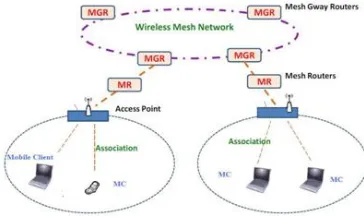
Figure 1: Wireless Mesh Network
Wireless Mesh Networks consists of Gateways (GW), Mesh Routers (MR), Access Points (AP), and Mesh Clients (MC). Gateways are the connection points to the wire-line networks [2]. Mesh clients are the terminal users. Wireless Access Points (APs) are the entities in charge of
the wireless access for the
mesh clients. MRs are usually Static/ Stationary and form a wireless multi-hop backbone of WMNs with long-range high-speed wireless techniques. Some MRs also serves as Access Points (AP).
When the mobile clients are stationary, with the support of backbone routing, the wireless access for them can be accomplished within a few hops. However, difficulty arises when there are needs for the mesh clients to move across the coverage area of different APs/ MRs.
Wireless mesh networks mobility management consists of location management and handoff management. Location management keeps track of the location information of mesh clients, through location registration and location update operations. Handoff management maintains ongoing connections of mesh clients while they are moving around and changing their points of attachment [3].
II.
R
ELATEDW
ORKThe existing WMN Mobility schemes are classified into three different categories, i.e., Tunneling-based, Routing Tunneling-based, and Multicasting based [4][5].
2.1 Tunneling Based Schemes
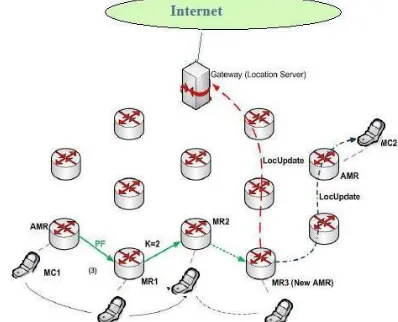
18 Fig 2. Pointer Forwarding Method (FP Forwarding Pointer) Examples of tunnel-based mobility management schemes
include Ant and M3 for WMNs [6].
2.2 Routing Based Schemes
Routing-based schemes represent another class of mobility management schemes with the basic idea of integrating the mobility management with routing such that location information of mobile clients can be propagated throughout the network through regular packet routing. Typical examples of routing-based mobility management schemes include WMM, iMesh, MEMO and MTMM [6]. A common problem of routing based schemes such as iMesh, MEMO is that they rely on broadcasting for route discovery or location change notification, leading to excessive signaling overhead.
2.3 Multicasting Based Schemes
The multicasting based schemes such as SMesh offers a seamless wireless mesh network system to mesh clients, where the fast handoff is achieved by using a group of mesh routers to serve mesh client and multicast traffic to the mesh client during the handoff. In this scheme the mesh clients view the system as a single access point. This incurs a high signaling cost, which is especially a severe problem when the average mobility rate of mesh clients is high. Management of multicasting groups is also a major source of signaling overhead in SMesh [6].
2.4 Pointer Forwarding Schemes
In order to overcome the difficulties of the above schemes mentioned under section 2.1 through 2.3, a Wireless Mesh Mobility scheme with the pointer forwarding is designed [6].
In the proposed mobility management schemes, the central location database resides in the gateway. For each MC roaming around in a WMN, an entry exists in the location database for storing the location information of the MC, i.e., the address of its anchor MR (AMR). The AMR of an MC is the head of its forwarding chain. With the address of an MC‟s AMR, the MC can be reached by following the forwarding chain. Data packets sent to an MC will be routed to its current AMR first, which then forwards them to the MC by following the forwarding chain. Packet delivery in the proposed schemes simply rely on the routing protocol used. The concept of pointer forwarding comes from mobility management schemes proposed for cellular networks. The idea behind pointer forwarding is minimizing the overall network signaling cost incurred by mobility management operations by reducing the number of expensive location update events. A location update event means sending to the gateway a location update message informing it to update the location database. With pointer forwarding, a location handoff simply involves setting up a forwarding pointer between two neighboring MRs without having to trigger a location update event.
The forwarding chain length of an MC significantly affects the network traffic cost incurred by mobility management and packet delivery, with respect to the MC. The longer the forwarding chain, the lower rate the location update event, thus the smaller the signaling overhead. However, a long forwarding chain will increase the packet delivery cost because packets have to travel a long distance to reach the destination. Therefore, there exists a trade-off between the signaling cost incurred by mobility management vs. the service cost incurred by packet delivery. Consequently, there exists an optimal threshold of the forwarding chain length for each MC. In the proposed schemes, this optimal threshold denoted by K is determined for each individual MC dynamically, based on the MC‟s specific mobility and service patterns.
These schemes are further divided into Static Anchor Scheme and Dynamic Anchor schemes [6].
III.
P
ROBLEMS
TATEMENTThe pointer forwarding method significantly reduces the location update to the Gateways despite the extra periodic location update of the mobile clients with high mobility.
The problem with this scheme is that it is based on the single Gateway Model. In present scenario the requirement of covering the large area with WMNs and to serve more and more number of clients within that vast area is significantly growing.
19 Fig 3. Throughput should increase with number of Gateways.
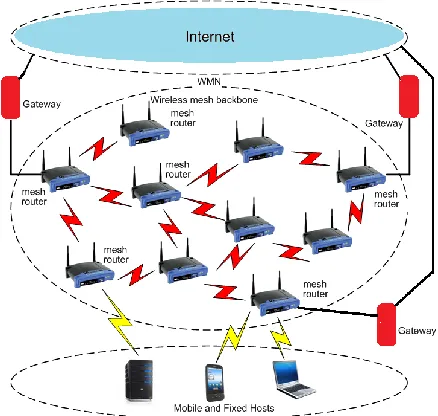
Fig 4. WMN with Multiple Gateways
order to avoid interference we can not achieve the similar service to all the MR/MCs in WMNs. In order to cater the heavy load on Single Gateway and to increase the network throughput of the Mesh, we need to place the more number of gateways at different positions in the mesh.
throughput
number of gateways
0
optimal case
poor performance
In the next sections of this paper, we propose Two Pointer forwarding schemes, i.e. Static Anchor Scheme and Dynamic Anchor Scheme for the Mobility Management of WMNs with Multiple Gateways.
IV.
P
ROPOSEDM
ODELThe following figure shows a wireless mesh network with Multiple Gateways
We propose two different Mobility management schemes for Multiple Gateway WMNs, namely Static Anchor Scheme and Dynamic Anchor Scheme.
The Static Anchor is the one in which the MC is connected to the MR called as AMR, and during the data transfer session pointers are added till the predefined limit of pointers „K‟ is reached. If the limit of pointers is more
than the predefined value „K‟ the AMR is reset. On the beginning of new session the AMR will not be changed. Whereas for the Dynamic Anchor Scheme the AMR will be updated and K is Reset to „0‟ at the time of beginning of every new data transfer session.
With this simple explanation, now we proceed to define the Location search procedure which is one of the associated activities related to Mobility Management of WMNs.
Figure 5: Location search procedure for Internet Session teways
4.1 Location Search Procedure
The following figure Fig. 5 illustrates the location search procedure for a new Internet session initiated towards an MC, which is described as follows:
1) When an Internet session initiated by an Internet host towards an MC arrives at the gateway, the gateway sends a location request message to the MC‟s current AMR (the gateway keeps the address of the MC‟s AMR in the location database);
2) The AMR forwards the message to the MC‟s current serving MR;
3) Upon receiving the location request message, the MC‟s current serving MR sends a location message back to the gateway, through AMR of the MC;
4) The gateway identifies the location information of the MC in the location database, and the location search procedure is completed.
4.2 Static Anchor Scheme for Multiple Gateway WMN
To route data packets to an MC, the current AMR of the MC is identified from the location database of the Gateway. On identifying the address of the MC‟s current AMR, the data packets are routed to the MC using routing protocols from the Internet host through the Gateway. The Gateway routes the packets to the Current AMR of the MC. If the AMR and current serving MR are not co-located/or not the same, the AMR forwards the data packets to the MC‟s current serving MR.
Gatewa
y
MC’s
AMR
MC’s Serving MR
1
2
3
20
Figure 7: Static Anchor scheme for Multi Gateway WMN
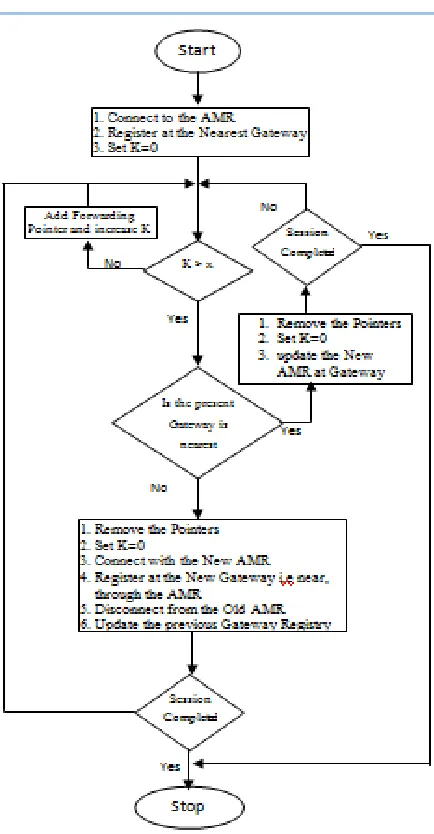
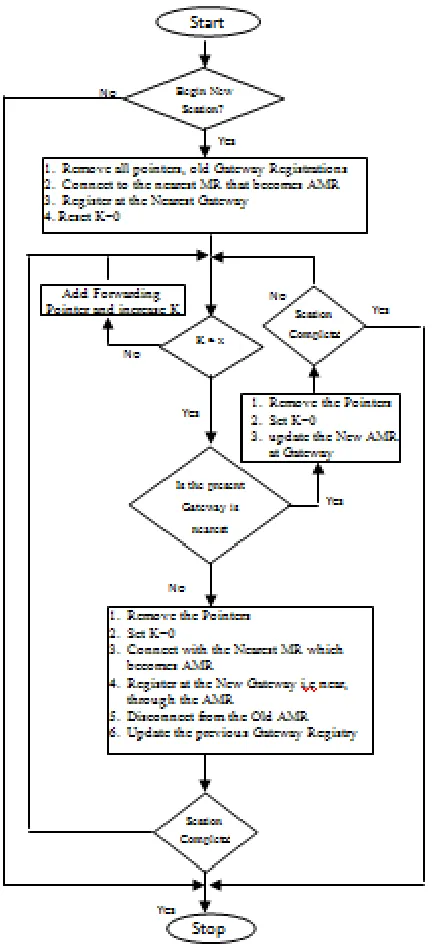
As shown in the figure No 6, and explained in the Flow Chart shown in Figure No.7, the Mobility management and data routing is detailed below.
a. When the MC1 enters the WMN for the first time, it gets signal from the nearest MR and will be connected to that MR, hereafter called as Anchor Mesh Router (AMR). b. The AMR will send this identity of the MC1 to the nearest
Gateway and the MC1 will be registered at the Nearest Gateway i.e., Gateway1. The Gateway1 will identify the MC1 through its serving MR i.e., AMR.
c. Any one of the Routing metrics such as Shortest Path or Hop Count or Expected transmission time etc., are used to identify the nearest Gateway for catering the needs of the MC1.
d. The maximum Limit of pointers „K‟ is set to „x, for example in this case as „2‟ and is initialized to „0‟ since it is connected to AMR and no pointer is added.
e. When MC1 moves towards the MR1 ( as shown in Fig6 step1) a pointer is added from the AMR to the MR1 and K is incremented by „1‟(Since one pointer is added) The data will be transferred to MC1 as explained in Para1 of section 4.2
f. On further movement of the MC1, towards MR2 and MR3 increase the K value by „1‟ every time & adds Forwarding pointer.
g. If the K value is more than the set limit „x‟ i.e., 2 in this case, we have to stop adding the pointers and AMR must be changed, in order to have the tradeoff between the Signaling cost to Delivery time.
h. At this point of time, just before updating the AMR, we put a check to find the nearest Gateway using any one of the Routing metrics (for example Hop count). In this example the nearest Gateway to the MR3, the current service area the MC1 presently resides, is Gateway-2.and it differs from the previous Gateway.
i. Now the MC1 will be registered at New Gateway and its MR is MR3. After this action the K is reset to „0‟, and all the pointers are delinked as well as it gets deregistered from its previous Gateway.
j. This continues till the session is completed or the MC1 moves out of the service area of the WMN. In this scheme the AMR will be reset only whenever the K value is more than the predefined value of forwarding pointers, say „x‟.
21
4.3 Dynamic Anchor Scheme for Multiple Gateway WMN
Figure 8: Dynamic Anchor Scheme for Multi Gateway WMN
The sequence of actions from „a‟ through „i' , as mentioned in section 4.2 of this paper are same for the Dynamic Anchor scheme, except that the MC1 will be registered with New Gateway and get connected to New AMR, on every new Data transfer session, in addition to the reset due to reaching of maximum value of „K‟.
V.
CONCLUSION
In this paper, we have discussed the necessity to design the Multi Gateway WMN systems and we propose two Mobility management schemes based on Pointer forwarding for Multi Gateway Wireless Mesh Networks, namely the Static anchor scheme and Dynamic anchor Scheme. These schemes are per user based schemes. The advantage of these schemes is that we need not have the Home Agent / Foreign Agent unlike the existing systems, even though consists of Multiple Gateways
VI.
FUTURE ENHANCEMENTS
In future we plan to investigate how caching of location information of MCs can be used to reduce the signaling cost incurred by our proposed schemes, and also to examine these schemes under more realistic mobility models other than the random walk model
REFERENCES
[1] Ian F. Akyildiz, Xudong Wang, Weilin Wang,“Wireless mesh networks: a survey,” Computer Networks, vol. 47, no. 4, pp.445–487, Mar. 2005.
[2] A. Raniwala and T. cker Chiueh, “Architecture and algorithms for an ieee 802.11-based multi-channel wireless mesh network,”Proc. 24th Annual IEEE Conference on Computer Communications (INFOCOM ‟05), vol. 3, pp. 2223–2234, Mar. 2005.
[3] I. Akyildiz, J. McNair, J. Ho, H. Uzunalioglu, and W. Wang,“Mobility management in next-generation wireless systems,”Proceedings of the IEEE, vol. 87, no. 8, pp. 1347–1384, 1999.
[4] I. Akyildiz, J. Xie, and S. Mohanty, “A survey of mobility management in next-generation all-IP-based wireless systems,” IEEE Wireless Communications, vol.11, no. 4, pp. 16–28, 2004.
[5] D. Huang, P. Lin, and C. Gan, “Design and performance study for a mobility management mechanism (WMM) using locationcache for wireless mesh networks,” IEEE Transactions on Mobile Computing, vol. 7, no.5, pp.546–556, 2008.
[6] Yinan Li and Ing-Ray Chen “ Design and Performance Analysis of Mobility Management Schemes Based on Pointer Forwarding for Wireless Mesh Networks” IEEE Transactions On Mobile Computing, Vol. 10, No. 3, pp.349–361, March 2011
[7] N. Nandiraju, et al., “Wireless mesh networks: Current challenges and future directions of Web-In-The-Sky,” IEEE Wireless Communications, vol. 14, no. 4, pp. 79–89, 2007
IF1=0