33
Copyright © 2011-15. Vandana Publications. All Rights Reserved.
Volume-5, Issue-2, April-2015
International Journal of Engineering and Management Research
Page Number: 33-39
Reduced Eigen Space Dimensionality for Fast Face Recognition
Davoud Aflakian1,M. Syamala Devi2
1
Research Scholar, Department of Computer Science and Applications, Panjab University, Chandigarh, INDIA
2
Professor, Department of Computer Science and Applications, Panjab University, Chandigarh, INDIA
ABSTRACT
Principal Component Analysis (PCA) is one of the techniques to reduce dimensionality of images for face recognition. Two dimensional Principal Component Analysis (2DPCA) algorithm is used to reduce time complexity of PCA algorithm. In this paper, 2DPCA algorithm is modified and developed a new algorithm using transpose of extracted eigenvectors. The new algorithm is named as Two dimensional Principal Component Transpose Analysis (2DPCTA) algorithm. It extracts Principal components of two dimensional images and represents the face images using extracted eigenvectors as well as transpose of the selected eigenvectors whereas 2DPCA used extracted eigenvectors only to represent images. Therefore, the proposed technique reduces face space dimensionality as well as time complexity as compared to PCA and 2DPCA algorithms. The proposed algorithm has been implemented on various standard face databases e.g. Yale, ORL, Jaffe and KDEF face databases. The 2DPCTA, PCA and 2DPCA algorithms tested on faces databases independent of pose, expression and degradation variations. The results are analyzed with respect to time, space dimensionality and recognition rate in time domain as well as frequency domain. It is observed from experimental results that the proposed technique reduces face space dimensionality and time complexity including time of extracting eigenvectors, time of image representation as well as time of objects classification as compared to PCA and 2DPCA algorithms.
Keywords—Feature extraction, Principal Component
Analysis (PCA), two dimensional Principal Component Analysis (2DPCA), Time and Frequency Domain.
I.
INTRODUCTION
The Face Recognition (FR) system is a computer application to recognize and verify faces independent of pose, rotation, expression, scale, age, degradation etc. Although many face recognition (FR) algorithms have
been recently devised, they are still not best enough for face recognition in real time. In general, face recognition algorithms can be divided into three groups based on extraction of features in two dimensional (2-D) as well as three dimensional (3-D) images [1] as follows:
a) Holistic Approaches, which recognize face by matching the Global features extracted from the whole image.
b) Local feature based approaches, which perform face recognition by using the similarity of Local features. c) Model Based Approaches or Feature- based model
which use local and/or global geometric facial features (mouth, eyes, eyebrows, cheeks etc.) and geometric relationships between them [2].
Many FR algorithms had been proposed in time domain like Principal Component Analysis (PCA) and Linear Discriminant Analysis (LDA) [3] and Local Binary Pattern (LBP) [2][4]. Many researchers developed algorithms to extract features in frequency domain such as Fourier magnitudes of PCA (FMPCA) [5][6] and Discrete Cosine transform (DCT) [7][8][9]. Also there are some algorithms that extract features from Moment domain such as Zernike Moments (ZMs) [10] and Complex Zernike Moments (CZMs) [11] etc.
Principal Component Analysis (PCA) is an optimal linear global feature extraction algorithm that is used to reduce dimensionality of image matrix, in digital image processing [12][13][14]. The PCA algorithm is based on vector (one dimensional) images. Therefore, size of its covariance matrix is huge and requires high processing time. It represents images using selected eigenvectors according to higher eigenvalues of the covariance matrix, which refer to highest energy magnitude concentration of image matrix [15].
34
Copyright © 2011-15. Vandana Publications. All Rights Reserved.
matrix. Therefore, the size of the covariance matrix in 2DPCA is much smaller than the covariance matrix in PCA algorithm which reduces time complexity of 2DPCA algorithm. 2DPCA provide better performance when there is single image for each individual in training set [16].
The rest of this paper is organized as follows. Section 2 includes review of related work on Principal components based features extraction algorithms for face recognition in time as well as frequency domain. The proposed algorithm is presented in Section 3. Testing and discussion of experimental results on different face databases is given in section 4. Section 5 includes the conclusions and future scope.
II.
REVIEW OF RELATED WORK
Holistic methods became very popular in the 1990’s with a well-known approach of Eigen-face. Sirovich and Kirby [17] used PCA efficiently to represent the images of faces and their significant characteristics. Two directional two dimensional Principal Component Analysis ((2D)2PCA) technique [18] was developed in 2005 by applying column directional two dimensional PCA (c2DPCA) that centralizes data with mean of columns and then combines it with Robust two dimensional Principal Component Analysis (r2DPCA) which presents the row details of the images; thus this algorithm considered both the row and column details of the images. However it computed two covariance matrices with respect to row and column directional details which increase the time complexity of algorithm as compared with 2DPCA algorithm. The 2DPCA proved to be performed better than PCA when there is a single image for each individual in the training set and also required less recognition time as compared to PCA [16]. Zhang et al. [19] developed Diagonal Principal Component Analysis (Dia-PCA) in 2006 which represented diagonal details of the images.
Recently, Zeytunlu and Ahmad in 2012 applied 2-D Fourier transform on ORL database to calculate Fourier magnitude of all images and then r2DPCA, c2DPCA, (2D)2PCA and Dia-PCA was applied to their Fourier magnitudes. They compared their results with (FM-PCA) which is based on PCA applied to the Fourier magnitudes of the images [5]. The computation of Fourier magnitude is very expensive, even if when it is computed using Fast Fourier transforms. There are advantages of working in frequency domain for face recognition irrespective of degradation and pose variation [6].
The PCA algorithm is very popular in face recognition [17][18][20] for general object recognition of 3-D models with illumination variation [21] and handprint identification [22], but it has the following disadvantages [15][19]:
• Loses details of the image on selection of highest eigenvectors from top eigenvalues.
• Recognition time of PCA is high because of the size of covariance (scatter) matrix and nested loops in this algorithm.
To solve this problem 2DPCA was developed but still it needed a large number of coefficients to reconstruct an image [15][16]. PCA and 2DPCA algorithms are used for face recognition independent of pose and expression variation [3][15][16][18]. Lekshmi et al. [14] applied PCA algorithm on full and half face and results compared for face recognition against illumination variations.
It is observed that, in the field of digital image processing, PCA is a popular algorithm that extracts global features irrespective of pose and expression. It has high time complexity due to the size of its covariance matrix [15][19][23][24]. Principal components represent energy magnitude concentration of the images. The 2DPCA has better recognition rate in less time complexity than PCA [15], especially when there is a single train image for each individual [16]. There are advantages of working in frequency domain such as degradation, shift-invariance and closed-form solutions [6].
III.
PROPOSED ALGORITHM
In this work, a new algorithm is developed based on 2DPCA and transpose of its extracted eigenvectors. The newly proposed algorithm is named as Two Dimensional Principal Component Transpose Analysis (2DPCTA) algorithm. The 2DPCTA algorithm provides significant global features irrespective of pose, expression and degradation in less space dimensionality and has less time complexity as compared with PCA and 2DPCA in time as well as frequency domain. Also, it gives better recognition rate in the same face space dimensionality against above algorithms. The 2DPCTA and 2DPCA algorithms have same covariance matrix but the face space dimensionality of the proposed algorithm has been reduced due to using the extracted eigenvectors as well as their transpose for representing images. The 2DPCTA algorithm has to be applied on square images only due to product operation for image representation. Therefore, face database images should be resized into mxm matrices.
The Principal component algorithms have following steps. The main modification of the proposed algorithm is in image representation (step 5). For image representation, PCA algorithm uses the transpose of extracted eigenvectors [23][24]. The 2DPCA represents images using the extracted eigenvectors [15], whereas the proposed algorithm uses the extracted eigenvectors as well as their transpose.
The main steps of 2DPCTA algorithm are as follows:
35
Copyright © 2011-15. Vandana Publications. All Rights Reserved.
1) Compute the average image Amean of the training set.
1
1 N
mean i
i
A A
N =
=
∑
(1)Where Ai (i=1 to N) denotes each image of training set.
2) The Covariance matrix of the training set is computed as below.
1
1
( ) ( )
N
T
j mean j mean
j
G A A A A
N =
=
∑
− − (2)The covariance matrix G is a mxm square matrix that contains attributes of all the training images.
3) Eigenvectors and eigenvalues are computed from matrix G as follows:
.
i i i
GU =λU (3) Where Ui are eigenvectors corresponding to ƛi eigenvalues of matrix G.
4) Select h eigenvectors U according to higher eigenvalues of the covariance matrix G.
{
1, 2, 3,..., h}
U = U U U U (4) Where U is a two dimensional mxh matrix which contains h selected eigenvectors.
5) Image representation step: The proposed algorithm uses extracted eigenvectors as well as their transpose matrix to represent image. This computation distinguishes the proposed algorithm from PCA and 2DPCA. The computation of represented image Yi is proposed as below.
( * ) *T
i i
Y = A U U (5) Alternatively, from Eq. (5) we can suggest another expression that gives same result as Eq. (5) as follows:
* ( * ) T
i i
Y =U A U (6) Where Yi is represented images, U refers to the extracted eigenvectors and Ai (i=1 to N) are training images. Therefore, it reduces the face space into hxh space dimensionality with selecting h eigenvectors whereas the 2DPCA algorithm represents images using Yi=Ai*U [15] in mxh face space dimensionality (when m>h). PCA algorithm represents images using Yi=UT*Ai [23] in hx1
dimensional space. According to the experimental results in section 4, it is observed that, more number of eigenvectors should be extracted in PCA algorithm to provide accurate recognition rate.
6) All the test images of mxm size also should be represented in Eigen-space by using Eq. (5) or Eq. (6).
7) Image classification: classification involves two steps.
(i) Find Euclidean distance between each test image and each image in training set which is computed as follows:
2
( ) ( ) 2
1
( , ) ( )
h
k k
i j i j
k
d Y Y Y Y
=
=
∑
− (7)Where Yi and Yj are represented images of the training and test sets respectively, and measures the distance between Yi and Yj in face space.
(ii) Select minimum distance to identify the nearest match to the test image.
IV.
EXPERIMENTAL RESULTS AND
DISCUSSION
IV.1 Requirements
The proposed algorithm along with PCA [23] and 2DPCA [15] are implemented on Pentium IV Intel® core™ i7-4770 CPU, RAM 4 GB with Windows 8.1 professional Operating System.
The above algorithms are implemented using MATLAB in time domain as well as in frequency domain (FM2DPCTA, FMPCA [6] and FM2DPCA [5]) for various poses, expressions and degradation. The results are tested on Yale, ORL, Jaffe and KDEF face databases. The Yale face database contains 165 images of 15 individuals with 11 images per person under illumination variation and facial expression. The ORL face database consists of 400 images including 40 images from 10 individuals in different poses and expressions. The Jaffe face database considered includes images of 7 individuals with 20 images selected from each person in different pose, expression and illumination. The KDEF face database is a set of 4900 face images including 70 individuals each displayed into 7 various expressions from 5 different angles in two folders as training and test set images. Images of ORL, Yale, Jaffe and KDEF databases are renamed by numbers and then the odd images are taken in the training set and remaining even images are used as test set. Fig. 1 displays sample images from above face databases which were used in these experiments.
Figure 1: Sample images from (a) ORL, (b) Yale, (c) Jaffe
and (d) KDEF
The obtained results are compared based on the following parameters:
(i) Size of image representation (Face space dimensionality)
(ii) Time complexity including time elapsed in eigenvectors extraction, image representation and classification.
36
Copyright © 2011-15. Vandana Publications. All Rights Reserved.
The unit of time in these experimental results is in seconds. For degradation (Table.6), ORL database 90x90 pixels are required to retain the details of images. For other implementation 64x64 pixels images are considered.
IV.2 Discussion
The discussion is mainly focused on time and space complexity, and recognition accuracy.
IV.2.1 Time and space complexity
As shown in Tables.1 to 6, the proposed algorithm achieves approximately same recognition rate in less space dimensionality as that of PCA and 2DPCA in time and frequency domains. Also the time complexity is reduced as seen in the results.
The Table.1 shows the results of PCA, 2DPCA and 2DPCTA algorithms on Yale database. It is observed that minimum 5 eigenvectors are requires to achieve 73.6% recognition rate using 2DPCA whereas the proposed algorithm has 69.3% recognition rate due to
illumination variation. However, with increasing the number of extracted eigenvectors to 16, the recognition rate of proposed algorithm increased to 74.6% whereas for 2DPCA it remained the same. The face space dimensionality of the proposed technique with 16x16 extracted eigenvectors is less than 2DPCA. The PCA has 73.3% recognition rate with minimum 43 extracted eigenvectors. It is observed that total computation time of the proposed technique is less than PCA and 2DPCA algorithms. The time of projecting image in Eigen-space is slightly increased for 2DPCTA as compared with PCA due to two multiplications involved in projecting an image. However it is not effecting on total computation time.
The results of Tables.2 to 4 with same number of extracted eigenvectors proved that the proposed technique is robust against pose and expression and required less face TABLEI
PERFORMANCE COMPARISON OF PROPOSED TECHNIQUE WITH 5 AND 16
EXTRACTED EIGENVECTORS RESPECTIVELY ON YALE DATABASE
Algorithm
Parameter
PCA 2DPCA 2DPCTA
5 EV 16 EV 5 EV 16 EV Recognition
rate (Percentage)
73.3 73.3 73.3 69.3 74.6
Selected eigenvectors (Matrix size)
43 5 16 5 16
Single image representation
(Matrix size)
43 64x5 =320
64x16 =1024
5x5 =25
16x16 =256
Time of eigenvectors
extraction (sec)
30.26 0.003 0.003 0.003 0.003
Time of projecting
image in Eigen-space
(sec)
0.004 0.012 0.0268 0.010 0.013
Similarity measurement
time 0.012 0.018 0.0326 0.011 0.016 Total
Computation
time (sec) 30.27 0.033 0.0624 0.024 0.032
TABLEIII
PERFORMANCE COMPARISON OF PROPOSED TECHNIQUE ON JAFFE DATABASE
Algorithm
Parameter
PCA 2DPCA 2DPCTA
Recognition rate
(Percentage) 98.57 100 98.57 Selected eigenvectors
(Matrix size) 43 5 5
Single image representation (Matrix
size)
43 64x5=320 5x5=25
Time of eigenvector
extraction (sec) 31.341 0.003 0.003 Time of projecting image
in Eigen-space (sec) 0.0039 0.0121 0.0113 Similarity measurement
time 0.0110 0.0141 0.0097 Total Computation time
(sec) 31.3559 0.0292 0.024
TABLEIV
PERFORMANCE COMPARISON OF PROPOSED TECHNIQUE IN FREQUENCY
DOMAIN ON ORL DATABASE
Algorithm
Parameter
FM-PCA
FM-2DPCA FM-2DPCTA
5 EV 7 EV 5 EV 7 EV Recognition
rate (Percentage)
97.5 97.5 97.5 96 97.5
Selected eigenvectors (Matrix size)
43 5 7 5 7
Single image representation
(Matrix size)
43 64x5 =320
64x7 =448
5x5= 25
7x7= 49
Time of eigenvectors
extraction
32.6 0.003 0.003 0.003 0.003
Time of projecting
image in Eigen-space
0.008 0.041 0.055 0.017 0.019
Similarity measurement
time 0.072 0.104 0.117 0.078 0.081 Total
Computation
37
Copyright © 2011-15. Vandana Publications. All Rights Reserved.
space dimensionality which reduced time complexity of algorithm. Table.4 shows the comparison of existing techniques and proposed technique when they are applied in frequency domain on ORL database.
In Table.5, comparison of the proposed algorithm
with other existing techniques on KDEF face database is shown. It can be observed that for the same recognition rate (97.0204%), for the proposed algorithm, the image representation size and total computation times are reduced.
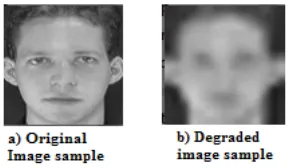
The Fig. 2 shows an image sample of ORL
database before and after image degradation. The spatial resolution of test images were set to 15x15 pixels for degradation and then again resized to 90x90 pixels for experimental results. As shown in Table.6, the 2DPCA provided recognition accuracy of 93.5% by extracting 3, 4 or 5 eigenvectors and represent 90x90 pixel images in 270, 360 and 450 dimensional face space. Also three eigenvectors have been selected in frequency domain. Table.6 proved the improvement of the proposed technique in time as well as frequency domain for face recognition. The recognition was independent of pose, expression and degradation. There is advantage of degradation variation in frequency domain as compared with time domain images [6].
Figure 2: a) Original sample image, b) Degraded sample image of ORL Database resized into 90x90 pixels
IV.2.2 Recognition accuracy
The recognition rate depends on number of eigenvectors selected. Fig. 3 shows that the proposed technique (2DPCTA) provides better average recognition rate in same face space dimensionality as compared with PCA and 2DPCA algorithms on ORL database in time domain.
Figure 3: Recognition Comparison of PCA, 2DPCA and 2DPCTA (the same face space dimensionality vs
recognition rate) on ORL database
It can be observed from above experimental results that 2DPCTA gives good results with respect to less space dimensionality, times complexity and recognition accuracy irrespective of pose, expression and degradation.
V.
CONCLUSION
From experimental results, it is observed that the performance of the proposed algorithm provides good results for face recognition irrespective of pose, expression and degradation. It is also observed that the proposed algorithm represents images in less dimensional face space and time complexity. Due to these advantages, the proposed algorithm can be used in many interactive applications such as Personal Digital Assistants (PDA) or mobile based and real time applications which have space and time constraints and desire equally good recognition accuracy. The proposed technique can be applied on other categories of PCA like Dia-PCA [19], Kernel-PCA [25] algorithms to provide better and faster recognition for face recognition independent of rotation and illumination variations.
TABLEV
PERFORMANCE COMPARISON OF FACE RECOGNITION ON KDEF FACE
DATABASE IN TIME DOMAIN
Algorithm
Parameter
PCA 2DPCA 2DPCTA
Recognition rate
(Percentage) 97.0204 97.0204 97.0204 Single image
representation face space (Matrix size)
227 (64x13)=832 16x16=256
Total Computation
time (sec) 400.83 214.69 139.53
TABLEVI
PERFORMANCE COMPARISON OF FACE RECOGNITION INDEPENDENT OF POSE,
EXPRESSION AND DEGRADATION ON ORL IN TIME AS WELL AS FREQUENCY DOMAIN
Name of Algorithm Face space dimensionality
Recognition rate
PCA 40x1=40 93.5%
2DPCA 3x90=270 93.5%
2DPCTA 4x4=16 93.5%
FMPCA 40x1=40 91%
FM2DPCA 3x90=270 94%
38
Copyright © 2011-15. Vandana Publications. All Rights Reserved.
ACKNOLEDGMENT
I would like to thank Iranian Embassy, Panjab University and South Asian University in India for their support to develop and publish this paper.
REFERENCES
[1] T. Ahonen, and M. Pietikainen, Face Description with Local Binary Patterns: Application to Face Recognition, IEEE Trans. On Pattern Analy.Mach. Intell, vol. 28(12), Pages 2037-2041, 2006.
[2] J. Zou, Q. Ji, and G. Nagy, A Comparative Study of Local Matching Approach for Face Recognition, IEEE Transactions on Image Processing, vol. 16, No. 10, 2007. [3] A.M. Martinez, and A.C. Kak, PCA versus LDA, IEEE Trans. on Pattern Analysis and Machine Intelligence, vol. 23, No. 2, Pages 228-233, 2001.
[4] T. Ojala, M. Pietikainen, and T. Maenpaa, Multiresolution Gray-Scale and Rotation Invariant Texture Classification with Local Binary Patterns, IEEE Trans. Pattern Analysis and Machine Intelligence, vol. 24(7), Pages 971-987, 2002.
[5] A. Zeytunlu, and M. Ahmad, Two-Dimensional face recognition Algorithms in the frequency Domain, IEEE Canadian Conference on Electrical and computer Engineering (CCECE), 2012.
[6] Bhagavatula, V. Kumar, M. Savvides, and C. Xie, Correlation Pattern Recognition for Face Recognition, Proceedings of the IEEE, vol. 94, No. 11, Pages 1963-1976, 2006.
[7] Z. M. Hafed and M. D. Levine, Face Recognition using the Discrete Cosine Transform, International Journal of Computer Vision, 43(3), 2001.
[8] C. Lu , W. Liu and S. An, Face Recognition with Only One Training Sample, Proceedings of the 25th Chinese Control Conference, Pages 2215-2219, 2006. [9] B. H. Shekar, G. Thippeswamy and M. Sharmila Kumari, Face Recognition Based on Fractional Discrete Cosine Transform, IEEE-International Conference on Recent Trends in Information Technology, ICRTIT, Pages 987-991, 2011.
[10] C. Singh, Neerja and E. Walia, Face Recognition Using Zernike and Complex Zernike Moment Features, ISSN 1054_6618, Pattern Recognition and Image Analysis, Springer, vol. 20, No. 4, Pages 71–81, 2010. [11] C. Singh, E. Walia and N. Mittal, Rotation invariant complex Zernike moments features and their applications to human face and character recognition, The Institution of Engineering and Technology 2011. Pages 1-12, 2011. [12] C. Liu, H. Yan, and D. Geman, Local discriminant wavelet packet coordinates for face recognition, Journal of Machine Learning Research, vol.8, Pages 1165-1195, 2007.
[13] D. Zhang, S. Chen, and Z-Hua Zhou, A New Face Recognition Method Based on SVD Perturbation for single Example Image per Person, Applied Mathematics and Computation, vol.163(2), Pages 895-907, 2005. [14] P. Lekshmi, S. Kumar, D. Vidyaharan and Naveen, Analysis of Facial Expression Using PCA on Half and Full Faces, 978-1-4244-1724-7/08 IEEE, Pages 1379-1383, ICALIP, 2008.
[15] J. Yang , D. Zhang , A. F. Frangi , and J-yu Yang, Two-Dimensional PCA: A New Approach to Appearance-Based Face Representation and Recognition, IEEE Trans. on Pattern Analysis and Machine Intelligence, vol. 26 no. 1, Pages 131-137, 2004.
[16] L. Min, and L. Song, Face recognition based on PCA and 2DPCA with single Image Sample, IEEE Ninth Web Information Systems and Applications Conference, Pages 111-114, 2012.
[17] L. Sirovich, and M. Kirby, Low dimensional procedure for the characterization of human faces, J. Optical Soc. of Am., vol. 4, Pages 519-524, 1987. [18] D. Zhang, and Z. Zhou, (2D) 2PCA: Two-directional two-dimensional PCA for efficient face representation and recognition, Neurocomputing, vol. 69, Pages 224–231, 2005.
[19] D. Zhang, Z. Zhou, and S. Chen, Diagonal Principal Component Analysis for Face Recognition, Pattern Recognition, vol. 39(1), Pages 140-142, 2006.
[20] P. Belhumeur, J. Hespanha, and D. Kriegman, Eigenfaces vs. Fisherfaces: Recognition using Class Specific Linear Projection, IEEE Trans. Pattern Anal. Machine intell, vol. 19, No. 7, Pages 711-720, 1997. [21] H. Murase, and S. Nayar, Visual Learning and Recognition of 3-D objects from Appearance, International Journal of Computer Vision, 1995.
[22] H. Murase, F. Kimura, M. Yoshimura, and Y. Miyake, An Improvement of the Autocorrelation Matrix in Pattern Matching Method and Its Application to Handprinted, Trans. IECE Japan, vol. 64D, no. 3, 1981. [23] P. Kamencay , D. Jelsovka and M. Zachariasova, The Impact of Segmentation on Face Recognition using the Principal Component Analysis (PCA), Signal Processing Algorithms, Architectures, Arrangements and Applications Conference Proceedings (SPPA),ISBN 978-1-4577-1486-3, IEEE, 2011.
[24] Neerja and E. Walia, Face Recognition Using Improved Fast PCA Algorithm 978-0-7695-3119-9/08, IEEE DOI 10.1109/ CISP.2008.144, 2008.
[25] H.M Ebied, Feature Extraction using PCA and Kernel-PCA for Face Recognition, Informatics and Systems (INFOS2012), 2012.
BIBLIOGRAPHY
39
Copyright © 2011-15. Vandana Publications. All Rights Reserved.
[2] Yale, 1997 [Online] http://cvc.yale.edu.
[3] Japanese Female Facial Expression (JAFFE), Database of digital images (1997), [Online] http://www.kasrl.org/jaffe_info.html
[4] The Karolinska Directed Emotional Faces (KDEF) Lundqvist, D., Flykt, A., & Öhman, A. (1998). The Karolinska Directed Emotional Faces - KDEF, CD-ROM
from Department of Clinical Neuroscience, Psychology section, Karolinska Institutet, ISBN 91-630-7164-9. [5] MATLAB, The Language of Technical Computing,