Research Article
Parity and Duration of Labor Affects the Risk of Urinary Retention
in post C-Section Patients
Paritas dan Lama Persalinan mempengaruhi Risiko Retensi Urin
pada Pasien Pasca Seksio Sesarea
Yulia I. Nurullah1, Amir F1, Asrol Byrin1, Zen Hafy2
1Department of Obstetrics and Gynecology 2Medical and Health Research Unit
Faculty of Medicine University of Sriwijaya/ Dr. Mohammad Hoesin General Hospital
Palembang
INTRODUCTION
Post partum urinary retention was one of compli-cation of abdominal or vaginal delivery. Urinary re-tention is an inability to urinate spontaneously in the first 6 hours after vaginal delivery or 6 hours after urinary catheter is removed in C-section (CS) with residual urine volume >200 ml.1
Prevalence of urinary retention varied from 1.7% to 17.9%, but most of it was taken from uri-nary retention after vaginal delivery, uriuri-nary
reten-tion after CS delivery has not widely studied.2 In a study of post CS urinary retention in RSCM con-ducted by Kartono H (1998), the rate of post CS urinary retention was 7.1% after 24 hours of uri-nary catheter insertion.3
Some pathophysiology underlying urinary reten-tion, it included hormonal changes during pregnancy which decreasing smooth muscle tonus including uri-nary vesicles and its capacity start to increase at the third month of pregnancy. After labor, urinary ves-Abstract
Objective: To determine the rate of urinary retention cases and con-tributing risk factors in Department of Obstetrics and Gynecology Dr. Mohammad Hoesin Hospital (RSMH), Palembang.
Methods: The study conducted on 111 patients who met our study criteria. After CS, urinary catheter were inserted for 24 hours, and then it was opened for 6 hour, after that patients were asked to uri-nate spontaneously, then we examined the residual urine volume with transvaginal ultrasound. If residual urine volume post CS was >200 ml, it categorized as urinary retention.
Result: During the follow up we found that the rate of urinary reten-tion after CS was 3.6% (4 subject). All subject has a covert urinary retention. Factors contribute to post CS urinary retention was dura-tion of labor and parity. The mean of labor duradura-tion in group with urinary retention is 8.75±13.04 hour, and 7.55±7.28 hour in the nor-mal group (p = 0.003 RP= 106.00 CI 95%= 6.587-1705.778). All case with urinary retention were primipara (p = 0.045).
Conclusion: Our study found that the rate of post CS urinary reten-tion was 3.6%. Risk factors for post CS urinary retenreten-tion were dura-tion of labor more than 24 hours and primipara.
[Indones J Obstet Gynecol 2013; 37-1: 46-50]
Keyword: caesarean section, residual urine, urinary retention
Abstrak
Tujuan: Untuk mengetahui angka kejadian retensio urin pascaseksio sesarea dan faktor-faktor yang mempengaruhinya di Bagian Obstetri Ginekologi RSMH Palembang.
Metode: Sebanyak seratus sebelas pasien yang memenuhi kriteria di-ikutkan dalam penelitian ini. Setelah pasien menjalani tindakan seksio sesarea dilakukan pemasangan kateter selama 24 jam, setelah kateter dibuka 6 jam kemudian pasien diminta untuk berkemih spontan, ke-mudian dilakukan pemeriksaan volume urin sisa dengan menggu-nakan USG transvaginal. Apabila volume urin sisa >200 ml, pasien di-kategorikan mengalami retensio urin.
Hasil: Dari hasil penelitian didapatkan angka kejadian retensio urin pascaseksio sesarea sebesar 3,6% (4 subjek). Semua subjek tergolong jenis retensio urin terselubung (covert urinary retention). Faktor risiko yang berhubungan dengan kejadian retensio urin pascaseksio sesarea adalah lama persalinan dan paritas. Rerata lama persalinan yang menderita retensio urin 8,75±13,04 jam, sedangkan pada subjek yang tidak mengalami retensio urin 7,55±7,28 jam (p = 0,003 RP= 106,00 CI 95%= 6,587-1705,778). Semua kejadian retensio urin terjadi pada primiparitas (p = 0,045).
Kesimpulan: Dari hasil penelitian didapatkan angka kejadian reten-sio urin pascasekreten-sio sesarea sebesar (3,6%). Faktor risiko yang berhubungan dengan kejadian retensio urin pascaseksio sesarea adalah lama persalinan lebih dari 24 jam dan primiparitas. [Maj Obstet Ginekol Indones 2013; 37-1: 46-50]
Kata kunci: residual urin, retensio urin, seksio sesarea
icles tend to be hypotonic for a couple of days to week. During labor, urinary vesicles can be injured due to trauma in nerve, pelvic muscles, and urinary vesicles muscle, and these can be risk factors contrib-uting to post CS urinary retention. Risk of post SC urinary retention was higher because: first, indica-tion that underlying CS usually prolonged labor, his-tory of CS with adhesions of urinary vesicles with lower segment of uterus. Second, CS itself causes bruising and edema of the bladder near the uterovesical area, traumatic of urinary vesicles on in-traoperative (the rate was 0.14-0.31%). Finally, im-mobilization post surgery, wound pain and lack of privacy increased the risk of urinary retention.4-6
Post CS urinary retention cause uncomfortable feeling for the patient especially during insertion of urinary catheter and increase risk of infection.7 Rate of persistent urinary retention after delivery was 0.05%, some risk factors including duration of sec-ond stage of labor, epidural analgesia, and delayed of diagnoses and intervention.8,9
In this study, we aimed to examine the prevalence of post CS urinary and estimate the relationship of risk factors including maternal age, parity, indica-tion of CS, number of previous CS, adhesions of uri-nary vesicles during CS, opening plicavesicouterine, type of abdominal incition and birthweight with post CS urinary retention in Department of Obstetrics and Gynecology in Dr. Moehammad Hoesin Hospital (RSMH).
METHODS
This was an observational analytical study with cross sectional methods. This study was conducted in Department of Obstetrics and Gynecology RSMH Palembang from September 2011 to March 2012. Our study participants were woman who under-went CS in Department of Obstetrics and Gynecol-ogy RSMH Palembang who met our inclusions cri-teria and taken by consecutive sampling. We esti-mated the sample size to be 111 subjects, at minimum.
Inclusions criteria of this study included women who underwent CS with LSCS technique (lower seg-ment caesarean section) under spinal analgesia in Department of Obstetrics and Gynecology RSMH Palembang, agreed to participate in this study and signed the informed consent. Exclusions criteria of this study including history of prior urinate disorder, history of diabetes mellitus, and severe anemia.
Withdrawal criteria were using catheter more than 24 hours after CS, post partum hemorrhage, ne-glected labour and poor general condition. After CS, catheter Fr 16 transutera was inserted and left for 24 hours. After 6 hours the catheter was removed, patient was asked to urinate spontaneously and then examined by the clinician.
The residual urine volume was assessed with transvaginal ultrasonography. Examination was per-formed in fetomaternal ultrasonography room using ALOKA SM 3500 product.
This was anon-invasive and low risk methods to examine the residual urine volume. The examination were performed with the patient lying on a bed and her back was supported with a pillow, then the depth and height of uterine vesicles were measured and calculated using Haylen formu-la:10,11 PVR (ml) = (5.9 x H x D) – 14.6H was horizontal axis (superoinferior) of maximum diameter of urinary vesicles; D was ver-tical axis (posteroanterior) of urinary vesicles. Uri-nary retention is defined as residual urine of more than 200 ml.
Each subject data was recorded in a form and col-lected into one main table. Data tabulation was con-ducted based on the objective of this study, and ana-lyzed using statistic software (SPSS version 16.0). Data analysis was conducted based on type of the data, and data distribution. Fisher’s exacttest was used to analyze categorical data and independent t test.
RESULT
Table 1. Basic Characteristics
Urinary Retention Normal Maternal Age
< 20 and > 35 1 (25%) 26 (24.3%) p = 0.678
20 - 35 3 (75%) 81 (75.7%) RP = 1.038
Education CI 95% = 0.104-10.419
Elementary school 1 (25%) 1 (0.9%)
Junior high school 1 (25%) 12 (11.2%)
Senior high school 2 (50%) 94 (87.9%)
Address
City 2 (50%) 74 (69.2%)
Country 2 (50%) 33 (30.8%)
Job
Housewife 4 (100%) 96 (89.7%)
Private employee 0 (0%) 6 (5.6%)
Farmer Merchant 0 (0%) 3 (2.8%)
Parity 0 (0%) 2 (1.9%)
Primipara 4 (100%) 48 (44.9%)
Multipara 0 (0%) 59 (55.1%) p = 0.045
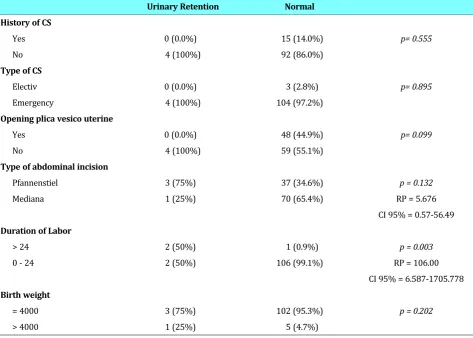
Table 2. Risk factors of Post CS Urinary Retention.
Urinary Retention Normal History of CS
Yes 0 (0.0%) 15 (14.0%) p= 0.555
No 4 (100%) 92 (86.0%)
Type of CS
Electiv 0 (0.0%) 3 (2.8%) p= 0.895
Emergency 4 (100%) 104 (97.2%)
Opening plica vesico uterine
Yes 0 (0.0%) 48 (44.9%) p= 0.099
No 4 (100%) 59 (55.1%)
Type of abdominal incision
Pfannenstiel 3 (75%) 37 (34.6%) p = 0.132
Mediana 1 (25%) 70 (65.4%) RP = 5.676
CI 95% = 0.57-56.49 Duration of Labor
> 24 2 (50%) 1 (0.9%) p = 0.003
0 - 24 2 (50%) 106 (99.1%) RP = 106.00
CI 95% = 6.587-1705.778 Birth weight
= 4000 3 (75%) 102 (95.3%) p = 0.202
Table 2 show risk factors of post CS urinary re-tention. Urinary retention happened post CS was indicated by uterine inertia, transversal position, oligohydramnion, and intrapartum infection, 1 sub-ject for each indication. In this study, urinary re-tention also occurred in subjects who had no history of prior CS, emergency CS, and having non -opening plika vesicouterine technique performed. There was a statistical significance differences bet-ween. CS technique and post CS urinary retention. (p = 0.099).
Urinary retention mostly occurred in pfannen-stiel abdominal incision (3 subjects, 75%), and the differences with the occurence in mediana incision-was statistically significant (p = 0.132). Mean of la-bor duration in urinary retention group was 8.75±13.04 and 7.55±7.28 in normal group. Only 3 subjects had labor duration more than 24 hours (66.7%), and two of them suffered urinary reten-tion. The difference of labor duration between two groups was statistically significant (p = 0.003), with prevalence ratio of 106. It showed that subjects with duration of labor more than 24 hours was at risk of urinary retention 106 times higher than subjects with duration of labor less than 24 hours. Birth weight was dominant in = 4000 grams group (94.6%, 105 subjects). The differences between-birth weight was statistically significant (p = 0.202).
DISCUSSION
This study showed that rate of post CS urinary re-tention was 3.6%. All of these case was covert uri-nary retention because patients did not report any discomfort during urinate. Our result is contra-dicted with the result of Yip SK’s study, which found that post CS urinary retention case was 9.7% covert and 4.9% overt.4 Kartono reported that incidence of post CS urinary retention was 17.1% in 6 hours catheter and 7.1% in 24 hours catheter. This distinction may happen because there was no uniform criteria to examine urinary retention.2,3,12 Urinary retention occurred in 4 sub-jects, all of these case was covert type and urine residual was <500 ml, based on urinary retention management protocol with residual urine <500 ml, intermittent urinary catheter was inserted. After 1 intermittent urinary catheter insertion, all subjects could urinate without any complain and residual urine was <200 ml.
Risk factors correlated with post CS urinary re-tention were duration of labor, parity, maternal age, history of prior CS, opening plikavesicouterine, and type of abdominal incision was not statistically significant with post CS urinary retention.
Chai AH reported that the most common cause of urinary retention based on CS indication was ob-structed labor (p = 0.001). Kekre AN also reported that there is a significant differences between risk of urinary retention with duration of labor (p < 0.001). Obstructed or long duration of labor usually traumatized lower urinary tractus and pelvical nerve, these lead to urinary retention. Long dura-tion of labor would cause perineal oedema, so it would be harder for patient to urinate.4,13
In this study urinary retention occurred in pri-mipara, it may happen because usually labor dura-tion was longer than multipara. However, Chai AH found there was no differences between multi or primipara in the urinary retention event.5 This re-sult was similar to Liang, his study showed that there was no significant difference between primi and multipara in the urinary retention event (p = 0.19).4,8
CONCLUSION
The rate of post CS urinary retention in this study was 3.6%. All urinary retention cases in this study were covert urinary retention. Risk factors corre-lated to post CS urinary retention were duration of labor and parity. Meanwhile, maternal age, history of prior CS, the act of opening plikavesicouterine, and the type of abdominal incision was not statis-tically significant with post CS urinary retention.
REFERENCES
1. Lotisna D. Retensio urine. Dalam: Junizaf, Santoso BI. Editor. Buku ajar uroginekologi Indonesia. Edisi 1. Jakarta: Himpu-nan Uroginekologi Indonesia. 2011; 133-44
2. Djusad S. Penatalaksanaan retensio urine pascabedah. Da-lam: Junizaf, Buku ajar uroginekologi. Subbagian Urogineko-logi-Rekontruksi bagian Obgin FKUI/RSUPN-CM. Jakarta: Himpunan Uroginekologi Indonesia. 2002; 63-9
3. Josoprawiro MJ. Penatalaksanaan retensio urine post par-tum. Dalam: Junizaf, Buku ajar uroginekologi. Subbagian Uroginekologi-Rekontruksi bagian Obgin FKUI/RSUPN-CM. Jakarta: Himpunan Uroginekologi Indonesia. 2002; 60-2 4. Chai AH, Wong T, Mak HL, Cheon C, Yip SK, Wong AS.
5. Sullivan MP, Yalla SV. Physiology of female micturition. Urol Clin N Am. 2002; 29: 499-514
6. Chaliha C. Postpartum bladder dysfunction. Reviews in Gy-naecological and Perinatal Practice. 2006; 6: 133-9 7. Rizvi RM, Khan ZS, Khan Z. Diagnosis and management of
postpartum urinary retention. Int J Gynecol Obstet, 2005; 91(1): 71-7
8. Liang CC, Chang SD, Chang YL, Chen SH, Chueh HY, Cheng PJ. Postpartum urinary retention after cesarean delivery. Int J Gynecol Obstet. 2007; 99: 229-32
9. Humburg J, Troeger C, Holzgreve W, Hoesli I. Risk factors in prolonged postpartum urinary retention: an analysis of six cases. Arch Gynecol Obstet. 2009; 9: 1320-9
10. Haylen BT. Residual urine volumes in a normal female population: application of transvaginal ultrasound. Br J Urol. 1989; 64: 347-9
11. HaylenBT. Verification of the accuracy and range of trans-vaginal ultrasound in measurineg bladder volumes in wo-men. Br J Urol, 1989; 64: 350-7
12. Yip SK, Sahota D, Pang MW, Chang A. Screening test model using duration of labor for detection of postpartum urinary retention. Neurol Urodynamics. 2005; 24: 248-53
13. Kekre AN, Vijayanand S, Dasgupta R. Postpartum urinary retention after vaginal delivery. Int J Gynecol Obstet. 2011; 112: 112-5