STABILITY INDICATING UPLC METHOD OPTIMISATION AND VALIDATION OF
TRIAMCINOLONE IN SYRUP DOSAGE FORM
Anas Rasheed*1 and Dr. Osman Ahmed2 1
Research Scholar, Faculty of Pharmacy, Pacific Academy of Higher Education and Research University, Udaipur.
2
Research Supervisor, Faculty of Pharmacy, Pacific Academy of Higher Education and Research University, Udaipur.
Article Received on 10/04/2017 Article Revised on 29/04/2017 Article Accepted on 20/05/2017
1. INTRODUCTION
Triamcinolone, (8S, 9R, 10S, 11S, 13S, 14S, 16R, 17S) -9- fluoro- 11, 16, 17- trihydroxy-17-(2-hydroxyacetyl)-
10,13-dimethyl-6,7,8,11,12,14,15,16-octahydrocyclopenta[a]phenanthren-3-one (Fig.1),[9] is an intermediate-acting glucocorticoid, as the free alcohol or in esterified form, it is administered orally, intramuscularly, by local injection, by inhalation, or applied topically in the management of various disorders in which corticosteroids are indicated.[1-4]
The stability of Triamcinolone is a matter of great concern as it affects the safety and efficacy of the finished syrup product. Stability indicating studies provide data to support identification of possible degradants; degradation pathways and intrinsic stability of the Triamcinolone molecule and validation of stability indicating analytical procedures.
Fig.1: Molecular Structure of Triamcinolone, (8S, 9R, 10S, 11S, 13S, 14S, 16R, 17S) -9- fluoro- 11, 16, 17- trihydroxy-17-(2-hydroxyacetyl)-10, 13-dimethyl-6, 7, 8, 11, 12, 14, 15, 16 -octahydrocyclopenta[a] phenanthren-3-one[9]
Regulatory agencies recommend the use of stability indicating methods (SIMs) for the analysis of stability samples. This requires stress studies in order to generate the potential related impurities under stressed conditions, method development and validation. With the evident of the International Conference on Harmonization (ICH) guidelines, requirements for the establishment of SIMs have become more clearly mandated.[1-3] Environmental
World Journal of Pharmaceutical and Life Sciences
WJPLSwww.wjpls.org SJIF Impact Factor: 4.223
*Corresponding Author: Anas Rasheed
Research Scholar, Faculty of Pharmacy, Pacific Academy of Higher Education and Research University, Udaipur.
ABSTRACT
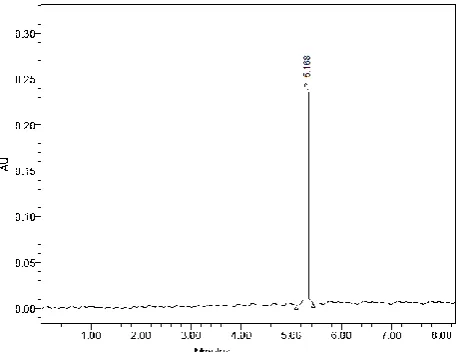
A selective, precise, accurate and stability indicating UPLC method is validated for estimation of Triamcinolone in syrup dosage form. The method employed, with Hypersil BDS C18 (100 mm x 2.1 mm, 1.7 μm) column in gradient mode, with mobile phase of Methanol and Acetonitrile in the ratio of 45:55 %v/v. The flow rate was 1.2 ml/min and effluent was monitored at 238nm. Retention time was found to be 5.212±0.58 min. The method was validated in terms of linearity, accuracy, precision, limit of detection (LOD), limit of quantification (LOQ) etc. in accordance with ICH guidelines. Linear regression analysis data for the calibration plot showed that there was good linear relationship between response and concentration in the range of 8- 40µg/ml respectively. The LOD and LOQ values for were found to be 0.8426(μg/ml) and 2.5535(μg/ml) respectively. No chromatographic interference from syrup’s excipients and degradants were found. The proposed method was successfully used for estimation of Triamcinolone in syrup dosage form.
conditions including light, heat and the susceptibility of the drug product towards hydrolysis or oxidation can play an important role in the production of potential impurities.[10-11] Stress testing can help identifying degradation products and provide important information about intrinsic stability of the drug product.[12-14] Therefore, herein we report the results of stability study of Triamcinolone with the aim of determining the extent of the influence of different stress conditions on the stability of the syrup product.
Fig. 2: Standard Chromatogram of Triamcinolone, using mobile phase of Methanol and Acetonitrile in the ratio of 45:55 %v/v.
2. EXPERIMENTAL Materials
Triamcinolone (99.80 % purity) used as analytical standard was procured from Active Pharma Labs (Hyderabad).
HPLC grade methanol, Acetonitrile (HPLC grade) was purchased from Qualigens fine chemicals, Mumbai, India. Distilled, 0.45 μm filtered water used for UPLC quantification and preparation of buffer. Buffers and all other chemicals were analytical grade.
The commercial syrup-dosage (Aristocort - Syr Orl) labeled to contain 0.4mg/ml of Triamcinolone. All chemicals used were of pharmaceutical or special analytical grade.
Instrumentation
Acquity, Waters UPLC system consisting of a Water 2695 binary gradient pump, an inbuilt auto sampler, a column oven and Water 2996 wavelength absorbance detector (PDA) was employed throughout the analysis.
The data was collected using Empower 2 software. The column used was Hypersil BDS C18 (100 mm x 2.1 mm, 1.7 μm). A Band line sonerex sonicator was used for enhancing dissolution of the compounds. A Labindia pH System 362 was used for pH adjustment.
Chromatographic Conditions
Table 1: Chromatographic Conditions of the validating method.
Parameter Value
Column Hypersil BDS C18 (100 mm x 2.1 mm, 1.7 μm) Mobile Phase Methanol and Acetonitrile
in the ratio of 45:55 %v/v Flow rate 1.2 mL/min
Run time 08 Min.
Column Temperature Maintained at ambient temperature
Injection volume 20 μL Detection wavelength 238nm Diluent Mobile Phase
Preparation of Standard Stock Solution Preparation of Diluent
In order to achieve the separation under the optimized conditions after experimental trials that can be summarized. Stationary phase like Hypersil BDS C18 (100 mm x 2.1 mm, 1.7 μm) column was most suitable one, since it produced symmetrical peaks with high resolution and a very good sensitivity and with good resolution. The flow rate was maintained 1.2 mL min-1 shows good resolution. The PDA detector response of Triamcinolone was studied and the best wavelength was found to be 238 nm showing highest sensitivity.
The mixture of two solutions methanol and acetonitrile in the ratio of 45:55%v/v. Finally, the pH was adjusted to 10.5 with triethylamine. with gradient programming was used as mobile phase at 1.2mL/min was found to be an appropriate mobile phase for separation of Triamcinolone. The column was maintained at ambient temperature.
Preparation of internal standard solution
Weighed accurately about 10 mg of prednisolone working standard and transfer to 100 ml volumetric flask, add 50 ml of mobile phase and sonicate to dissolve it completely and then volume was made up to the mark with mobile phase to get 100 µg/ml of standard stock solution of working standard. Then it was ultrasonicated for 10 minutes and filtered through 0.20 μ membrane filter.
Preparation of Triamcinolone standard solution
Stability Indicating Studies
Stability Indicating studies like acid hydrolysis, basic hydrolysis, dry heat degradation, wet heat degradation and oxidative degradation were carried out.
3. RESULTS AND DISCUSSIONS Validation
The analytical method was validated with respect to parameters such as linearity, precision, specificity and accuracy, limit of detection (LOD), limit of quantitation (LOQ) and robustness in compliance with ICH guidelines.
Linearity and Range
The linearity of an analytical procedure is the ability to obtain test results that are directly proportional to the concentration of an analyte in the sample.
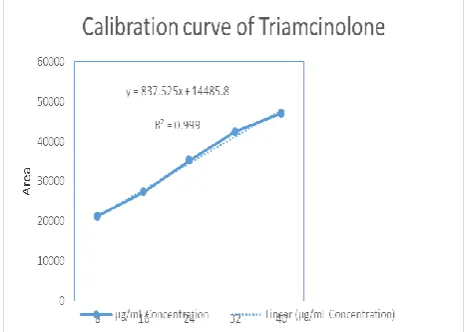
The calibration curve showed good linearity in the range of 8 – 40 µg/ml, for Triamcinolone(API) with correlation coefficient (r2 ) of 0.9966. A typical calibration curve has the regression equation of y = 837.525x +14485.8 for Triamcinolone. Results are given in Table 2.
Limit of Detection (LOD) and Limit of Quantitation (LOQ)
The LOD and LOQ of Triamcinolone were calculated by mathematical equation. LOD= 3.3×standard deviation ÷ slope and LOQ=10×standard deviation ÷ slope. The LOQ of Triamcinolone was found to be 2.5535(μg/ml) and the LOD of Triamcinolone was found to be 0.8426(μg/ml). Results are given in Table 2.
Table 2: Summary of validation parameters for the proposed method.
PARAMETER Triamcinolone
Linearity 8 – 40 µg/ml Intercept (c) 14485.8 Slope (m) 837.525 Correlation coefficient 0.9966 LOD 2.5535(μg/ml) LOQ 0.8426(μg/ml)
Precision
The Precision of the method was studied in terms of intraday and interday precision of sample injections (16 µg/ml). Intraday precision was investigated by injecting six replicate samples of each of the sample on the same day. The % RSD was found to be 0.20%. Interday precision was assessed by analysis of the 6 solutions on three consecutive days. The % RSD obtained was found to be 0.61%. Low % RSD values indicate that the method is precise. The results are given in table 3.
Accuracy
To study the accuracy of method, recovery studies were carried out by spiking of standard drug solution to pre-analyzed sample at three different levels i.e., at 50, 100, and 150%. The resultant solutions were then reanalyzed by the proposed method. At each level of the amount, six determinations were performed. From the data obtained, the method was found to be accurate. The % recovery and %RSD were calculated and presented in Table 4.
Robustness
Small deliberate changes in chromatographic conditions such as change in temperature (± 2°C), flow rate (± 0.1ml/min) and wavelength of detection (± 2nm) were studied to determine the robustness of the method. The results were in favor of (% RSD < 2%) the developed UPLC method for the analysis of Triamcinolone. The results are given in table 5.
Table 3: Results of Precision Studies. Triamcinolone
Precision Studies
Parameter Peak Area % RSD % L C Intraday
precision
26856
0 . 5 0 %
9 8 . 8 8 % 27104 9 9 . 7 9 % 27067 9 9 . 6 6 %
Inter day precision
26838
0 . 6 1 %
9 8 . 8 1 % 27147 9 9 . 9 5 % 27087 9 9 . 7 3 %
Instrument:1 Acquity UPLC Waters, 2695H
27111
0 . 0 3 %
9 9 . 8 2 % 27126 9 9 . 8 7 % 27109 9 9 . 8 1 %
Instrument:2 Agilent Technologies, 1290
27117
0 . 0 4 %
9 9 . 8 4 % 27129 9 9 . 8 8 %
27107 9 9 . 8 0 %
Average 9 9 . 6 5
Std.Dev 0 . 3 8
Table 4: Results of accuracy study. Triamcinolone
Level % Amount added (μg/ml) Amount found (μg/ml) % Recovery Mean
recovery (%) Std. Dev % RSD
50 08.06 08.02 99.50
99.25 0.7071 0.71% 100 16.12 16.09 99.81
150 24.18 23.81 98.46
Table 5: Results of Robustness Studies. Robustness Studies
Parameter Value Peak Area % RSD Flow Rate
Low 27553
0.11%
Actual 27597
Plus 27613
Temperature
Low 27559
0.13%
Actual 27624
Plus 27620
Wavelength
Low 27544
0.14%
Actual 27589
Plus 27620
Results of Stability Indicating Studies
According to Singh and Bakshi, the stress testing suggests a target degradation of 20-80 % for establishing stability indicating nature of the method. UPLC study of samples obtained on stress testing of Triamcinolone under different conditions using mixture Methanol and Acetonitrile in the ratio of 45:55 %v/v as a mobile solvent system suggested the following degradation behaviour.
a. Acid hydrolysis
An accurate 10 ml of pure drug sample solution was transferred to a clean and dry round bottom flask (RBF). 30 ml of 0.1 N HCl was added to it. It was refluxed in a water bath at 60°C for 4 hours. Drug became soluble after reflux which was insoluble initially. Allowed to cool at room temperature. The sample was then neutralized using 2N NaOH solution and final volume of the sample was made up to 100ml with water to prepare 100ppm solution. It was injected into the UPLC system against a blank of Methanol and Acetonitrile in the ratio of 45:55 %v/v after optimizing the mobile phase composition, chromatogram was recorded and shown in Fig. 3.
Fig. 3: Chromatogram showing the degraded products in Acidic degradation.
b. Basic hydrolysis
An accurate 10 ml of pure drug sample solution was transferred to a clean and dry RBF. 30 ml of 0.1N NaOH was added to it. It was refluxed in a water bath at 60°C for 4 hours. Drug became soluble after reflux which was insoluble initially. It was allowed to cool at room temperature. The sample was then neutralized using 2N HCl solution and final volume of the sample was made up to 100ml with water to prepare 100ppm solution. It was injected into the UPLC system against a blank of Methanol and Acetonitrile in the ratio of 45:55 %v/v after optimizing the mobile phase composition, chromatogram was recorded and shown in Fig. 4.
c. Wet heat degradation
Accurate 10 ml of pure drug sample was transferred to a clean and dry RBF. 30 ml of HPLC grade water was added to it. Then, it was refluxed in a water bath at 60°C for 6 hours uninterruptedly. After the completion of reflux, the drug became soluble and the mixture of drug and water was allowed to cool at room temperature. Final volume was made up to 100 ml with HPLC grade water to prepare 100 ppm solution. It was injected into the UPLC system against a blank of Methanol and Acetonitrile in the ratio of 45:55 %v/v after optimizing the mobile phase composition, chromatogram was recorded and shown in Fig. 5.
Fig. 5: Chromatogram showing the degraded products in Wet heat degradation.
d. Oxidation with (3%) H2O2
Approximately 10 ml of pure drug sample was transferred in a clean and dry 100 ml volumetric flask. 30 ml of 3% H2O2 and a little methanol was added to it to
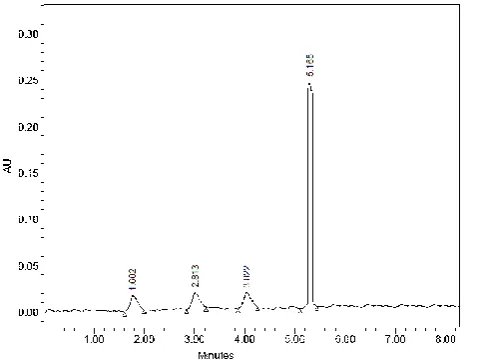
make it soluble and then kept as such in dark for 24 hours. Final volume was made up to 100 ml using water to prepare 100 ppm solution. The above sample was injected into the UPLC system. The chromatogram was recorded and shown in Fig. 6.
Fig. 6: Chromatogram showing the degraded products in H O
In all degradation studies, there was a significant formation of degradation products when compared to that of a standard. This indicates that, the drug may be degraded to low molecular weight non-chromophoric compounds.
Table 6: Stability Indicating study for the developed method.
Nature of Stress
Degradation condition
Time (h)
Number of degradation products (Rt)
Acidic 60°C 3 1 (4.821) Basic 60°C 9 1 (1.381)
Oxidative RT 48 3 (1.602, 2.813, 3.822) Wet Heat 105°C 24 2 (1.637, 2.213)
4. CONCLUSION
A selective and sensitive stability indicating UPLC method has been validated for the analysis of Triamcinolone in bulk drug and syrup dosage form. Based on peak purity results, obtained from the analysis of stability indicating studying samples using described method, it can be concluded that the absence of co-eluting peak along with the main peak of Triamcinolone indicated that the developed method is specific for the estimation of Triamcinolone in presence of degradation products. Further the proposed UPLC method has excellent precision, sensitivity and reproducibility. Even though no attempt has been made to identify the degraded products, proposed method can be used as stability indicating method for assay of Triamcinolone in commercial formulations.
5. ACKNOWLEDGEMENTS
The authors are thankful to Active Pharma Labs (Hyderabad, India) for providing gift sample of Triamcinolone.
6. REFERENCES
1. International Conference on Harmonization Guideline on Validation of Analytical Procedures Text and Methodology: Q2 (R1), 2005.
2. Rania N, El-Shatieny, Fathalla F.B. Journal of Chemistry, 2015: 1-9.
3. Nguyen D.T., Guillarme D, Rudaz S, Veuthey J. L., Fast Analysis in Liquid Chromatography Using Small Particle Size and High Pressure. J Sep Sci, 2006 Aug; 29(12): 1836-48.
4. Katharina Sterz, Gerhard Scherer, Josef Ecker. A Simple and Robust UPLC-SRM/MS Method To Quantify Urinary Eicosanoids.J Lipid Res, 2013; 1-28.
6. Michael E Swartz, Ultra performance liquid chromatography UPLC: an introduction. Separation science redefined, 2005; 1: 8-14.
7. Rasheed A et al., Analytical Method Development and Validation for the Simultaneous Estimation of Aspirin, Clopidogrel Bisulphate and Atorvastatin Calcium in Tablet Dosage Form. American Journal of PharmTech Research, 2014.
8. Ranjit S, Rehman Z. Current trends in stability indicatingstudy for pharmaceutical product development. J Pharm Educ Res, 2012; 3(1): 54-63. 9. The European Pharmacopoeia convention on the
Elaboration of European Pharmacopoeia, (5th Edn), 2005; 2: 2613.
10. Gupta SK, Kumar B, Sharma PK Development and validation of Spectrophotometric method for estimation of Triamcinolone in solid dosage form. Asian J Pharm Ana, 2013; 3(2): 42-43.
11. Dave BR, Jiladia MA, Vidysagar G.Simultaneous estimation of Chlorhexidine and Tramcinolone by HPLC. Int Jou of Pharm Sci, 2012; 3(4): 2850-2860. 12. Emirhan N, Filiz S, Umut A, Nursabah B. Determination of Tramcinolone in subretinal fluid by avalidated HPLC method. Hacettepe University, Journal of Faculty of Pharmacy, 2005; 25(2): 71-78. 13. Aquino GDA, Stopilha RT, Pedrosa KSCR, et al. Validation of quantitative analysis method for Triamcinolone in ternary complexes by UV -Vis spectrophotometry. Rev Cienc Farm Basica Apl, 2011; 32(1): 35- 40.
14. Silva AA, Formariz TP, Scarpa MV, Oliveria AG Devlopment and validation of HPLC method for quantitative analysis of Triamcinolone in biodegradable microparticales. Rev Cienc Farm Basica Apl, 2006; 27(2): 119-126.