95
Copyright © 2016. Vandana Publications. All Rights Reserved.
Volume-6, Issue-6, November-December 2016
International Journal of Engineering and Management Research
Page Number: 95-102
Delivering Results in Diversity & Demographic Differences
Dr. K. R. Subramanian
Professor of Management & Business Consultant,INDIA
ABSTRACT
An organization’s success and competitiveness depends upon its ability to understand environmental changes and embrace diversity and realize the benefits. When organizations actively assess their handling of workplace diversity issues, develop and implement diversity plans, multiple benefits are reported such as:Organizations employing a diverse workforce can supply a greater variety of solutions to problems in service, sourcing, and allocation of resources. Employees from diverse backgrounds bring individual talents and experiences in suggesting ideas that are flexible in adapting to fluctuating markets and customer demands.A diverse collection of skills and experiences (e.g. languages, cultural understanding) allows a company to provide service to customers on a global basis.A diverse workforce that feels comfortable communicating varying points of view provides a larger pool of ideas and experiences. The organization can draw from that pool to meet business strategy needs and the needs of customers more effectively.Companies that encourage diversity in the workplace inspire all of their employees to perform to their highest ability. Company-wide strategies can be then executed; resulting in higher productivity, profit, and return on investment. This calls for high level of integration of global competencies for delivering best results in the competitive environment.
Keywords-- Environmental changes, competitiveness, work place diversity and demographics.
I.
INTRODUCTION
Diversity in the work place is a reality in modern organizations with work force from different cultural backgrounds. Integrating the efforts of such a diverse work force towards organisational goals is the challenge of present day organisations. Taking full advantage of the benefits of diversity in the workplace is not without its challenges. Some of those challenges are: Communication - Perceptual, cultural and language barriers need to be overcome for diversity programs to succeed. Ineffective communication of key objectives results in confusion, lack of teamwork, and low morale. Resistance to change -
There are always employees who will refuse to accept the fact that the social and cultural makeup of their workplace is changing. The ―we‘ve always done it this way‖ mentality silences new ideas and inhibits progress. Implementation of diversity in the workplace policies - This can be the overriding challenge to all diversity advocates. Armed with the results of employee assessments and research data, they must build and implement a customized strategy to maximize the effects of diversity in the workplace for their particular organization. Successful Management of Diversity in the Workplace - Diversity training alone is not sufficient for your organization‘s diversity management plan. A strategy must be created and implemented to create a culture of diversity that permeates every department and function of the organization.
II.
ASSESSMENT OF DIVERSITY IN
THE WORKPLACE
Top companies make assessing and evaluating their diversity process an integral part of their management system. A customizable employee satisfaction survey can accomplish this assessment for your company efficiently and conveniently. It can help your management team determine which challenges and obstacles to diversity are present in your workplace and which policies need to be added or eliminated. Reassessment can then determine the success of you diversity in the workplace plan implementation. Development of diversity in the workplace plan - Choosing a survey provider that provides comprehensive reporting is a key decision. That report will be the beginning structure of your diversity in the workplace plan. The plan must be comprehensive, attainable and measurable. An organization must decide what changes need to be made and a timeline for that change to be attained.
96
Copyright © 2016. Vandana Publications. All Rights Reserved.
The personal commitment of executive and managerial teams is a must. Leaders and managers within organizations must incorporate diversity policies into every aspect of the organization‘s function and purpose. Attitudes toward diversity originate at the top and filter downward. Management cooperation and participation is required to create a culture conducive to the success of your organization‘s plan.
IV.
OBJECTIVES AND
METHODOLOGY
Today while organizations are striving to get the best performance out of Employees, and deliver results consistently,they have to contend with work place diversity, which is a reality. The present study and research is to understand how present day organizations cope with the situations and meet the challenges of diversity in the work force. With this in mind following research objectives have been identified for the purpose of this research work:
1. To assess present business environment and evaluate the reality of diversity.
2. To study and highlight the key issues arising out of work place diversity.
3. To understand how organizations are coping with diversity issues
4. The impact of demographic differences in the work force on diversity
5. To suggest ways and means for organizations to cope with this problem
On a detailed Literature search and Analysis, it has been observed that the amount of published information through previous research papers on this and related issues is enormous so a separate field investigation through questionnaire survey or other methods was not found necessary to arrive at conclusions for the present limited research objectives as cited above. A detailed analysis and classification of data from various sources was, of course, necessary to focus on the research problemand arrive at the conclusions at the end of this paper.
V.
REVIEW OF LITERATURE
To create a corporate culture that values diversity, Workplace diversity has become an increasingly important part of the global workplace. The Equal Employment Opportunity Commission was created in 1965 to open the door for women and minorities to find better employment opportunities in workplace. New visa categories and programs facilitating entry of information technology professionals, technical consultants, scientists, and business and management professionals from a cross section of countries have made the workplace even more
diverse. Businesses benefit in many ways from having employees with differing backgrounds and perspectives. Access to a larger talent pool is one of the biggest advantages of having an employment recruitment policy that values diversity. Employees from all races, classes, creeds, religions, ages and political viewpoints should be recruited based on competencies and skill sets, without regard to gender or disability.Teams working on complex and expansive projects can draw on the varied experiences of fellow workers from diverse backgrounds. This can aid in understanding new markets -- foreign or domestic. When human resources channels and harnesses varied skills, specialized competencies and distinctive capabilities of employees of multiple races and minority classes, it can result in creative solutions for problems and better organizational productivity.
Regular interaction with people from different countries or backgrounds can help reduce discrimination, prejudice and misunderstandings from earlier eras. Taking time to celebrate of fellow workers‘ cultures and holidays can boost morale and create a better team bond among diverse employees. Cultural multiplicity, ethnic diversity and multiple viewpoints bring vibrancy to the workplace. Fostering workplace camaraderie and a humanitarianism spirit shape employees to be better citizens of tomorrow.
Figure 1: Diversity in the work pace
VI.
LIST ADVANTAGES OF
DIVERSITY IN THE WORKPLACE
Workplace diversity refers to the variety of differences between people in an organization. That sounds simple, but diversity encompasses race, gender, ethnic group, age, personality, cognitive style, tenure, organizational function, education, background and more. Diversity in not only how people perceive themselves, but how they perceive others. These perceptions affect their interaction. For a wide assortment of employees to function effectively as an organization, human resource personnel need to deal with issues such as communication,
adaptability and change. Diversity will increase
97
Copyright © 2016. Vandana Publications. All Rights Reserved.
willing to spend resources on managing diversity in the workplace now.
A diverse workforce that feels comfortable communicating varying points of view provides a larger pool of ideas and experiences. The organization can draw from that pool to meet business strategy needs and the needs of customers more effectively. An organization‘s success and competitiveness depends upon its ability to embrace diversity and realize the benefits. When organizations actively assess their handling of workplace diversity issues, develop and implement diversity plans, multiple benefits are reported such as:
1. Increased Creativity
Didn‘t they say two heads are better than one? In a diverse workplace, this saying becomes two different people are better than one. When people in different cultures, backgrounds and beliefs come together to work for a common goal, increased creativity can be achieved. What is already artistic can become even better. What already works can evolve into something else. Companies that encourage diversity in the workplace inspire all of their employees to perform to their highest ability. Company-wide strategies can then be executed; resulting in higher productivity, profit, and return on investment.
2. Increased adaptability
In order to address problems of workplace diversity, an organization has to develop a variety of solutions, forcing them to adapt to a diverse workforce. It will be a long process, but totally worth it. Moreover, people from diverse backgrounds can provide ideas for adapting to ever-changing customer demands and fluctuating markets. Organizations employing a diverse workforce can supply a greater variety of solutions to problems in service, sourcing, and allocation of resources. Employees from diverse backgrounds bring individual talents and experiences in suggesting ideas that are flexible in adapting to fluctuating markets and customer demands. This also means that an organization has to develop a new process for people with different ideas to collaborate and work together. They must also learn to think cross-culturally and to quickly adapt to new situations.
3. Melting Pot of ideas
No two people think exactly alike, and a company that knows how to exploit varying viewpoints of each individual can create a large pool of ideas and experiences. They can then draw from the pool strategies to effectively deal with business concerns and customer needs.
4. Increased productivity
Globalization and internalization are two of the gifts that workforce diversity brings to the table, which is why foreign executives are very successful in the corporate world in America, while citizens from Europe find their place in high-level jobs. Put them together in one place and what you get is increased productivity.
5. Increased range of services
A diverse collection of people with different experiences, skills, cultural understanding, languages and other differences enables a company to provide customers services on a global basis. A hotel, for example, that employs people of different races will have the confidence to accommodate guests from different races as well. This is because language and cultural gaps are avoided. If management gets an in-depth understanding of the culture of a particular race, they can also provide services that would appeal specifically to them.A diverse collection of
skills and experiences (e.g. languages, cultural
understanding) allows a company to provide service to customers on a global basis.
Figure 2: Diversity in work place
VII.
LIST OF DISADVANTAGES OF
DIVERSITY IN THE WORKPLACE
1. Communication Issue
Effective communication is a driving factor for success. Unfortunately, diversity can be in the way, and can directly impact productivity because of a lack of cohesiveness. This explains why some companies catering to international customers hire multilingual or bilingual customer service reps. It is easier for Spanish-speaking customers, for example, to communicate with someone who understands their culture and knows their native language. So unless effective communication is achieved, workplace diversity can be a problem.
2. Lack of freedom of speech
In a diverse workplace, an employee must be sensitive to others‘ race, cultural background, beliefs, etc. So you don‘t just crack jokes about the Chinese or Indians, because it won‘t be as acceptable as when a stand-up comedian would do it. People can‘t freely state their opinions or tell stories whenever they want for fear of being judged as discriminating. So it‘s not only effective communication that is a disadvantage in a diverse workplace, but also freedom of speech. Imagine working in an environment where you need to always tread carefully. Not exactly a fun and attractive workplace.
3. Increased cost of training
98
Copyright © 2016. Vandana Publications. All Rights Reserved.
achieved, such training is essential as they will teach employees how to accept thoughts, ideas and personalities of others in the workplace. It will also provide information on how to deal with prejudice and conflict in a civilized and professional manner. As it is possible that you are likely to continue hiring employees, you will continue to spend on training.
4. Integration issues
Even in a non-diverse workplace exclusive social groups or cliques naturally happens, more so in a diverse workforce. When such groups form, informal divisions can occur, which will impede social integration. It will also lead to a situation where culturally diverse employees will avoid each other. This can hinder the effective sharing of knowledge, experience, skills, resulting in decreased productivity, team efficacy, and business growth.
5. Increased competition
Competition in the workplace is good as it can drive success and higher productivity. But when employees do not accept other culture, they are likely to compete against each other, rather than become collaborative members of a team. These results in divisions where people prefer to work separately, prolonging the process of task or project completion. This can have a negative impact on business because progress will be slow moving. There is strength in numbers, after all.
6. Breeds disrespect
The same people who don‘t accept other cultures are likely to openly show disrespect and indifference. This can lead to unnecessary tension and can inhibit communication in the workplace. The problem with a highly tense or hostile workplace is that everyone is affected, including those that accept and respect diversity in the workplace
7. Demographic differences
World over, the demographic Composition of population in general and particularly the work force population is undergoing a serious change. The average age of working population is increasing in the western world where as the younger population is growing in the South East and Asian counties. This has a profound influence in the qualified and technical work force migrating to developed countries from developing or less developed countries. The policy makers in western countries are possessed of this situation! We may see a lot of policy changes in the immigration rules of these countries and how far and what segment of population is allowed to migrate, some racial prejudices, adding to the drama.
VIII. CHALLENGES OF DIVERSITY IN
THE WORKPLACE
Taking full advantage of the benefits of diversity in the workplace is not without its challenges. Some of
those challenges are:Communication,Resistance to
change,Implementation of diversity in the workplace policies, Successful Management of Diversity in the Workplace, Assessment of diversity in the workplace, Development of diversity in the workplace plan and Implementation of diversity in the workplace plan.
Perceptual, cultural and language barriers need to be overcome for diversity programs to succeed. Ineffective communication of key objectives results in confusion, lack of teamwork, and low morale. There are always employees who will refuse to accept the fact that the social and cultural makeup of their workplace is changing. The ―we‘ve always done it this way‖ mentality silences new ideas and inhibits progress.This can be the overriding challenge to all diversity advocates. Armed with the results of employee assessments and research data, they must build and implement a customized strategy to maximize the effects of diversity in the workplace for their particular organization.Diversity training alone is not sufficient for your organization‘s diversity management plan. A strategy must be created and implemented to create a culture of diversity that permeates every department and function of the organization.
Top companies make assessing and evaluating their diversity process an integral part of their management system. A customizable employee satisfaction survey can accomplish this assessment for your company efficiently and conveniently. It can help your management team determine which challenges and obstacles to diversity are present in your workplace and which policies need to be added or eliminated. Reassessment can then determine the success of you diversity in the workplace plan implementation.
Choosing a survey provider that provides comprehensive reporting is a key decision. That report will be the beginning structure of your diversity in the workplace plan. The plan must be comprehensive, attainable and measurable. An organization must decide what changes need to be made and a timeline for that change to be attained.
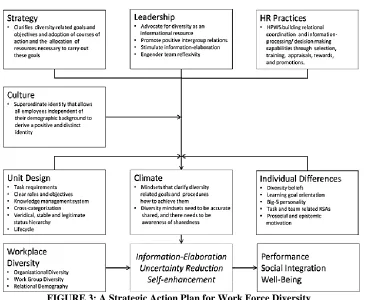
The personal commitment of executive and managerial teams is a must. Leaders and managers within organizations must incorporate diversity policies into every aspect of the organization‘s function and purpose. Attitudes toward diversity originate at the top and filter downward. Management cooperation and participation is required to create a culture conducive to the success of your organization‘s plan. (Ref: Figure 3).
99
Copyright © 2016. Vandana Publications. All Rights Reserved.
FIGURE 3: A Strategic Action Plan for Work Force Diversityand enhance performance through information-elaboration in demographically diverse work groups performing tasks with a strong informational and decision-making component in particular. Extroversion, self-monitoring, and positive stereotypes were shown to safeguard against
negative affective-evaluative responses towards
demographically dissimilar group members and, in turn, prevent lower social integration. As Conscientiousness, Agreeableness, and Emotional Stability are also likely to aid individuals and teams in exploiting and coping with demographic differences (because Agreeableness and Emotional Stability may promote positive interpersonal
relations, and Conscientiousness may facilitate
information-elaboration), future research should examine whether these factors also moderate workplace diversity effects on social integration, well-being, and performance.
IX.
CONCLUSION AND
RECOMMENDATION
In the present globalized environment of business work place diversity is a reality. Companies local or diversified are becoming global with the embracing of
globalization philosophy and advantages
thereof.Recommended diversity in the workplace solutions include: Ward off change resistance with inclusion. - Involve every employee possible in formulating and executing diversity initiatives in your workplace. Foster an attitude of openness in your organization. - Encourage
employees to express their ideas and opinions and attribute a sense of equal value to all. Promote diversity in leadership positions. - This practice provides visibility and realizes the benefits of diversity in the workplace. Utilize diversity training. - Use it as a tool to shape your diversity policy. Launch a customizable employee satisfaction survey that provides comprehensive reporting. - Use the results to build and implement successful diversity in the workplace policies.
As the economy becomes increasingly global, our workforce becomes increasingly diverse. Organizational success and competitiveness will depend on the ability to manage diversity in the workplace effectively. Evaluate your organization‘s diversity policies and plan for the future, starting today. In an increasingly global economy,
the workforce becomes increasingly diverse.
100
Copyright © 2016. Vandana Publications. All Rights Reserved.
results to build and implement successful diversity in the workplace policies.
Individuals often initially judge others based on surface-level diversity. Over time, this effect tends to fade and is replaced by deep-level traits such as similarity in values and attitudes. See Figure 3. Build a Culture of Respecting Diversity: In the most successful companies, diversity management is not the responsibility of the
human resource department. Starting from top
management and including the lowest levels in the hierarchy, each person understands the importance of respecting others. If this respect is not part of an organization‘s culture, no amount of diversity training or other programs are likely to be effective. In fact, in the most successful companies, diversity is viewed as everyone‘s responsibility.
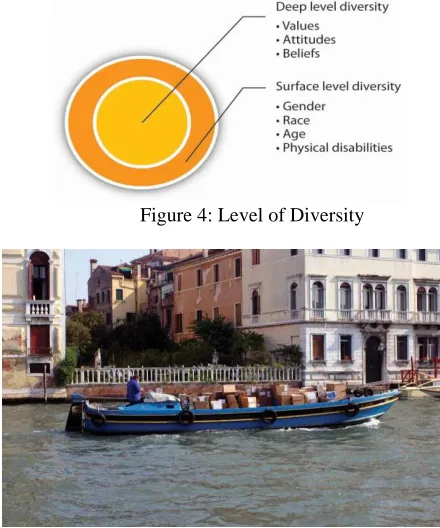
Companies need to understand he two basic levels of diversity – Surface level diversity and Deep rooted Diversity as depicted in the Figure 4. Gender, Age, Race and Physical disabilities are easy to discern and resolve. But deep rooted diversity in the form of Values, Attitudes and Beliefs are the ones companies concentrate on. These can be oriented and reinforced to achieve the company culture and corporate goals through systematic and well designed training programs.
Figure 4: Level of Diversity
Figure5: UPS operates in 200 countries, including Italy Wherea boat is carrying packages on the Canal Grande in
Venice.At UPS, 58% of all senior officers are women or minorities
The United Parcel Service of America Inc. (UPS), the international shipping company, refuses to hire a
diversity officer, underlining that it is not one person‘s job. Companies with a strong culture—where people have a sense of shared values, loyalty to the organization is rewarded, and team performance is celebrated—enable employees with vastly different demographics and backgrounds to feel a sense of belonging.
Diversity is one of our country‘s core strengths. The economic data clearly show that our nation—and, by extension, our workforce—will continue to become increasingly more diverse, as racial and ethnic minorities make up a larger portion of the population, as women continue to enter the workforce, and as gay and transgender individuals, as well as people with disabilities, continue to play a vital role in growing our economy. Going forward, businesses should continue to capitalize and embrace diversity as the workforce itself becomes more diverse. Our economy and our society depend on it.
REFERENCES
[1] Avery, D. R., &McKay, P. F. (2010). Doing diversity right: An empirically based approach to effective diversity management. In G. P. Hodgkinson, &J. K. Ford (Eds.),
International review of industrial and organizational psychology (Vol. 25, pp. 227–252). Oxford, UK: Wiley-Blackwell
[2] Chatman, J. A., Polzer, J. T., Barsade, S. G., & Neale, M. A. (1998). ‗Being different yet feeling similar: The influence of demographic composition and organizational culture on work processes and outcomes‘. Administrative Science Quarterly, 43, 749–780; Fisher, A. (2004). How you can do better on diversity. Fortune, 150(10), 60. [3] Carpenter, M. A.The implications of strategy and social context for the relationship between top management team
heterogeneity and firm performance. Strategic
Management Journal, 23, 275–284. (2002).
[4] Chattopadhyay, P. (1999). Beyond direct and
symmetrical effects: The influence of demographic dissimilarity on organizational citizenship behavior.
Academy of Management Journal, 42, 273–287.
[5] Chattopadhyay, P., George, E., &Ng, C. KAn uncertainty reduction model of relational demography. In
A. Joshi, H. Liao&J. J. Martocchio (Eds.), Research in personnel and human resource management (Vol. 30, pp.
219–251). Bingley, UK: Emerald Group Publishing
Limited. . (2011).
[6] Chattopadhyay, P., George, E., &Ng, C. K.Hearts and minds: Integrating regulatory focus and relational
demography to explain responses to dissimilarity.
Organizational Psychology Review. Advance online
publication. (2015).
[7] Black Enterprise. ―Managing a multicultural work-force.‖ Black Enterprise Magazine (July), 2001.
101
Copyright © 2016. Vandana Publications. All Rights Reserved.
[9] Esty, K., R. Griffin, and M. Schorr-Hirsh. Workplace diversity. A manager‘s guide to solving problems and turning diversity into competitive advantage,Avon, MA: Adams Media Corporation, 1995.
[10] Flagg, A ―Managing diverse workgroups success -fully.‖ United Behavioral Health, 2002.
[11] Koonce, R. ―Redefining diversity: It‘s not just the right thing to do; it also makes good business sense.‖ Training and Development (December), 2001.
[12] Loysk, B. Managing a changing workforce: Achieving outstanding service with today‘s employees. Davie, FL: Workplace Trends Publishing,1996.
[13] Robinson, K-S. 2002. ―U.S. must focus on diversity or face decline in competitiveness.‖,The Society for Human Resource Management (SHRM).
[14] Roosevelt, T.R. Jr. 2001. ―Elements of a successful diversity process‘,The American Institute for Managing Diversity,
[15] ―SHRM survey explores the best in diversity practices, Fortune 500 firms outpace the competition with greater commitment to diversity.‖, The Society for Human Resource Management (SHRM). 1998.
[16] Ely, R., & Thomas, A. (2001). Cultural diversity at work: the effects of diversity perspectives on work group processes and outcomes. Administrative Science Quarterly, 24, 229-273.
[17] Cianni, M., & Romberger, B. (1995). Perceived racial, ethnic, and gender differences in access to developmental
experiences. Group and Organisation Management, 20(4),
440-459.
[18] Kirton, G., & Greene, A. (2000). The dynamics of managing diversity: A critical approach, Oxford: Butterworth Heinemann.
[19] Lawrence, B. S. (1988). New wrinkles in the theory of age: Demography, norms, and performance ratings.
Academy of Management Journal, 31(2), 309-337.
[20] Lawrence, B. S. (1997). The black box of organizational demography. Organization Science, 8(1), 1-22.
[21] Mai-Dalton, R., & Sullivan. J. J. (1981). The effect of manager‘s sex on the assignment to a challenging or dull task and reasons for the choice. Academy of Management Journal, 24(3), 603-612.
[22] Mor Barak, M. E., Cherin, D. A., & Berkman, S. (1998). Organisational and personal dimensions in diversity climate. Journal of Applied Behavioral Science, 34(1), 82-104
[23] Pfeffer, J. (1985). Organizational demography:
Implications for management. California Management
Review, 28(1), 67-81.
[24] Shenhav, Y., & Haberfeld, Y. (1992). Organizational demography and inequality. Social Forces, 71(1), 123-143. [25] Stewman, S. (1988). Organizational demography.
Annual Review of Sociology, 14, 173-202.
[26] Wagner, W. G., Pfeffer, J., & O‘Reilly, C. A. 111. (1984) Organisational demography and turnover in
top-management groups. Administrative Science Quarterly,
vol. 29, pp. 74-92
[27] Wiersema, M. F., & Bantel, K. A. (1992). Top management team demography and corporate strategic
change. Academy of Management Journal, 35(1), 91-108.
[28] Wiersema, M. F., & Bird, A. (1993). Organisational demography in Japanese firms: Group heterogeneity, individual dissimilarity, and top management team turnover. Academy of Management Journal, 38(5), 996-1026.
[29] Zenger, T. R., & Lawrence, B. S. (1989). Organisational demography: The differential effects of age and tenure distributions on technical communication,
Academy of Management Journal, 32(2), 353-376. [30] Zweigenhaft, R.L., and G.W. Domhoff. ‗Diversity in the power elite: Have women and minorities reached the top?‘ New Haven, CT: Yale University Press. 1998. [31] Chattopadhyay, P. (2003). Can dissimilarity lead to positive outcomes? The influence of open versus closed minds. Journal of Organizational Behavior, 24, 295–312.
[32] Chi, N. W., Lin, S. C., &Huang, Y. MA double-edged sword? Exploring the curvilinear relationship between organizational tenure diversity and team innovation: The moderating role of team-oriented HR practices. Group and Organization Management, 34, 698–726. (2009).
[33] Daily, B., Whatley, A., Ash, S. R., &Steiner, R. LThe effects of a group decision support system on culturally diverse and culturally homogeneous group decision making. Information & Management, 30, 281–289..
(1996).
[34] Elfenbein, H. A., &O'Reilly, C. A. IIIFitting in: The effects of relational demography and person-culture fit on group process and performance. Group and Organization Management, 32, 109–142.(2007).
[35]Gonzalez, J. A., &DeNisi, A. S.Cross-level effects of demography and diversity climate on organizational
attachment and firm effectiveness. Journal of
Organizational Behavior, 30, 21–40.(2009).
[36] Guillaume, Y. R. F., Dawson, J. F., Priola, V.,
Sacramento, C. A., Woods, S. A., Higson, H. E., … West, M. A.Managing diversity in organizations: An integrative model and agenda for future research. European Journal of
Work and Organizational Psychology, 23, 783–802,
(2014).
[37] House, R. J., Hanges, P. J., Javidan, M., Dorfman, P. W., &Gupta, N. (Eds.). Culture, leadership, and
organizations: The GLOBE study of 62 societies.
Thousand Oaks, CA: Sage Publications. (2004).
[38] Mohammed, S., &Angell, L. C.Surface- and deep-level diversity in workgroups: Examining the moderating effects of team orientation and team process on relationship conflict. Journal of Organizational Behavior,
25, 1015–1039. (2004).
102
Copyright © 2016. Vandana Publications. All Rights Reserved.
organizational behavior, 20 (Vol. 20, pp. 77–140). New York: Elsevier/JAI. (1998).
[40] Zoogah, D. B., Vora, D., Richard, O., &Peng, M. W.
(2011). Strategic alliance team diversity, coordination, and effectiveness. International Journal of Human Resource Management, 22, 510–529.
WEB REFERENCES
[1] http://www.shrm.org/
[2] Toyota; http://www.toyota.com/about/diversity/ [3]Coca Cola;
http://www.coca-colacompany.com/ourcompany/diversity/
[4] Toyota; http://www.toyota.com/about/diversity/ [5]http://www.diversitybusiness.com/Resources/DivLists/2 013/DivTop50/2013Div50C.htm