S T U D Y P R O T O C O L
Open Access
The effect of computer-based cognitive
flexibility training on recovery of executive
function after stroke: rationale, design and
methods of the TAPASS study
Renate M. van de Ven
1*, Ben Schmand
1, Erny Groet
2, Dick J. Veltman
3and Jaap M. J. Murre
1Abstract
Background:Stroke survivors frequently suffer from executive impairments even in the chronic phase after stroke, and there is a need for improved rehabilitation of these functions. One way of improving current rehabilitation treatment may be by online cognitive training. Based on a review of the effectiveness of computer-based cognitive training in healthy elderly, we concluded that cognitive flexibility may be a key element for an effective training, which results in improvements not merely on trained tasks but also in untrained tasks (i.e., far transfer). The aim of the current study was to track the behavioral and neural effects of computer-based cognitive flexibility training after stroke. We expected that executive functioning would improve after the cognitive flexibility training, and that neural activity and
connectivity would normalize towards what is seen in healthy elderly.
Methods/design:The design was a multicenter, double blind, randomized controlled trial (RCT) with three groups: an experimental intervention group, an active control group who did a mock training, and a waiting list control group. Stroke patients (3 months to 5 years post-stroke) with cognitive complaints were included. Training consisted of 58 half-hour sessions spread over 12 weeks. The primary study outcome was objective executive function. Secondary measures were improvement on training tasks, cognitive flexibility, objective cognitive functioning in other domains than the executive domain, subjective cognitive and everyday life functioning, and neural correlates assessed by both structural and resting-state functional Magnetic Resonance Imaging. The three groups were compared at baseline, after six and twelve weeks of training, and four weeks after the end of the training. Furthermore, they were compared to healthy elderly who received the same training.
Discussion:The cognitive flexibility training consisted of several factors deemed important for effects that go beyond improvement on merely the training task themselves. Due to the presence of two control groups, the effects of the training could be compared with spontaneous recovery and with the effects of a mock training. This study provides insight into the potential of online cognitive flexibility training after stroke. We also compared its results with the effectiveness of the same training in healthy elderly.
Trial registration:The Netherlands National Trial Register NTR5174. Registered 22 May 2015.
Keywords:Stroke, Cognitive flexibility training, Computer-based training, Online testing, Rehabilitation outcome, Executive functions, Cognitive control, Randomized controlled trial, Cognition, Structural and functional Magnetic Resonance Imaging (MRI and fMRI)
* Correspondence:[email protected] 1
Department of Psychology, University of Amsterdam, Weesperplein 4, 1018XA, Amsterdam, The Netherlands
Full list of author information is available at the end of the article
Background
There is a great need for cognitive rehabilitation after stroke (i.e., brain hemorrhage or infarct). More than half of stroke patients suffer from cognitive impairment three months post-stroke [1]. Even in the chronic phase (90 days to 2 years post-stroke), approximately a third of stroke survivors still suffer from cognitive impairment [2]. Im-portantly, current rehabilitation programs do not seem to significantly improve executive functioning [3], whereas these impairments are related to reduced functionality in instrumental activities of daily living.
One promising way to ameliorate these impairments is to use computer games as cognitive exercises. In a recent review by our group, we concluded that cognitive training in healthy elderly subjects may result in cognitive im-provement, provided that it includes frequent switching between various training tasks [4]. Such cognitive flexibil-ity training improved cognitive functioning even in tasks that were not the focus of training, that is, the effects of the training generalized to so called‘far transfer tasks’[5].
Transfer of training to cognitive domains such as execu-tive functioning, and especially generalization of training effects to the patient’s daily life functioning, is essential for clinical application of any rehabilitation technique. More-over, effects of cognitive training may be largest in people who start at a low level of functional performance [6, 7]. Thus, it seems likely that cognitive flexibility training will result in significant improvements in cognitively impaired stroke patients. Several studies in healthy people observed changes in brain activity after intensive cognitive training, which correlated with training performance even if behav-ioral training effects were small [8–10]. This suggests that the training effects may leave visible traces in the brain. Against this background we planned the‘Training Project Amsterdam Seniors and Stroke’(TAPASS) study.
Aim of the study
TAPASS aimed to determine whether cognitive flexibil-ity training could improve executive functioning in stroke patients, and if so, to investigate how changes in executive functioning were correlated with functional and structural changes in the brain. We expected that cognitive flexibility training improved objective executive functioning after stroke over and above improvements due to care as usual and spontaneous recovery. More so, we expected that cognitive flexibility training would result in more executive improvement compared to an active control condition, i.e. mock training.
To determine the neural correlates of executive im-provements after cognitive flexibility training we per-formed resting-state functional Magnetic Resonance Imaging (fMRI), Diffusion Tensor Imaging (DTI), and gray matter imaging in part of the sample. We expected that cognitive improvement would be related to changes
in brain activity and structure. In particular, we expected that resting-state brain activity and structural connectivity of stroke patients who received cognitive flexibility training converged to “normal”, more so than brain activity and connectivity of those who did not receive this training.
Finally, we studied whether cognitive flexibility training was more beneficial for those with lower baseline execu-tive performance (stroke patients compared to healthy adults), and whether this training was more beneficial in the post-acute or in the chronic phase post-stroke. We predicted that cognitive flexibility training would be more effective in stroke patients compared with healthy adults, and that it would be more effective in the post-acute phase than in the chronic phase post-stroke. We also explored which lesion characteristics (e.g., type of stroke, size and localization of lesion) and other variables (e.g., IQ, age, comorbidities, cognitive flexibility at baseline) predicted outcome.
Design
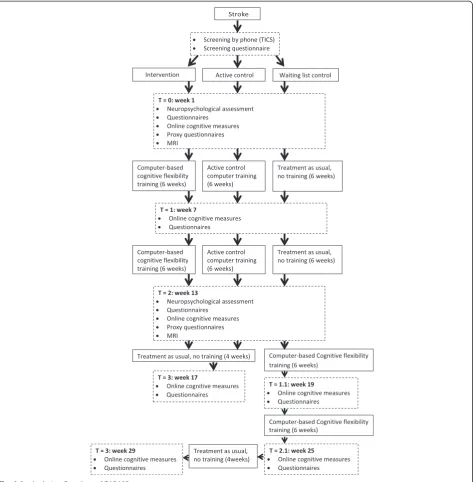
The design was a multicenter, double blind, randomized controlled trial (RCT) with an experimental intervention group, an active control group, and a waiting list control group. A schematic overview of the study design can be found in Fig. 1. We aimed to include 120 participants.
Methods
Patient sample
The TAPASS study was carried out at the University of Amsterdam. Participants were recruited from several Dutch rehabilitation centers and rehabilitation depart-ments of hospitals. Each of the rehabilitation centers treats approximately 150 stroke patients per year, of whom at least 31–35 % have cognitive complaints [2, 11] and approximately 67 % of these also fulfill other study requirements. We expected that 35 % of the eligible group would participate in our study, which is ap-proximately 7.5 % of the stroke patients admitted to the rehabilitation centers per year.
In-and exclusion criteria
emails (e.g., open emails and click on links), and able to smoothly use the mouse.
Exclusion criteria for patients were the presence of neurodegenerative disease, epilepsy, serious psychiatric illness (e.g., history of multiple psychotic episodes, acute psychosis, acute major depression), any disease other than stroke which results in severe cognitive impair-ments, drug or alcohol dependency, severe color blind-ness, severe aphasia, severe neglect, invalidating vision or hearing problems, severe computer fear disabling the participant to fully complete the neuropsychological
Healthy elderly were recruited in another, parallel study conducted as part of TAPASS. They were elderly (older than 60 years) who did not have any cognitive complaints. The same exclusion criteria applied to the healthy elderly sample as described above for stroke patients. Also, they needed to have daily access to a computer with Internet and sound as well as basic computer skills.
For the MRI part of the study additional exclusion cri-teria were contraindications to MRI (see Additional file 1), such as presence of metal parts in the body and claustro-phobia, and being unable to walk a small distance to reach the MRI scanner without metal support.
Recruitment procedures
Participants were recruited from patient databases of re-habilitation centers (Reade Amsterdam, Heliomare Wijk aan Zee, De Hoogstraat Utrecht, De Trappenberg Huizen, Adelante Hoensbroek, The Netherlands) and a hospital (Academic Medical Centre Amsterdam). Those who ful-filled the inclusion criteria were notified by their clinician, or via their caregiver, or were sent a letter with a request to participate in this study. Patients who were inter-ested received written information regarding the study either by mail or at one of their treatment sessions. The researcher contacted the patients to provide further in-formation (if needed) and to invite them to participate.
Additionally, participants were recruited by advertise-ments in newsletters and forums of Dutch stroke pa-tients associations. The advertisement called for people who suffered from stroke less than five years ago, who (had) received rehabilitation, and who had residual cog-nitive complaints. Those interested in participating in our study were asked to contact the researchers, who provided them with written information about the study. Whenever participants indicated that they wanted to participate in the study, they were asked to sign an in-formed consent form and complete an online screening questionnaire and a cognitive screening by phone (TICS) to assess inclusion and exclusion criteria. Permission was asked to access rehabilitation and hospital files to further establish the presence of in- and exclusion cri-teria (e.g., cognitive impairments during rehabilitation), inspect results of neuropsychological assessment, and to record lesion characteristics.
In total, we aimed to include at least 120 participants. Inclusion will end in March 2015, or earlier if 120 par-ticipants have been recruited. Parpar-ticipants received travel cost reimbursement and lifelong subscription to the training website (www.braingymmer.com).
Intervention and control conditions
The study included an intervention group (cognitive flexibility training), an active control group (mock train-ing), and a waiting list control group. Both training
groups received 30 to 45 min of training per day, five times per week for 12 weeks. Training tasks were pre-sented online (uva.braingymmer.com) and were done at home without the presence of a trainer. However, a trainer could be contacted via e-mail in case participants had questions or ran into problems. The trainers were trained master students who were familiar with all ing tasks and login procedures. Furthermore, both train-ing groups were contacted by phone once per week or two weeks (week 1, 2, 3, 5, 6, 8, and 10) by the trainer. Participants were given the opportunity to ask questions, and training adherence was discussed.
The tasks were designed to be visually attractive and motivating. Feedback was provided based on personal scores. After each task, feedback was given visually on a three star rating scale, with more stars for better per-formance. At the end of each training session partici-pants were provided with more detailed feedback of their scores on each task.
Cognitive flexibility training
The intervention group received cognitive flexibility training. Nine tasks were selected to train three cogni-tive domains: attention, reasoning, and working memory. An elaborate description of these tasks can be found in Additional file 2. The training provided several tasks within one session, and participants were asked to fre-quently switch between these tasks. Each day they trained on 10 tasks for approximately three minutes each. Note that at least one of the tasks was done twice within one training session. Tasks were presented directly after each other to ensure that cognitive flexibility, that is, switching from one task to the other, was required. To become fa-miliar with the tasks, participants trained for 10 min per task in the first week, three tasks per day. From the sec-ond week on, the number of trials per task was reduced to promote frequent switching between tasks.
The intervention training was adaptive, so that task difficulty was adapted to individual performance. Partici-pants were instructed to go to the next level when two or three stars were obtained. However, participants could choose to stay at the same level when receiving two stars, whereas they were obliged to stay at the same level when one star or less was obtained. Level 20 was the highest level. Per day a training session with the tasks of that day was set up for each participant. The order of the tasks ensured that tasks from the same cog-nitive domain (attention, reasoning, and working mem-ory) were not presented immediately after each other.
Mock training
(see Additional file 2 for a more elaborate descriptions of the tasks). The active control group switched between tasks approximately every 10 min, thus doing three tasks per day. The control tasks were presented in the same online environment as the intervention (Braingymmer). Nine levels of the tasks were selected and presented to the control group. These levels were selected to be suffi-ciently challenging but not too difficult. The active con-trol group trained at one of these levels per week while the level was increased each week during the first five weeks. From week 6 to 12 the level was increased every two weeks. If, however, the participant did not master a level (i.e., did not receive at least one star), the partici-pant was told to stay at that level until one week after they had received one star. The control training was designed to have the same amount of feedback, motiv-ational instructions, visual stimulation, and use of mouse as the intervention training.
Waiting list control condition
The waiting list control group did not receive training and were not contacted by phone during the first 12 weeks. After this waiting period, all waiting list par-ticipants received the intervention training.
Outcome measures Primary outcomes
The primary outcome was objective executive functioning. Executive function was measured by five neuropsycho-logical tasks, i.e. the number-letter switching condition corrected for the separate letter and number conditions of the Trail Making Test (TMT) from the Delis-Kaplan Executive Function System (D-Kefs) [13]; Category fluency [14]; Letter fluency [15]; Tower of London (ToL; online version based on Culbertson & Zillmer [16]); and the Wechsler adult intelligence scale Letter-Number Sequen-cing (WAIS III-NL) [17]. A trained master student of neuropsychology administered these tasks immediately before and immediately after the training phase (T0 and T2). The ToL was administered online without an assessor. Parallel versions were used for category and letter fluency to minimize learning effects at the second time-point. Nor-mative data were available for the TMT, letter fluency, and for Letter- Number Sequencing. These were used to adjust for age and education differences.
For category fluency, participants had to mention as many words as possible of a given category within one minute. As most participants had already performed the commonly used versions of the fluency task (animals, occupations), we used four different categories. Either male names and supermarket articles, or female names and city names were used as categories. The versions used were counterbalanced over participants such that at follow-up they did the other version.
We added a switch condition to the category fluency task. After naming words of category one, participants named words from category two, and finally they were asked to alternate between mentioning a word from cat-egory one with a word from catcat-egory two (i.e., the switch condition). In all fluency conditions, participants had to mention as many words as possible within one minute. Scores for the single condition were the numbers of cor-rect words mentioned within one minute. For the switch condition, the score was calculated by subtracting the total number of correct words in the switch condition from the average of the two single conditions (i.e., switch cost = (category 1 + category 2)/2 - switch category). Higher switch costs reflect lower cognitive flexibility.
Secondary outcomes
Switch dual task Cognitive functions related to the train-ing, in particular cognitive flexibility, were measured by switch cost and dual cost task. These measures were de-rived from a combined version of a switch task [18] and a dual task [19]. These switch and dual tasks were combined to reduce testing time. The switch and dual tasks together take approximately 30 min to administer. Furthermore, the original instructions of the switch task (i.e., to differen-tiate between vowels and consonants, and between odd and even digits) appeared to be too difficult in a pilot study in healthy elderly and stroke patients. Thus, a modi-fied version was used. The details of the combined and modified version of the switch and dual task can be found in Additional file 3.
Training outcome Improvement on training tasks was
registered automatically by the training website. Perform-ance was evaluated in the intervention group by the level the participant had reached and the number of stars he or she obtained at each level. Note that the active control group trained on a predefined level. In this group, perform-ance was based only on the number of stars obtained at each of these predefined levels. Additionally, each time the participant completed a task, he or she obtained a score on that task. For each task, a summation of all scores obtained was registered as a cumulative score. Thus, one cumulative score existed for each task that was done by the participant. In both groups, a global performance estimate was based on the z-scores of the cumulative scores of each performed training task. To calculate these z-scores, the mean and standard deviation per task of the final cumulative score at the end of the training of the whole sample was used.
of dependent variables, composite scores were calculated based on standard scores of the following cognitive domains: attention, memory, working memory, reasoning, and psychomotor speed. Tasks used to compute these composite domain scores can be found in Table 1. Scores were expressed as demographically corrected z-scores, where possible. If normative data for a task were not avail-able, demographically uncorrected z-scores for all time-points were calculated based on the standard deviation and mean of the sample at baseline. In Additional file 4 it can be found when these measures were adminis-tered and in Additional file 5 a description of several computer tasks is given.
Subjective cognitive functioning Subjective cognitive functioning was assessed by five online questionnaires. A proxy of the participant also completed some of these questionnaires. Subjective executive functioning was measured by the Dysexecutive Questionnaire (DEX;
participant and proxy) [26], cognitive complaints by the Cognitive Failure Questionnaire (CFQ; participant and proxy) [27], participation in everyday life activities by the modified version of the Utrechtse Schaal voor Evaluatie en Revalidatie- Participatie (USER-P; participant) [28], instrumental activities of daily living by the Lawton & Brody Instrumental activity of daily living scale (IADL; participant and proxy) [29], and quality of life by the Short Form Health Survey (SF-36; participant) [30]. These questionnaires are brief and are commonly used in clinical and research settings. See Additional file 4 for administration occasions.
MRI Secondary outcome measures included MRI. In all MRI analyses, a mask of the lesion was created to ensure that this part would not be taken into account during analysis. Analyses consisted of resting-state fMRI, DTI, and voxel based morphometry (VBM) data. The results of these analyses were compared with those of healthy elderly (which were obtained in a parallel study con-ducted in the TAPASS project).
Functional connectivity was assessed using resting state fMRI. Resting-state fMRI data were analyzed with inde-pendent component analyses (ICA) and graph theoretical metrics such as degree distribution as a measure of resili-ence or robustness [31]. This measure reflects‘the distri-bution of the number of connections linking each node to other nodes throughout the network’ [31]. Furthermore, global and local efficiency of information exchange, small-worldness, and centrality were quantified. Cardiac and re-spiratory function, and a questionnaire determining what participants were thinking during the resting-state scan-ning (measured by the Amsterdam Resting-State Ques-tionnaire; ARSQ) [32], were obtained as potentially confounding factors. Furthermore, participants rated whether they had fallen asleep during resting-state fMRI.
Structural connectivity was assessed based on white matter tracts analyses. White matter was measured with diffusion weighted imaging. DTI measures were used to assess global and local structural connectivity. Gray mat-ter was measured with T1 weighted structural MRI scans. VBM was used to examine possible gray matter changes due to training, with a focus on the frontal lobe. Furthermore, lesion characteristics such as type of stroke, lesion size and location, diffuse versus local dam-age, and size of the damaged network, were derived from FLAIR and T2 weighted structural MRI scans to exam-ine whether they could predict training outcome.
Other parameters
Compliance, blinding, and other training-related measures During the training the following data were registered by the training website or researcher: amount Table 1Composite scores of several cognitive domains
Cognitive domain Task
Primary outcome measures
Executive functioning - D-Kefs TMT number-letter switching condition corrected for the separate letter and number conditions [13]
- Category fluency [14]
- Letter fluency [13,15]
- Tower of Londona[20]
- Wechsler adult intelligence scale Letter-Number Sequencing [17]
Secondary outcome measures
Attention - Trail Making Test contrast condition B corrected for Ab(TMT; NeuroTask BV)
- Paced Auditory Serial Addition Task (PASAT) [21]
- Digit-Symbol-Codinga(DSC) [17]
Memory - Rey’s auditory verbal learning test (RAVLT) [22]
Working Memory - Operation spanab
- N-backb[23]
- Blokkenreeksen (NeuroTask BV); online modified version of Corsi taskab
Reasoning - Raven Coloured Progressive Matricesa(CPM) [24]
- Shipley Institute of Living Scale-2a[25]
Psychomotor speed - D-Kefs TMT motor speed condition [13]
- Mouse skills tasksab(NeuroTask BV)
Inhibition - stop-signal taskb
Note. D-Kefs TMT = Delis-Kaplan Executive Function System Trail Making Test
a
= Online measures;b
of training sessions actually performed, amount of extra personal contact (phone or email) due to questions or technical issues during training, and level of engagement (i.e., how often a reminder to train was needed). Further-more, participants recorded in a daily log their level of motivation during training, amount of physical exercise at the day of training, how interesting and difficult were the tasks of that day, and fatigue level before and after train-ing. Once every week or every two weeks, participants were asked by phone (see procedures section) about the amount of cognitive or physical rehabilitation received during the past period. Finally, after six weeks of training, at the end of training, and at the end of the study, an exit questionnaire was administered including questions about subjective training effectiveness; change of strategies dur-ing traindur-ing; check of blinddur-ing to experimental condition; changes in cognitive stimulation in daily life besides study related training; and major changes during training (e.g., change of medication or major life event).
Clinical measures Stroke measures were obtained at
baseline. These were age at stroke, time since stroke, cog-nitive complaints immediately after stroke, received re-habilitation prior to the study, and work status. Whenever possible this information was checked in the medical files. Furthermore, the participants rated their recovery after stroke on a 10 cm vertical visual analogue scale.
Depression was assessed with the Hospital Anxiety Depression Scale (HADS) [33]. Fatigue was assessed with the Checklist Individual Strength- Fatigue subscale (CIS-f ) [34]. Prior to training, cognitive status was screened with the TICS [35] Dutch version of Brandt, Spencer, Folstein (1988). Furthermore, prior to training, visuoperception was measured with D-KEFS visual scan-ning condition [13] to ensure absence of severe neglect.
Several possible confounding factors were registered. Educational level was estimated based on UNESCO ISCED 1997. Comorbidity was assessed by asking the participants whether they were under medical treatment for anything else than stroke. Moreover, participants were asked about their alcohol and drugs use, occupa-tion, prior neuropsychological assessment, participation in similar research projects, mouse skills and computer aversion, and previous computer game experience.
Sample size
We were interested in large differences between the treat-ment and control groups. A difference of one standard de-viation was considered clinically significant. Therefore, assuming a power of .80 and alpha of .05 (one tailed), an effect size of 1 standard deviation would be detected with a sample size of 28 (2 × 14). A large effect size (d= 0.80) would be detected at a sample size of 40 (2 × 20).
With a sample size of 120 (3 × 40) participants and with a power of .80 and alpha of .05 (one tailed), an ef-fect size of d= 0.56 (medium) could be detected. Kar-bach and Kray [5] found an average effect size for far transfer effects of d= 0.40. This effect size was already found after four training sessions. Therefore, it was ex-pected that in our training, with 58 sessions, the effect size would be at leastd= 0.56. Furthermore, Westerberg et al. [36] found an effect size of d= 0.80 for subjective cognitive complaints (measured by the CFQ) after 16.6 h of working memory training. This effect would be re-vealed with 40 (2 × 20) participants. Attrition was ex-pected to be approximately 15 %. Therefore, we expected that 138 participants had to be included to reach a sample size of 120.
In all conditions, a subset of participants was scanned. Thus far, it is not known what the effect sizes are of the MRI outcome measures. Earlier studies that were able to reveal neural changes related to training included 11–33 participants per condition [9, 10, 37, 38]. However, these studies have been conducted in healthy subjects who probably have less variability in brain anatomy and func-tion. It was nevertheless expected that a sample size of 20 per condition should be sufficient to demonstrate neural alterations related to intensive cognitive training. At follow-up, we expected to be able to reexamine at least 65 % of the participants who were scanned at T0. Therefore, we expected to be able to analyze 13 partici-pants per condition, which should have been sufficient for the planned analyses.
Procedures
Randomization and blinding
Participants were randomized evenly into three groups, that is, the intervention group (cognitive flexibility train-ing), the active control group (mock traintrain-ing), or the wait-ing list control group. This was done as soon as the telephone screening (TICS) had been administered, thus, before medical files had been received. A minimization technique [39], implemented in the software of Minimpy, was used to minimize imbalance between the conditions for time since stroke (post-acute versus chronic), level of computer experience, age, scores on TICS, and sex.
In case the medical file revealed that a participant did not fulfill in- or exclusion criteria, he or she was con-tacted to notify them about their exclusion and was re-placed by a new participant. Excluded waiting list participants who already started the waiting period were given access to the training immediately. No further measurements were performed in those participants.
the study aimed to compare two types of cognitive train-ing by computer tasks, but not that one traintrain-ing was ex-pected to result in superior improvements. Moreover, they were asked not to talk about training content dur-ing follow-up assessments to ensure that assessors remained blind to training allocation. Likewise, they were asked not to talk about the training sessions with other study participants. Note that assessors of com-puter tasks were not blinded to condition as they pro-vided the training instructions.
Training instructions
Training instructions were given at baseline (T0) for the training groups or after the waiting period (T2) for the waiting list group. A trained master student at the University of Amsterdam gave these instructions. If the participant preferred, a different location could be selected. During an instruction session, instruction videos were shown of each training task on individual computers, after which the participant practiced the task. A researcher was present to explain the training and to answer questions. An instruction booklet was provided that also included the instructions.
Participants were asked to train at moments when they knew they had at least 50 min available so that they would not be under time pressure. Moreover, they were asked to train at moments of the day when they were not mentally fatigued (e.g., not to train late at night). Participants were stimulated to perform well. Both train-ing groups were provided with the same motivational instructions. Furthermore, they were informed that their training frequency was monitored. Since performance on training tasks would be analyzed afterwards, it was emphasized that only the participant himself or herself should use the personal login codes. Thus, only the par-ticipant should do the tasks on his/her own account. The use of brain training programs, other than the study training, during study period was not allowed. Import-antly, any other treatment that was ongoing at enroll-ment in the study was continued (care as usual).
During the training, participants kept a daily log to register subjective performance on the training tasks,
motivation and fatigue during training, amount of physical activity at the day of the training, and potential technical issues of the training. The log took less than five minutes to complete. Participants received a reminder e-mail when they did not train for two days and were contacted by the researcher after three days without training.
Data acquisition
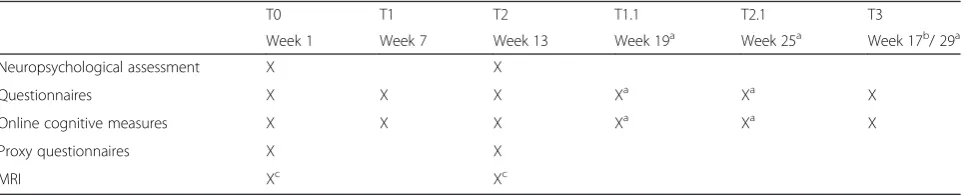
Prior to the training or waiting period (T0) and at the end of the training or waiting period (T2) neuropsychological tasks were administered to measure far transfer effects of the training. Some of the measurements were performed online. Furthermore, five questionnaires were adminis-tered online at these time-points to determine health status, participation in daily life activities, and subjective cognitive functioning. The proxy of the participant also completed three of these questionnaires online. Partici-pants were asked to do all online measurements of the dif-ferent time-points on the same computer. A global outline of all measurement time-points can be found in Table 2.
The tasks and questionnaires were spread over three days (two days at home and one day at the University of Amsterdam or an alternative location). The tasks done at home were performed online without assessor (see Additional file 4). The remaining tasks were done with an assessor at the University of Amsterdam or alterna-tive location. Importantly, some neuropsychological tasks were administered both online (without assessor) and as paper and pencil tasks (with assessor). The order of these tasks was counterbalanced over days such that either the computer tasks were done on day one and the paper and pencil tasks on day two, or vice versa.
In order to compare our study with other training studies, which mostly consisted of six weeks of training or less [36, 40, 41], a subset of online tasks and ques-tionnaires were administered six weeks after training on-set (T1; see Additional file 4). These tasks were done at home instead of two training sessions.
After 6 and 12 weeks of training, a brief questionnaire regarding subjective training success was administered. Finally, to measure long-term effects of the training, a subset of online tasks and questionnaires were
Table 2Schematic outline of measurements per time-point
T0 T1 T2 T1.1 T2.1 T3
Week 1 Week 7 Week 13 Week 19a Week 25a Week 17b/ 29a
Neuropsychological assessment X X
Questionnaires X X X Xa Xa X
Online cognitive measures X X X Xa Xa X
Proxy questionnaires X X
MRI Xc Xc
Note. X = administered at time-point. A detailed overview can be found in Additional file4
a
administered four weeks after training completion (T3; Additional file 4). Note that the switch task was adminis-tered online four times (T0, T1, T2, and T3). The dual task was administered at T0 and T2 only. An assessor was present at T0 and T2 when the switch and dual task was done at the University, but not at T1 and T3 when the switch task was done at home. An overview of tasks administered at different time-points can be found in Additional file 4.
The waiting list control group received the same mea-surements as the training groups. They did not, however, receive any training during the first 13 weeks. Training commenced immediately after the 12 weeks waiting period measurements (T2). The same tasks performed after six weeks of waiting (T1) were repeated after six weeks of training (T1.1) and at the end of the training (T2.1, see Table 2). Finally, similar to the training groups, there was a follow-up measurement four weeks after training completion (T3). Note that to minimize extra effort, the waiting list control group only per-formed the online measures after training completion and did not visit the University of Amsterdam again.
MRI Before and after the training or waiting list period, a selected subset of participants was scanned. They were participants who were able to come to the MRI scanner and who fulfilled all MRI inclusion and exclusion cri-teria. Participants were screened with an MRI safety checklist. Because we used a resting-state protocol, par-ticipants were not required to perform any tasks during the scans. However, one questionnaire was administered within the MRI scanner immediately after the resting-state scan to assess their mental resting-state during that scan. Further MRI procedures, including the scan sequences used, can be found in Additional file 1.
The current study was approved by the Medical Ethical Review Board of the VU University Medical Center, Amsterdam. TAPASS is registered with the Central Com-mittee on Research Involving Human Subjects Register NL4468502913 (www.toetsingonline.nl). Inclusion started in September 2013.
Statistical analyses
P-values of .05 or lower (one tailed) were considered sig-nificant. Sociodemographics (age and education) and clinical data (time since stroke) at baseline were evalu-ated with Student t-test or Mann–Whitney U-test and were added as covariates. Additionally, number of train-ing sessions completed was added as a covariate.
To evaluate blinding success, the two trainings were compared to check if the mock training was not per-ceived as a control training. Reported motivation, train-ing compliance, and check of blindtrain-ing were analyzed with Mann–WhitneyU-test orχ2.
Primary analyses were performed with mixed model analyses. The dependent variables were switch cost on the DKEFS TMT, number of words mentioned during the category fluency and the letter fluency task, number of steps and execution time of the ToL, and score on Letter-Number Sequencing. The independent variable was condition (intervention, active control training, and waiting list control group). Time-points in this model were before and after training.
Secondary analyses were performed in a similar way. However, the dependent variables were cognitive flexibil-ity based on switch cost and dual cost; objective cogni-tive function based on the composite scores of attention, memory, working memory, reasoning, inhibition, and psychomotor speed; training improvement; and subject-ive cognitsubject-ive and everyday life functioning.
Whenever intervention resulted in a significant im-provement of the dependent variables that were add-itionally measured at T1 (after six weeks of training) and T3 (follow-up four weeks after training completion), the time-points T1 and T3 were added to the model. This was done to determine whether the training was already effective after six weeks of training and to establish whether training effects would persist after the training.
MRI analysis for the resting-state data were performed with ICA and dual regression and graph analysis. Car-diac and respiratory function, time since stroke, and scores on the ARSQ were treated as potentially con-founding factors. DTI data were analyzed using tract-based spatial statistics [42]. Gray matter was analyzed with VBM [43]. Mixed ANOVA’s were used to analyze differences in changes from baseline after training be-tween intervention and active control group of the values derived from DTI analyses, VBM values, and graph metrics.
Finally, we explored whether the effect of cognitive flexi-bility training varied as a function of baseline executive functioning, health state (stroke versus healthy) and time since stroke (sub-acute versus chronic). Linear regression was used to determine predictors of training outcome.
All analyses were performed as intention-to-treat ana-lysis, including all participants who started the training. Additionally, analyses were rerun as per-protocol ana-lysis. In these analyses, only the participants who com-pleted the training according to the protocol were included in the analyses.
Discussion
Several earlier studies have reported positive transfer effects of computer-based cognitive training in healthy elderly [38, 44, 45], but far transfer effects on tasks dis-similar to the training are not always found [9, 46]. Beneficial effects have also been reported in stroke or other acquired brain injury populations [6, 36, 41]. It remains, however, uncertain under what conditions computer-based training is effective.
The current training has not been proven effective yet in the healthy population or in stroke survivors. Neverthe-less, it consisted of several factors that are likely important to induce far transfer effects [4]. Most importantly, the training included a switch element. The training did not only train one specific cognitive domain, but it also trained cognitive flexibility, which is a higher-level cogni-tive function, called upon in many tasks. As a result, it is likely that the training would lead to improvements in other, untrained tasks that do require cognitive flexibility.
Length of the training also seems to be important. Basak, Boot, Voss, and Kramer [44] found a transfer ef-fect of their video game training of executive functions after 23.5 h of training, but not yet after 11 h of training. The current training contained 58 sessions of half an hour, adding up to a total of 29 h.
Another important factor for far transfer effects of training is that training should be adaptive [47]. Diffi-culty level of the intervention training was adapted to the performance of the participant. This was done after completion of one round of a training task.
Training may have a larger effect on everyday life functioning in stroke patients than in the healthy popu-lation. People who have suffered from stroke commonly have lower baseline cognitive functioning than healthy elderly. There is more room for improvement compared to healthy elderly [6, 7]. Also, stroke patients may be more motivated to improve their functioning precisely because they have lost much of their function.
There are several potential pitfalls in the current study. As the training and several outcome measure tasks were done online on the participant’s own computer, com-puters may have had different settings (e.g., different screen sizes and, therefore, different size of training or tasks presentation). These settings could affect outcome measures. To minimize the effect of setting differences, participants were asked to do all measurements of the dif-ferent time-points on the same computer. Furthermore, due to continuous changes within Internet browsers (e.g., changes of packages used for flash tasks), technical failures could have occurred. To reduce the risk of technical fail-ures, the participants were advised to install comparatively stable Internet browsers (e.g., Mozilla Firefox or Safari). All instructions for installing browsers, starting the train-ing, doing the online tasks etc. were thoroughly explained face to face and in an instruction booklet.
Motivation and fatigue of the participants possibly played a major role in this study. Participants were re-quired to spend approximately 50 h on the TAPASS pro-ject. This is a large investment, which may have led to fatigue and loss of motivation. In turn, this may have negatively influenced the outcome measures. To avoid loss of motivation, participants were contacted by phone once a week or every two weeks. Positive feedback was given after completion of each training session. The as-sessment of the outcome measures was spread over three days, to reduce the influences of fatigue. Extra breaks were offered when needed.
One of the major strengths of this study is the design with two control groups. Most previous training studies either did not include a control group or provided a less motivating training as control condition [47]. This study included both an active control group and a waiting list control group. The active control group received a mock training we considered was motivating and visually stimulating. We checked this assumption in the exit questionnaire. This is important not only to keep partici-pants motivated to train for 12 weeks, but also to ensure that participants remained blind to training condition. As the mock training could still have been quite challen-ging, this training may also have improved cognitive functioning. It was, however, not expected that improve-ment would transfer to tasks dissimilar to the training. In case both trainings turned out to be effective, the ef-fects of spontaneous recovery and learning could be taken into account based on comparisons with the wait-ing list control group.
The training could be done at home and most assess-ments were also in-home. A large sample could, conse-quently, be acquired and a follow-up measurement could be done after four weeks. The large sample size is another strength of this study. In case of a null effect, the results would still provide valuable insights, as statis-tical power was sufficient to detect medium-sized effects. The results of this study were compared with the re-sults of a parallel study of computer-based cognitive flexibility training in healthy elderly. We expected that those who have suffered from stroke and currently have cognitive complaints will have a lower cognitive base-line than healthy elderly. This study, thus, gives insight into the effect of different baseline cognitive abilities on training outcome.
Conclusions
additionally provides insights into the field of cognitive training as it not only looks at behavioral effects, but also at changes in the brain.
Additional files
Additional file 1:MRI Scan protocol.(PDF 273 kb)
Additional file 2:Description of training tasks.(PDF 712 kb)
Additional file 3:Details of the switch and dual task.(PDF 389 kb)
Additional file 4:Measures at different time-points.(PDF 370 kb)
Additional file 5:Description of the computer tasks.[48–52] (PDF 529 kb)
Abbreviation
ARSQ:Amsterdam Resting-State Questionnaire; CFQ: Cognitive Failure Questionnaire; CIS-F: Checklist Individual Strength- Fatigue subscale; CPM: Raven Coloured Progressive Matrices; DEX: Dysexecutive Questionnaire; D-Kefs TMT: Delis- Kaplan Executive Function System Trail Making Test; DSC: Digit-Symbol-Coding; DSST: Digit Symbol substitution Task;
DTI: Diffusion Tensor Imaging; fMRI: Functional Magnetic Resonance Imaging; HADS: Hospital Anxiety Depression Scale; IADL: Instrumental activity of daily life scale; ICA: Independent component analyses; MRI: Magnetic Resonance Imaging; O-span: Operation span; PASAT: Paced Auditory Serial Addition Test; RAVLT: Rey Auditory Verbal Learning Task; RCT: Randomized controlled trial; SF-36: Short Form Health Survey; TAPASS: Training Project Amsterdam Seniors and Stroke; TICS: Telephone Interview Cognitive Status; TMT: Trail Making Test; ToL: Tower of London; USER-P: Utrechtse Schaal voor Evaluatie en Revalidatie- Participatie; VBM: Voxel based morphometry.
Competing interests
The authors declare that they have no competing interests.
Authors’contributions
RvdV, JM and BS conceived the idea of this study. RvdV, JM, BS, EG and DV contributed to the design of the study. RvdV coordinated the study under supervision of JM and BS. RvdV and EG took care of the recruitment and RvdV monitored the intervention treatment. RvdV was the primary author for this manuscript. JM and BS helped draft the manuscript. All authors critically reviewed the manuscript and approved the submitted version.
Acknowledgements
We want to thank J.I.V. Buitenweg for the valuable discussion and contribution to the set-up of the study design and the master students for contributing to the data collection. This project is part of the research program "Treatment of cognitive disorders based on functional brain imaging" funded by the Netherlands Initiative Brain and Cognition, a part of the Organization for Scientific Research (NWO) under grant number 056-14-013.
Author details
1Department of Psychology, University of Amsterdam, Weesperplein 4,
1018XA, Amsterdam, The Netherlands.2Heliomare Research and
Development, Relweg 51, 1949EC, Wijk aan Zee, The Netherlands.
3
Department of Psychiatry, VU University medical center, De Boelelaan 1117, 1081HZ, Amsterdam, The Netherlands.
Received: 1 April 2015 Accepted: 31 July 2015
References
1. Madureira S, Guerreiro M, Ferro JM. Dementia and cognitive impairment three months after stroke. European Journal of Neurology. 2001;8(6):621–7. 2. Middleton LE, Lam B, Fahmi H, Black SE, McIlroy WE, Stuss DT, et al.
Frequency of domain-specific cognitive impairment in sub-acute and chronic stroke. Neurorehabilitation. 2014;34(2):305–12.
3. Rasquin SMC, Welter J, van Heugten CM. Course of cognitive functioning during stroke rehabilitation. Neuropsychological Rehabilitation. 2013;23(6):811–23. 4. Buitenweg JIV, Murre JMJ, Ridderinkhof KR. Brain training in progress: A review
of trainability in healthy seniors. Front Hum Neurosci. 2012;6:183.
5. Karbach J, Kray J. How useful is executive control training? Age differences in near and far transfer of task-switching training. Developmental Science. 2009;12(6):978–90.
6. Johansson B, Tornmalm M. Working memory training for patients with acquired brain injury: Effects in daily life. Scandinavian Journal of Occupational Therapy. 2012;19(2):176–83.
7. Peretz C, Korczyn AD, Shatil E, Aharonson V, Birnboim S, Giladi N. Computer-based, personalized cognitive training versus classical computer games: A randomized double-blind prospective trial of cognitive stimulation. Neuroepidemiology. 2011;36(2):91–9.
8. Mozolic JL, Hayasaka S, Laurienti PJ. A cognitive training intervention increases resting cerebral blood flow in healthy older adults. Frontiers in Human Neuroscience. 2010;4:16.
9. Dahlin E, Neely AS, Larsson A, Backman L, Nyberg L. Transfer of learning after updating training mediated by the striatum. Science. 2008;320(5882):1510–2. 10. Belleville S, Clement F, Mellah S, Gilbert B, Fontaine F, Gauthier S. Training-related brain plasticity in subjects at risk of developing Alzheimer's disease. Brain. 2011;134:1623–34.
11. Tatemichi TK, Desmond DW, Stern Y, Paik M, Sano M, Bagiella E. Cognitive impairment after stroke - Frequency, patterns, and relationship to functional abilities. Journal of Neurology Neurosurgery and Psychiatry. 1994;57(2):202–7. 12. Brandt J, Spencer M, Folstein M. The Telephone Interview for Cognitive
Status. Neuropsychiatry Neuropsychol Behav Neurol. 1988;1(2):111–7. 13. Delis DC, Kaplan E, Kramer J. Delis–Kaplan Executive Function System.
San Antonio: Psychological Corporation; 2001.
14. Thurnstone LL. Primary mental abilities. Chicago: University of Chicago Press; 1938.
15. Benton AL, Hamsher K. Multilingual Aphasia Examination. Iowa City: AJA associates; 1989.
16. Culbertson W, Zillmer E. Tower of London Drexel University. Chicago: Multi-Health Systems; 2005.
17. Wechsler D. Wechsler Adult Intelligence Scale (WAIS-III) Nederlandstalige bewerking. Technische handleiding. Lisse: Swets & Zeitlinger; 2000. 18. Rogers RD, Monsell S. Costs of a predictable switch between simple
cognitive tasks. Journal of Experimental Psychology-General 1995, 124(2):207–31.
19. Stablum F, Umilta C, Mazzoldi M, Pastore N, Magon S. Rehabilitation of endogenous task shift processes in closed head injury patients. Neuropsychological Rehabilitation. 2007;17(1):1–33.
20. Schagen SB, Vermeulen IE, Murre JMJ, Feenstra H. An online testing approach to assess cognitive problems associated with cancer and cancer treatment. Research Project Dutch Cancer Society, KWF Project NKI2010-4876 2010–2015.
21. Gronwall DMA. Paced Auditory Serial-Addition Task: Measure of recovery from concussion. Percept Mot Skills. 1977;44(2):367–73.
22. Saan R, Deelman B. De 15-Woordentest A en B. (Een voorlopige handleiding). Groningen: Afdeling Neuropsychologie, AZG (international publication); 1986.
23. Lever AG, Werkle-Bergner M, Brandmaier AM, Ridderinkhof KR, Geurts HM. Atypical working memory decline across the adult lifespan in autism spectrum disorder. Journal of Abnormal Psychology.
24. Raven JC. Manual for the Coloured Progressive Matrices (revised). Windsor: NFRE-Nelson; 1995.
25. Zachary RA. Shipley Institute of Living Scale: Revised manual. Los Angeles: Western Psychological Services; 1991.
26. Burgess PW, Alderman N, Wilson BA, Evans JJ, Emslie H. The Dysexecutive Questionnaire. In: Wilson BA, Alderman N, Burgess PW, Emslie H, Evans JJ, editors. Behavioural Assessment of the Dysexecutive Syndrome. Bury St. Edmunds: Thames Valley Test Company; 1996.
27. Broadbent DE, Cooper PF, FitzGerald P, Parkes KR. The Cognitive Failures Questionnaire (CFQ) and its correlates. British Journal of Clinical Psychology. 1982;21(1):1–16.
28. Post M, van de Port I, Kap B, van Berlekom S. Development and validation of the Utrecht Scale for Evaluation of Clinical Rehabilitation (USER). Clinical Rehabilitation. 2009;23:909–17.
29. Lawton MP, Brody EM. Instrumental Activities of Daily Living (IADL) Scale - Self-Rated Version. Psychopharmacol Bull. 1988;24(4):789–91.
30. Ware JE, Sherbourne CD. The Mos 36-Item Short-Form Health Survey (Sf-36).1. Conceptual-framework and item selection. Med Care. 1992;30(6):473–83. 31. Guye M, Bettus G, Bartolomei F, Cozzone PJ. Graph theoretical analysis of
networks. Magnetic Resonance Materials in Physics Biology and Medicine. 2010;23:409–21.
32. Diaz BA, Van der Sluis S, Benjamins JS, Stoffers D, Hardstone R, Mansvelder HD, et al. The ARSQ 2.0 reveals age and personality effects on mind-wandering experiences. Front Psychol. 2014;5:271.
33. Zigmond AS, Snaith RP. The Hospital Anxiety and Depression Scale. Acta Psychiatr Scand. 1983;67(6):361–70.
34. Vercoulen JHMM, Bazelmans E, Swanink CMA, Fennis JFM, Galama JMD, Jongen PJH, et al. Physical activity in chronic fatigue syndrome: Assessment and its role in fatigue. J Psychiatr Res. 1997;31(6):661–73.
35. Kempen GIJM, Meier AJL, Bouwens SFM, van Deursen J, Verhey FRJ. [The psychometric properties of the Dutch version of the Telephone Interview Cognitive Status (TICS)]. Tijdschr Gerontol Geriatr. 2007;38(1):38–45.
36. Westerberg H, Jacobaeus H, Hirvikoski T, Clevberger P, Ostensson M, Bartfai A, et al. Computerized working memory training after stroke - A pilot study. Brain Injury. 2007;21(1):21–9.
37. Genevsky A, Garrett CT, Alexander PP, Vinogradov S. Cognitive training in schizophrenia: A neuroscience-based approach. Dialogues Clin Neurosci. 2010;12(3):416–21.
38. Steinerman JR. Minding the aging brain: Technology-enabled cognitive training for healthy elders. Curr Neurol Neurosci Rep. 2010;10(5):374–80. 39. Pocock SJ, Simon R. Sequential treatment assignment with balancing
for prognostic factors in controlled clinical trial. Biometrics. 1975;31(1):103–15.
40. Prokopenko SV, Mozheyko EY, Petrova MM, Koryagina TD, Kaskaeva DS, Chernykh TV, et al. Correction of post-stroke cognitive impairments using computer programs. J Neurol Sci. 2013;325(1–2):148–53.
41. Lundqvist A, Grundstrom K, Samuelsson K, Ronnberg J. Computerized training of working memory in a group of patients suffering from acquired brain injury. Brain Inj. 2010;24(10):1173–83.
42. Smith SM, Jenkinson M, Johansen-Berg H, Rueckert D, Nichols TE, Mackay CE, et al. Tract-based spatial statistics: Voxelwise analysis of multi-subject diffusion data. Neuroimage. 2006;31(4):1487–505.
43. Ashburner J, Friston KJ. Voxel-based morphometry - The methods. Neuroimage. 2000;11(6):805–21.
44. Basak C, Boot WR, Voss MW, Kramer AF. Can training in a real-time strategy video game attenuate cognitive decline in older adults? Psychol Aging. 2008;23(4):765–77.
45. Brehmer Y, Westerberg H, Backman L. Working-memory training in younger and older adults: Training gains, transfer, and maintenance. Frontiers in Human Neuroscience. 2012;6:63.
46. Owen AM, Hampshire A, Grahn JA, Stenton R, Dajani S, Burns AS, et al. Putting brain training to the test. Nature. 2010;465(7299):775–8. 47. Shipstead Z, Redick TS, Engle RW. Is working memory training effective?
Psychol Bull. 2012;138(4):628–54.
48. Reitan RM. The relation of the trail making test to organic brain damage. J Consult Psychol. 1955;19(5):393–4.
49. Unsworth N, Heitz RR, Schrock JC, Engle RW. An automated version of the operation span task. Behavior Research Methods. 2005;37(3):498–505. 50. de Vries M, Geurts HM. Beyond individual differences: Are working memory
and inhibition informative specifiers within ASD? J Neural Transm. 2014;121(9):1183–98.
51. Milner B. Interhemispheric differences in the localization of psychological processes in man. Br Med Bull. 1971;27(3):272–7.
52. Logan G, Schachar R, Tannock R. Impulsivity and inhibitory control. Psychol Sci. 1997;8(1):60–4.
Submit your next manuscript to BioMed Central and take full advantage of:
• Convenient online submission
• Thorough peer review
• No space constraints or color figure charges
• Immediate publication on acceptance
• Inclusion in PubMed, CAS, Scopus and Google Scholar
• Research which is freely available for redistribution