--August 8, 2011 EUROPEAN JO URKAL O F ~>IEDI CA L RESEARCH 375
E ur J i\led Res (201 1) 16: 375-380 © I. Holzap fel Publishers 2011
TRANSIENT HYPERTHYROIDISM AFTER SURGERY FOR SECONDARY
HYPERPARATHYROIDISM:
A
COMMON PROBLEM
G. Rudofsky', M. Tsiogat , P. Reismann2, C. Leowardi3, S. Kopf1, l. A. Grafe t,
P. P. N awrothl, B. Iscrmann1
I Departm ent o f Endocrinology and Cli nical Chemistry, U niver sity of Heidelberg, H eidelberg, Germany 2Second D epartment o f Med icine, Semmelweis University, Budapest, H ungar)'
3Department o f General Surger)', U niversit)' of H eidelberg, H eidelberg, G erman)'
Abstract
Background: Postoperative hyperthyroidism occurs in
approximately one third of patients following parathy-roidectomy due to primary hyperparathyroidism
(PI IP), but has only rarely been described in sec-ondary hyperparathyroidism (SHP). The frequency, course, and laboratory markers of postoperative hy-perthyroidism in SHP remain tmknown. Our purpose was to evaluate the frequency and the clinical course of postoperative hyperthyroidism following surger y of SHP and to determine the diagnostic value of thy-roglobulin in this setting.
M ate rial a11d 1\1.ethods: A total of 40 patients
undergo-ing parathyroidectomy because of SHP were included in this study. Thyroid stimulating hormone (T SH), free triiodothyronine (fT 3), free thyroxine (ff4), and thy-roglobulin (T g) were determined one day before and on day 1, 3, 5, 10, and 40 after surgery. At each of these visits patients were clinically evaluated for signs or symptoms of hyperthyroidism.
R wtlts: Biochemical evidence o f hyperthyroidism was evident in 77% of patients postoperatively despite of preoperatively no rmal serum levels. TSH dropped
from 1.18
±
0.06mU / L to 0.15±
0.07mU / L (p=
0.001 5). Free triiodothyronine (IT3) and IT4 levels in-creased from 2.86
±
0.02ng/ L and 10.32±
0.1 3ng/L,respecti,rely, to their maximum of 4.83
±
0.1 7ng/Land 19.35
±
0.58ng/J., respectively. T hyroglobulinlev-els rose from 3.8
±
0.8ng/ mL to 111.8±
45.3ng/ mL (p<0.001). At day 40 all thyroid related laboratory val-ues were within normal range. Correlation analysis o f postoperative values revealed significant correlations for lowest T SH (r=
-0.32; p=
0.038), and highest IT3 (r = 0.55; p<0.001) and IT4levcls (r = 0.67; p <0.001) with Tg.Conclusion: Transient hyperthyroidism is frequent after
parathyroidectomy for SHP with Tg being a suitable marker. Awareness of this self-l imiting disorder is im-portant to avoid inappropriate and potentially harmful treatment.
K~y 1/!0rds: hyperthyroidism, secondary
hyperpararoidism, palpation thyroiditi s, parathyroidectomy, thy-roglobulin
I NTROD UCTI ON
r early all patients with chronic renal failure on long-term hemodialysis develop secondary hyperparathy-roidism due impaired renal function resulting in a defi-ciency of 1,25-deoxycholecalciferol [1 ]. Tn most of these patients secondary hyperparathyroidism can be managed by medical therapy. However, in approxi-mately 5% of these patients' longstanding secondary hyperparathyroidism progresses into an autonomous function of parathyroid cells, hypercalcemia and an in-ability o f vitamin D analogues to suppress parathyroid hormone despite increasing serum calcium levels f2]. In these patients parathyroidectomy is the only effec-tive treatment. T he fact that four-gland hyperplasia is most commonly observed in these patients necessi-tates intraoperative evaluation of all four parathyroid
glands wid1 total or subtotal parathyroidectomy in these patients [2-4].
Postoperative hyperthyroidism is a complication oc-curring after parathyroidectomy in primary hyper-parathyroidism (PHP) [5-11 ], and is attributed to pal-pation thyroiditis l12]. Palpal-pation thyroiditis histologi-cally imposes as a m ultifocal granulomatous folliculitis, which is a common finding following intraoperative manipulation of the thyroid gland. Palpation thyroidi-tis is sppposecl to result from traumatic injury or rup-ture of isolated thyroid follicles caused by pressure on the gland [1 2]. Two studies evaluated newly diagnosed hyperthyroidism following surgery in patients with pri-mary hyperparathyroidism (PHP) f6, 8]. Abnormal blood values of TSH, IT3, or IT4 indicating postoper-ative hyperthyroidism were observed in 31.2% and 42.3% of patients, respectively, in these stud ies. Fur-thermore, 15.0% and 34.6% of patients, respectively, reported symptoms o f hyperthyroidism one to two weeks after operation (6, 8]. A marker of thyroid trau-ma has not been reported hitherto, but thyreoglobulin, p resumably being released from the injured thyroid follicles, may be a suitable marker.
postoper-376 EUROPEAN JOURNAL OF l'vfEDl CAL RESEARCH August 8, 2011
ative hyperthyroidism remains unknown in these pa-tients. We hypothesize that the frequency of postoper-ative hyperthyroidism is even higher compared to pa-tients with PHP due to the intraoperative preparation of all four glands associated with an increased manip-ulation of the thyroid gland. Hence we prospectively enrolled 40 consecutive haemodialysis patients under-going parathyroidectomy because of SHP at the Uni-versity Hospital of H eidelberg. T he frequency, dura-tion and severity of p ostoperative hyperthyroidism as well as the diagnostic value of thyroglobulin (Tg) as a marker for postoperative hyperthyroidism were evalu-ated in this study.
METHODS
This prospective monocentric trial was performed in forty consecutive patients undergoing parathyroidecto-my because of SHP at the surgical department of the University Hospital of H eidelberg. The study was ap-proved by the local ethics committee, and all patients gave written informed consent. The study was con-ducted from April 2008 to January 2009 . Patients were eligible for the study if they had SHP. Exclusion crite-ria were preoperative thyroid medication, known thy-roid dysfunction, or prior thythy-roid or parathythy-roid surgery. Further, only patients without clinical suspi-cion or a history of concomitant autoimmune thyroidi-tis were included. Therefore, in the first ten patients this approach was evaluated with determining TSH
re-ceptor
[TRA],
thyroperoxidase [fPOA], andthyroglob-ulin [TgA] antibodies [13]. Hyperthyroidism was bio-chemically defined as serum TSH below 0.40 mU/ L.
OPERATIVE MANAGEMENT
All procedures were performed under general anaes-thesia and orotracheal intubation. Following a Kocher incision, preparation and mobilisation of the thyroid and parathyroid glands, all four parathyroid glands were identified and removed. Intraoperative serum
PTH measurements were performed to assure that all
parathyroid glands had been removed. After frozen-section confirmation, an autotransplantation into the tibialis muscle was performed. Intravenous gluconate calcium was administered after the last parathyroid re-moval to prevent severe hypocalcaemia.
PERIOPERATIVE MANi\GEMENT
Patients were evaluated by an endocrinologist at visits one day before and on day 1, 3, 5, 10, and 40 after surgery. Typically, patients were discharged from the hospital on day 5 and returned on day 10 and 40 after operation to the outpatients' clinic of the D epartment of Endocrinology. At each visit blood was taken and patients were evaluated by an endocrinologist. Patients were queried with open-ended questions regarding problems, symptoms, and insomnia. Their pulse, weight, and blood pressure were recorded. The physi-cian was unaware o f the laboratory test results when recording the patients history and performing the clin-ical evaluation. At each visit a full thyroid function test panel was ob tained (TSH, free triiodothyronine lfT3l,
free thyroxine [ff4]) and thyroglobulin [Tg]). Patients were maintained post-operatively on calcium and cal-citriol to avoid hypocalcaemia.
Seventeen patients suffering from hyperthyroidism due to other causes (Graves' disease: n
=
7, autono-mous thyroid adenoma: n=
10) were recruited at the outpatients' clinic of the D epartment of Endocrinolo-gy serving as non-operative control group. Blood was taken at fasting state at 8:00 in the morning. Diagnoses were made according to the current guidelines.STATISTICS
Results of biochemical measurements are expressed as
median
±
standard error of the mean (s.e.m.) andMann-Whitney U test for unmatched, nonparametric continuous variables was used for statistical compar-isons. Results of frequencies and rates are given as mean with the corresponding 95% confidence interval and the chi-square test (X2) for univariate analysis of categorical data was used. P-values <0.05 were consid-ered statistically significant.
RESULTS
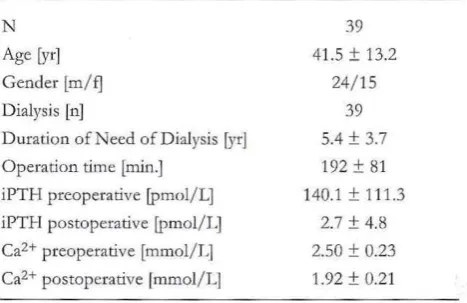
Forty patients with the diagnosis of secondary hyper-parathyroidism due to ch ronic renal failure were re-ferred to the D epartment of General Surgery at the University Hospital of H eidelberg in Germany for surgical treatment. D emographic information as well as PTH and calcium levels before and after surgery is summarized in Table 1. Both pre- and postoperative laboratory thyroid tests were available in all 40 study patients. One patient was noted to have preoperative subclinical TSH suppression, which persisted postop-eratively. T his patient was excluded from analysis. Fur-ther, to exclude an underlying autoimmune disease as a possible cause for hyperthyroidism antibody testing of TRA, TPOA, and TgA was performed in the first ten patients and in further 5 patients based on clinical sus-picion. All antibody tests were negative.
In total, 30 of the 39 patients [77%; 95ryo confi-dence interval (95%-CI): 64-90%] with preoperatively normal serum TSH, IT3, and IT4 displayed
postopera-T able 1. Patients' characteristics of all 39 patients undergoing
parath~'roidal surgery are displayed. Mean values and their
standard deviation are given.
N
Age [yr] Gender [m/ f] Dialysis [n]
Duration of Need of Dialysis [yrJ Operation time [min.]
iPTH preoperative (pmol/L) iPTH postoperative (pmoi/L] Ca2+ preoperative [mmol/L] Ca2+ postoperative lmmoi/L]
39 41 .5
±
13.224/ 15 39 5.4 ± 3 .7 192 ± 81 140.1 ± 111.3
2.7 ± 4.8 2.50 ± 0.23 1.92 ± 0.21
---August 8, 2011 E UROPEAN J OURNAL OI' MEDICAL RESEARCH 377
A) B)
2,25
v
21
;J
::J
~
=> 14
.s
1,5 a,I
.s
(/)
.,.
1- 0,75 1;: 7
0 0
-1 1 3 5 10 40 -1 1 3 5 10 40
Days from surgery Days from surgery
C)
6
::J
~
~
4"'
t:: 2
0
-1 1 3 5 10 40
Days from surgery
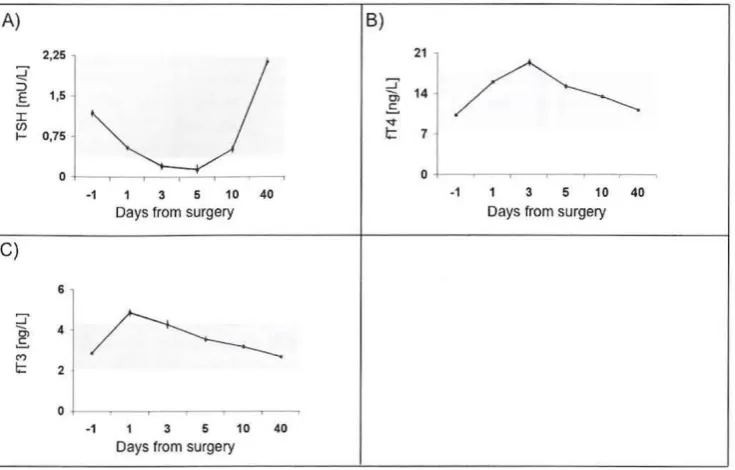
Fig. 1. T ime course of biochemical thyroid function markers in all patients undergoing parathyroidal surgery (n = 39). Mean value ± s.e.m. are shown (A-C). A) Time course of thyroid stimulating hormone (TSH, mU/ L); the light grey box marks the normal range of TSH (0.4 to 4.0 mU/ L). B) Time course of free thyroxine (IT4, ng/L); the light grey box marks the normal range of IT4 (8.0 to 18.0 ng/L). C) Time course of free triiodothyro nine (IT3, ng/L); the light grey box marks the normal range of fi'3 (2.0 to 4.2 ng/J.).
100
~
e:.
I
(/)
1- 75
'0
Q)
~
a.
50a.
:J
(I)
0
>-0 25 c
Q)
:J 0'
!~:! u...
0
-1 3 5 10 40
Days from surgery
tively biochemically hyperthyroidism with T SH levels below the lower normal range of 0.40 mU/L. L evels of TSH dropped significandy from a preoperative
lev-el of 1.18
±
0.06 mU/L to 0.15±
0.07 mU/ Lpostop-eratively (p
=
0.0015) (Pig. 1A). T his TSI-1-drop was paralleled by an increase of the free hormones ff4and IT3 from 10.32
±
0.13 ng/ L to 19.35±
0.58 ng/ L(p
<
0.001) and from 2.86±
0.02 ng/ L to 4.83±
0.1 7 ng/L (p < 0.001), respectively (Fig. 1 B, C). At the endo f the observation period at day forty after surgery all thyroid related laboratory values had returned to their
normal values in all studied subject (ISH 2.14
±
0.07mU/L, IT4 11.20
±
0.19 ng/L, and IT3 2.68±
0.03ng/L, Fig. 1 A-C). Free Triiodothyronine and IT4 reached their maximum after surgery on day 1 and day 3, respectively (Fig. 1 B, C) . The TSH nadir was reached at the fifth day after surgery, at which time 21
~
Fig. 2. Frequency of biochemical hyperthyroidism
(TSH < 0.40 mU/ L) in all patients (n
=
39) under-going parathyroidal surgery. l'requency is shown separately for one day before surgery (-1), and the first (1 ), third (3), fifth (5), tenth (1 0), or fortieth(40) day after surgery. The highest frequency of 61.5% is observed on the third day after surgery. O ne day before and at day 40 after surgery no pa-tient with biochemical hyperthyroidism was ob-served.
patients (54%; 95%-CI: 46 - 62%) displayed TSH val-ue lower than 0.40 mU/L (Fig. 2).
Eighteen o f the 30 patients with biochemical hyper-thyroidism (60%; 95%-CI: 423 - 78%) complained about hyperthyroid symptoms, representing 46% (95%-CI: 31 - 62%) of all 39 patients undergoing parathyroidal surgery.
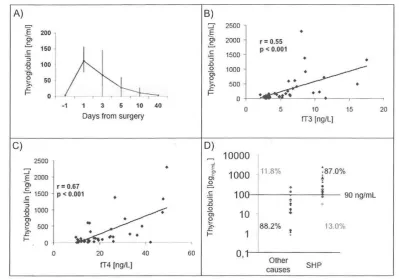
Thyroglobulin was evaluated as a marker of thyroid trauma. Preoperatively, Tg values were within the nor-mal range, averaging 3.8
±
0.8 ng/ mL (normal: < 30ng/mL). Postoperatively, Tg increased up to 111.8
±
378 EUROPEAN JOURNA I. Ol' lv[EDlCAL RESEi\RCl l August 8, 2011
A) B)
E 200 ::r .§ 2500
•
l
f
2000 r = 0.55150 p < 0.001
.s .S 1500
:; :;
•
•
.0 100 .0
0 0 1000
0>
8'
e
50>. ;;_ 500
~ 0 ~
•
0
-1 1 3 5 10 40 0 5 10 15 20
Days from surgery IT3 (ng/Ll
C)
D)
2500 10000
:::J ~ ~· ' 11 .8% :a7.0%
1000
E 2000 Ol
±
a, r = 0.67 g
i
c
£1 500 p < 0.001 .£ :; 100 90 ng/mL
•
:; .0
•
.g 1000 0
:
c;, 10
c;,
e
e
500 >. 88.2% 13.0%>. .c
.c ...
... 0
0 20 40 60 0,
fT4 (ng/Ll Other SHP
causes
Fig. 3. A) Time course ofTg in [ng/ mL) in all patients undergoing parathyroidal surgery (n
=
39); the light grey box marks the no rmal range of'fg (up to 30 ng/L); Mean value± s.e.m. are shown. B) Correlation of Tg with free triiodothyronine is given (r= 0.55; p < 0.001). C) Correlation of Tg with free thyroxine is given (r = 0.67; p < 0.001). D) D istribution of Tg values of hy-perthyroid patients after Sl-IP surgery and patients with hyperthyroiclism due to other causes of hyhy-perthyroidism are clisplayed. Using a cut-off of 90 ng/mL gives a good diagnostic sensitivit-y and specificity. Values outlying the cut-off and their corre-sponding rates are highlighted in grey.
T tible 2. Thyroid function of hyperthyroid patients after parathyroidal surgery (n
=
30) is compared with hyperthyroid patientsdue to other causes (n = 17; Graves' d isease: n = 7, autonomous thyroid adenoma: n = 1 0) serving as control group. Medians ±
standard errors are clisplayed. A two tailed student's-t test was used.
Hyperthyroid patients
after Sl-IP surgery Control group
p
TSH lmU/LI ff3 jng/L) ff4lng/LJ
Thyroglobulin (ng/ mi.l
n = 30
0.13 ± 0.02 6.47 ± 0.68 22.33 ± 2.14 373.6 ± 93.3
n
=
170.01 ± 0.01 5.40 ± 1.61 16.33 ± 4.55 31.6 ± 12.2
0.003 0.30 0.87 0.01
ff3: free triiodothyronine, ff4: free thyroxine, SHP: secondary hyperpa'rat11yroiclism, TSH: thyroid stimulating hormone.
TSH with Tg was weakened by the lower detection
lim-it of TSH of 0.01 mU/L Nevertheless, the correlation
between TSH and Tg was significant (r
=
-0.32; p=
0.038). Correlation with IT3 (r
=
0.55; p < 0.001) (Fig. 3 B), and fT4 levels (r=
0.67; p < 0.001) (Pig. 3 C) was more pronounced. Furthermore, the amount of Tg el-evation after operation correlated significantly with the duration of the surgical procedure (r 0.55; p=
0.002).Furthermore, Tg levels of hyperthyroid post
surgery patients (n
=
30) were compared with 17pa-tients suffering from hyperthyroidism due to other
causes (Graves' disease: n
=
7, autonomous thyroidadenoma: n
=
10) serving as control group (fable 2,Pig. 3D). Although values of free hormones fT3 and
ff4 were not significantly different between both
groups, postoperative hyperthyroidism was associated with significantly higher levels of Tg in patients dis-playing postoperative hyperthyroidism (patients with
postoperative hyperthyroidism (n
=
30): 373.6±
93.3ng/mL vs. patients with hyperthyroidism of other causes (n
=
17): 31.6±
12.2 ng/mL, p=
0.01). A Tg cut-off value o f 90 ng/ mL gave a good discrimination of both groups with a sensitivity of 87.0% and a specificity of 88.2% in this setting (Fig. 3D).D ISCUSS ION
parathy-- parathy-- parathy-- - - ---~
August 8, 2011 EUROPEAN JOURNAL OF MEDICAL RESEARCH 379
roidectomy due to SHP. Further, the results indicate that Tg is a suitable marker supporting the diagnoses of postoperative hyperthyroidism.
Up to now, only a few case reports described
tran-sient hyperthyroidism following surgery for SHP
f7,
9,10, 11
J.
This is the firs t prospective study evaluating the frequency and natural course of postoperative hy-perthyroidism in patients with SHP. Compared to studies evaluating patients tmdergoing parathyroidalsurgery due to primary PHP l6, 8J we observed a
much higher frequency of postoperative hyperthy-roidism. The rate of postoperative hyperthyroidism following parathyroidal surgery for PHP ranges be-t\veen 31% and 42% [6, 8], while in our cohort 30 of 39 patients (77%) developed postoperative hyperthy-roidism. Being a monocentric study we can not fully exclude that this effect might be caused due to differ-ent operation procedures differing between the study centres. However, it is more likely that the higher inci-dence rate reflects the different surgical approach of PHP and SHP. In contrast to PHP, where only one preoperatively localized parathyroid gland has to be re-moved, in patients with SHP all four glands have to be
removed [21, resulting in more extensive manipulation
of the thyroid gland intraoperatively. Because of the non-daily performed laboratory controls of thyroid function it can not be fully excluded that some sub-clinical and only moderate cases of hyperthyroidism might have been missed in the current study. There-fore, the rate of hyperthyroidism might even be higher than 80% in patients operated for SHP.
One may hypothesize that the observed postopera-tive hyperthyroidism is unrelated to intraoperapostopera-tive thy-roid manipulation itself and rather caused e.g. by gen-eral anaesthesia agents or perioperative stress. Howev-er, this possibility was already ruled out by Lindblom and colleagues who evaluated patients undergoing sur-gical procedures other than parathyroidectomy [6]. In patients after breast cancer operation they observed a decrease of TSI-I paralleled by a concomitant decrease
of the peripheral hormones IT3 and IT4 l6]. This
phe-nomenon is known as "non thyroidal illness syn-drome" and has been attributed to an acute phase re-sponse mainly seen in severely diseased patients [13]. Consistent with the data by Lindblom et al. we failed to observe postoperative hyperthyroidism with an
in-crease of ff3 and/ or IT4 in patients undergoing
oper-ative procedures outside the neck (data not shown). J\.n unresolved issue is why 23% of the patients did no develop postoperative hyperthyroidism within the current study. One potential explanation is differences in the anatomical situs, e.g. different size or shape of the thyroid gland. Indeed, variations o f the thyroid size or shape have been demonstrated to affect thyroid pathologies associated with parathyroidectomy [14]. Unfortunately, a preoperative ultrasound of the thy-wid gland was not obtained in our study, and hence this issue needs to be addressed in future studies.
The time course and spontaneous resolution of hy-perthyroidism in this study are consistent with surgical trauma being the primary cause of postoperative thy-rotoxicosis l4, 5, 8, 11]. Following surgical trauma one would expect an increase within the firs t days postop-eratively and, based on the half-life (fT4: 8 days) ,
bio-chemical persistence for up to four weeks [1 5]. Spon-taneous resolution after forty days, as observed in the current study in all patients, can be expected in these
patients. If hyperthyroidism persists beyond forty days
after surgery it is mandatory to search for other causes of hyperthyroidism, e.g. Graves' disease or au-tonomous thyroid adenoma, because these conditions require a different therapeutic approach, including thy-roid suppressive drugs.
Interestingly, despite biochemical evidence for hy-perthyroidism in more than three quarters of all pa-tients, hyperthyroid symptoms were less frequent and rather mild. E ighteen patients (46.2%) complained about hyperthyroid symptoms, mainly diarrhoea and trem ulousness. Since post-operative hyperthyroidism is not caused by an enhanced production but by an in-creased TSH receptor independent release of thyroid hormones secondary to surgical trauma, thyroid sup-pressive drugs are not indicated, although this has
been proposed by others
r6l.
H owever, (3-blockers maybe appropriate for marked symptomatic thyrotoxicosis and are strongly recommended and indicated especial-ly if the patient suffers from coronary heart disease
l16, 17]. Consistently, thyroid suppressive medication (e.g. carbimazole) was not started in any patients in the current study and all thyroid blood values returned to normal values. However, symptomatic treatment with propranolol was required in one p atient because of symptomatic tachycardia.
Purthermore, our results suggest that Tg is a suit-able marker in diagnosing palpation thyroiditis. Thy-roglobulin is a large molecule with a molecular weight of 330 Jill. It is solely expressed in the thyroid gland. iodinated Tg is stored in the lumen of the thyroid fol-licles and serves as thyroid hmmone storage protein. Thyroglobulin levels in the plasma are low in healthy individuals and only elevated following injury of folli-cles, e.g. in thyroid cancer or G rave's disease [18, 19] .
Thyroglobulin elevation correlates very well with postoperative hyperthyroidi sm in the current study. Further, the comparison of Tg values of hyperthyroid SHP patients with Tg values in patients with hyperthy-roidism due to other causes showed a good sensitivity and specificity using a cut-off value of 90 ng/mL. Therefore, elevated Tg after parathyroid surger y, espe-cially when higher than 90 ng/ mL, supports the diag-nosis .pf a postoperative transitory palpation thyroidi-tis. Future studies are required to confirm the cut-off level defined in this study.
In conclusion, parathyroidectomy in patients with Sl-IP causes frequently postoperative hyperthyroidism with transient hyperthyroidism, most likely reflecting palpation thyroiditis. Further, Tg is marker aiding the diagnoses of palpation thyroiditis. Awareness of this self-limiting disorder is important to avoid inappropri-ate and potentially har mful treatment to the patients. \Vhen necessary, B-blockers may be required to con-trol symptoms of hyperthyroidism, but treatment with thyrostatic drugs is not indicated.
Clinical Trials. ,~ov Identifier: NCT01095341
Di.rc/o.rttre: T here is no conflict of interest in regard of this study.
380 EUROPEAN J OORNAL OF MEDICAL RESEARCH August 8, 201 1
R EFERKNCES
1. Lindberg JS, Culleton 13, Wong G, Borah MF, Clark RV,
Shapiro WB, Roger SD, Husserl FE, Klassen PS, Guo
MD, Albi~em MB, Coburn JW (2005) Cinacalcet HCl, an
oral calcimimetic agent for the treatment of secondary hy-perparath yroidism in hemodialysis and peritoneal dialysis: a randomized, double-blind, multicenter study. J Am Soc Nephrol16: 800-7
2. Fraser WD (2009) H yperparathyroidism. Lancet 374: 145-158
3. Kebebew E, Duh QY, Clark Oll (2004) Tertiarj' hyper-parathyroidism: histologic patterns of disease and results of parathyroidectomy. Arch Surg 139: 974-7
4. Triponez F, Kebebew E , D osseh D , D uh QY, H az~an M, Noel C, Cherrow GM, Wambergue F, Pleury D , Lemaitre V, Proye CA, Clark OH (2006) Less-than-subtotal parathyroidectomy increases the risk of persistent/ recur-rent hyperparathyroidism after parathyroidectomy in ter-tiary hyperparathyroidism after renal transplantation. Surgery 140: 990-7
5. Walfish PG, Caplan D, Rosen lB (1992) Postparathy-roidectomy transient thyrotoxicosis.
J
Clio Endocrinol Metab 75: 224-76. Lindblom P, Valdemarsson S, Westerdahl J, T ennvall J , Bergenfelz A (1999) Hyperthyroidism after surgery for primary hyperparathyroidism. Langenbecks Arch Surg 384: 568-75
7. Musi N, Braverman LE, Norris CMJr (2000) Severe thyro-toxicosis after parathyroid surgery for hyperparathy-ro idism. AmJ Med 108: 519-20
8. Stang MT, Yim JH, Challinor SM, Bah! S, Carty SE (2005) Hyperthyroidism after parathyroid exploration. Surgery 138: 1058-64
9. Lederer SR, Schiff! H (2008) Transient hyperthyroidism af-ter total parathyroidectomy for af-tertiary hyperparathy roidism: a report of two cases. Wien Kli n Wochenschr 120: 432-4
10. Sato H, Miyamoto Y, Inagaki M, Kanai G, Suzuki H, Tanaka R, Kakuta T, Saito A (2008) Atrial fibrillation in-duced by post-parathyroidectomy transient thyrotoxico-sis. Intern Med47: 1807-11
11. Rudofsky G Jr, Grafe IA, Metzner C, J .eowardi C, Fohr B
(2009) Transient post-operative thyrotoxicosis after para-thyroidectomy. Med Sci Manit 15: CS41-3
12. Hwang TS, Park SH (1988) Histopathologic study of the so called 'palpation thyroiditis'.
J
Korean Med Sci 3: 27-9 13. Warner Mll, Beckett GJ (2010) Mechanisms behind thenon-thyroidal illness syndrome: an update.
J
Rndocrinol 205:1-1314. Heizmann 0, Viehl CT, Schmid R, Muller-Brand J, Miiller 13, Oertli D (2009) Impact of concomitant thyroid pathology on preoperative workup for primary hyper-parathyroidism. Eur
J
Med Res. 28: 37-4115. McGowan DM, Vaswani A, Shperling I (1991) Coexisting hyperparathyroidism with thyrotoxicosis. J Endocrinol lnvest 14:305-10
16. Jansson S, Lie-Karlsen K, Stenqvist 0, Korner U, Lund-holm K, Tisell LE (2001) Oxygen consumption in pa-tients with hyperthyroidism before and after treatmen t with beta-blockade versus thyrostatic treatment: a pro-spective randomized study. Annals of Surgery 233: 60-4 17. Nayak B, Burman K (2006) T hyrotoxicosis and thyroid
storm. Endocrinology and Metabolism Clinics of North America 35:663-86
18. Lin JD. Thyroglobulin and human thyroid cancer (2008) Clin Chim Acta 2008; 388:1 5-21
19. Brown RS (2009) Autoimmune thyroid disease: unlocking a complex puzzle. Curr Opin Pediatr 2009; 21: 523-8
Received: Ma1·ch 29, 2011 / Accepted: April 11, 2011
Address foe correspondence: Gottfried Rudofsky, MD
Division of Endocrinology and Clinical Chemistry Department ofMcdicine
Im Neuenheimer Feld 410 69120 Heidelberg Germany
Tel.: +49-6221-5638620 Fax: +49-6221-564233