in the population sciences published by the Max Planck Institute for Demographic Research Konrad-Zuse Str. 1, D-18057 Rostock · GERMANY www.demographic-research.org
DEMOGRAPHIC RESEARCH
VOLUME 19 ARTICLE 39, PAGES 1451-1500
PUBLISHED 22 AUGUST 2008
http://www.demographic-research.org/Volumes/Vol19/39/ DOI: 10.4054/DemRes.2008.19.39
Research Article
Gender roles and values of children:
Childless couples in East and West Germany
Ursula Henz
© 2008 Henz.
This open-access work is published under the terms of the Creative Commons Attribution NonCommercial License 2.0 Germany, which permits use, reproduction & distribution in any medium for non-commercial purposes, provided the original author(s) and source are given credit.
1 Introduction 1452
2 Theoretical background 1453
2.1 Gendered division of household work and fertility 1453
2.2 Values of children 1454
3 The case of Germany 1456
3.1 Family and fertility policies in the German Democratic Republic (GDR) and the Federal Republic of Germany (FRG)
1456
3.2 Gender division of household work 1458
3.3 Values of children 1459
3.4 Attitudes to women’s employment 1461
3.5 Summary 1462
4 Data and methods 1462
4.1 Sample 1462
4.2 Core variables 1465
4.2.1 Values of children 1465
4.2.2 Household work 1466
4.2.3 Attitudes to women’s employment 1469
4.3 Methods and models 1469
5 Results 1471
5.1 Confirmatory factor analysis of the values of children 1471 5.2 Variations in the values of children between East and
West-German women and men
1474
5.3 Having a first child in West Germany 1479
6 Summary and discussion 1482
7 Acknowledgements 1487
Bibliography 1488
Gender roles and values of children:
Childless couples in East and West Germany
Ursula Henz1
Abstract
Presuming that not just economic circumstances but also ideational factors influence fertility decisions, the paper examines the values of children of East and West-German childless men and women living with a partner. Based on the survey about ‘Change and Development of Family Life Forms’, a confirmatory factor analysis identifies an affective, a utility and a cost dimension of the values of children, and for West-German women an additional dimension of opportunity costs. Although East and West-German men and women differed in their values of children, hypotheses about the higher affective value of children for East Germans compared to West Germans or for women compared to men are not supported for the specific sample. The values of children varied with respondent’s labour-market position and the division of household work. An analysis of panel data for West Germany shows that first-birth rates depended on the values of children especially of women and on the gender roles in the home. Couples that practised a patriarchal division of labour had a relatively high first-birth rate whereas less traditional couples’ behaviour was more varied depending on their affective value of children.
1. Introduction
A popular explanation of current fertility trends in Western societies is the neoclassical economic theory (Becker 1981), which assumes that it is economically advantageous for spouses to specialize in market and in family work, respectively. As women’s level of employment has risen during the last decades, women’s increasing income has raised the opportunity costs of having children, lowering the presumed advantage of specialization. While these changes explain the drop in fertility in many Western countries, they do not fully account for the differences in fertility levels between these countries (Friedman et al. 1994). Recent research on the low levels of fertility in Western societies has suggested that not just the division of market work between the spouses but also the division of household work are key to their explanation(McDonald 2000a, 2000b; Oláh 2003; Cooke 2004; Torr and Short 2004; de Laat and Sevilla Sanz 2007).The main argument is that women find it difficult to combine work and family if the household work is divided in the traditional way between the spouses. As a consequence women are reluctant to have children especially if they pursue a career. A more egalitarian setting should be associated with fewer stressors and higher fertility rates.
The other major explanation of current fertility trends emphasizes the importance of ideational and cultural factors as part of the theory of the ‘Second Demographic Transition’ (van de Kaa 1987; Lesthaeghe 1995). According to this approach, the drop in fertility in Western societies was related to a change in the role and structure of the family in the context of rising postmaterialist values of self-expression and quality of life. This change might have progressed differently in different societal groups. In contrast, Becker’s neoclassical economic theory presumes that all people have the same preferences about children. If one assumes that some couples are more eager for the woman to have a career than others, and that some couples have a more positive attitude to children than others, one can distinguish three situations: (a) The couple values children highly and wants the woman to be in paid work: these couples should profit from equality in the societal institutions and in the home when pursuing their fertility goals. (b) The couple does not especially value the woman’s involvement in paid work but still holds positive values of children. These couples’ intentions are compatible with a more traditional male breadwinner model. (c) The couple does not hold positive values of children. For these couples one would expect no relationship between gender equality and fertility. To test these scenarios it is necessary to consider in fertility models attitudes to children and to women’s careers and the anticipated gender division of household work.
Therefore, considering attitudes means not only taking subjective aspects into account but indirectly also past experiences. A possible problem of the analytic strategy is that the attitudes to children, to women’s participation in paid work, and the gender division of household work are dependent on each other. For example, the expectations about labour-market participation and childbirth could influence (the choice of spouse and) the gender division of work in the home. Similarly, the attitudes to children could result from career ambitions and the gender division of household work. In the first part of my analyses I will explore whether the values of children are related to the other two indicators in East and West Germany. Studying the two parts of Germany is a unique opportunity to compare two countries where the socio-legal framework for families and working lives have been quickly aligned after 1989 but where past experiences and, therefore, attitudes might differ strongly. I use data from the survey about ‘Change and Development of Family Life Forms’ (Familiensurvey, FS) (Deutsches Jugendinstitut 2004), which provides representative samples of the East and West-German populations aged 18 to 55 in 1988 (West only), 1990-1 (East only), 1994 and 2000 (both East and West). The final analyses assess the importance of gender roles in the home and attitudes to children for first births in West Germany, using the West-German panel waves from 1988, 1994, and 2000. The main hypothesis is that both traditional couples and couples with positive values of children and a relatively equal gender division of household work have a high propensity of having children.
2. Theoretical background
2.1 Gendered division of household work and fertility
of housework in which women take on a smaller share of housework’. De Laat and Sevilla Sanz (2004)argue that more children require more household work, and that in egalitarian countries it is easier for men to contribute substantially more to the household work than in less egalitarian countries because it is associated with less social stigma. As a result, men do more household work and thus the couples can afford to have more children even if the woman is working. Turning from the country level to the household level, egalitarian families should still have fewer children than traditional families in the same country because neither spouse values doing household work. De Laat and Sevilla Sanz (2004) find support for these hypotheses in their analysis.
A further elaboration of these ideas by Torr and Short (2004) consisted of introducing ‘gender ideology’ as a mediating factor between household work and fertility: not housework division per se but its evaluation as fair or unfair should be related to fertility. This elaboration suggests a U-shaped pattern between man’s share of household work and fertility. In their analysis of US transitions to a second child they found that both couples with an equal division of household work and couples with an extremely unequal division of household work had high fertility rates. However, gender ideology did not exert an independent effect on fertility.
2.2 Values of children
One of the weaknesses of the neoclassical economic theory is the assumption that people’s attitudes to children are the same for men and women in all situations and circumstances (Nauck 2000). The social-psychological ‘value-of-children-approach’ offers a suitable framework to incorporate such differences. Originally developed by Hoffman and Hoffman (1973), it formulates a set of economic, normative and psychological categories that are thought to influence people’s fertility behaviour.2 Hoffman and Hoffman’s values-of-children concept is part of a broader model of fertility that also takes alternatives into account that produce the same values for (potential) parents, the direct and indirect costs of having children, as well as the
2Hoffman and Hoffman (1973) give the potential values of children as: children give primary group ties and
barriers and incentives for having them. The approach has been applied in a number of studies (Arnold 1975; Hoffman and Manis 1979; Fawcett 1988).
In an attempt to clarify the theoretical foundations of the value-of-children approach, Nauck has recently integrated it into the general theory of social production functions (Nauck 2005, 2007). In this context it tries to explain ‘how and under which conditions children become intermediate goods in their (potential) parents’ social production function by optimizing their social esteem and physical well-being’ (Nauck 2005:186). Nauck derived a four-dimensional utility function of children: their labour utility in contributing to the household production or the household income; their insurance utility against life’s eventualities; their status-attainment utility by creating new relations, changing existing ones, or directly affecting parents’ status; and their emotional utility through creating intimate life-long bonds. The labour and insurance utilities might be of comparatively little importance in Western welfare states but some aspects of the insurance utility are actually part of many instruments for measuring the values of children.
3. The case of Germany
3.1 Family and fertility policies in the German Democratic Republic (GDR) and the Federal Republic of Germany (FRG)
East and West Germany are interesting cases for a comparative study because of their specific mixture of similarities and differences in the conduct of private life (Schneider 1994; Schneider et al. 1995). One of the most striking differences between the two parts of Germany refers to women’s employment. In West Germany, tax regulations strongly support the male breadwinner model. The majority of women interrupt employment at childbirth. While older generations of women never returned to the labour market, younger generations increasingly go back to work, and the times outside the labour market have got shorter. Since 1986 parents can stay at home with their child for up to three years while keeping the right to the job and getting a flat rate benefit for up to 18 months, which is means tested for part of the time.3 Public childcare offers mainly part-time places for three to six year olds. It reached nearly full coverage in the 1990s. Time in school is usually limited to half days.
In the former GDR women fully participated in the labour market. After a new policy was established in the 1970s women were allowed to take an employment break after childbirth. Since 1986 women could stay at home for up to one year after childbirth while retaining 70-90 per cent of their salary (Trappe 1995). The normative model of combining full-time work and parenthood was supported by a bundle of social and family benefits, e.g. shorter working hours, access to housing, and low-cost public childcare. Thereby the state took over a large part of the time and financial costs of bringing up children (Schneider et al. 1995).
Since reunification, both parts of Germany have been governed by the same laws and social security system although some provisions were paid at a lower level in East Germany. The high level of kindergarten provision in East Germany was cut substantially after re-unification but because of the drop in fertility and possibly also a drop in demand of parents, day care for children was still readily available in Eastern Germany (Hank and Kreyenfeld 2003). West Germany continued expanding kindergartens at a slow pace. Both parts of Germany experienced increasing levels of unemployment with higher levels in East Germany.
3 These parental-leave regulations applied to the early 1990s. In 2007 a major policy reform has introduced a
Regarding family development, both parts of Germany have followed a special path in a European context (Schneider et al. 1995). West Germany experienced a polarization of living arrangements into a declining family/child oriented sector and a pluralized childless sector that is oriented towards employment (Höhn and Dorbritz 1995; Strohmeier 1995; Strohmeier and Schulze 1995; Federkeil 1997). The family/child oriented sector consisted mostly of married couples with children, a majority of which followed the classic male breadwinner model. Smaller groups were formed by single mothers and even less common living arrangements with children. The childless sector consisted of married couples without children and employed or not employed women, unmarried couples, and singles. The notion of a polarization of living arrangements is not only based on the increasing non-child sector but is also expressed in the increasing number of children among married couples (Höhn and Dorbritz 1995).4 This contrasts with the GDR where living with children remained the normal life style although the family size decreased. Insofar living arrangements reflect family preferences one would expect more homogenous attitudes to children among East Germans and more variation among West Germans. Despite the differences between the former GDR and the former FRG, having a child was more consequential for women’s careers than for men’s in both countries because in both countries most women assumed the primary responsibility for bringing up children.
Figure 1 depicts the total fertility rates in the two parts of Germany. It shows the increase of the fertility rate in the GDR following the policy reforms of the early 1970s and the collapse of GDR birth rates after re-unification. The drop in East-German fertility levels was partly due to a change in the East-German states towards higher ages at first birth (Witte and Wagner 1995; Conrad et al. 1996; Kreyenfeld 2003). The most prominent explanation for the fertility decline in East Germany, however, has been the difficulty of combining family and employment under the new Western system (Schneider et al. 1995). This was not only because women’s access to employment and their chances for occupational upward mobility weakened after the German re-unification compared to men’s, but also because of cuts or insufficient adaptation of infrastructure that aimed at facilitating to combine family and employment. These changes meant that the responsibility for bringing up children was handed back to women (Schneider et al. 1995:9).
4 Höhn and Dorbritz (1995) saw the continuing strength of the institution of marriage in West Germany as the
Figure 1: Total fertility rates in East and West Germany
0.00 0.50 1.00 1.50 2.00 2.50 3.00
195 0
1955 196 0
196 5
197 0
1975 1980 198 5
199 0
199 5
2000 200 5
West East
Source: Statistisches Bundesamt 2007
3.2 Gender division of household work
The majority of both East and West-German couples followed a traditional division of household work (Keddi and Seidenspinner 1991; Dannenbeck et al. 1995). Analyses of the 1988 FS for West Germany have shown that shopping for the household, cleaning, cooking, childcare, contact with teachers and eldercare were predominantly female activities whereas men were responsible for small repairs in the household and decorating the apartment or house (Keddi and Seidenspinner 1991). Both partners played about equally often with children, kept social contacts, looked after finances and dealt with authorities. Women spent on average considerably more hours doing household work.
time as both partners typically worked full time, leaving couples with a considerable organisatory burden when carrying out subsidiary family tasks.
There are rather few studies of whether and how the division of household work changes over different life stages. In West Germany, childless couples who lived in non-marital cohabitations followed a more equal division of household work than couples in marital unions before they also adapted a more traditional model of household work when a child was born (Keddi and Seidenspinner 1991). There remained, however, a gradual difference in the distribution of household work between couples that had directly married and couples that had cohabited before getting married. Most of this research has been based on cross-sectional data, which means that any discrepancies between different life stages could actually be cohort effects. However, the few longitudinal studies that have traced the division of household work of couples over their life course tend to support the cross-sectional findings that women but not men increased their hours of household work when the couple had a child (for West Germany: Schulz and Blossfeld 2006; Grunow et al. 2007; for Sweden: Flood and Gråsjö 1997; Evertsson and Nermo 2007; for the US: Sanchez and Thomson 1997).
3.3 Values of children
Earlier analyses of the FS have identified three dimensions of values of children, labelled as ‘children as meaning of life’, ‘children as burden’ and ‘children as utility’ (Bertram 1991, 1992). A related study of Bavarian women found four factors, dividing the ‘burden’ into the ‘material, psychic and social costs of children’ and ‘opportunity costs of children’ (Nauck 1993).
means of achieving a sense of accomplishment, for example through a career, whereas women either do not have a career or they might get less satisfaction from a career if they have it. The latter should be true for women who have chosen their occupation in anticipation of motherhood, which often leads to marginal positions in the labour market. Women who have been rather indifferent towards children should have invested more in their education and career, and embarked on careers similar to those of men. If women get less satisfaction from a career than men, one should also find a difference in the value of children expressed by women who have a career compared to those who have not (hypothesis 2a). Some earlier research supports the hypothesis. In an analysis of a question about the joy that children give, women agreed more often than men, and women in East Germany more often fully agreed than women in the West (Dannenbeck et al. 1995).
Figure 2: Hypotheses about the values of children in East and West Germany
1. The affective value of children was higher among East than West
Germans.
2. The affective value of children was higher for women than for men.
2a. Women with a successful labour-market career had a lower affective value of children than other women.
3. Women rated the costs of children higher than men did.
4. The opportunity costs of children were rated higher in West than in
East Germany.
5. Women endorsed more strongly the opportunity costs of children
than men, especially in West Germany.
6. The insurance value of children was higher among East Germans
than among West Germans.
7. The insurance value of children was higher among parents with
fewer individual resources.
children with employment. There were hardly any income-related opportunity costs for bringing up children. Individual life plans where family and children would be a restraint or an obstacle were extremely limited in the GDR (Huinink 1995). Indeed, East Germans agreed less with the notion that children are a burden than West Germans (Bien 1996). Hypothesis 5 states that women experienced higher opportunity costs of children than men, especially West-German women who wanted to have a career. Both Nauck (1993) and Bertram (1991) report findings in line with this presumption for West Germany.
Hypothesis 6 proposes that the insurance utility of children might have been more valued by East Germans. On the one hand, this could be a correlate of the closer family ties in East Germany if they were associated with expectations about reciprocity. On the other hand, both parts of Germany had developed systems of state care for the elderly that complemented the informal care provided by the family. In West Germany, there was a small private market for care, whereas private care hardly existed in East Germany. A direct comparison shows that slightly more frail East Germans relied on informal care by a family member or a friend.5 Indeed, Bien (1996) reported that East Germans agreed more than West Germans with statements about the usefulness of children. Finally, I want to take up the more general hypothesis that the insurance value of children was higher among parents with fewer individual resources (hypothesis 7) as suggested by Nauck (2001). This is partly supported by Bertram’s (1991) finding that people with lower educational levels or from lower social strata emphasized more often the insurance utility of children.
Although the hypotheses have been motivated with general East-West differences, they will be tested for the more specific population of childless people living with a partner. The group is more extreme in East Germany than in West Germany. Issues of selectivity in this sub-group will be discussed in the methods section.
3.4 Attitudes to women’s employment
Research about attitudes to women’s employment has focused on two aspects: the consequences of women’s employment for the family and children and on gender-role
5 This is based on own evaluations of the Eurobarometer 1992 survey (Reif and Melich 1992). Among the
ideology (Alwin et al. 1992; Braun et al. 1994; Braun and Borg 1997; Knudsen and Waerness 2001). West Germany emerged as a country that preferred a primarily familial role of women, especially when pre-school children were present (Alwin et al. 1992). The East-West German comparison by Braun, Scott and Alwin (1994) suggested that East Germans were more modern than West Germans with regard to the consequences of women working, which the authors explained with the East-German norm of a working mother and the availability of public child care. With regard to gender ideology, the two parts of Germany were quite similar, which has been put down to the way that emancipation had been decreed to GDR citizens by the state without much struggle by the citizens. Direct questions about the importance of work pointed to some ambiguity (Braun et al. 1994:38). Braun and Borg (1997) diagnosed a tendency of West Germans to regard female employment as luxury that can only be afforded when the economy is booming.
3.5 Summary
Previous analyses of the division of housework suggest that in both parts of Germany the family has not yet adapted the same level of gender equity as institutions of education and employment. Studies of the values of children in both regions are pointing to several potential differences with the possibility of a higher significance of children in East Germany compared to West Germany. Most previous comparisons of the values of children were based on single items. The following analyses will identify broader dimensions of values and children and compare them between East and West Germans.
4. Data and methods
4.1 Sample
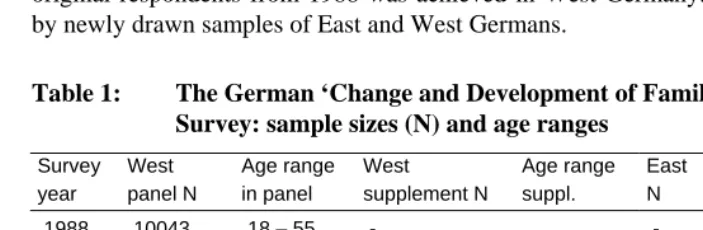
states in 1990 with rather few modifications. For the 1994 wave, the aim of re-interviewing the East-German participants of the 1990 survey had to be given up. For West Germany, the panel was supplemented with an additional sample to obtain a more representative sample for the population in 1994.6 In 2000, a further panel wave with original respondents from 1988 was achieved in West Germany. It was supplemented by newly drawn samples of East and West Germans.
Table 1: The German ‘Change and Development of Family Life Forms’
Survey: sample sizes (N) and age ranges
Survey year
West panel N
Age range in panel
West supplement N
Age range suppl.
East N
Age range East Total
1988 10043 18 – 55 - - 10043
1990 - - 1951 18 – 55 1951
1994 4997 24 – 61 2002 18 – 30 3995 18 – 55 10994 2000 2002 30 – 67 6613 18 – 55 1478 18 – 55 10093
Source: Bender, Bien & Alt (1996); Infratest Burke Sozialforschung (2000); Alt (1991).
All sub-samples of the 1988, 1990 and 1994 samples were probability samples. The 1988 survey consisted of two separate samples with response rates of 55% and 51% (Bender et al. 1996:274). The 1990 survey was carried out in the confusion after the fall of the iron curtain, which led to a response rate of just 39%. The 1994 survey consisted of three separate samples with response rates of 56.2% (West panel), 58.6% (East) and 58.8% (West, 18-30 year old). In 2000, the panel part had a response rate of 53% (Infratest Burke Sozialforschung 2000). The new participants of the 2000 survey were found via a modified random-route method where the flexible use of quotas for the selection of household members at the sampled addresses precluded the calculation of a response rate (Infratest Burke Sozialforschung 2000). Weights have been provided for most survey parts to help achieving representative data for the German population in the survey year. No weights have been calculated for the 1990 sample. There is some evidence of bias in the panel (Bender et al. 1996), most importantly an under-representation of people living in cities, of single people, and of single-person
6
households. I address this issue by controlling for respondents living in a city in 1988. The other main threats do not apply because my study is limited to couples.
The analyses are based on weighted data where possible. However, the software AMOS that I used for the confirmatory factor analysis does not accept weighted data. This should not seriously affect the results because, when comparing exploratory factor analyses from weighted and unweighted versions of the data, the results hardly differ. Similarly, the Cox model cannot be estimated from weighted data.
The study focuses on childless couples’ attitudes and the influence of these attitudes on the rate of first birth. A couple is classified as ‘childless’ if the respondent had no own children at the time of the interview, and no children of the partner were living with the couple.7 The asymmetry of the question means that some ‘childless’ couples included a partner who had a child from a previous relationship, a situation which should have been more common among female respondents. In the 1988 and 1990 surveys but not in the later surveys one can tentatively identify couples who were involuntarily childless.8 These couples will be excluded from some of the analyses.
The analysis is restricted to childless couples living together with the respondent being at most 40 years old, leaving 40 East-German men, 45 East-German women, 484 West-German men and 543 West-German women in the unweighted sample for the analysis. The differences in sample sizes reflect the different sizes of the overall East and West samples and also genuine differences in the populations. Because the age at first birth was very low in East Germany, most East-German respondents in the sample were late in forming a family compared to their peers. Difficulties of access to housing for childless couples in the GDR might be another reason for the small size of this group. Genuine differences between the populations are also reflected in the different shares of respondents indicating that the couple might be infertile, which is double as high among childless East-German men and women compared to West-German men and women, respectively, although the difference is not statistically significant.9
I considered two strategies for boosting the East-German sample. Because childless couples had difficulties to get access to housing one could argue that childless
7 The original question in the 1988 and 1990 survey was: ‘Do you or did you have any children? I am
interested in your own, step, foster and adopted children as well as the children of your partner, those who live with you’. In the 1994 survey, the qualification ‘those who lived with you’ was omitted.
8 The corresponding self-completion question asked: ‘Do you or your partner use a contraceptive regularly?’,
and for those who answered in the negative a follow-up question about the reason offered the pre-coded answer: ‘Because of biological or medical reasons not necessary’.
9
East-German couples living apart together should also be included in the analyses. However, the division of household work, a key variable in the study, differed strongly between childless couples living together and those living apart. Another way of boosting the East-German sample was to include the 1994 East-German sample in the analysis. This strategy is justified if changes between 1990 and 1994 were small compared to the East-West differences. Therefore, the analysis of attitudinal data will be based on the 1988 West-German sample and the combined 1990 and 1994 East-German samples.10 The resulting East-German sample of childless respondents aged 40 or younger living with a partner comprises 133 men and 167 women. Because infertility information is not available for the 1994 sample, all childless couples remain in the analysis irrespective of potential infertility issues. After excluding respondents with missing values of children the sample comprises 469 German men, 528 West-German women, 132 East-West-German men and 166 East-West-German women.
By focusing on childless couples the analyses address a part of the population that held less favourable values of children than people who were already parents. Therefore, the results of this study cannot be generalized to the whole German population. A slightly different question is whether the selected group might be more extreme in East Germany than in West Germany in terms of their values of children. Although there is no final answer to this question, examining the responses to the value-of-children items suggests that, compared to the whole East and West-German populations, the drop in appreciation of children by childless couples is about the same in East and West Germany.
The rest of the paper concerns only childless people who lived with a partner. Whenever I refer to East or West Germans from here on it is short for ‘childless East or West Germans who lived with a partner and were at most 40 years old’.
4.2 Core variables
4.2.1 Values of children
Respondents were asked to indicate their level of agreement or disagreement with 13 items (see Figure 3) by selecting one of four answers: ‘Strongly agree’, ‘Agree’,
‘Disagree’, ‘Strongly disagree’.11 The answers are coded so that high values indicate agreement with the item.
Figure 3: Items about the values of children in the FS
0. Children make life more intensive and fulfilled
1. Children leave too little time for one’s own interests
2. Children are practical, because when you’re older you have
someone to take care of you
3. Children create problems with neighbours, on trips and in public
4. Children burden the relationship
5. Children give one a sense of being needed
6. Children are a financial burden and reduce one’s living standards
7. Children bring worries and problems
8. Having children at home and watching them grow-up is enjoyable
9. Children make a decrease in employment necessary
10. It is good to have children because you can rely on them in an
emergency
11. Children bring partners in a relationship closer together
12. When a woman wants to have a career, she must do it without
children
4.2.2 Household work
My analytic strategy requires information about the anticipated gender division of household work after having a child. As this information was not available, I used the
11
second-best solution and interpreted the division of household work of the childless couple as a signal for the future division of household work. This assumption is relatively unproblematic for couples who already practised a traditional division of household work as it just suggests that they continue their current arrangement. The assumption is more problematic for childless couples whose household division of labour was more equitable because previous research suggests that many of these couples will change towards a more traditional division of labour when they have a child. This should be especially true for (West) Germany with its lack of institutional support for parents after childbirth and its policies that are directed towards a gendered division of childcare. It is unclear to which extent couples anticipate this change. There is some evidence that a couple’s household division of labour prior to having a child continues to exert some effect on the division of labour after childbirth (Sanchez and Thomson 1997; Schulz and Blossfeld 2006). Therefore, the anticipated gender division of household work after childbirth in couples that are sharing rather equitably will be either of two scenarios: a pronounced change towards a more traditional division of domestic labour with the associated threat of the woman’s economic dependency, or a struggle to continue an equitable arrangement with the possible associated stress within the partnership.
The survey provides subjective reports about the division of household work by the respondents from reporting ‘how the tasks are divided in your marriage or partnership…Which one of you does the majority of a particular task?’ The tasks covered in all surveys are:
• Shopping for the household
• Cleaning
• Cooking
• Caring for an ill or elderly family member
• Small repairs in the household
• Taking care of finances
‘Does not apply’. For deriving a summarizing measure for the distribution of household work I followed the logic of Ahrne and Roman’s classification (Ahrne and Roman 1997:28) and took only the three most demanding tasks from the list into account: shopping, cleaning and cooking.12 I distinguish five types of partnerships.13 In role-changed partnerships, the man does more household work than the woman. In equal
partnerships, there is an equal division of household work; all three tasks are shared equally, or each partner does the majority of one task and the third task is shared. In
semi-equal relationships, the man does quite a lot of household work but the woman has the main responsibility and carries out more work. They consist of partnerships where the spouses equally share two tasks and the woman carries out the majority of the third task, or where the woman carries out the majority of two tasks and the man of one. The fourth type of partnership is called conventional and captures couples where the woman does the majority of two tasks whereas the third task is shared between the spouses. Finally, in patriarchal relationships the woman carries out the majority of all three tasks.
In the FS respondents have not reported the actual hours spent on each task. By restricting the measure to the three most prominent tasks, I prevented rare or less demanding tasks from having an undue impact on the classification. When comparing the distribution of household work as reported by male and female respondents, one finds the well-known pattern of men and women over-estimating their own contribution (Keddi and Seidenspinner 1991; Dannenbeck 1992). The discrepancy in spouses’ reporting is not yet well understood (Booth and Welch 1978; Marini and Shelton 1993) but it has been linked to social desirability (Kamo 2000). When interpreting the analyses one needs to bear in mind that the reported contributions to household work are not necessarily the true behaviour but reflect the respondent’s subjective view (Höpflinger 1986).
12 The selection of these three tasks is based on the average time-use by day as reported in the Time-Budget
Study of the German Statistical Office (Statistisches Bundesamt 2004:637).
13 It was necessary to modify Ahrne and Roman’s categories because they would not lead to a coherent and
all.
4.2.3 Attitudes to women’s employment
The 1988 and 1990 surveys did not include a general item about the importance of paid work for the respondent. I used the related question: ‘What role do you think employment plays in a relationship or marriage?... Which do you personally believe is the correct solution – while there are no children? – while there is a child under 3? – while the youngest child is still of kindergarten age? – while the youngest child is still in school?’ with possible responses ‘Both should be fully employed’, ‘Both should be fully employed, but at a minimum one should only be part-time (the woman, the man, depends on the situation, both)’, ‘One from both should not be employed (the woman, the man)’. I argue that a preference for the woman working even when a preschool child is present captures to some degree the importance that the respondent attaches to paid work for the woman. I recoded the answers into four categories: a preference for a mother working full time14, part time, not at all, or ‘gender neutral’ if the respondent did not indicate whether the man or the women should be working part time or who of them should not be working at
4.3 Methods and models
The paper contains three pieces of analysis. The next section gives the results of a confirmatory factor analysis for the values of children. Then I test the hypotheses about the values of children by regressing the predicted factor scores on selected respondent characteristics. These models also examine how closely the values of children are related to the household division of labour and the ideal hours of work for mothers of preschool children. Additional variables include age, which is measured at the time of the interview minus 30, and dummy variables for the four groups of West and East-German men and women. The educational level is classified as low if the respondent either left school without qualification, with a lower secondary degree, or finished 8th grade; it is coded as medium if the respondent obtained a middle level degree, obtained a polytechnic entrance qualification, or finished 10th grade; and it is coded as high if the respondent obtained a university entrance qualification. I use a combined measure of labour-market participation and education as a proxy for alternative resources for achieving a sense of accomplishment. The set of dummy variables indicates whether the
14
respondent held a job at the interview, and if so his or her highest level of education. A high level of education should be associated with a high level of individual resources that allow for other ways of achieving a sense of accomplishment.
Finally, I will examine the importance of these attitudes for the propensity of having a first child in West Germany by estimating a Cox model. All covariates are measured at the 1988 interview and do not change over time. The information about a couple’s childbearing after the 1988 survey is taken from the 1994 and, if available and necessary, the 2000 interview. Only respondents who participated at least in the 1994 interview could be included in the analysis. Of the 997 childless respondents who lived with a partner in 1988, 455 were included in the 1994 panel, 406 providing valid information about the 1988 partnership.15 I take account of the bias in the 1994 panel wave by including an indicator for living in a city in 1988.16 The other known biases in the 1994 sample – the under-representation of single people and single-person households – should not affect the analysis of couples’ childbearing. The observation period starts in 1988 and ends either with the birth of the first child to the couple, their date of separation, or the last interview date, whichever occurred first.
The baseline duration is time until first birth since the 1988 interview. The covariates include the duration of the partnership in 1988 in years as well as the partnership duration squared and divided by 100.17 His and her age are measured at the 1988 interview in years minus 30. I also include his and her age minus 30 squared and divided by 100 to capture non-linear effects of age. The dummy-variable ‘city’ indicates whether the respondent lived in a town with more than 100,000 inhabitants in 1988. The survey did not collect information about partner’s attendance of a polytechnic college or university, nor did it record changes in respondent’s educational level by the time of the second interview. The survey does not provide employment histories for partners. To obtain equivalent measures for respondents’ and their partners’ education and employment, I use the same combined variable of labour-force participation and education in 1988 as in the regression models. The further covariates like the values of children, gender-division of household work and respondent’s ideal
15 Reasons for the loss of 49 cases are, on the one hand, inconsistencies in the partnership histories and, on the
other hand, differences in identifying partnerships. The 1988 instructions asked respondents to report whether they ‘currently have a strong relationship’, whereas the 1994 instructions asked them to report ‘past relationships that lasted at least for one year and were more than passing acquaintances or infatuations’.
16 Ideally the indicator would change over time because the bias is related to the 1994 place of living.
However, the data do not include histories of geographical mobility.
17 This date can differ from the year of first meeting the partner and the year of moving together. Because all
working time for mothers of pre-school children have been described earlier. However, the values-of-children variables have been standardized to have means zero and variances one so that their effects can be compared more easily. For men the value of ‘Opportunity costs’ is set to zero, the mean value for women. I also include interaction effects of the values of children with respondent’s gender as well as interaction effects of the values of children with simplified versions of the ideal working hours for mothers and the division of household work. The model does not include variables for whether and when a couple married because marriage is endogenous to both childbirth and the attitudes of interest.
Among the 406 childless partnerships at the 1988 wave with some follow-up information and a female partner of at most 40 years of age, I identified 213 with a first child after the 1988 survey and 193 who remained childless, using the information from the 1994 and 2000 panels. After excluding 17 couples with infertility issues and further couples with missing values for the covariates, 354 partnerships remained, reporting 192 first births.18
5. Results
5.1 Confirmatory factor analysis of the values of children
Before deriving scales for values of children I performed a confirmatory factor analysis to find out about similarities and differences in the structure of the values of children between East and West-German childless men and women (Long 1983; Lewis-Beck 1994; Byrne 2001). The confirmatory factor analysis tests how well correlations of the items about the values of children can be explained by a smaller set of factors. It also helps to explore the meaning of the different items. Following Byrne (2001) I first tried to establish baseline models for the four different subgroups.19 When examining several goodness-of-fit statistics, a three-factor model similar to the one referred to by Bertram (1991, 1992) was the best model for West-German men. For West-German women, a model with a separate factor capturing opportunity costs led to the best model fit. The three-factor model has also been adopted for the two East-German groups. Although
18 For the 406 couples, there are missing values for partner’s age (n=5), division of household work (n=17),
ideal working hours for mothers (n=4), the combined employment and education variable for females (n=4) and males (n=6).
being in each case the best model compared to plausible alternative models, only the model for East-German women achieved a satisfactory fit by conventional standards. However, as there were no obvious and theoretically founded model improvements for the other groups I did not further modify the models.
The next analytic step was to establish whether, apart from the fourth factor for West-German women, the same factor structure holds for the four sub-groups. When testing whether the same three-factor model holds for West-German men, East-German men, and East-German women I found that the three factors can be assumed to have the same factor loadings apart from three small differences. Item 12 (cf. Figure 2) loads higher on the Costs factor for East-German women than for the other two groups. Although the opportunity costs do not form a separate factor for East-German women, the issue of women combining children with a career is more closely related with the costs of having children than for men. The other differences in the factor structure refer to two factor variances. A higher variance of Affection for West-German men and a lower variance of Utility for East-German men suggest a more heterogeneous perception of the Affection value among West-German men and a more homogenous perception of the Utility aspect among East-German men than in the other groups, respectively.
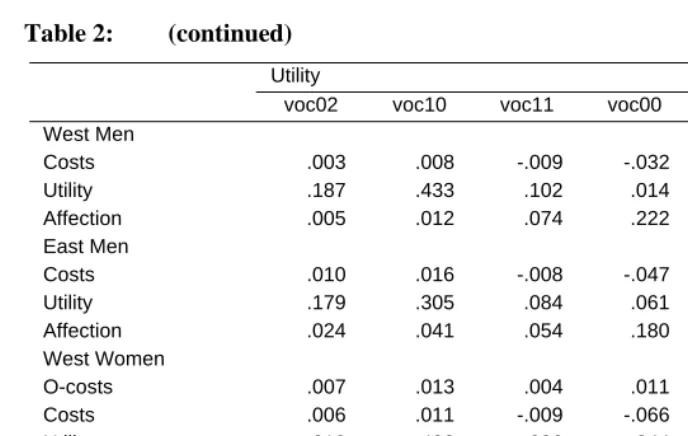
Table 2: Factor score weights based on final models in the appendix Figures A1 to A4
Costs O-Costs
voc01 voc03 voc06 voc04 voc07 voc09 voc12 West Men
Costs .132 .148 .169 .151 .143 .040 .021
Utility .003 .004 .004 .004 .004 .001 .001
Affection -.012 -.014 -.015 -.014 -.013 -.004 -.002
East Men
Costs .138 .171 .130 .189 .121 .044 .020
Utility .009 .011 .008 .012 .008 .003 .001
Affection -.018 -.022 -.017 -.024 -.016 -.006 -.003
West Women
O-costs .032 .034 .039 .030 .040 .159 .131
Costs .130 .137 .159 .123 .164 .044 .036
Utility .005 .006 .006 .005 .007 .008 .007
Affection -.016 -.017 -.020 -.015 -.020 .004 .003
East Women
Costs .137 .132 .157 .156 .121 .048 .058
Utility .006 .005 .006 .006 .005 .002 .002
Table 2: (continued)
Utility Affection
voc02 voc10 voc11 voc00 voc05 voc08
West Men
Costs .003 .008 -.009 -.032 -.019 -.037
Utility .187 .433 .102 .014 .008 .016
Affection .005 .012 .074 .222 .132 .255
East Men
Costs .010 .016 -.008 -.047 -.038 -.054
Utility .179 .305 .084 .061 .048 .069
Affection .024 .041 .054 .180 .143 .206
West Women
O-costs .007 .013 .004 .011 .002 .007
Costs .006 .011 -.009 -.066 -.013 -.042
Utility .210 .406 .086 .044 .009 .028
Affection .012 .023 .044 .246 .049 .157
East Women
Costs .006 .013 -.007 -.048 -.042 -.044
Utility .193 .452 .076 .033 .029 .030
Affection .011 .026 .045 .203 .179 .188
In the next step, I added West-German women to the analysis, postulating a fourth factor ‘Opportunity costs’ for this group and excluding the respective items from the Cost factor. After allowing for different loadings of items 0 and 5 (cf. Figure 2) on the Affection factor for West-German women, the four-group model achieved an overall acceptable fit. The estimated parameters – factor loadings, factor variances and factor correlations – of the final model are displayed in the appendix (Figures A1 to A4).
To sum up, the models identify three or four separate dimensions of the values of children for men and women. The factors Affection and Utility are shared by all groups in the analysis and load on the same indicators. However, the values of children differ in some aspects between the four groups. Most important is the separate factor for West-German women for the opportunity costs of children, reflecting the more serious consequences of children for women’s employment. The most ambiguous item in the analysis is ‘Bring partners closer’, which respondents interpreted in different ways, and which does not load strongly on any factor. As the item is one of two that could be interpreted as indicators of children’s social value, one can speculate whether including more items for this dimension would bring out the additional theoretically expected factor.
In conclusion, the factor structure of the values of children is equivalent in all groups apart from West-German women. There is partial measurement invariance of the Affection and the Costs factors, but the differences are actually few. In the following analyses I assume that the factors Affection and Utility are equivalent for all groups, and that the Cost factor is the same for both groups of men. However, some cautionary notes are warranted. The small East-German samples did not allow testing the model on a new sample. Therefore, the results are only exploratory. Furthermore, the small German samples provide limited power for detecting significant differences in the East-West comparisons.
5.2 Variations in the values of children between East and West-German women and men
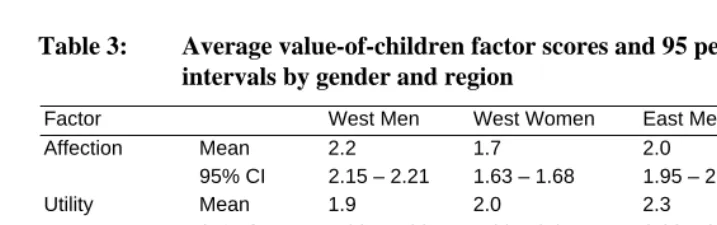
Table 3 gives the mean values of the factors and the corresponding 95 per cent confidence intervals for the four groups. High values indicate an endorsement of the respective factor. West-German men show a polarized pattern with on average the highest Affection scores among the four groups, the lowest Utility scores and the highest scores on the Cost factor. West-German women have similar Cost and Utility scores but they appreciate least of the four groups the affective value of children. Their cost assessment does not include the opportunity costs. East-German men and women score quite similarly on all scales, expressing medium affective values, high utility values and low perceived costs of children.
directly, but the factor score weights for items 9 and 12 could suggest that the perceived opportunity costs were especially high among West-German women. Hypothesis 6 is supported.
Table 3: Average value-of-children factor scores and 95 per cent confidence intervals by gender and region
Factor West Men West Women East Men East Women
Affection Mean 2.2 1.7 2.0 2.1
95% CI 2.15 – 2.21 1.63 – 1.68 1.95 – 2.05 2.06 – 2.15
Utility Mean 1.9 2.0 2.3 2.3
95% CI 1.89 – 1.99 1.98 – 2.07 2.26 – 2.38 2.25 – 2.41
Costs Mean 1.6 1.5 1.1 1.3
95% CI 1.57 – 1.65 1.49 – 1.57 1.00 – 1.13 1.22 – 1.35
Opportunity Mean 1.4
Costs 95% CI 1.42 – 1.46
Note: Weighted data.
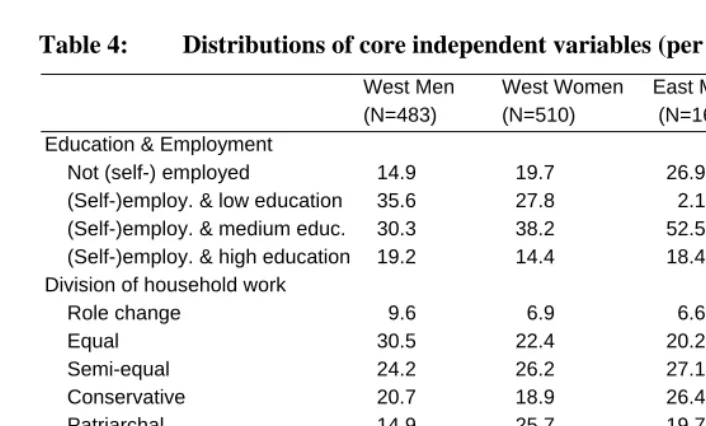
Hypotheses 2a, 5 and 7 refer to variations in the values of children by individual resources and by the woman having a career. To put them to the test I regressed the different factor scores onto individual respondent characteristics. In addition, the regression models test whether hypotheses 1 to 7 hold net of age, and whether the values of children vary with the gender-division of household work and with attitudes to mothers’ employment. The distributions of these variables are given in Table 4, showing some pronounced differences among the four groups. Considerably fewer East Germans than West Germans in the selected sample were in the labour market, and very few East Germans who were employed or self-employed had a low level of education. This skewed pattern is the combined result of differences in peoples’ educational attainment in East and West and several selection processes. Overall, fewer East Germans than West Germans have left school with a low level of education; more of them obtained a middle-level educational degree instead.20 Selecting childless couples means for all subgroups a drop of the share of people with low education in favour of the share of people with a medium level education (especially in the East) or a high level of education (especially in the West). Selecting childless couples means for West
20 When looking at the total sample, 49 per cent of West-German men and women compared to 17 per cent of
Germany also a drop of the share of people who are not employed (especially strong for women) and for East Germany an increase of this share.
Table 4: Distributions of core independent variables (per cent)
West Men
(N=483)
West Women (N=510)
East Men (N=162)
East Women (N=155) Education & Employment
Not (self-) employed 14.9 19.7 26.9 32.8
(Self-)employ. & low education 35.6 27.8 2.1 0.6 (Self-)employ. & medium educ. 30.3 38.2 52.5 49.8 (Self-)employ. & high education 19.2 14.4 18.4 16.9 Division of household work
Role change 9.6 6.9 6.6 4.5
Equal 30.5 22.4 20.2 18.6
Semi-equal 24.2 26.2 27.1 30.1
Conservative 20.7 18.9 26.4 30.4
Patriarchal 14.9 25.7 19.7 16.4
Ideal employment for mothers of preschool children
Full time 2.1 2.5 26.5 21.6
Part time 32.2 33.0 43.0 42.1
Not working 37.6 32.7 13.9 8.4
Gender neutral 28.0 31.8 16.6 27.9
Note: Weighted data
The division of household work shows a similar pattern for East-German men and women whereas West-German men report a rather high share of equal partnerships and West-German women report a rather high share of patriarchal partnerships.21 One also finds large regional differences in the ideal working hours for mothers of pre-school children especially in the categories of full-time work and not working. Except of East-German men, large shares of the sample gave a gender-neutral answer concerning whether the man or the woman should work part time or stay at home to care for the child. As the variable is used to capture respondent’s attitude to women’s careers, I interpret this specific category as comprising respondents who tend to support women’s careers depending on the specific circumstances. East and West-German men and
women also differ somewhat by age at the interview (not shown) with average ages in the weighed sample being 29.3 for West-German men, 27.1 for West-German women, 27.6 for East-German men and 26.1 for East-German women.
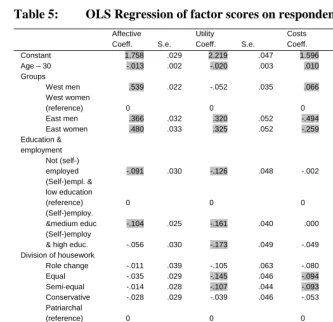
The regression results are presented in Table 5. The older the respondents are, the less prevalent are the Affective and Utility values of children and the more they emphasize the Cost aspect of children except Opportunity costs for West-German women, where there is no variation with age. The net differences in values of children by region and by gender show the same rank orders as the gross differences in Table 3. Both on the Affective and the Utility dimensions respondents with a job and a low level of education score highest. The same pattern holds if one carries out the analysis separately for men and women (not shown). These findings lend partial support to hypotheses 2a and 7.
Overall the Affective value of children does not vary with the division of household work. However, when I estimate the effects of the division of household work separately for men and women, I find that an equal division of household work is associated with a significantly lower Affective value for women whereas it exerts no influence on men’s Affection score.22 The perceived Utility of children is associated negatively with an equal or semi-equal division of household work. One can explain this as either being an indicator of less traditional values, emphasizing instead children’s independence and their right to their own lives, or of a high confidence of couples who share their household work equally that they can support each other without having to rely on their children. A semi-equal or equal division of household work is also associated with lower perceived Costs of children, possibly because the couple expects to share the burden. The effects of the ideal working hours for mothers of pre-school children show the expected patterns but they are not associated with any significant differences in the predicted values of children except for the group of respondents who postulate that men’s and women’s working hours are interchangeable. The group consists of highly educated individuals; 40 per cent of them have passed the university entrance exam. Among these non-traditional well-educated people there is little appreciation of the contributions of children to individual well-being. As the group does not score high on the Cost factor either, these people might best be described as having ‘no attitude’ to children.
22
Table 5: OLS Regression of factor scores on respondent characteristics
Affective Utility Costs Opportun. costs
Coeff. S.e. Coeff. S.e. Coeff. S.e. Coeff. S.e.
Constant 1.758 .029 2.219 .047 1.596 .041 1.497 .031
Age – 30 -.013 .002 -.020 .003 .010 .003 .000 .002
Groups
West men .539 .022 -.052 .035 .066 .030
West women
(reference) 0 0 0 0
East men .366 .032 .320 .052 -.494 .046
East women .480 .033 .325 .052 -.259 .046
Education &
employment
Not (self-)
employed -.091 .030 -.126 .048 -.002 .042 -.028 .034
(Self-)empl. &
low education
(reference) 0 0 0 0
(Self-)employ.
&medium educ -.104 .025 -.161 .040 .000 .035 -.009 .028
(Self-)employ
& high educ. -.056 .030 -.173 .049 -.049 .043 -.057 .039
Division of housework
Role change -.011 .039 -.105 .063 -.080 .056 -.069 .048
Equal -.035 .029 -.145 .046 -.094 .040 -.052 .033
Semi-equal -.014 .028 -.107 .044 -.093 .039 -.022 .032
Conservative -.028 .029 -.039 .046 -.053 .040 .017 .034
Patriarchal
(reference) 0 0 0 0
Ideal employment for mothers
Full time -.056 .041 -.060 .066 .075 .058 -.017 .073
Part time -.039 .024 -.025 .038 .061 .033 -.007 .028
Not working
(reference) 0 0 0 0
Gender neutral -.125 .025 -.155 .040 .049 .036 -.052 .029
Adjusted R2 .39 .14 .15 .02
N 1227 1227 1227 483
Notes: Coefficients with a grey background are significantly different from zero at the 5 per cent level. Weighted data
5.3 Having a first child in West Germany
Table 6 gives the relative risks of a first birth after 1988 for childless West-German respondents aged 40 or younger living with a partner at the 1988 interview. The first model includes only some control variables. The first-birth risk increases with partnership duration to about five years and decreases thereafter. Also woman’s age has a non-linear effect with the risk increasing up to about age 24 and decreasing thereafter. The male partner’s age is not significant at the five percent level once the woman’s age is taken into account.23 The indicator for living in a city controls for a possible selection bias in the panel. The first-birth risk is 23 per cent lower in cities than in smaller towns and villages, but the difference virtually disappears in the models that take other characteristics of the couple into account.
Model 2 adds the four factors of values of children to the model. Only one of them has a significant effect on the first birth rate: the higher the Affective value of children, the sooner the respondent has a child. Perceptions of the Costs of children or their Utility have no significant impact on the birth rate. Similarly the perceived Opportunity costs do not influence the first-birth rate of West-German women. Model 3 shows that the influence of the Affective value of children applies only to women.
The next models test whether other variables are confounded with the effect of the values of children. Model 4 takes into account whether the couple is in paid work and, if yes, their educational degrees. Women’s occupational resources do not prove significant for the first birth rate but if the man does not hold a job the couple tends to postpone childbirth.
A strong predictor of first births turns out to be the division of household work. Couples where the man carries out more tasks than the woman and couples where both partners share the tasks equally or semi-equally have a much lower rate of first birth than couples with a patriarchal division of household work. Finally, the respondent’s ideas about the ideal working hours for a mother of a pre-school child do not have any significant influence on the propensity of having a first child although the parameters display the expected pattern.
Table 6: Results from Cox models for first birth in West-Germany; relative risks
(1) (2) (3) (4) (5) (6)
Respondent male 1.08 .70 .73 .71 .75 .75
Partnersh. duration (y.) 1.16 1.16 1.17 1.18† 1.18† 1.20†
Part. dur. squared / 100 .23* .23* .21* .19* .18* .16**
Her age (years) .88** .90** .90** .90** .89** .89*
Her age squared / 100 .29** .31* .31* .30* .28** .27**
His age (years) 1.01 1.02 1.02 1.01 1.01 1.01
His age squared / 100 .67† .69 .69 .76 .69 .71
Lived in city .78† .88 .91 .91 .95 .95
Values of children
Affection 1.40* 2.16** 2.23** 2.21** 2.26**
Costs .94 .89 .92 .87 .85
Utility 1.01 .93 .90 .90 .90
Opportunity Costs 1.00 1.05 1.03 1.01 1.04
Men: Values of children
Affection .53* .51* .50* .49*
Costs 1.10 1.04 1.07 1.11
Utility 1.12 1.17 1.10 1.11
Her education and employment
Not (self-)employed 1.07 0.99 1.02
(Self-)employed & low
education (reference) 1 1 1
(Self-)empl. & med educ. .95 .95 .94
(Self-)empl. & high educ. 1.25 1.21 1.21
His education and employment
Not (self-) employed .49* .53† .53†
(Self-)employed & low
education (reference) 1 1 1
(Self-)empl. & med educ. 1.02 1.02 1.05
(Self-)empl. & high educ. 1.15 1.24 1.33
Division of housework
Role change .41** .40**
Equal .51** .49**
Semi-equal .56* .54**
Conservative .66† .62*
Patriarchal (reference) 1 1
Ideal working hours for mothers
Full time .72
Part time 1.25
No working (reference) 1
Gender neutral 1.17
-2 Loglikelihood0 2082.4
-2 Loglikelihood 2012.3 2000.2 1993.7 1985.6 1974.2 1972.1
Df 8 12 15 21 25 28
Note: ** p<0.01, * p<0.05, † p<0.10
Table 7: Results from Cox models for first birth in West-Germany with two-way interaction effects of the division of household work;
relative risks
(1) (2) (3) (4)
Respondent male .74 .75 .71 .72
Values of children
Affection 2.22** 2.23** 1.75† 1.19
Costs .85 .84 .86 .79
Utility .89 .88 .88 1.23
Opportunity Costs 1.04 1.06 1.03 .64†
Men: Values of children
Affection .50* .49* .52* .52*
Costs 1.07 1.08 1.06 1.23
Utility 1.15 1.17 1.17 1.20
Division of housework
Non-patriarchal .53** .50** .48**
Patriarchal (reference) 1 1 1
Ideal working hours for mothers
Working 1.24 1.10 1.13
Not working (reference) 1 1 1
Gender neutral 1.16 1.10 1.16
Combined ideal working hours for mothers and division of h/h work
Work & non-patriarchal .65
Not working & non-patriarchal .56†
Gender neutral & non-patriarchal .66
Work & patriarchal 1.54
Not working & patriarchal (reference) 1
Gender neutral & patriarchal .87
Interaction: Mother’s working hours * values of children
Working * Affective 1.42†
Gender neutral * Affective 1.40
Interaction: division of h/h work * values of children
Non-patriarchal * Affective 2.12**
Non-patriarchal * Costs 1.01
Non-patriarchal * Utility .69†
Non-patriarchal * Opportunity costs 1.90*
-2 Loglikelihood 1974.6 1973.5 1971.1 1960.9
Df 24 26 26 28
Note: ** p<0.01, * p<0.05, † p<0.10 The models also control for partnership duration, partnership duration squared, her and his age, his and her age squared, ‘Lived in city’, and his and her education and employment.
6. Summary and discussion
children. The confirmatory factor analysis revealed strong similarities in the factor structure of East and West-German men and women. In all groups I identified an Affective, a Utility and a Cost dimension of the values of children, each of which was linked to about the same items in each group. The main exception was the additional Opportunity-costs factor for West-German women, pointing to differences in the perceptions of the consequences of having children for women’s careers. A similar difference was found by Liefbroer (2005) for Dutch women. Another special feature of the factor structure for West-German women was the low association of the ‘sense of being needed’ with any factor, whereas it aligned with the affective dimension of having children in the other groups. Possibly, West-German women associate the item with obligations rather than with emotional closeness. Altogether the factor structures were similar enough to treat the three factors as equivalent in the later analyses. However, it is also important to note that the confirmatory factor analysis suffered from the small East-German sample size even when using both 1990 and 1994 data for East Germany. It is possible that special structures of East-German values of children did not surface clearly enough in the analysis to be distinguished from random error.
The items included in the survey do not cover all aspects of the values of children that have been discussed in the theoretically oriented literature, especially positive social aspects of having children. Some items have been interpreted by respondents in different ways. Altogether the analysis calls for a clearer and more comprehensive set of items to measure the values of children in social surveys. Such a revision could also try to further differentiate the items that capture the costs associated with children so that different negative aspects of having children could be separated out more clearly in addition to the opportunity costs to women’s careers.
When comparing the values of children between East and West-German men and women, several hypotheses about the values of children were not supported. Neither did I find a general regional difference in the Affective value nor any general gender difference. The real surprise was the high level of Affection that West-German men have expressed. The unexpected gender pattern is not entirely unusual. Liefbroer (2005) found that women perceive bigger disadvantages and smaller advantages of having a child than men. Using the concept of the ‘centrality of children to one’s life’, Jones and Brayfield (1997) found in two out of six countries that women saw children as less central to their lives than men.24 To explain this, Jones and Brayfield pointed out the
24 Jones and Brayfield (1997) measure the centrality of children by summing up the Likert scores for three
importance of national context for the expression of gender differences in attitudes to children. One could read the West-German results such that either women express relatively low Affective values for children because they are aware of the negative consequences of children for their life-styles; or that West-German men express relatively high affective values in trying to live up to a new ideal of fatherhood. One can also link the results for West-German men to a specific group of childless couples identified by Onnen-Isemann (2003): couples that are childless despite having a strong traditional family orientation. Onnen-Isemann speculated that these couples were postponing childbirth because they first tried to establish ideal conditions for bringing up a child in a traditional family. Childlessness results then from ‘an exaggerated valuation’ of family and children (Onnen-Isemann 2003:131).
The hypothesis that people with fewer individual resources rank higher on the Affective scale turned out to be true for people with a low level of education who are in work. It is in line with the theoretical argument that they have fewer alternative ways of achieving a sense of accomplishment. Similar findings have been reported in the studies by Hoffman, Thornton and Manis (1978) and Jones and Brayfield (1997). The hypothesis has not been supported for people without a job, which could be due to the heterogeneity of this group and its considerable share (45 per cent) of people with a high educational level.
The next question addressed in the paper was how the values of children were related to some other attitudes that might also influence the propensity of having a child. I found that couples with an equal or semi-equal division of household work perceived both the Utility and the Costs of children as lower than other couples. Only for women there was an association with the Affective value of children: women who equally shared the household work with their partners had lower Affection scores than women with a patriarchal division of labour. The finding is similar to Jones and Brayfield’s (1997) results and some of Bernhardt and Goldscheider’s (2006) results for Sweden. Both teams explained the findings as a consequence of the gender revolution, which led both to more liberal gender-role attitudes and to women and men becoming more conscious of the conflicts associated with parenthood. In addition, egalitarian men were less likely to anticipate the negative consequences of children in Bernhardt and Goldscheider’s study, which the authors explained by gains in the financial stability in dual worker families.25
25