Copyright © 2012-2017 CTTS.IN, All right reserved
Review of various visual cryptography methods to improve
security in image transaction
Vibhor Saxena
M. Tech Scholar, Department of Computer Science & Engg SSSIST Sehore
Prof. Kailash Patidar
Department of Computer Science & Engg,SSSIST Sehore, India. [email protected]
Abstract — Image cryptography plays an important role in data security. Visual cryptography is a method which is used to encrypt information in any format like text, image, led display such that decryption is done by human eye. It does not require any key for decryption so security during image transformation is always desirable but challenging task. Rapid growth in the techniques for doing so is also increasing. Internet has become most commonly used media for communication and hence text, voice, video, Images and many more are transmitted through Internet. These might include Military Secrets, Commercial Secrets and Information of individuals and therefore it has to be transmitted by safer means with enhanced security. In the process of Visual Cryptography a secret image is encrypted into shares which refuse to divulge information about the original secret image. Various researchers are working on improvement of security features in image transaction. In this review paper we are presenting analysis of various visual cryptography methods for and security enhancement techniques during image transactions.
Keyword — Image Security, Security, Visual Cryptography, Visual Secret Share
1. I
NTRODUCTIONDue to rapid development in internet technology, different types of information can be transferred over internet. Hence there is security issues associated with transmitting high value assets like commercial data, user personal information, banking or transaction data, and data related to military. Security of such data transfer must be taken into consideration because hacker can use various methods and steal such high value assets which results in high monetary, social, personal loss. Visual secret sharing (VSS) scheme is an efficient secure method for hiding a secret image by dividing it into share images and any one can decode it easily by the human visual system. The main concept of the original visual secret sharing (VSS) scheme is to encrypt a secret image into n meaningless share images. It cannot leak any
information of the shared secret by any combination of the n share images except for all of images [4,5].
Figure 1.1 Visual Cryptography
2. Related work
Arya k.rakhee baiju et al [1] worked on A Novel Visual Cryptographic Scheme for Improved Binary Image Quality.
According to Arya Visual Cryptography is an encryption method which shares secret information into n shares and decrypted into original image without any cryptographic technique. Existing visual cryptography does not provide good visual quality reconstructed image. Hence author proposed novel visual cryptography method with additional post processing technique which preserves good quality recovered image. Experimental results on this technique clearly shown that recovered image has competitive visual quality compared with input binary image.
Naor & Shamir [4] proposed visual cryptography scheme in 1994. This is the basic scheme of visual cryptography in which the secret image is divided into two shares. The shares generated are meaningless. When the two shares are stacked together, it produces the original secret image. This scheme is only for black & white images. Ateniese, Blundo & Stinson [2,3] proposed extended visual cryptography in 1996. This scheme contains meaningful shares. The (2,2) EVC theme projected during this needed enlargement of one picture element within the original image to four sub pixels which may then be chosen to supply the specified pictures for every share. Up to 1997, Visual cryptography schemes were applied to only black & white images.
Verheul & Tilborg [3, 4], proposed first colored visual cryptography scheme. But this scheme produces meaningless share. Wu and Chen [4] in 1998, were the first researchers to present the visual cryptography schemes to share two secret images in two shares Hsu et al [5] proposed another scheme in 2004. The scheme hides two secret images in two share images with arbitrary rotating angles. Verheul
and Van Tilborg [6] proposed a scheme for colored secret images can be shared; the concept of arcs was used to construct a colored visual cryptography scheme S J Shyu et al [7] were first researchers to advise the multiple secrets sharing in visual cryptography. This scheme encodes a set of n ≥ 2 secrets into two circle shares. The n secrets can be obtained one by one by stacking the first share and the rotated second shares with n different rotation angles. To encode unlimited shapes of image and to remove the limitation of transparencies to be circular.
3. V
ISUALC
RYPTOGRAPHYM
ETHODS3.1. Visual Cryptographic Schemes for Black and White Images / Binary Images
a) Binary Images: Wu and Chen [4, 9] in 1998, were the first researchers to present the visual cryptography schemes to share two secret images in two shares. In this scheme two secret binary images were considered which were hidden into two random shares, namely share A and share B. In retrieving phase the first secret image can be revealed by stacking the two shares, denoted by A⊗ B, and the second secret can be revealed by first rotating share A by angle Ө anticlockwise. The rotation angle Ө was designed to be 90◦.
b) Previous efforts in visual cryptography were restricted to binary images which is insufficient in real time applications. It is proposed visual cryptography for gray level images by dithering techniques. Instead of using gray sub pixels directly to constructed shares, a dithering technique is used to convert gray level images into approximate binary images. Then existing visual cryptography schemes for binary images are applied to accomplish the work of creating shares. The effect of this scheme is still satisfactory in the aspects of increase in relative size and decoded image quality, even when the number of gray levels in the original image still reaches 256 [16,18].
3.2. Visual Cryptography Schemes for color images
Copyright © 2012-2017 CTTS.IN, All right reserved schemes share generated were meaningless.
This is very popular in use, Colored secret images can be shared using this method; the concept of arcs was used to construct a colored visual cryptography scheme [11, 13]. As color images are extremely famous, in c-colorful visual cryptography scheme one pixel is transformed into m sub pixels, and each sub pixel is divided into c color regions. In each sub pixel, there is exactly one color region colored, and all the other color regions are black. Cryptography scheme color of one pixel depends on the interrelations between the stacked sub pixels.
b) The first approach to realize color VCS is to print the colors in the secret image on the shares directly similar to basic model. It uses larger pixel expansion which reduces the quality of the decoded color image [10].
c) The second approach converts a color image into black and white images on the three color channels (red, green, blue or equivalently cyan, magenta, yellow), respectively, and then apply the black and white VCS to each of the color channels. This results in decrease of pixel expansion but reduces the quality of the image due to halftone process.
3.3 Visual cryptography for general access structures: In (k,n) Basic model any “k” shares will decode representation is extended to general access structures by G. Ateniese, C. Blundo, A. De Santis, and D. R. Stinson [6], where an access structure is a specification of all qualified and forbidden subsets of “n” shares. Any subset of “k” or more qualified shares can decrypt the secret image but no information can be obtained by stacking lesser number of qualified shares or by stacking disqualified shares. The secret image which reduces security level. To defeat this concern the fundamental
3.4 Halftone Visual Cryptography: The meaningful shares generated in extended visual cryptography proposed by Mizuho nakajima and yasushi yamaguchi [7] was of poor quality which again increases the suspicion of data encryption. Zhi Zhou, Gonzalo R. Arce, and Giovanni Di Crescenzo proposed halftone visual cryptography which increases the quality of the consequential shares.
4.
C
HALLENGES INV
ISUALC
RYPTOGRAPHYM
ETHODS-As protecting template in the database securely is one of the Challenges in any biometric system. Here visual cryptography technique is applied to iris authentication system. In this system there are two modules: Enrollment module and Authentication module. For accessing any secure resource by authenticated users this system can be used.
4.1 Enrollment The administrator will collect the eye image of the eligible users those are having access to secure resource. The enrolled eye image is required to be processed so characteristic iris features can be extracted for this purpose algorithms are developed from.
Three steps that are: segmentation, normalization, and feature extraction are performed as conferred below:
Segmentation- is performed to extract the iris from the eye image. By employing circular Hough transform boundary of iris is searched. By fitting two lines using the linear Hough Transform eyelids are detected and eyelash is separated by threshold technique.
Normalization of iris region is carried out using Daugman’s rubber sheet model. This model remaps each pixel within the iris region to a pair of polar coordinates. The center of the pupil is considered as the reference point and the radial vectors circle through the iris region. Feature extraction is done by convolving the
normalized iris pattern into one dimensional Log- Gabor wavelets. The resulting phase information for both the real and the imaginary response is quantized, generating a bitwise template which is of 20*480 sizes. In the existing system generated template is stored in the database.
5.
C
OMPARATIVE ANALYSES OF VARIOUSV
ISUALC
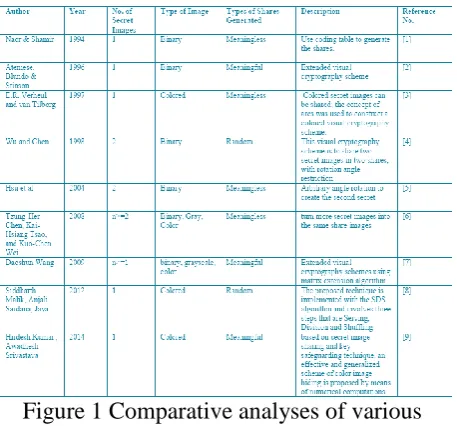
RYPTOGRAPHY METHODSTable 1 shows Comparative analyses of various Visual Cryptography methods. This analysis shows comparisons of various images such as binary, grey scale and colored images.
Figure 1 Comparative analyses of various
Visual Cryptography methods
6.
C
ONCLUSION ANDF
UTURE WORKSCryptography is well known and widely used tech. That manipulates much information in order to cipher or hide their existence. This tech. Have many applications in computer science and other related fields; they are used to protect email messages, credit card information, corporate data etc. This paper discusses the introduction of different types of Visual Cryptography schemes. It compares the image quality and security using various visual cryptography schemes. In order to hide the secrecy we go for expansion and increasing of the number of shares, but this affects the resolution .therefore an optimum number of shares are required to hide the secrecy at the same time security is also an important issue. Hence research in VC is towards maintaining the contrast at the same time maintaining the security. In future work we will present an efficient security scheme for visual
cryptography for grey scale images. This study helps us to understand various aspects of visual cryptography.
References
1. Arya k.1,rakhee baiju2, sreenarayanan n. M.3 , lakshmi m.4, nimisha mohan 5, soumya m. K.6, aswathy a.s.7, reshmi k.c., a novel visual cryptographic scheme for improved binary Image Quality, International Conference On Information Communication And Embedded System(ICICES 2016), PP 252-257
2. Kede Ma, Weiming Zhang, Xianfeng Zhao, Nenghai Yu, and Fenghua Li. Reversible Data Hiding in Encrypted Images by Reserving Room Before Encryption. IEEE Transaction on Information Forensics and Security: March 2013;Vol.8; No.3.
3. Jun Tian. Reversible Data Embedding Using a Difference Expansion.Transactions on circuits and systems for video technology: AUGUST 2003; VOL. 13, NO. 8.
4. Siddharth Malik, Anjali Sardana, Jaya. A Keyless Approach to Image Encryption. International conference on Communication systems and Network Technologies:2012; IEEE.
5. R. Vijayaraghavan, S. Sathya, N. R. Raajan. Security for an Image using Bit-slice Rotation Method–image Encryption. Indian Journal of Science and Technology:April 2014;Vol 7(4S); p 1–7.
6. C. Anuradha, S. Lavanya. Secure and Authenticated Reversible Data Hiding in Encrypted Image. International Journal of Advanced Research in Computer Science and Software Engineering: April 2013; volume 3, issue 4.
7. Zhicheng Ni, Yun-Qing Shi, Nirwan Ansari, Wei Su. Reversible Data Hiding. IEEE transactions on circuits and systems for video technology: March 2006; vol. 16, no. 3.
Copyright © 2012-2017 CTTS.IN, All right reserved Engineering Research: April-2012; Volume
3, Issue 4.
9. R. Lukac, K.N. Plataniotis. Bit-level based secret sharing for image encryption. The Journal of Pattern Recognition Society: 2005.
10. InKoo Kang, Gonzalo R. Arce, Heung-Kyu Lee. Color extended visual cryptography using error diffusion. IEEE:2009.
11. Yi, Feng; Wang, Daoshun; Luo, Ping, Huang, Liansheng, Dai, Yiqi.Multi Secret Image Color Visual Cryptography Schemes for General Access Structures. April 2006; Volume 16, Number 4; pp. 431-436.
12. J. Fridrich, M. Goljan, and D. Rui. Lossless Data Embedding - New Paradigm in Digital Watermarking. In Special Issue on Emerging Applications of Multimedia Data Hiding: February 2002; Vol. 2; pp. 185-196.
13. Chen Y, Tsai D-S, Horng G (2012) Comment on Bcheating prevention in visual cryptography. IEEE Trans Image Process 21:3319–3323
14. Corke P (2011) Image feature extraction robotics. Vision Control, Springer 73:335– 379
15. Corke P (2011) Image feature extraction. Robotics, Vision Control, Springer 73:335– 379
16. Desmedt Y, Van Le T (2000) Moire cryptography. In: the 7th ACM conference on Computer and Communications Security, 116–124
17. . Hersch RD, Chosson S (2004) Band moiré images. ACM Trans Graphics (TOG) 23(3):239–247