Research Journal
Volume 10, No. 30, June 2016, pages 69–75
DOI: 10.12913/22998624/62514 Research Article
IMPROVING DATA ACCESS SECURITY BY SERVER-SIDE FUNCTIONAL
EXTENSIONS
Marek Miłosz1, Dariusz Draganek1
1 Institute of Computer Science, Lublin University of Technology, Nadbystrzycka 36b, 20-618 Lublin, Poland, e-mail: [email protected], [email protected]
ABSTRACT
All Database Management Systems used in the industry provide secure access to data
at the server level. The level of security is influenced by technology, security model, password encryption method, password strength and others. The human factor – un
-reasonable behaviour of users – also has a significant impact on safety. Developers of
database applications often implement their security policy by limiting the risk caused
by users. This implementation has a disadvantage – it does not work outside of the
application. A large number and variety of applications that work with the database server may then create a security gap. The paper presents the authors’ extensions of
the functional features implemented in the Oracle database server, increasing the se -curity of data access. The implemented methods of controlling the time of user access to data and limiting the use of serial and modular passwords are also discussed. Keywords: security, data access, access time control, password policy.
INTRODUCTION
Security is one of the key elements determin-ing the proper operation of database (DB) industrial information systems. The problem of its
enhance-ment became more significant with increasing risks
resulting from the spread of information technology
(enlargement of people’s knowledge and skills),
development of the Internet (increased access to information for everyone) and the opening of the industry to a broader environment (development of remote access to enterprise information systems).
Industrial information security problems in
multi-tier systems can be resolved at different levels, for example application, network (e.g. Di
-rectory Services, DS), application server, or da -tabase. Some methods can only be carried out in a particular tier (e.g. [7]). Oracle Database Man-agement System (DBMS) supports the following methods of user authentication [8]:
• Password – through the ORACLE DB server. • External – through an operating system, direc
-tory services (usually Microsoft Active Direc-tory or analogical).
• Global – by an external authentication service
(e.g. Oracle Internet Directory).
External and Global methods, using cen
-tral authentication and user roles management,
enable the realisation of the policy of “Single Sign-On.” For this purpose the Windows Active Directory with Windows Native Authentication
can be used, or Kerberos - in heterogeneous en
-vironments. However, in these cases the installa -tion and maintenance services in the system are
required. Very different methods of implementa -tion of an authentica-tion policy are available in Active Directory.
Industrial information systems are
character-ised by a large number of various applications,
including legacy applications [9]. Very often they
do not use the Directory Services, so the only
common point is the database.
One of the many elements of information sys-tem security is the limiting of access to data. The need for restrictions is caused by legal regulations (e.g. in the area of access to personal data) or the well-understood interests of companies.
Industrial information systems implement
different security models. The most important are [1, 2, 10]:
• Discretionary Access Control (DAC), in which
the owner of the resource determines its acces-sibility and the rights of other users to it.
• Mandatory Access Control (MAC), which im
-plies the existence of pre-defined access rules
classifying the data due to their level of
con-fidentiality, and the users by assigning them a confidence class, which automatically regu -lates access permissions to all resources.
• Role-Based Access Control (RBAC), in which
the roles assigned to the user (or vice versa) are used for the management of access rules.
Roles are created and assigned manually by a
central administrator.
Modern Database Management Systems
(DBMS), which are an integral part of industrial systems, usually implement hybrid models that
combine the features of a number of security
mod-els. This also applies to the Oracle DBMS [20]. Unfortunately, even if DB industrial system security models perform correctly, after the col -lection and consolidation of data in a DBMS a problem emerges. The data in fact lose contact
with the application – they live outside it. This may pose a significant threat to their safety. The
situation becomes even more complicated in a
multiple application environment, which DB systems are. In such environments, the user can perform many roles with different access rules to the data. Simultaneous use of different
roles can lead to violations of data security. An important limitation of this risk is transferring the rules of secure data access to the database
server level [22].
The safety level of a particular DBMS
de-pends on the supplier, and the developer of in
-dustrial systems, unfortunately, does not have any effect on it (except the choice of one or an -other DBMS). Security levels are determined by
standards. One of them is an ISO/IEC 15408 [3], which defines seven levels of security: EAL1... EAL7 (EAL – Evaluation Assurance Level).
Industrial DBMSs obtain a maximum level of
EAL4. DBMSs at a very high level of security include, among others, servers [5]: IBM DB2 v. 10.1, MS SQL Server 2012 EE x64, Oracle Database 11g, Teradata Database 13.0, Sybase Adaptive Server Enterprise 15.0.1.
METHODS OF ACCESS CONTROL
IN ORACLE DBMS
The current version of the Oracle DBMS
pro-vides EAL4 level of data security. It is ensured
through the implementation of two tasks: protec-tion of data and protecprotec-tion of the system. The term protection of the system is meant as: control of
access to the DBMS (access authorisation), con -trol of resources allocated to the user (e.g. disk
space or CPU time) and monitoring their actions
in terms of resource consumption. The concept of
data protection is related to defining the access rights to the objects in the database, authorised
operations on these objects and monitoring per-formed operations.
Access control on the server level in the Oracle DBMS is implemented by the following items:
• user account, • profile, • privilege, • role.
The user account is classically characterised by a name and a password. Other parameters of the account are the default and temporary table
space, profile, set of roles and permissions. During the Oracle DBMS installation, an ac
-count is created for an administrator, who dis
-poses and manually assigns permission (RBAC model). In addition to the user account, access control is provided by profiles limiting the use of
system resources by the user.
Privileges are divided into system ones
(de-fining user rights to perform the operation) and object ones (defining database objects on which
operations can be performed). Under certain
cir-cumstances, one user may transfer his or her own privileges to other users (DAC model).
Roles are used to granting or revoking an ac -cess to groups of users (or other roles). Therefore
they simplify permissions management, enable
the selective and dynamic usage and enhance sys-tem performance.
The MAC model is implemented in the DBMS Oracle in a special version of the Trusted Oracle, and in cooperation with the operating system,
An important element of the Oracle system
security (starting from version 11) is the possi -bility of distinguishing uppercase and lowercase
letters in passwords, and generating a hash of
concatenation of a user’s name and password (for the purpose of storage in the database) using
algo-rithm SHA-1 with salt [8, 11]. This algoalgo-rithm is much more secure than the previously used DES/ MD5. Unfortunately, to encrypt historical pass -words stored in the database (e.g. for control of
duplications) the old SHA-1 algorithm is used. In
certain circumstances this may constitute a seri-ous hazard of guessing a user’s password.
THE HUMAN FACTOR IN SECURITY
POLICY
Security policy is created in three dimensions
[14]: technical, human and organisational. The
human factor in data security is very important
[13], even if technical and organisational security
is perfect. There are some aspects of the human factor which expose weaknesses in the security
system and should be carefully considered, for example user authentication [12, 17].
One essential element of security policy strongly dependent on the human factor is the
password policy. Rules applied in the security policy may be as follows [4, 14, 15, 18, 23]: • forcing a change of password after a certain
period (e.g. monthly) or user activity (e.g.
ev-ery 20th logging into the system);
• determining the minimum number of
charac-ters allowed in a password;
• forcing the use of an appropriately broad set of
characters – uppercase and lowercase letters, numbers, special characters;
• blocking easy passwords relating to the ap-plication and the user’s account (the same or
similar password to the name of the user, sys
-tem, server or database, etc.) and the names of months, seasons, colours, etc.;
• blocking the possibility of using periodically repeating (looping) passwords for
implemen-tation of security policies, enforcing periodi -cal change of password to another (lock level:
N previous passwords, N = 1, 2, 3);
• forcing differences in passwords at the ap
-propriate level, e.g. at least 4 characters of the password must be different compared to the previously used password;
• exclusion of a frequently used, shape-based,
switch of letters to numbers: I-1, Z-2, E-3, A-4, S-5, G-6, T-7, B-8, Q-9, O-0;
• limiting the use of serial passwords (so called
serialisation of passwords) – blocking the pos -sibility of setting passwords too similar to
those used in the past by, for example, [19]: – changing the numbers at the end, e.g. pass
-word1, password2, password3, ...;
– converting lowercase to uppercase letters and vice versa, e.g. pass1, Pass1, paSS1, etc.; – using modular passwords, which join a
number of consecutive characters in a
va-riety of configurations, e.g. marta12jan, jan34marta, martajan4b, etc.
Unfortunately, the application of these rules
(generally correct in their assumption) induces objective problems (such as: forgetting passwords
and the need for their recovery, writing down
passwords on removable media and storing them in places easily accessible to unauthorised
per-sons, reducing the list of potential passwords and
the complexity of the process of their creation)
and a negative reaction of the user, who bypasses
inconvenient security rules and regulations (by
for example saving passwords on pieces of paper,
using serialised or culture-related passwords). At
the same time, research shows that the behaviour of different groups of users is different [6].
This shows that the weakest element in the process of password management will always be
its user. Even the best-designed and implemented security can become insufficient with a wrong
approach to the access to information systems.
Therefore, it is necessary to systematically edu -cate users and remind them of their
responsibil-ity for the securresponsibil-ity of the system for each user, regardless of privilege level [12, 14].
The Oracle DBMS and it security policy parameters
In the standard versions of the Oracle DBMS
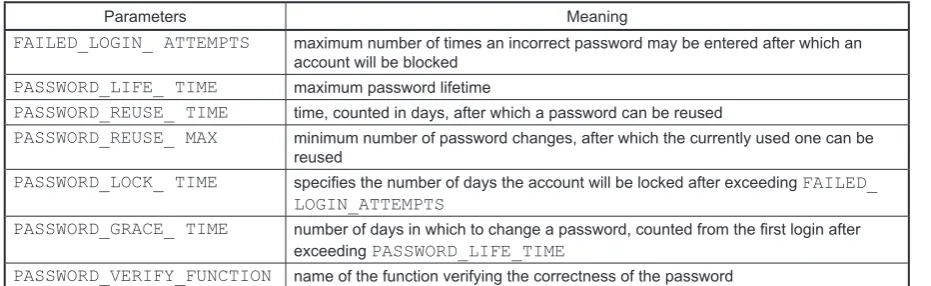
password policy is defined in a user profile with a number of parameters – Table 1 [11].
Parameters PASSWORD_REUSE_MAX and
PASSWORD_REUSE_TIME (Table 1) require sav -ing the hash function for previously used passwords.
In Oracle, the MD5 algorithm and sys.user_ history$ system table are used for each user
has three columns: USER# (a unique user code in
the database), PASSWORD (hash of password) and
PASSWORD_DATE (password expiration date).
The existence in the profile of the PASS-WORD_VERIFY_FUNCTION parameter allows
to create more complex, personalised password
security policies.
The authors’ extensions to increasing data access security
Increasing security of access to data in the Or-acle DBMS is possible through the development of additional server-side functionality. Authors’
extensions perform the Time Control of User Ac
-cess to Data (TCAD) and Limiting the Use of Un
-acceptable Passwords (LUUP). They are targeted
at industrial applications.
MODULE OF THE TIME CONTROL OF
USER ACCESS TO DATA
The management of the time of user access to
the data means defining the intervals in which the user cannot log in to the DB server. Typically, the functionality is realised on the application side,
connected to the DB. The Oracle DBMS does not
have this functionality built into the server, so it is
necessary to develop it on the server side.
The TCAD tool consists of a web application for defining intervals of access/access block and
the extended DB trigger function that prevents users from logging into the DB except at the
de-fined intervals. This tool uses the AFTER LOGIN trigger and a table consisting of defined intervals
of access blocks.
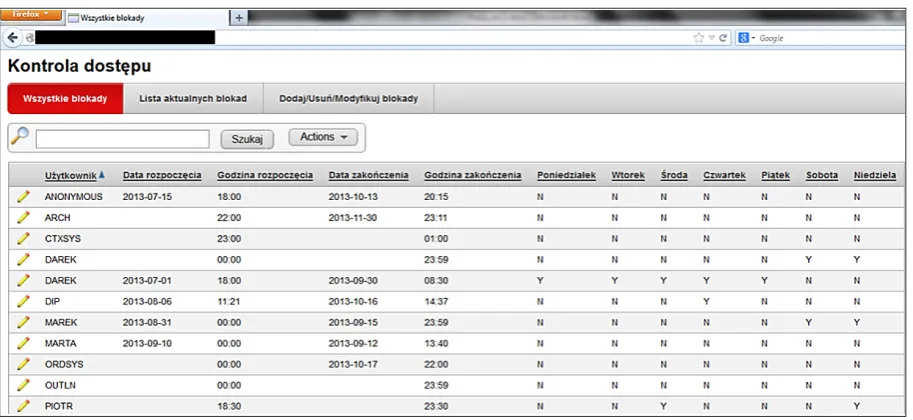
A specially developed Access Control Defini
-tion (ACD) applica-tion (see Fig. 1) allows to de
-fine intervals of logging restriction for each user. Due to the industrial use, the schedule of access blocks is defined to the minute (server time): dur -ing the particular period (i.e. from the date of the
day), for the particular days of the week (e.g. for all weekends) and selectively for specific days. In the ACD application, the adoption of group defin -ing limits for the days of the week results from a typical cyclic scheduling of workers (i.e. users of the DB) in the industry.
The ACD application, beyond the ability to edit blocks of user access, has expanded reporting and filtering options.
The restriction of access to the data corre-sponds to the trigger which on the basis of entries blocks the access. The trigger is activated by the
AFTER LOGIN event. In the case of blockade
detection (based on the contents of a table filled with ACD applications) the trigger performs the DISCONNECT IMMEDIATE operation.
MODULE OF LIMITING THE USE OF
UNACCEPTABLE PASSWORDS
The LUUP tool is a function stored in the Oracle DB (and executed by the server), which after its indication in the profile of a DB user
(parameter PASSWORD_VERIFY_FUNCTION) replaces the standard Oracle solution (function
VERIFY_FUNCTION_11G) with the one devel-oped buy authors. The standard function VER-IFY_FUNCTION_11G performs a very simple password security policy. This policy is in many
cases insufficient.
The Oracle function VERIFY_ FUNCTION_11G controls the following
situa-tions [10]:
Table 1. Parameters defining the password policy for the user profile of the Oracle DBMS
Parameters Meaning
FAILED_LOGIN_ ATTEMPTS maximum number of times an incorrect password may be entered after which an account will be blocked
PASSWORD_LIFE_ TIME maximum password lifetime
PASSWORD_REUSE_ TIME time, counted in days, after which a password can be reused
PASSWORD_REUSE_ MAX minimum number of password changes, after which the currently used one can be reused
PASSWORD_LOCK_ TIME specifies the number of days the account will be locked after exceeding FAILED_ LOGIN_ATTEMPTS
PASSWORD_GRACE_ TIME number of days in which to change a password, counted from the first login after exceeding PASSWORD_LIFE_TIME
O1. Is the minimum password length greater than
8 characters?
O2. Is the new password not the same as the
username or username + a number between
1 and 100?
O3. Is the password not the username written
backwards?
O4. Is the password different from the database
name or database name plus a number
be-tween 1 and 100?
O5. Is the password one of the strings: ‘wel
-come1’, ‘database1’, ‘account1’, ‘user1234’, ‘password1’, ‘oracle123’, ‘computer1’, ‘abcdefg1’, ‘change_on_install’?
O6. Is the password ‘oracle + number in the range 1-100’?
O7. Does the password contain at least one letter and one number?
O8. Is the password different from the previous
one by at least three characters?
In the case of even one negative response, the VERIFY_FUNCTION_11G function returns a
value, indicating an incorrect password.
The authors’ extensions modify the
perfor-mance of a function defined in PASSWORD_VE-RIFY_ FUNCTION into the function verifying:
• the existing provisions of the standard func-tion VERIFY_FUNCTION_11G;
• additional conditions.
The additional conditions used in the authors’
LUUP tool are:
A1. Does the password contain at least one lower
-case letter, one upper-case letter, one number
and one special character?
A2. Does the password not contain the same N el -ement string as the previous password?
A3. Is the password not similar to the n previ -ous passwords: by changing the uppercase and lowercase letters and/or by changing the numbers?
In addition, the dictionary of verified words from condition O5 was expanded into a person
-alised one, developed on the basis of the most
commonly used passwords. This dictionary must
be adapted to the specific language of the user (in
this case Polish).
Condition A1 forces the user to use a more
diverse set of characters and is “patching a hole”
in the DBMS Oracle 11g (only: “one letter and one number” – condition O7). Condition A2 con
-trols the use of modular passwords, i.e. permuta
-tions of the same strings. Control of the use of
passwords similar to those already used is
imple-mented by condition A3.
SECURED PROFILE
The authors’ TCAD and LUUP tools will work only for those users that have a profile us -ing it assigned for them. To facilitate its
appli-cation, a model profile called RESTRICTED has been created, containing the following settings of
a password’s grace period:
CREATE PROFILE RESTRICTED LIMIT FAILED_LOGIN_ATTEMPTS 3
PASSWORD_REUSE_MAX 7
PASSWORD_LOCK_TIME UNLIMITED PASSWORD_GRACE_TIME 7
PASSWORD_VERIFY_FUNCTION FUNCTION_RESTRICTED_DD;
The proposed password policy settings in the
profile RESTRICTED introduce the following limitations:
• 3 consecutive failed login attempts block the account;
• password expiration: 30 days;
• the time the password will be remembered for:
180 days;
• minimum number of passwords, after which the password can be used again: 7;
• the time for which a password is blocked after exceeding the allowed number of logins:
per-manently;
• the time in which the password can be changed
after its expiration: 7 days;
• the function verifying a password change:
FUNCTION_RESTRICTED_DD (name of the
LUUP tool function).
Each user who has this profile set up will be
subject to all the restrictions. The parameters that control the password expiration period and his-tory: PASSWORD_LIFE_TIME, PASSWORD_ REUSE_ MAX and PASSWORD_REUSE_TIME
are asymmetrically selected in order to force the user to use more than the average number of passwords.
CONCLUSIONS AND FUTURE WORK
The Oracle DBMS, in addition to the stan
-dard built-in security of access control processes, offers opportunities for developing these proce -dures. It is the chance to create a personal soft-ware and policy of protecting access to industrial systems data.
The developed TCAD and LUUP tools are
examples of actions that enhance the security of
data access in industrial applications, especially
in multiple application systems.
An unresolved problem in the TCAD tool is
treating the session of users logged into the data-base before activating the block. It cannot under any circumstances be assumed that at the time of activating the block the session is
automati-cally closed, because it might lead to loss of user performance, and in addition it is difficult to es
-timate the time of rolling back the changes. The
option of session closing after confirming the last transaction has been used. The TCAD application
controls only the newly opened access to the DB.
This tool seems to be better, because it limits the possibility of further work, but does not interfere
with the implementation of a long operation.
The TCAD tool does not implement the fol -lowing possible features:
• monitoring the correct (in the sense of: user
name + password) login attempts, but in the
unauthorised time the access blocks that occur are only mapped in the system tables and are
not supported by the author’s extensions tool; • notifying the administrator about blocked
ac-cess attempts in real-time (by SMS).
These features will be the tasks of future
work. The LUUP module can be expanded to re -alise more and more complex algorithms. These algorithms are the result of the actions of the system users. Analysis of these actions provides
information for detecting new, bad patterns of us -ers’ password policy. Spotting these patterns al-lows to create new algorithms and programs to neutralise violations of security policy.
REFERENCES
1. Ahn G.-J., Sandhu R., Role-based authorization constraints specification. ACM Transactions on In
-formation & System Security, 3 (4), 2000, 207–226. 2. Bouzida Y., Logrippo L., Mankovski S., Con -crete- and abstract-based access control.
Inter-national Journal of Information Security, 10 (4), 2011, 223–238.
3. CC. Common Criteria, 1/25/2016, http://www.
commoncriteriaportal.org.
4. Chiasson S., van Oorschot P.C., Quantifying the se -curity advantage of password expiration policies.
De-signs Codes and Cryptography, 77, 2015, 401–408. 5. CP. Certified Products. Common Criteria,
(1/25/2016), http://www.commoncriteriaportal.
org/products/.
6. Duggan G.B., Johnson H., Grawemeyer B., Ratio -nal security: Modelling everyday password use.
International Journal of Human Computer Studies, 70 (6), 2012, 415–431.
7. El Menshawy D., Mokhtar H., Hegazy O., A Key
8. Fogel S., Oracle Database Administrator’s Guide. 11g Release 2 (11.2). Oracle Corp., 2013.
9. Gruner F., Kassel S., Extending Lifecycle of Leg
-acy Systems – An Approach for SME to Enhance
Their Supported Business Processes through a Ser-vice-Integration-System. International Federation
For Information Processing –Publications, 372, 2012, 43–50.
10. Hasani S. M., Modiri N., Criteria Specifications for the Comparison and Evaluation of Access Control Models. International Journal of Computer Net
-work & Information Security, 5 (5), 2013, 19–29. 11. Huey P., Oracle Database Security Guide. 11g Re
-lease 2 (11.2). Oracle Corp., 2012.
12. Juszczyk M., Digital identity acceptance at Polish
large enterprises: The survey results. Actual
Prob-lems of Economics, 132, 2012, 474–481.
13. Juszczyk M., Impact of human factor in data se
-curity. Actual Problems of Economics, 120, 2011, 359–364.
14. Kozieł G., Information security policy creating. Ac
-tual Problems of Economics, 126, 2011, 367–380. 15. Lichtfield D., Anley C., Heasman J., Grindlay B.,
The Database Hacker’s Handbook: Defending
Da-tabase Server. Wiley&Sons, 2005.
16. Lorenz B., Kikkas K., Klooster A., The four most-used passwords are love, sex, secret, and god: Pass
-word security and training in different user groups. In: Marinos, L., Askoxylakis, I. (eds) First Int. Con
-ference on Human Aspects of Information Security, Privacy, and Trust. LNCS, 8030, 2013, 276–283. 17. Milosz E., Milosz M., Digital Identity Manage
-ment at Polish SMEs. Actual Problems of Econom
-ics, 120, 2011, 340–345.
18. Natan R.B., Implementing Database Security and Auditing. Elsevier Inc., 2005.
19. Neagu A., Oracle 11g Anti-Hackre’s Cookbook. PACKT Publishing, 2012.
20. Ni Q., Bertino E., Lobo J., Brodie C., Karat C., Karat J., Trombetta A., Privacy-Aware Role-Based Access Control. ACM Transactions on Information & System Security, 13 (3), 2010, 24–31.
21. Shaul J., Ingram A., Practical Oracle Security: Your Unauthorized Guide to Relational Database Security. Syngress Publishing Inc., 2007.
22. Thion R., Coulondre S., A relational database in -tegrity framework for access control policies.
Journal of Intelligent Information Systems, 38 (1), 2012, 131–159.