Improvement of Software Reliability Research Using a
Systematic Review
D.Jyothirmai*,M.Suresh Kumar**,Dr.K.Subba Rao***
*(CSE Department, BVRIT, and NarsapurEmail;[email protected]) ** (DRDO, Scientist-E, and Hyderabad
Email ;[email protected] )
***(CSE Department,BVRIT, and Narsapur) Email;[email protected])
---
************************
---Abstract
:
In the Software Engineering. The Software Reliability is very Important Concept. Here, This paper aims “To provide a basis for the improvement of software reliability research through a systematic review of previous works”. The review identifies some papers on software reliability in less journals and classifies the papers according to “research topic, research approach, and study context”. The review results combined with other knowledge provide the support for recommendations for future research on software reliability, including 1) increase the breadth of the search for relevant studies, 2) search manually for relevant papers within a carefully selected set of journals when completeness is essential, and 3) conduct more studies on reliability methods commonly used by the software industry.Keywords —Software Engineering, Software Reliability, approaches, methods
---
************************
---I. INTRODUCTION
This Research reviews of the journal articles on software reliability with the goal of “supporting and directing future reliability researches” Our review has the following elements:
a)Different goal: The main goal of this review is
“to direct and support future reliability researches”, the other reviews principally aim at introducing software practitioners or novice reliability researchers to the variety of formal reliability models. This difference in goal leads to a different focus. For example, our review focuses on research methods and does not include a comprehensive description of different software reliability methods.
b)More comprehensive and systematic review:
Here, we have to based the analysis on a systematic search of journal papers, which led to the identification of some journal papers from less journals. We did not find any such review describing a systematic selection process or state clear criteria for inclusion or exclusion.
c) Classification of studies: We classified the
software reliability papers with respect to“research topic, research approach, and study context”.
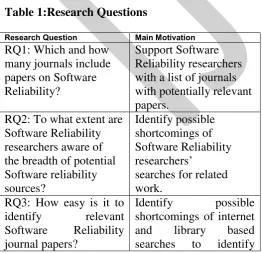
Here,based on what we believed were interesting issues to analyze, we posed Three research questions described in Table 1. The underlying motivation for all questions was “our goal of
improvement of the software reliability researches.” These research questions guided the design of the review process.
2. REVIEW PROCESS:
Here, The Review Process is consists of Inclusion Criteria, Identification of Papers, Classification of Papers, Analysis and Threats to Validity. These above five are briefly described in given below. 2.1 Inclusion criteria:
The main criterion for including a journal paper in our review is that the paper describes research on software reliability models. Papers related to Software Reliability are only included if the main purpose of the studies is to improve Software Reliability process. We excluded pure discussion/opinion papers.
There were examples of papers describing, essentially, the same study in more than one journal paper. Fortunately, the number of such cases was small and would not lead to important changes in the outcome of our analysis. We, therefore, decided not to exclude any paper for that reason.
Table 1:Research Questions
Research Question Main Motivation
RQ1: Which and how many journals include papers on Software Reliability?
Support Software Reliability researchers with a list of journals with potentially relevant papers.
RQ2: To what extent are Software Reliability researchers aware of the breadth of potential Software reliability sources?
Identify possible shortcomings of Software Reliability researchers’
searches for related work.
RQ3: How easy is it to identify relevant Software Reliability journal papers?
Identify possible shortcomings of internet and library based searches to identify
Software Reliability papers.
2.2 Identification of papers
The search for papers was based on an issue-by-issue, manual reading of titles and abstracts of all published papers, written in English in various journals published in IEEE Xplore, Springer, ACM, Wiley, Elsevier, Questia and Sage.
The journals were identified through reading the reference list of software reliability papers, searching on internet for previously not identified, relevant journals. Both authors constructed a list of potentially relevant journals independently. These two journals were merged together. In spite of the good number of identified journals, it is possible that there are, e.g. national or company specific journals with papers on software reliability that we have missed.
Papers that were potential candidates for inclusion in our review were read more thoroughly to decide whether to include them or not. In total, Some relevant papers were found in less journals 2.3 Classification of papers
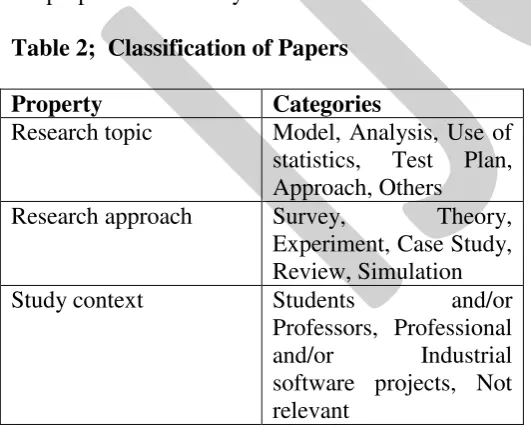
For the purpose of our analysis, i.e., addressing the research questions, we have classified the papers according to the properties and categories listed in Table 2. The categories are adapted to the needs of our analysis .The classification schema was developed for the purpose of our review and is not intended to be a general-purpose classification of software reliability studies.
more than one research model. The robustness of the classification schema and process was evaluated by testing a random sample of papers. The classification test showed that several of the initial descriptions of categories were vague. Most of the disagreements were due to recurring issues, e.g., different interpretations regarding how much review of previous studies a paper should include to be classified as a review paper. In other words, the main problem was the clarity of the descriptions and not so much the initial classification itself. We therefore decided that the initial classification had a degree of accuracy sufficiently high for the purpose of this paper, given that we
1) Clarified the descriptions that led to disagreements, and
2) Reclassified the papers that belonged to the problematic categories.
In spite of this effort to improve the reliability of the classification, it is likely that several of our classifications are subject to discussion, that the descriptions could be improved further, and that some of the papers are classified incorrectly. However, we believe that on the whole, the current classification is of sufficiently high quality to serve the purpose of our analysis.
Table 2; Classification of Papers
Property Categories
Research topic Model, Analysis, Use of statistics, Test Plan, Approach, Others
Research approach Survey, Theory, Experiment, Case Study, Review, Simulation
Study context Students and/or
Professors, Professional and/or Industrial software projects, Not relevant
2.4 Analysis;
The classification of research papers provided a general picture of the characteristics of the software reliability research. This general picture served as a starting point for deeper investigation of findings that seemed, from our perspectives, to suggest important shortcomings in reliability research and possibilities for improvement
2.5 Threats to validity:
The main threats to the validity of our review, we have identified, are these:
a)Publication bias:
The exclusion of conference papers and reports is based mainly on practical concerns, including workload, e.g., the problems of identifying all relevant papers and the amount of analysis needed to handle the fact that many journal papers are improvements of previously published conference papers. However, we are interested mainly in properties of the research into software reliability. The main bias of our inclusion of journal papers is simply one toward papers with high scientific quality.
We probably have excluded a major source of information about the software industry’s experience in using different reliability approaches. Our analyses and recommendations ry to reflect this bias. Another potential publication bias is that which might result from not publishing reliability research that has no significant results, results that did not yield the desired outcome, company-confidential results, or results that were conducted on topics that do not fit into the common software engineering journals. Also, only those papers were included which were available free of cost and paid papers were excluded.
The size and effect of the potential publication biases would be interesting to study but would require a study design different from ours. b)Vested interest of the authors:
c)Unfamiliarity with other fields:
Clearly ,reliability is a topic that is relevant to many fields; thus, it is possible that we have overlooked essential work and relevant journals published in another discipline, e.g. medical science.
3.R
ESULTS:
3.1 Relevant Software Reliability Research Journals(RQ1):
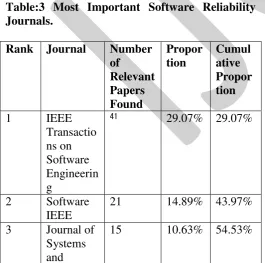
We found papers on software reliability in as many as less journals, i.e., the total number of journals with such papers are higher than we expected. The name of the journal with five or more papers on software reliability is also displayed in Table 3, together with the corresponding number, proportion and cumulative proportion of papers. These six journals include two-thirds (65.90%) of all identified journal papers on software reliability. Reading only the top five most relevant journals means that important results may be missed.
Table:3 Most Important Software Reliability Journals.
Rank Journal Number of
Relevant Papers Found
Propor tion
Cumul ative Propor tion
1 IEEE
Transactio ns on Software Engineerin g
41 29.07% 29.07%
2 Software IEEE
21 14.89% 43.97%
3 Journal of Systems and
15 10.63% 54.53%
Software 4 Electronic
s and Communi cations in Japan
6 4.25% 58.80%
5 5
Annals of Software Engineerin g
Empirical Software Engineerin g
5 5
3.55% 3.55%
62.35% 65.90%
3.2 Researcher Awareness of Relevant Journals (RQ2):
We were interested in the degree to which software reliability researchers were aware of and systematically searched for related research in more than a small set of journals. An indication of this awareness was derived through a random selection of 15 software reliability journal papers (above 10% of the journal). These papers are marked with (S) in Appendix C. The reference lists of each of these papers were examined. From this examination, we found that:
The typical (median) software reliability study relates its work to and/or builds on Software Reliability studies found in only few different journals, esp. in IEEE TSE. 12 out of 15 (80%) of the selected papers referred to this journal, for example, in paper “Analyzing and Improving Reliability: a tree based approach”, 37.50% paper referred were from IEEE TSE. 33.33% selected papers also referred to IBM Journal of Research and Development.
We examined the topics of the papers and found that some of the papers did not referred to previously published, seemingly relevant, papers on the same research topic. For example,
Bayesian modification to the Jelinski– Moranda software reliability model” by Bev Little wood and Ariela Sofer, published in journal paper Software Engineering Journal in 1987 by IEEE Xplore. This indicates, we believe, that many papers on Software Reliability are based on information derived from a rather narrow search for relevant papers.
The most referenced journal, with respect to related Software reliability work, was the IEEE Transactions on Software Engineering (IEEETSE) and it contained maximum number of papers (29.07%). Reliability papers from this journal were referred to in as many as 80 percent of the papers. There were surprisingly many references (33.33%) to IBM Journal of Research and Development. 20 percent papers also referred to Journal of System and Software.
Few papers referred to papers published outside the software community like “Estimation of Software Reliability by Stratified Sampling ”and
“Software Reliability Models: Assumptions, Limitations, and Applicability” referred to
“Estimating software reliability from Teat Data” By E.N. NELSON, published in Mircro electronin 1978 and “A Sequential Bayesian Generalization of the Jelinski–Moranda Software Reliability Model” referred to journals like “American Institute of Aeronautics and Astronautics” and “IEEE Trans Aerospace 2”.
Also, some journals outside computer science field also published paper on reliability improvement and referred to papers from IEEE TSE. Paper “Improving the Reliability of Medical Software by Predicting the Dangerous Software Modules” was published in the Journal of Medical Systems.
The above evidence indicates that several authors use narrow criteria when searching for relevant software reliability papers. The most important issue, however, is whether papers on software reliability miss prior result that would improve its study. This can not be derived from our view alone. Our impression, however, based on the review presented in this paper, is that the major deviation from what we assess as the best research
practice is the lack of identification and integration of results outside the computer science domain. 3.3 Identification of Relevant Software Reliability Research Journal Papers (RQ3)
Our search for software reliability papers was, as described earlier, based on a manual issue-by-issue search from the journal. This is, we believe, an accurate method of identifying relevant research papers, given that the people conducting the search possess sufficient expertise. It does, however, require much effort and, if possible, it should be replaced with more automated search and identification methods. The main tool for this is the use of digital libraries. To indicate the power of the digital libraries we conducted the following evaluation:
1. The search term: “software reliability” was applied in many journals. Wider searches would, obviously, lead to more complete searches. The number of “false alarms” would, however, also increase strongly and the benefit of automatic search may easily disappear.
2. The papers identified by using the above searches were compared with the set of papers from our manual search.
The main conclusion from this simple test was that the use of the search facilities of digital libraries to search for common software reliability terms is not sufficient for the identification of all relevant software reliability research papers. The search in many journals missed a substantial part of relevant papers. A closer examination of the titles and abstracts of the journal papers not identified suggests that the most typical reasons for non-identification in our test were:
i) When we typed “software reliability”, all papers, around some, appeared, as “software” appeared on each paper in the journal “IEEE Transactions on Software Engineering”, out of only less were relevant, which were found by manual issue-by issue search.
e.g., “fault tolerable”, etc were used.
iii)A variety of terms used instead of “software,” e.g., “system,”“project,” and “program”, etc.
iv) Use of more specific terms derived from particular reliability methods, e.g., “Bayesian analysis,” instead of more general reliability terms like “Enhancing software reliability”.
v) Studies dealing with specific reliability topics, e.g., “Reliability estimation for a software system with sequential independent reviews” may not use the general “reliability” term.
In many cases, a software reliability researcher will use more specific terms when searching for relevant papers. This may reduce the effect of the last two of the above reasons and higher coverage rates can be expected. However, there remains the problem that a number of synonyms are used for the terms “reliability” and “software.” A wider search, e.g., the search (“software” AND “reliability”) identified the paper. In addition, if we had used variants of the terms, e.g., “reliable” instead of
“reliability,” we would not have identified the paper in spite of a very wide search. It is evident that searches in digital libraries that are sufficiently wide to identify relevant software reliability estimation research can easily lead to higher workload than purely manual search processes. Manual searches do not guarantee completeness, either. It is easy to make errors and to miss relevant journals. The current situation, with a lack of standardized terminology, may require a manual search of titles and abstracts in a carefully selected set of journals to ensure the proper identification of relevant research on software cost estimation. In the longer term, enforcing a more standard scheme of classification for software reliability or a more standardized use of keywords should be an important goal for digital libraries and researchers on software reliability.
4. CONCLUSION:
Here ,this paper reviews software reliability papers published in journals classified according to research topic, research approach, and study context. Based on our, to some extent subjective, interpretation of the review results and other knowledge, we recommend the following changes in reliability research: a)Increase the breadth of the search for relevant Studies, b)Search manually for relevant papers in a carefully selected set of journals when completeness is essential,c)Conduct more studies on reliability methods commonly used by the software industry:
Here, we cannot claim, based on empirical evidence, that adherence to our recommendations actually leads to better software reliability predictions. However, adherence to these recommendations will, we believe, increase the probability that future reliability research builds on existing knowledge, is relevant for the software industry and is easier to generalize to other contexts. This in turn, we think, will increase the probability of better reliability predicting methods and reliability practices.
5 REFERENCES:
[1] D.Jyothirmai,M.Suresh Kumar,Dr.K.Subba Rao Published a international Journal on” Evaluation Technology of Software Reliability By using the BP Neural Network” International Journal of Engineering and Techniques(IJET)Vol:5 Issue: 1,ISSN No: 2395-1303, Feb 2019( UGC Approved Journal).
[2] D.Jyothirmai,M.Suresh Kumar, Dr.K.Subba Rao Published a international Journal on” Improve the Reliability and Quality of Software by Using Software Metrics” International Journal of Current Engineering Scientific Research (IJCESR), Vol:5
Issue: 11,ISSN No: 2394-0697(Online),
2393-8374(Print), Nov,2018( UGC Approved Journal)
[3] A. Goel and K. Okumoto, "Time-dependent error-detection rate model for software reliability and other performance measures," IEEE Trans.
[4] Z. Jelinski and P. B. Moranda, "Software reliability research," in Statistical Computer
Performance Evaluation, W. Freiberger, Ed.
New York: Academic, 1972, 485-502
[5] M. Shooman, "Probabilistic models for software reliability and prediction," in Statistical Computer
Performance Evaluation, W. Freiberger, Ed. New
York: Academic, 1972, 485-502.
[6] R.H. Hou, S.Y. Kuo, and Y.P. Chang, “On a Unified Theory of Some Non homogenous Poisson Process Models for Software Reliability,” Proc.
1998 Int’l Conf. Software Eng., Education &
Practice (SEEP ’98), 60-67, Jan. 1998
[7] D.R. Miller, “Exponential Order Statistic Models of Software Reliability Growth,” IEEE
Trans. Software Eng., vol. 12, no. 1, 12-24, Jan.
1986.
[8] M. Trachtenberg, “A General Theory of Software-Reliability Modeling,” IEEE Trans.
Reliability, vol. 39, no. 1, 92-96, Jan. 1990.
[9] D.Jyothirmai, Dr.K.Subba Rao Published a international Journal on
“ Evaluate the Required level of Software Reliability Using Reliability Prediction” International Journal of Innovative Research in Technology(IJIRT) Vol:5
Issue:3 , ISSN : 2349-6002 ,Aug
2018( UGC Approved Journal).
[10] D.Jyothirmai, Dr.K.Subba Rao Published a international Journal on “Improve The Software Reliability Using Software Reliability Growth Models and Reliability Activities” International Journal of Innovative Research in Technology (IJIRT) Vol:5 Issue:1 , ISSN : 2349-6002 ,June 2018( UGC Approved Journal).
[11] Puli Nageswararao, D.Jyothirmai, Dr.K.Subba Rao Published a international Journal on” Develop the Software Reliability using Software Reliability Improving Techniques” International Journal of Current Engineering Scientific Research (IJCESR),
Vol:5 Issue: 4,ISSN No: 2394-0697(Online), 2393-8374(Print), April 2018( UGC Approved Journal).