A Comprehensive study on Energy Audit of a
Thermal Power Plant
Amit Hooda
1, Yogesh Sharma
21,2Manufacturing & Authomation Engg., CBS Group of institution, Jhajjar, Haryana
ABSTRACT
The conservation of energy means to use energy in a efficient and effective manner. Energy Audit is basically a technical survey of a plant used to study the machine/section wise/ department wise pattern of energy consumption and helps in balancing the total energy input correlating with production. As a result of the study the areas where the energy is wastefully used and the improvements are felt, are identified and corrective measures are recommended so that the overall plant efficiency could be improved. Fundamental understanding of the process is essential if we are to improve the overall efficiency of the system.
Keyword: Energy audit, Thermal power station, efficiency, losses, combustion.
INTRODUCTION
Energy auditing of a thermal power plant involves the study of boiler system, electrical system, pumping system, air compressor system, cooling towers, auxiliaries power consumption etcAn energy audit is a technique for identifying energy losses, quantifying them, estimating conservation potential, evolving technological options for conservation and evaluating techno economics for the measures suggested e.g. Assist industries in reducing their energy consumption, To promote energy-efficient technologies among industry sectors, Disseminate information on energy efficiency through training programs and workshops, To promote transfer of energy-efficient and environmental-sound technologies to the industrial sectors in the context of climate change. The energy audit evaluates the efficiency of all process equipment/systems that require energy. The energy auditor begins at the utility meters, locating all energy sources coming into a facility. The auditor then identifies energy streams for each fuel, quantifies those energy streams into discrete functions, evaluates the efficiency of each of those functions, and identifies energy and cost savings opportunities.
Energy Audit of Thermal Power Plant
Energy Audit
Energy audit is the first step forward systematic efforts for conservation of energy like financial audit. It involves and collection of energy related data on regular basis. It tells how and where the energy is being consumed and it also tells how efficiently and effectively the energy is being used. It is not only study to identify various weak areas but also tells the tool to take corrective actions and monitor the performance. Energy audit provides with the tool to bench mark your consumption against your best figure.
Walk Through Audit: Walk through audit commonly falls under the operations and maintenance financial plan.
Encouraging employees to develop energy-efficient habits can be accomplished by setting new procedures. Repairing or replacing small items which are in poor working condition. Use the Walk-Through Checklist to identify the easy, low- to no-cost improvements you can make in your facilities. Once the audit has been completed, you will be able to identify energy-saving improvements. Unit 1(209.3 MW) was chosen for conducting energy audit test. After discussions with the power station engineer, the following studies/tests were decided to carry out:
1. Boiler efficiency test
2. Furnace
4. Furnace radiation losses
5. Turbine heat rate
6. Condenser performance
7. Regenerative system performance
8. Auxiliary power consumption
Boiler Efficiency Test
Due to poor combustion, poor operation, heat transfer fouling and maintenance, the performance of boiler is reduced with time. There are two other causes which also lead to poor performance of boiler i.e. Deterioration of fuel quality and water quality. Efficiency testing helps to observe, how far the boiler floats away from the best efficiency.
Furnace
Furnace walls are made up of tubes. The water flows in these tubes. These tubes generate steam from water. So, these tubes are known as generating tubes. All these wall tubes are open to a „boiler drum' from top headers. From the upper outlet headers of the steam water mixture are taken to the steam drum through 118 numbers pipes called up riser. For ignition quickly and completely, Heavy Fuel Oil (HFC) or Heavy Petroleum Stock (HPS) is sprayed on pulverize coal due to coal has lower ignition temperature.
Figure 1: Furnace of G.H.T.P.
Air Pre-heaters
Fig. 2: Air Pre Heaters
Furnace Radiation Losses:
Infra-Red Pyrometer is used to determine the radiation losses from the boiler due poor condition of the insulation. The equation to find out the radiation losses is
R = E.T
Where R = Radiation Losses E = Emissivity factor of the surface T = Temperature in degree Kelvin
The temperature measured at various locations of boiler with the help of infra-red pyrometer.
Turbines and Its Auxiliary
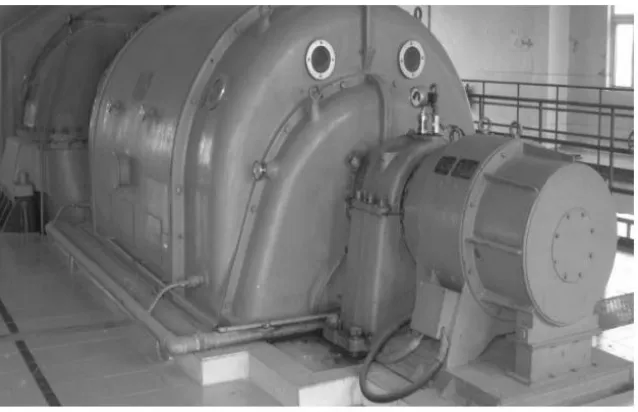
Ideal steam turbines are considered to be an In the constant entropy process, entropy of the steam entering the turbine is equal to the entropy of the steam leaving the turbine. There is truly no isentropic steam turbine. However, ranging from 20% to90% of the typical isentropic efficiencies is based on the application of the turbine.
Figure 3: Turbine
Condenser
pressure of the steam and of the saturation temperature along with it. This shows that the latent heat increase. Cause of it, more cooling
water is required. This will result in lower efficiency.
Fig. 4: Blocked Condenser Tube
Regenerative System
An investigation was carried out for regenerative system at 100% MCR loads. The result of heater survey is shown in Annexure – IV.
H.P. Heater Survey (100% MCR)
A comparison of actual and design data for HPH – 6: Actual Design
Bled steam temperature 0C 347 343
Drip temperature0C 190 240
FW inlet temperature0C 192.8 198
FW outlet temperature0C 236
240
T.T.D0C (drain water) 35 0
Exhaust steam flow (t/ hr) 49.8 57
F.W. flow (t/hr) 652
680
Bled steam pressure 33.9 40
The bulk power consumption is utilized in pumps, mills, fans etc. The equipments like motor driven equipment, lighting, etc are accounted in auxiliary power consumption.
Auxiliary power consumption of unit- 1(During the audit) Auxiliary power consumption (MW) = 18.7
Load in MW = 210
Auxiliary power consumption in % = (18.7/210) x 100 = 8.95%
COOLING TOWER TYPES
Cooling towers are two types
1. Natural draft 2. Mechanical draft.
Natural draft towers use very large concrete chimneys to introduce air through the media. Due to the large size of these towers, they are generally used for water flow rates above 45,000 m3/hr. These types of towers are used only by utility power stations. Mechanical draft towers utilize large fans to force or suck air through circulated water. Cooling rates of Mechanical draft towers depend upon their fan diameter and speed of operation.
The mechanical draft cooling towers are much more widely used. Cooling Water Treatment Cooling water treatment is mandatory for any cooling tower whether with splash fill or with film type fill for controlling suspended solids, algae growth, etc. With increasing costs of water, efforts to increase Cycles of Concentration (COC), by Cooling Water Treatment would help to reduce make up water requirements significantly. In large industries, power plants, Table 2 Calculation of cooling tower losses COC improvement is often considered as a key area for water conservation. Range" is the difference between the cooling tower water inlet and outlet temperature. "Approach" is the difference between the cooling tower outlet cold water temperatures and ambient wet bulb temperature.
Formulae for calculating Cooling Tower losses
Cooling tower effectiveness (in percentage) is the ratio of range, to the ideal range, i.e., difference between cooling water inlet temperature and ambient wet bulb temperature, or in other words it is = Range / (Range + Approach). Evaporation Loss (m3/hr) = 0.00085 x 1.8 x circulation rate (m3/hr) x (T1-T2)
T1-T2 = Temperature difference between inlet and outlet water.
Cycles of concentration (C.O.C) is the ratio of dissolved solids in circulating water to the dissolved solids in makeup water.
Blow down losses depend upon cycles of concentration and the evaporation losses and is given by relation [3]
CONCLUSIONS
(1) Overall Plant efficiency at lower loads decreases so we should run the Plant at higher load.
(2) Boiler has scaling problem which aggravates localized corrosion and affects the boiler life. Scale formation in
the boiler is caused due to water hardness. A layer of scale on a boiler tube acts as an insulator and results in
inefficient heat transfer and overheating of metal walls. It is estimated that about 2% coal consumption can be
reduced or saved by eliminating scale accumulation in the boiler.
(3) The decrease in the amount of steam flowing through the low pressure end of the turbine and the amount of
steam to be condensed.
(4) The boiler efficiency found 84.66 % to 85.23 %; this can be increased up to 90 % to 95 % by adopting
following recommendation.The effect of supplying only the theoretical amount of air for combustion with coal.
Some coal remains into chemical combustion with the constituents of the fuel, which results great loss of
unburant carbon in ash, and possibly a further 15 % app. Lost up chimney as unburant gas. Thus about 75 % of
the heat is liberated in the furnace.
(5) Boiler efficiency is mainly attributed to dry flue gas, wet gas & sensible heat loss, which may reduced quite
significantly by reducing the flue gas exhaust temperature. Reduction in flue gas temperature less than that of
the dew point temperature may cause loss of boiler life even more than that saving money on flue cost because
of higher efficiency.
(6) To increase the heat available compared to the heat rejected is to increase the superheated steam temperature.
Unfortunately this is only possible to a very small degree because metallurgical limitations. Thus there is very
little scope in this direction.
(7) For improving condenser efficiency main factors is the improvement in quality of cooling water and close
cycle. At present in plant using open cycle.
(8) Overall efficiency of plant can be increased by using wash-coal which helps to eliminate the ash contents from
the coal. By doing so, we can save the energy waste with ash.
REFERENCES
[1]. Bergander, Mark J. Porter, R.W. (2003) “ Most troublesome component of electric power generation plant”, Energy conservation in coal fired boilers, Vol. 32, 2003, Page No. 142-149
[2]. Rajan G.G (2001), “Optimizing Energy efficiency in industries by Energy Loss Control-models”,
[3]. Rask, E Lo, K.L. & Song E, Z. M.(1969), “Tube Failures Occurring in the primary super heaters and re heaters and in the economizers of coal fired boilers”, Energy Conservation in Coal fired boilers , Vol.12, 1969, Page No. 185.
[4]. “Energy managements” Hand book by C.Turner, Jhon Willey, and sons publication.
[5]. Dognlin, Chen James, D & Varies B.de (2001), “Review of current combustion, technologies for burning pulverized coal”, Energy conservation in coal fired boilers Vol.48, Page No. 121-131.
[6]. Adams, J., Clark, D.R., Louis, J.R., & Spanbauer, J.P. 1965. Mathematical modeling of once-through boiler dynamics. IEEE Transactions on Power Apparatus and Systems, PAS.Vol.84, issue (2), pp 146-156.
[7]. “ASHRAE Handbook”, NPC Case Studies in 2013.
[8]. M. & Lewis, W “Coal ash deposits in coal fired boilers” Energy conservation of coal fired boilers, Vol. 13, , Page No. 170-180.