A b s t r a c t. In Hapludand, Southern Chile with different types of land use and differentiated time periods after clear-cutting of the native forest by fire, the following parameters: pore size distribution, bearing capacity, internal cohesion, penetration resistance and spatial stress distri-bution due to loading were determined. The most pro-nounced settlement occurs immediately after forest clear-ing. During consecutive periods of land use, the settlement rate became smaller. Additionally, the major settlements occur on the sites with a long time of agricultural landuse while mere strong grassing had a smaller effect. As ex-pected, changes in the pore size distribution could be de-tected. Coarse pores decrease and the amount of medium pores increases. These changes depended on the pedolo-gical environment and soil use. Due to the rearrangement of the parent volcanic ash material and the corresponding aggregates during soil settlement as a consequence of stress induced changes in the shape of the particles and the more spherical shape, soil penetration resistance increased with settlement as well as the amount of roots above the plow pan layer. The latter is also an index of the impermeability as a consequence of the assumed increase in the contact points due to loading and “reformation“of these particles. Accor-ding to utilization-type, soil strength differs. The same soil can either react very stable or is extremely weak even if only a small stress, e.g., by an agricultural machinery, has been applied. Recently, cultivated agricultural sites have low pre-compression strength and internal cohesion values. Due to the rearrangement of particles and shape as a consequence of soil deformation during land use the strength increase even if the pore size distribution doesn’t change con-siderably. More detailed informations are given in the text.
K e y w o r d s: soil management, structural properties, volcanic ash soil
INTRODUCTION
It is very well known that Hapludands have an enormous pore volume with a dominance of coarse pores which slightly resist soil com-paction. In addition, loss of pore volume due to soil deformation was not considered as a pro-blem, because the remaining pore space seemed to permit a considerable plant growth and the effect of soil erosion on the soil loss was still acceptable. Moreover, the destruction of aggre-gates due to summer dryness together with a long saturated period with plant growth stress circumstances from autumn to spring were typical for these sites [1].
What is more, it is often described in the literature that any stress applied to the soil in-duces changes of the soil physical and physico chemical functions and depend on the internal as well as on external site and landuse properties [9]. If we consider the structural and mechanical properties of volcanic ash soils, the kind of soil and land management seem to play a major role in plant growth and may also affect biodiversity
[4]. How far the effect of landuse and time after clear cutting the native vegetation alters the physical and mechanical soil properties, was until now unknown and will be described in this research.
EFFECT OF MANAGEMENT OF A VOLCANIC ASH SOIL ON STRUCTURAL PROPERTIES*
A. Ellies1, R. Horn2, R. Smith1
1Universidad Austral de Chile, Casilla 567, Valdivia, Chile, E-mail: [email protected] 2
Institut für Pflanzenernährung und Bodenkunde, Christian Albrechts Universität Olshausenstraße 40, 24118 Kiel, Germany, E-mail: [email protected]
Accepted January 18, 2000
MATERIALS AND METHODS
The research was carried out in a typical Hapludand (volcanic ash soil) from southern Chile. The original native vegetation was a temperate rain forest of Nothofago-Persetum linguae. Physical and mechanical properties of the original site were compared with other types of land use and its variation with time after elimination of native vegetation was quantified taking into account soil physical aspects.
The investigations were carried out in an homogeneous area of 50 ha with sites of dif-ferent management types. The maximum di-stance between sites was smaller than 400 m. Various management systems under investi-gation were:
- Native rain forest (secondary forest). - Recent grassland 4 years after clearing native
forest vegetation by machines.
- Agroforest, 12 years after partial clear cutting of native forest by machines.
- Meadow; the management of this site was the same for 52 years after burning the native forest.
- Trampled grassland used as a wide corridor for cattle passage for 82 years after burning native forest.
- Rotation of crops with grasslands for 120 years after burning the native forest.
In order to classify the physical properties of the sites, undisturbed soil samples were taken at various depths in order to determine pore size distribution, direct shear strength [7] and pre-compression stress (for more detailed informa-tion see Hartge and Horn [8], more detailed in-formation about dynamic processes in the soils are described by Horn and Baumgartl [11]). Under in situ conditions, the pressure transmi-ssion due to wheeling was registered by stress transducers originally developed and described by Horn [10]. In total, 16 transducers were installed at 4 depths from 15 cm down to 60 cm and in 4 distances (20 cm in-between) from the wheel track. Mechanical soil properties were determined in- and outside the wheeltrack.
RESULTS AND DISCUSSION
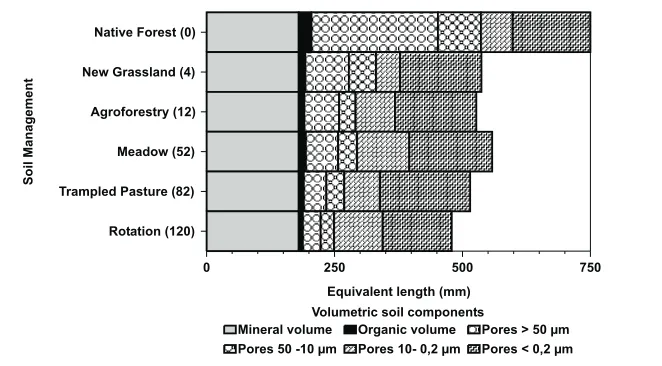
Structural changes expressed as alterations in the pore volume and pore size distribution differed significantly among various soil ma-nagement systems. Soil settlement started immediately after clear cutting of forest. During the following treatments, further settlement rate was smaller and depended on the kind of management. Figure 1 shows soil settlement
Native Forest (0)
New Grassland (4)
Agroforestry (12)
Meadow (52)
Trampled Pasture (82)
Rotation (120)
Soil
Management
0 250 500 750
Equivalent length (mm) Volumetric soil components
Mineral volume Organic volume Pores > 50 µm Pores 50 -10 µm Pores 10- 0,2 µm Pores < 0,2 µm
Parenthesis years after burning native vegetation
expressed as changes in the pore size distri-bution due to soil management. The numbers in parenthesis indicate the number of years after clearing of native vegetation by burning.
Under native forest, coarse pores dominate, but this fraction was reduced intensely 4 years after clear cutting. After more than 50 years of grassland management, trampling by cattles under any climatic conditions, increased pore volume slightly due to added dynamic energy. Especially the medium pores increased due to these management effects, while the coarse pores mainly ranged between 50 and 10 µm as a consequence of the destruction of very coarse pores. The effects of this management type on the soil properties can be defined by a new type of more dense aggregates as a result of regained normal shrinking properties followed by intense drying.
The grassland with a very intensive tramp-ling for many decades resulted in the maximum loss of secondary coarse pores and in an in-creasing amount of “primary” pores.
However, due to kneading, total porosity of the soil remained constant. Finally, the site under a very long period with crop/grassland rotation management shows that medium pores
were partially restored by tillage but the amount of secondary pores was smaller than in the original site. The subsoil shows a strong reduc-tion of secondary pores. It is expected that in the future the settlement of the soil will decline with time, unless a new management system with corresponding changes of mechanical proper-ties occurred with a higher degree of stress ap-plication.
If we calculate according to these results, we can prove changes in the soil depth, height reduction of 213 mm after 4 years of pasture management, if the original 750 mm thickness is considered as reference. The maximum set-tlement was detected at the site with crop rota-tion with grass resulting in height decrease by 271 mm in 120 years’ of land use[5].
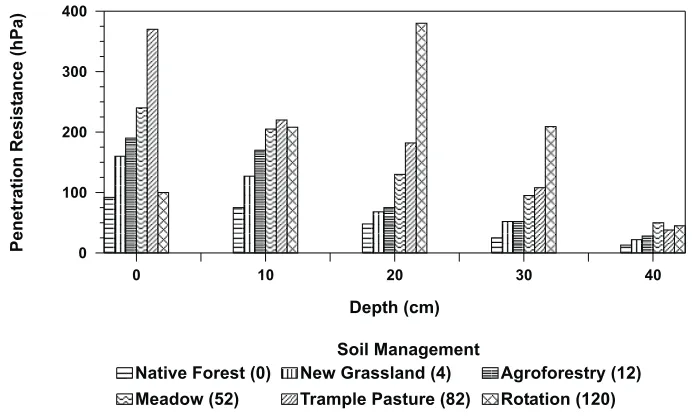
Figure 2 represents variation of penetration resistance under wet (winter) conditions for the-se soil management systems. The place under native rain forest and the places where vegetation was recently burnt maintained their original looseness. Penetration resistance, how-ever, increased with the intensity of soil mana-gement. Even if tillage in the upper soil of the site with rotation of crops and pastures decrea-ses penetration resistance, it resulted in higher
0 10 20 30 40
Depth (cm)
0 100 200 300 400
Penetration
R
esist
ance
(hPa)
Soil Management
Native Forest (0) New Grassland (4) Agroforestry (12)
Meadow (52) Trample Pasture (82) Rotation (120)
resistance values down to the depth of >20 cm due to the formation of a plough pan in the subsoil.
The effect of soil management on the plant growth behaviour can also be derived from the root growth, which especially at the crop ro-tation site, was mainly restricted to the upper soil layers. In the compacted areas with agri-cultural management, only fine roots dominate in order to assure nutrient and water uptake by plants (Table 1).
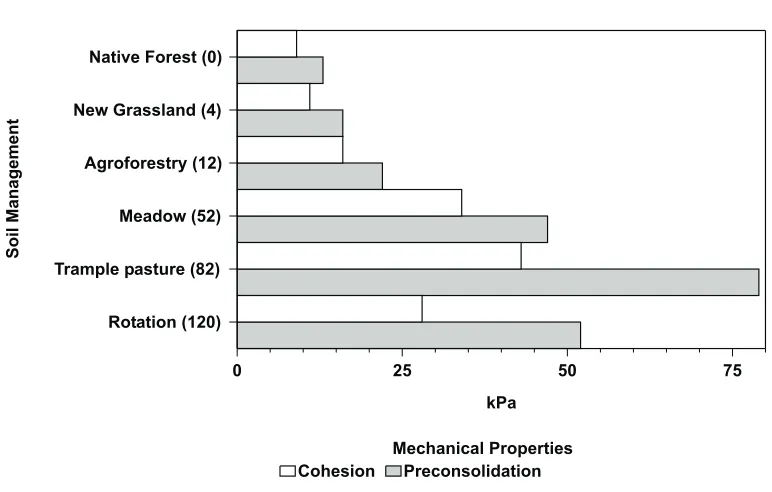
These fine roots may also increase soil strength due to the more intense drying. To-gether with the anthropogenic soil compaction effects during plowing, higher values of soil co-hesion and the precompression stress values can be also explained.
The reasons for these findings can be ex-plained by the processes of regaining mecha-nical strength and changes in the volcanic ash soils which mainly depend on the roughness and microaggregate characteristics as well as on the primary components such as volcanic glass
[2]
.If we compare the structure stability of such soils we have to consider that both the shape of the original glass and their uneven characteristics induce an intense strength increase as long as the properties parent material are still available. If the shape of the glass (which equals the shape of an asterix) is more rounded due to soil deformation by shearing, than such “spheres” are less stable and the total soil volume more compressible, which results in further settlement and re-orientation of particles and pores. If, in addition, extra external forces are applied, e.g., during deep plowing in order to re-loosen those compacted systems even a more pronounced additional soil compaction can be expected as a consequence of the completed further smoothening. Thus, heavy machinery can cause irreversible changes of soil mechanical and physical properties of such vol-canic ash soils [3,6].
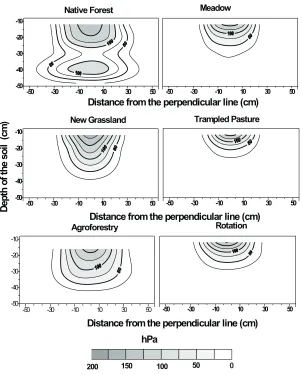
These changes in the soil properties can be derived by the stress distribution due to loading at various moisture contents. As can be seen from the pattern of the equipotential lines which
define the shape of the pressure bulbs, various treatments result in a very different stress distribution, irrespective of the identical forces externally applied.
Figure 3 shows transmission of stress with depth due to wheeling at comparable soil moi-sture content by a tractor under various mana-gement systems. The equipotential lines are much more concentrated along perpendicular line and reach deeper if the soil is less dense. Under native forest, new grassland, and agro-forest, the isobars were concentrated near the vertical axis, which indicates a more pro-nounced sensitivity to soil stress and induces a further soil settlement. The meadow with a long time of cattle trampling, however, was less sus-ceptible to soil compaction as can be derived from the more horizontally oriented stress. This indicates a low concentration factor and a stress attenuation in the upper part of the soil profile under the given externally applied stress fields. Consequently, the same soil reveals intense changes of the structural properties.
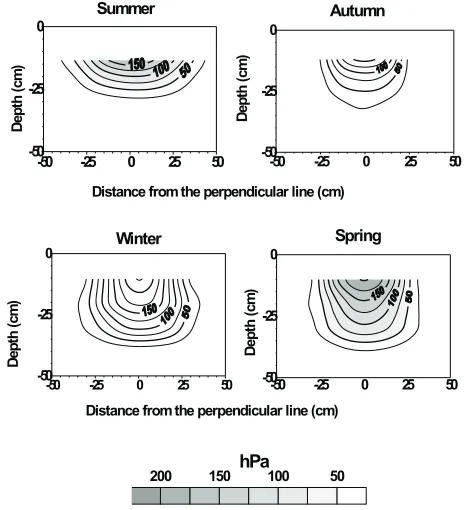
Depending on the moisture content and due to seasonal changes in the soil strength these patterns show a clear dependency on the water content. A greater soil moisture content causes deeper stress distribution and can be quantified by an increase in the values of the concentration factor. The opposite effect was detected in the dry soil due to an increased cohesion between aggregates.
The stress distribution under natural forest depends on the effect of moisture content. As can be seen, especially in winter and spring, stress distribution is more pronounced than during the 2 other seasons of the year (Fig. 4).
With increasing soil management, rearran-gement of particles/breakage of aggregates is less pronounced, so that the consequences of stress application yield less pronounced dif-ferences in the pattern of equipotential lines (Fig. 5).
-50 -30 -10 10 30 50 -50
-40 -30 -20 -10
-50 -30 -10 10 30 50
-50 -40 -30 -20 -10
-50 -30 -10 10 30 50
-50 -40 -30 -20 -10
-50 -30 -10 10 30 50
-50 -30 -10 10 30 50
-50 -30 -10 10 30 50
De
p
th
o
f
th
e
s
o
il
(c
m
)
Native Forest
New Grassland
Agroforestry
Meadow
Trampled Pasture
Rotation
50 100 150
200
hPa
Distance from the perpendicular line (cm)
Distance from the perpendicular line (cm)
Distance from the perpendicular line (cm)
Fig. 3.Transmission of stress produced during autumn in a Hapludand submitted to different management systems.
Management Time Roots (g l-1)
Coarse > 500 µmÆ Fine < 500µm Æ Total
Native forest New grassland Agroforest Meadow Trampled pasture Rotation
0 4 12 52 82 120
20.2 9.1 8.5 2.6 4.5 3.5
13.1 17.0 10.7 20.7 14.3 10.8
33.3 26.1 19.2 23.3 18.8 14.3 T a b l e 1.Root biomass in the upper layers in wet Hapludand submitted to different management systems
-50 -25 0 25 50 -50
-25 0
-50 -25 0 25 50
-50 -25 0
-50 -25 0 25 50
-50 -25 0
-50 -25 0 25 50
-50 -25 0
Distance from the perpendicular line (cm)
Distance from the perpendicular line (cm)
De
p
th
(c
m
)
De
p
th
(c
m
)
De
p
th
(c
m
)
De
p
th
(c
m
)
50 100 150 200
hPa
Summer Autumn
Winter Spring
Fig. 4.Seasonal changes in the pattern of pressure bulbs in a Hapludand under forest as a function of different soil moisture contents.
-50 -25 0 25 50 -50
-25 0
-50 -25 0 25 50
-50 -25 0
-50 -25 0 25 50 -50
-25 0
-50 -25 0 25 50
-50 -25 0
Distance from the perpendicular line (cm) Distance from the perpendicular line (cm)
De
p
th
(c
m
)
De
p
th
(c
m
)
De
p
th
(c
m
)
De
p
th
(c
m
)
Summer Autumn
Winter Spring
50 100 150
200 hPa
The sites which underwent only an ex-tensive change in the land use (young meadow and agroforest) showed only a slight increase in soil strength while trampling created the highest values of soil cohesion and precompression stress as a consequence of more pronounced rearrangement of particles and changes in the shape of volcanic ash material. Finally, after 120 years of crop rotation, the soil showed a decrease of the precompression stress and in-ternal cohesion in the upper layers, probably due to tillage, while in the subsoil precom-pression stress is expected increase especially because of the plowpan formation.
CONCLUSIONS
- The main settlement of volcanic ash soils occurs immediately after clear cutting of native vegetation, followed by a smaller and further settlement which depends on the soil manage-ment type and pedological developmanage-ment.
- Loss of pore volume increased penetra-tion resistance, affecting root growth and their size distribution.
- Stress distribution due to wheeling was the more pronounced the less dense the soil, and it further depends on the water content of the site.
- Under wet conditions the values of internal cohesion and the bearing capacity of volcanic ashes were small, and they were increasing with further intensification of manmade land use.
REFERENCES
1. Ellies A., Contreras C.:Modificaciones estructurales de un Palehumult sometido a distintos manejos. Agri-cultura Técnica, 57, 15-21, 1997.
2. Ellies A., Funes M.: Morphology and stability of aggregates from chilean volcanic ash soils. Z. Pflan-zenernaehr. Bodenkd., 143, 530-536, 1982. 3. Ellies A., Hartge K.H.: Erfaßung der
Gefügeve-ränderung infolge Inkulturnahme von Sekundärwald in Südchile durch Multivarianzanalysen. Z. f. Kultur-technik und Landentwicklung, 31, 380-388, 1990. 4. Ellies A., Ramirez C.:Efecto del manejo sobre la
estructura del suelo y la biodiversidad específica vegetal. In: Seminario Medio Ambiente Biodiversidad y actividades Productivas, 79-106, 1994.
5. Ellies A., Ramírez C., Mac Donald R.: Modifi-caciones estacionales en la distribución del espacio poroso por tamaño en un suelo sometido a un variado uso forestal. Bosque, 14(2), 31-36, 1993.
Native Forest (0)
New Grassland (4)
Agroforestry (12)
Meadow (52)
Trample pasture (82)
Rotation (120)
Soil
Management
0 25 50 75
kPa
Mechanical Properties
Cohesion Preconsolidation
6. Ellies A., Smith R., Horn R.:Transmisiones de pre-siones en el perfil de algunos suelos. Agro Sur, 24(2), 149-159, 1996.
7. Forsythe W.:Física de Suelos, Manual de Labora-torio. IICA San José de Costa Rica, p. 212, 1975. 8. Hartge K.H., Horn R.:Die physikalische
Unter-suchung von Böden. Enke Stuttgart, 3rd Ed., 1992.
9. Hartge K.H., Horn R.:Einführung in die Boden-physik. Enke Stuttgart 3rd Ed., 1999.