NightShift Simulation to Train Newly Qualified Doctors in
Non-technical Skills: A Feasibility Study
Abstract
Background: There is greater morbidity and mortality in hospitals at night,
especially when newly qualified doctors commence work.
Aim: To trialled an online simulation of a night shift to improve non-technical skills and clinical outcomes.
Design: Randomised feasibility trial of an electronic training simulation.
Methods: Medical students at the end of their training followed into initial
weeks of working (n=30) at a large teaching hospital.
Results: Participants in the intervention group completed their non-urgent tasks more rapidly than the control group though there was a broad range of completion times: mean (SD) time to complete a non-urgent task of 85.1 (50.1) versus 157.6 (90.4) minutes, p=0.027. This difference persisted using linear regression analysis were undertaken using rota and task volume as independent cofactors (p=0.028).
Conclusions: This study shows the potential to leverage data routinely
collected from newer technologies to develop on-line simulations.
Introduction
Hospitals in the United Kingdom are struggling to cope with the demands of ever increasing numbers of admissions. This pressure is felt keenly during the 75% of the year that does not fall between 9am and 5pm Monday to Friday. During this ‘Out of Hours’ (OOH) period staffing levels are generally much lower. This effect is further exacerbated ,during the 10pm to 9am ‘night shift’
when care is largely provided by a skeleton staff of junior doctors, support
workers and nurses.
This small and relatively junior OOH team must provide timely care for
emergency admissions and acutely unwell patients on the wards. Over the
These challenges are magnified by the increased stress, decreased support,
and potential fatigue when working OOH. Failure to perform well may both
delay patient care and impact on its quality, with well-documented effects on error rate and adverse outcomes (3, 4). and tThere is evidence that this high demand role leads to emotional burnout and poorworse quality of life(5).
Junior doctors’ awareness and use of best practice for night shift work appears low (6), with many reporting instances of not being able to take breaks during shifts. Objective assessment of the non-technical skills of junior doctors (such as time management, communication, and navigation) is
increasingly possible from routinely collected data from electronic records, ordering and taskflow systems (7, 8). However this is either not captured or not interrogated in most hospitals. We have previously described objective granular data on tasks undertaken by new junior doctors that supports the need for training in task prioritization (9) and route planning(10) and
highlighted the gap between senior and junior clinicians in understanding non-technical skills in OOH care (229). Such results relate to recurrently voiced concerns over the preparedness of new junior doctors and may be
In response to this ‘apprenticeship gap’, simulation has become an
increasingly common and effective tool in medical education, particularly for invasive or high-risk procedures(e.g.(19, 20)12, 13)). However, standard clinical simulation techniques are usually resource intensive with limited scope for repeated attempts, particularly if applied to non-technical skills(14). Virtual simulation is an appealing prospect in this regard, as it has the potential to prepare people and improve performance (15). The application of video game technology and methodology is becoming more influential in delivering
successful medical education aimed at junior doctors(16) and patients(17).
In this paper we describe the leveraging of existing large and detailed data on junior doctors’ actual activity to develop a serious video game simulating night shift working. We build upon previous focus group and survey results(18), and testing with medical students to evaluate it in a pilot trial in doctors about to start work for the first time. We aimed to trial this intervention using actual work activity as the outcome measure to highlight the potential and challenges in this approach, and so to inform future, multicentre studies.
In this paper we explore the research question: does data driven nightshift
simulation have the potential to improve the training of junior doctors in
1.
To test the impact of a ‘nightshift’ simulator on task completion times
during out of hours working for junior doctors during the first two month
after the august handover.
2.
To identify the practical considerations for development and
deployment of a ‘nightshift’ simulation focused on non-technical skills.
Method
“NightShift” Simulation development
We undertook focus groups and subsequent surveys of medical trainees as
described elsewhere to identify key non-technical skills for OOH work(1).
Task prioritization (optimal time management when multiple tasks are
important and/or urgent) was consistently identified as the most important skill
in this preparatory work. We therefore used task prioritization as a key focus
of the simulation. As prioritization and indoor navigation are intimately linked,
a central aim of the simulation was to provide a realistic environment in which
tasks were distributed so users could learn the hospital layout.
templates to produce an accurate but simplified floor plan. Photographs were taken of the hospital to ensure correct placement and representation of internal aspects of the hospital (e.g. slopes, floor colour, staircases, and so on) and to provide orientation to the user during the simulation.
Gameplay was developed to replicate a time-compressed night shift for a
junior doctor in medicine at the Nottingham City Hospital. The team worked in
an iterative fashion to create a simulation that was graphically of lower fidelity
but robustly simulated task elements of on-call work. The decision to use a
lower fidelity simulation was consistent with the medical simulation literature(2, 3).
We used one calendar year of data (2011) from the NerveCentre on-call task management system (NerveCentre, Wokingham, UK) to inform our
simulation. As described elsewhere(4), the NerveCentre system allocates tasks a colour code (red, amber, or green) based on clinical urgency. The taskflow data were summarised overall, by urgency colour code, by task, and per ward by hour of shift (>100,000 OOH task requests in total). The mean and standard deviation of the number of tasks requested of a junior doctor for
each hour of the shift was also calculated. These summary data informed the
Of the discrete tasks within the NerveCentre system some have the potential
to trigger subsequent tasks: For example an initial task of admitting a patient
with a fever after chemotherapy could trigger a subsequent task of “review
chest X-ray” on the same patient later in the shift. The team agreed a list of
such trigger tasks, what they may prompt, and the chance that the
subsequent task would be required. This process (and others) was facilitated
by non-clinical team members spending periods observing junior doctors
during out of hours work.
We used the actual activity data to calculate the mean (and SD) time to completion for each specific task type recorded in the NerveCentre data (e.g. “clinical review for chest pain”, “interpret ECG”). Each specific task therefore had its own time distribution in the simulation. The team agreed a list of potential delaying or complicating factors (e.g. unable to find notes, first cannulation failed) with approximate frequencies. These factors could then be displayed to the user when tasks took longer than the minimum time to
complete to add to the realism of the simulation. In order to reduce complexity, cardiac arrest calls were the only tasks not included in the simulation.
To reduce usage time to a reasonable duration, simulation time was
5 times faster. To convey a sense of increasing fatigue, the character in the simulation walked more slowly with time and the screen darkened; this was improved by a visit to the mess or to a vending machine. The simulation was structured to provide summary statistics on performance.
The simulation was initially tested by the research team and volunteers (non-medical researchers the University of Nottingham) who did not have a working knowledge of the layout of the hospital. These sessions also informed the level of the paper gameplay instructions given to each subsequent user, as well as adding to the iterative design process.
A version of the simulation was released for further appraisal amongst final year medical students in Nottingham. This appraisal comprised four sessions where 6-10 students undertook at least one shift in place of a usual one hour formal teaching session.
Trial of Simulation
Setting
Participants
Medical students were approached before their “shadowing” fortnight: This phase immediately prior to starting work as a doctor for the first time involves following the existing, outgoing doctor in the role they are about to commence. The simulation was described to all eligible students via a presentation whilst they were assembled for their Trust induction. The first 30 students who expressed an interest were randomly assigned to either standard induction or induction plus serious game training. All participants were given an information sheet and signed a consent form relating to the use of their performance data from both the simulation and the Nerve Centre task tracking system. Free use of the simulation was permitted, and the participants were encouraged to contact a named team member if there was a technical issue preventing their engagement: tablet computers were made freely available for no-cost loan during the study.
Data Collection and Analysis
on 30th September (10am 1st October). The primary outcome for a future
efficacy trial was taken to be time taken to complete a non-urgent task (coded “green” by NerveCentre). Secondary outcomes were time taken to complete an urgent task (coded “red” by NerveCentre), and crash calls per shift. Analyses were undertaken in SPSS (IBM, USA); continuous outcome variables were compared using T tests and linear regression.
Feedback from study participants was gathered through a focus group feedback session after the completion of the trial. Non-medical researchers led the session as we believed this would encourage more open reporting of difficulties. We also circulated links to on-line feedback forms to gather comments made directly after shifts and from those who could not attend the focus group.
Ethical approval for the study was obtained through the Ethics Committee of the Department of Engineering of the University of Nottingham
Results
27 of the 30 individuals who initially volunteered to participate completed the study, and full task level datasets were available for 22 of these as 5 did not undertake night shifts during the study period. 7 (32%) of those with full
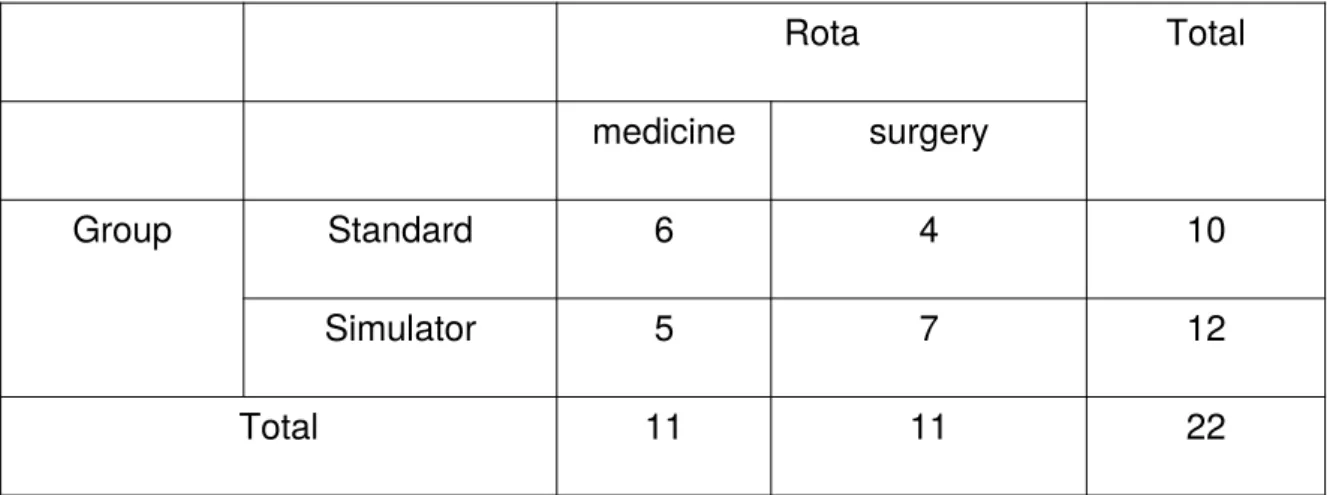
used it, and 2 individuals used it repeatedly. Table 1 shows the distribution of participants across the medical and surgical rotas.
Activity Data
Participants in the intervention group completed their non-urgent tasks more rapidly than the control group though there was a broad range of completion times: mean (SD) time to complete a non-urgent task of 85.1 (SD=50.1, Median=84.5,IQR=71.02) versus 157.6 (SD=90.4,Median=128.3, IQR=128.6)
minutes, p=0.027. This difference was also observedpersisted using linear regression analysis were undertaken using rota and task volume as independent cofactors (p=0.028). There was no difference in the time to complete urgent tasks (see figure 2). These task completion times and distributions values are comparable to those seen in previous work (10) and
are slightly skewed from a normal distribution (see appendix 1).
These task completion times and distributions values are comparable to those
seen in previous work (5) and suggest an efficacy trial would need to include
in excess of 800 students to have 80% power to detect a 10 minute difference
Standard cardiac arrest logs were complete for all study days. There was no difference in the mean number of cardiac arrest calls attended per shift (0.39 vs 0.45).
Feedback
Following the trial, the new junior doctors were clear that they had been overwhelmed by the experience of starting work, and with so many new clinical protocols and systems to learn they had not had time to devote to a simulation. In their focus group, they also raised issues that mirrored those described in feedback forms by the medical students who had undertaken testing:
Reported short-comings
A key issue reported by users of the simulation was difficulty in navigation around the virtual hospital using a plan (top-down) view and a static set of
pictures relating to what the user would see at that location (see figure 3). Users recognised that hospitals have a plethora of signs, but felt the level of visual information provided tended to be too simple (such as some signs above ward doors not being in place). Users also were frustrated by the “fatigue” element (slower walking pace with gradual darkening of the screen).
The second area of feedback related to realistic aspects of the night shift. The simulation involves a great deal of walking around in comparison to the medical activity undertaken. Although this is realistic (and time was compressed in the simulation) it reduced engagement in the activity. Similarly, students reported it was impossible to attend to multiple urgent tasks that appeared in a short time window. Again, this is representative of actual shifts rather than a game where one can “win”, but highlights an important issue with the representations of real-world tasks within serious games or simulations.
Discussion
Strengths and Weaknesses of the Study
This work has strengths in its use of a high-volume of task level data and precise mapping to inform the underlying mechanics of the simulation. However given the practicalities of collecting and integrating such data, it is
unclear if this approach shouldIn this regard it could serve as a template for
future studies.
The project also focuses on the teaching of non-technical skills for junior doctors, a clear unmet need as discussed previously. It is possible that relatively brief exposure to the simulation could teach the layout of the hospital and increase navigational efficiency, and make the user more aware of the importance of clinical task prioritization, but it seems unlikely there was a major training effect.
develop a suite of software with elements that focus on specific skills. The initial candidate would appear to be training in task prioritization skills as it is likely valuable experience could be provided in limited time period without the need to resolve complexities of accurate individual hospital mapping, time compression of full shifts, and making walking round the hospital engaging for the user.
Conclusions
This study has highlighted that virtuale potential of even limited engagement
with a ‘nightshift’ simulations orbased on routine clinical data could be
developed and deployed as part of medical school training in non-technical
tasks. This could to significantly reduce time completion times for newly
qualified doctors and potentially thus, at least partially, mitigate the previously
reported ‘august effect’ on out of hours care (10).
While apparently effective, our study suggests improvements that could
enhance engagement with the system and streamline the development of
future systems.
Firstly the use of a ‘top-down’ highly detailed virtual environment was time
consuming to develop and the cause of frustration for the participants. We
specific skills (task prioritisation, hospital navigation or the management of
personal needs) rather than attempting to emulate the entire nightshift
experience. More constrained simulation/games such as these could more
efficiently deliver training need and would likely require less tailoring to
specific sites.
Similarly it is unclear if the ‘fatigue’ feature added sufficiently to the training
value of the simulator to justify the development effort required to develop it
and the commonly reported participant frustration with it.
Future Work
As suggested above future work is needed in developing and testing more
focused and engaging simulators in order to provide training as efficiently as
possible and with minimum user frustration. Large scale deployments
arewould be required to definitively study a full night shift simulation,validate
our results, with our data suggesting a efficacy trial would need to include in
excess of 800 students to have 80% power to detect a 10 minute difference in
task completion time. However the potential benefits of success of tthis type
of training clearly appear to justify justified the need and value of developing/
validating such tools.development and formal testing of more generalizable
In summary, this project has delivered constructive information regarding the
design and testing of a serious game style simulation to train junior doctors in
core skills required for out of hours work. Research into generic digital
simulation for non-technical skills that builds on this work has the potential to
Acknowledgements: REMOVED FOR BLIND REVIEW
References
1.
Pickersgill T. The European working time directive for doctors in training. Bmj. 2001 Dec 1;323(7324):1266. PubMed PMID: 11731377. Pubmed Central PMCID: 1121739. Epub 2001/12/04. eng.
2.
Raduma-Tomas MA, Flin R, Yule S, Williams D. Doctors' handovers in hospitals: a literature review. BMJ Qual Saf. 2011 Feb;20(2):128-33. PubMed PMID: 21209133. Epub 2011/01/07. eng.
3.
Aylin P, Yunus A, Bottle A, Majeed A, Bell D. Weekend mortality for emergency admissions. A large, multicentre study. Qual Saf Health Care. 2010 Jun;19(3):213-7. PubMed PMID: 20110288. Epub 2010/01/30. eng.
4.
Maggs F, Mallet M. Mortality in out-of-hours emergency medical admissions--more than just a weekend effect. The journal of the Royal College of Physicians of Edinburgh. 2010 Jun;40(2):115-8. PubMed PMID: 21125051.
5.
6.
Jackson EJ, Moreton A. Safety during night shifts: a cross-sectional survey of junior doctors' preparation and practice. BMJ Open.
2013;3(9):e003567. PubMed PMID: 24056488. Pubmed Central PMCID: 3780329.
7.
Blakey JD, Guy D, Simpson C, Fearn A, Cannaby S, Wilson P, et al. Multimodal observational assessment of quality and productivity benefits from the implementation of wireless technology for out of hours working. BMJ Open. 2012;2(2):e000701. PubMed PMID: 22466035. Pubmed Central PMCID: 3317138. Epub 2012/04/03. eng.
8.
Herrod PJ, Barclay C, Blakey JD. Can mobile technology improve response times of junior doctors to urgent out-of-hours calls? A prospective observational study. QJM. 2014 Apr;107(4):271-6. PubMed PMID: 24300162.
9.
Brown M, Shaw D, Sharples S, et al. A surveybased cross-sectional study of doctors’ expectations and experiences of non-technical skills for Out of Hours work. BMJ Open 2015;5:e006102. doi:10.1136/bmjopen-2014- 006102 Brown M, Shaw D, Sharples S, Le Jeune I, J. B. A survey-based cross-sectional study of doctors’ expectations and experiences of
10.
Blakey JD, Fearn A, Shaw DE. What drives the 'August effect'? A observational study of the effect of junior doctor changeover on out of hours work. JRSM Short Rep. 2013;4(8):2042533313489823. PubMed PMID: 24040495. Pubmed Central PMCID: 3767064.
11.
Jen MH, Bottle A, Majeed A, Bell D, Aylin P. Early in-hospital mortality following trainee doctors' first day at work. PLoS One. 2009;4(9):e7103. PubMed PMID: 19774078. Pubmed Central PMCID: 2743809. Epub 2009/09/24. eng.
12.
Kennedy CC, Cannon EK, Warner DO, Cook DA. Advanced airway management simulation training in medical education: a systematic review and meta-analysis. Crit Care Med. 2014 Jan;42(1):169-78. PubMed PMID: 24220691. Epub 2013/11/14.
13.
Kennedy CC, Maldonado F, Cook DA. Simulation-based bronchoscopy training: systematic review and meta-analysis. Chest. 2013 Jul;144(1):183-92. PubMed PMID: 23370487. Pubmed Central PMCID: 3707173. Epub
2013/02/02.
14.
multicenter simulation training for operating room teams. Ann Surg. 2014 Mar;259(3):403-10. PubMed PMID: 24263327.
15.
Lawson G, Sharples S, Clarke D, Cobb S. Validating a low cost approach for predicting human responses to emergency situations. Applied ergonomics. 2013 Jan;44(1):27-34. PubMed PMID: 22591762. Epub
2012/05/18.
16.
Lagro J, van de Pol MH, Laan A, Huijbregts-Verheyden FJ, Fluit LC, Olde Rikkert MG. A Randomized Controlled Trial on Teaching Geriatric Medical Decision Making and Cost Consciousness With the Serious Game GeriatriX. J Am Med Dir Assoc. 2014 Jun 6. PubMed PMID: 24913210. Epub 2014/06/11.
17.
Kato PM, Cole SW, Bradlyn AS, Pollock BH. A video game improves behavioral outcomes in adolescents and young adults with cancer: a
randomized trial. Pediatrics. 2008 Aug;122(2):e305-17. PubMed PMID: 18676516. Epub 2008/08/05. eng.
18.
19.
de Giovanni D, Roberts T, Norman G. Relative effectiveness of high- versus low-fidelity simulation in learning heart sounds. Med Educ. 2009 Jul;43(7):661-8. PubMed PMID: 19573189. Epub 2009/07/04.
20.
Norman G, Dore K, Grierson L. The minimal relationship between simulation fidelity and transfer of learning. Med Educ. 2012 Jul;46(7):636-47. PubMed PMID: 22616789. Epub 2012/05/24.
21.
Cook DA, Hatala R, Brydges R, Zendejas B, Szostek JH, Wang AT, et al. Technology-enhanced simulation for health professions education: a systematic review and meta-analysis. JAMA. 2011 Sep 7;306(9):978-88. PubMed PMID: 21900138.
22.
Brown M, Shaw D, Sharples S, et al. A surveybased cross-sectional study of doctors’ expectations and experiences of non-technical skills for Out
of Hours work. BMJ Open 2015;5:e006102. doi:10.1136/bmjopen-2014-
Figure Legends
Figure 1: Consort diagram of flow of participants in pilot trial of the NightShift
simulation.
Figure 2: Boxplot of time taken to complete individual tasks by study arm
illustrating range, quartiles and median. Red boxes represent urgent tasks,
green boxes represent less urgent tasks.
Tables
Rota Total
medicine surgery
Group Standard 6 4 10
Simulator 5 7 12
Total 11 11 22