ADAPTIVE OBSERVER BASED NONLINEAR STOCHASTIC SYSTEM
CONTROL WITH SLIDING MODE SCHEMES
Feng Qiao1*, Quanmin Zhu2**†, Jian Liu1, and Feng Zhang1
1 Faculty of Information and Control
Engineering
2 Faculty of Computing, Engineering and
Mathematical Sciences
Shenyang Jianzhu University University of the West of England
9 Hunnan East Road, Hunnan New District Frenchay Campus, Coldharbour Lane
Shenyang, Liaoning, China 110168 Bristol BS16 1QY UK
*[email protected] **[email protected]
ABSTRACT: In this paper, an adaptive sliding mode observer is designed to reconstruct the states of nonlinear stochastic systems with uncertainties from the measurable system output and the reconstructed states are employed to construct a sliding mode controller for the stabilization control of complex nonlinear systems. It takes the advantages of the sliding mode schemes to design both observer and the controller. The convergence of the observer and the globally asymptotical stability of the controller are analysed in terms of stochastic Lyapunov stability, and the effectiveness of the control strategy is verified with numerical simulation studies.
KEY WORDS: Adaptive Observer, Stochastic System Control, Sliding Mode Scheme, Itô Differential Equation
1. INTRODUCTION
Up to now, considerable research work has been done in the control system design for many classes of nonlinear deterministic systems with uncertainties in the literature. The types of uncertainties include external disturbances, lack of knowledge of the system dynamics and time varying of system parameters. Generally, the main objective of the control system design is to set up a control strategy to eliminate or attenuate the influence of the uncertainty on the overall performance of the systems. The uncertainties in the dynamic systems could also be modelled as random noise. Recently, the global stabilization of nonlinear stochastic systems has gained increasing attraction, referring to Florchinger (1995), Deng and Krstic (1997a, 1997b and 1999) and the references therein. The widely employed concepts of stability in stochastic systems were introduced by Khas'minskii (1980) for boundedness in probability and asymptotical stability in the large in his classical work.
Sliding mode control (SMC) for variable structure systems (VSS) is well applied as a robust approach for control of dynamic systems with uncertainties for its various features such as fast response, good transient performance, and robust to system uncertainties and external disturbances. SMC for VSS was first proposed and elaborated in the early 1950s in the former Soviet Union by Emelyanov and several co-researchers (Emelyanov, 1967, Itkis, 1976 and Utkin, 1977). From then on, SMC has been expanded into a general design method being examined for a wide spectrum of system types including nonlinear systems, multi-input/multi-output systems, discrete time models, large scale and infinite dimensional systems, and stochastic systems. And today, research and development continue to apply SMC to a wide variety of modern but complex engineering systems to achieve high quality products and specified operational performance (Hung, et al, 1993).
It is proposed, in this paper, an adaptive observer based controller is designed to enhance the design of nonlinear stochastic system control with sliding mode schemes. First of all an adaptive sliding mode observer (ASMO) is developed to reconstruct the system states with the system output, and then a SMC law is synthesized based on the estimated states. The convergence of the observer and the asymptotic stability in probability of the controller based on sliding mode schemes are theoretically analysed and the effectiveness of the proposed control strategy is verified with numerical simulation studies.
The remaining part of this paper is organised as follows: in Section 2, the dynamic model of nonlinear stochastic systems with uncertainty is described and the objective of the controller design is stated with some preliminaries; in Section 3, an adaptive observer based sliding mode scheme is developed for reconstructing the states of the stochastic systems; in Section 4 SMC law for system stabilisation is synthesized based on the estimates of the system states; in Section 5 numerical simulation is studied to verify the effectiveness of the proposed control strategy; and in Section 6 conclusions are drawn to summarise the sudy.
The following notation will be used throughout this paper: is the set of non-negative real numbers. ( ) denotes an -vector ( matrix) with real elements with the associated norm, or
Euclidean norm, ( ), where denotes transposition, and
denote the maximum and minimum eigenvalues of a symmetric matrix . denotes the sum of absolute values of the vector or 1-norm of a vector; it is clear that for any . The symbol is used for the exponential function. and denotes the continuous and differentiable functions, respectively. is an identity matrix with dimension. is a complete probability space where is the sample space, is the -algebra of the subsets of the sample space and is the probability measure. denotes the expectation operator with respect to probability measure .
2. PROBLEM STATEMENT AND PRELIMINARIES
Consider the following nonlinear non-autonomous stochastic system given by the Itô differential equation
(1a) with the measurable output equation
(1b)
where , is the system state vector, is the system input vector, is
the measurable system output, , and are matrices with suitable dimensions,
represents the nonlinear and uncertain dynamics, is the deterministic process disturbance that can not be measured, and the intensities of noises are shown by ,
and and are bounded as and , and are standard
Wiener process noises independent of defined on complete probability space of .
The following assumptions are imposed to system (1) for discussion.
A. 1.The pair is detectable and observable so that there exists an observer gain such
that is a strictly Hurwitz matrix.
A. 2. is separable into two parts
where the known nonlinearity satisfies a Lipschitz condition as
for all where is a known constant. On the other hand, is an excessive
where , satisfies
(2)
for unknown values of , known bounded such that , ,
and is the unique positive definite solution to
(3) for some positive definite matrix
A. 3.The Lipshitz constant satisfies (Thau, 1973):
The following definitions are imposed for the stability in probability:
D 1.The stochastic system in (1) is globally stable at the equilibrium if there exists a region at the origin, for any and , there exists a class function (i.e. is a strict
ascending continuous function at at ) satisfying
, , .
D 2.The stochastic system in (1) is globally asymptotically stable at the equilibrium for any and there exists a class function (i.e. the continuous function
defined on is strictly ascending and with respect to for fixed , and
descending and with respect to for fixed ), satisfying
, , .
The following lemmas are introduced for discussion.
L 1.(Khas'minskii, 1980) Consider the system in (1) and suppose there exists a positive definite, radially unbounded, twice differentiable function such that the infinitesimal generator
is negative definite. Then the equilibrium of the system in (1) is globally asymptotically stable in probability.
It is quite common in practice that not all of the system states are always measurable due to the limitation of physical condition and/or capital investment. Hence, in order to realize the stabilization of the closed-loop stochastic system with uncertainty in (1) at the origin , a SMC law with investigated in this research work with estimated system states from an adaptive observer. The objective of the system control is to determine the control law to guarantee the globally asymptotic stabilization of the system in (1) in probability at the origin.
The controller to be designed for the stochastic system in (1) is based on the reconstructed system states obtained by an adaptive sliding mode observer and the control law is derived from the sliding mode scheme. In the following Sections 3 and 4, the adaptive observer and the control law are proposed; and the convergence of the estimation error and stabilization of the overall system are investigated, respectively.
3. ADAPTIVE OBSERVER DESIGNED BASED ON SLIDING MODE SCHEME
3.1 Design of the Observer
The following adaptive observer is designed based on sliding mode scheme for reconstructing the states of system (1) from measurement
(4) with the general sliding mode gain
(5)
where is designed as
. (6)
here, the functions and satisfy the following design conditions:
C 1. , is such that and .
C 2. , is any function satisfying for all .
The term in the sliding mode gain in (5) functions as boundary layer
that vanishes in time.
The candidate functions for can be chosen , , where , >0.
The candidate functions for can be and where and .
The adaptation algorithm is based on the expected value of the estimation error as
(7)
where is the adaptation rate which is a positive constant to be designed.
3.2 Convergence of the Observer
Now, the convergence of the observer designed based on the adaptive sliding mode scheme in (4) is investigated with the following theorem T 1 concluded.
T 1.If the assumptions A 1, A 2 and A 3 hold, the adaptive observer based on sliding mode scheme designed in (4) for system (1) converges in probability to a small spherical region at the equilibrium state for a small deviation with the adaptation algorithm (7).
Proof: The observation error is defined as
(8) According to the definition of the observation error (8) and equations (1) and (4), the observation error dynamics can be obtained as
where and .
Consider the following positive definite Lyapunov function candidate
To analyse the behaviour of this stochastic differential equation, infinitesimal generator, equation (9), is considered as follows
(10)
where is a positive symmetric matrix satisfying
for some symmetric positive matrix ( ) and is selected as a Lipschitz constant
satisfying A 3.
Taking (9) into the above equation (10), the equation can be got as follows,
(11)
Taking (2), (3), (5), and (6) into (11), we can get the following inequality (12).
(12)
The above inequality is derived on the fact that for a positive definite matrix , the following relationship is resulted as
According to the design conditions C 1 and C 2, we know that the last two terms on the right side of the above inequality is negative. Thus, we can get
and
As for
and
Then, the following inequality can be obtained,
Let,
and
we solve,
,
The steady system state estimate error is obtained
This means that the estimation of the proposed adaptive observer has a mean-square exponential
ultimately bounded estimation error. □
4. CONTROLLER DESIGNED BASED ON SLIDING MODE SCHEME
The aim of this paper is to design a controller synthesized on the estimated states which are obtained from the adaptive observer discussed in the last section to stabilize the stochastic system dynamics (1) in Itô differential equation.
4.1 Sliding mode controller The sliding function is designed as
(13)
where , and is selected so that is nonsingularity, and is the
coefficient matrix which is chosen so that satisfies Hurwitz condition, is the estimated state vector obtained from (4). And is the sliding surface.
1) the sliding surface is reachable if there exists finite time such that
and when for any .
2) the sliding surface is subordinated reachable if there exists finite time such that
and when for any .
For the stochastic system in (1), the sliding surface still satisfies , but is continuously excited by stochastic signals with the system states, we should describe the extent of reachability in sense of norm means or norm square means of , hence, it is said that the sliding mode is reachable in probability if the system starts from any initial states . There exists finite time
, if , satisfies the condition or .
The controller law is constructed based on the estimate as
(14) where the switching gain is designed as
(15) and a small positive constant.
T 2.Suppose that the sliding function is designed in (13), and the sliding mode control law in (14), the state trajectories of the observer dynamics (4) can be driven on the sliding surface in finite time and remain there in subsequence time.
Proof: From (13) and (4), it can be obtained that
Let , the infinitesimal generator is considered as follows
(16)
then
, for (17)
The above inequality (17) is derived by taking (15) into (16) and employing the fact .
Following the fact that for , it can be obtained that and
. This implies that with the sliding mode control law in (13), the sliding surface is reachable and the state trajectories of the observer dynamics (4) can be driven onto the sliding manifold in finite time and remain there in subsequence time. This completes the proof of the theorem.
□
obtained as
and the sliding mode dynamics in the state estimation space can be obtained as
4.2 Stability Analysis of overall closed-loop systems
It will be concluded that that the overall closed-loop of the stochastic system in (1) can be asymptotically stabilised in probability with the controller designed in (14) based on the estimated states in (4).
The following theorem shows that the sliding motion of the sliding function designed in (13) is reachable in stochastic theory.
T 3.Consider the system in (1) which satisfies the assumptions A 1, A 2 and A 3, the system state vector which is not completely measurable and estimated by the ASMO proposed in (4), the sliding manifold is designed by (13), and the control law is designed by (14), the system can be stabilized and asymptotically stable in probability in the bounded region of the equilibrium .
Proof: The stochastic Lyapunov candidate function is chosen as
where is a positive symmetric matrix satisfying
for some symmetric positive matrix ( ).
Using Itô formula, it can be obtained
where is the Lipschitz constant satisfying the assumption A 3, and is a small positive constant proportional to bound the estimation error of the observer designed in Section 3.
Similar to the discussion in Section 3 about the convergence of the observer, we can conclude that if and are suitably designed, then the globally asymptotic stability in probability of the overall closed-loop uncertain stochastic system in (1) can be guaranteed by the control law in (15). Such
completes the proof of the theorem. □
5. SIMULATION STUDIES
and
The above system is formulated to the same form in (1) with
, , ,
,
,
and and are Gaussian white noises with variances
and , respectively.
Both and satisfy the assumption in A.2 and
The observer is designed as follows.
The observer gain , is chosen as to meet the requirement of the assumption in A1. The positive definite matrix is selected as
thus can be obtained as
The eigenvalues of and are, and , respectively. The
Lipschitz constant is selected as ( ).
, , .
The sliding function is designed as
with
where is designed as and .
The controller is designed as
The simulation period is set to , and the sampling rate is .
In order eliminate or attenuate the chattering effect aroused by pure SMC strategy, a think boundary
layer in adopted in the control law in (14) by replacing with .
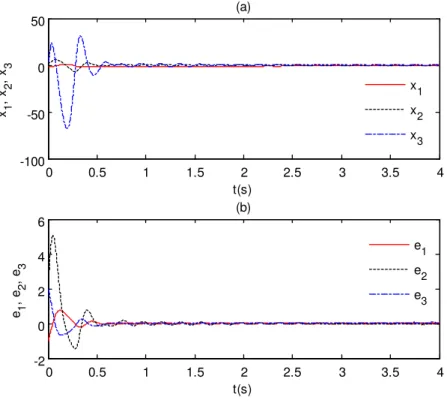
0 0.5 1 1.5 2 2.5 3 3.5 4 -100 -50 0 50 (a) t(s) x1 , x2 , x3
0 0.5 1 1.5 2 2.5 3 3.5 4 -2 0 2 4 6 (b) t(s) e1 , e2 , e3
x1 x2 x3 e1 e2 e3
Figure 1 The trajectories of system states and the estimation errors
The trajectories of the system states under the SMC law in (14) is shown in Figure 1 (a) and the trajectories of the estimation error of the ASMO is shown in Figure 1(b). And Figure 2 (a) and (b) show the trajectory of sliding scalar and the control input. It can be seen, from Figures 1 and 2, that the reachability of sliding surface can be guaranteed and the overall closed-loop system is globally asymptotically stable in probability. And also, in Figure1 (b), the effectiveness of the adaptive observer is numerically verified.
0 0.5 1 1.5 2 2.5 3 3.5 4 -0.5 0 0.5 1 (a) t(s) S c
Figure 2 The trajectory of sliding function and the control input
6. CONCLUSIONS
This study has been contributed to some challenging issues in control of nonlinear stochastic systems. Sliding mode mechanism has been properly referred to accommodate the un-measurable (but observable) system states and therefore to design the controller. An adaptive sliding mode observer is designed to reconstruct the unmeasured system states with measurable output, and a sliding mode control law is constructed by synthesizing the estimated system states from the observer. The convergence of ASMO designed is proved and its estimation error is mean-square exponential ultimately bounded. The overall closed-loop nonlinear stochastic systems can be guaranteed to be globally asymptotically stabilized in probability with the design strategy.
In summary, the design procedure has been well justified from the demand of application background, concept development, mathematical derivation and proof, tool development and integration, and simulation bench tests. Obviously this is a promising procedure to be applied to a wide range of practical operations. Additionally this theoretical-algorithm-simulation study will advance the investigations on complex system control and coordination. Therefore the contributions will go to both academia and industry.
7. ACKNOWLEDGEMENT
The authors are grateful to the editor and the anonymous reviewers for their helpful comments and constructive suggestions with regard to the revision of the paper. They would also like to thank to the Ministry of Housing and Urban-Rural Development, China for its support (2008-K2-18).
REFERENCES
[1]Azemi, A. and Yaz, E. E., (2000), ‘Sliding mode adaptive observer approach to chaotic synchronization’, Transactions of the ASME, 122, December, pp. 758-765.
[2]Chan, C. Y., (1999), ‘Discrete adaptive sliding-mode control of a class, of stochastic systems’, Automatica, 35, pp. 1491-1498.
[3]Chang, K. Y. and Wang, W. J., (1999), ‘Robust covariance control for perturbed stochastic multivariable system via variable structure control’, Systems Control Letter 37, pp. 323–328.
[4]Deng H. and Krstic, M., (1997), ‘Stochastic nonlinear stabilization—Part I: A backstepping design’, Systems and Control Letters, Vol. 32, pp. 143–150.
[5]Deng, H. and Krstic, M., (1997), ‘Stochastic nonlinear stabilization—Part II: Inverse optimality’, Systems and Control Letters, Vol. 32, pp. 151–159.
[6]Deng, H., Krsti´c, M., (1999), ‘Output-feedback stochastic nonlinear stabilization’, IEEE Transactions on Automatic Control, 44: 328.333.
[7]Edwards C. and Spurgeon, S. K., (1996), ‘Robust output tracking using a sliding-mode controller/observer scheme’, International Journal of Control 64, pp. 967–983.
[8]Emelyanov, S. V., (1967), ‘Variable Structure Control Systems’, Moscow: Nauka (in Russian).
[9]Florchinger, P., (1995), ‘Lyapunov-like techniques for stochastic stability’, SIAM Journal on Control and Optimization, 33, pp. 1151-1169.
[10] Hung, J. Y., Gao, W. and J. Hung, C., (1993). ‘Variable structure control: A survey’, IEEE transaction on Industrial Electronics, 40(1), February, pp.2-22.
[11] Itkis, Y., (1976), ‘Control Systems of Variable Structure’, New York: Wiley.
[12] Khas'minskii, R. Z., (1980), ‘Stochastic Stability of Differential Equations’, Rockville: S and N International Publishers.
[13] Niu Y. G. and Ho, D. W.C., (2006), ‘Robust observer design for Itô stochastic time-delay systems via sliding mode control’, Systems and Control Letters, 55, 781 – 793
[14] Niu, Y. G., Ho, D. W. C. and Lam, J., (2005), ‘Robust integral sliding mode control for uncertain stochastic systems with time-varying delay’, Automatica, Vol. 41, pp.873-880.
[15] Niu, Y., Lam, J. Wang, X. and Ho D.W.C., (2004), ‘Observer-based sliding mode control for nonlinear state-delayed systems’, International Journal Systems Sciences, 35, pp. 139–150.
[16] Pai, M.C. and Sinha, A., (2000), ‘Sliding mode control of vibration in a flexible structure via estimated stated and H∞ techniques’, Proceedings of the American Control Conference, Chicago, IL, pp. 1118–1123.
[17] Qiao, F., Zhu, Q. M. and Zhang, H., (2008), ‘Adaptive sliding mode observer for nonlinear stochastic systems with uncertainties’, Proceedings of International Conference on Modelling, Identification and Control, (submitted), June 29 - July 2, 2008 Shanghai, China.
[19] Rundell, A.E., Drakunov, S.V. and DeCarlo, R. A., (1996), ‘A sliding mode observer and controller for stabilization of rotational motion of a vertical shaft magnetic bearing’, IEEE Transactions of Control Systems Technology, 4, pp. 598– 608.
[20] Thau, F. E., (1973), ‘Observing the state of non-linear dynamic systems’, International Journal of Control, 18, pp. 471–479.
[21] Utkin, V. I., (1977), ‘Variable Structure Systems with Sliding Modes’, IEEE Transactions on Automatic Control, 22 (2), April, pp. 212-222.
[22] Zheng, F., Cheng, M. and Gao, W. B., (1992), ‘Variable Structure Control of Discrete Time Stochastic Systems, Proceedings of the 31st. Conference on Decision and Control, Tucson, Arizona, December, pp. 1830-1835.